




Abstract
In this paper, a systematic experimental and kinetic model investigation was conducted over Cu-SSZ-13 catalyst to study the DeNOx efficiency and N2O formation for selective catalytic reduction of NOx with NH3 (NH3-SCR). The kinetic model was developed for various reactions to take place in the NH3-SCR system, including NH3 adsorption/desorption, NH3 oxidation, NO oxidation, standard SCR, fast SCR, slow SCR and N2O formation reactions. In addition, the reaction of N2O formation from NH3 non-selective oxidation was taken into account. All the experiments were performed in a flow reactor with a feed stream near to the real application of diesel engine vehicles exhaust. The current model can satisfactorily predict the steady state conversion rate of various species at the reactor outlet and the effect of gas hourly space velocities and ammonia nitrogen ratio on N2O formation. The results show that the kinetic model can simulate the reaction process of the Cu-SSZ-13 catalyst well. This is significant for the optimization of NH3-SCR system for achieving the higher DeNOx efficiency and the lower N2O emission.
Introduction
Due to the high nitrogen oxide (NOx) emissions, diesel vehicles mainly used in industrial, transport and agricultural applications were difficult to meet the more stringent emission regulations. The stricter regulations on exhaust emissions provide a strong encouragement to the application of exhaust aftertreatment system. Selective catalytic reduction (SCR) of NOx by NH3 is currently the most effective technology used for reducing NOx through selective reactions on the catalytic surface between NOx and adsorbed NH3.1–5 The SCR of NOx with NH3 has been studied extensively on various catalysts.6–13 Ciardelli et al. 6 studied the reactivity of NH3-SCR over a commercial V2O5-WO3/TiO2 catalyst in a wide range of conditions and identified the reaction network at the different operating conditions. Grossale et al. 8 studied the reactivity of a commercial Fe-zeolite catalyst in the NH3-SCR reactions for the aftertreatment of diesel exhausts and compared the results with a commercial V2O5-WO3/TiO2 catalyst, which indicated the Fe-zeolite catalyst had a superior activity. Colombo et al. 10 investigated the NH3-SCR reactions over a commercial Cu-zeolite catalyst and a Fe-zeolite catalyst, suggesting that the Cu-zeolite catalyst was more active at lower temperatures, while Fe-zeolite catalyst was highly active at higher temperatures.
However, a significant amount of N2O emissions for diesel engines with NH3-SCR was observed, especially on Cu-zeolite catalysts. 14 N2O adsorbs radioactive energy in the range of 8 and 20 µm and therefore is active in adsorbing and emitting radiation in the thermal infrared range. Based on the adsorption characteristics and the relatively long atmospheric lifetime of 114 years, N2O has a global warming potential 298 times compared to CO2. 15 As a result, N2O has been regulated by United States Environmental Protection Agency and N2O formation mechanisms in NH3-SCR over various catalysts have been studied.15–21 Jung et al. 16 studied the conversion efficiency of NOx and N2O emissions on NH3-SCR over a combined catalyst consisted of vanadium-based catalyst and Cu-zeolite catalyst. They found that there was a trade-off relationship between NOx conversion efficiency and N2O emission, the emissions of NO and NO2 decreased with the increase of urea injection while the emissions of N2O increased. Zhang et al. 17 probed the N2O formation mechanism on NH3-SCR and found that N2O formation depended on the complex reactions within the NH3-SCR system. The trade-off relationship between NOx conversion efficiency and N2O emission presents the challenges for the SCR developments. Liu et al. 21 investigated N2O formation over Cu-SSZ-13 during the NH3-SCR process under different conditions. They found that the N2O formation at different temperatures usually occurred via different mechanisms. At low temperature, N2O is mainly formed through non-selective reduction reaction, while at high temperature, the N2O formation mainly due to the nonselective NH3 oxidation. To overcome the abovementioned trade-off relationship, it is necessary to study the formation mechanism of N2O which is determined by NH3-SCR reactions.
A much number of experimental studies focused on reaction mechanism and kinetic modeling have been performed for NH3-SCR reactions. Xiong et al. 22 developed a global kinetic model for V2O5-WO3/TiO2 with the key factors, which might predict the SCR performance and describe the relationship between the SCR performance and the key factors. Colombo et al. 23 developed a detailed kinetic model for a commercial Cu-zeolite catalyst, which could predict the complex transient behaviors about NO2-related SCR catalytic reactions. In addition, they also presented a systematic kinetic model for the NH3-SCR reacting system over a commercial Fe-zeolite catalyst. 24 This model included the well-known reactions of the NH3-SCR system and took into account N2O formation reaction, which could predict the reactivity of N2O in related SCR reactions. Metkar et al. 25 developed a global kinetic model, and Grossale et al. 26 developed a transient kinetic model for both Fe-zeolite and Cu-zeolite catalysts. Their model was used to predict the performance of several SCR system reactions and estimated by the steady-state and transient experiment. Olsson et al. 27 developed a detailed transient kinetic model, which described well the transient NOx conversion and the effect of feed NO/NO2 ratio on the NH3-SCR chemistry. Pant and Schmieg 28 developed a kinetic model for a commercial Cu-zeolite SCR catalyst and optimized pre-exponential factors and activation energy according to catalyst performance data under actual engine operating conditions. Wang and Im 29 developed a kinetic model to investigate the impact of hydrothermal aging on the ammonia adsorption capacity over a commercial Cu-zeolite SCR catalyst. Baleta et al. 30 developed a numerical model to simulate physical processes and chemical reactions during the SCR process. This model was used to predict ammonia generation, NOx reduction and ammonia slip. Tronconi et al. 31 developed an unsteady mathematical model for the NH3-selective catalytic reduction for V2O5-WO3/TiO2 catalyst to simulate the transient behavior of SCR under different operating conditions.
In this paper, a kinetic model was developed for Cu-SSZ-13 SCR catalyst and optimized with the experimental measurement data to study the performance of the NH3-SCR catalyst, especially the formation mechanism of N2O. In a self-built flow reactor with a Cu-SSZ-13 catalyst sample, the experiments were performed under diesel engine-like conditions to study the main features of NH3-SCR system reactions. The kinetic model was developed for various reactions including NH3 adsorption and desorption, NH3 oxidation, NO oxidation, standard SCR, fast SCR, flow SCR and N2O formation. Different from the previous studies, the reaction of N2O formation from NH3 non-selective oxidation was taken into account, which is significant for studying the N2O formation mechanism at high temperature. The main kinetic parameters were identified by calibrating the model to the reactor data. The optimized model could simulate the actual performance of the engine such as NH3 storage, NOx conversion and N2O formation. This can theoretically solve the problem of N2O emission more effectively. Additionally, the development of SCR control based on this kinetic model is of great significance to reduce NOx and N2O emissions simultaneously.
Experimental set-up
Catalyst sample
In this paper, the sample provided from Weichai Power was directly cut from the core area of a full size honeycomb Cu-SSZ-13 catalyst utilized in a commercial SCR system. The parameters of the core sample are shown in Table 1. Prior to catalytic experiments, the core sample was subjected to hydrothermal pretreatment at 650°C for 100 h under a gas flow of 10% H2O in balance air with rare of 5 L/min to ensure their stable performance during the subsequent tests.
Parameters of the core catalyst sample.

Flow reactor
The present experiments were performed in a flow reactor at atmospheric pressure. The schematic diagram of the flow reactor is shown in Figure 1. The catalyst sample was loaded in a quartz glass tube placed in the isothermal zone of an electrical furnace. A quartz cotton gasket provided by Weichai Power was used for sealing between the quartz tube and the catalytic sample to prevent the reaction gas from reacting without passing through the catalyst sample, which may result in an increased error. The test temperature was precisely controlled by electrical furnace with temperature program heating and measured by a K-type thermocouple deployed upstream of the catalyst sample. Gas compositions and gas hourly space velocities (GHSV) were adjusted and metered by mass flow controllers. The gas stream was evenly mixed by the mixing tank then fed into the flow reactor. The gas mixing system may prepare different proportions of mixture according to the test requirements. The concentrations of gaseous species in the inlet and outlet of the catalyst sample were measured by gas chromatography with electron capture detector (GC-ECD) for N2O, gas analyzer for NOx and customized ammonia detector for NH3.

Schematic diagram of experimental apparatus.
Methodology
According to the composition of diesel engine exhaust, a variety of single gas from compressed gas bottles were used to simulate the working environment of NH3-SCR in the diesel engine exhaust aftertreatment. In a typical run, reaction conditions were set as 0–550 ppm of NH3, 0–500 ppm of NO, 10% of O2, 8% of CO2, and balance N2 flowed through the reactor to investigate the properties and kinetics of the SCR, such as NOx conversion and N2O formation. Catalytic activity experiments were conducted at a temperature range of 150 to 650°C with the test space velocity range of 10,000 to 60,000 h−1. The temperature was fixed in increments of 25°C below 400°C to accurately record the performances of catalyst over the low temperature range while the temperature was fixed in increments of 50°C above 400°C. The concentrations were recorded while the flow was completely stable in order to ensure the accuracy of measurement results.
The transient response experiments for NH3 storage on catalyst surface were performed through the temperature programmed desorption (TPD) method. The catalyst was exposed to the feed stream containing 500 ppm of NH3, 8% of CO2and balance N2 at GHSV of 20,000 h−1 and initial temperature of 150°C until adsorption saturation. Then the inlet NH3 was removed from the feed stream and the temperature was raised to 650°C with a heating rate of 10°C/min. During the desorption process, CO2 and N2 were continuously fed into the flow reactor. Meanwhile, the concentration NH3 at the outlet of flow reactor was continuously measured to evaluate the behavior of NH3 desorption.
Model
Kinetic model
In this study, a kinetic model for NH3-SCR catalyst was developed using the AVL BOOST code to simulate the catalytic reactions taking place in NH3-SCR system. This solver is able to complete the kinetic parameterization and basic system analysis calculations. The established model is a transient response model based on NH3-SCR reaction mechanism. In addition to the original NH3 adsorption/desorption, NH3 oxidation, NO oxidation, standard SCR, fast SCR, slow SCR and N2O formation reaction, the nonselective NH3 oxidation to N2O reaction is also taken into account in this model.
This model is based on three assumptions: (a) in order to simplify the model, the gaseous NH3 is directly sprayed into the exhaust, instead of the urea solution spray and decomposition process. (b) The reaction model suggests that NH3 is first adsorbed on the active site S on the catalyst surface, and only NH3(S) in the adsorbed state catalyzes the reaction with NOx. (c) The heat generation rate, corresponding temperature rise and the pressure drop are negligible.
In NH3-SCR reactions, NH3 adsorption-desorption is a key step, which has significant influence on the transient behavior of SCR catalyst:27, 30–32


NH3 is first adsorbed on the active site S on the catalyst surface then NOx is selectively reduced by reacting with adsorbed NH3 to N2 and water vapor. Therefore, the storage capacities of NH3 on the catalyst surface would strongly influence the DeNOx performances of NH3-SCR. Meanwhile, the storage capacity of NH3 decreases with increasing temperature, resulting in a NH3 desorption from the catalyst surface. So a step for NH3 adsorption-desorption was considered in this work.
According to the NO2/NOx ratio, three possible reaction are involved in the NH3-SCR process,that is, the Standard SCR reaction, the Fast SCR reaction, the Slow SCR reaction:32,33



The standard SCR reaction (R3) involves a reaction between NH3 and NO. In the SCR system, the reaction R3 is the main reaction because NO is the dominant component of NOx in typical engine exhausts (NO2/NOx < 0.5). In fact, the amount of urea injected is measured based on this reaction due to the reduction of NO in an equimolar ratio with ammonia. The fast SCR reaction (R4) involves the reduction between equimolecular amounts of NO and NO2 with NH3. Reaction R4 is the main prevailing reaction at NO2/NOx = 0.5 while the SCR system achieves a maximum DeNOx activity. The slow SCR reaction (R5) involves a reaction between NH3 and only NO2. When NO2/NOx is over 0.5, the DeNOx activity decreases because the slow SCR reaction plays a significant role in the selective reduction reaction.
In addition to the NH3-SCR reactions, there are several important side reactions (e.g., oxidation reactions) that take place in the SCR system to be considered:


The NO oxidation reaction takes place over the SCR catalysts to oxidize NO to NO2. This oxidation reaction is particularly important for the SCR reaction because of its invertibility at higher temperature (>400°C). The low temperature oxidation of NO is impacted by reaction kinetics, while the high temperature oxidation is impacted by chemical equilibrium, which is confirmed by experimental investigations. 34 Additionally, the oxidizing properties of SCR-catalyst significantly enhance as the temperature increases, which can oxidize NH3 to N2 (R7). 35 NH3 can also be oxidized to N2O via reaction R8 that is proved to be the pathway of formation of N2O at high temperature. 36
N2O is an unwanted by-product during the SCR process. Some researchers21,23 confirmed that the NO2 can be reduced to N2O by NH3 on the catalyst surface:

The N2O formation reaction is obtained by adding the following two reactions:


The ammonium nitrates (NH4NO3) may be generated in the NH3-SCR reactions by reaction of ammonia with NO2, and the decomposition of NH4NO3 provided the formation path for N2O. To simplify the model, only reaction R9 is considered in this paper instead of reactions involved NH4NO3 as they decomposed directly into N2O and H2O at 200°C. 37
In summary, the reactions considered in the kinetic modeling studies are given in Table 2 and the reaction mechanism for N2O formation over NH3-SCR system is shown in Figure 2. The expressions for the reaction rate of all above reactions are also given in Table 2. The reaction rate constants are defined as Arrhenius equation:

where A is the pre-exponential factor and E is the activation energy of each reaction. R stands for the universal gas constant and T represents the catalyst surface temperature. Accordingly, the rate of chemical reaction is determined by the pre-exponential factor A and the activation energy E.
Reactions and rate expressions for each reaction.


Reaction mechanism for N2O formation over NH3-SCR system.
Model optimization
In order to improve the performance of the kinetic model, the kinetic parameters optimization was focused on pre-exponential factor A and the activation energy E for each reaction by calibrating the model according to the experimental data. An optimization algorithm was used to optimize the model and minimize the system loss function by changing the values of the kinetic parameters. The loss function is defined as the residual sum of squares between experimental and simulation values:

where Ci,Exp and Ci,Sim are the concentration for the species i obtained by experimental measurement and model simulation respectively. The change of species concentration with reaction time was measured continuously at a constant temperature. The experimental data were used to calculate the loss function.
By solving for the lowest value of loss function, the reaction rate equation and optimal reaction rate constants can be determined. Then, the reaction temperature is changed and the experiment is repeated to obtain the set of reaction rate constants at different temperatures according to the above optimization process. The optimal reaction rate constants are linearized to determine Arrhenius equation for each reaction. The pre-exponential and activation energy of each reaction can be calculated from slope and intercept.
Results and discussion
NH3 adsorption-desorption
The NH3 adsorption and desorption reactions are obviously important reaction steps in SCR catalytic system, which have significant influence on the storage capacities of NH3 on the catalyst surface, the transient response characteristics and DeNOx performances of SCR converters. The adsorption-desorption behavior of NH3 was investigated by Temperature Programmed Desorption (TPD) experiment. First, 500 ppm of NH3 inlet concentration was fed into the reactor with 8% of CO2 and balance N2 at initial temperature of 150°C and GHSV of 20,000 h−1. After the concentration of NH3 at the outlet of the reactor trended to be stable, the inlet NH3 was removed from the feed stream. And a gradually decreased NH3 outlet concentration would be found until a steady state concentration was reached again. Then, the temperature was increased to 650°C with a heating rate of 10°C/min, while the NH3 outlet concentration was continuously measured. Figure 3 shows the NH3 concentration measured at the reactor outlet during the TPD run.

Comparison of reactor outlet NH3 concentrations obtained by experimental measurement and model simulation during the NH3-TPD run.
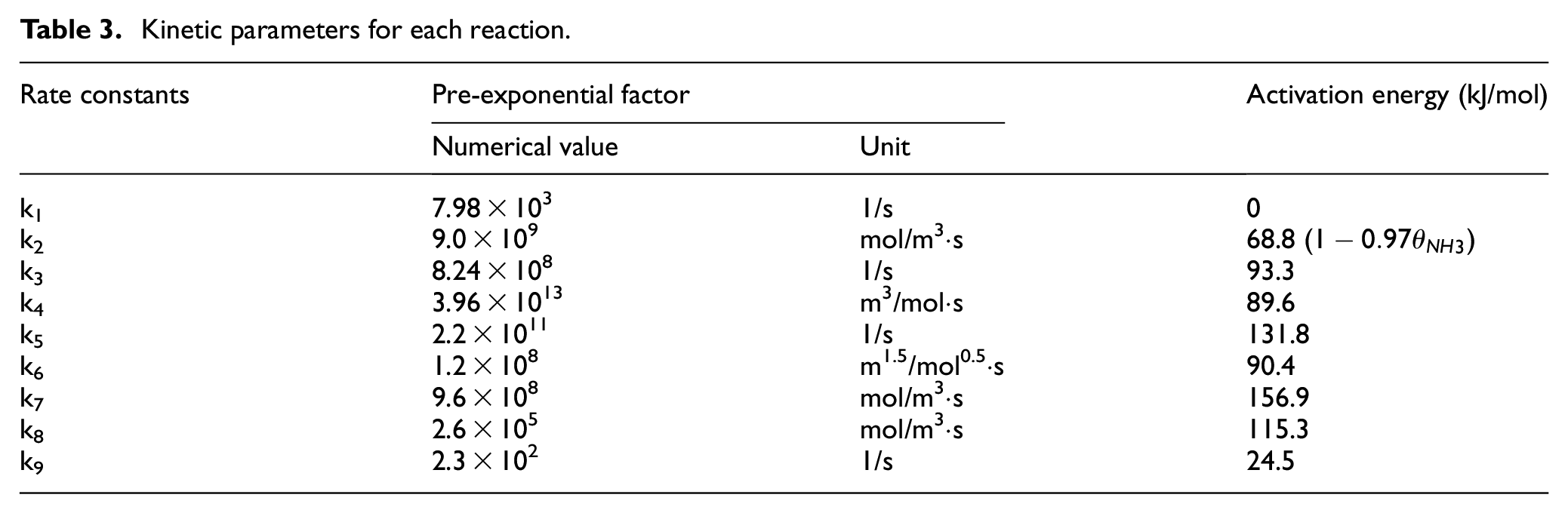
It can be seen from Figure 3 that the outlet molar concentration of NH3 at the initial stage (t = 0–1500 s) gradually rises after delay, indicating that NH3 is gradually adsorbed to the surface of the catalyst. As catalyst saturation, the concentration of NH3 at the outlet achieves a stable level equating to the concentration at the reactor inlet. The amount of ammonia stored on the catalyst surface is calculated by integrating the difference between the inlet and outlet NH3 concentrations and the saturated ammonia storage is calculated to be 169 ± 5 mol/m3. After removing NH3, the NH3 outlet concentration decreases rapidly and gradually approaches to zero in the period from 2000 s to 6000 s. This behavior can be attributed to desorption of some physically adsorbed ammonia, which accounts for about 70% of the total ammonia storage. At t = 6000–7200 s, a significant amount of NH3 adsorbed chemically on the catalyst surface, 30% of the total ammonia storage, are desorbed with the increase of temperature. A desorption peak can be found in the NH3 outlet concentration curve while the peak value reaches the maximum concentration close to 80 ppm around 350°C. The obtained data were compared with the simulation results to modify the kinetic parameters for the NH3 adsorption and desorption reaction. The optimized kinetic parameters are given in Table 3. The good match between simulated curve and NH3-TPD experimental curve proves that the modification of kinetic parameters is reasonable. Hence, the model can predict the NH3 adsorption and desorption behaviors with a satisfactory accuracy. In addition, these rate parameters were kept constant in subsequent model development.
Kinetic parameters for each reaction.
NH3 oxidation
During the operation of diesel engine, the injection amount of NH3, used as reducing agent of urea-SCR system, should be determined according to the actual working conditions. It is necessary to capture the reaction of consuming reductive agent. Therefore, the kinetics of NH3 oxidation should be considered because these are important side reactions as the key pathway consuming NH3 in the NH3-SCR reactions system. The catalyst was exposed to the feed stream containing 500 ppm NH3, 8% CO2, 10% O2 and balance N2 at GHSV of 20,000 h−1. The temperature gradient was fixed in 50°C to investigate the NH3 oxidation activity of SCR catalyst at different temperatures from 150 to 650°C. Figure 4 shows the ammonia concentration and N2O concentrations generated through NH3 oxidation reactions as a function of temperature during NH3 oxidation reactions. Meanwhile, the N2 production was calculated according to the consumption of NH3 and shown in Figure 4 to compare with the formation of N2O. It can be seen that, the activity of NH3 oxidation is low at temperature of 150°C to 300°C and there is almost no ammonia oxidized. The reactivity increases greatly from 350°C to 550°C and more than 90% of NH3 is oxidized above 600°C. At 650°C, the NH3 conversion rate of the catalyst achieves 100%. The concentrations of N2 and N2O gradually increase from 300°C to 450°C. However, decreasing trend for N2O concentration can be found above 450°C. It indicates that the reaction rate of R7 is much higher than R8 in higher temperature range. Much amount of NH3 is oxidized to N2 and only a small fraction of NH3 is involved in reaction R8, resulting in a decrease in N2O concentration.

Comparison of NH3 concentration and generation concentrations of N2 and N2O obtained by experimental measurement and model simulation during the NH3 oxidation studies. Feed: 500 ppm NH3, 8% CO2 and 10% O2.
The above analysis indicated that the Cu-SSZ-13 catalyst has a high activity for NH3 oxidation. The kinetic parameters for reactions R7 and R8 were modified by comparing with the simulation results with the obtained test data, as shown in Table 3. Figure 4 also presents the comparison of the experimentally measured NH3 outlet concentrations and the model predictions. As can be seen, the prediction results fit well with the experimental values. Thus, the model can be used to accurately predict the change of NH3 concentration on catalyst surface in the process of NH3 oxidation. As mentioned above, the determined parameters for NH3 oxidation reactions were not optimized in subsequent parameter optimization for SCR reactions.
NOx conversion
On the basis of the previous modification, the kinetics of NOx conversion reaction were captured for the model, including standard SCR, fast SCR and slow SCR reactions. In typical operating conditions, NO is the dominant component of NOx. So, the standard SCR reaction is a dominant reaction that determines the DeNOx activity of SCR. Meanwhile, other NO2 involved SCR reactions including fast SCR reaction and slow SCR reaction also take place in this process because of the presence of NO2 generated through the NO oxidation reaction. The experiment was conducted with a feed stream comprising 500 ppm NH3, 500 ppm NO, 8% CO2 and 10% O2 at GHSV of 20,000 h−1 and temperature range of 150°C to 650°C. Nitrogen was balance gas.
The NOx and NH3 conversion efficiency as a function of temperature are shown in Figure 5. Different variation trends of NOx conversion efficiency can be found in different temperature ranges. This might be attributed to the change of reaction mechanism in different temperature ranges. As can be seen, the activity of the catalyst increases gradually with the increase of temperature at low temperature (150°C −300°C) and more than 90% of the inlet NO is reduced above 250°C. It is considered that the standard SCR reaction is the dominant reaction at this stage, resulting in a rapid reduction of NOx and NH3. However, the reduction of NOx conversion can be observed over the temperature range of 300°C to 375°C. This is due to the increasing reaction rate of NH3 oxidation as temperature rises. Some of the ammonia is oxidized, resulting in a reduction of ammonia involved in the standard reaction, which reduces the conversion efficiency for NOx. As the temperature continues to increase (375°C–500°C), the NOx conversion rate gradually increases. This is because that the increasing temperature significantly accelerates the NO oxidation reaction. A fraction of NO is oxidized to NO2, which is rapidly reduced via fast SCR and slow SCR reaction. Hence, NOx conversion slightly increases with temperature in this phase. The NOx conversion rate decreases obviously during the high temperature range (above 500°C). This can be attributed to higher rate of NH3 oxidation reactions during the high temperature phase, which causes a significant amount of NH3 to be oxidized. The reduction of ammonia leads to a reduction in the rate of standard SCR reaction. Meanwhile, NO oxidation reverse reaction occurs at high temperature, which reduces the NO2 production. As a result, the rate of fast SCR reaction decreases which also reduces NOx conversion efficiency. In addition, NH3 oxidation reactions led to an over-consumption of ammonia that was defined as the consumption of ammonia not involved in NOx conversion, as shown in Figure 6. Therefore, the actual molarity ratio of NH3 to NOx is higher than the chemical equivalent ratio of NH3/NOx (The molarity ratio of NH3 to NOx when NH3 and NOx are exactly reacting).

The conversion efficiency of NOx and NH3 as a function of catalyst temperature. Feed: 500 ppm NH3, 500 ppm NO, 8% CO2, and 10% O2.

Over-consumption ratio of NH3 not involved in NOx conversion as a function of catalyst temperature. Feed: 500 ppm NH3, 500 ppm NO, 8% CO2, and 10% O2.
The parameter modification process was conducted by taking into account the combined influences of standard SCR, fast SCR and slow SCR reactions as well as NH3 oxidation side reactions on the various species concentrations and NOx conversion. The experimental data were used to optimize kinetic parameters for those reactions and the optimized pre-exponential factor and activation energy are given in Table 3. Figure 7 compares the NOx conversion efficiency obtained by experiments with that predicted by the model. A well match can be found from the figure between the simulation results and experiment results. The model is able to well predict the DeNOx behavior as a function of temperature.
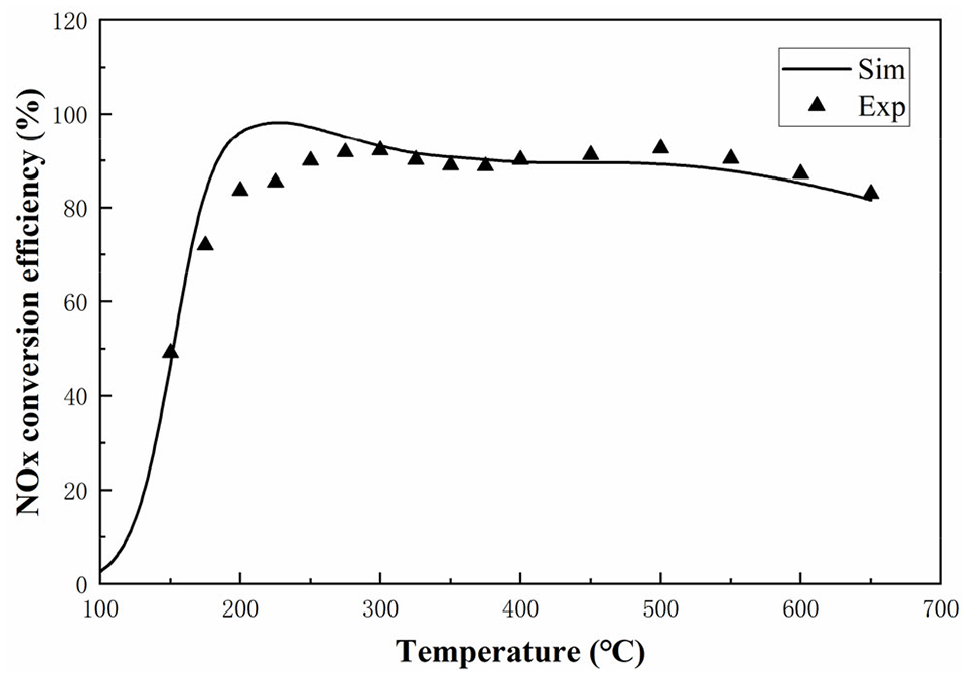
Comparison of NOx conversion efficiency obtained by experimental measurement and model simulation during the SCR reaction studies. Feed: 500 ppm NH3, 500 ppm NO, 8% CO2, and 10% O2.
N2O formation
In the process of selective reduction of NOx by NH3, N2O by-products are inevitably generated through reactions R8 and R9. As the latest emission standards put forward new requirements on N2O emission, it is of great significance to study the N2O emission of diesel vehicle SCR system. Thus, the kinetics of N2O formation reaction should be captured for this model.
A feed stream comprising 500 NH3, 500 ppm NO, 8% CO2, and 10% O2 in balance N2 were fed into the reactor at GHSV of 20,000 h−1 to study the N2O formation reaction. The N2O outlet concentration profile as function of temperature, which plays an important role in the generation of N2O, was obtained as shown in Figure 8. It can be seen that the N2O production increases with the increase of temperature in the low temperature range (150°C to 275°C) while a distinct peak of higher N2O formation can be found at around 275°C. The formation of huge amounts of N2O is primarily due to the side reaction between NO2 and NH3 (R9). Raising the temperature increases the activity of reaction R9. Therefore, the increased N2O production and the appearance of the peak are observed with an increase in the rate of reaction R9. But, the N2O production decreases when the temperature increases further. That could be explained that NH3 oxidation and fast SCR reactions are accelerated at high temperatures, resulting in a reduction of both NH3 and NO2, while NH3 and NO2 are important source of N2O formation, so the reaction R9 is weakened and the N2O production is reduced. In the higher temperature range, N2O concentration goes up again and a peak of higher N2O formation can be found at around 450°C which is created by the NH3 oxidation mechanism. The increased N2O production rate is attributed to an increase in the rate of reaction R8. Similar results can be found from the previous publication, which reported that the low temperature peak created by the NH4NO3 decomposition mechanism and the high temperature peak created by the NH3 oxidation mechanism. 21 As mentioned before, the reaction rate of R7 is much higher than R8 above 450°C, causing more NH3 to be oxidized to N2. At the same time, NO oxidation reverse reaction also proceeds. For the above reasons, the generation of N2O decreases rapidly at high temperature (above 500°C).
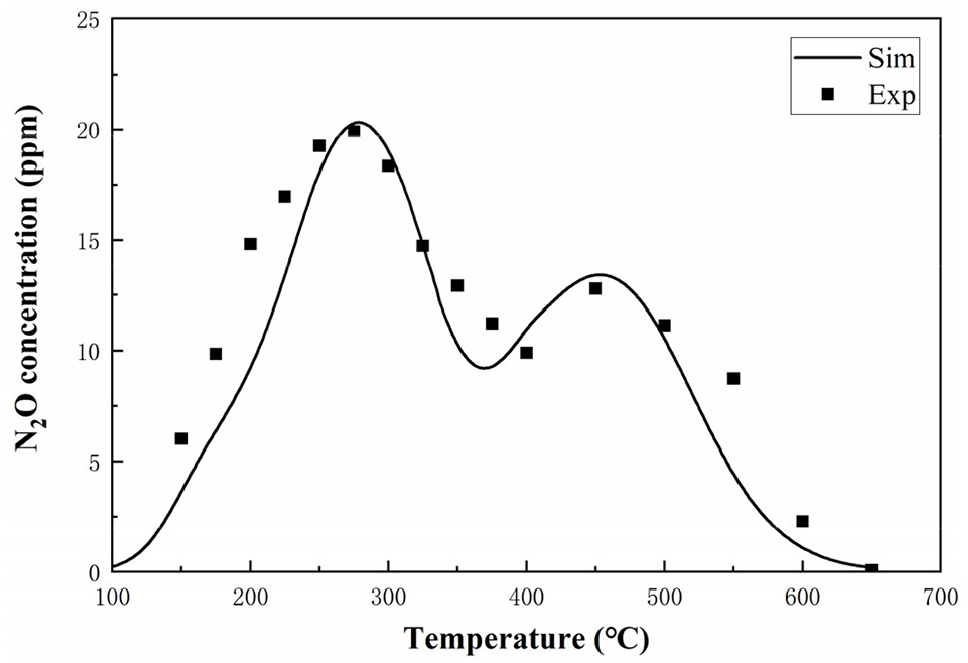
Comparison of N2O concentrations obtained by experimental measurement and model simulation during the N2O formation reaction studies. Feed: 500 ppm NH3, 500 ppm NO, 8% CO2, and 10% O2.
The kinetic parameters for N2O formation reaction were optimized according to the experimental data, as shown in Table 3. Comparison of N2O concentrations at outlet between model simulation and experimental results is also shown in Figure 8. The model satisfactorily predicted the experimental trends indicating that the N2O formation is consistent with the stoichiometry of reactions R8 and R9.
Model validation
In the NH3-SCR reaction process, GHSV and ammonia nitrogen ratio (ANR), as well as temperature, would also affect the catalytic performance of SCR. To study the effects of GHSV and ammonia nitrogen ratio on the DeNOx activity and N2O production of the catalyst and further verify the model, the validation experiments were operated in a wide GHSV range of 10,000 to 60,000 h−1 and ANR range of 0.8 to 1.2.
Effects of GHSV
In order to study the effects of GHSV on the NOx conversion and formation of N2O, a same feed stream comprising 500 ppm NH3, 500 ppm NO, 8% CO2, and 10% O2 was selected at GHSV of 10,000 to 60,000 h−1 and temperature of 300°C. Figure 9a and b respectively present the NOx concentrations and N2O concentrations obtained by experimental measurement and model prediction. As can be seen, over the whole GHSV range, the NOx conversion decreases with the increase of GHSV and a small decrease in N2O formation can be observed by increasing the GHSV. This can be explained that the increased GHSV would enhance corresponding gas flow rate when the volume of the catalysis remains constant. Thus, the lower GHSV can achieve sufficient response because of long contact time between reaction gas and catalyst. On the contrary, the higher GHSV is unfavorable to diffusion, adsorption and reaction of the reaction gas in catalytic converter. More NH3 and NOx pass through reactor without reaction, resulting in the reduction of NOx conversion and N2O production. Overall, the prediction results fit well with the experimental values, which confirm that the model is able to well predict the NOx conversion and N2O production under different GHSV conditions.
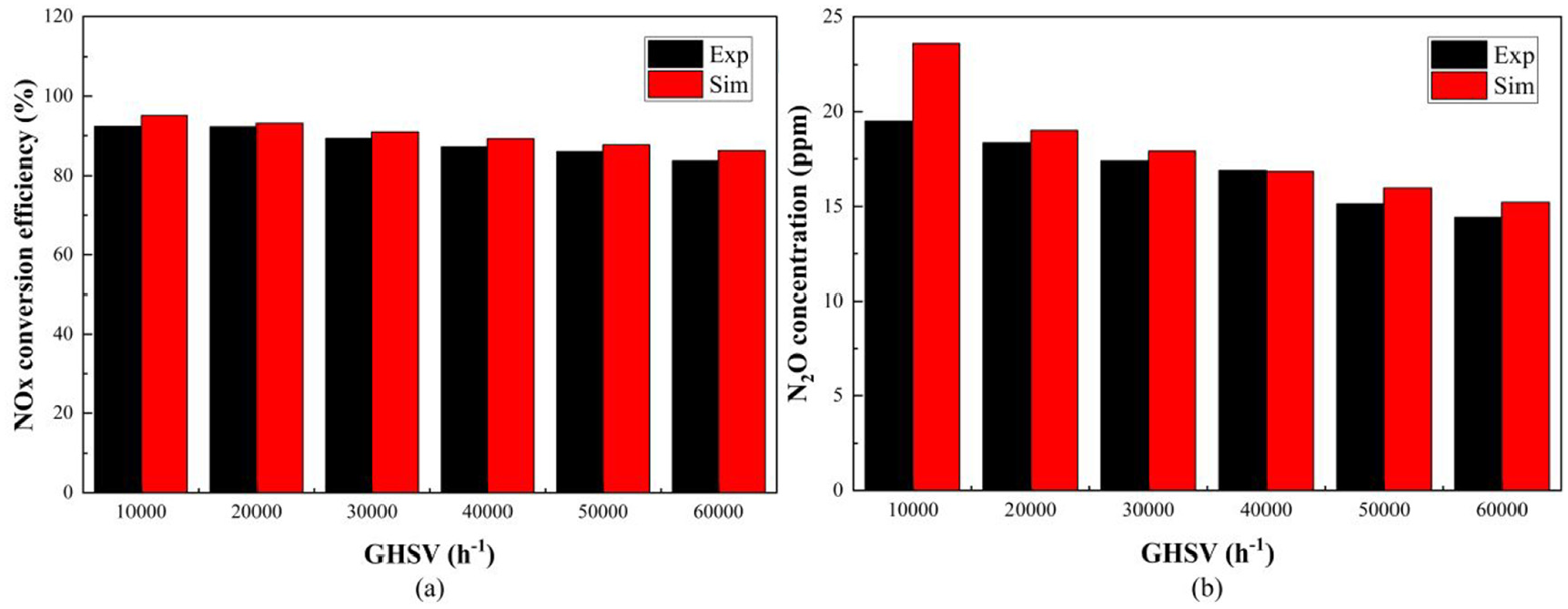
Comparison of experimental data and model prediction results for: (a) NOx concentrations and (b) N2O concentrations at temperature 300°C and ANR of 1.0. Feed: 500 ppm NH3, 500 ppm NO, 8% CO2, and 10% O2.
Effects of ANR
The verification experiment for effects of ANR was performed with variable concentration of NH3, 500 ppm NO, 8% CO2, 10% O2 and balance N2 at GHSV of 20,000 h−1 and temperature of 300°C. The reactor outlet concentrations predicted by the model were compared to the experimental measurements for different ANR, as shown in Figure 10. Figure 10a compares the experimental and simulated values of NOx conversion. As can be seen, the NOx conversion increases with the increase of ANR. This can be explained that the increase of NH3 would accelerate the standard SCR reaction, fast SCR reaction, and slow SCR reaction, which increase the DeNOx activity of catalyst. Figure 10b shows the comparison of experimental and predicted N2O concentration. It can be seen that the N2O concentration increases with the increase of ANR. This is because the excess NH3 makes up for the loss of NH3 due to reaction R7 so that the N2O formation (R9) could react more fully. Meanwhile, excess NH3 adds more reactants to reaction R8. All of this leads to an increase in the generation of N2O. Therefore, higher ANR may improve the SCR performance of the catalyst. However, this would also lead to an increase in N2O emissions. The trade-off relationship is also reproduced in Figure 10. In general, the results predicted by the model fitted well with the experimental results. The comparison results show that this model well predicts the NOx conversion and N2O production under different ANR.

Comparison of experimental data and model prediction results for: (a) NOx concentrations and (b) N2O concentrations at temperature 300°C and GHSV of 20,000 h1. Feed: 500 ppm NO, 8% CO2, and 10% O2.
Conclusions
In this work, a kinetic model was developed combined with a systematic experimental investigation for various reactions taking place in the NH3-SCR reactions over Cu-SSZ-13 catalyst. The kinetic model included NH3 adsorption/desorption, NH3 oxidation, NO oxidation, standard SCR, fast SCR, slow SCR and N2O formation reactions. On this basis, the mechanism of N2O formation from NH3 non-selective oxidation was taken into account to study the performance of the Cu-SSZ-13 catalyst, including NOx conversion efficiency and N2O production. The reaction kinetic parameters such as activation energy and pre-exponential factor were optimized by the optimization algorithm and the optimized model was verified by comparing with experimental data. Based on the study, the following conclusions could be made:
Under the condition of NO is the only NOx component, the standard SCR reaction is a dominant reaction during the process of selective catalytic reduction. In the high temperature phase (above 300°C), the DeNOx activity is affected by NH3 oxidation, NO oxidation, fast SCR, and slow SCR reactions in common. The change of reaction rate for these reactions in different temperature ranges results in different variation trends of NOx conversion efficiency in different temperature ranges.
Temperature has a significant effect on N2O generation. As the temperature increases, two distinct peaks of higher N2O formation could be found. The low temperature peak is created by the N2O formation reaction (R9) mechanism while the high temperature peak is created by the NH3 oxidation reaction (R8) mechanism.
The formation of N2O on the SCR catalyst is also affected by both the ANR and GHSV. Increasing the ANR increases the amount of NH3 available for the reactions involving N2O formation and therefore yields higher N2O formation. Increasing the GHSV reduces the contact time between reaction gas and catalyst, resulting in a decrease of N2O formation.
The comparison between model prediction and experimental measurement indicates that the optimized model can satisfactorily predict the changing trend of molality concentration and steady state conversion rate of various species at the reactor outlet. It is proved that the kinetic model can simulate the reaction process of the Cu-SSZ-13 catalyst used in this study well.
Footnotes
Appendix I
Handling Editor: James Baldwin
Declaration of conflicting interests
The author(s) declared no potential conflicts of interest with respect to the research, authorship, and/or publication of this article.
Funding
The author(s) disclosed receipt of the following financial support for the research, authorship, and/or publication of this article: This study was supported by the Key Research and Development Program of Shaanxi Province (2019ZDLGY15-07) and the Special Fund for Basic Scientific Research of Central Colleges, Chang’an University (300102229502, 300102229202, 300102220512, 300102221506).
