




Abstract
Accurate description of the mechanical properties for soft tissues can help surgeon predict the state during surgery. In unconfined compression tests (UCT) of soft tissue, a tiny force is typically applied to determine the starting position of compression. The preloading force will cause the obtained material parameters to deviate from the real parameters. In this paper, a novel elimination method was proposed to eliminate the effect of the preloading force. The effects of preloading force on mechanical response were analyzed by performing unconfined compression numerical tests. Different preloading force were applied in the simulation. The parameters obtained by traditional optimization method were defined as preloading material parameters. In the proposed method, an estimation model between the preloading material parameters and the preloading force was established to estimate real parameters. The proposed elimination method was verified by three sample diameters and material parameters. The results show that the material parameters obtained by proposed method are closer to the real parameters (estimated accuracy exceeds 97%). The proposed method can obtain more accurate constitutive model parameters, and eliminate the effect of preloading force.
Introduction
Most soft tissue characterizations are hyperelastic and non-linear, such as the liver, kidney, and spleen. 1 Hyperelastic constitutive model is used to describe the mechanical properties of soft tissue, and the commonly used hyperelastic constitutive models are Mooney-Rivlin model, Yeoh model, Ogden model, Neo-Hookean model, etc. 2 Since the Ogden model was often used to describe the mechanical response of liver tissue, 1 the Ogden model is selected in this paper.
Unconfined compression test (UCT) is usually applied to obtain the mechanical response of soft tissue. In unconfined compression tests, sample experimental process is performed and complex sample shapes and gripping samples for tensile test were avoided. 3 However, the contact state between the soft tissue sample and test tool is difficult to determine. In unconfined compression experiments, a small force is usually required to ensure sufficient contact between the test tool and the sample, and this position is used as the initial position of the compression process. 4 The small force is defined as the preloading force. Osman et al. 5 presented anextension and application of a recently proposed finite element formulation for quasi-inextensible and quasi-incompressible finite hyperelasticity to fibrous soft biological tissues and touches in particular upon computational aspects thereof. Miller et al. 6 performed unconfined compression tests on the human calcaneal fat pad to obtain the material properties, the contact state was determined from both visual inspection and a preloading force of 0.01 John et al. 7 measured nonlinear and viscoelastic characteristics of skin using unconfined compression test, and the contact position was determined by a preloading force of 5 g (0.049 N). Ledoux et al. 8 applied unconfined compression tests to obtain the material properties of the plantar tissue, initial thickness of the specimen was determined by a preloading force of approximately 0.5 N. Roan et al. 9 performed compression tests on liver tissue, and the compression experiment was initiated immediately after a preloading force of 0.002 N. Barrientos et al. 10 developed a new simple method for the evaluation of joint viscoelasticity, a steady contact preloading of 5 mN was applied to the disc to ensure adequate whole specimen-fixture contact. Zhu et al. 11 identified the properties of ultra-soft materials using unconfined compression test, the zero strain point was defined as the point when the contact force reached 0.1 N. Budday et al.12,13 studied the mechanical characterization of human brain tissue using unconfined compression test, a preloading force of about 10 mN was applied during compression test. Prevost et al. 14 imposed a preloading of 0.02 N on each sample prior to testing in order to accurately determine the sample thickness. Zimmermann et al. 15 applied a preloading force of 0.2 N to ensure complete contact between the mechanical testing device and the tissue sample. Jiang et al. 16 applied a preloading force of 0.02 N to assure all samples were tested under the same initial conditions. In the above studies, there is generally a small preloading force in the compression experiments. However, the influence of preloading force is directly ignored in obtaining the mechanical response of soft tissue samples. The obtained mechanical response is directly used to fit the constitutive model to obtain material parameters.
Clarke et al. 17 concluded that “true” storage moduli of liver will deviates by 47% at 10% linear compression. Mattei et al.18,19 found pre-stressed liver samples exhibit a more elastic behavior compared to pre-stress-free states, two methods for obtaining viscoelastic parameters based on small strain regions and linear viscoelastic regions were proposed. Yu et al. 20 proposed an elimination method to eliminate the influence of preloading force. Mechanical responses under different preloading forces are obtained by compression tests. Compared with traditional methods, it can effectively improve the accuracy of material parameters. Santamaría et al. 21 analyzed the effects of three different pre-contact states on soft tissue characteristic parameters, and proposed a new contact protocol to approximate the simulated zero preloading condition, but this method still has a small preloading force of 0.01~0.02 N. The above studies show that the preloading force existing in the compression test has a non-negligible effect on the constitutive model parameters.
The existence of preloading force will lead to the deviation of the obtained model parameters from the real parameters. In this paper, the influence of preloading force on mechanical response is considered in the process of obtaining material parameters. A preloading force elimination method is proposed. Based on this method, the influence of preloading force on constitutive model parameters can be eliminated.
Problem statement
In a complete compression process, the contact state between soft tissue sample and test tool can be divided into three types, as shown in Figure 1. In no-contact state, the sample has no strain. Real-contact state is that the contact between soft tissue and test tool is just beginning. This state is an instantaneous time and difficult to be determined. Reference-contact state is a state in which the reaction force of the specimen reaches the preloading force (a threshold). The height of the sample in the reference state h is less than the natural height of the sample h0. In the actual compression test, the reference-contact state is considered to be real-contact state. This causes the obtained mechanical response to deviate from the true mechanical response.

Three contact states in unconfined compression tests of soft tissue.
In traditional parameter optimization method, the initial compression stage of the sample is determined by the reference-contact state. The preloading force between soft tissue and test tool is ignored, and the collected response of soft tissue deviates from the real response. The relationship between collected and real mechanical response is shown in Figure 2.
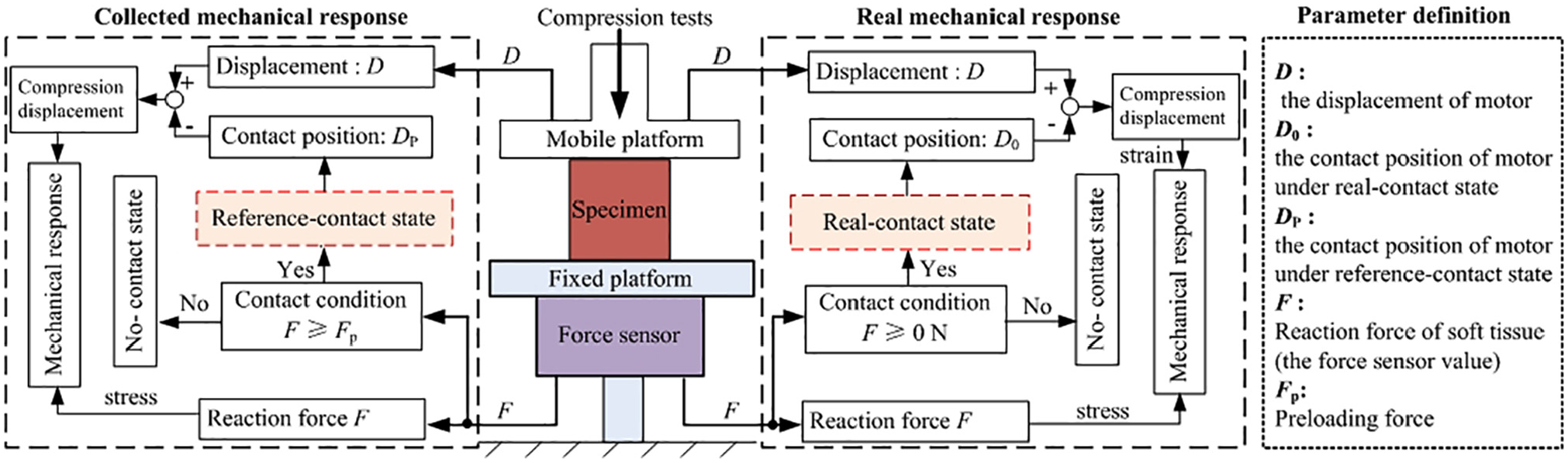
The relationship between collected mechanical response and real mechanical response.
The difference between collected and real mechanical response is mainly due to different contact states. Reference-contact state is used in collected mechanical response. Real-contact state is used in real mechanical response. The collected response is used to optimize constitutive model parameters directly in traditional optimization method.
Based on the traditional optimization method, an elimination method of preloading force is proposed. Material parameters under different preloading forces are obtained by traditional optimization method. These parameters are defined as preloading material parameters. Estimation models between preloading material parameters and preloading force are established, and the constant terms are the optimal material parameters.
Methods
Constitutive model
Isotropic and incompressible are considered as the basic properties of soft tissues.22,23 The hyperelastic model is often used to describe mechanical properties of soft tissue, such as the liver, kidney and brain, etc. For the Ogden hyperelastic model, 2 the strain energy density function can be expressed as shown in equation (1). For compression experiments, the stretch is defined as the ratio of the sample height after compression to the initial sample height.

Where
Soft tissue is considered to be incompressible (The coefficient of volume change J=1), engineering stress expressed by first-order ogden model
2
as shown in equation (2). Where

Based on the collected mechanical response of soft tissue, the preloading material parameters obtained using the traditional optimization method are

Where
Methodology
In this paper, constitutive model parameters optimization without considering the influence of preloading force is defined as traditional optimization method. In this method, the influence caused by preloading force is ignored. Collected mechanical response is applied to parameter fitting of constitutive model (as shown in Figure 2). The test force is directly used as reaction force of liver sample. In the traditional optimization method, the preloading force is ignored, and the collected mechanical response by the UCT is directly applied to fit constitutive model parameters. Taking into account the effects of preloading force on mechanical response, an elimination method of preloading force is proposed to eliminate the influence, as shown in Figure 3. The constitutive model parameters obtained by traditional optimization method are defined as preloading material parameters (
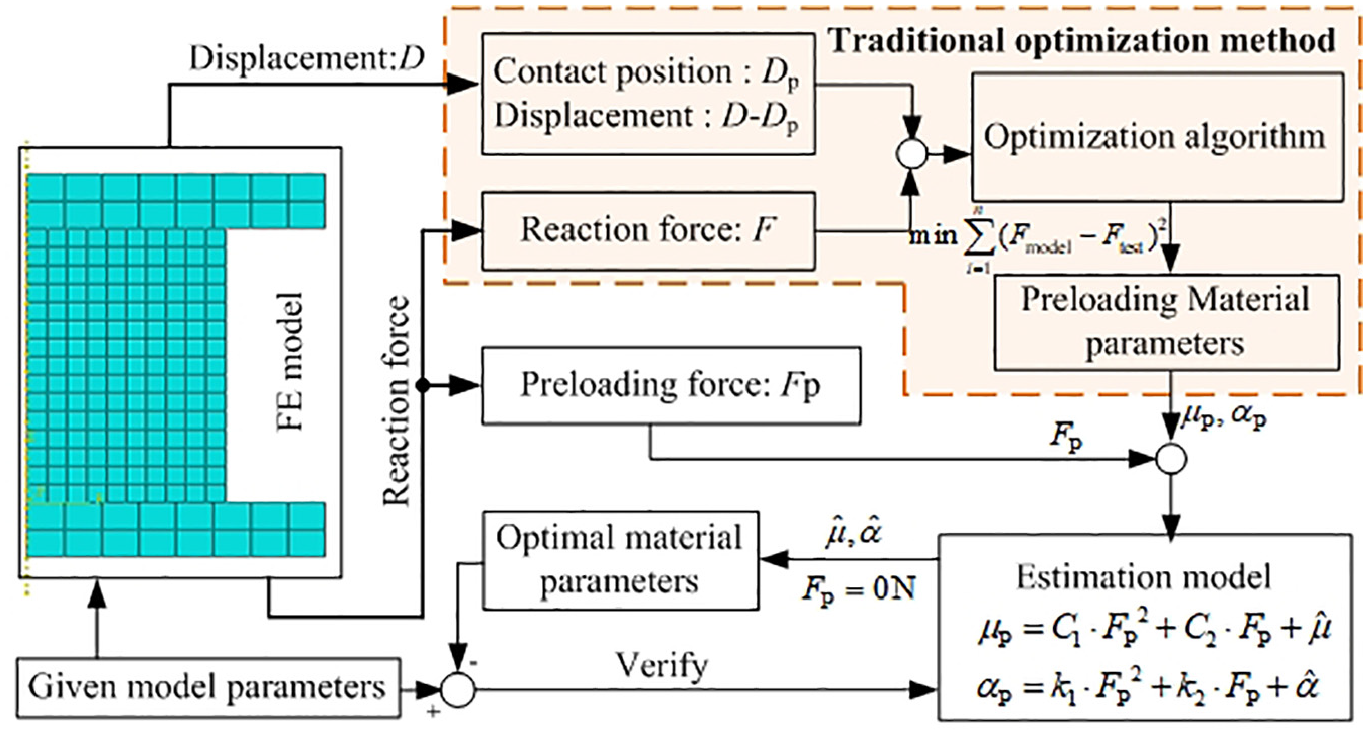
Flow chart of elimination method.
Numerical tests
A finite element model of soft tissue is established by using the same settings in previous research. 24 The FE model was established in ABAQUS software. Elastic material (Young’s modulus is 2.06 Gpa, Poisson’s ratio is 0.3) used as finite element model material for mobile and bottom platforms. The grid type of platform model is CAX4H type. Hyperelastic material (First order Ogden model) used as finite element model material for sample. The paramater u and α are given parameters (H1, H2, H3), parameter D1 is set to 0. The grid type of sample model is CAX8H type. The lower surface of the mobile platform and the upper surface of the sample are set to contact properties. The upper surface of the bottom platform and the lower surface of the sample are set to contact properties. The contact property is tangential behavior and penalty is select as the friction formulation. The platform is set as the master surface, and the sample is set as the slave surface. The friction coefficients of the contact surfaces are set to 0. The established FE model in is shown in Figure 4. The material parameters of liver sample used in FE numerical tests are shown in Table 1. Three material parameters are applied to the numerical tests. H1 is previous research results, 24 H2 and H3 are from literature. 25

The finite element model of unconfined compression test.
Different material parameters used in numerical tests.

Five numerical tests were performed as shown in Table 2. The quasi-static response of soft tissue is only studied and the viscoelasticity is not considered in this paper. The compression velocity in all numerical tests is 0.1 mm/s. Each sample is compressed to a strain of 0.2. For test 1, the influence of preloading force were analyzed by comparing the collected mechanical response under different preloading force with the real response. For test 2, the accuracy of traditional optimization method was analyzed by the fitting results of two preloading forces. For test 3, ten preloading forces were applied to numerical tests, the accuracy of the elimination method is verified by comparing the estimated material parameters with the real material parameters. For test 4, three sample diameters were applied to numerical tests, and the influence of sample diameter on the estimation results was analyzed. For test 5, three material parameters were used to verify the applicability of the elimination method.
Different parameters used in numerical tests.
Parameter definition for samples with non-uniform thickness
The sample of soft tissue is not easy to prepare into regular shapes. In this paper, samples with non-uniform thickness are parameterized, as shown in Figure 5. The specific parameters are defined as follows, Lmax is the maximum height of the sample, Lmin is the minimal height of the sample, d is the liver sample diameter, dP is compression platform diameter, θ is defined as the sample angle. The highest sample height Lmax is used as the sample height. The sample angle θ is a main parameter as the variable of analysis, and this parameter can be calculated by the sample height and diameter (Lmax, Lmin, d). The diameter of compression platform is 50 mm.The liver tissue is developed using hyperelastic material. the first-order Ogden model is selected as the hyperelastic material model.

The parameters definition for samples with non-uniform thickness.
Results and discussion
Analysis of preloading force for uniform Thickness Sample
In order to analyze the influence of different preloading forces on the mechanical response, the stress difference is defined as shown in equation (4). Where

Mechanical responses under different preloading force were obtained by numerical tests, as shown in Figure 6. The preloading force will lead to significant differences in mechanical responses, as shown in Figure 6(a). The results show that the stress difference percentage between the collected and the real mechanical response increases with a bigger preloading force, and the stress difference percentage of the low strain region is significantly larger than the high strain region, as shown in Figure 6(b). When the stretch is from 0.9 to 0.85, the stress difference percentage is approximately 4% under a preloading force 0.01 N. When the preloading force is increased ten times, the stress difference percentage is also increased by about 10 times.

Stress difference between collected and real mechanical response: (a) mechanical responses with different preloaing force, and (b) stress difference percentage with different preloaing force.
The relevant fitting process was performed in the curve fitting tool of Matlab software. Collected responses were fitted based on the traditional optimization method, as shown in Figure 7. The results show that the stress difference percentage is obvious in low strain area. The greater the preloading force, the greater the stress difference percentage. When the preloading force is 0.01 N, there is a 4% error between the preloading material parameter

Stress difference percentage and preloading material parameters with prloadingforce.
The preloading material parameters obtained by the traditional optimization method and the estimated model fitting results under the material parameters H1 are shown in the Figure 8. The estimation model can describe the relationship between preloading material parameters and preloading forces. The material parameters obtained by the elimination method are

Fitting results of the estimation model under the material parameters H1: (a) optimization result of parameter
The effect of preloading force on mechanical response of soft tissue is related to the sample diameter. In order to analyze the effect of specimen diameter on the accuracy of elimination method, three specimen diameters were used for numerical tests. Ten preloading forces are applied to obtain mechanical responses for each sample diameter. Preloading force changed from 0.01 to 0.1 N, and the interval is 0.01 N. Preloading material parameters (

Comparison of estimated model fitting results with three different diameters of specimen: (a) fitting results of parameter
For test 4, estimation material parameters for three sample diameter were obtained by the proposed elimination method. The process to obtain model parameters is the same as test 3. Ten preloading forces are applied to obtain the estimation material parameters. The results are shown in Table 3. High-precision (exceed 97%) estimation of material parameters at different sample diameters can be achieved.
Results of elimination methods under different diameter of specimen.

In previous research, an indirect optimization method was proposed to eliminate the influence of the preloading force.
20
In this paper, the proposed novel elimination method was compared with previous method. Ten preloading forces are applied to obtain mechanical responses of sample (diameter is 30 mm). Mechanical response under preloading force of 0.01 N was used to optimize material parameters using previous method. The obtained material parameters are

Comparison between of novel elimination method and previous elimination method.
In order to analyze the effect of material parameters on the elimination method, three material parameters (H1, H2, H3) were used for numerical tests. The sample diameter of finite element model was 30 mm. Estimation results of three material parameters based on elimination method are shown in Table 4. High-precision (exceed 99%) estimation of material parameters at three material parameters can be achieved.
Estimation results of three material parameters based on elimination method.

For the collected mechanical response under a preloading force of 0.01 N and the real mechanical response is close, the material parameters obtained by the elimination method were compared with it. The comparison results are shown in the Figure 11. The results show that the stress difference obtained by the elimination method is significantly smaller than the preloading force of 0.01 N.

Comparison of stress difference percentage between traditional optimization and elimination method.
Taking the material parameter H1 as an example, the influence of the number of preloading forces on the estimation result was analyzed. The results were shown in Figure 12. The conclusion that at least three kinds of preloading force tests can guarantee the accuracy of parameter estimation can be obtained.

The effect of the number of preloading experiments on the estimation results.
The influence of non-uniform thickness sample on mechanical response
The sample angle θ is used as a variable, and the maximum height Lmax of the sample is used as the sample height. The sample stretch of non-uniform thickness is the ratio of the height after compression to the maximum height Lmax. To analyze the effect of sample angles on the mechanical response, five sample angles were used to obtain the mechanical response of sample. The results are shown in the Figure 13. The sample angle will lead to a significant differences in mechanical responses. The mechanical response for θ = 0° and θ = 2° crosses when stretch is at around 0.83 mm/mm. The reason for this phenomenon may be is small sample angle has little effect on the mechanical response. When the compressive strain reaches about 0.15, the internal force of the sample will increase, and the reaction force of the test tool on the sample will gradually increase, which exceeds the mechanical response of the sample without angle. When the sample angle is 2°, the existence of the sample inclination at a large stretch (bigger than 0.83) will have a small stress response. As the stretch decreases, the stress response increases. Under other angle conditions, the stress response shows a downward trend, and the larger the sample angle, the smaller the stress response.
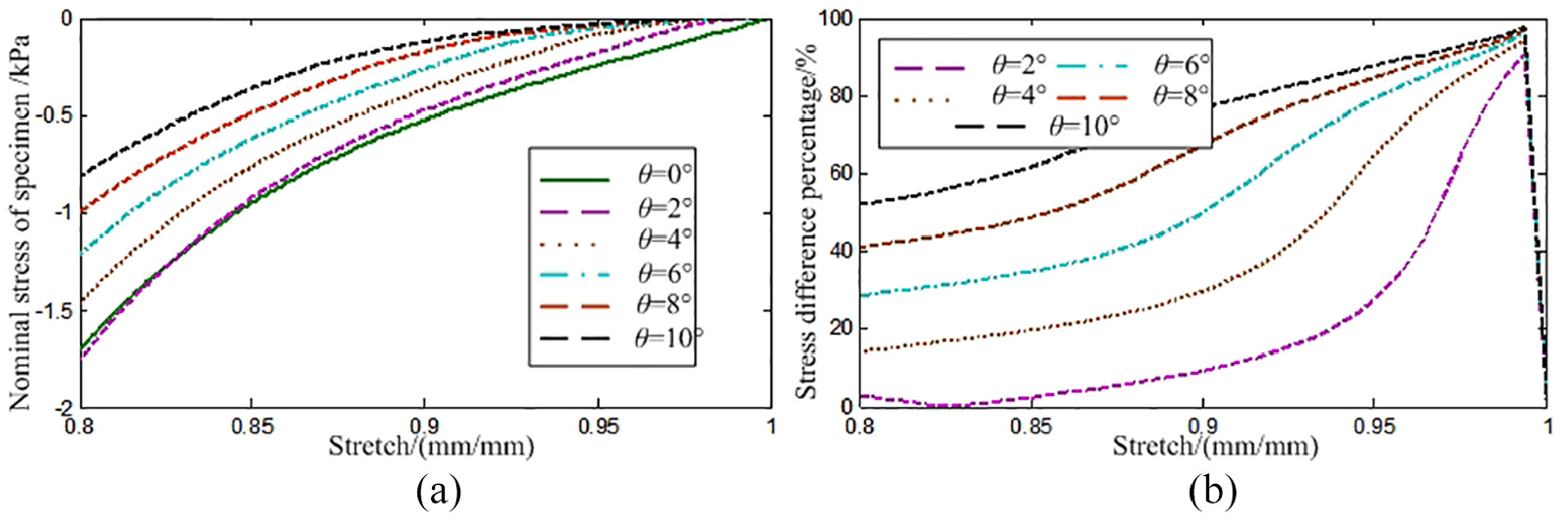
The effect of different angles on the mechanical response of the sample: (a) mechanical responses with different sample angle, and (b) stress difference percentage with different sample angle.
Conclusion
In this paper, the effects of the preloading force on the mechanical response of soft tissue in UCT was analyzed. A novel elimination method was proposed to eliminate the effects of preloading force.
Based on the preloading parameters obtained by the traditional optimization method, estimation model between the preloading material parameters and preloading force was established to estimate the material parameters.
Elimination method was verified by numerical tests under three sample diameters and material parameters. The results show that the novel elimination method can achieve high-precision estimation (accuracy is more than 97%) of material parameters under variable material parameters and sample diameters.
The elimination method provides a new way to obtain the real material parameters of soft tissue. The method achieves indirect estimation of material parameters by several simple preloading experiments (greater than 3).
In the future, these factors will be considered in the eliminating method of preloading force. For non-uniform thickness of sample, the sample parameters defined in this paper will be taken into account in parameter acquisition. The coupling effects of sample shape parameters and friction on the mechanical response will be considered in the unconfined compression tests.
Footnotes
Handling Editor: James Baldwin
Declaration of conflicting interests
The author(s) declared no potential conflicts of interest with respect to the research, authorship, and/or publication of this article.
Funding
The author(s) disclosed receipt of the following financial support for the research, authorship, and/or publication of this article: This work is supported by the National Key R&D Program of China(2018YFB1308100), Zhejiang Provincial Natural Science Foundation under Grant LQ21F020026, Science foundation of Zhejiang Sci-Tech University(ZSTU) under Grant No. 19022104-Y. General Scientific Research Project of Zhejiang Provincial Department of Education (Grant Nos.19020033-F, 19020038-F).National Natural Science Foundation (Grant 51805488). Hubei Provincial Natural Science Foundation (Grant 2018CFB313). the Project of Hubei University of Arts ans Science(XK2020013), the Project of Hubei Superior and Distinctive Discipline Group of “Mechatronics and Automobiles” (XKQ2021041).
