



Abstract
The growing development in the thermal engineering and nano-technology, much attention has been paid on the thermal properties of nanoparticles which convey many applications in industrial, technological and medical era of sciences. The noteworthy applications of nano-materials included heat transfer enhancement, thermal energy, solar systems, cooling of electronics, controlling the heat mechanisms etc. Beside this, entropy generation is an optimized scheme which reflects significances in thermodynamics systems to control the higher energy efficiency. On this end, present work presents the slip flow of Jeffrey nanofluid over a stretching sheet with applications of activation energy and viscous dissipation. The entropy generation features along with Bejan number significance is also addressed in present analysis. Buongiorno model of nanofluid is used to discuss the heat and mass transfer. The formulated flow equations are attained into non-dimensional form. An appropriate ND MATHEMATICA built-in scheme is used to find the solution. The solution confirmation is verified by performing the error analysis. For developed flow model and impacted parameters, a comprehensive graphical analysis is performed. It is observed that slip phenomenon is used to decays the velocity profile. Temperature and concentration are in direct relation with Brownian motion parameter and activation energy respectively. Entropy and Bejan number have same results for greater diffusion parameter.
Keywords
Introduction
The non-Newtonian fluids attribute the importance in era of industries and technologies and scientists have paid special attention by exploring distinct rheological mechanism. Different researches have been conducted on the dynamics of gases and he proposed a theory to explain different properties of gases. Scientists also work on the pseudo-plastic liquids and constituted expressions for them. Scientists have also worked on the properties and behavior of Bingham like viscous materials which referred to the significances of lubrication flows. Ramesh 1 worked on two types of flow Couette and Poiseuille flows of Jeffrey fluid. Jeffrey fluid flow through porous medium and Soret and Dufour effect has been worked out by Kumar and co-researchers. 2 Ramesh et al. 3 discussed the motion of Casson fluid with stagnation point over variable thickness. Xun et al. 4 discussed the rheological behavior of Ostwald-de Waele fluid confined by rotating disk. Farooq et al. 5 elucidated the radiative flow of viscoelastic nanofluid. Some more recent analysis expressing the rheological mechanism of non-Newtonian materials can be shown in Refs.6–10
The nano-materials are the materials that contain particles in the size range of 1–100 nm. A lot of research has been done on the properties and studies of nano materials in the last few years because of their wide range of applications in many fields. They have many applications in different fields like in engineering, nano technology micro manufacturing and in pharmaceutical processes as well. There main applications of such materials in industries, technologies and thermal sciences. The utilization of nanoparticles significantly improves the efficiency of heat transfer processes. The heat transfer increases due to suspension of nano particles in the base fluid. The stability of nano materials is very important so that the thermo physical characteristics of the material are maintained after fabrication process. Many researches have been conducted on it and still researchers are working on it due to their applications in various fields. Choi and Eastman 11 was one who first discovered the nanofluid flow. Hayat et al. 12 examined the entropy generation in Ag and Cu water nanofluid. Krishnamurthy et al. 13 analyzed the convective thermal transport of nanoparticles in presence of slip effects and porous space. Kumar et al. 14 inspected the Marangoni flow of Casson nanofluid with dynamic impact of chemical reaction and heat generation mechanism. The features of entropy generation, viscous dissipation in radiative flow of micropolar nanofluid have been suggested by Roja et al. 15 Hamid et al. 16 addressed the heat transfer enhancement in water-based carbon nanotubes configured by heated fin-shaped cavity. Khan et al. 17 used interesting Galerkin numerical scheme suggest the solution of a problem based on an unsteady flow of Eyring–Powell nano-material. A wavelet approach based theoretical investigation for the stagnation point flow of Williamson nanofluid has been directed by Hamid and co-researchers. 18 Usman et al. 19 used the modified wavelets scheme for the flow of nanofluid accounted by infinitely parallel plates. Khan et al. 20 studied the diffusive flow of nanofluid in porous cavity with combined features of heat and mass transportation. The triple diffusive flow of nanofluid with entropy generation assessment in horizontal plate has been directed by Khan et al. 21
Following to the motivation applications of non-Newtonian nano-materials and entropy generation phenomenon, current research aims to explore the slip flow of Jeffrey nanofluid in presence of entropy generation and various thermal features. The novel features of current work are summarized as follows:
❖ To examine the heat transfer phenomenon in flow of Jeffrey nanofluid over a stretched configuration.
❖ The impact of activation energy and viscous dissipation effects has also been introduced as a novelty.
❖ The entropy generation phenomenon is addressed with thermodynamic approach.
❖ The partial slip features utilized to examine the flow pattern.
❖ The characteristics of thermophoresis and Brownian motion mechanism are addressed by employing Buongiorno model of nanofluid.
❖ he distinct flow characteristics of various parameters are discussed through graphs with relevant physical justification.
Modeling
Here, two dimensional, steady and incompressible slip flow of Jeffrey fluid is examined. Heat and mass transfer flow is discussed in presence of viscous dissipation, activation energy and Buongiorno model of nanofluid. The stretching sheet causes the flow of non-Newtonian fluid as shown in Figure 1. In cartesian coordinate plane, the velocity components


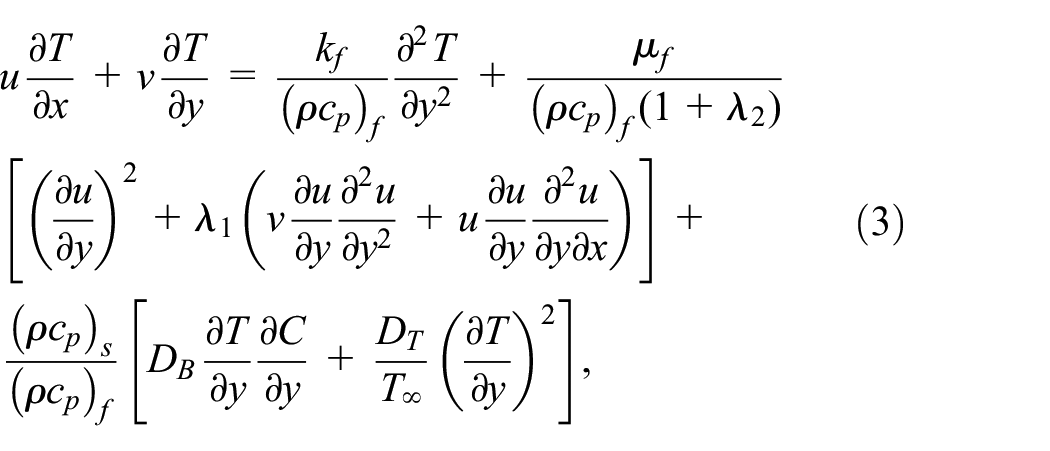

with boundary conditions:22,23


Geometry of flow problem.
In above expressions
Considering the dimensionless variables:
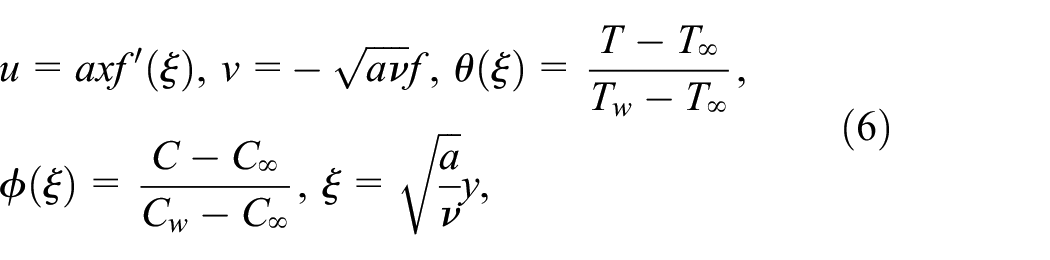
we arrive

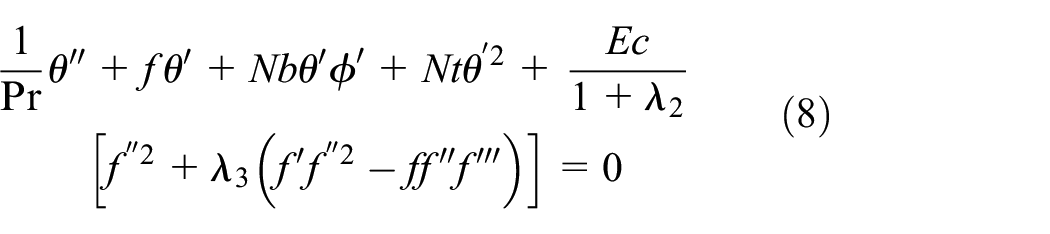


with

Mathematically, entropy generation in presence of above assumptions is addressed as:

dimensionless form is

The Bejan number is

where
Expressions for physical quantities skin friction, Nusselt number and Sherwood number are presented below

After implementation of transformation Eq. (15) takes the form

Discussion
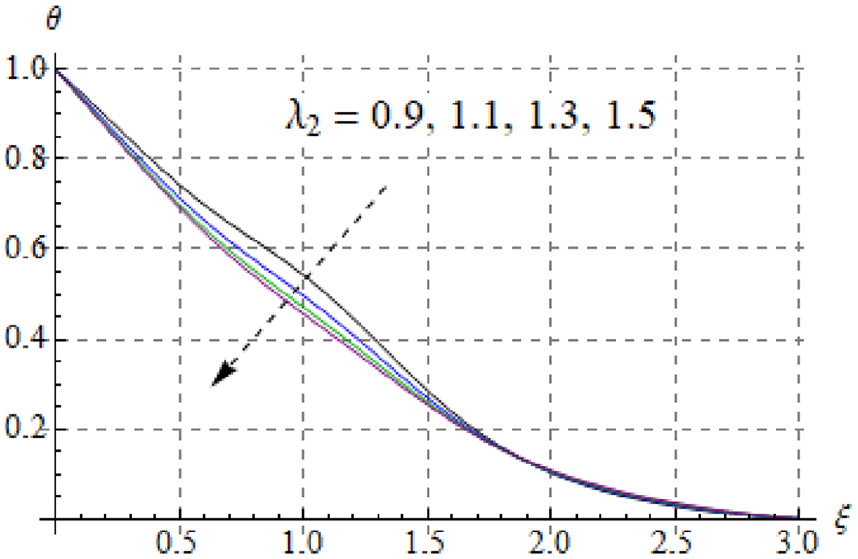
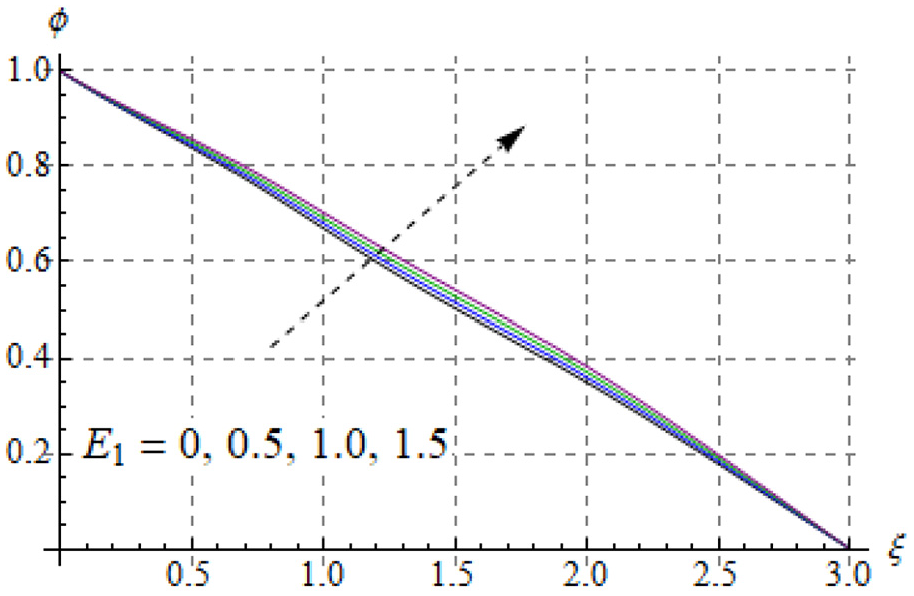
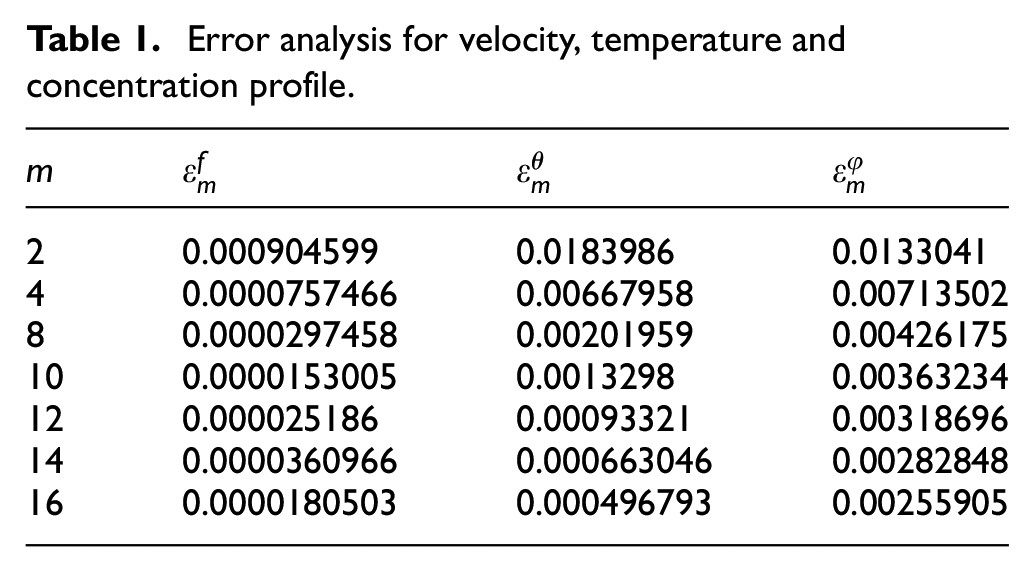
Present section dedicated to analyze the behavior of velocity, concentration, temperature, entropy generation, Bejan number, Nusselt number, skin friction and Sherwood number versus different parameters (See Figures 2–16 and Tables 1–4).






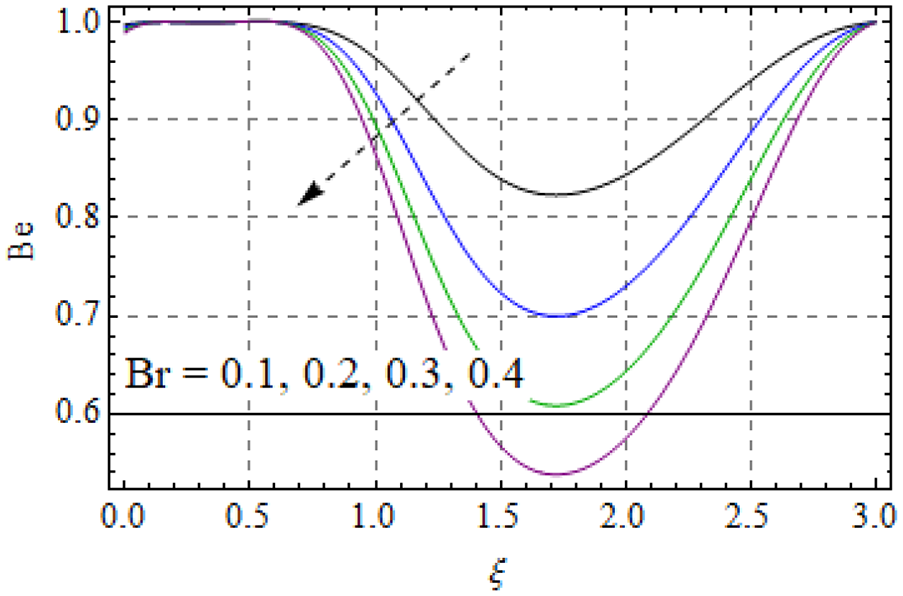
Be via Br.


Be via


Be via L.

Total averaged squared residual error.
Error analysis for velocity, temperature and concentration profile.
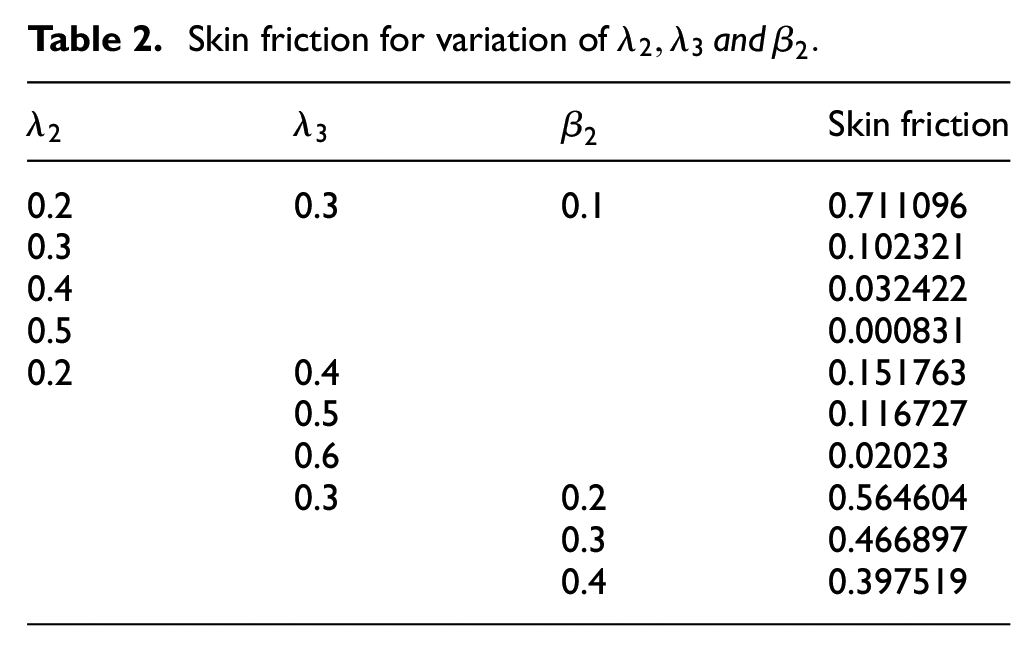
Skin friction for variation of
Nusselt number for variation of Nt, Nb and Ec.

Sherwood number for variation of Sc, Nt and

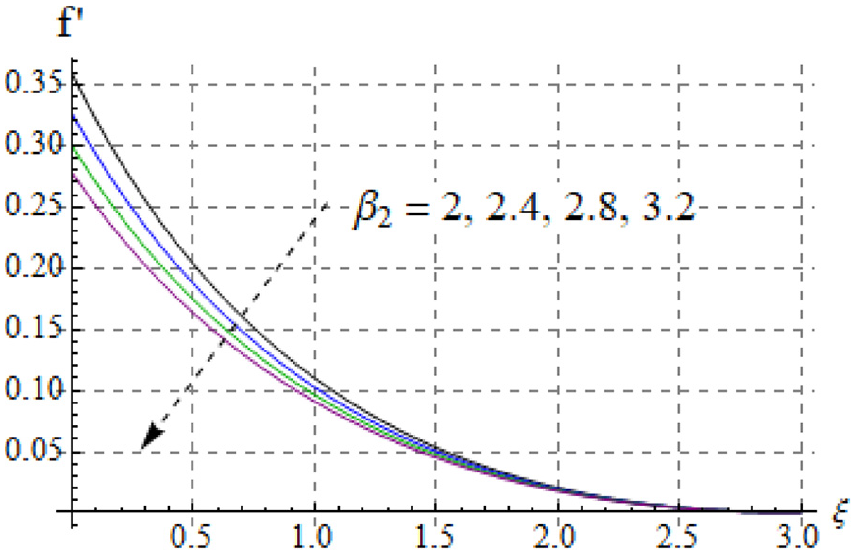
Impact of ratio of relaxation to retardation time parameter
Figures 5 to 7 describe the behavior of
Figures 8 and 9 exhibit the impact of activation energy parameter
Figures 10 to 15 are sketched to examine the influence of various parameters on entropy generation and Bejan number. Figures 10 and 11 reveal the impact of Brinkman number versus
Figure 16 is drawn to show that average total residual error is decreasing with increasing order of approximation which shocd the optimal values of



Letting

where
Tables 2 to 4 describe the results of skin friction Nusselt number and Sherwood number against involved parameters. Here we have seen that drag force at surface reduces for higher values of
Conclusions
The optimized flow of Jeffrey nanofluid in presence of partial slip confined by a stretched surface has been analyzed in this communication. The additional impact of viscous dissipation and activation energy are also addressed as a novelty. The numerical simulations are performed which is based on MATHEMAITCA built-in ND scheme. The accuracy of solution is verified by performing error analysis. The main observations form present research work is summarized as:
➢ Theelocity profile enhances for ratio of relaxation to retardation time parameter while it decays for rising values of retardation time parameter.
➢ The presence of slip offers more resistance to fluid flow.
➢ An impvsed temperature is examined with thermophoretic and Brownian constants.
➢ The presence of activation is more efficient to improve the nanofluid concentration.
➢ The Bejan number and entropy generation parameter shows an increasing trend for diffusion
➢ An increasing entropy generation profile is observed with Brinkman number.
Footnotes
Appendix
Handling Editor: James Baldwin
Declaration of conflicting interests
The author(s) declared no potential conflicts of interest with respect to the research, authorship, and/or publication of this article.
Funding
The author(s) received no financial support for the research, authorship, and/or publication of this article.
