




Abstract
In this paper, a cross resonator pressure sensor is proposed to improve the detection accuracy of capacitor-detecting sensor. Considering electrostatic force and molecular force, the multi-field coupled dynamic equation of the sensor is established. By solving the dynamic equation, the equations for the mode function and the natural frequencies of the resonator are obtained. Using these equations, the natural frequency and mode function of the sensor are given. Changes of natural frequency of sensor with main parameters are studied. Influence of molecular force on the natural frequency is analyzed. Results show that within a considerable range of pressure, the natural frequencies increase approximately linearly with pressure. Under small pressure, small initial distance between resonator and base, and lower order modes, effects of the Van der Waals force on the natural frequencies are quite obvious.
Keywords
Introduction
Micro electro mechanical system (MEMS), also known as microelectronic mechanical system, refers to micro system manufactured using micromachining technology and integrated circuit technology.1–3 MEMS is a frontier field integrating mechanics, electronics, computer software and other disciplines, which has become one of the most rapidly developing science and technology.4–6 In MEMS field, micro-resonance sensor has the most market and development potential.7–9 Among micro-resonance sensors, micro-resonant pressure sensors have been widely used in fields such as aerospace and automobile, etc.10–12
In 2005, Akhtar deposited 0.45 μm-thick polysilicon thin film on p-type silicon wafers by LPCVD process, which was used in the manufacturing of micro-resonant pressure sensors. 13 In 2010, Liu analyzed nonlinear free vibration of a prestressed orthotropic membrane using L-P perturbation method. 14 In 2011, Li studied the dynamic characteristics of a micro resonance pressure sensor under thermal excitation. 15 In 2016, Guan proposed a new type of 0–3 kPa pressure sensor which has high sensitivity and linearity. 16 Tajaddodianfar proposed a homotopy analysis method to derive the analytical solution of the frequency response of the resonator. 17 In 2018, Amir studied the nonlinear vibration of electrostatically driven resonator and analyzed the influence of various factors on its vibration. 18 Ding resolved the steady-state response of nonlinear transverse vibration of viscoelastic beams under periodic excitation. 19 In 2019, Hao developed a new micro resonant pressure sensor combining beam and peninsula with thin film, with a range up to 800 kPa. 20 Fu investigated chaotic vibration of a micro resonant pressure sensor. 21 The resonators are the key element of micro-resonance sensor. Its dynamic behavior determines the operation performance of the sensor. The solving method of the dynamic equation of the micro-resonators was developed and the calculated accuracy of the dynamic characteristic was discussed in depth.22–23
To sum up, a lot of research work has been done on micro-resonant pressure sensors. Dynamic characteristic is the key to ensure the working performance of resonance sensor, so it has become the most important research work of micro resonance pressure sensor. In the micro resonant pressure sensor, capacitance detection method can greatly simplify the process of the system, so it is widely used. However, the capacitance between the existing resonator and base is very small, so the capacitance change signal in the resonance is very small, which increases the difficulty of making the subsequent amplifier circuit.
For this reason, this paper proposes a micro resonant pressure sensor with cross-type resonator to increase the area in the middle of the resonator. It can increase capacitance between the resonator and base to raise the capacitance change signal in the resonance. For the micro resonant pressure sensor with cross-type resonator, the dynamic characteristics of the resonator are still the key to its performance. So, the multi-field coupled dynamic equation of the sensor is established. By solving the dynamic equation, the equations for the mode function and natural frequencies of the resonator are obtained. Using these equations, changes of natural frequency of sensor with main parameters and pressure are studied. The influence of molecular force on the natural frequency of the sensor is analyzed.
Free vibration equations
The structure model and force analysis model of the micro resonant pressure sensor with cross structure are shown in Figure 1. Cartesian coordinates are established, with the midpoint of a fixed end of the resonant beam as the origin of coordinates, the length direction of the resonant beam as the X-axis, and the thickness direction of the resonant beam as the Y-axis. Here, 2L is the length of the resonator, h is the thickness of the resonator, E is the elastic modulus of resonator material, ρ is density of the resonator material, EI is bending stiffness of resonator, F is axial force subjected to resonator in the x direction, f is force per unit length subjected to resonator in the y direction,

Structure model and force model of a micro resonant pressure sensor: (a) structural model and (b) force analysis model.
The dynamics balance equation of resonator is

The electrostatic force fe per unit length can be given by

where
The voltage is divided into static and dynamic components

where
The displacement of the resonator in the y direction is divided into static and dynamic components

where
Taylor expanding equation (2) at
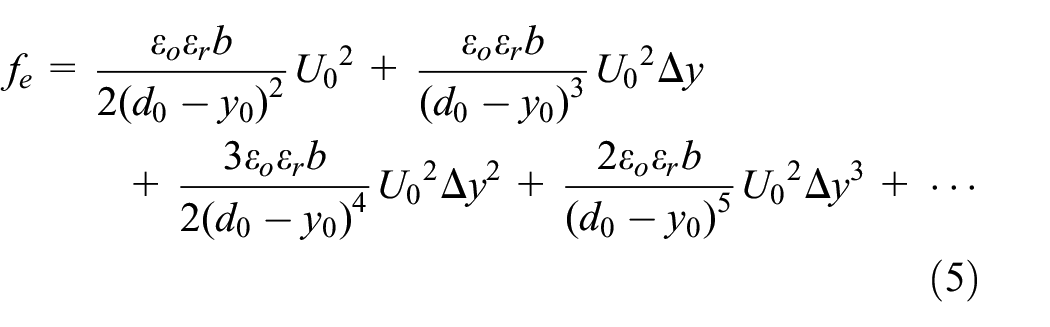
The static electrostatic force is

Neglecting higher terms, the dynamic electrostatic force is

where
The pressure film damping force fp per unit length can be given by

where
Taylor expanding equation (8) at

Neglecting higher terms, the pressure film damping force can be obtained

where
Van der Waals force fv per unit length can be given by

where
Taylor expanding equation (11) at

The static Van der Waals force is

Neglecting higher terms, the dynamic Van der Waals force is

where
Substituting related force and displacement equations into (1), yields


where equations (15) and (16) are the static balance equation and free vibration equation of the resonator, respectively.
Solution of static equation
Letting

Substituting equation (17) into (15), yields

Solution of equation (18) is

The resonator is fixed at both ends, both displacement and angle at the fixed end are zero, that is,

From equations (19) and (20), the static displacement of the resonator can be obtained

The average displacement of the resonator is

Solution of free vibration equation
Letting

Substituting equation (23) into (16), yields


where
The secular equation of equation (24) is

The four secular roots of equation (26) are

where
Thus, the solution of equation (24) is

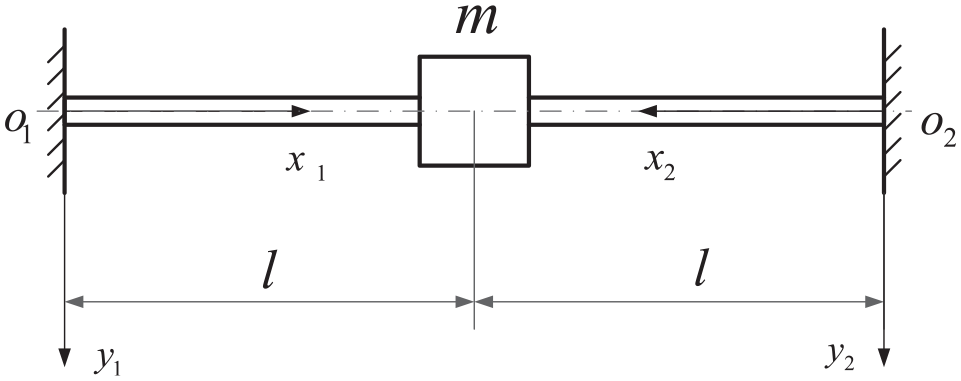
Letting two local coordinates, with the origin at the left and right ends of the resonator (see Figure 2), and then mode function of left resonator is

Local coordinates in the resonator.
The mode function of right resonator is

where cj (j=1,2,3,4,5,6,7,8) and λ are undetermined constants.
When the left beam and the right beam show odd function symmetry, the boundary condition of the left beam is

Combining equation (30) with (28), yields
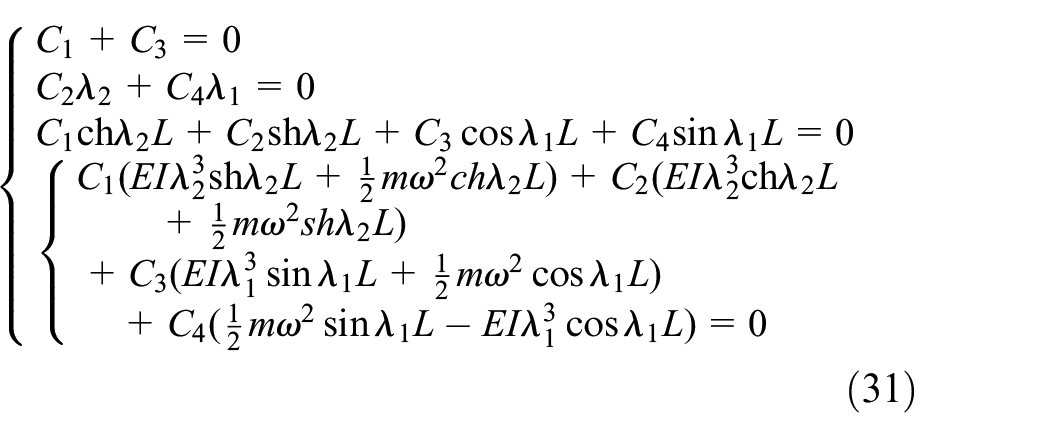
The necessary and sufficient condition for the above expression to have a non-zero solution is that the determinant of the coefficients is equal to zero. From it, the frequency equation can be given

The mode function of left resonator is

where
When the left beam and the right beam show odd function symmetry, the boundary condition of the right beam is

Combining equation (34) with (29), yields

The necessary and sufficient condition for the above expression to have a non-zero solution is that the determinant of the coefficients is equal to zero. From it, the frequency equation can be given which is the same as equation (32).
The mode function of right resonator is

where
When the left beam and the right beam show even function symmetry, the boundary condition of the left beam is

Combining equation (37) with (28), yields
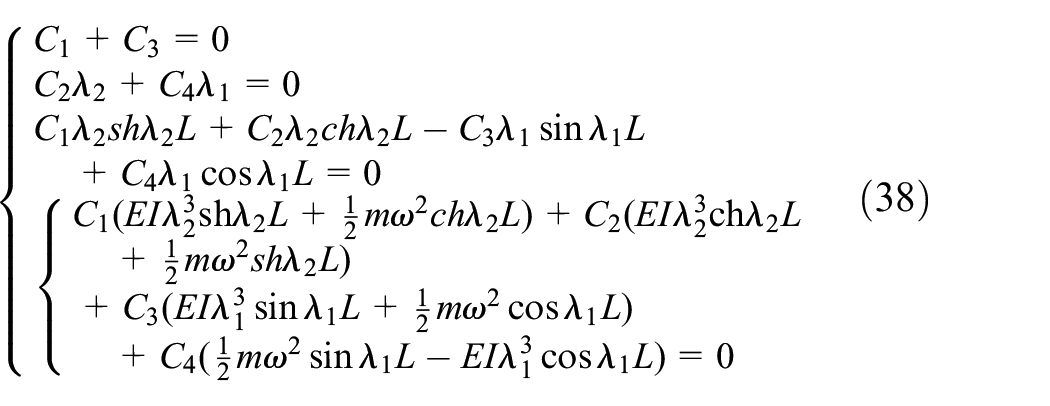
The necessary and sufficient condition for the above expression to have a non-zero solution is that the determinant of the coefficients is equal to zero. From it, the frequency equation can be given

The mode function of left resonator is

where
When the left beam and the right beam show even function symmetry, the boundary condition of the right beam is

Combining equation (41) with (29), yields

The necessary and sufficient condition for the above expression to have a non-zero solution is that the determinant of the coefficients is equal to zero. From it, the frequency equation can be given which is the same as equation (39).
The mode function of right resonator is

where
Relationship between the membrane pressure and internal axial force of the resonator
The structure of the pressure sensor chip is shown in Figure 3(a). The structure to feel the external pressure is a rectangular film with four fixed sides. P denotes the pressure applied to the film. The coordinate system of the film is taken as shown in Figure 3(b).

Structure of the pressure sensor and coordinate system of the film: (a) structure of the pressure sensor and (b) coordinate system of film.
Supposing the thickness of the film is d, and its deflection is w, and then the boundary conditions of the film are

Letting the deflection satisfying all boundary conditions be

Substituting equation (45) into the Galerkin equation, yields

From equation (46), it is obtained

where
According to the relationship between deflection and stress, it is known

Substituting equation (45) into (48), yields

Position coordinates of the resonator in the film are y = 0 and z = d/2. Thus, the axial stress of the resonator in the x direction is

The average value of the axial stress in the x direction is

Thus, the relation between axial force F in the resonator and pressure P can be given by

Results and discussion
Using above equations, the natural frequencies and modes of the micro resonant pressure sensor are calculated. Parameters of the calculated example sensor are given in Table 1. The first two-order natural frequencies and modes are shown in Table 2 and Figures 4–5. Results show:
Parameters of example sensor.

The first two-order natural frequencies (Hz).
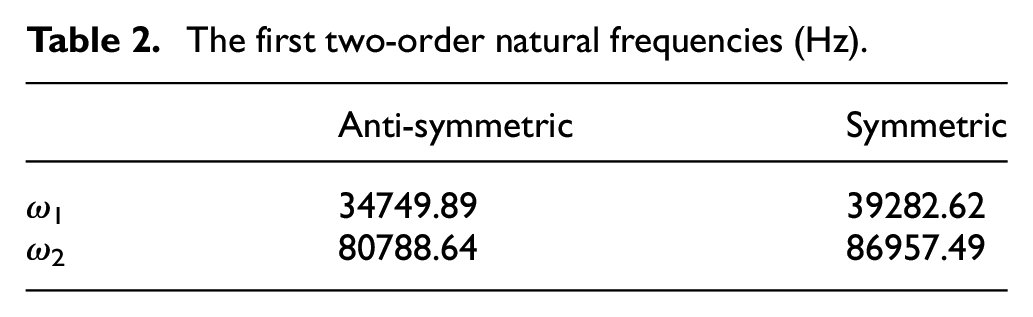

First two-order vibration modes (anti-symmetric): (a) mode 1 and (b) mode 2.
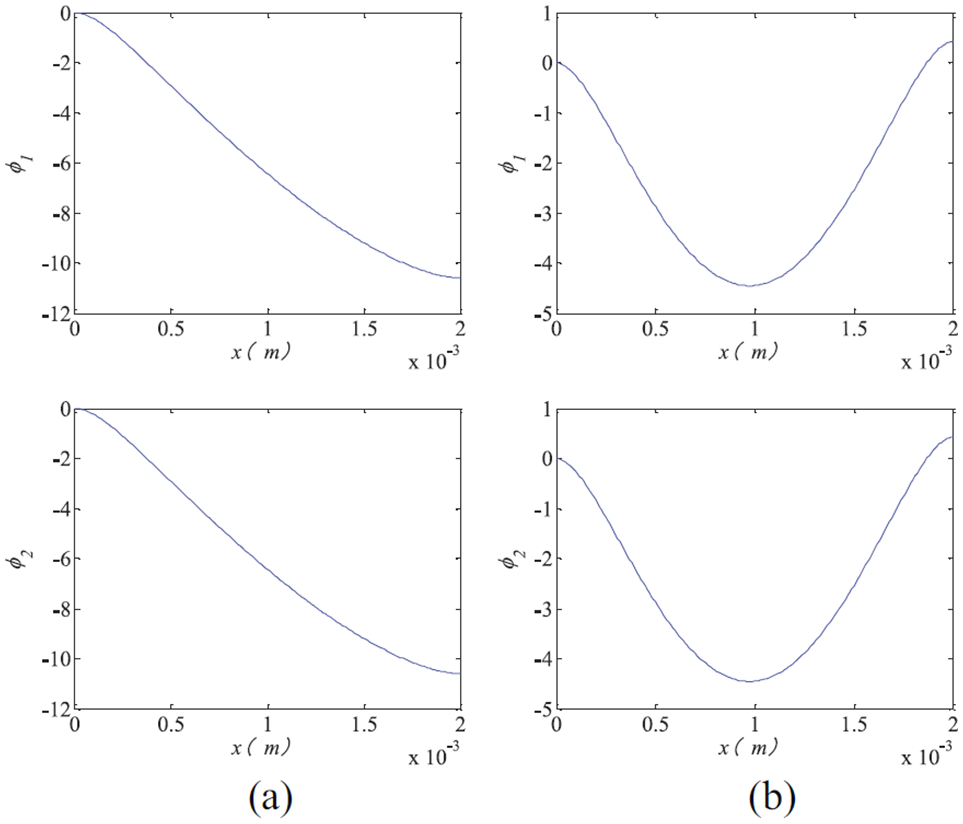
First two-order vibration modes (symmetric): (a) mode 1 and (b) mode 2.
In the case of odd modal functions, the modal functions of the left and right beams are anti-symmetric. When the modal function is an even function, the modal functions of the left beam and the right beam are symmetric. Whether the modal function is even or odd, the number of displacement peaks of the resonator increases with increasing the order number. For the same order number, natural frequencies for symmetric modes are larger than those for anti-symmetric modes.
For the anti-symmetric modes, the vibration displacement at the center of the resonator is always zero. For the symmetric modes, the vibration displacement at the center of the resonator is not zero. For the first order symmetric mode, the vibration displacement at the center of the resonator is the maximum which is suitable for capacitance detection scheme of the pressure sensor.
Effects of the main parameters on the natural frequencies of the micro sensor are investigated (see Figures 6 and 7). Results show:

Effects of the main parameters on the natural frequencies (odd functions): (a) length changes, (b) distance changes and (c) thickness changes.
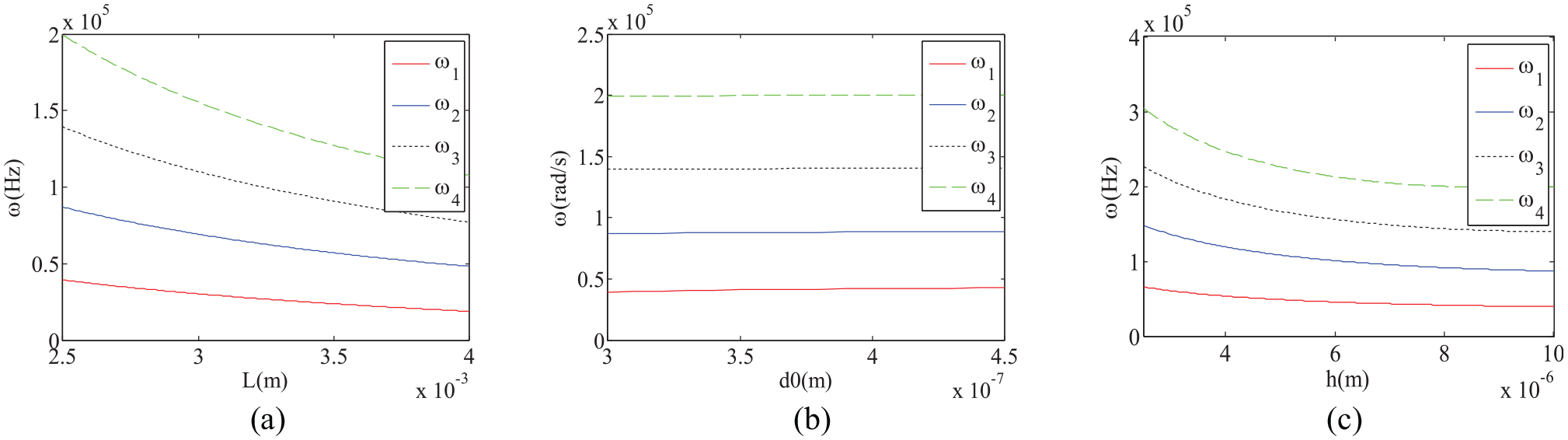
Effects of the main parameters on the natural frequencies (even functions): (a) length changes, (b) distance changes and (c) thickness changes.
Whether the modal function is even or odd, the natural frequencies of the micro sensor decrease with increasing length of the resonator. For higher order modes, the natural frequencies of the micro sensor decrease more obviously with increasing length of the resonator.
Whether the modal function is even or odd, the natural frequencies of the micro sensor increase with increasing initial distance between the resonator and base. At given range of the initial distance, effects of the initial distance on the natural frequencies of the micro sensor are not quite obvious.
Whether the modal function is even or odd, the natural frequencies of the micro sensor decrease with increasing thickness of the resonator. For higher order modes, the natural frequencies of the micro sensor decrease more obviously with increasing thickness of the resonator.
Effects of the Van der Waals force on the natural frequencies of the micro sensor are investigated (see Figures 8 and 9). Results show:

Effects of the Van der Waals force on the natural frequencies (odd functions): (a) length changes, (b) distance changes and (c) thickness changes.

Effects of the Van der Waals force on the natural frequencies (even functions): (a) length changes, (b) distance changes and (c) thickness changes.
With or without the consideration of molecular forces, the natural frequency difference increases with increasing length of the resonator. When mode order number increases, the natural frequency difference decreases. It means that effects of the Van der Waals force on the natural frequencies of the micro sensor become strong for a longer resonator and lower order modes. Besides it, the natural frequency difference increases more significantly for odd mode functions than that for even function modes.
With or without the consideration of molecular forces, the natural frequency difference decreases with increasing initial distance between the resonator and base. It is obvious that the Van der Waals force has larger effects on the natural frequencies of the micro sensor under small initial distance between the resonator and base. When mode order number increases, the natural frequency difference decreases. Besides it, the natural frequency difference also increases more significantly for odd mode functions than that for even function modes under different initial distance between the resonator and base.
With or without the consideration of molecular forces, the natural frequency difference decreases with increasing thickness of the resonator. When mode order number increases, the natural frequency difference decreases. It means that effects of the Van der Waals force on the natural frequencies of the micro sensor become strong for a thinner resonator and lower order modes. Besides it, the natural frequency difference increases more significantly for odd mode functions than that for even function modes as well.
In a word, in order to increase the natural frequency of the resonator, the initial distance between the resonator and base can be increased, while the length and thickness of the resonator can be reduced. However, it should be noted that the smaller the initial distance between the resonator and base, the greater the effect of molecular forces on the natural frequency which should be considered.
Changes of the natural frequency of the resonator along with pressure applied to sensor film are analyzed (see Figure 10).

Changes of the natural frequency of the resonator along with pressure: (a) odd function modes and (b) even function modes.
With increase of the pressure applied to sensor film, the natural frequencies of the resonator increase significantly for different modes. Within a considerable range of pressures, the natural frequencies of the resonator increase approximately linearly with pressure for different modes. This makes it easier to measure pressure changes by frequency changes.
Effects of the Van der Waals force on the relation between natural frequency and pressure applied to sensor film are investigated (see Figure 11). It shows:
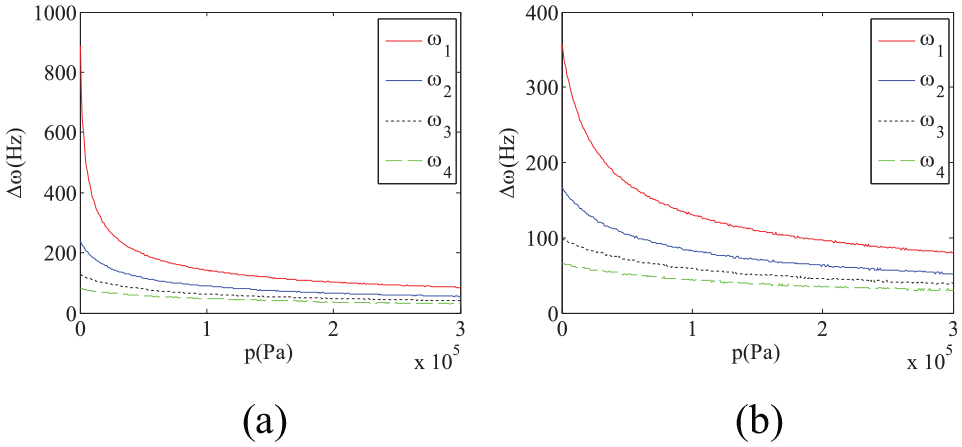
Effects of Van der Waals force on relation between natural frequency and pressure: (a) odd function modes and (b) even function modes.
With increase of the pressure applied to sensor film, the natural frequency difference with or without the consideration of molecular forces first decreases rapidly, and then decreases gradually with increasing pressure. It means that effects of the Van der Waals force on the natural frequencies reduce with increasing the pressure. Under small pressure and lower order modes, effects of the Van der Waals force on the natural frequencies are quite obvious and should not be neglected.
A three-dimensional solid model of the micro-resonant pressure sensor was produced. ANSYS, a finite element software is applied to modal simulation of the 3D model under different pressures. The solid model and the grid division are shown in Figure 12(a). Here, the number of grids is 70,000. The boundary condition is that all sides of the sensor are fixed. Results show:
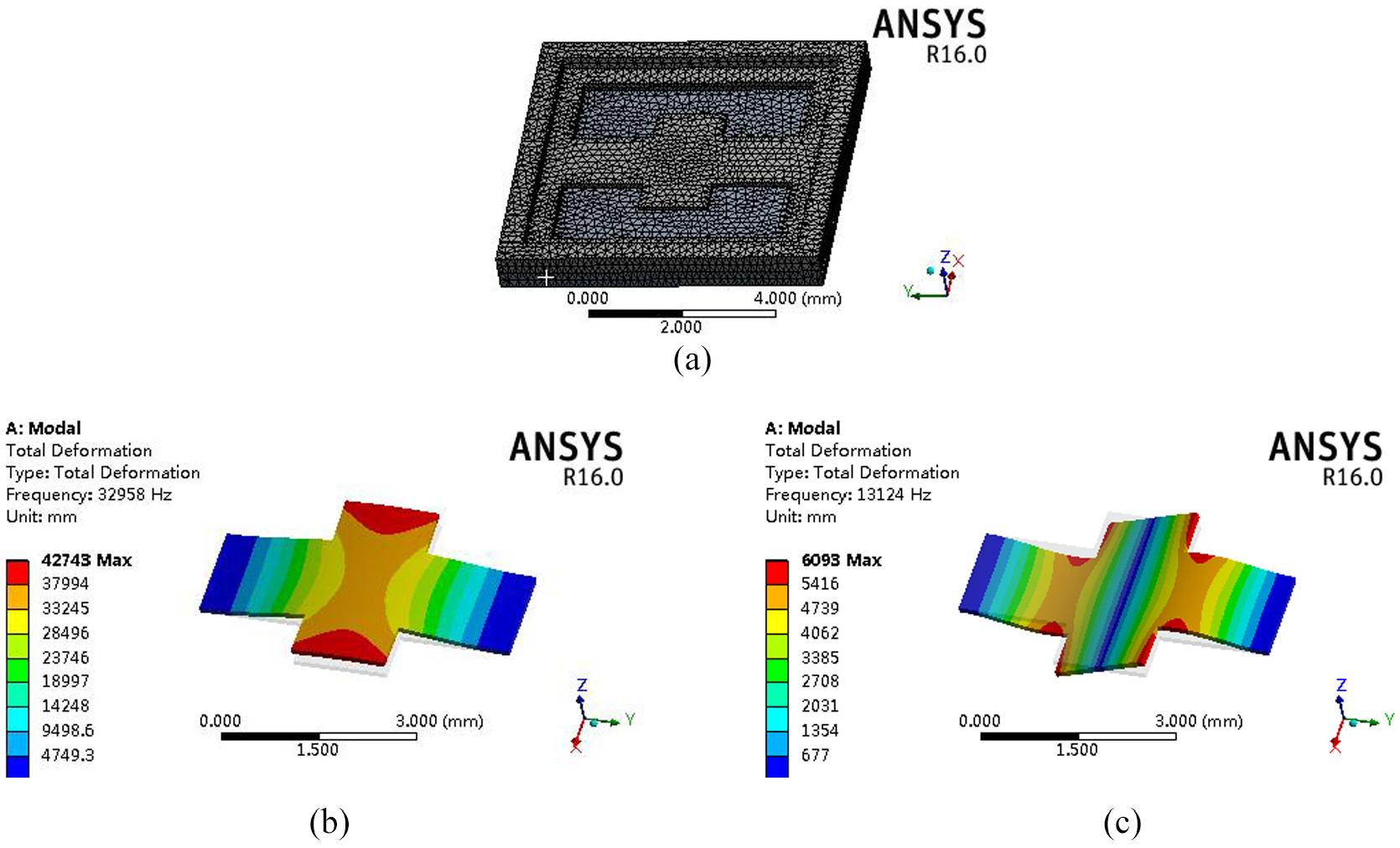
Solid model of sensor and its two mode types: (a) solid model and the grid division, (b) symmetric mode and (c) anti-symmetric mode.
For the cross resonator pressure sensor, two different modes occur, one is symmetric mode and another is anti-symmetric mode which is in agreement with above-mentioned calculation. Among them, two typical results are given in Figure 12(b) and (c). For two different modes, the natural frequencies of the sensor increase indeed with increasing pressure applied to the pressure film (see Figure 13(a) and (b)). Here, the simulation results are also compared to calculated ones and a good agreement between them is obtained. It illustrates analysis given in this paper.

Natural frequencies as a function of pressure: (a) symmetric mode and (b) anti-symmetric mode.
Conclusions
In this paper, a cross resonator pressure sensor is proposed. For the novel pressure sensor, the multi-field coupling free vibration equation of the pressure sensor considering electrostatic force and molecular force is established. Using the equations, the natural frequency and mode function of the sensor are given. Changes of natural frequency with main parameters and pressure are obtained. The influence of molecular force on the natural frequency is analyzed. Results show:
For the first order symmetric mode, the vibration displacement at the center of the resonator is the maximum which is suitable for capacitance detection scheme of the pressure sensor.
Within a considerable range of pressures, the natural frequencies of the resonator increase approximately linearly with pressure for different modes. This makes it easier to measure pressure changes by frequency changes.
Under small pressure, small initial distance between resonator and base, and lower order modes, effects of the Van der Waals force on the natural frequencies are quite obvious and should not be neglected.
Footnotes
Handling Editor: James Baldwin
Declaration of conflicting interests
The author(s) declared no potential conflicts of interest with respect to the research, authorship, and/or publication of this article.
Funding
The author(s) received no financial support for the research, authorship, and/or publication of this article.
