



Abstract
Experiments and simulations were conducted to study effects of charge density, temperature, and oxygen concentration on the mixing-controlled engine combustion pathway in heavy-duty diesel engines. Due to the inherent heterogeneity of diesel combustion in high-load operations, the rich and lean mixtures are simultaneous present. The mass and accompanying heat transfers were found to be decisive in determining the combustion path. The chemical transformation from a richer mixture to a leaner mixture is primarily driven by charge density, which activates the combustion process, and reduction in oxygen concentration, which stagnates the mass and heat transfer and chemical transformation, reduces the reactivity of the mixtures. The difference in mass and heat transfer processes causes differences in the mass fractions of mixtures with different equivalence ratio intervals. The different mixtures produce different mass fractions of intermediate combustion products (carbon dioxide, CO), different heat releases, and different mass temperature distributions. It is found that the accumulated CO correlates well with the gross indicated thermal efficiency and soot emission; the mass averaged temperature and the high temperature abidance scale (HTAS) correlate well with NOx emissions. A significant optimization of the overall engine performance could be achieved by simultaneously minimizing the HTAS and accumulated CO.
Keywords
Introduction
The application of low-temperature combustion (LTC) is a suitable solution for the simultaneous reduction of nitrogen oxides (NOx) and particulate matter (PM) emissions.1–4 The LTC regime requires a very high exhaust gas recirculation (EGR) rate (>60%) to aggressively prolong the ignition delay. Barriers to LTC in high-load operations are associated with the supercharger system, heat loss at high EGR, and other engineering complications.5,6
A compound combustion system without EGR was developed, which consists of premixed charge compression ignition (PCCI) combustion at low loads through early and modulated multi-pulse injections. 7 The PCCI combustion was further combined with lean diffusion combustion methodology, using a high-mixing-rate combustion chamber and multi-pulse fuel injection technique.8,9 Subsequently, a hybrid combustion control strategy consisting of mixing enhancements and inhibition of chemical reactions by using a high EGR rate was proposed for engines operating at low and medium loads. 10 A high-density low-temperature diesel combustion (HD-LTDC) engine system was developed, 11 achieving high efficiency and low emissions under high and full load operations. It relied on a high charge density by increasing the boost pressure (Pb) up to 0.45 MPa, moderately low oxygen concentrations (φO2) using lower rate of EGR, and lowering the charge temperature at TDC (Ttdc) through the development of a variable Miller Cycle mechanism retarding the intake valve closing timing (IVCT). The combustion control strategy resulted in very low engine emissions and improved efficiency. However, the combustion mechanism of the HD-LTDC has not been thoroughly investigated.
Genzale et al. 12 studied the significance of enhancing the mixing rate via computational investigation on the effects of spray targeting, bowl geometry, and swirl ratio for low-temperature combustion in a heavy-duty diesel engine. Wakisaka et al. 13 studied the effects of increasing boost pressure, high EGR rate, and high injection pressure on exhaust emissions from a high-speed direct-injection diesel engine. The mechanisms were then investigated under a high-load condition, and we concluded that increasing the charging efficiency, combined with a high injection pressure and high EGR rate, was effective for reducing NOx and soot simultaneously. Variable valve timing (VVT) is an effective strategy to adjust the effective compression ratio, which is beneficial for controlling the combustion process of advanced combustion modes. Recently, Xu et al. 14 optimized the PCCI combustion coupled with the VVT strategy at a wide load range, and it was found that the performance of fuel consumption, NOx and soot emissions can be improved simultaneously at different loads with the employment of the late IVCT strategy. Xu et al. 15 also evaluated the VVT strategy in a heavy-duty diesel engine with reactivity controlled compression ignition (RCCI) combustion under a wide load range.
The hybrid combustion control principle for low and medium engine loads 10 has been well understood using a combination of mixing rate and reaction rate. A high gross indicated thermal efficiency (ITEg) of 53% and near-zero emissions over a wide range of diesel engine operations, up to a gross indicated mean effective pressure (IMEP) of 1.1 MPa, are realized. However, the primary challenge is to achieve high efficiency and low emissions in high and full load operations of a heavy-duty diesel engine. This study explores factors that affect the combustion when brake mean effective pressure (BMEP) exceeds 2 MPa. Accordingly, the effects of the combustion boundaries on overall engine performance have been investigated experimentally and numerically. 16 However, the influencing mechanism of the boundaries on the combustion path has not been clearly explored. Therefore, a detailed correlation study of the boundaries, including charge density at TDC (ρtdc), Ttdc, and φO2, with combustion parameters was conducted. The correlations of the significant combustion boundaries in both burned and unburned mixtures, charge mass-averaged temperatures, and mass of the intermediate combustion product CO have been studied revealing a deeper understanding of the combustion process at very high engine loads.
Experimental set-up and CFD model
Experimental set-up
The experimental set-up was presented in Figure 1. The test engine was a single-cylinder engine modified from a six-cylinder heavy-duty diesel engine. The sixth cylinder of the diesel engine was used as the test cylinder, while the other five cylinders only dragged the sixth one. Since the combustion process of the other five cylinders was not controlled, they were equipped with common exhaust systems, turbocharged intercooled intake systems and mechanical fuel supply systems. The test system was composed of the electrically controlled high pressure common-rail fuel supply system, simulated pressurized intake system, VVT system, EGR system, multi-function combustion parameter acquisition and analysis system and exhaust gas emission test system.

Schematic diagram of the experimental equipment.
The second-generation electrically controlled high-pressure common-rail fuel supply system Bosch was used to supply the sixth cylinder in the test. The EGR rate could be met by cooperatively adjusting the intake regulating valve, the exhaust back pressure regulating valve and the EGR valve.
A single-cylinder VVT system was a kind of variable valve system which could be continuously and flexibly adjusted to realize the Miller Cycle. By retarding IVCT, the effective compression ratio was reduced, the compression pressure and temperature at TDC were both decreased, and the exceeding limit of in-cylinder pressure caused by high pressure could be effectively avoided. And the expansion ratio remained unchanged to realize the Miller Cycle, which ensured the high thermal efficiency. The IVCT actuation system combined with the high pressurization and EGR systems could realize reasonable control of the state in the cylinder and was one of the indispensable means to realize the high density-low temperature combustion process. The adjustment range of variable valve system was determined by the engine piston, the original valve motion law and the valve motion law attached to the variable valve system. The real-time position of the engine piston and valve must be analyzed to know whether there was interference between piston motion and valve motion. Considering a certain safety factor, it was absolutely possible to avoid the collision between the piston and the valve by limiting the additional valve action range of 50°CA between the inlet cam vertex and the TDC. Besides, the later the IVCT was closed, the lower the effective compression ratio was, and the lower the temperature in the compression stage was. Under overall consideration, the IVCT was fixed at −60° CA ATDC for cases 2–8 in Table 2 to fully utilize the Miller Cycle.
A multi-function combustion parameter acquisition and analysis software based on single-cylinder pressure acquisition was developed in LabView language and it had a real-time man-machine interface at each working point of a single cylinder. The purpose of this interface was to monitor and collect the power diagram, the mean indicated pressure, the peak in-cylinder pressure, the maximum pressure rise rate, the start point of combustion, the instantaneous heat release rate in real time, and the key parameters of the combustion process after adopting the VVT system.
The engine emissions, including NOx, CO2, CO, UHC, and O2, were measured with a Horiba 7100 gas analyzer. An AVL 415S smoke meter was used to measure soot emissions, whose presentation of measurement results was filter smoke number (FSN), resolution ratio was 0.001 FSN, lower limit of detection was 0.002 FSN, measuring range was 0–10.
Table 1 provides the specifications and operating parameters of the engine. Table 2 presents the engine experimental conditions and overall performances for various cases, in which the ρtdc and Ttdc are calculated by the ideal gas equation of state and adiabatic equation. According to experimental result, the in-cylinder temperature at IVCT with retarded IVCT is already much higher than the intake temperature, which can also be estimated by GT-POWER.
Engine specifications and operating parameters.

Experimental control parameters and resulting performance.

Numerical simulation models
The extended coherent flame combustion model in three zones (ECFM3Z) 18 developed by the Groupement Scientifique Moteur (GSM) consortium was employed. The model was featured an additional level of refinement by simulation of the subgrid turbulent mixing between air, EGR gas, and fuel. Two states of mixture zones, namely, the unburned mixture zones and the burned mixture zones, were considered during combustion. The ERC soot model, 19 kinetic oxidation of CO, and extended Zeldovich mechanism of NOx 20 were introduced. Simulations were performed with STAR-CD, developed by the CD-Adapco Group. 21 In the above mentioned computer program, the Reitz–Diwakar model was used to simulate high-pressure diesel spray atomization and secondary breakup, 22 whereas the Bai model, developed by Bai and Gosman, 23 was used to simulate droplet-wall interactions. The RNG κ–ε turbulence model, developed by Han and Reitz, 24 was used to model turbulent mixing, and the double-delay auto-ignition model, developed by Colin et al., 25 was used to model diesel auto-ignition. The double-delay auto-ignition model uses pre-computed values representing the results of complex calculations for the auto-ignition of n-heptane and provides values for both delays as a function of pressure, temperature, equivalence ratio, and EGR. As shown in Figure 2, the calculated values of in-cylinder pressure (Pcyl), rate of heat release (ROHR), the NOx, soot, and CO emissions are in reasonable agreement with the measured values.
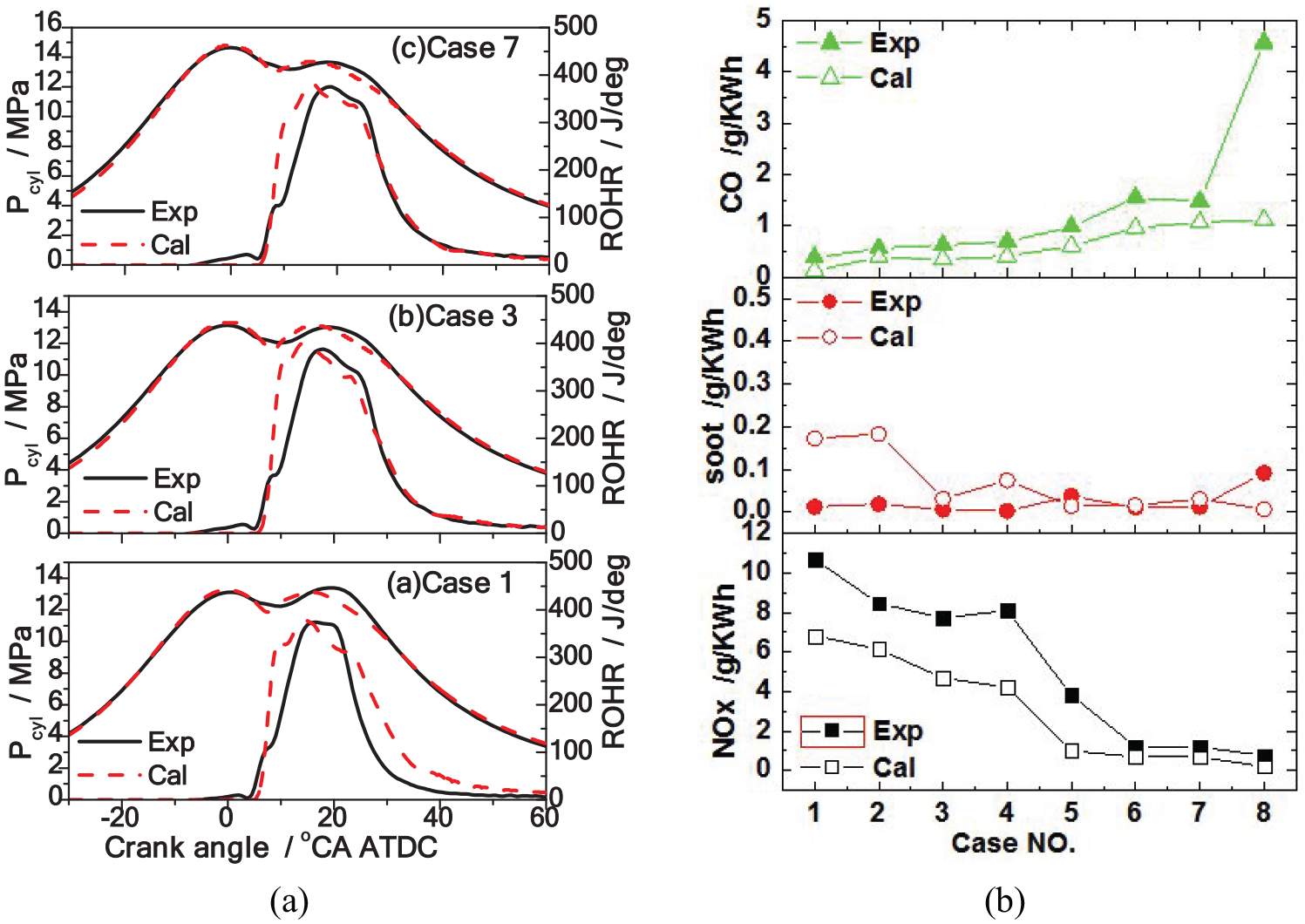
Comparison of experimental and calculated results for various cases in Table 2: (a) Pcyl and ROHR and (b) NOx, soot and CO emissions.
Results and discussion
Experimental results and discussion
As shown in Table 2, case 1, the baseline case for comparison of thermal efficiency and emissions, is with Pb of 0.3 MPa, EGR of zero, and IVCT of −146° crank angle (CA) after top dead center (ATDC) with corresponding effective compression ratio (ε) of 16.1. For cases 2–8, the IVCTs are all retarded to −60° CA ATDC by Miller Cycle mechanism with corresponding ε of 5.96. For cases 3 and 4, Pb is increased from 0.265 MPa (the value obtained in case 2) to 0.41 MPa and 0.46 MPa, respectively. Therefore, the ρtdc increases from 31.4 kg/m3 (the value obtained in case 2) to 48 kg/m3 and 60.3 kg/m3 for cases 3 and 4, respectively. The in-cylinder peak combustion pressures are consistently below 16.5 MPa because of the retarded IVCT. Accordingly, the in-cylinder overall equivalence ratio (Φm) decreases from 0.59 to 0.44 and 0.38 with a constant φO2 of 21%. For cases 5, 6, and 7, the Pb, ρtdc, and IVCT are set almost identical to those in cases 2, 3, and 4, respectively; however, the φO2 decreases from 21% to 19%, 18.6%, and 18.4%, respectively, using EGR. Case 8, with an EGR of 26.6% and φO2 of 17.2%, represents an over-high EGR scenario.
Comparing case 3 with the original case 1, the Ttdc is reduced by up to 82 K due to the retardation of IVCT from −146° to −60° CA ATDC. A reduction in NOx and soot emissions of 28% and 54%, respectively, and a 6% increase in ITEg are shown in Table 2. The significant effect of ρtdc is observed by comparing cases 2, 3, and 4. Soot reduction by a factor of 2–5 and a slight NOx reduction are obtained as ρtdc increases from 31.4 to 60.3 kg/m3. For cases 5, 6, 7, and 8, the combined effects of ρtdc and φO2 demonstrate that the NOx emissions are significantly reduced while the exhaust emissions maintain acceptable levels until φO2 decreases to 18.4%.
Simulation results and discussion
Combustion path model
Simulations demonstrate that the combustion field is heterogeneous in equivalence ratio and temperature, including ignition and non-ignition charge zones, which are denoted as the burned zone mass (Mb) and unburned zone mass (Mu), respectively. The combustion path is depicted by the overall behavior of mixing and chemical reactions of the charge zones in the combustion processes. The Mb and Mu charge zones are further categorized into three subzones according to the local fuel/oxygen equivalence ratio Φ: the lean zone 0 < Φ ≤ 1, rich zone 1 < Φ < 2, and over-rich zone Φ ≥ 2. Driven by the energy of the gas entrainment motion, the fuel mass in a richer zone is transferred to a leaner zone in both burned and unburned. The occurrence of ignition in a local unburned zone indicates immediate transfer from Mu to Mb. However, the combustion path is determined by the Φ as indicated in Figure 3. Only the fuel mass in the lean zone can be completely oxidized and form CO2 and H2O, releasing chemical heat, when the zone temperature is higher than 1400 K. This is shown on a Φ–T map of CO distribution created by Huang and Su. 26 The study proved that the formation of CO and other intermediate combustion products is caused by the existence of rich and over-rich mixtures in Mb. The Φ–T map of CO showed the distribution of CO as a function of the Φ and combustion temperature. For rich zones, even at very high temperatures of combustion, CO and other intermediate combustion products are produced first and eventually transformed into the complete combustion products of CO2 and H2O when they react with oxidizers (O, O2, and OH). The rate of production is controlled by the mixing rate of intermediate products with oxidizers as well as the mixing temperature, which promotes NO formation if the mixing rate is high. The over-rich zone is richer than the equivalence ratio threshold of soot formation (e.g. Φ ≥ 2). The soot particles are also an intermediate product. The final soot emission is determined by the net difference of the formation process and oxidation process. 19
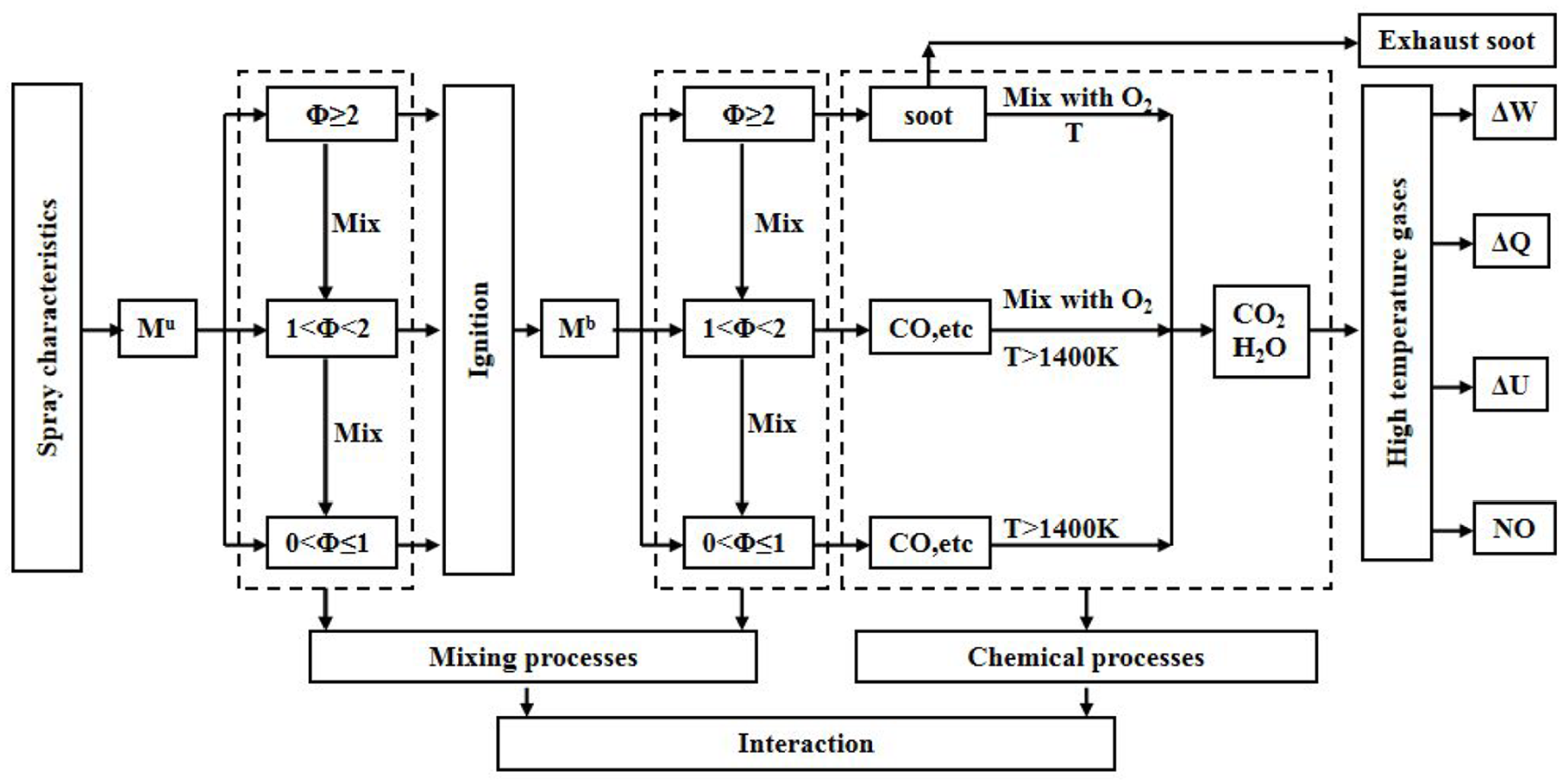
Schematic depiction of combustion paths.
Effects of ρtdc and φO2 on the combustion paths
Figure 4 shows the change in the mass fractions of equivalence ratio zones in Mu and Mb for cases 2, 3, and 4. The cases have an equal φO2 of 21% and a near-equal Ttdc of 903 K, 899 K, and 906 K, respectively, whereas, they have varying ρtdc of 31.4 kg/m3, 48 kg/m3, and 60.3 kg/m3, respectively. The mass fractions of various equivalence ratio zones in Mu for the three cases are quantitatively quite similar at the beginning of fuel injection. More precisely, for case 2 (ρtdc = 31.4 kg/m3), the three mass fractions of the lean zone, rich zone, and over-rich zone are approximately 25%, 35%, and 40%, respectively. In contrast, for case 4 (ρtdc = 60.3 kg/m3) the fractions are more evenly distributed as 30% (lean zone), 35% (rich zone), and 35% (over-rich zone). The start of combustion, recognized by the appearance of the fuel mass in Mb, is retarded from 7° to 9° and to 12° CA ATDC as ρtdc decreases from 60.3 kg/m3 to 48 kg/m3 and to 31.4 kg/m3. Case 4 with the highest ρtdc of 60.3 kg/m3 has the earliest ignition, fastest mass consumption in the equivalence ratio zone of Mu, and the fastest rate of increase in Mb. At approximately 15° CA ATDC, the total Mb can be as high as 95% of the total evaporated fuel, which is distributed as approximately 50% in the lean zone, 25% in the rich zone, and 20% in the over-rich zone. In comparison, case 2 has the lowest ρtdc of 31.4 kg/m3, its Mb is nearly zero, and the ignition is barely possible at 15° CA ATDC.

Effect of ρtdc on mass fractions of different equivalence ratio intervals in Mu and Mb with no EGR.
The findings confirm that increasing ρtdc does not obviously change the distribution of Mu fractions at the beginning of fuel injection, but significantly enhances the mass transfer rate from Mu to Mb. Enhancing the environment charge of the spray by increasing ρtdc would enhance the entrained gas motion, oxygen entrainment, and heat into the spray, resulting in an increased mixing rate of fuel with oxygen and elevated mixture temperature. The local equivalence ratios in Mu are determined by balancing the fuel evaporation rate and mixing rate of evaporated fuel with entrained air. As ρtdc increases, the fuel evaporation rate and mixing rate of evaporated fuel are promoted because heat transfer is enhanced by air entrainment. Therefore, the mass fractions of all equivalence ratio zones in Mu do not clearly change in the early stage of combustion. Subsequently, the mass fractions in Mu decrease rapidly as more and more mixtures in Mu zones are transferred to Mb because of an increase in temperature caused by combustion. It can be concluded that transfer rates both from richer zones to leaner zones and from Mu to Mb are strongly dependent on ρtdc.
For cases 5, 6, and 7, the combustion control parameters Pb, ρtdc, and IVCT are the same as those of cases 2, 3, and 4, respectively, with the exception of the φO2 which is 19% (case 5), 18.6% (case 6), and 18.4% (case 7) instead of 21% (case 2–4). Figure 5 shows the change in the mass fractions of various equivalence ratio zones of Mu and Mb. In comparison to Figure 4, it is illustrated that the ignition occurrences for cases 5, 6, and 7 are almost identical to cases 2, 3, and 4, indicating that the ignition occurrence is dominated by ρtdc and Ttdc rather than φO2 in high-load operations. This is predicted by the ignition delay model. 25 However, the mass fractions of rich and over-rich zones in Mu increase by approximately 5% at the beginning of fuel injection due to the low φO2; this increase is not significant. However, comparing cases 3 and 6 with the same high ρtdc (48 kg/m3) but with different φO2 of 21% and 18.6%, respectively, the total mass fractions of Mb in case 3 increase more rapidly than those in case 6 due to the higher φO2. This results in considerably faster, early heat release. In contrast, case 6, with a lower φO2 of 18.6%, yields a slower, delayed heat release, as illustrated in Figure 6. For the in-cylinder temperatures at injection timing of case 3, 6, and 8 are all above the ignition temperature of the fuel, as a result, the ignition times differ little, however, the lower φO2 slows down the combustion rate, thus, the ROHR is slowed down with decreasing φO2. Therefore, it can be concluded that lowering the φO2 reduces the ROHR and heat release phase.

Effect of ρtdc on the mass fractions of different equivalence ratio intervals in Mu and Mb with basically fixed φO2.

Effect of φO2 on ROHR at constant ρtdc and IVCT.
Effects of ρtdc and φO2 on the NOx, CO, and soot emissions
To analyze the combined effects of ρtdc and φO2 on NO formation, a combustion process parameter termed as the charge mass averaged temperature is defined as follows:

where mi and Ti are the mixture mass and temperature of a calculation cell, respectively. The collected temperature is deliberately set above 2000 K, which is assumed to be the threshold temperature for rapid NO formation. Therefore, the charge mass averaged temperature is a comprehensive measurement of the historical high temperature and high-temperature mass scale. Higher mi and Ti values result in a higher formation rate of NO. Figure 7 shows the calculated charge mass averaged temperature versus crank angle for all experimental cases in Table 2. In case 2, with a low ρtdc of 31.4 kg/m3, a lower mass averaged temperature is obtained in comparison with that of the higher ρtdc cases in the early period. However, soon after the start of combustion, it exceeds the higher ρtdc cases and lasts for a considerably longer time, resulting in higher NO emissions. In contrast, cases 3 and 4, with higher ρtdc, result in slightly lower and shorter mass averaged temperature curves. The effects of ρtdc on the charge mass averaged temperature are manifold. On one hand, an increase in ρtdc promotes the mixing process and increases NO formation, and on the other hand, an increase in ρtdc also increases the heat capacity of the charge. Therefore, the final charge mass averaged temperature is actually a combined result of the two opposing effects of ρtdc: the enhancement of the mixing rate and the inhibition of the elevated charge temperature due to heat capacity. The effect of Ttdc on the charge mass averaged temperature can also be observed in Figure 7 by comparing case 1 and case 3. Case 3, with a retarded IVCT and an 82 K lower Ttdc, results in a lower mass averaged temperature curve.

The deduced mass-averaged temperature for all cases in Table 2.
For cases 5, 6, and 7, all operation control parameters, including Pb, ρtdc, and IVCT, are consistent with those of cases 2, 3, and 4, respectively, with the exception of the φO2 of 19% (case 5), 18.6% (case 6), and 18.4% (case 7) versus 21% (cases 2–4). This causes the peak of the mass averaged temperature to decrease from approximately 2350 K to approximately 2250 K, and the high temperature duration of the mass averaged temperature curve becomes 10° CA shorter. For case 8, the over-high EGR case with a ρtdc of 51 kg/m3 and φO2 of 17.2%, the mass averaged temperature is significantly reduced to 2150 K in peak and an additional 15° CA shorter in duration. Therefore, it can be concluded that reducing the in-cylinder φO2 can substantially reduce the mass averaged temperature due to the effect of inhibited heat release. Relative to this effect, increasing the ρtdc is secondary for decreasing the mass averaged temperature through an increase in charge heat capacity. Moreover, a further increase of ρtdc from 48 kg/m3 to 60.3 kg/m3 does not effectively reduce the mass averaged temperature due to the counter action of enhanced mixing and increased heat capacity. Figure 8 shows the calculated NO formation processes for all test cases in which the formation rate, phase, and accumulated quantity are very well correlated to the mass averaged temperature.

Effect of ρtdc, φO2, and IVCT on calculated NO formation.
High temperature, high oxygen concentration and high temperature duration time were three key factors to form thermal NO. To further understand this phenomenon, the high temperature abidance scale (HTAS) is defined to analyze NOx formation and is as follows:

where T is the cell temperature which is higher than the NOx formation boundary temperature (NFBT), mO2 is the mass of oxygen in the cell and Δt is the duration of combustion. HTAS is an indication of the duration and scale of the high temperature zone. Figure 9 displays the correlation of HTAS with NOx emissions in each test case. The number in the frames in the figure denotes the test case number. The results indicate that the NOx emissions correlate well with the HTAS, higher HTAS leads to higher NOx emissions.

Correlation between HTAS and NOx emissions.
To understand the mechanism of lowering φO2 by adding EGR to decrease the mass averaged temperature and NO formation, we look at the transfer rate from Mu to Mb. For case 4, with a ρtdc of 60.3 kg/m3 and φO2 of 21%, the sum of the mass fractions in Mb is approximately 98% at 20° CA ATDC which falls in the lean zone resulting in quick heat release. Compared with case 4, with the same ρtdc but a reduced φO2 of 18.4%, the sum of the mass fractions in Mb is only 90% for case 7. The sum of the mass fractions in Mb is even lower when the ρtdc and φO2 are lowered, especially when the mass fraction in the lean zone (0 < Φ ≤ 1) is lower. This allows much of the mixture to leave unburned zones or rich burned zones during the later stage of combustion (e.g. after 20° CA ATDC), causing the presence of a larger fuel fraction as unburned hydrocarbons (UHC) and other intermediate products, including CO. Consequently, the mass averaged temperature is lower, which in turn decreases the transfer rate from Mu to Mb. The presence of different mass fractions of UHCs and intermediate combustion products, resulting from different charge densities and oxygen concentrations, is an important characteristic of diesel combustion paths.
In this study, the intermediate combustion product CO is considered as an indicator of the combustion intermediate products, as shown in Figure 10. The formation of intermediate combustion products, including CO, releases a small quantity of heat according to chemical thermodynamics. Therefore, the mass fraction of CO and its maintenance in the combustion process would retard and slow down the heat release. It would benefit in reduction of NOx but counter against the oxidation of soot particles and ITEg. Because soot formed in the early combustion phase can only be oxidized upon contacting oxidizers. Thus, in the later phase of combustion, the mixing rate of soot with the oxidizers, which is effectively promoted by increasing the ρtdc, is a decisive factor for soot emission. In this study, the cases of high ρtdc combined with moderate φO2 (e.g. 18.4%–19%) yield very low NOx emissions along with acceptable soot emissions. In the formation of CO during the early combustion phase, the fuel releases negligible heat but maintains a “cool atmosphere,” which is favorable for mixing time and avoids the formation of both NO and soot. The fuel refers to the fuel mass in “cold storage of CO”. Figure 6 shows that reducing φO2 slows the ROHR and prolongs the overall heat release duration; the increase of CO cold storage is illustrated in Figure 10. However, in the later phase of combustion, the presence of CO produces a lower mixing rate, lower heat release, and lower combustion temperature, which results in lower ITEg and poor soot emission.

Effect of ρtdc, φO2, and IVCT on CO formation.
The factors influencing the cold storage of CO are illustrated according to significance in Figure 10. The ρtdc is the most important factor influencing the change of CO. Case 5 shown in Figure 10, with a lower ρtdc of 32.5 kg/m3 and lower φO2 of 19% exhibits the highest peak of CO at approximately 30° CA ATDC and very slow CO consumption. The operation control parameters of case 2 are the same as those of case 5, with the exception that φO2 = 21%, which reduces the peak and final maintenance time of CO. Therefore, φO2 is another influencing factor of CO over time. Comparing case 1 with case 3, the Ttdc also affects the order of the CO curves. It is illustrated that the higher values of ρtdc result in a lower CO curve. For the cases with the same values of ρtdc, φO2 is the decisive factor. The higher values of φO2 result in a lower CO curve. The concept of accumulated cold storage of CO is introduced, which is the integration of CO mass throughout the combustion process. As shown in Figure 11, the accumulated cold storage of CO correlates well with the measured soot emission and ITEg. The number in the frames in the figure denotes the test case number. The data with arrowheads denotes the gross indicated thermal efficiency increase, Δηt, relative to the base case 1. The significance of the influencing factors on the accumulated cold storage of CO is (in ascending order) Ttdc, φO2, and ρtdc. A higher ρtdc, higher φO2, and lower Ttdc result in a lower accumulated cold storage of CO, lower soot emission, and higher Δηt.

Correlation of soot emission and ITEg with the accumulated CO cold storage.
Cases 2 and 5, with the lowest ρtdc of the test cases, yield the highest accumulated cold storage of CO. For case 6 (ρtdc = 48 kg/m3 and φO2 = 18.6%) and case 7 (ρtdc = 60.4 kg/m3 and φO2 = 18.4%), the accumulated cold storage of CO is less in comparison with cases 2 and 5 due to the increased ρtdc. Finally, for cases 1, 3, and 4, the accumulated cold storage of CO is further reduced due to the increase in φO2 and decrease in Ttdc.
In case 3 (ρtdc = 48 kg/m3 and φO2 = 21% ) and case 7 (ρtdc = 60.4 kg/m3 and φO2 = 18.4%), the cold storage of CO plots almost coincide and yield a similar value of measured soot emission and difference of Δηt at 4%, as shown in Figure 11. A high ρtdc can balance the inhibiting effect of low φO2 on combustion rate, benefiting NO reduction and increasing soot emission with a limited negative impact on ITEg. Therefore, the technology of compromising a high ρtdc and moderate EGR is very important for diesel mixing-controlled combustion under high-load operations. From Figures 8 and 10, it is found that optimization of the overall engine performance is actually attributed to simultaneously minimizing the HTAS as well as the accumulated cold storage of CO.
Conclusion
The changes in mass fraction of combustion intermediate products, such as CO and UHC, are the significant indicators of combustion paths. This can be represented through the formation phase, quantity versus time, and maintenance duration of the intermediate products. Formation of intermediate products in the early phase of combustion can inhibit heat release, thereby inhibiting the rise of charge temperature, optimizing mixing time, and reducing NO formation. The maintenance of intermediate products in the later phase of combustion is a crucial factor for reducing charge activation, leading to poor thermal efficiency and soot emission.
The charge density and oxygen concentration are the decisive factors affecting formation and maintenance in time and accumulation of the intermediate products in diesel engine combustion at high-load operations. Increase in charge density can activate the combustion and enhance the transfer from intermediate combustion products to complete combustion products. In contrast, the oxygen concentration of the charge can reduce the reactivity of the charge resulting in the formation and maintenance of intermediate products. In comparison with oxygen concentration, charge density is a more significant parameter in the later phase of combustion, affecting the behavior of intermediate products.
The deduced mass averaged temperature and the HTAS correlates very well with the measured NOx emissions, and the deduced accumulated CO correlates very well with the soot emissions and gross indicated thermal efficiency. Optimization of overall engine performance is attributed to determining a technique to simultaneously minimize the HTAS and the accumulated CO by utilizing proper charge density and EGR.
Footnotes
Appendix
Handling Editor: James Baldwin
Declaration of conflicting interests
The author(s) declared no potential conflicts of interest with respect to the research, authorship, and/or publication of this article.
Funding
The author(s) disclosed receipt of the following financial support for the research, authorship, and/or publication of this article: This research was supported by the Natural Science Foundation of China through its youth project funding (grant number 51806097) and the Open Subject of State Key Laboratory of Engines of Tianjin University (grant number K2018-08).
