




Abstract
This paper aims to study the non-stationary situation of the effectiveness of an external centrifugal force (ECF) and the heat transfer (HT) on the manner of neutral gas (NG). We solve a system of non-linear non-stationary partial differential equations, which represents an enormous task. Our model is examined to follow the manner of the macroscopic properties of the NG that bounded between two parallel horizontal rigid fixed plane plates (HRFPPs). The moment method and the traveling wave method are utilized. The draw an analogy among the perturbed distribution function (DF), and the equilibrium DF with time is studied. The thermodynamic predictions are calculated. System internal energy change (IEC) is investigated. We applied the results for laboratory helium NG. We detected that in specific conditions, we could compensate for the decreasing of particles’ number adjacent to the lower HRFPP because of the centrifugation process, with other particles adjacent to the higher heated HRFPP. We did that with the help of the reverse heat current from the heated upper HRFPP, which gave us a considerable enhancement and development of gases isotope separation processes. Furthermore, we approved that our model is compatible with the second law of thermodynamics, the rule of Le Chatelier, and the H-Theorem of Boltzmann. Those investigations were done with a non-restricted range of the temperatures ratio factor, the centrifugal Mach number, and the Knudsen numbers. The significance of this study was due to its vast applications in numerous fields, such as in physics, engineering, biomedical, and various commercial and industrial applications.
Keywords
Introduction
Enhancement of isotope separation processes quality of an NG affected by an ECF is one of the critical aims in commercial and industrial applications, especially in the peaceful use of uranium enrichment technology in the generation of electricity and radiation therapy in medicine. In the previous paper, Wahid and El-Malky
1
introduced a new pattern that investigated the effect of the ECF and the HT on a gas bounded by parallel two HRFPPs. They solved a steady ordinary differential equation system and applied the results for argon gas. While in the present paper, a non-linear non-stationary partial differential equations system is solved, and the results applied for helium gas. The non-stationary manner of the temperature and concentration are investigated with non-restricted values of

Cylindrical geometry illustrated in (a) and Pomraning’s strip approximation model illustrated in (b).
Many papers were dealing with the fantastic applications of the Bhatnagar–Gross–Krook (BGK)-pattern of the Boltzmann kinetic equation (BKE) and its usedness in various essential physical cases. Some of those critical cases are the HT between two HRFPPs, 5 shock waves, 6 oscillation flow,7,8 irreversible non-equilibrium thermodynamics, 9 sound propagation in an NG,10,11 the force of thermal radiation,12–15 plasma fluid,17–19 and other many exciting applications.20–22
We aim to discuss the influence of an ECF and an HT on the performance of the particles’ non-equilibrium DF of an NG bounded by two parallel HRFPPs. This examination is done in several Kn in transition, hydrodynamic and rarefied gas regimes, and a non-restricted range of M in durable, moderated, and weak external radial fields. For this approach, an analytical solution of the BGK-pattern of the BKE is presented with two-sided non-equilibrium DFs. The IEC of the system is studied. Finally, the results were employed for laboratory helium NG. The graphics are drawn to follow their manner. The obtained results were carefully discussed.
Basic equations and analytical solution procedures
We deal with the NG between two illimitable HRFPPs situated at y = ±L/2. The two HRFPPs are saved at two fixed temperatures; see Figure 2. However, inconsistent temperatures as TI for the lower HRFPP and TII for the upper HRFPP with

Geometry of our model of the problem, here
For a non-stationary motion, an ECF y-component


Here the collision frequency
The moment method27,28 is utilized to get the solution of the BKE. Appling Liu-Lees pattern of the DFs in the form9,23–27:

Moments are obtained by multiplying the BGK type by a velocity function

Dimensionless forms of the used variables are:

When
Number density,

Velocity,

Temperature,

Pressure,

Heat flux component,

In (3), there are four uncharted variables


Using the state equation:

With the condition that the velocity

Appling traveling wave method1,16,19 as:

Such that all functions will be dependent on

Here
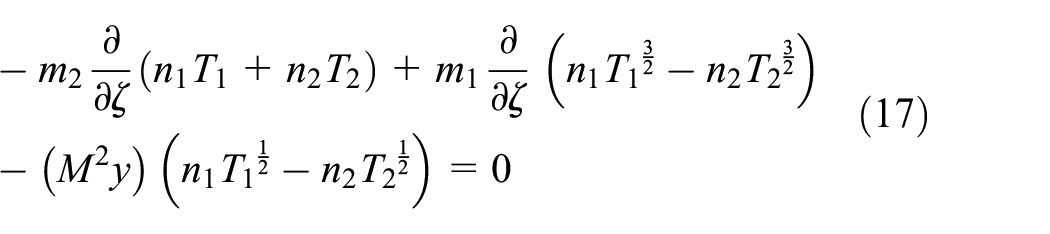

We will solve equations (13), (14), (17), and (18) to get
Using equation (14), we have

Substituting from equations (13) and (19), into equation (17), taking into consideration equation (9), we obtain:

Integrating equation (20), for

as we put

Here C2 is the constant of integration. Here
Making the best use of equation (19), we can define a new function

From (22) and (23), we can obtain

Integrating equation (18) w.r.t.
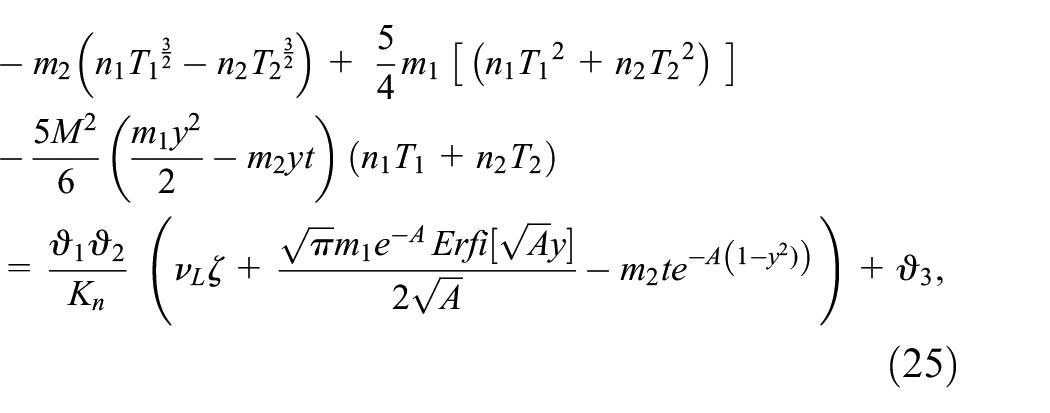
Here

We gain three values of



Solving the algebraic system of equations (27) to (30), we obtain:
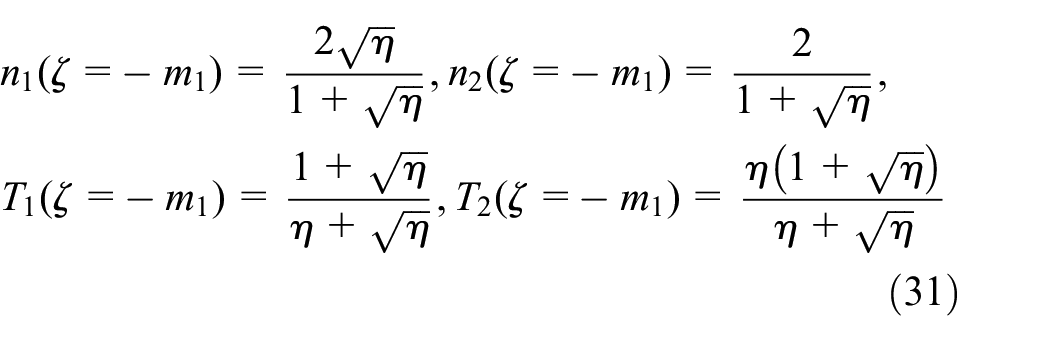
Substituting equation (31) into equation (22), we get:

Substituting equations (31) to (32) into equation (26), we obtain:

where

Substituting the obtained variables into the two-sided Maxwellian DF,
These DF
Non-stationary Non-Equilibrium Thermodynamic properties
The non-equilibrium thermodynamics state characteristics of the system are described in this section under the effectiveness of an applied ECF. Entropy per unit mass S is 30 ;

The y-component of entropy flux is;

Entropy production as 30 :

The thermodynamic force (THF), consonant with the modification of concentration, temperature, and ECF, could be calculated, respectively, as in30,31:

Here
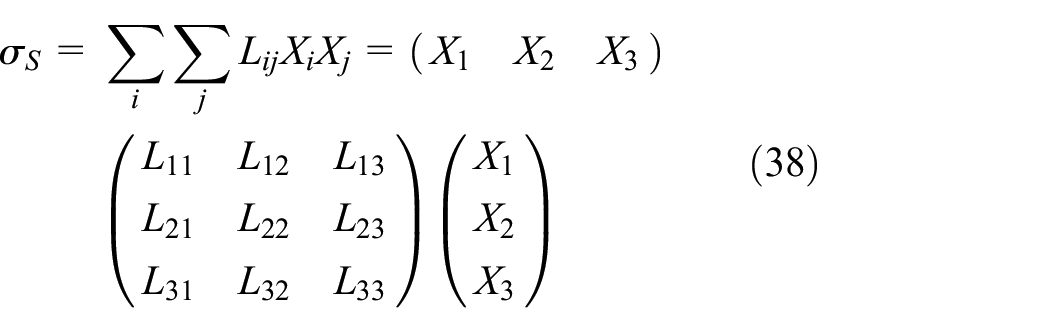
Gibb’s equation for the IEC employed to the system is:

Discussions and results
With a frame of reference that is co-moving with the gas, NG manner under ECF effectiveness, plus the HT in the non-stationary situation, is examined. The ECF is introduced in the modified BGK-pattern of the BKE, taking into consideration the effect of ECF on the collision frequency
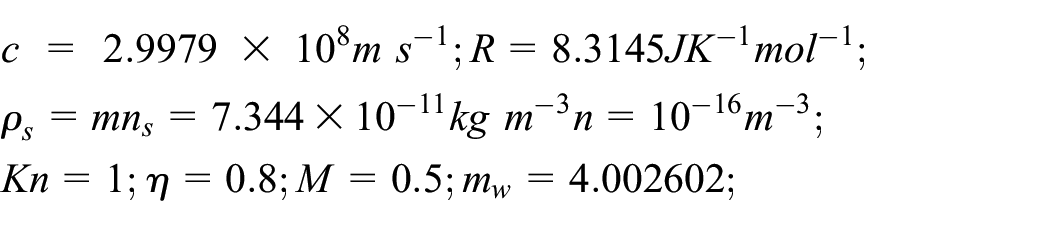
In all evaluations and graphics, we consider the values for helium NG:
We calculate the transformation constants to get
I. A non-restricted range of Kn.
II. A non-restricted range of M.
III. A non-restricted range of η between the two parallel HRFPPs. The helium NG figure captions are as follows:
All Figures satisfy the boundary conditions as:
n (−1, 0) =1 and T (−1, 0) =1.
Graphics are drawn with fixed values of the dimensionless numbers that we clarify the physical meaning as:
- Kn = 1 in the transition regime, therefore the NG is rarefied.
- The η = 0.8 reveals that the temperature amount of the upper HRFPP is equal to 1.25 times the same amount of the lower HRFPP.
- The M = 0.5 reveals that it exemplifies the moderate intensity of the ECF.
Our new mathematical model has no restrictions on the magnitude of (M, Kn, and η). Therefore, we have a vast number of graphics. Then we try to reduce the discussion as possible as we can. Therefore, we will talk about general notices of the figure’s manners. Therefore, when we analyzed the performance of all-macroscopic and thermodynamics variable, we will mention some critical notes. Figure 3(a) to (f) shed light upon the fact that the decrement in

(a) φ[φ1, φ2 ] and φo (Green) for y = –0.8, M = 0.5 and Kn = 1 as t = 0.5, (b) φ[φ1, φ2 ] and φo (Green) for y = –0.8, M = 0.5 and Kn = 0.05 as t = 0.5, (c) φ[φ1, φ2] for y = –0.8, η = 0.8 and Kn = 1 as t = 0.5, (d) φ[φ1, φ2 ] for y = –0.8, η = 0.8 and Kn = 0.05 as t = 0.5, (e) φ[φ1, φ2 ] for y = –0.8, η = 0.8 and M = 0.5 as t = 0.5, and (f) φ[φ1, φ2 ] for y = –0.8, η = 0.8 and M = 1.5 as t = 0.5.
Figure 4(a) and (b) illustrate that the NG particles move far from the lower HRFPP because of the ECF, normal to the lower HRFPP takes the direction from the lower to the upper one. Besides, it had a reverse direction that moves far from the upper HRFPP towards the lower one because of the HT current from the heated HRFPP to the colder one. After many efforts and trials, we found that in specific conditions, for example, for helium NG at (

(a) n versus y and t for M = 0.5, Kn = 1, with η = 0.8, (b) T versus y and for M = 0.5, Kn = 1, with η = 0.8, (c) Entropy S versus y and t for M = 0.5, Kn = 1, with η = 0.8, (d) σ versus y and t for M = 0.5, Kn = 1, with η = 0.8, (e) dUS versus y and t for M = 0.5, Kn = 1, with η = 0.8, (f) dUv versus y and t for M = 0.5, Kn = 1, with η = 0.8, (g) dUC versus y and t for M = 0.5, Kn = 1, with η =0.8, (h) dU versus y and t for M = 0.5, Kn = 1, with η = 0.8, (i) The XT versus y and t for M = 0.5, Kn = 1, with η = 0.8, (j) The Xn versus y and t for M = 0.5, Kn = 1, with η = 0.8, and (k) The XC versus y and t for M = 0.5, Kn = 1, with η = 0.8.
Figure 4(c) clarified the manner of S as it increases with time that behavior coincides with thermodynamics second law and H-Theorem of Boltzmann. This manner reveals that the system in our new pattern goes towards an equilibrium state with time, which confirms with Le Chatelier as the entropy had maximum value at balance.
Figure 4(d) is evident that
Figure 4(e) to (h) illuminate the various contributions in the system IEC as
The concentration manner behaves in the reverse manner of the temperature performance, as we clarified before. Accordingly, the

Figure 4(k) reveals that
The negative sign on some kinetic factors concerning cross-effects reveals that in these situations, there is a heat flux (HF) in the invert orientation to the flux due to the related THF (slope), which is compatible with the results gained by Tij and Santos.
33
They clarified that the force induces heat transport over the force orientation, even in the non-attendance of slopes over that orientation. Besides, it compatible with the results gained by Aoki et al.
34
and Xiao et al.
35
obtain identical results, where they concluded that the HF over the positive orientation of ECF acceleration was enhanced. In another meaning, the ECF will participate the HF transport in the forcing orientation. We conclude that we get a negative sign for
In Figure 5(a) to (e), and Figure 6(a) to (e), the temperature manner behaves in a reverse direction manner of the concentration performance done. That is because of the uniform pressure. That reveals that n is comparative to 1/T. Therefore, they act in a reverse scenario, which is happening for all values of the main factors

(a) n versus y and M for Kn = 1, η = 0.8 as t = 0.5, (b) n versus y and M for Kn = 1, η = 0.8 as t = 0.5, (c) n versus y and η for Kn = 1, M = 0.5 as t = 0.5, (d) n versus y and Kn for M = 0.5, η = 0.8 as t = 0.5, and (e) n versus y and Kn for M = 0.5, η = 0.8 as t = 0.5.
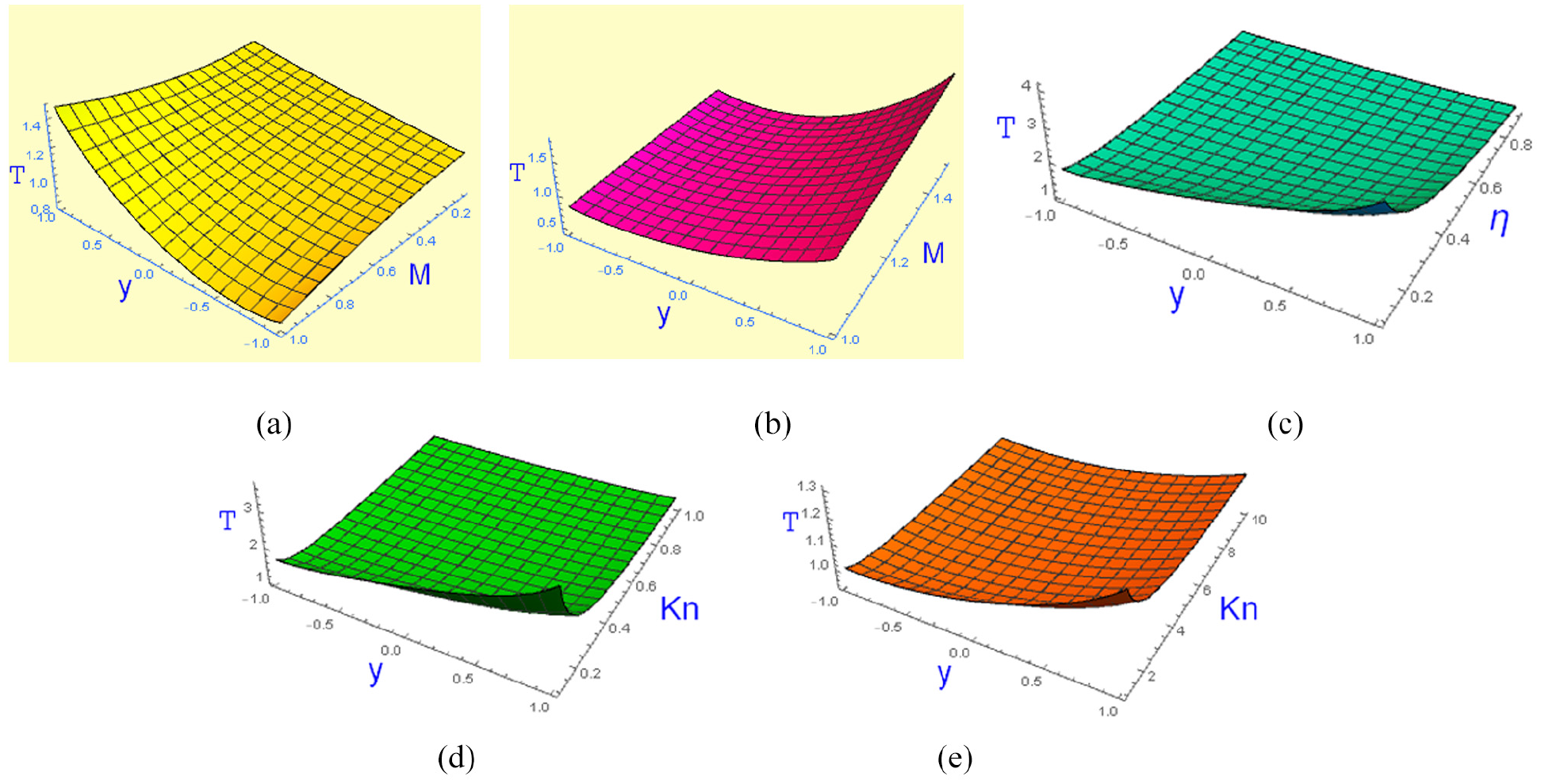
(a) T versus y and M for Kn = 1, η = 0.8 as t = 0.5, (b) T versus y and M for Kn = 1, η = 0.8 as t = 0.5, (c) T versus y and η for Kn = 1, M = 0.5 as t = 0.5, (d) T versus y and Kn for M = 0.5, η = 0.8 as t = 0.5, and (e) T versus y and Kn for M = 0.5, η = 0.8 as t = 0.5.
The numerical ratios between the various involvement of the IEC based on the derivatives of the extensive factors are evaluated via the Gibbs rule. Which clarified that they are ordered in absolute value as:
The varied range of M is from 0.1 to 1, which exemplifies the intensity of the ECF in weak and moderated values. For t = 0.5, we had:
In the situation where Kn = 1, t = 0.5, η = 0.8, and M varied from 1 to 1.5, which exemplifies the vigorous relativity intensity of the ECF and t = 0.5, we found:
In the situation where Kn = 1, t = 0.5, M = 0.5, and η varied from 0.1 to 0.9, which exemplifies the variable intensity of the temperature variation between the two parallel HRFPPs in several situations, we found:
Where the
In the situation where η = 0.8, t = 0.5, M = 0.5, Kn varied from 0.1 to 1, that is, in the transition regime, where NG is rarefied, we found:
In the situation of η = 0.8, t = 0.5, M = 0.5, Kn varied from 1 to 10, that is, in the transition regime, where the NG is highly rarefied.
We indicated that as n behaves reversely via T performance, the XT manner would have the reverse direction of the Xn manner.
We shed light upon the dependence of the ECF on y and M only and not on time. It changes linearly with y and nonlinearly with M.
Conclusion
ECF influences and HT, on the performance of an NG, bounded between two HRFPPs, is introduced in the non-stationary situation. For this new model, an exact non-stationary analytical calculation of the BGK pattern is shown. With a frame of reference that is co-moving with the gas, a non-linear non-stationary partial differential equations system is investigated. Therefore, we applied the moment and traveling wave factors methods to get the unsteady exact analytical solution. The gas temperature, concentration, and a comparison among the perturbed DFs and the equilibrium DFs are studied. We discussed the thermodynamic properties of the considered new model. Besides, we examined the various participants of the IEC. The results are applied for a helium NG. Graphics are performed to introduce their behavior, which is discussed.
Similarly, many agreements with relevant previous papers are clarified. After many efforts, we detected that in specific conditions, we could compensate for the decrease of particle numbers adjacent to the lower HRFPP because of the centrifugation process with other particles. We did this with the help of the counter current of HT from the heated upper HRFPP, which obtains a high enhancement to gases isotope separation processes. Our new pattern and all calculations were examined. We proved that it was compatible with thermodynamics second law, the rule of Le Chatelier, and the H-Theorem of Boltzmann. That tested was performed with a non-restricted range of the factor of temperatures ratio, Knudsen numbers, and Mach number of centrifugal force.
Footnotes
Appendix
Acknowledgements
The author wants to thank reviewers, editors, assistant editors, and the entire family of the journal. Thanks for their concern, valuable time, and useful comments that improved the paper value much more than before.
Handling Editor: James Baldwin
Declaration of conflicting interests
The author declared no potential conflicts of interest with respect to the research, authorship, and/or publication of this article.
Funding
The author disclosed receipt of the following financial support for the research, authorship, and/or publication of this article: This study is supported by the Egyptian Academy of Scientific Research and Technology by the associated grant number (No. 6508), under the program of ScienceUP Faculties of Science.

Data availability
The data used to support the findings of this study are included within the article.