




Abstract
In this paper, the dynamics and stability of multi-span pipe conveying fluid embedded in Pasternak foundation is studied. Based on Euler-Bernoulli beam theory, the dynamics of multi-span pipe conveying fluid embedded in two parameters Pasternak foundation is analyzed. The dynamic stiffness method (DSM) is used to solve the control equation. A seven span pipe is calculated. The affection of two parameters of Pasternak foundation is mainly studied. Along with increasing the elastic stiffness K and shear stiffness G, the frequency is also increasing.
Introduction
Fluid conveying pipes are widely used in the fields of petrochemicals, ocean engineering, drainage systems, nuclear engineering and so on. The fluid structure interaction vibration are wildly existing in the pipelines. Research on the dynamics and stability of pipes has always attracted a lot attentions.1–10 Paidoussis2,10–12 made a great work on the dynamics of pipes with conveying fluid within the linear and non-linear aspect.
The boundary conditions of pipeline includes the simple supported, clamped supported, and multi-span supported. 13 In engineering practice, pipelines mostly exist in the form of multi-span. Li 14 studied the free vibration analysis of multi-span pipe conveying fluid. By taking a pipe as a Timoshenko beam, the dynamics stiffness method was deduced for the free vibration of a three span pipe with 12 m long in three different cases. And it is shown that the dynamic stiffness method can still high precision than finite element method. Li 15 also used the reverberation-ray matrix method for analyzing the transient response of a multi-span pipe conveying fluid. The pipe was considered as a Timoshenko beam, the support points of the pipe are chosen as the elements’ nodes. In the examples, the natural frequencies are calculated for single- and multi-span pipe conveying fluid with different fluid velocity. And then the transient responses, such as deformation, velocity, shear force, and bending moment are obtained for a two-span pipe conveying fluid under different fluid velocity.
Multi-span pipelines have also been applied to new materials such as functional graded material pipe.16–19 Deng 16 proposed a hybrid method which combines reverberation-ray matrix method and wave propagation method for analyze the transverse vibration and stability of multi-span viscoelastic function graded material pipes conveying fluid. The effects of fluid velocity, volume fraction laws, and internal damping are analyzed. Deng 17 used the dynamic stiffness method for analyze the dynamic behaviors of a multi-span viscoelastic functional graded material pipe conveying fluid which is a seven span pipe with 40 m long. The natural frequency, critical velocity, critical pressure, and frequency responses are determined by the dynamic stiffness method. The numerical results are in good agreement with finite element method result.
In engineering practice, pipes often exist in the form of buried ground, which is equivalent to applying an elastic foundation support to the outside of the pipe. Due to the supporting effect of the foundation, the stability and dynamic characteristics of multi-span pipes will have an impact. Many researchers are committed to studying the dynamic characteristics of pipes buried in the foundation. Ni 20 studied the forced vibration of a curved pipe conveying fluid resting on a nonlinear elastic foundation used the Galerkin method and multiple scales method. Chellapilla 21 studied the critical flow velocity problem of transfer pipes on two-parameter foundations like the Pasternak foundation. Three simple boundary conditions are computed. The effects of foundation stiffness are found on the critical flow velocity of the pipeline. Li 22 analyzed the stability of oil-conveying pipes on two-parameter foundations with generalized boundary condition by means of Green’s functions. With the assistance of the Euler-Bernoulli assumption, the effects of boundary stiffness, foundation parameters and geometric parameters on the natural frequency and the critical velocity are discussed. Rao 23 study the critical velocities in fluid-conveying single-walled carbon nanotubes embedded in an elastic foundation. Closed-form expressions for the critical flow velocity are obtained for different values of the Winkler and Pasternak foundation stiffness parameters. It is observed that the nonlocal length parameter along with the Winkler and Pasternak foundation stiffness parameters exert considerable effects on the critical velocities of the fluid flow in nanotubes. Chen 24 calculated natural frequency of pipe conveying fluid resting on Pasternak foundation with the complex mode method and Galerkin method. The influence of Pasternak foundations shear stiffness, spring stiffness, and mass parameter to truncation error are also focused on. Khudayarov 25 studied the nonlinear vibrations of fluid transporting pipes on a viscoelastic foundation in the form of two-parameter model of the Pasternak. The effects of the parameters of the Pasternak foundations, the singularity in the heredity kernels and geometric parameters of the pipeline on vibrations of structures with viscoelastic properties are numerically investigated. Research on the dynamics of multi-span pipelines conveying fluid in the foundation has not been found. It is necessary to study the dynamic characteristics of multi-span pipelines with foundations because the wildly using of multi-span pipeline in foundations.
In this paper, the dynamic control equations of multi-span pipes under Pasternak’s two-parameter foundation model will be constructed, the equations will be solved using dynamic stiffness method, the natural frequency and static crutical velocity of the pipes will be calculated, and the multi-span pipes on Pasternak foundation will be studied.
The introduction will be shown in section 1. In section 2, the foundation modal and control equation will be built. In section 3, the dyanmic stiffness method for solving the control equation will be introduced. In the section 4, a seven span pipe with total 40 m long will be calculated and discussed. The natural frequency and critical velocity with two parameters of Pasternak foundation will be calculated. In section 5, the conclusion will be given.
The control equation
The foundation modal
In the approximate model of elastic foundation, there are two kinds of models which are more extensive, namely Winkler model and Pasternak model. The Winkler model has a simple structure, and only considers the linear elasticity effect at the position related to the reference point, and the accuracy is not high. The Pasternak model is more complicated. It considers the effect of shear deformation at the nodes at adjacent positions, which is more reasonable and closer to the real foundation model. The following Figure 1 is a model of a two-span pipe in Pasternak two-parameter foundation.

Multi-span pipe embedded in Pasternak foundation model.
The Winkler foundation model discrete the foundation into countless independent linear spring systems. At any point on the foundation, only the spring at that point is deformed. In the Pasternak two-parameter foundation model, a layer of lateral shear is added between the linear spring and the pipe. The shear layer of force, which links the upper ends of all the springs, and makes the deformation of the entire foundation appear continuous, thereby improving the accuracy of the model. The relationship between the force

where
The dynamic equation
The governing equation of the dynamics of the straight pipe under the Pasternak foundation model is:

Where,
Dynamic stiffness method
Let the solution of the equation be:

Where
Bring the set solution into the governing equation and get:

Set the solution of the displacement in the frequency domain to:


After solving the root of the equation, set:

According to Euler-Bernoulli theory, the solution of the rotation angle, bending moment and shear force of a multi-span pipe in a matrix can be expressed as:



The displacement of the m-th unit node of the pipe is as follows:
The relationship between node displacement and node degrees of freedom in Figure 2 is as follows:


The displacement of m-th element.
In the formula,
In the local coordinate system, the unit node displacement can be expressed as:

Where,
Equation (13) can be expressed as:

where,
The force of a node can be expressed as:
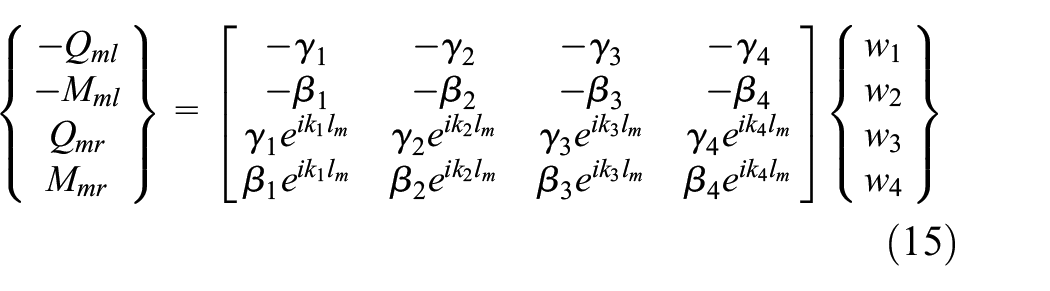
Where,
Equation (15) can be expressed as:

Where,
From equations (14) and (16), the relationship between the node force vector and the node displacement vector of the m-th unit node of the pipe can be obtained:


Where
The dynamic stiffness matrix of the remaining sub-span elements can be established in the same way. The relationship between the joint displacement and joint force in the overall coordinate system of a multi-span pipe embedded with a temperature-varying matrix can be established using the unit dynamic stiffness matrix, which is expressed as follows:

where,
Applying boundary conditions to

The subscript cg represents the matrix and vector to which the boundary conditions are applied.

If there are several elements in the structure, it is need to assemble the global dynamic stiffness through element dynamic stiffness. The process is the same as that in the conventional finite element method. And for different boundary conditions, equation (21) holds different forms.
The natural frequency of the system can be obtained from the above formula. In this paper, the real part of the frequency is the vibration frequency (Re (ω)) and the imaginary part is the damping (Im (ω)). The stability form of the pipe can be divided into three cases: steady state: (Re (ω)> 0 and Im (ω) = 0); static instability (Re (ω) = 0, Im (ω) is negative); Dynamic instability (Re (ω)> 0 and Im (ω) is negative).
Calculation and discussion
In order to verify the correctness of the calculation in this paper, compare with Deng 16 results, the structural parameters and material parameters of the pipe were selected in accordance with Deng. 16 The seven-span pipe is shown in Figure 3. And set the parameters related to the base material to zero, and ignore the effect of pipe material damping. First calculate the natural frequency of the first four orders of the pipe, as shown in Table 1. Through calculation, it can be found that the calculation method and model used in this paper are in line with Deng’s calculation results, which are reasonable and effective.

Seven-span pipe diagram.
First four order natural frequency of seven-span pipe compared with Deng. 16

Take a section of a seven-span pipe as an example. The entire pipe is supported by 8 hinges. The total length of the pipe is
Dynamics with Pasternak foundation
Calculate the relationship between the first three orders of natural frequency of the pipe and the flow velocity, as shown in Figures 4 and 5. When the first-order frequency of the pipe is reduced to 0, static instability occurs in the pipe, and when the imaginary part of the characteristic value of the pipe frequency becomes negative, dynamic instability occurs in the pipe. At this time, the corresponding flow velocity is the dynamic instability velocity.

The first third order frequency of the seven-span pipe without foundation along with the flow velocity, K = 0, G = 0.

The first third order frequency of seven-span pipes with foundation along with the flow velocity, K = 2.0E5, G = 1.0E5.
By comparing the curve of the frequency of the pipe with and without foundation as a function of the flow velocity, it can be found that the static instability flow velocity (≈300 m/s) of the seven-span pipe with foundation is higher than that of the seven-span pipe without foundation. The steady flow velocity (≈200 m/s); the corresponding first- and second-order modal coupling point velocity, the seven-span pipe with foundation is higher than the seven-span pipe without foundation; in the seven-span pipe without foundation, enter After static instability, the first-order frequency of the pipe will remain at 0 in a large flow velocity range (200–285 m/s), while in a seven-span pipe with foundation, its first-order frequency will remain at a range of 0. Small (300–309 m/s); after considering the elastic effect of the foundation, the natural frequency of the pipe containing the foundation is higher than the natural frequency without the foundation at the same flow rate. It can be seen that the existence of the foundation is equivalent to strong the pipe’s stiffness.
Natural frequency with two parameters of Pasternak
The first three natural frequencies of the pipe are calculated, and the calculation results are shown in Figure 6. It can be found that with the increase of the elastic stiffness of the foundation, the natural frequencies of pipes gradually increase, and the whole shows a linear change law. The change of the first order is greater than that of the second order, and the change of the second order is greater than that of the third order.

The first third order natural frequency of the pipe varies with K,
The variation of the natural frequency of the pipe with the shear stiffness G is studied, and the calculation results are shown in the Figure 7.
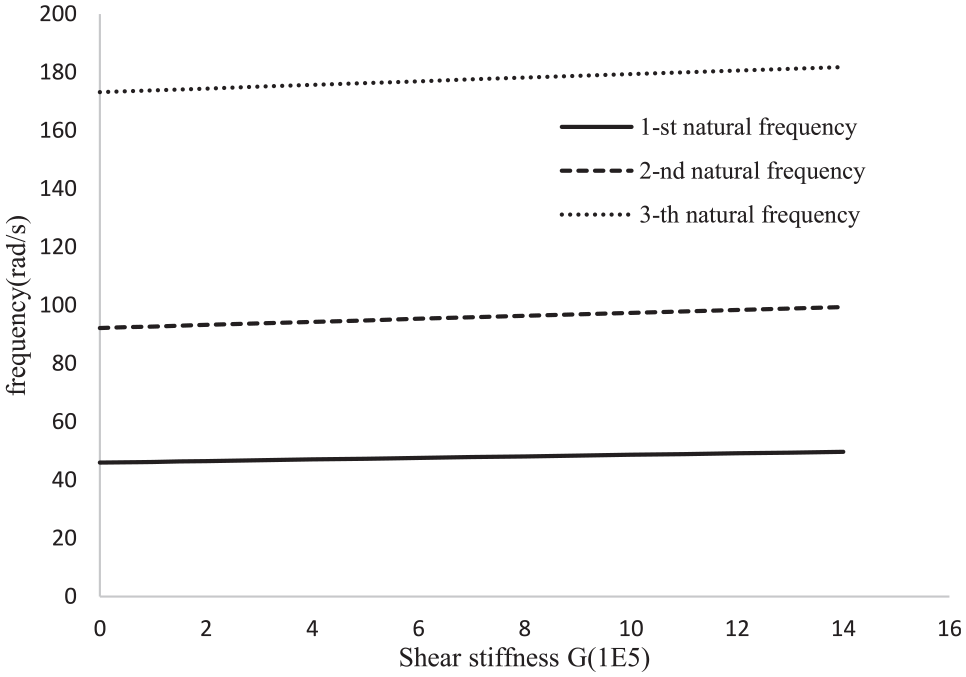
The first third order natural frequency changes along with G,
Critical flow velocity with two parameters of Pasternak
Calculate the critical flow velocity of the pipe as a function of two parameters in the Pasternak model. The calculation results are shown in the Figures 8 and 9. The critical flow which is the static instability flow, is an important indicator of pipe stability. In practical engineering, the value of the critical flow velocity should be increased as much as possible.

Critical velocity along with elastic stiffness K (1E5).

Critical velocity along with shear stiffness G (1E5).
As elastic stiffness K increases, the critical flow velocity increases non-linearly. As shear stiffness G increases, the critical flow velocity increases linearly. The effect of elastic stiffness K on the critical velocity is much greater than the effect of shear stiffness G on the critical velocity. It can be seen that if want to increase the critical flow velocity of the pipe, one can strengthen the foundation around the pipe to make its elastic stiffness K value larger.
Conclusion
This paper mainly studies the dynamic characteristics of multi-span pipe in Pasternak foundation with two parameters. The dynamic stiffness method is used to solve the control equation. The natural frequency and critical velocity are calculated for a seven span pipe with total 40 m long. The research in this article is meaningful for buried multi-span pipelines. Some conclusions are as follows.
The natural frequency and critical velocity have been increased when considering the two parameters of Pasternak foundation.
With increasing the elastic stiffness K and shear stiffness G of the foundation, the natural frequency increases linearly. The natural frequency shows a nonlinear relationship with the increasing of stiffness K. And the natural frequency shows a linear relationship with the increasing of shear stiffness G.
With increasing the elastic stiffness K, the critical flow velocity increases nonlinearly. On the contrary, the critical flow velocity increases linearly with increasing the shear stiffness G. The relationship between critical velocity and two parameters of Pasternak foundation is much like the relationship between the natural frequency and two parameter of foundation.
Footnotes
Handling Editor: James Baldwin
Declaration of conflicting interests
The author(s) declared no potential conflicts of interest with respect to the research, authorship, and/or publication of this article.
Funding
The author(s) received no financial support for the research, authorship, and/or publication of this article.
