




Abstract
Finding the optimal structural design to avoid resonance has been a goal for decades. While recent applied methods often result in using additional active systems or higher mass, structural adaptation enables to shift eigenfrequencies without adding weight. The aim of this study is to investigate the influence of the structural adaptation of a beam and a plate on its eigenfrequency change, while varying the height of the structural pre-deformation according to its mode shapes. Besides the maximisation of single eigenfrequencies, also the simultaneous increase of multiple eigenfrequencies is analysed. It is possible to almost exclusively raise the frequency of the targeted
Introduction
Finding the optimal structural design to avoid resonance has been a goal for decades as it is of high interest in many technical areas, for example, in the car industry to minimise the occurring noise and vibration during operation or in the space industry to avoid coupling with the control system. 1 Especially with recent demands for high-function structures including substantial weight reductions, the vibration design in consideration of dynamic characteristics has become extremely important. 2
The dynamics of a structure can be modified either actively or passively. As active systems imply the use of additional devices, passive systems are of high interest. By altering the structures geometry or material, changes in the dynamics appear due to alterations of the stiffness or mass. 3 In regard to lightweight structures, the change of a structure's geometry to shift its eigenfrequency obtains therefore high potential and has been subject of many studies. Most projects have been focusing on structural optimisations (sizing, topology and shape optimisation) to find an optimum material distribution with the aim to maximise eigenfrequencies.
Numerical sizing optimisations of 1D and 2D structures under certain static or dynamic loading conditions to optimise specific, single eigenfrequencies have already been studied starting from the 70s, for example, conducting cross-section optimisation of beams4,5 or focussing on thickness optimisation of circular and rectangular plates.6,7 A regularised mathematical formulation of annular plates with the objective to maximise the 1st eigenfrequency has been presented. 8 Similar, but taking dual optimisation problems into account, beams, frames and plates have been studied using a generalised steepest descent method to optimise the 1st eigenfrequency with constraints on the deflection while keeping minimum weight and varying the cross-section of beams or frames or the thickness of plates.9–11 A summary of literature concerning sizing optimisation to increase frequencies of different 1D and 2D structures was published. 12
Next to the sizing optimisation, most focus has been put on topology optimisation that was first considered using the homogenisation design method with focus on increasing the 1st eigenfrequency of plates. 13 The work was extended focusing on single and multiple eigenfrequencies as well as isotropic and composite plates. 14
Other optimisation methods were utilised as well in order to maximise the 1st eigenfrequency or high-order eigenfrequencies, for example, the solid isotropic microstructures with penalisation method,15–17 the evolutionary structural optimisation method,18,19 the bi-directional evolutionary structural optimisation method 20 and the level set method. 21 Focus points within the topology optimisation were ways to handle and maximise multiple eigenfrequencies16,22 as well as to create stiffener layout patterns that are engraved in or added to the plate to maximise eigenfrequencies.23,24
Beside topology optimisation, also shape optimisation has been frequently used. The natural frequency of various plates and shells have been maximised by altering the shape and thickness. 25 Also the vibration design of stiffened thin-walled shell structures have been optimised to increase eigenvalues or reach specified eigenvalues. 2 Parametric investigations regarding topography optimisation have been applied examining the optimal distribution of spherical dimples or cylindrical beads to optimise the natural frequency of plate-like structures. 26 Shape optimisations to increase single eigenfrequencies of plate membranes have been performed, 27 also considering constraints on the volume. 28 An optimum bead orientation was investigated for the maximisation of the first five eigenfrequencies of a cantilever plate 29 and continued aiming at a 1st eigenfrequency increase of 3D shell/plate structures by implementing an energy-based method. 23 An optimum distribution of sinusoidal and trapezoidal corrugations was studied in order to shift the fundamental frequency to maximum values. 30
It can be concluded that many different approaches have already been studied to maximise the eigenfrequencies of different structures. However, structural optimisations like topology and shape optimisations are often time consuming and require high computational effort. In addition, the manufacturing of the optimised structures is often restricted to additive manufacturing, which has become more promising in the last years, but still lacks on reproducibility, costs and production time. Therefore, all mentioned studies led to good results, however, might not be applied in big scale or for low-cost parts. A current demand for an efficient frequency optimisation method is therefore still present.
A new method of shape optimisation to maximise eigenfrequencies of beams has recently been published, which obtains the potential to be such an efficient optimisation technique.
3
Within the study, it was concluded that it is possible to influence the
The advantages of this shape adaptation methodology are that no special manufacturing methods are needed as well as that the proposed methodology implies relatively small time and computational efforts compared to other optimisation procedures as solely the mode shapes of the structure have to be known. However, the improved loadbearing capacity (arch or vault effect) due to the pre-deformation, which leads to eigenfrequency increases, requires axial constraints.
This study therefore focuses on an extension of the work of Da Silva and Nicoletti 3 by further investigating the potential of the method regarding higher pre-deformations of simply supported beams. In addition, the parametric studies were applied to squared plates. The study objective was to investigate the potential of the method not only to increase single eigenfrequencies and frequencies of specific mode shapes of beams and plates by adapting the shape according to one single mode shape, but also to study the possibility to use the proposed optimisation method for the maximisation of multiple eigenfrequencies by applying several mode shapes.
Material and method
A slender beam, which has already been studied, 3 and a squared plate were pre-deformed according to their mode shapes conducting parametric studies to investigate the impact of the pre-deformations on the eigenfrequencies.
All parametric and algorithm-based constructions were performed using the software Rhinoceros (version 6 SR10, Robert McNeel & Associates) and its plug-In Grasshopper® (version 1.0.0007, Robert McNeel & Associates). The additional Grasshopper®-based module ELISE (version 1.0.36, ELISE GmbH, www.elise.de) allowed the construction of the entire design and simulation process and the connection to the solver OptiStruct (Altair® HyperWorks® Version 2017) used to obtain the numerical results.
Slender beam
The beam geometry and material properties were defined in analogy to Da Silva and Nicoletti
3
leading to a 600 × 30 × 3 mm beam (Figure 1) made out of aluminium (Young’s modulus: 69,000 MPa, density:

Slender reference beam with coordinate system.
A modal analysis to calculate the first six eigenfrequencies and eigenmodes was conducted. The adequate mesh was obtained in a mesh convergence study varying the total number of nodes from 3 to 31, based on which CBEAM elements were defined. A sufficient mesh fineness was reached as soon as the results differed less than 5% from the results of the following three finer meshes. The results were evaluated on the 1st and the 6th eigenfrequency.
The numerically obtained results of the straight reference beam and the beam deformed according to the 1st mode shape were compared to analytically obtained eigenfrequencies to confirm the plausibility of the numerical simulations. The eigenfrequencies



The

Formulae to calculate the 1st and 2nd eigenfrequency of a circular arch have been published
33
and may serve as approximation for sinusoidal beams with small


with the radius



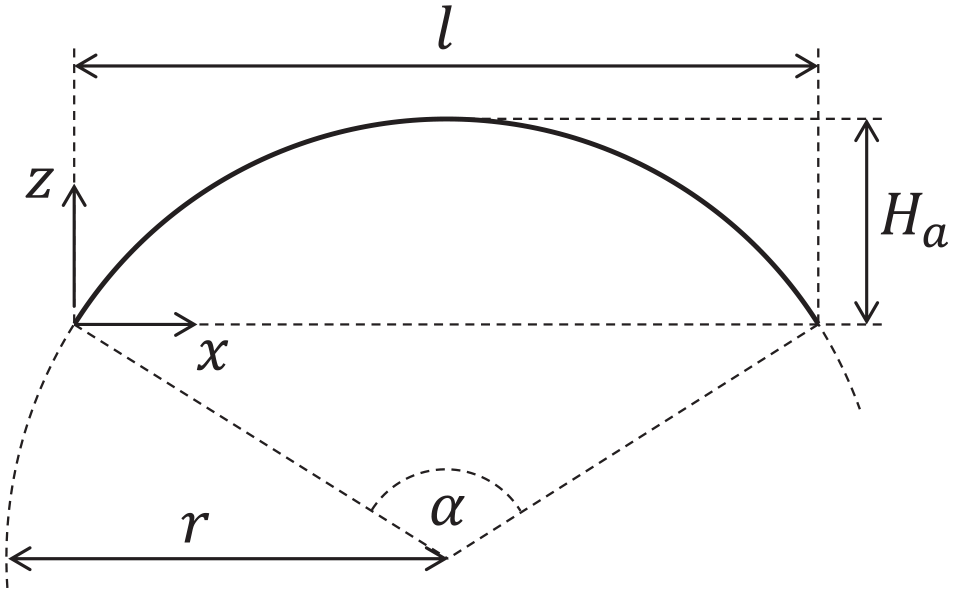
Dimensions of a circular arch.
Maximisation of a specific eigenfrequency or mode shape frequency
A pre-deformation according to the 1st, 2nd, 3rd, 4th and 5th eigenvectors was applied to the analysed beam. In analogy to Da Silva and Nicoletti,
3
a maximum relative pre-deformation

In parametric studies,
It may be mentioned that, although the pre-deformation was quite large, the analyses were still linear. The mechanical system, however, was changed considerably. Instead of beams (and plates), arches (and vaults or shells) were investigated. In linear beam theory, the natural eigenfrequencies do not depend on the axial constraint, whereas the axial constraint (hindered horizontal displacements at the ends) becomes essential for arches and shells as the membrane load-bearing capacity increases and so do the eigenfrequencies. Without the horizontal constraint, the frequency change is marginal.
3
Since the span length
During the analyses, the first six eigenfrequencies and the mode shapes were recorded. The resulting eigenfrequencies were always ordered by their value. Consequently, the frequency increase of a specific mode shape can lead to an alternation of the mode shape order. Thus, if the mode shape that was adapted to the beam could not be found within the first six eigenmodes, higher-order mode shapes were searched for the corresponding mode shape.
The results of the parametric studies were compared to the reference beam. The obtained eigenfrequency increase

Equation (11) was also utilised to obtain the increase of specific mode shape frequencies.
Maximisation of multiple eigenfrequencies
The reference beam was pre-deformed according to linear combinations of different mode shapes to analyse whether a simultaneous maximisation of different eigenfrequencies was possible. The effect of linear combinations of mode 1 and 2, mode 1, 2 and 3, and mode 1, 2, 3 and 4 of the reference beam were tested for maximum relative pre-deformations of 1.0, 3.0, and 5.0. For each beam node, the normalised eigenvectors of the considered mode shapes were added in equal parts. The resulting sum was normalised to obtain a maximum amplitude of 1, which was multiplied by the maximum relative pre-deformation
Additionally, weighted linear combinations of mode 1 and mode 2 were investigated considering also maximum relative pre-deformations of 1.0, 3.0, and 5.0. The normalised eigenvectors of mode 1 and mode 2 were multiplied with the factors
Squared plate
The considered plate was characterised by an edge length

Top view (a) and front view (b) of the squared reference plate with coordinate system.
Similar to the investigated beam, a shell mesh convergence study was conducted varying the number of elements per plate edge from 4 to 200 to identify a sufficient element size. A modal analysis was performed in order to obtain the first six eigenfrequencies and the corresponding mode shapes.
As the thickness to length ratio of the reference plate was smaller than 10%, the plate could be considered as thin and the classic plate theory of Kirchhoff was applied to calculate the eigenfrequencies analytically.
34
The eigenfrequencies


The mode shapes

The reference plate pre-deformed according to mode 1 was alike a spherical shell. Thus, shallow spherical shell theory was used to validate the numerical calculations. Shallow spherical shell theory implies thin shells.
34
These thin shells are characterised by a shell wall length and width of less than 10% of the shell radius, a constant shell thickness and a shell rise of less than about 1/8th of its lateral dimension. During vibration, these shells deform primarily perpendicular to the shell surface. The eigenfrequencies of a shallow spherical shell


Maximisation of a specific eigenfrequency or mode shape frequency
The plate was pre-deformed according to its first four mode shapes by calculating the
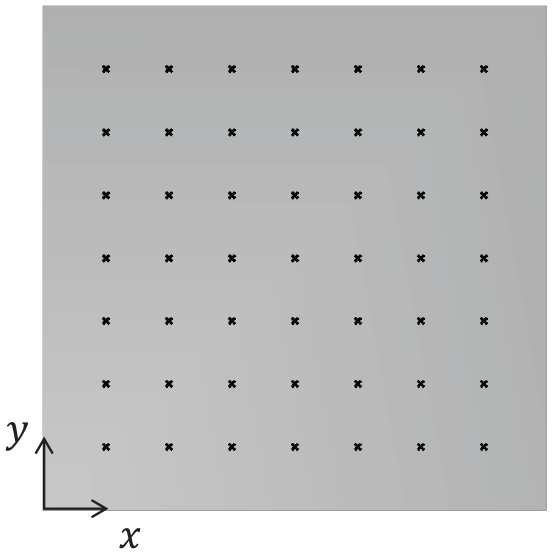
Regular distribution of points on the plate which were used for pre-deforming the plate according to its mode shapes.
Analogue to the slender beam, the maximum relative pre-deformation
To investigate the impact of the boundary conditions on the eigenvector approach, the boundary conditions of the reference plate were varied in three studies involving (1) all four edges clamped, (2) two opposite edges clamped and the other two edges free and (3) one edge clamped and the other three edges free. The plates were pre-deformed according to their corresponding first four mode shapes. The maximum pre-deformations were varied in the same way as for the simply supported plate and their impact on the first six eigenfrequencies was analysed.
Maximisation of multiple eigenfrequencies
According to the investigated beam, linear combinations of mode shapes were applied to the reference plate. As already described in the corresponding paragraph about the beam, mode 1 and 2 and mode 1, 2, and 3 were equally combined. Also here, weighted combinations of mode 1 and mode 2 were investigated. Both analyses were performed for maximum relative pre-deformations of 1.0, 3.0 and 5.0. The mesh properties and boundary conditions coincided with the previous investigations.
Figure 5 exemplarily shows the squared plate pre-deformed according to the first four mode shapes and a linear combination of the first two and the first three mode shapes. Here, a maximum pre-deformation of 10 mm was considered.

Squared plate pre-deformed according to the 1st (a), 2nd (b), 3rd (c) and 4th (d) single bending mode shape. (e) shows the pre-deformation according to a linear combination of the first two mode shapes (50% mode 1 and 50% mode 2) and (f) the linear combination of the first three mode shapes (33% mode 1, 33% mode 2, and 33% mode 3). The pre-deformed plates are displayed in four different views for
Results
Slender beam
A beam mesh consisting of 24 elements (25 nodes) was chosen to allow the generation of complex beam deformations throughout all simulations, even though the mesh study results showed that the output values had already converged with a coarser mesh and coincided with the analytically obtained values (Figure 6). The first six mode shapes of the reference beam are shown in Figure 7. The 1st, 2nd, 3rd, 4th and 6th mode shapes represented the 1st, 2nd, 3rd, 4th and 5th bending mode shapes in the

Results of the beam mesh study involving the 1st (a) and the 6th (b) eigenfrequency depending on the number of nodes. The dotted lines represent the analytically obtained results using Bernoulli beam theory. The framed data points indicate the chosen mesh properties.

First six bending mode shapes of the analysed beam in the
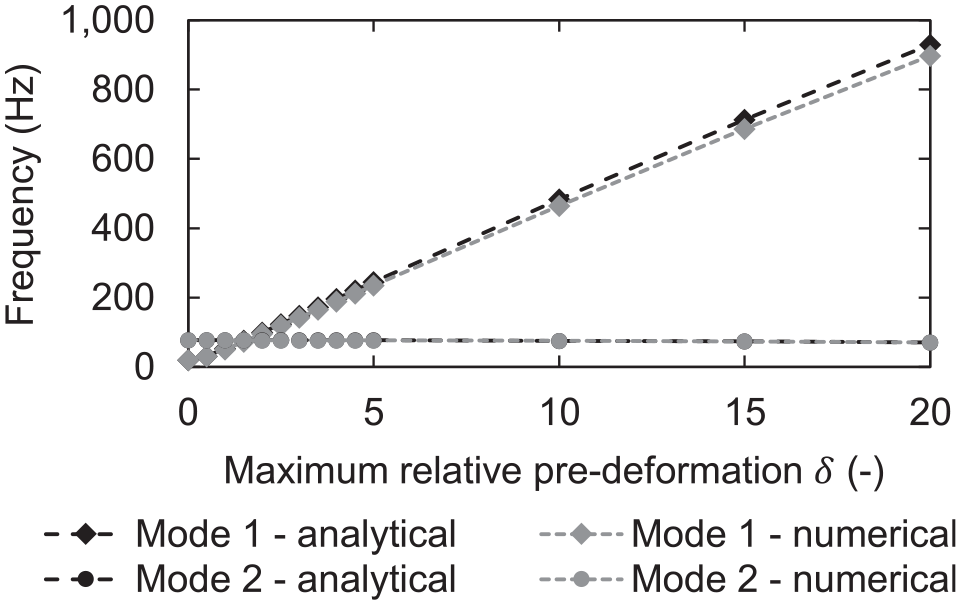
1st and 2nd eigenfrequency of the beam pre-deformed according to the bending mode 1 for different maximum relative pre-deformations. The analytically obtained values are based on formulae for circular arches published by Den Hartog. 33
Maximisation of a specific eigenfrequency or mode shape frequency
Shaping the beam according to the 1st, 2nd, 3rd and 4th bending mode shape resulted in a strong increase of the eigenfrequency connected to the corresponding mode shape. Figure 9 shows exemplarily the results for shaping the beam according to the 3rd and 4th bending mode shape, while the results for the 1st and 2nd bending mode shape adaptation are attached in the Supplemental Material. Lower-order frequencies remained constant, also for higher maximum relative pre-deformations. However, higher-order frequencies mostly decreased slightly with increasing maximum relative pre-deformation. Especially the frequency of the 5th mode shape (i.e. 1st bending mode in the xz plane) strongly decreased with increasing maximum relative pre-deformation for all beam pre-deformations. Regarding the 5th mode adaptation, however, the corresponding eigenfrequency first increased and later decreased with increasing maximum relative pre-deformation (Figure 10). The other recorded eigenfrequencies remained constant or decreased slightly.
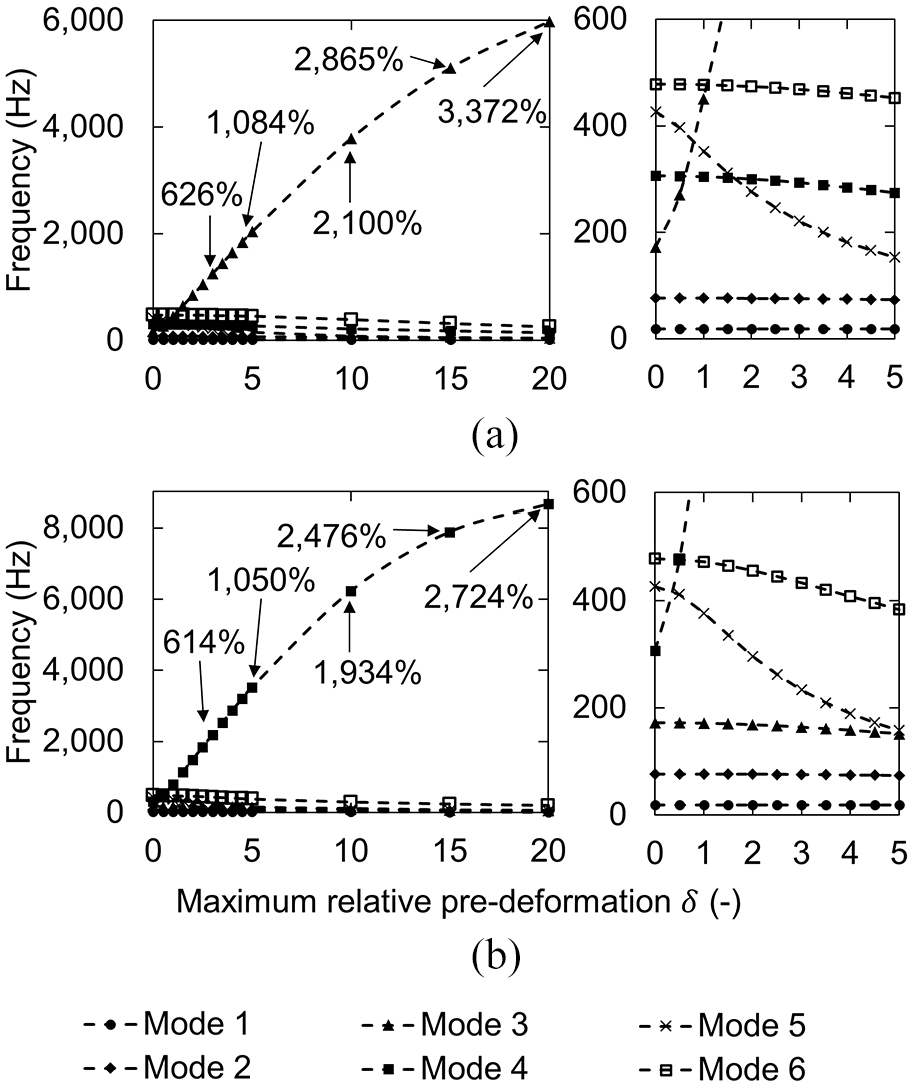
Frequencies of the first six bending mode shapes of the slender beam depending on the maximum relative pre-deformation according to mode 3 (a) and mode 4 (b). For some data points, the frequency increase of the 3rd and 4th bending mode shape compared to the reference beam is given. A magnified view of the lower right corner of the diagram involving small pre-deformations
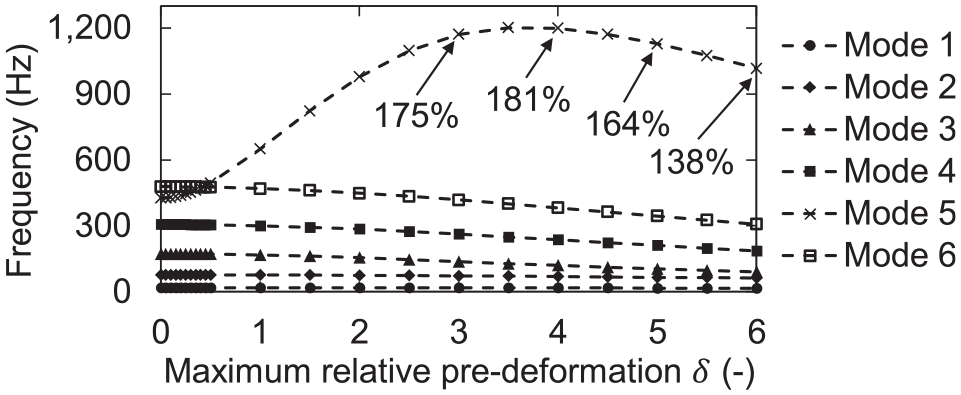
Frequencies of the first six bending mode shapes of the slender beam depending on the maximum relative pre-deformation according to mode 5. For some data points, the frequency increase of the 1st bending mode shape in the
In summary, a maximum relative pre-deformation of 5.0 already resulted in a frequency increase of a specific mode shape of more than 1000% for a shape adaptation of the beam according to the 1st, 2nd, 3rd and 4th bending mode shape. Maximum relative pre-deformation of 20.0 generated frequency increases of more than 4000% for pre-deformations according to mode 1 and 2 and of more than 2000% for mode 3 and 4. However, shaping the beam according to the 5th mode shape increased the corresponding eigenfrequency only by 164% for a maximum relative pre-deformation of 5.0.
The investigated methods to increase specific eigenfrequencies rose the targeted eigenfrequencies in almost all analyses, as shown in Table 1(a). Only when shaping the beam according to the 4th mode shape, a decrease of all six eigenfrequencies with strongest decrease for the 4th eigenfrequency was present. In addition, the not targeted eigenfrequencies were also altered (i.e. decreased or increased) by 8% to 28% applying maximum relative pre-deformations of 3.0.
(a) Eigenfrequency changes compared to the reference beam due to the eigenvector approach, which was applied to the slender beam considering a maximum relative pre-deformation of 3.0. The alterations of the frequencies connected to specific mode shapes (M) are shown in (b). The average deviations of not targeted eigenfrequencies are given. All targeted eigenfrequencies or mode shapes are shown in bold numbers.
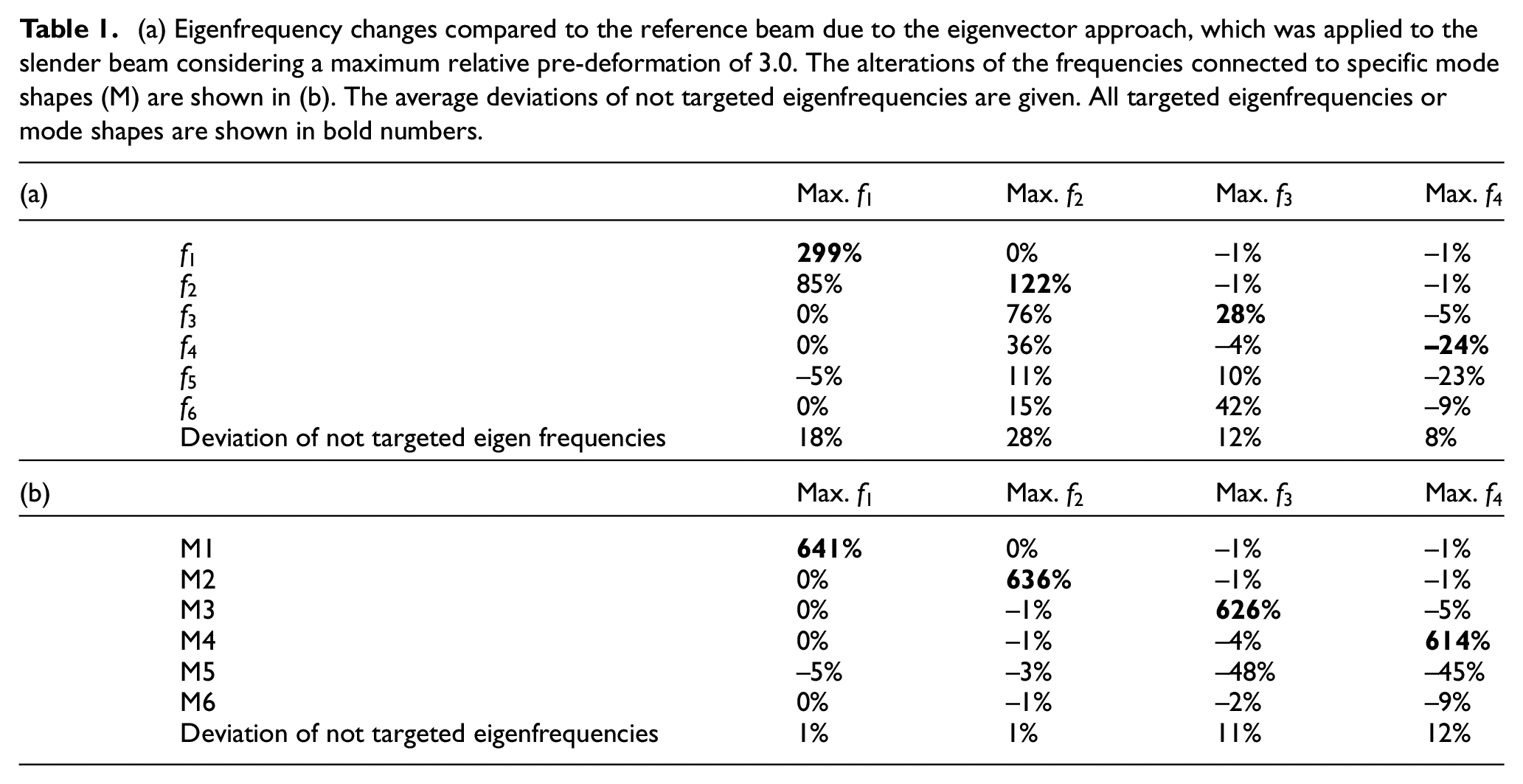
Comparing the obtained frequency changes corresponding to a specific mode, all results showed highest frequency increase for the targeted mode shape (Table 1(b)). The increase varied from 614% for the frequency of the 4th bending mode shape to 641% for the frequency of the 1st bending mode shape for the eigenvector approach considering a maximum relative pre-deformation of 3.0.
The not targeted mode shape frequencies changed in average between 1% and 12%.
Maximisation of multiple eigenfrequencies
Pre-deforming the reference beam according to a single mode shape led to high frequency increases of the considered mode shape, whereas the frequencies of the other mode shapes only differed slightly (Table 2). This trend was also observed for combinations of the different mode shapes. By shaping the reference beam according to a combination of the bending modes 1 and 2, only the frequencies of both considered mode shapes increased, while the frequencies of the other mode shapes remained almost constant. This also applied for the combinations of mode 1, 2, and 3 and of mode 1, 2, 3, and 4, however, the former also resulted in a rise of the 4th bending mode frequency for a maximum relative pre-deformation of 1.0. In all analysed mode combinations, the frequencies of the highest order mode shapes always increased most.
Frequency deviations of the first four bending mode shapes (M1 to M4) compared to the reference beam for different maximum relative pre-deformations

Pre-deforming the reference beam according to weighted combinations of the bending modes 1 and 2 led to different results for varying relative maximum pre-deformations (Figure 11). For

1st and 2nd eigenfrequency of the beam shaped with a maximum relative pre-deformation
Squared plate
The mesh size study indicated the sufficiency of an element edge size of 16.6 mm to obtain correct values for the 1st and 6th eigenfrequency (Figure 12). Also in this case, a finer mesh with an element edge size of 1 mm and a total of 10,000 CQUAD4 elements was used to picture the mode shapes correctly. The bending mode shapes of the reference plate are demonstrated in Figure 13. The comparison between the numerical and analytical results for the plate shaped according to the 1st bending mode shape showed good coincidence (Figure 14).

Results of the plate mesh study involving the 1st (a) and the 6th (b) eigenfrequency depending on the number of elements per plate edge. The dotted lines represent the analytically obtained results using the classic plate theory of Kirchhoff. The framed data points indicate the chosen mesh properties.

1st (a), 2nd (b), 3rd (c), 4th (d), 5th (e) and 6th (f) bending mode shapes of the reference plate showing the absolute normalised vibration amplitude.
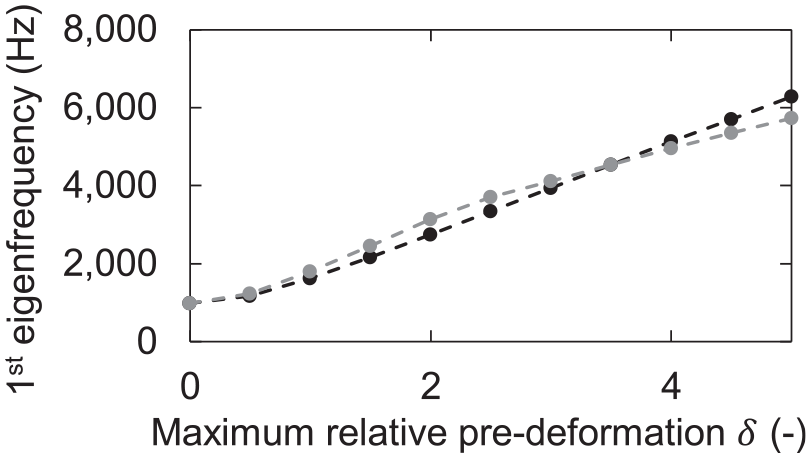
Analytically (black) and numerically (grey) obtained 1st eigenfrequency of the reference plate shaped according to the 1st bending mode shape depending on different maximum relative pre-deformations. The analytical solutions were calculated using classic plate theory of Kirchhoff for
Maximisation of a specific eigenfrequency or mode shape frequency
The pre-deformations of the reference plate implied adaptations of the plate thickness to ensure a constant mass. In the Supplemental Material, a table with the decreased plate thicknesses dependent on the maximum pre-deformations
Pre-deforming the reference plate according to its 1st bending mode shape resulted at first in an increase of all considered eigenfrequencies (Figure 15(a)), which decreased after a maximum relative pre-deformation of 14.7 for the 1st and 6th eigenfrequency and 10.8 for the remaining eigenfrequencies. At its highest peak, the 1st eigenfrequency increased by 606% compared to the reference plate. Figure 15(b) shows how the first six bending mode shapes changed with increasing pre-deformation of the plate. The 1st bending mode shape of the reference plate disappeared with maximum relative pre-deformations higher than 4.1 and could also not be found within the first 50 mode shapes. Thus, the frequency of the 1st bending mode shape was increased by 488% at

Eigenfrequencies (a) and frequencies of the different mode shapes (b) of the squared plate pre-deformed according to its 1st bending mode shape depending on different maximum relative pre-deformations. The highest 1st eigenfrequency increase is given. In (b), mode shapes which are not among the first six bending mode shapes of the reference plate are named ‘Mode X’. For
Shaping the reference plate according to its 2nd or 3rd bending mode shape led to the same results (Figure 16). Similar to the plate adaptation according to its 1st bending mode shape, all analysed eigenfrequencies first increased and then decreased with increasing maximum relative pre-deformation. At their highest peaks at a maximum relative pre-deformation of 11.6 for the 2nd and at 5.2 for the 3rd eigenfrequency, the eigenfrequencies increased by 159% and 233%, respectively. Regarding the mode shapes, only the 1st bending mode shape did not change order until a maximum relative pre-deformation of 5.2, while the frequencies of the other studied mode shapes exceeded each other and thus led to alterations in the mode shape order. The 2nd bending mode shape was found among the first 50 mode shapes up to a maximum relative pre-deformation of 3.1 with 12,237 Hz, whereas the 3rd bending mode shape could be identified up to a maximum relative pre-deformation of 5.2, however, its shape changed slightly. Thus, the frequency of the 2nd bending mode shape increased by 402% at

Eigenfrequencies (a) and frequencies of the different mode shapes (b) of the squared plate pre-deformed according to its 2nd or 3rd bending mode shape depending on different maximum relative pre-deformations. For both the 2nd and the 3rd eigenfrequency, the highest increases are given. In (b), mode shapes which are not among the first six bending mode shapes of the reference plate are named ‘Mode X’. For
A plate shape adaptation according to the 4th bending mode shape resulted into similar eigenfrequency plots as for the previous shape adaptations involving first the eigenfrequency increase and with increasing maximum relative pre-deformations a decrease of all eigenfrequencies (Figure 17). The 4th eigenfrequency reached its highest peak at a maximum relative pre-deformation of 12.1 with an eigenfrequency increase of 164% compared to the reference plate. The 4th bending mode shape was found within the first 50 mode shapes up to a maximum relative pre-deformation of 5.3 and its frequency reached 26,612 Hz resulting in a frequency increase of 584% compared to the reference plate.

Eigenfrequencies (a) and frequencies of the different mode shapes (b) of the squared plate pre-deformed according to its 4th bending mode shape depending on different maximum relative pre-deformations. The highest 4th eigenfrequency increase is given. In (b), mode shapes which are not among the first six bending mode shapes of the reference plate are named ‘Mode X’. For
The variation of boundary conditions showed that the eigenfrequency increase was dependent on the boundary conditions (Figure 18). While the highest 1st eigenfrequency increase of the fully clamped plate due to pre-deformation according to the bending mode 1 obtained about half of the value as for the simply supported plate, clamping of only two plate sides led to lower eigenfrequency increases. Moreover, the 1st eigenfrequency of the cantilever plate did not even rise. A similar trend could be observed for shaping the plates according to the 2nd, 3rd and 4th bending mode shapes, as seen in the Supplemental Material.

Eigenfrequencies of the squared plate pre-deformed according to its 1st mode shape depending on different maximum relative pre-deformations and the boundary conditions characterised by all sides clamped (a), two opposite sides clamped, the other two free (b) and one side clamped, the other three free (c). The highest 1st eigenfrequency increases are given.
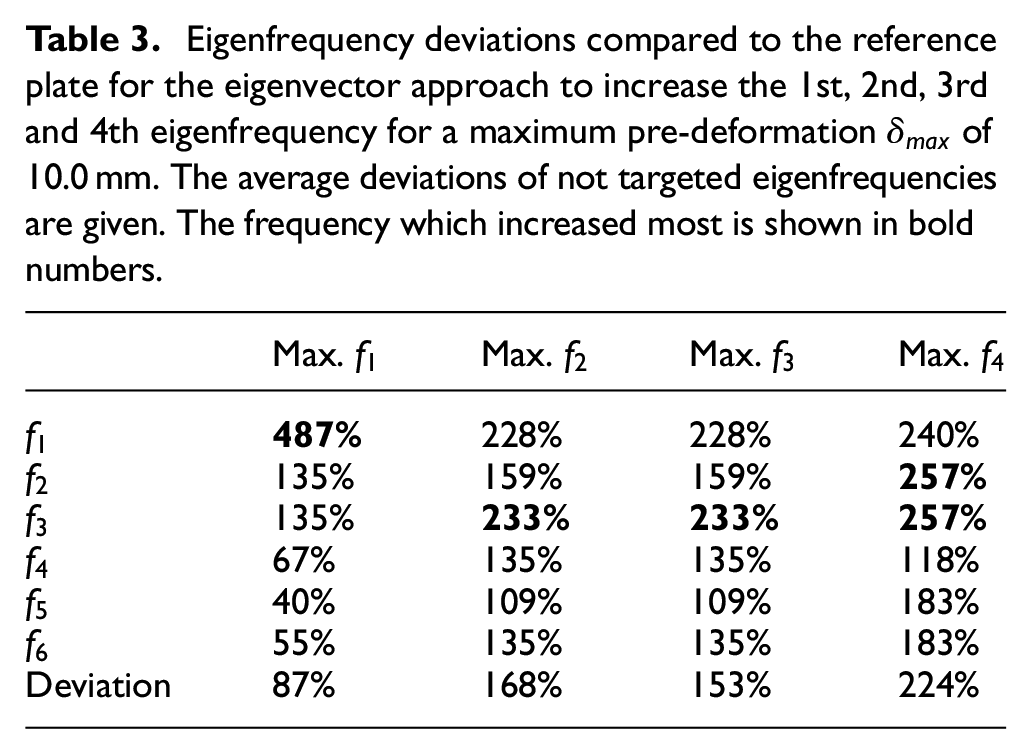
In summary, the eigenvector approach resulted in high eigenfrequency increases by pre-deforming a plate vertically of maximum 10% of the plate edge length (Table 3). The applied plate pre-deformations led not only to an increase of the targeted eigenfrequency, but also to an increase of all other eigenfrequencies of 87% to 224% in average. An exclusive increase of the targeted eigenfrequency was not possible. While the objective to maximise the 1st and 3rd eigenfrequency resulted in highest increase of the targeted eigenfrequency, pre-deforming the plate according to the 2nd or 4th bending mode shape resulted in highest rise of an eigenfrequency, which was not targeted. However, the targeted eigenfrequencies also increased.
Eigenfrequency deviations compared to the reference plate for the eigenvector approach to increase the 1st, 2nd, 3rd and 4th eigenfrequency for a maximum pre-deformation
Maximisation of multiple eigenfrequencies
The plate pre-deformation according to linear combinations of the 1st, 2nd and 3rd bending mode shape resulted in frequency rises for all analysed eigenfrequencies (Table 4). However, while a plate adaptation according to the bending mode 1 caused highest increase for the 1st eigenfrequency, the plate pre-deformations according to higher-order mode shapes did not always rise the targeted eigenfrequencies most. Both the linear combination of the bending modes 1 and 2 and of the bending modes 1, 2, and 3 resulted in high eigenfrequency increases for the 1st, 2nd, and 3rd eigenfrequency, while the 4th eigenfrequency rose less. It has to be noted that due to symmetry, a linear combination of the bending modes 1 and 3 caused the same results as the linear combination of the bending modes 1 and 2.
Frequency deviations of the first four eigenfrequencies compared to the reference plate for different maximum relative pre-deformations

Next to the linear combinations, the weighted combinations of the bending modes 1 and 2 were also considered. The results of Figure 19 indicated that the highest eigenfrequency increase for the 1st eigenfrequency appeared at a full plate adaptation according to the bending mode 1 for all considered maximum pre-deformations. With increasing influence of the 2nd bending mode, the 1st eigenfrequency decreased, but rose again after a certain ratio. A similar trend could also be observed for the bending mode 2, where highest values of the 2nd eigenfrequency appeared at the complete plate adaptation according to the bending mode 2. The eigenfrequency minima appeared for the 1st eigenfrequency at

1st and 2nd eigenfrequency of the plate pre-deformed with a maximum relative pre-deformation
Discussion
Slender beam
The numerical results obtained by using the defined sufficient mesh fineness coincided very well with the analytical results and can thus be seen as plausible.
Maximisation of a specific eigenfrequency or mode shape frequency
The investigated method to increase specific eigenfrequencies by shaping the beam according to the corresponding mode shape led to high increases of the targeted 1st, 2nd, 3rd, and 4th eigenfrequencies. The results for small maximum relative pre-deformations according to the 1st, 2nd, and 3rd bending mode shape coincided very well with the results obtained by
3
indicating an exclusive increase of the targeted mode shape frequency, while especially lower-order eigenfrequencies remained constant. Similar results were obtained by shaping the beam according to the 4th bending mode shape. Among all investigated mode shape adaptations, highest frequency increase of up to 4,589% compared to the reference beam was achieved for the 1st bending mode by shaping the beam according to the targeted mode shape (
It has been stated that as soon as a beam receives a curved shape, the 1st mode shape becomes extensional implying high tangential displacement.
33
The 2nd mode shape, however, remains as a non-extensional mode, which is characterised by a radial displacement. For small angles
Regarding maximum relative pre-deformations larger than 5.0, variations (especially decreases) of not targeted eigenfrequencies were registered, which was not shown by Da Silva and Nicoletti. 3 At the same time, higher pre-deformations allowed an additional, very high frequency increase of the targeted mode shape.
A special role played the 5th mode shape, that is, the 1st out-of-plane bending mode (1st bending mode in the
In summary, shaping the beam according to its mode shapes is an efficient way to strongly increase the frequency of a specific mode shape, while the frequencies of the other mode shapes only differ slightly. It has to be noted, however, that the occurrence of mode switching and multiple eigenfrequencies due to the applied pre-deformations is possible.
Maximisation of multiple eigenfrequencies
Beam pre-deformations according to linear combinations of mode shapes are an efficient method to increase the frequencies of various mode shapes simultaneously. Shaping the beam according to its 3rd bending mode shape, for example, increased the corresponding frequencies strongly, while the frequencies of the other analysed mode shapes remained constant or decreased insignificantly. Pre-deformations according to a linear combination of the 1st, 2nd, and 3rd bending mode shape, however, increased all three corresponding frequencies, while the frequency of the 4th bending mode shape changed only slightly. The weighted combinations of the bending modes 1 and 2 showed that the highest sum of the 1st and the 2nd eigenfrequency was obtained by shaping the beam according to only the 1st or only the 2nd bending mode shape depending on the maximum relative pre-deformation.
Squared plate
As for the analysed beam, the chosen mesh properties led to numerical results that corresponded to the analytical results for maximum relative pre-deformations up to 5.0. Higher pre-deformations were not calculated analytically, as the shell theory only applies for shallow shells.
Maximisation of a specific eigenfrequency or mode shape frequency
By adapting the shape of a simply supported squared plate according to a specific mode shape, an increase of all eigenfrequencies could be stated up to a certain pre-deformation. Applying this method to a fully clamped plate resulted only in a small eigenfrequency increase, while the absence of in-plane constraints hardly altered the eigenfrequencies, which had already been demonstrated for beams. 3
It has been shown that by applying structural modifications, the mode shapes change, resulting in an increase of the corresponding eigenfrequency. 26 In the case of the 1st bending mode shape, the alterations of the maximum relative pre-deformations led to an increase of the 1st eigenfrequency. It was concluded that the highest eigenfrequency increase of dimpled plates can be achieved by placing the dimples at the plate centre, as it increases the local bending stiffness at the region of high modal strain energy. Modal strain energy was not taken into account in this study, so no statement can be made with regard to the results obtained. However, as the modal strain energy is defined as the product of the element stiffness matrix and the second power of the mode shape component, 36 it can be assumed that the mode shape has a high influence and that therefore areas, which show a high modal deflection, also obtain high modal strain energy. This would mean that published statements on dimpled plates can also be applied here to a certain extend. 26
The results of this study showed that by altering the shape of a plate, a change in the mode shape frequencies and order always occurred. In addition, a connection between the mode shape change and the eigenfrequency increase could be observed which supports already published statements. 26 Considering the results of the eigenfrequency increase connected to their mode shapes, high mode shape changes led to high increases of the corresponding frequencies, while frequencies connected to mode shapes similar to the reference plate obtained low eigenfrequency increases. This can exemplarily be seen for the adaptation of the plate according to the 1st bending mode shape, where the bending modes 4 and 6 showed minor mode shape alterations up to a maximum relative pre-deformation of 5.0 and therefore also low corresponding eigenfrequency increases. High increases were achieved for the frequencies connected to the first three bending modes, while the 1st bending mode frequency showed the highest rise. This 1st bending mode shape was not present within the first 50 mode shapes, leading to the conclusion that a high frequency increase of this mode shape appeared. In analogy to the beam, the 1st extensional mode shape is characterised by a higher energy than for example the 2nd flexural mode shape. Consequently, highest increase of the 1st bending mode frequency was also observed for the plate. Next, the 2nd and 3rd bending mode frequencies changed most. A decrease of the wave dimensions could be found within pre-deformations of 3.0 and 5.0, while the remaining mode shapes seemed similar to the ones occurring for a reference plate.
Similar conclusions could be made for the plate pre-deformations according to the bending modes 2/3 and 4. It has to be noted that the shape adaptation according to the 2nd and 3rd mode shapes led to the same results as the analysed plate was characterised by a constant edge length. Consequently, the 2nd and 3rd eigenfrequency coincided and the 2nd mode shape corresponded to the 90° rotated 3rd mode shape.
Regarding the eigenfrequency decrease for high maximum relative pre-deformations, it has been shown that the 1st plate eigenfrequency increased with rising dimple height up to an optimum height and later decreased with further increasing dimple height.
26
It was argued that the eigenfrequency decrease was due to the dimple thickness decrease. Also in the present study, the eigenfrequency decreases for high pre-deformations might be due to the reduction of the bending stiffness because of the decreasing plate thickness, which was inevitable to have a constant mass (cf., the discussion in connection with the 5th beam mode in a the previous chapter). Moreover, it has to be noted that the formulae used for the eigenfrequency calculations are restricted to small pre-deformations and different dependencies can be expected for plates with high pre-deformations. Figure 20 shows exemplarily the 1st mode shapes of a plate pre-deformed according to the bending mode 1 with maximum relative pre-deformations of 5.0, 10.0, 15.0 and 20.0, where it can be seen that a flexural mode shape appeared for all pre-deformations. However, it was shifted from a mainly
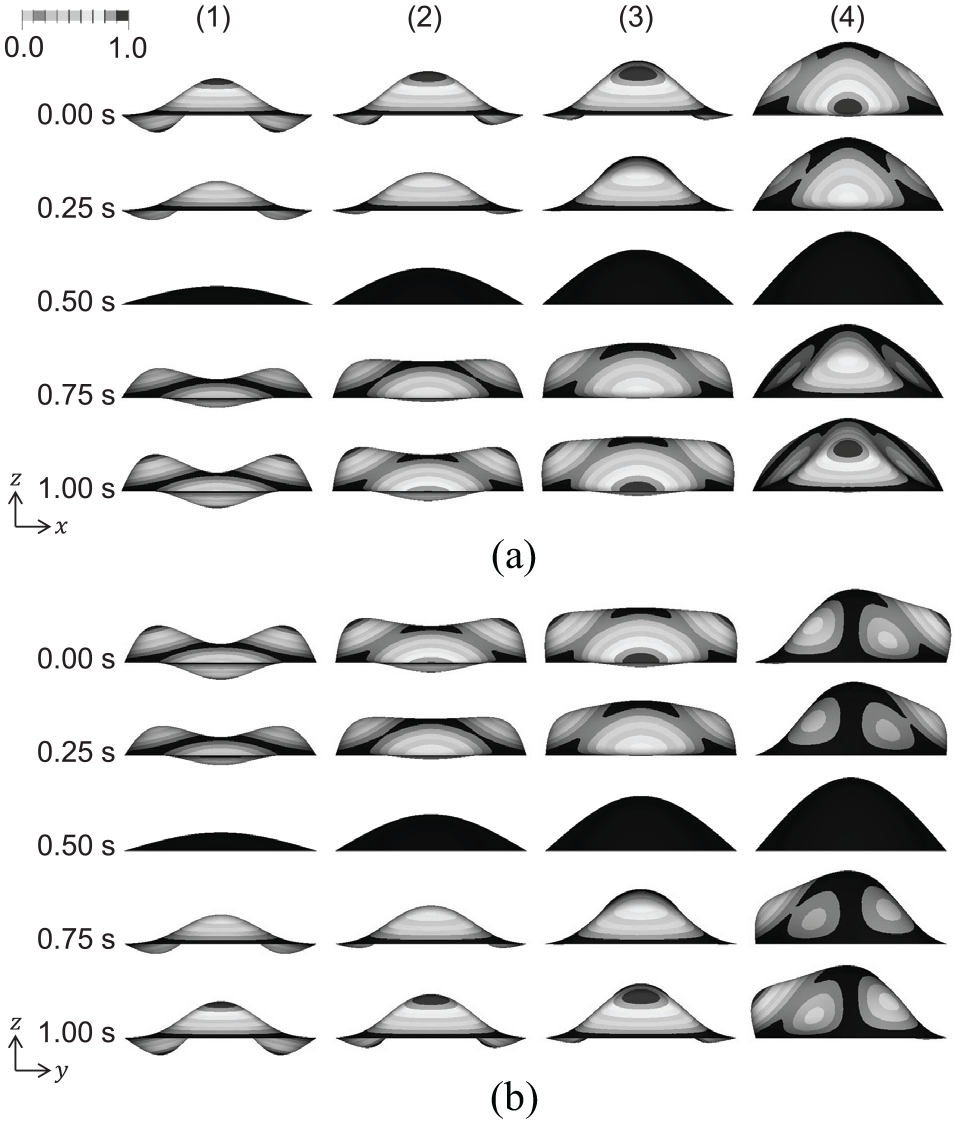
1st mode shape and the normalised vibration amplitude of the squared plate pre-deformed according to the 1st mode shape at different time frames
In contrast to the results for the slender beam, for which the exclusive increase of a specific mode shape frequency was quite successful, the plate pre-deformation according to different mode shapes always led to an increase of all considered eigenfrequencies. Consequently, in the case of plates, the mode shapes cannot be seen as independent. It has rather to be noted that all mode shapes deflected certain plate areas, which were also influenced by other mode shapes. Thus, all eigenfrequencies altered when shaping the plate according to certain eigenvectors. In the here obtained results, the frequency of the 1st bending mode showed the highest or second highest frequency increase for any plate adaptations. As the 1st bending mode shape elevates the whole plate area, it is expected that an influence on the corresponding frequency is always present when adapting the plate according to any other mode shape. Though, the highest increase of the 1st eigenfrequency could be achieved when shaping the plate according to the bending mode 1.
Maximisation of multiple eigenfrequencies
In contrast to the investigated beam, the linear combination of several mode shapes cannot be seen as a useful method to simultaneously increase multiple eigenfrequencies as none of the considered combinations led to as high eigenfrequency increases as the adaptation according to the corresponding mode shape. While in the case of the slender beam it was possible to track the frequency changes of the different mode shapes, the mode shapes of the plate altered so strongly that tracking was not possible. Consequently, only the increase of the different eigenfrequencies was evaluated regardless of the changing mode shapes.
The weighted combinations of the bending modes 1 and 2 also indicated that an adaptation according to one single mode shape simultaneously caused an increase of the other eigenfrequencies. Thus, an adaptation according to one mode shape provided better results than a combination, concerning both eigenfrequencies, which had also been observed for the slender beam. The results are consequently in accordance with other findings.3,31
By comparing all plate shapes considered within this report, the highest sum of the first two and three eigenfrequencies were achieved for the eigenvalue adaptation according to the bending mode 4. As described above, highest increase of the first three eigenfrequencies were present, especially influenced by the high values of the 2nd and 3rd eigenfrequency. In summary, it can be concluded from the results that the linear combination itself is not a good method to reach highest increases of several eigenfrequencies.
Comparison between slender beam and squared plate
It has been demonstrated that it is possible to increase the
Contrary to the results obtained for the squared plate, the not targeted beam eigenfrequencies changed only slightly, while a strong change was visible for all plate mode shape frequencies. Thus, applying the eigenvector approach to plates results in strong increases of the targeted eigenfrequencies, but also in high changes of other eigenfrequencies. It can be concluded that the eigenfrequency increase is less specific. This also comes along with intensive alterations in mode shapes, which is why a mode tracking was only partly possible. The beam mode shapes, in contrast, changed less strongly their mode shape order and frequency apart from the targeted mode shape.
Comparison of the different methods to increase eigenfrequencies
Different methods to increase eigenfrequencies and frequencies of specific mode shapes have been published. The main advantage of the eigenvector method to increase eigenfrequencies over other types of stiffening techniques and optimisations is that stiffening and thus high eigenfrequency increase is already achieved with small computational effort. In addition, no mass increase is needed and the method is already efficient for small pre-deformations. To underline this statement, an 1st eigenfrequency increase of 300% for the beam and 221% for the plate was generated by a maximum relative pre-deformation of 2.0 according to the 1st bending mode shape. The 1st bending mode frequency of the beam was even increased by 400%. Maximum relative pre-deformations of 3.0 led to 1st eigenfrequency rises of 300% for the beam and 322% for the plate. The 1st bending mode frequency of the beam increased by 641%. Regarding the plate, both mentioned eigenfrequency increases corresponded to the 1st bending mode shape.
The eigenfrequency increase of simply supported 2D beams by applying topology optimisations have been studied.
37
Within this study, a 1st eigenfrequency increase of about 155% and a 2nd eigenfrequency increase of about 135% including mass reduction of 50% was reached. Both values were significantly lower than the beam eigenfrequency increases obtained by the eigenvector approach. The increase of the 1st eigenfrequency of a squared plate with similar boundary conditions has also been investigated by using topology optimisation, where an eigenfrequency increase of 102% with a mass reduction of 50% occurred.
37
A study on the optimal distribution of dimples and beading using a genetic algorithm to maximise the 1st eigenfrequency of simply supported rectangular plates revealed maximum frequency increases of 25.4% (
The eigenfrequencies of the here analysed beam and plate have also been increased by applying evolutionary strategic optimisations and topography optimisations to compare these optimisation techniques to the eigenvector approach. The work will soon be presented in a different publication.
Overall, it can be concluded that the comparison of the eigenvector approach to other optimisation techniques indicated higher eigenfrequency increases and frequency increases of specific mode shapes for the former methodology.
Conclusion
We have shown that shaping axially constrained beams and squared plates according to their mode shapes leads to strong eigenfrequency increases. This methodology allows the almost exclusive increase of the frequency of the
Supplemental Material
sj-pdf-1-ade-10.1177_1687814020971903 – Supplemental material for Shape adaptation of beams (1D) and plates (2D) to maximise eigenfrequencies
Supplemental material, sj-pdf-1-ade-10.1177_1687814020971903 for Shape adaptation of beams (1D) and plates (2D) to maximise eigenfrequencies by Simone Andresen, Laura M Lottes, Selina K Linnemann and Reinhold Kienzler in Advances in Mechanical Engineering
Footnotes
Acknowledgements
The authors acknowledge the comments and suggestions of reviewers.
Handling Editor: James Baldwin
Declaration of conflicting interests
The author(s) declared no potential conflicts of interest with respect to the research, authorship, and/or publication of this article.
Funding
The author(s) disclosed receipt of the following financial support for the research, authorship, and/or publication of this article: This study was financially supported by the Alfred Wegener Institute Helmholtz Centre for Polar and Marine Research (AWI) and the German Electron Synchrotron (DESY), a research centre of the Helmholtz Association.

Supplemental material
Supplemental material for this article is available online.
References
Supplementary Material
Please find the following supplemental material available below.
For Open Access articles published under a Creative Commons License, all supplemental material carries the same license as the article it is associated with.
For non-Open Access articles published, all supplemental material carries a non-exclusive license, and permission requests for re-use of supplemental material or any part of supplemental material shall be sent directly to the copyright owner as specified in the copyright notice associated with the article.
