




Abstract
Peristaltic transport phenomena are of great significance in biological sciences. The physiological transport of fluid takes place under the action of peristalsis generated as a pressure gradient. The peristaltic waves generate a pressure gradient which is responsible for the fluid flow in the forward direction. The further properties of this phenomena can be seen if an imposed pressure gradient is applied in addition to the one appearing due to peristaltic waves. This situation has not been discussed in the literature that needs further attention. The effects of the wavy boundaries and imposed pressure on the velocity of the flow field are analyzed. Here we impose a question: what happens if an imposed pressure gradient is also applied? This question of physical importance has not been addressed; and thus, remains the topic of this study. In previous papers of peristaltic motion, the flow generated by peristaltic waves only has been examined while in this study we will discuss the contribution of imposed pressure gradient on velocity field. The analytical results for the velocity field are obtained using the boundary perturbation method. The study shows that the impact of the wavy boundaries on the flow increases with the increase in corrugation parameter and imposed pressure.
Introduction
This article is concerned with the fluid mechanics of peristaltic pumping under conditions for which the length of peristaltic wave is large compared with the channel width and the appropriate Reynolds number is sufficiently small for the flow to be considered inertia- free. The basic principle of peristaltic motion is based on the sinusoidal wave boundary which is produced due to the traveling of sinusoidal wave along flexible walls of the channel. There are other muscular structures which are responsible for pumping the fluids by means of peristaltic motion. Technologically, peristaltic devices are commonly used for slurries, pumping of blood through human body, transporting corrosive fluids etc. In bio-mechanics; the peristaltic phenomena have great relevance in arterioles, heart-lung machine, intestines, ureter and many other. The procedures are adopted by pumping of blood, food in small intestines, passing of fluid from kidney to ureter. Peristalsis in human physiological systems have been the reasons of many recent investigations
Mathematically, the peristaltic flows induced by the waves traveling along a flexible channel have been treated under various geometrical situations and various fluid models. It must be kept in mind that the fluid is transported by the pressure gradient developed in the peristalsis mechanism. Before going further, we would like to refer few papers of major interest.
A literature review gives a general idea of the literature and theories related to the subject of the present problem. With the help of literature review, historical aspects of theories and literature is reached which lays importance forthrightly to the subject of the research. Even though peristalsis existed very well in physiology, its relevance came about mainly through the work of Engelmann. 1 He was the first to investigate the phenomena of peristaltic waves in human ureter. He performed an analysis on physiological or methodological issues which opened new ways for further investigation of physiological mechanisms. After that, Latham 2 investigated the mechanism of augmented fluid mixing within a peristaltic pump. After Latham several investigations have been made on the functioning of ureter following the peristaltic motion. Impacts of long wavelengths at low Reynolds number are assumed by Shapiro et al. 3 He modeled the problem and found all elegant analytical results for channel and tube. A number of physically impact and phenomena of bolus, augmented flow and backward flow are discussed. An analysis of peristaltic transport is addressed by considering nonlinear convective acceleration and no slip condition on wavy wall by Fung. 4 Hayat et al. 5 adopted perturbation method to investigate the peristaltic transport in a planar channel. Shapiro et al. 6 modeled a problem to present the simple physical picture of working of a peristaltic pump by means of peristaltic waves in the laboratory frame of reference. Importance of investigations in medical and industrial sciences based on peristaltic motion cannot be ignored. Duane 7 examined the impact of peristaltic motion in urinary tract and provide an overview of the basic anatomy and physiology of the urinary tract with an emphasis on their specific roles in host defense. Srivastava et al. 8 modeled a problem to investigate the attributes of peristaltic fluid suspension in transport of fluid and revealed that the reversal flow increases with increasing particle concentration and Reynolds number. Yin et al. 9 employed a relation between theory and experiments in peristaltic transport. When theoretical and experimental results are compared, they are in good accord and provide confirmation to the theoretical analysis. Zien and Ostrach 10 investigated the peristaltic transport for a long wave approximation and indicated that mean pressure gradient is associated with the motion. Leal gave a brief study of fluid flow in curved tubes. 11 Hanin 12 investigated the peristalsis in nano-fluid under endoscopic effects.
Pressure driven flows has demonstrated the ability to control fluids pressure in modern investigation like peristaltic pumping, cell sorting and microfluid injections. In microfluidics, it is often desirable to minimize the circulating volume of fluid. Imposed pressure can regulate the desired volume of fluid flow. Pressure driven flows has been analyzed by.16,17,18
We observe that in these cases, the flow is generated by the peristaltic waves only through the pressure gradient developed in the channel or tube. However, the question remains; what happens if an external pressure gradient is imposed in addition to the one generated by the peristalsis. We believe that such situation is of much interest both from mathematical and physical points of view that has not been discussed so far.
The imposed pressure gradient is superimposed, and the peristalsis problem is remodeled. The solution is obtained using perturbation technique. The effects and the consequences of the imposed pressure gradient are investigated analytically. Hopefully, this will be a step further in the discussion of peristalsis flows.
Mathematical formulation
Consider a steady two-dimensional boundary layer flow of a viscous and in compressible fluid with imposed pressure gradient along a horizontal channel bounded by two periodic sinusoidal boundaries having separation

Geometry of fluid flow.
The above figure shows a long channel in which a peristaltic wave of contraction is produced by moving walls to the right at speed
We assume that the pressure gradient



Momentum equation with imposed pressure gradient G is presented as
In x-direction

in y-direction

In the above equations
For the present model the relevant boundary conditions are given as


We introduce the following dimensionless variable transformations



Using the above transformation, the equation of continuity is comparatively satisfied and the remaining equations (4) and (5) along with boundary conditions (6) and (7) are reduced into the following non-dimensional partial differential equations.

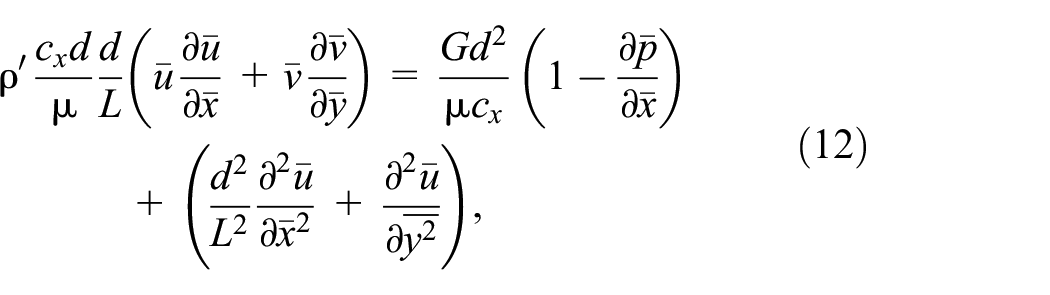

The notation
However, we do assume that the Reynolds number is vanishingly small compared even with the geometric amplitude parameter
For


The transformed boundary conditions are


Where
We see that the dimensionless problem (and its solution) depends on a single dimensionless parameter,
This parameter is just the ratio of the two possible velocity scales
Here we consider the domain perturbation method. In this section we seek the solution for limiting case



For this limiting case, the boundary conditions, can also be approximated in terms of asymptotically equivalent boundary conditions applied at
Applying Taylor’s expansion on the boundary we have:

Using the above relation in equations and comparing the coefficients of
Zeroth order equations




First order equations




The Reynolds number is
For the O(1) problem, the boundaries are flat; hence
Perturbative solution
In this article we provide the solution of the formulated mathematical model by perturbation method. The focus has been on velocity along the channel. This method applies to problems in which the geometry of the flow or transport domain is irregular in the sense that the boundaries do not correspond to coordinate surfaces of any known analytic coordinate system but are nevertheless near to such coordinate surfaces. The basic idea is to replace the exact boundary condition with the approximate boundary condition that is asymptotically equivalent for
Zeroth order solution

First order solution
This solution at

To solve this problem, we note that the boundary condition imposes a specific

It is clear from (28) that the
If we substitute this proposed solution form into equation (24) we have


Simplifying equation (31) we obtain

with boundary conditions

The general solution that satisfy the symmetry is

where
The boundary condition then requires that

Hence,
The boundary condition then requires that
Hence,

The constant

that is independent of

To satisfy this condition, we must determine a specific value for

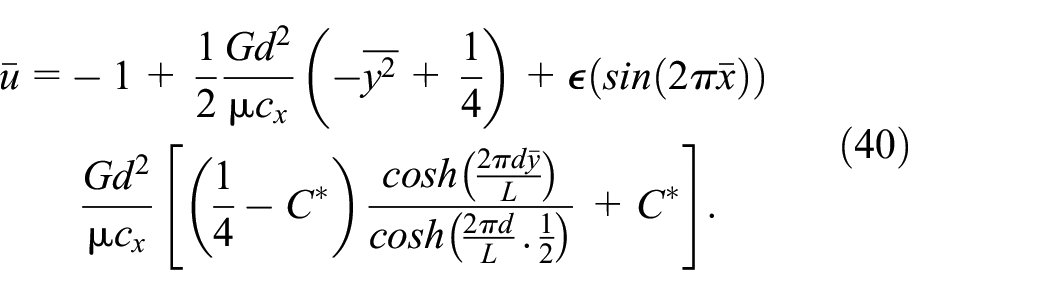
The only remaining issue is to determine the
To solve for


Hence

Results
This section deals with the physical interpretation of the analytical results obtained in Section 3. The velocity of the fluid flow is analyzed. The influence of the imposed pressure on the viscous fluid flow in the corrugated channel is particularly of interest. The 3D-graphical illustration of the modification of the axial velocity in the channel is provided in Figures 2 to 8. These graphs describe the behavior of imposed pressure gradient and the velocity profile of peristaltic flow of a Newtonian fluid with different values of

Velocity profile of

Velocity profile of

Velocity profile

Velocity profile

Velocity profile u for

Velocity profile u for

Velocity profile u for

Velocity profile
The solution that we have generated is quite complicated. The fluid velocity in the x-direction,
Footnotes
Appendix
Handling Editor: James Baldwin
Declaration of conflicting interests
The author(s) declared no potential conflicts of interest with respect to the research, authorship, and/or publication of this article.
Funding
The author(s) received no financial support for the research, authorship, and/or publication of this article.
