



Abstract
Nonlinear partial differential equations are widely studied in Applied Mathematics and Physics. The generalized Burgers-Huxley equations play important roles in different nonlinear physics mechanisms. In this paper, we develop a kind of cubic B-spline quasi-interpolation which is used to solve Burgers-Huxley equations. Firstly, the cubic B-spline quasi-interpolation is presented. Next we get the numerical scheme by using the derivative of the quasi-interpolation to approximate the spatial derivative of the dependent variable and modified Euler scheme to approximate the time derivative of the dependent variable. Moreover, the efficiency of the proposed method is illustrated by the agreement between the numerical solution and the analytical solution which indicate the numerical scheme is quite acceptable.
Keywords
Introduction
Nonlinear phenomena play a crucial role in various nonlinear fields of science which has undergone many studies.1–5 It is known that various phenomena in scientific fields can be described by nonlinear partial differential equations. The Burgers-Huxley equations arise from the mathematical modeling of many nonlinear scientific phenomena.
Consider the following generalized Burgers-Huxley equation (1)

where
when

This equation is a very important fluid dynamic model which has many applications in fields as gas dynamics, number theory, heat conduction, elasticity etc.
when

As we all know, the nonlinear diffusion equations (2) and (3) play an important role in nonlinear physics.
Since the Burgers’ equation was firstly discussed by Bateman 7 in 1915, it had attracted many scholars’ attention.8–11 Hodgkin and Huxley 12 used the Huxley equation to predict the quantitative behavior of a model nerve. The homotopy analysis method was presented to get the analytical solution of the Burgers-Huxley equation (2). In 2013, Kevorkian and Cole 13 introduced a perturbation method to solve nonlinear problems based on perturbation quantity. Malfliet and Hereman14,15 developed the tanh method to derive the exact solutions of nonlinear evolution equations, such as the Kdv equation, the coupled schrodinger-KdV equation and the Kdv-Burgers equation. These exact solutions are impractical for the small values of viscosity constant due to the slow convergence of serious solutions, which were illustrated in the study of Miller. 16 Thus many numerical schemes are constructed to have solutions of the Burgers’ equation for small values of viscosity constant which corresponds to the steep front in the propagation of dynamic wave forms. Hodgkin and Huxley 12 developed an efficient numerical scheme for Burgers’ equation. They apply the multiquadric (MQ) method as a spatial approximation scheme and a low order explicit finite difference approximation to the time derivative. The Galerkin method was used to solve Burgers’ equation with fully upwind cubic functions by Christie and Mitchell. 17 Zhu and Wang 18 constructed a numerical scheme to solve the Burgers’ equation with cubic B-spline quasi-interpolation. Traveling wave solutions of generalized forms of Burgers and Burgers-KdV were obtained with the standard tanh method.3,19 Li and Zhu 20 proposed a multilevel univariate quasi-interpolation scheme which was applied to numerical integration. Bhatti et al.21,22 discussed the effects of heat transfer and Hall current on the sinusoidal motion of solid particles through a planar channel. Zhang et al. 23 studied the three-dimensional nanofluid flow among the rotating circularplates and used a differential transform scheme with the Padé approximation to solve the coupled highly nonlinear ordinary differential equations.
B-splines are generalizations of Bernstein polynomials and share many of their analytic and geometric properties. 24 B-spline curves and surfaces meet smoothly at their joins for completely arbitrary collections of control points. As the B-splines have become a fundamental tool for numerical methods to get the solution of the differential equations, there are a number of authors17,25 who have addressed the splines in the collocation with Galerkin methods for the numerical solutions of the Burgers’ equation. Quasi-interpolation (abbr. QI), especially B-spline quasi-interpolation (abbr. BQI), can be directly constructed without solving linear equations which implied a lot of applications in integration, differentiation and approximation of zeros. 26
In this paper, we provide a numerical scheme to solve the Burgers’ equation using the derivative of the cubic B-spline quasi-interpolation (abbr. CBSQI) to approximate the spatial derivative of the differential equations and employ a modified Euler scheme for the approach of the temporal derivative.
The framework of the paper is organized as follows. Some preliminaries regarding B-spline quasi-interpolation are addressed in Sec.2. In Sec.3, the numerical scheme to solve the generalized Burgers-Huxley equation is proposed. The accuracy and efficiency of our method are verified with two numerical examples in Sec.4. Finally, the paper is completed with a conclusion.
Cubic B-spline quasi-interpolation
Given an interval

for

for
Univariate spline quasi-interpolations can be defined as operators of the form

where
The main advantage of quasi-interpolation is that they have a direct construction without solving any system of linear equations. Moreover, they are local, in the sense that the value of
Given some values of an unknown function

the coefficient functionals are respectively:

For

Let

where

By differential the interpolation polynomials, the finite difference scheme of derivatives can be obtained. There are derivatives in Burgers-Huxley equations, it’s natural to approximate the derivatives of

The values of


Let


then

where
Numerical scheme using cubic B-spline quasi-interpolation
In this section, we construct the numerical scheme for solving Burgers-Huxley equation (1) with the cubic B-spline quasi-interpolation in space and modified Euler method for time. This scheme reduces the equation into a system of first-order ordinary differential equation (ODE) which is solved by modified Euler scheme. The efficiency of the proposed method is illustrated by two numerical experiments, which confirm that obtained results are in good agreement with earlier studies. This scheme is an easy, economical and efficient technique for finding numerical solutions for various kinds of (non)linear physical models as compared to the earlier schemes.
Discretizing Burgers-Huxley equation (1) with modified Euler scheme in time, we obtain
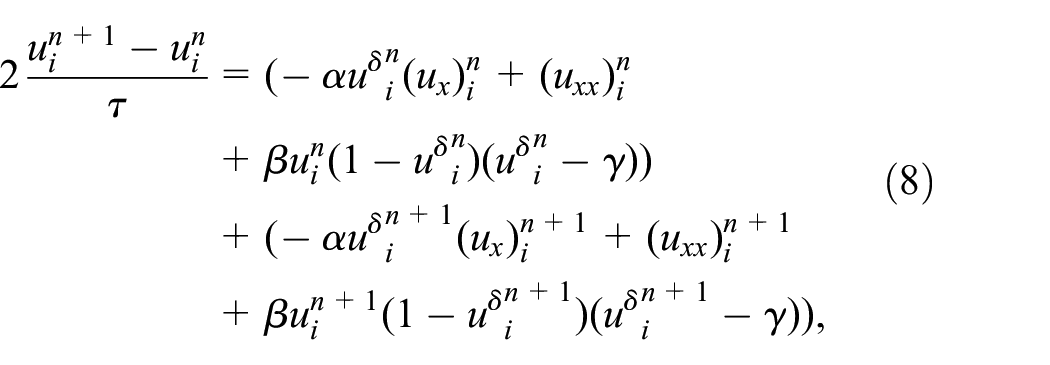
where

where

where
Numerical examples
In this section, we test the algorithm by two examples. To verify the feasible of our scheme, we compare the computational results to that of analytic solutions.

with the analytical solution [2]

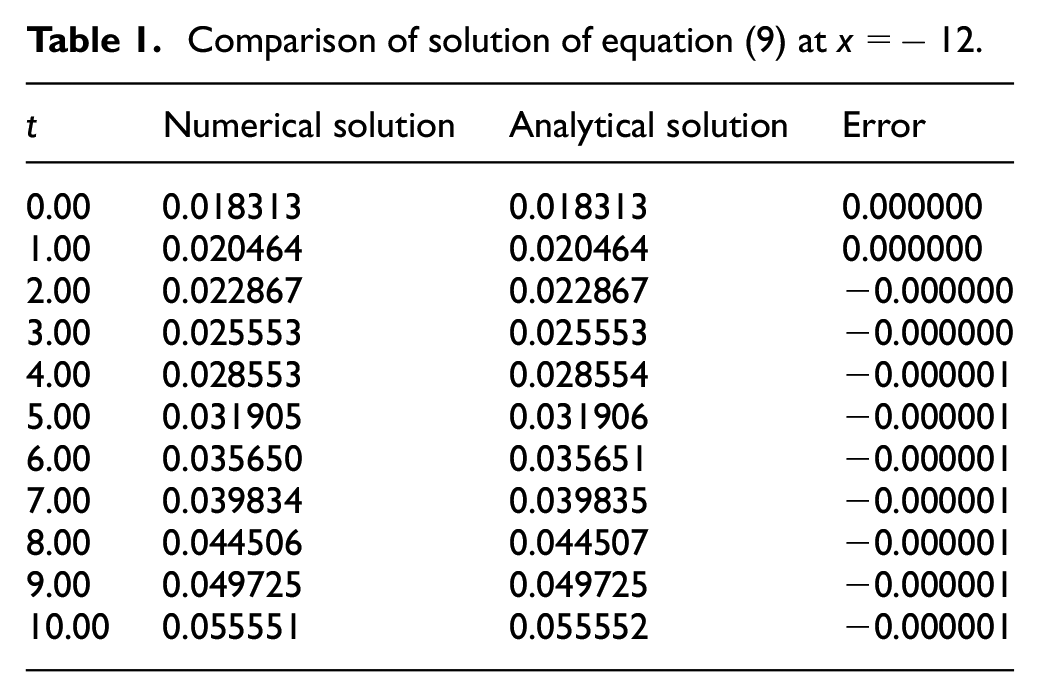
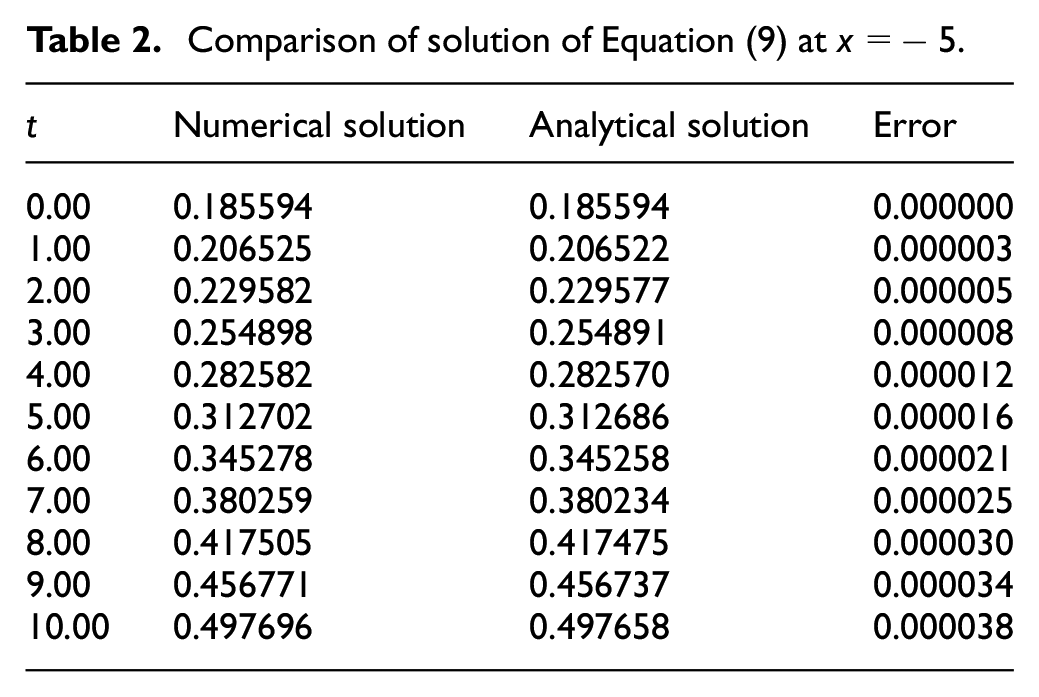
The versatility and the accuracy of the proposed method are measured by the difference between numerical solutions and analytical solutions. The numerical solutions and errors (Analytical-numerical) of equation (9) at

Numerical solutions and errors to equation (9) for

Numerical solutions and errors to equation (9) with CBSQI in 3D.
Comparison of solution of equation (9) at
Comparison of solution of Equation (9) at
Comparison of solution of equation (9) at
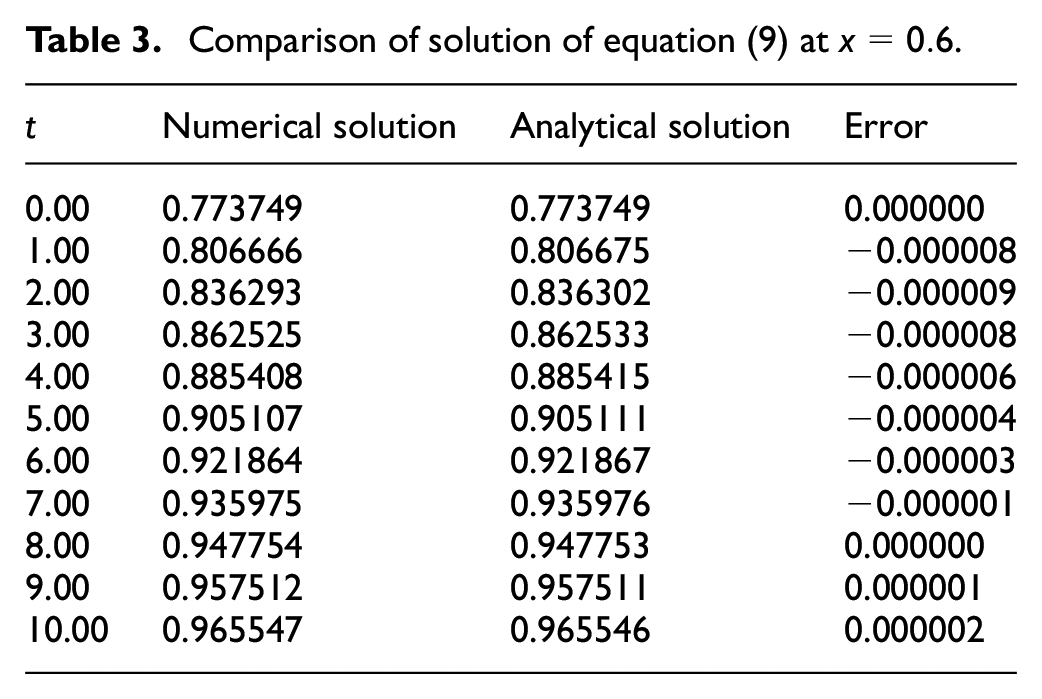
Comparison of solution of equation (9) at

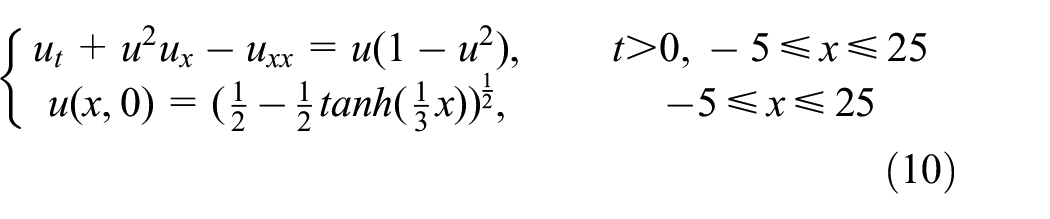
with the exact solution [2]

The comparison of the numerical solution and the analytical solution at
Comparison of solution of equation (10) at

Comparison of solution of equation (10) at

Comparison of solution of equation (10) at


Numerical solutions and errors to equation (10) for
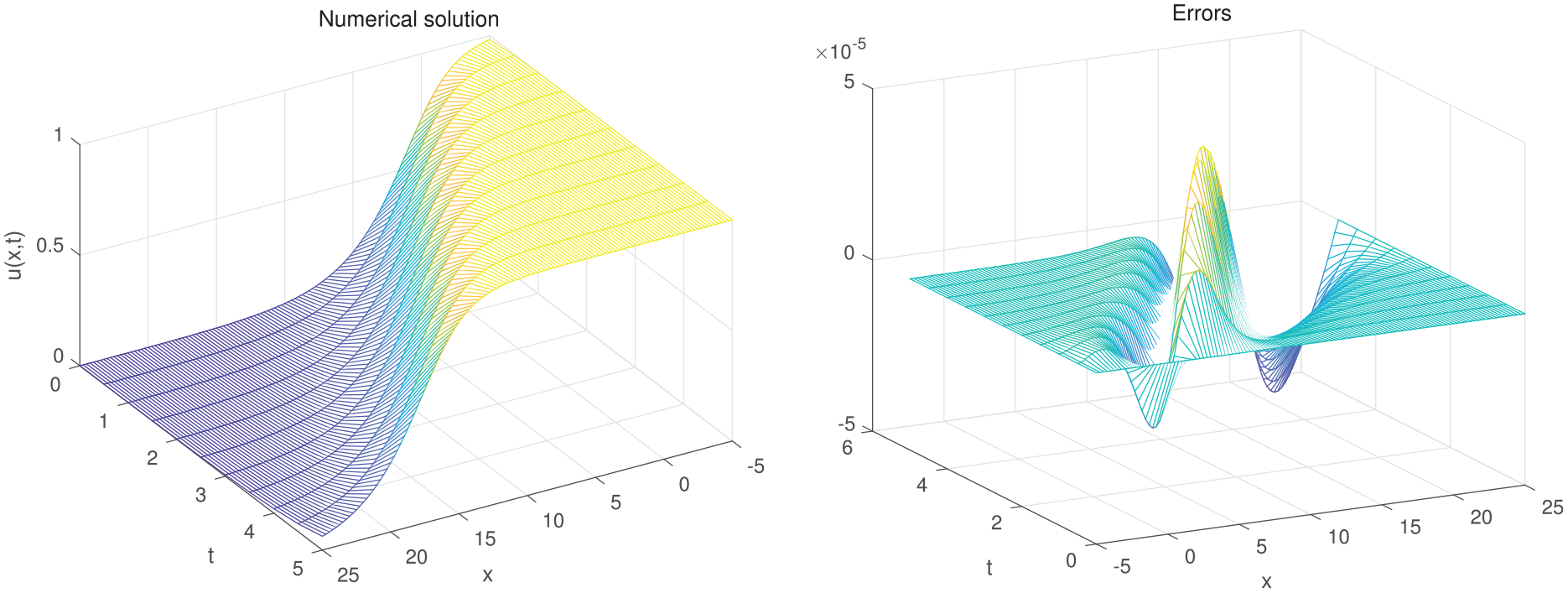
Numerical solutions and errors to equation (10) with CBSQI in 3D.
Conclusions and further work
In this paper, we develop a kind of cubic B-spline quasi-interpolation and use it to solve Burger-Huxley equation. The accuracy and efficiency of derived numerical scheme have been nicely validated through numerical examples which confirm that obtained results agree well with the analytic solutions. There are some valuable aspects that deserve further exploration in our future work. (i) how to analyze the stability of the numerical scheme. (ii) how to generalize the quasi-interpolation scheme to solve high dimension PDE. These research topics are more challenging.
Footnotes
Handling Editor: James Baldwin
Declaration of conflicting interests
The author(s) declared no potential conflicts of interest with respect to the research, authorship, and/or publication of this article.
Funding
The author(s) disclosed receipt of the following financial support for the research, authorship, and/or publication of this article: This work is partly supported by the National Natural Science Foundation of China (Nos. 11801490, 11671068).
