




Abstract
Objective:
Many methods have been used to maximize the capacity of heat transport. A constant pressure gradient or the motion of the wall can be used to increase the heat transfer rate and minimize entropy. The main goal of our investigation is to develop a mathematical model of a non-Newtonian fluid bounded within a parallel geometry. Minimization of entropy generation within the system also forms part of our objective.
Method:
Perturbation theory is applied to the nonlinear complex system of equations to obtain a series solution. The regular perturbation method is used to obtain analytical solutions to the resulting dimensionless nonlinear ordinary differential equations. A numerical scheme (the shooting method) is also used to validate the series solution obtained.
Results:
The flow and temperature of the fluid are accelerated as functions of the non-Newtonian parameter (via the power-law index). The pressure gradient parameter escalates the heat and volume flux fields. The energy loss due to entropy increases via the viscous heating parameter. A diminishing characteristic is predicted for the wall shear stress that occurs at the bottom plate versus the time-constant parameter. The Reynolds number suppresses the volume flux field.
Keywords
Introduction
A fluid that does not obey Newton’s law of viscosity is called a non-Newtonian fluid. Non-Newtonian fluids are more complex than Newtonian fluids because of the nonlinear relationship between their shear rates and shear stresses. Many common solutions and polymers, including ketchup, toothpaste, mud, blood, starch suspensions and paints, are examples of non-Newtonian fluids.1–3 Because of the extensive number of roles of non-Newtonian fluids in the chemical, production and manufacturing industries, a diverse range of research has been published in the literature in this context.4–7
The tangent hyperbolic fluid is a non-Newtonian fluid that was established for use in biochemical and engineering systems. Because of its physical robustness and simplicity when used in computations, this model offers distinct benefits when compared with other non-Newtonian models. The formulation of this model is based on the kinetic principle of fluids rather than an empirical relationship. The shear thinning phenomenon in non-Newtonian fluids can be described well using the tangent hyperbolic fluid model. The magnetohydrodynamic (MHD) flow of a tangent hyperbolic fluid over a porous sheet was observed by Patil et al. 8 They used the shooting method to solve the complex equations involved. They were able to capture the physical behavior of important physical quantities such as the Nusselt number, the Sherwood number and the skin friction. An analysis of the heat and flow transfer of tangent hyperbolic fluids was performed by Gaffar et al. 9 They considered the flow from a sphere and provided results for the effects of the Prandtl number, the Biot number, the power-law index and the Weissenberg number on the temperature and velocity fields in detail. The combined properties of the magnetic field and viscous dissipation on the flow of a tangent hyperbolic fluid over a stretching sheet were captured by Hussain et al. 10 They computed their analytical and numerical results with the aid of the shooting and homotopy analysis methods.
A porous medium or material is a surface that contains voids (pores), which can then be filled by the fluid. Porous media have a number of applications in engineering and technology, including packed absorption systems, fluid filtration, catalytic reaction systems, heat exchangers, distillation towers, ion exchange columns and transpiration cooling systems.11–15 Khan et al. 16 performed a numerical study of the behavior of a Carreau-Yasuda liquid that was subject to irreversibility and activation energy effects over a stretched surface. The mass and heat transfer characteristics of micropolar fluids with porous media were examined by Mohanty et al. 17 The effects of the porous parameter, the Eckert and Prandtl numbers and the unsteady parameter on the flow, concentration and temperature fields were discussed in their work. A numerical investigation of the effects of magnetic fields and thermal radiation on nanofluids in a parallel porous geometry was performed by Kothandapani and Prakash. 18 Prasad et al. 19 developed a mathematical model to explore the heat transfer effect of a non-Newtonian fluid through a porous wall. Hosseinzadeh et al.20–22 reported the impact of hybrid nanoparticle flow over stretching sheets and cylinders and the effects of a porous medium. Rostami et al. 23 selected two temperature models to perform a hydrothermal analysis of nanofluid flow through a cavity. A study of the Maxwell fluid model that considered nonlinear thermal radiation was also presented by Hosseinzadeh et al. 24
In recent times, the major challenge in various industrial processes has been to address energy losses. The attention of many researchers has shifted toward entropy generation in the flow of non-Newtonian fluids. Applications of entropy generation can be found in heat exchangers, pumps and electronic cooling systems. Research scientists and engineers have been working to find methods to control the waste of useful energy. For this purpose, the second law of thermodynamics is the best, most accurate and important tool for optimization of a given system. Using the work of Bejan 25 as a basis, various investigations into reduction of entropy generation based on the second law of thermodynamics have been presented in the literature. Waqas et al. 26 and Wang et al. 27 investigated the flow of viscous fluids over variable and plate surfaces from the perspectives of two hybrid nanoparticles, i.e. graphene oxide and copper, with a Darcy–Forchheimer porous medium in terms of thermal radiation, entropy generation, and magnetohydrodynamics. Astanina et al. 28 studied the combined effects of entropy generation and natural convection on ferrofluid flow in a cavity thorough porous media. Sivaraj and Sheremet 29 explored the effects of entropy generation and magnetohydrodynamic natural convection on ferrofluids. They used a uniform mesh-dependent method to solve the problem numerically. Reddy et al. 30 presented an entropy generation analysis for the flow of a viscoelastic fluid over a vertical cylinder and observed that entropy generation was minimized by increasing the viscoelastic parameter. Yin et al. 31 and Mukherjee et al. 32 worked on the heat transport characteristics of nanomaterials in flow boiling and the thermophysical characteristics and flow boiling performance of nanomaterials in a horizontal tube, respectively. Continuous generation of entropy in the blood flow of a micropolar fluid through a channel was investigated by Asha and Deepa. 33 They obtained expressions for the velocity, magnetic field, stream function, current density and entropy generation in their work.
An exclusive review of entropy generation and tangent hyperbolic fluids reveals that entropy analysis using a tangent hyperbolic fluid inside a porous heated horizontal channel has not been explored to date. Therefore, the main target of this study is to develop a mathematical analysis to reduce the energy losses due to continuous entropy generation for a tangent hyperbolic fluid inside the porous heated walls of a channel. The perturbation method is used by the authors to compute the results in a simple and easy manner. A graphical representation of the results is also presented. The effects of emerging parameters and their physical interpretations on the most important quantities are discussed in detail. Furthermore, the perturbation results are also validated with the aid of an iterative scheme and the absolute error is listed in tabular form. References [34–45] highlight the effects of fluid flow from the viewpoints of various flow diagrams.
Mathematical analysis
Consider the steady-state incompressible one-dimensional flow of a non-Newtonian fluid between the porous heated plates of a channel in which the thermal conductivity and viscosity are taken to be uniform. We assume that the two plates are set apart at a distance of


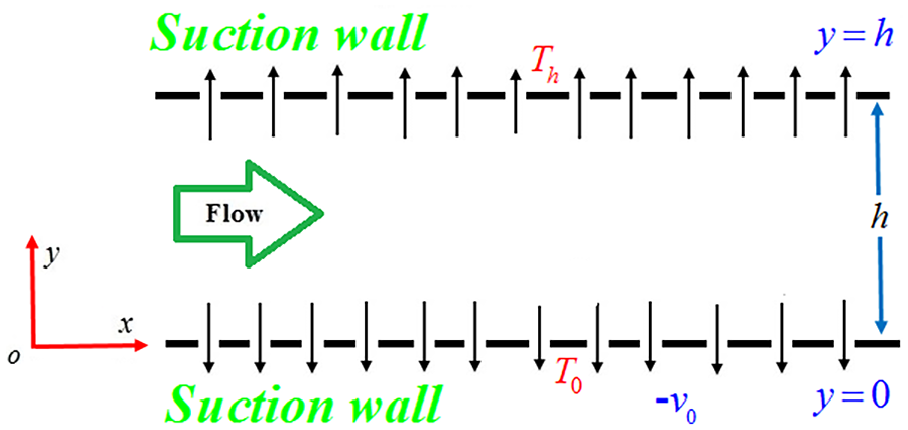
Systematic flow diagram.
The continuity and linear momentum equations are defined as: 19


The Cauchy stress tensor

The stress tensor

Additionally,

where

Because

then for the present case, we obtain

where
By substituting equation (10) into equation (7), we obtain

By substituting the values calculated above into equation (8) and subsequent simplification, the stress tensor becomes

Linear momentum equation
In view of our assumptions above, the momentum equation for the current problem can be written as

By defining the following normalized quantities, the dimensionless equation of motion can then be obtained:

By inserting the dimensionless quantities above into equation (13) and assuming the viscosity of the fluid to be constant, we obtain the dimensionless equation of motion as follows:

The final form of the dimensionless momentum equation is


where
Energy equation
The energy equation for the current problem can be written as:

The heat generation (absorption), Joule heating and radiative heat flux effects are not considered in the energy equation above.
Using equations (9) and (12), we obtain

By inserting equation (20) into equation (19), we then obtain the following dimensional form of the energy equation:

By using the dimensionless quantities given in equation (14) above and taking the viscosity to be a constant, we obtain the normalized form of the energy equation as follows:

The final form of the dimensionless energy equation with boundary conditions is defined by



where
Perturbation method
The governing equations (16)–(18) and (23)–(25), which represent the flow of the fluid, are nonlinear ordinary differential equations and it is not possible to obtain closed form solutions to these equations. Therefore, we are interested in finding approximate analytical solutions. For this purpose, we opted to use the regular perturbation method. 41 Approximate analytical solutions are obtained for the flow and temperature distributions using the following perturbation expansions:

where


The solution to equation (27) can be obtained easily and by making some simplifications, we then obtain

By inserting equation (33) into equation (30), we obtain the solution to the correction term in the following form:

To find the final expression for the velocity profile, we substitute equations (33) and (34) into equation (26). We then obtain the following final form for the velocity distribution:

Next, to determine the analytical solution to the temperature equation, we insert equation (26) into equations (23)–(25) and obtain the following systems for each order of



After making appropriate simplifications, the solution for the temperature for order

and the solution for the temperature for order

By substituting equations (42) and (43) into equation (26), we obtain the following final form for the temperature distribution:

Volume flux
The expression for the volumetric flow field in normalized form can be expressed as:

By inserting the value of

Then, by integrating from zero to one, we obtain the following analytical expression for the volumetric flow rate:

The equation above is the volumetric flow rate required for our current exploration.
Wall shear rate
The formula for the wall shear rate can be written as

By inserting the value of

The equation above in normalized form is given by:

The wall shear rate at the lower wall is denoted by

The wall shear rate at the upper wall is denoted by

Equations (51) and (52) are thus the expressions required for the skin friction coefficients at the lower and upper walls of the channel, respectively.
Heat flux
The heat flux is another important physical quantity and is given by the following formula:


By inserting the values

The heat flux quantity is given in normalized form by

The heat flux at the lower wall is denoted by

The heat flux at the upper wall is denoted by
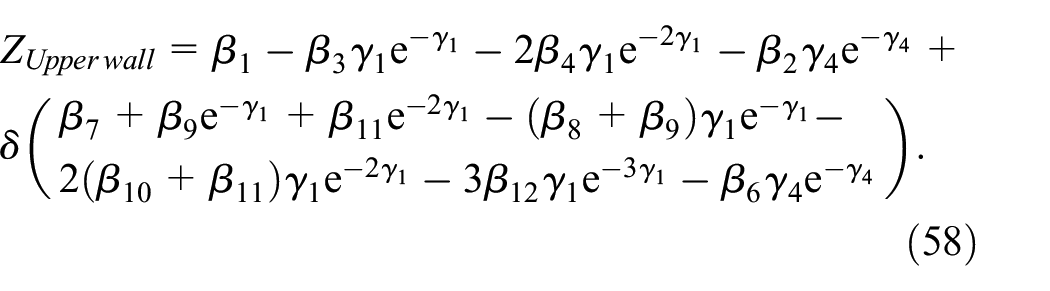
Equations (57) and (58) are the final expressions for the heat transfer rates at the lower and upper walls, respectively.
Entropy analysis
The dimensionless expressions for the total entropy generation


Numerical solution
To validate the perturbation solution for the current problem, the numerical solution with the absolute error is also calculated (as given in Table 1 ). The numerical and analytical solutions to the current problem are clearly in good agreement with each other. The numerical solution is achieved here using the shooting method, which is based on the fourth-order Runge–Kutta method. The missing conditions are determined via use of the secant iterative scheme. Our system is based on nonlinear ordinary differential equations and the shooting method is thus selected because of its excellent convergence. A detailed discussion of the shooting method is available in the literature.46,47
Comparative study results.
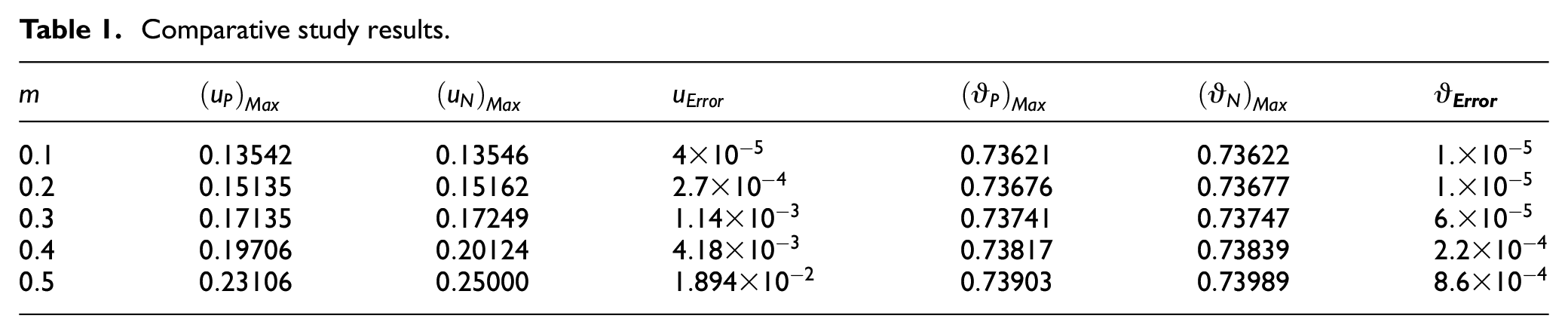
Comparison with previous study
We have matched our calculation results with the results reported by Gupta and Massoudi
48
for the uniform viscosity model case. Gupta and Massoudi
48
discussed a generalized second grade fluid between two heated walls for the cases of Newtonian
Comparison with the results of Gupta and Massoudi
48
when

Physical interpretation of results
This section includes a discussion of the physical behavior of the emerging parameters, i.e. the power-law index

Variations in flow and temperature for various values of power law index m along channel height y.

Variations in temperature for various values of Peclet number γ4, along channel height y.

Variations in volume flux profile for various values of “Reynolds number Re” and “pressure gradient parameter P” along power law index “m”.

Variations in wall shear rate for various values of dimensionless time constant parameter “delta” along power law index “m”.
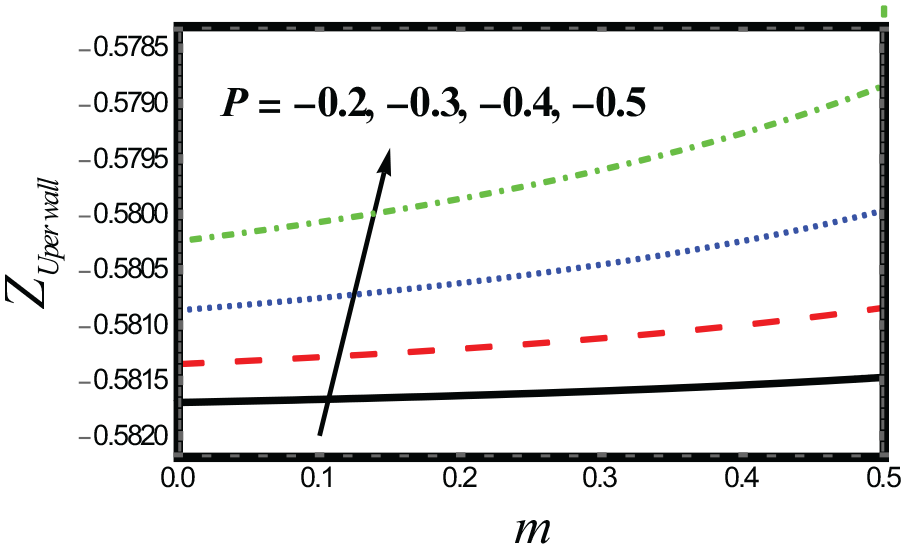
Variations in heat flux profile for various values of P along m.

Variations in total entropy generation for various values of (a) power law index “m” and (b) “time constant parameter δ” along channel height y.

Variations in total entropy generation for various values of (a) viscous heating parameter γ5 and (b) “temperature difference parameter Ω” along channel height y.

Variations in total Bejan number for various values of (a) power law index “m” and (b) “pressure gradient parameter P” along channel height y.
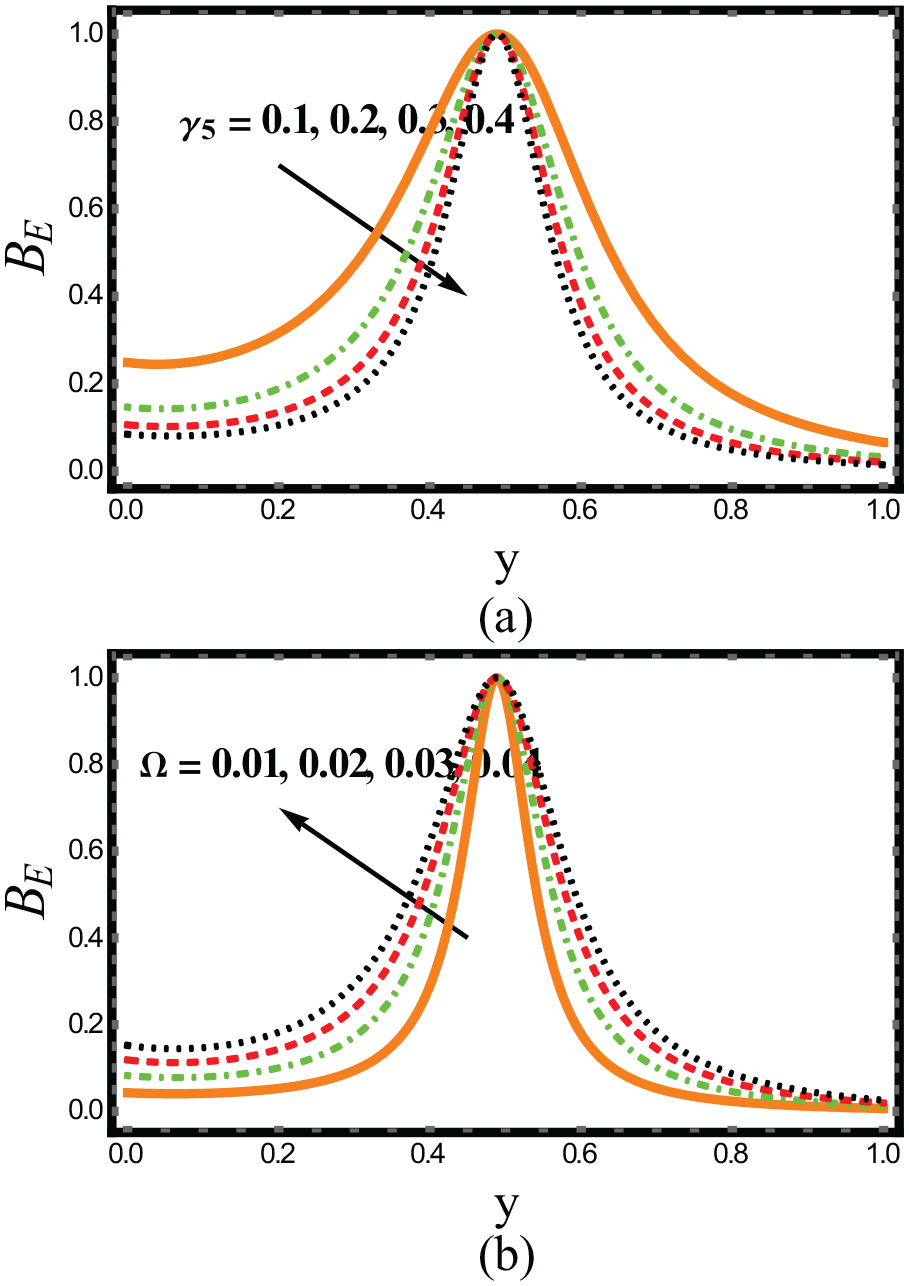
Variations in total Bejan number for various values of (a) viscous heating parameter γ5 and (b) “temperature difference parameter Ω” along channel height y.
Flow and temperature distribution
Figure 2 portrays the trends in the flow and temperature of the fluid using various values of the power-law index parameter. The figure shows that enlarging the value of the power-law index parameter causes both the flow and the temperature of the fluid to increase. This occurs because, for increasing values of
Volume flux
The Reynolds number and the pressure gradient parameter have opposite effects on the volume flux field (see Figure 4). When the value of the Reynolds number increases, it causes flow instability, with the flow even becoming turbulent at larger values; this instability reduces the volume flux rate. In contrast, an increase in the pressure gradient parameter is shown to enhance the volume flux field. It is obvious that when the value of
Skin friction coefficient
Figure 5 illustrates the effect of the time-constant parameter on the skin friction field. It is observed that increases in the time-constant parameter value lead to strong reductions in the
Heat flux
Increases in the values of
Entropy generation
Figures 7 and 8 illustrate the effects of the parameters involved on the entropy generation profile. Increasing the value of
Bejan number
The effects of the pertinent parameters on the Bejan number are illustrated in Figures 9 and 10. It is shown that increases in the power-law index parameter cause the Bejan number to decrease and that an extreme elevation in the profile is observed at the center of the channel (see Figure 9(a)). It is also observed that increasing magnitudes of
Concluding remarks
This investigation describes a heat irreversibility analysis for a tangent hyperbolic fluid between heated plates. The main conclusions drawn from the current investigation are summarized as follows:
The power-law index parameter enhances the flow and temperature of the fluid.
The pressure gradient parameter enhances the volume and the heat flux but reduces the Bejan number.
The wall shear rate at the bottom plate diminishes as the time-constant parameter increases.
Entropy generation is enhanced via increases in the power-law index parameter, the viscous heating parameter and the time-constant parameter.
Increases in both the power law index parameter and the pressure gradient parameter reduce the Bejan number.
In the case of the Bejan number, the maximum height of the number profile is observed at the center of the channel.
Footnotes
Appendix
Handling Editor: James Baldwin
Declaration of conflicting interests
The author(s) declared no potential conflicts of interest with respect to the research, authorship, and/or publication of this article.
Funding
The author(s) received no financial support for the research, authorship, and/or publication of this article.
