




Abstract
Nanoparticles of carbon has auspicious uses in a biomedical procedures like energy storage, catalyst supports, biomedical, in drug targeting system, in cancer treatment, in biological therapy, in blood diagnostic and coagulation systems. Motivated from these processes, peristalsis features have been accounted to study the mixed convection of the nanofluid, that is, Carbon-water in a vertical type channel with symmetric walls. Heat transport of magneto-hydro nanoliquid flow inside porous media is scrutinized. Single wall and multiwall Carbon nanotubes with water based nanoparticles are considered. Viscosity is prescribed as variable. The channel boundaries satisfy wall compliant and slip condition. Heat generation or absorption term is present. Assumptions of small Reynolds number along with long wave length are implemented for mathematical modeling. Transformed form of flow equations are evaluated by using numerical scheme. Through different parameters, graphical behaviors of temperature and velocity are displayed and elaborated. Moreover heat transfer rate is computed. Results revealed that for larger
Keywords
Introduction
Different studies related to peristalsis phenomenon have been addressed because of its importance in numerous processes of biological and industrial. Additionally, it has its significance due to unique characteristics of asymmetric and symmetric channel walls, that is, compulsion and contraction. In fact, this mechanism has another property in which the channel walls able to push and propagates the substance/material along the tube channel walls. The transport processes such as motion of chyme via gastrointestinal tract, food particles movement through digestive tract, urine via kidneys toward bladder etc. show the importance of peristalsis. Beside that dialysis machine, heart lung machines, hose-roller pump etc. are few industrial applications. Such (peristaltic) motions have connection with nano-fluids are utilized in modern system of drug delivery. Due to large utilization of peristalsis phenomenon, Latham 1 as well as Shapiro et al. 2 are the initiator who formulated peristalsis phenomenon by taking presumption of long wavelength and discussed in detail theoretical and numerically. Abbasi et al. 3 disclosed the dissipative effect in peristaltic movement of nanomaterial with Hall effects. Akbar et al. 4 discussed the slip features in peristaltic magneto flow of nanomaterial. Hayat et al. 5 depicted varying viscosity features in peristaltic nanofluid flow under the magnetic influence. Prakash et al. 6 described the peristaltic radiative flow of hydro-magnetic nanoliquid via asymmetric channel. Rafiq et al. 7 discussed the slip impact in peristalsis of nanomaterial under the Hall effects. Varying liquid properties in nanifluid motion driven by peristalsis is studied by Abbasi et al. 8 The Irreversibility analysis in hydro-magnetic peristalsis considering varying properties is discussed by Farooq et al. 9 Asha and Sunitha 10 reported the Hall impacts on nanofluid flow under the influence of peristalsis phenomenon. Sheriff et al. 11 examined peristalsis propulsion of nano particle flow in a channel having temperature dependent viscosity effects. Imran et al. 12 discussed the peristalsis driven chemically reactive flow under the slip phenomenon. Ahmed et al. 13 depicted the hydro-magnetic bio-liquid flow in curved geometry with peristalsis.
Nanofluids have gained much significance with the emergence of modern day technology. Among the extensive class of nanofluids, carbon nanotube (CNTs) have special place in it. In the antitumor therapy field, carbon nanotubes play great role in therapy. CNTs behave as a promising material which act as nano-carrier for anticancer drugs. Carbon nanotubes can be characterized as single and multi-walled CNTs. They are able to minimize toxicity, augment the half-life of drug, retrain their activity and stability enhancement in biological environment. CNTs have a properties of being metallic and semi conductivity which make CNTs a suited material for numerous applications like food safety, clinical diagnostic, environmental monitoring. Beside that carbon nanotubes very helpful in rapid enhancement in heat transfer process. Thermo- dynamical features of blood may impact the processes such as hemodialysis and the oxygenation when the blood is taken out from the body. Akbar et al. 14 explained the peristaltic darcian flow of tube shaped carbon nanoparticles suspended in copper oxide/water based nanoliquid in porous channel. Shahzadi et al. 15 reported the varying viscosity effects in carbon nanotubes (SWCNT) flow driven by peristalsis phenomenon under the wall characteristics impacts. Javed et al. 16 suggested the peristaltic transportation of single and multi-walled CNTs radiative nanofluid in asymmetric type channel. Nasir et al. 17 examined the convective heat transport in slip flow of radiative single- walled CNT deformed by stretchable disk under magnetic effects. Raza et al. 18 examined the hydro-magnetic nanomaterial flow in porous configuration under the peristalsis mechanism with carbon nanotubes. Farooq et al. 19 disclosed the Newtonian heating impacts in various CNTs flow caused by peristalsis transport with entropy effects. Anuar et al. 20 illustrated the CNT suspended nanomaterial flow deformed by vertical held moving porous sheet. Masood et al. 21 discussed the dissipative effects in MHD nanomaterial flow over stretchable sheet. Siddiq and Ashraf 22 described the double diffusive impacts in micropolar nanoliquid under bio-convection. Hasona et al. 23 discussed the radiative peristaltic transportation in nanofluid under magnetic impacts.
Fluids flow in environmental system either in natural way or in artificial means such as chemical reactors, petroleum reservoirs, flow of water in oceans and lakes, capillaries circulation, composites manufacturing process, filter plants etc., proceeds through porous space. Porous medium be found as a consequence of transmutation of medium structure via deposition, expanding/shrinkage of land, erosion, sand dunes formation etc. Literature revealed that Darcy 24 initiated the work in this direction by considering flow analysis through porous medium. However, very less focus has been paid on the peristalsis analysis via porous medium in channel having symmetric nature. Akbar et al. 25 explained flow of magneto suspended carbon nanotubes through porous channel under peristalsis flow phenomenon. Javed et al. 26 discussed the peristaltic magneto flow through the permeable-saturated channel. Makinde and Reddy 27 described the peristaltic magneto flow of Casson liquid in permeable vertical type channel under slip phenomenon. Hayat et al. 28 explained the peristaltic non-darcian motion of magneto Jeffrey liquid including activation energy. Ahmad et al. 29 disclosed the darcian reactive flow of convective squeezed fluid with activation energy impacts. Vaidya et al. 30 displayed the varying features of fluid in magneto-hydro fluid flow caused by peristalsis through permeable channel. Imran et al. 31 disclosed the peristalsis phenomenon in non-Darcy features of permeable channel. Hasona et al. 32 suggested the peristalsis driven flow of MHD nanomaterial in asymmetric type porous channel. Riaz et al. 33 disclosed the slip features in peristalsis driven nanoliquid through curved permeable channel. Kotnurkar and Giddaiah 34 explored the porosity impacts in peristaltic MHD nanomaterial flow under diffusion effects.
The current attempt depicts the peristaltic motion of water based suspended carbon nanotubes with variable viscosity subjected to symmetric channel. The flow kinetics additionally includes magneto-hydrodynamics, and mixed convection effects. Heat generation/absorption significance is implemented by energy equation. The impact of porous (Darcy) medium is also utilized in flow phenomenon. The slip condition in terms of velocity is retained. The transformed flow model is solved with numeric technique. The flow and temperature fields under the emerging parameters are analyzed through graphs. Moreover, graphical results are also illustrated for heat transfer rate. The objective and notable novelty of this attempt is the application of the carbon nanotubes suspended hydro-magnetic nanomaterial along with the porosity effect for symmetric channel which not yet exist in unfolded literature. This mathematical model has applications in energy storage, chemical reactors, catalyst supports, petroleum reservoirs, biomedical, platelet activation, cancer treatment, tissue regeneration, capillaries circulation, filter plants and many others.
Mathematical description
Peristalsis transport of nanoparticles, that is, carbon nanotubes both single and double-walled emerged in water as base liquid is considered through a symmetric porous channel of width ‘a’. The flow is considered here laminar, unsteady and two-dimensional for the incompressible nanofluid. Variable features (viscosity) along with magnetic field are accounted. The expression for varying viscosity with respect to temperature is as follows:

Here,

here,

Flow diagram.
Thus, following transformation is implemented to shift from laboratory to wave frame as:

The conservation laws governing the fluid flow in wave frame are described as:


Here,


In above mentioned equations,
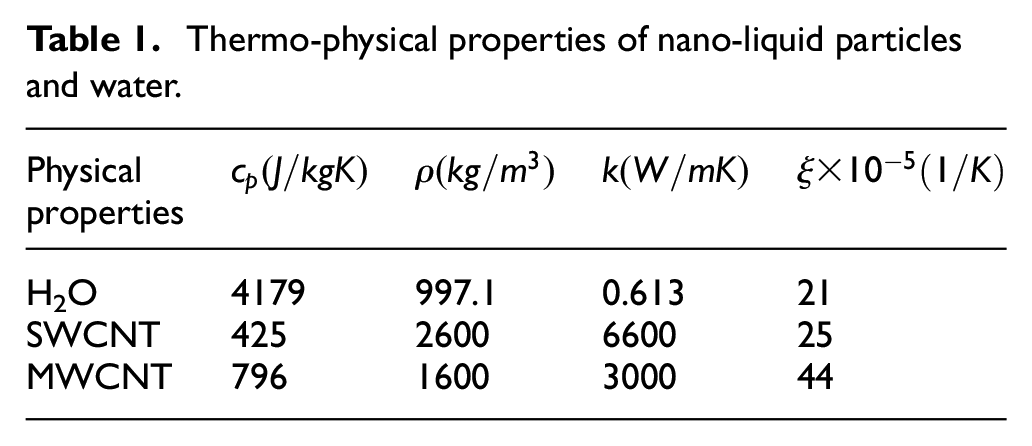
Thermo-physical characteristics of nanoparticles carbon nanotubes and water are addressed in Table 1.
Thermo-physical properties of nano-liquid particles and water.
Now introducing the dimensionless variables:

Here, the
The given definition is implemented to non-dimensional the above flow system:

In view of relation (3), dimensionless suitable variables (12), in the term of stream function, the velocity component (13) and low Reynolds number and large wave length assumptions (2) which satisfies automatically, the following dimensionless system under the considered constraint is attained as follows:


In view of equation (14), equation (16) becomes


subjected to dimensionless conditions on boundary are 4 :



The imposed conditions

In addition to this, magnetic field effects vanishes when
Results and discussion
A promising class of Nano fluid, that is, carbon nanotubes has been considered in the peristalsis analysis by using water as based fluid. The novel concepts of channel flow like slip at boundary wall, porosity, and symmetric configuration is considered. The transformed dimensionless equations are treated numerically by ND-Solve in Mathematica. This methodology has advantage because it selects appropriate algorithm and automatically track any possible error. Further, such procedure provides better computing outcomes with minimal CPU time (3–4 min) per evaluation. In fact, graphical descriptions are directly provided and avoided intricate solution expressions by such method. However, this method incorporates Shooting technique which provides graphical descriptions utilizing minimal to maximal range. For this, we adopted 2nd order of approximation and tolerance

Impact of

Impact of

Impact of
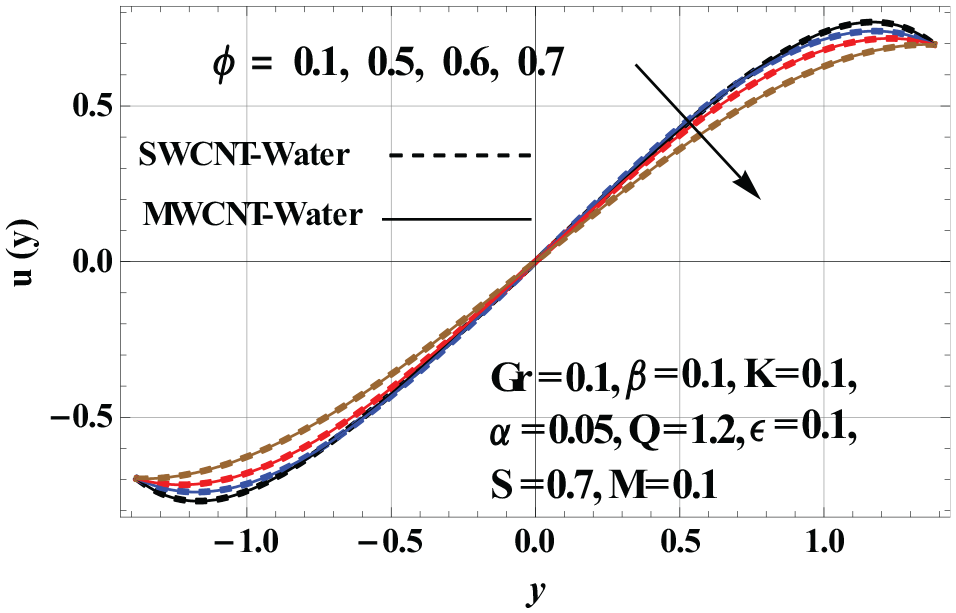
Impact of
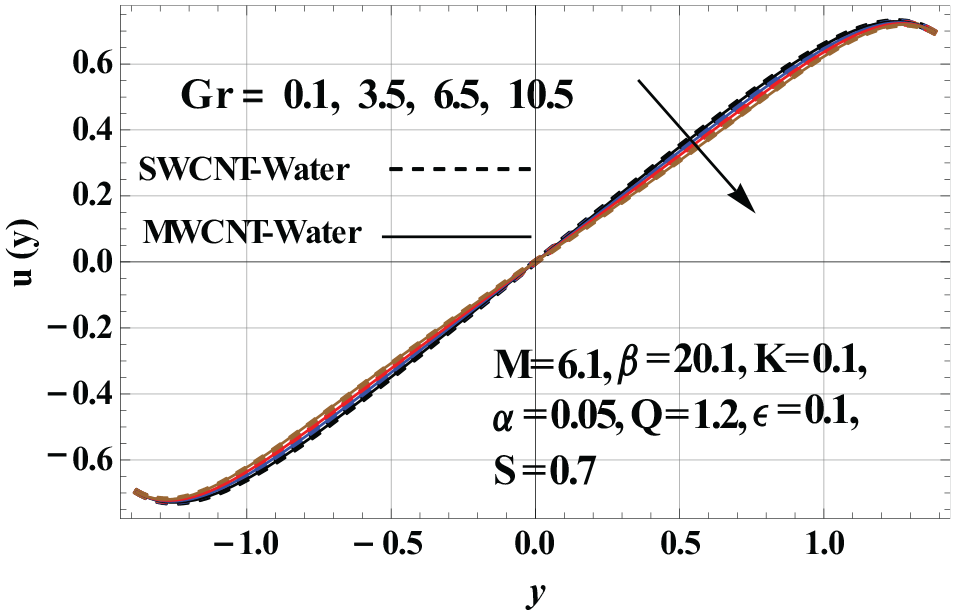
Impact of
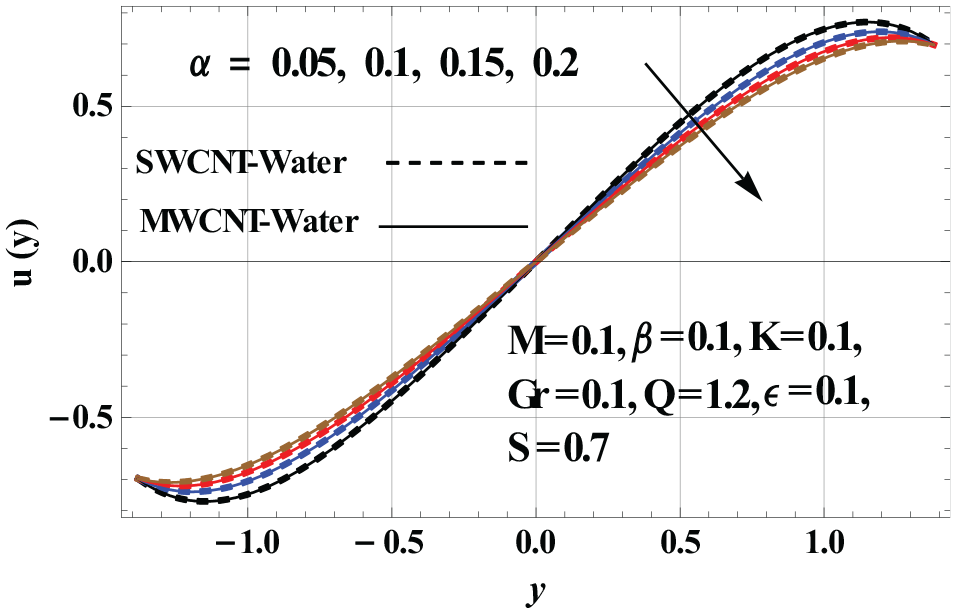
Impact of
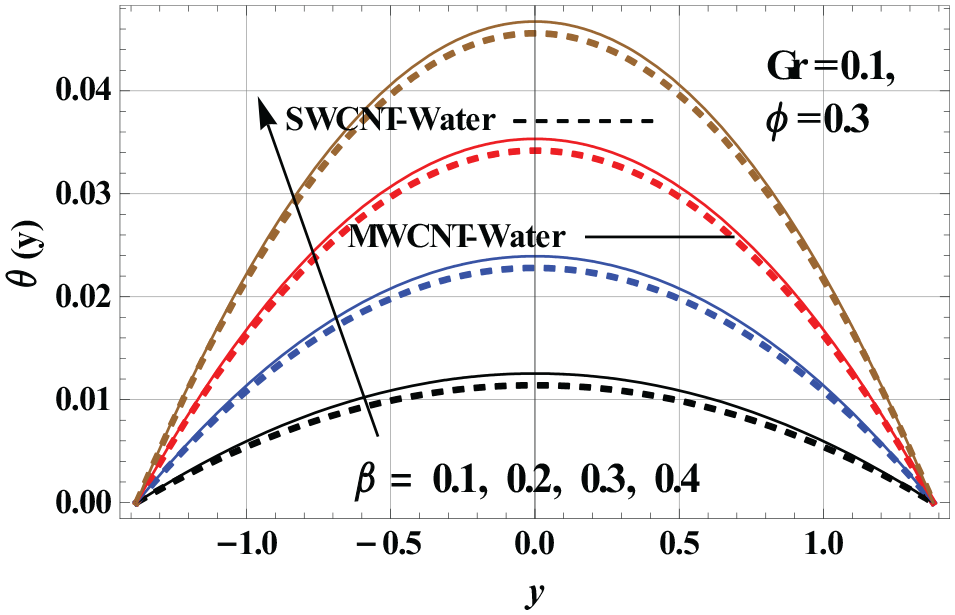
Impact of

Impact of

Impact of

Impact of

Impact of
Conclusions
Heat transport in mixed convection magneto nanomaterial flow with varying viscosity inside permeable media is communicated here. The mixture of carbon nanotubes in water is incorporated as a working fluid under the slip phenomenon. Here, the notable novelty of this attempt is the application of the carbon nanotubes suspended hydro-magnetic nanomaterial along with the porosity effect for symmetric channel which not yet exist in open literature. The results are reported graphically using NDSolve command. The results report that velocity and temperature against the dominating values of physical parameters are larger for MWCNT-water nanoparticles as comparative in the case of SWCNT-water nanoparticles.
Further, the key points are listed as follows:
Hartmann number and slip parameter enhance the velocity in lower part of channel and decline is observed in upper part of channel.
The higher Darcy number improves the velocity in upper part and decays in lower part of channel.
Temperature is enhanced in case of heat generation and reduces in the situation of heat absorption.
The reduction in nanoparticles volume fraction values correspond to weaker temperature field.
Footnotes
Handling Editor: James Baldwin
Declaration of conflicting interests
The author(s) declared no potential conflicts of interest with respect to the research, authorship, and/or publication of this article.
Funding
The author(s) received no financial support for the research, authorship, and/or publication of this article.
