




Abstract
Ultrasonic-assisted transient liquid phase bonding of pure Cu with Sn-In solder was realized at 140°C in air. Shear test was carried out on the weldment. The effect of ultrasonic vibration on microstructure and mechanical properties of the weld seam was studied. The relationship between the formation of intermetallic compounds and their mechanical properties was analyzed by means of electronic scanning and element analysis. (Sn) solid solution, ε(Cu3Sn), η(Cu6Sn5), Cu10Sn3, Cu11In9, Cu9In4, γ, β phase were detected in the weld seam. When the ultrasonic vibration time is 30 s, the shear strength reached a maximum of 22.76 MPa. The fracture occurred on the surface of the fine-grained η(Cu6Sn5) phase. The fracture surface was partially covered with coarse-grained Cu11In9 phase, which belonged to a brittle fracture.
Introduction
Transient liquid phase (TLP) bonding 1 is a potential method to improve the reliability of joints, which is used in the electronic and microelectronic assembly applications at low welding temperatures. However, the presence of surface oxide film hinders the diffusion of the elements, and a vacuum environment and a long welding time is required. 2 The related researches 3 reported that, the above problems could be solved by introducing ultrasonic vibration. Ultrasonic vibration can produce the acoustic softening effect in solid medium, 4 which contributes to the breakage of surface oxide film. In addition, ultrasonic cavitation effect and acoustic streaming effect are existed in the liquid medium, 5 promoting the elemental diffusion.
Nowadays, magnesium alloys, 6 aluminum-based composite materials, 7 through transient liquid phase bonding induced ultrasonic vibration (U-TLP), are successfully achieved welding at a short time in air.
Due to its good electrical conductivity, thermal conductivity, ductility and corrosion resistance, copper as the matrix exhibits excellent performance in electronic and microelectronic systems. A lot of researches have been done on the welding process of Cu using Sn-Pb solder. 8 However, in the electronics and microelectronics industries, the use of lead-free solders to meet environmental regulations has become a trend. Sn-In solder has excellent wettability, ductility and long fatigue life among lead-free solders, and has received great attention in surface mount technology (SMT) applications.
In this paper, Sn-52In was used as the interlayer to solder pure copper materials by ultrasonic-assisted transient liquid phase bonding. The effect of ultrasonic vibration on microstructure and mechanical properties of the weld seam was studied. With the increase of ultrasonic vibration time, the metastable phase gradually turns to the stable phase. It is found that the fracture occurs on the surface of metastable phase. Therefore, with the increase of ultrasonic vibration time, the shear strength of weld increases. The relationship between the formation of intermetallic compounds and the mechanical properties was analyzed.
Materials and methods
Materials
Using the purchased pure Cu with a size of 10 mm × 10 mm × 5 mm as the base materials, the surface of the base materials was ground and polished. The Sn-52In intermediate layer was cut to 10 mm × 10 mm × 0.25 mm, and its melting point was 119.98°C. The polished base materials and the interlayer were respectively immersed in an ethanol solution, ultrasonically washed for 20 mins, taken out and dried.
Welding process
The ultrasonic-assisted transient liquid phase bonding process is shown in Figure 1(a). The Cu/Sn-52In/Cu sandwich structure sample was loaded into the prefabricated fixture and placed in the heating device. Heated to a preset soldering temperature (140°C) and applied for a certain time (5 s, 15 s, 20 s, 30 s) of ultrasonic (frequency: 20 kHZ, power: 200 W, constant pressure: 0.1 MPa). The sample was cooled to room temperature in air.

Schematic diagram of: (a) ultrasonic-assisted transient liquid phase bonding process, (b) strength test of the joints.
Characterization test and observation
Scanning electron microscopy (SEM, ZEISS MERLIN Compact) equipped with an energy dispersive spectrometer (EDS) was used to observe the microstructure of the weld seam, the surface morphology of the fracture, and carry out the elemental analysis. Phase analysis of the fracture surface was conducted by X-ray diffraction (XRD, Rigaku D/max-2500V X-ray diffraction). As shown in Figure 1(b), the sample was placed in a prefabricated fixture, and the bonding strength of each joint was tested at a constant speed of 0.5 mm/min by a miniature electronic universal testing machine (WDW-D100EIII), carried out at least three times for each parameter.
Results and discussion
Experimental results
Figure 2 shows the microstructure of the weld seam under different ultrasonic vibration time using ultrasonic-assisted transient liquid phase bonding process. When the ultrasonic time was applied for 5 s to 30 s, the width of the weld seam varied between approximately 17 μm and 34 μm. When applied ultrasonic vibration time for 5 s, as shown in Figure 2(a), the Cu matrix has undergone a metallurgical reaction with the Sn-In interlayer. A dense fine-grained layered phase having a certain thickness was formed above the Cu/Cu-Sn-In interface. Below the Cu/Cu-Sn-In interface, a small amount of coarse-grained bulk phase with a gap was formed. The center of the weld seam was filled with a rough phase having some micro-pores.

Microstructure of the weld seam under different ultrasonic vibration time using ultrasonic-assisted transient liquid phase bonding process: (a) 5 s, (b) 15 s, (c) 20 s, and (d) 30 s.
When increased ultrasonic vibration to 15 s, as shown in Figure 2(b), the thickness of the fine-grained layered phase gradually increased. The coarse-grained bulk phase increased in size, the gap was filled, and at the same time, grown toward the center of the weld seam. The number of rough phases having some pores in the center of the weld seam was reduced. However, the presence of larger diameter pores was observed.
When the ultrasonic vibration time was 20 s, as shown in Figure 2(c), the fine-grained layered phase at the interface of Cu/Cu-Sn-In was also exited. However, no obvious coarse-grained phase was observed, the center of the weld seam was consisted of coarse porous phase and fine-grained layered phase. When ultrasonic vibration for 30 s, as shown in Figure 2(d), there were fine-grained layered phase, porous phase in the weld seam and the number of porous phase was larger than that of Figure 2(c).
Experimental analysis and discussion
In order to facilitate the observation of the distribution of each element in the weld seam, the surface energy spectrum of the sample was analyzed for 5 s ultrasonic vibration, as shown in Figure 3. Figure 3(a) shows the original view. Figure 3(b) shows the distribution of the Cu element, it can be observed that the fine-grained layered phase contains more Cu elements, the coarse-grained block-like phase contains less Cu elements, and the center of the weld seam contains the least amount of Cu. Figure 3(c) and (d) show the distribution of Sn element and In element, respectively. The fine-grained layered phase, the coarse-grained block phase, the coarse porous phase in the center of the weld seam are distributed a large amount of Sn and In elements.

Surface energy spectrum analysis of the sample for 5 s ultrasonic vibration: (a) original view, (b) Cu, (c) Sn, and (d) In.
Figure 4(a) shows the amplified view of I region in Figure 2(a). In order to investigate the elemental content of substances in the weld seam, the point element analysis was performed for the marked position in Figure 4(a), and the results are shown in Table 1. XRD phase analysis was performed for the shear fracture surface of the ultrasonic vibration 5 s sample, as shown in Figure 4(b).

(a) Magnified view of the I region in Figure 2(a), (b) phase analysis of the fracture surface for the ultrasonic vibration 5 s samples, and (c) ternary phase diagram of Cu-Sn-In.
Chemical composition of marked position in Figure 4(a).
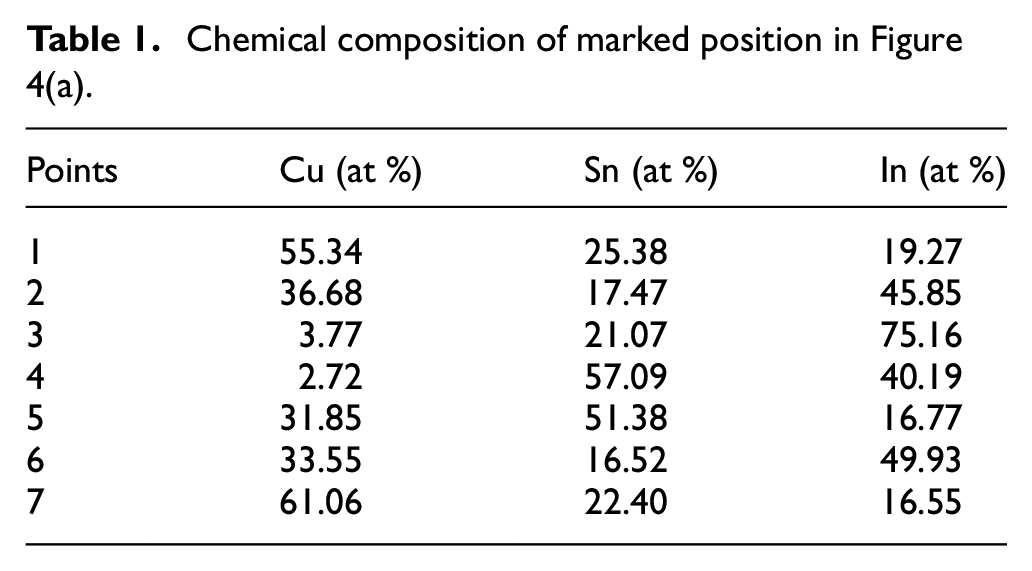
The results show that (Sn) solid solution, Cu-In intermetallic compound, Cu-Sn intermetallic compound exist in the weld seam. Preliminarily judge that the fine-grained layered phase where point 1 and point 7 are located is η(Cu6Sn5). The coarse-grained phase of point 2 and point 6 is Cu11In9. Point 3 is β phase rich in In. Point 4 is β+γ coexisting phase. Point 5 is the η phase. The presence of Cu10Sn3 and Cu9In4 was also detected in the weld seam. According to the conservation of chemical atoms and conservation of mass, the following equation can be derived:


In summary, ultrasonic vibration can promote the diffusion of Cu and induce the production of Cu11In9 and Cu6Sn5. According to the references, 9 Cu11In9 exists at a temperature higher than 157°C, the equilibrium transition temperature of Cu6Sn5 is 189°C, and the equilibrium phase at room temperature should be η’ phase, however, due to a rapid cooling conditions, the metastable η phase remains under high temperature conditions.
The microstructure of the II region in Figure 2(d) was magnified as shown in Figure 5(a). Point energy spectrum analysis was performed for the marked position in Figure 5(a), and the result is shown in Table 2. XRD phase analysis was performed for the shear fracture surface of the ultrasonic vibration 30 s samples, as shown in Figure 5(b).

(a) magnified view of the II region in Figure 2(d), (b) phase analysis of the fracture surface for the ultrasonic 30 s samples.
Chemical composition analysis of the marked position in Figure 5(a).

The results show that (Sn) solid solution, Cu11In9, Cu9In4, Cu6Sn5, Cu10Sn3 exist in the weld seam, and ε(Cu3Sn) phase exists. Preliminarily judge that point 9 is a fine-grained layered η(Cu6Sn5) phase. Point 9, point 11, and point 13 are coarse-grained bulk Cu11In9 phases. Point 10 is a β+γ coexisting phase. Point 12 is a β phase rich in In.
It is shown above that with the diffusion of Cu atoms, the In-rich β phase and the Sn-rich γ phase are consumed, Cu-Sn intermetallic compound and Cu-In intermetallic compound are formed, and the coarse-grained bulk Cu11In9 phase grows, and the volume increases, partially deviates from the Cu/Cu-Sn-In interface, migrates to the center of the weld seam, and is mixed with the β phase and the γ phase. The metastable η phase has a tendency to transform into a steady state ε(Cu3Sn) phase under the action of ultrasonic vibration, which is indicated by the following formula:

Figure 6(a) shows the strength test results of the samples at different ultrasonic vibration time. The results show that the joint strength increases with the extension of ultrasonic vibration time, and the shear strength reaches to 22.76 MPa at 30 s. Figure 6(b) and (c) are the microstructures of the fracture surface for the ultrasonic vibration 5 s and 30 s samples respectively. The results show that the fracture occurs on the surface of the fine-grained η(Cu6Sn5) phase, as shown as the original interface in Figure 2(b). The fracture surface is adhered to a part of the coarse-grained Cu11In9 phase. As shown in Figure 6(d), it is obvious that the fracture mode is brittle fracture.

(a) strength test results, (b) microstructure of the fracture surface for ultrasonic vibration 5 s sample, (c) microstructure of the fracture surface for ultrasonic vibration 30 s sample, and (d) stress strain curve for ultrasonic vibration 30 s sample.
Conclusion
Ultrasonic-assisted transient liquid phase bonding of pure Cu with Sn-In solder was realized at 140°C in air. (Sn) solid solution, ε(Cu3Sn), η(Cu6Sn5), Cu10Sn3, Cu11In9, Cu9In4, γ, β phase were detected in the weld seam. When the ultrasonic wave is 30 s, the shear strength reaches about 22.76 MPa. The fracture occurs on the surface of the fine-grained η(Cu6Sn5) phase. The fracture surface is partially covered with coarse-grained Cu11In9 phase, which belongs to brittle fracture.
Footnotes
Handling Editor: James Baldwin
Declaration of conflicting interests
The author(s) declared no potential conflicts of interest with respect to the research, authorship, and/or publication of this article.
Funding
The author(s) disclosed receipt of the following financial support for the research, authorship, and/or publication of this article: This research was sponsored by the National Natural Science Foundation of China (Grant No. 51504165).
