




Abstract
A heat pump in the aerospace industry can significantly reduce the area of radiator by elevating the rejection temperature. Especially for a Lunar base, the heat pump can improve the heat rejection capability of the thermal control system to adapt the high-temperature environment. However, gravity on the Lunar (about 1/6 g) may have an adverse impact on a gas-oil separator of the heat pump, and solving this problem is the key for a heat pump used on Lunar base. At present, the gas-oil separator all based on gravity separation theories, the researches under low or micro gravity were blank. In this work, a gravity separation model based on a single-particle principle was built, and the effects of the vapor velocity, the oil droplet initial velocity, and the oil droplet diameter were investigated under normal gravity. Then the variations of the separation efficiency under Lunar gravity were discussed and the numerical calculation results showed that the separation efficiency was reduced when the vapor velocity or droplet initial velocity increased in a certain height of the separator whenever under normal or Lunar gravity. Particularly, the separation efficiency under Lunar gravity was reduced from 99% to 55% than it under normal gravity.
Introduction
For decades, human space flight and deep space exploration had moved rapidly, First Lunar Outpost Lander and Permanent Lunar Base will be the next phase. But the environment of the Lunar is very different from the Earth, the maximum surface temperature of the Lunar can reach 120°C at noon 1 and the infrared radiation from a topographical ridge seriously weaken the efficiency of the radiator. It is well known that the heat rejection capability of a radiator is related to the temperature differences between the radiator surface and deep space. For example, a Lunar base thermal control system (TCS) collects waste heat from the crew habitat at a temperature of about 25°C, and heat dissipation of radiator in this temperature is only 200 kJ/m2, but if the temperature of the radiator surface is up to 65°C, the heat rejection capability can improve two times. Therefore, a heat pump is very suitable for this application.2,3 There had been some researches on a heat pump used in the aerospace industry, some initial conclusions had been achieved and several principle prototypes had been designed, but there was no precedent for practical application.4–10
In a heat pump system, a spot of lubricant oil is carried in the refrigerant vapor that discharged from the compressor and the oil-gas separator can prevent the lubricant oil entering the condenser and decreasing the condensation efficiency. A traditional oil-gas separator is based on gravity separation, as shown in Figure 1. The refrigerant vapor carries the oil droplets into the oil-gas separator, and the larger oil droplets finally fall to the bottom of the separator, while the smaller droplets are carried away from the separator by the refrigerant vapor.

Schematic of a traditional oil-gas separator.
The movement of the oil droplets in the separator belongs to “Microhydrodynamics” subject field which had referred to the motion of particles, droplets, and bubbles between 0.1 μm and 1000 μm. 11 In recent years, many studies had focused on deformation, fragmentation, collision, and merger of the droplets, showing the complexity of droplet motion. Dongbei Yue studied the separation of water droplets from water vapor in submerged combustion evaporator and built a gravity separation model, he got the analytical solution of droplet velocity differential equation. The results showed that the vapor velocity, the droplet initial velocity, and the droplet diameter influenced the separation efficiency and the separation height. 12 Zhigang Feng studied the drag force coefficient in the slip fluid at low Reynolds number (0<Re<75) with a numerical method and a correlation of the drag force coefficient for flow Reynolds number was derived. 13 Zaisha Mao detailed expounded various forces in single particle model and mainly studied on the particle swarms, and given the relationship between the drag force coefficient and the Reynolds number. It showed the very difference between the single-particle drag force coefficient and particle swarms drag force coefficient. 14 Xi Wang studied the drag force coefficient of particles on nonuniform distribution with a meshless Element-Free-Galerkin method and the results showed that particle distribution had a great influence on the drag force coefficient and the effect depended on the nonuniformity coefficients Cvx and Cvy. 15 Hai Tang studied the morphological change and local transfer characteristics of the countercurrent movement of the droplet in the gas flow and got the relationship between the drag force coefficient and the Reynolds number (30<Re<2000). 16 Jinyi Zhang studied the motion mechanism of a single droplet in the uniform flow field of the vapor-water separator and analyzed the force of the droplet in the vapor flow, got that the influence of its main parameters on the droplets was vapor flow rate, droplet diameter and droplet initial velocity, qualitatively described the gravity separation mechanism of droplets in vapor flow. 17 Yuansheng Li established the formula of interfacial tension by fitting the experimental data and introduced the drag force coefficient of droplet deformation, then obtained the critical liquid carrying flow model with interfacial tension and droplet deformation. The results showed that droplet size and deformation had a greater impact on the critical flow rate of liquid carrying. 18 All the studies were concentrated in gravity separation model under normal gravity and the working fluids numerously were water or air at normal temperature and pressure, most importantly, the influence of different gravitational accelerations on the separation efficiency was barely reported at home and abroad.
In this paper, based on our existing test equipment, the heat pump using R134a with the compressor discharged temperature being 95°C and the pressure being 2 MPa is taken as the background, a mathematical model for gravity separation of oil droplet from refrigerant vapor is established based on a single-particle model and its numerical solutions is given. The influences of vapor velocity, droplet initial velocity, droplet diameter, and gravity acceleration on droplet final velocity and droplet flying height are discussed, then the effects of different gravitational accelerations on the separation efficiency are evaluated based on the random diameter of the oil droplet.
Gravity separation model
Basic assumption
In consideration of the characteristics of the research object, the volume fraction of the oil among the vapor is 2% to 5% and the diameters of the oil droplets are micron-size (from compressor manufacture data of Emerson), so the distance between two droplets is bigger enough and the Van der Waals Force is smaller than the other forces. Therefore, this paper makes the following assumptions based on the Single-Particle Model12,17:
Droplets are standard spheres and no deformation during movement;
No interaction such as collision, breakage, and merger among droplets;
No phase change with droplets;
Ignore spins and other direction velocities (except the vertical direction) of droplets;
The cross section of the gas-oil separator is constant along the vertical direction;
The movement of the droplet in vapor flow is steady-state.
Mechanical analysis of droplet
The motion of a single droplet in the vapor flow is affected by inertial force, body force, acceleration force, pressure gradient force, flow uneven distribution force, and drag force, as shown in Figure 2. Basset force and virtual mass force are unsteady forces due to acceleration of that body with respect to the fluid. Basset force is also known as “history” force that describes the force with changing the relative velocity of bodies moving through a fluid, and virtual mass force also known as added mass force is the inertia added to a system because an accelerating or decelerating body must move (or deflect) some volume of surrounding fluid as it moves through it.19,20 Pressure gradient force is the force when there is a different pressure across a surface. Magnus force is the horizontal force that a spinning object moving through a fluid and Saffman lift force exists in a flow field with a velocity gradient even no spinning. 21
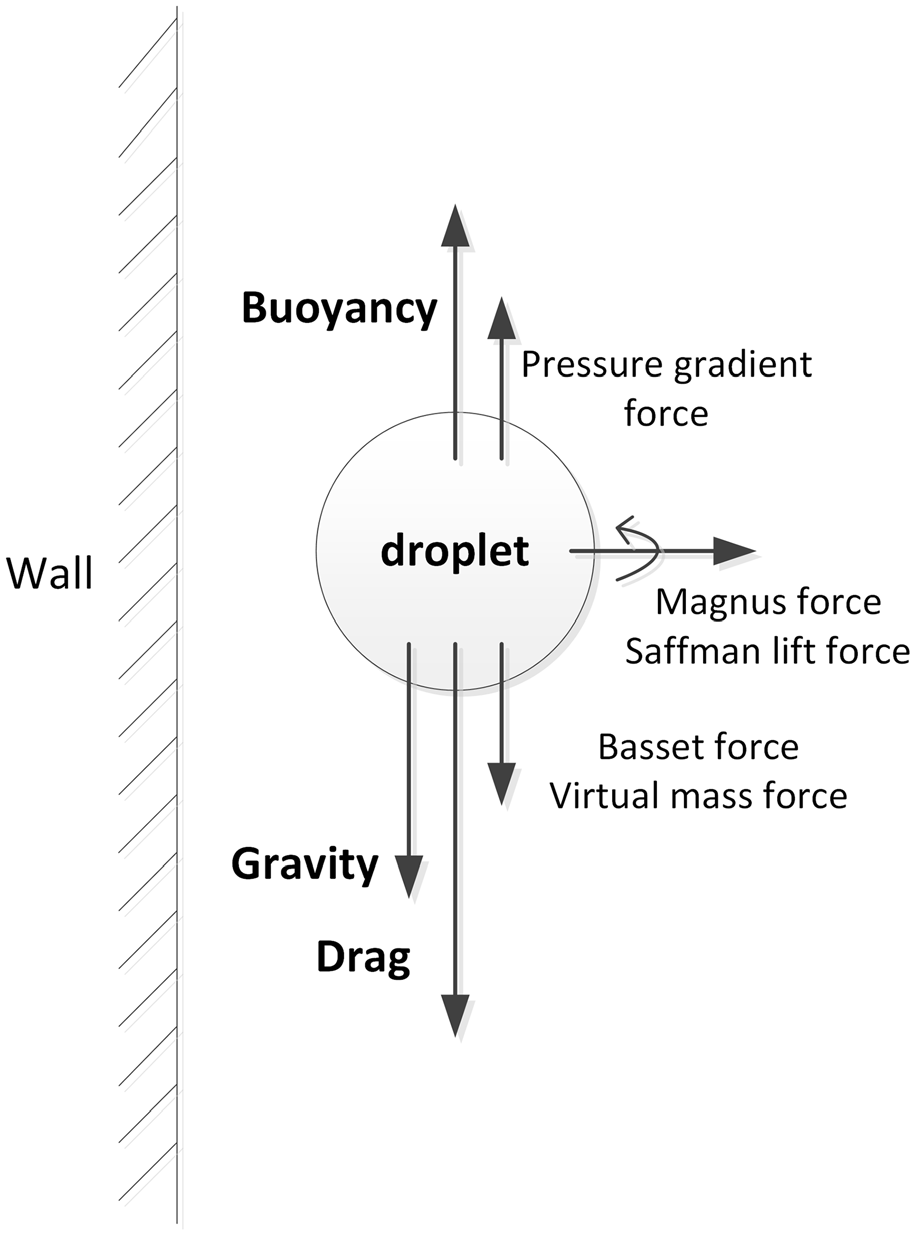
Schematic of the force analysis of oil droplet.
In fact, Basset force and virtual mass force are very smaller against other forces and can be ignored if the two phases have a big difference in density such as gas-liquid system or gas-solid system. 22 Some laser holographic experiments had shown that the particles were not spinning in most flow fields, so Magnus force or Saffman life force can be ignored, and pressure gradient force can also be neglected if the particles are small enough (micron-size).21,23 Therefore, in this study gravity, buoyancy and drag are only needed to be considered as same as Yue 12 or Zhongwen. 21
Governing equation
The force balance equation for a single droplet by using Newton second law can be written as:

Where
The mass of droplet is represented as:

Where
The gravity force is evaluated as:

Where
The buoyancy force is computed as:

Where
The drag force is given by:

Where
Bring equations (2) to (5) into equation (1) and simplify, then, the differential equation for the droplet velocity against time can be written as:

Due to drag forces coefficient related to Reynolds number, and Reynolds number has a relationship with relative velocity and diameter, so the derivative of velocity versus time is a function of droplet velocity
Drag force coefficient
An earlier analytical solution of the drag force coefficient in the creeping flow is given by Stokes’ law:

where
Expressions of the drag force coefficient.

Where

Where
The velocity of droplet
The velocity of droplet is the most concerned parameter of the droplet motion and it only can be got through solving the differential equation equation (6). Due to the drag force coefficient expression is very complex, the analytical solution is difficult to acquire, but the numerical solution by computer programs with some suitable algorithms will be easily obtained, Euler method and Runge-Kutta method are most commonly used.
The Euler method is the simplest numerical method to solve first-order ordinary differential equation with a given initial value. It is a first-order method, which means that the global error (error at a given time) is proportional to the step size. So, the Euler method is more accurate if the step size is smaller, and the algorithm of equation (6) is given by:

Where
The Runge-Kutta method that it is also known as “RK4” is a fourth-order method and more complex than the Euler method, which means that the global error is proportional to the fourth power of the step size. The algorithm of equation (6) is shown as:

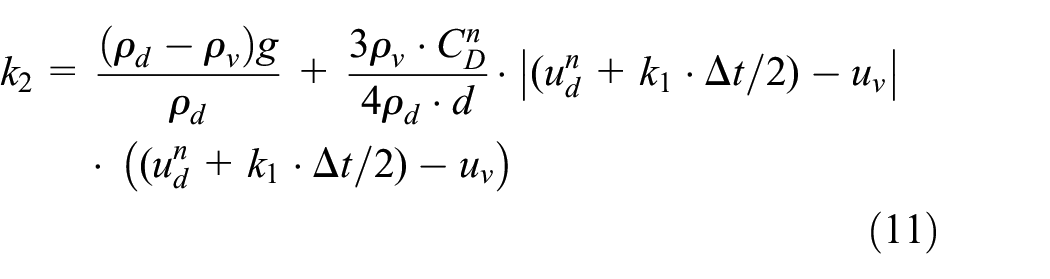


Where
In general, the Euler method has faster calculating speed and the Runge-Kutta method has higher precision, a comparison will be also made in the last of this paper.
The flying height of droplet
The flying height of droplet is another important parameter and it can be calculated by:

Where

Results and discussion
Calculation condition
A heat pump system contains compressor, gas-oil separator, condenser, expansion valve, and evaporator. According to the requirements of the Lunar base missions in future, the heat pump system is a bridge between the two-phase mechanical pumped loop inside the base and the radiator outside the base, the calculation results of the thermodynamic cycle are shown in Figure 3 and the status parameters obtained by NIST Reference Fluid Thermodynamic and Transport Properties Database (REFPROP) at this operating condition are shown as Table 2.

Schematic of a heat pump system in the Lunar base.
Status parameter of oil and refrigerant at 95°C and 2.1 MPa.
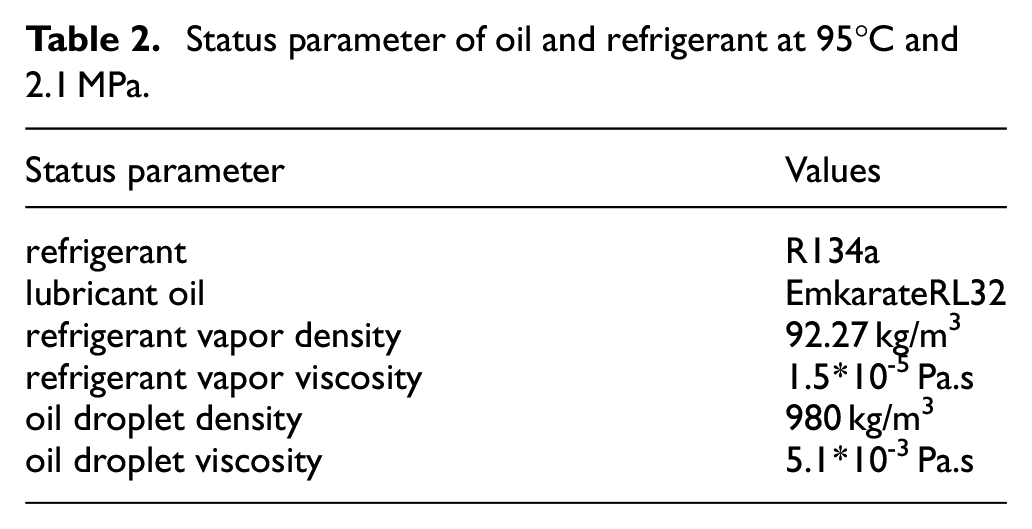
In this study, the Copeland Scroll Compressor from Emerson has been chosen. According to the product manual, the volume fraction of the oil among the refrigerant vapor is 2% to 5% and the diameters of the oil droplets are 200 μm to 900 μm.
Choice of correlation expressions and calculation methods
Assuming the initial velocity of droplet and vapor flow are 0.5 m/s and 0.4 m/s respectively (According to the calculation results of the thermodynamic cycle) and the average diameter of droplet is 700 μm (According to equation (17) and Figure 10). According to equation (8), under normal gravity the Reynolds number against time is shown as Figure 4 (left y-axis), and the droplet velocity versus time with different semi-empirical correlation expressions of drag force coefficient is shown as Figure 4 (right y-axis). When the droplet enters the separator and it moves upward with the vapor, the droplet velocity decreases due to the gravity force, so the relative velocity
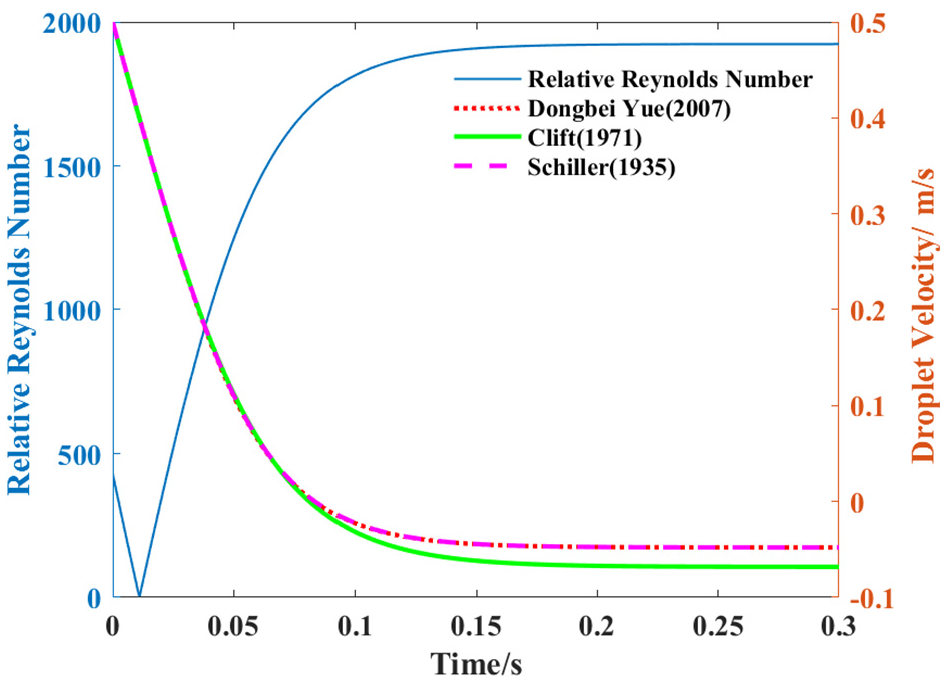
Reynolds number and droplet velocity against time under normal gravity.
Figure 5 illustrates the variation of droplet velocity and flying height against time with different methods of the differential equation and different step sizes under normal gravity. It is observed that the choice of step sizes has a great influence on the calculation results and the errors of three different methods are decreased with reduction of the step size. Because of RK4 having fourth-order precision and the computational complexity being as much as the Euler method for this case, the Runge-Kutta method will be chosen to solve differential equations.

Droplet velocity and flying height against time with different calculation methods under normal gravity: (a) step size is 0.003 s and (b) step size is 0.0003 s.
Separation effect with variation of different parameters
When the oil droplets enter a gas-oil separator with the refrigerant vapor flow moving upward, the velocity and the flying height of the droplet will be changed with time because of existing of gravity force, drag force, and buoyancy force. Some bigger droplets can reach a certain height and then fall back to the bottom, and its velocity can be decreased to zero, then increased in the opposite direction (it means negative values in the equations and figures), finally keep constant. This situation is suggested that the droplet can be separated from the vapor flow in this gas-oil separator. However, some smaller droplets will escape with the vapor flow from the separator at a constant speed, its final velocity will be over zero and the direction is upward in the figure. This situation is shown that the droplet cannot be separated from the vapor flow. So, a droplet that can be separated from the vapor flow is in the case when the droplet velocity is less than zero and the maximal flying height is below the height of the separator.
Figure 6 shows the variation of droplet velocity and flying height under normal gravity against time with different vapor flow velocities while the droplet initial velocity and the droplet diameter are keeping invariant (Here assume that droplet initial velocity is 0.5 m/s and droplet diameter is 700 μm). It is shown that the droplet final equilibrium velocity is decreased and the droplet maximal flying height is increased as the vapor velocity changes from 0.1 m/s to 0.4 m/s. According to the numerical model, the acceleration of droplet velocity is proportional to the relative value of droplet initial velocity and vapor velocity, while the relative value is bigger, the droplet final equilibrium velocity is higher linearly (the negative of velocity means the velocity direction being opposite) and the time of the droplet falls back to the bottom is shorter greatly. So, the height of the gas-oil separator should be higher and the time of the separation process will be longer while the vapor velocity is increased, this is the same as Dongbei Yue’s result. 12

Droplet velocity and flying height against time for different vapor velocities under normal gravity.
Figure 7 depicts the trend of droplet velocity and flying height under normal gravity against time with different droplet initial velocities while the vapor velocity and the droplet diameter are keeping unchanged (Here assume that vapor velocity is 0.3 m/s and droplet diameter is 700 μm). It is described that the droplet final equilibrium velocity is in full accord as changing of the droplet initial velocity, but the rate of the droplet velocity decreasing rises up with the relative value of droplet initial velocity and vapor velocity going up, and the changing trend is similar to Figure 6. It is also shown that the maximum of flying height has risen and the time of droplet falling back to the bottom is prolonged while the droplet initial velocity grows.
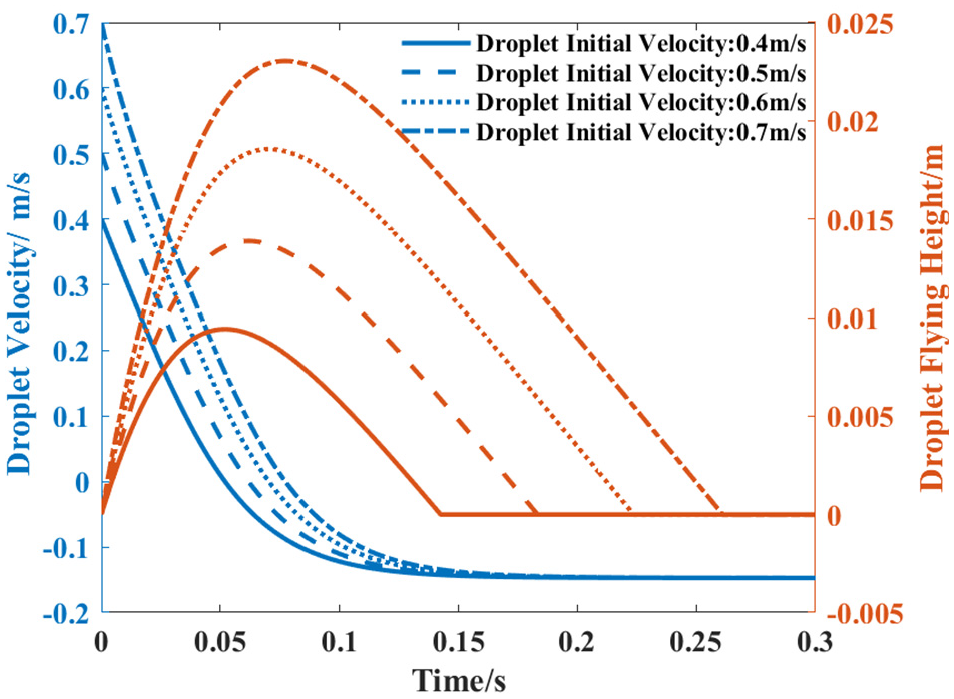
Droplet velocity and flying height against time for different droplet initial velocities under normal gravity.
Figure 8 provides the change of droplet velocity and flying height under normal gravity against time with different droplet diameters while the vapor flow velocity and the droplet initial velocity are keeping constant (Here assume that vapor velocity is 0.3 m/s and droplet initial velocity is 0.5 m/s). These curves are very interesting compared with Figures 6 and 7, the rate of decrease of the droplet velocity has no significant difference in front half part but the droplet final equilibrium velocity is increased appreciably while the droplet diameter becomes larger. It is also known that the maximal flying height is invariant basically, however, the time of droplet falling back to the bottom is shorter greatly as growing of the droplet diameter.

Droplet velocity and flying height against time for different droplet diameters under normal gravity.
The above three graphs are obtained under the gravity acceleration with 1 g (normal gravity) and reveal the variation law of the droplet being separated from the vapor flow in a gas-oil separation with different parameters. It is clearly illustrated that the vapor velocity and the droplet diameter have a greater effect of the droplet final equilibrium velocity, while the vapor velocity and the droplet initial velocity have a larger influence on the maximal flying height. It is also shown that the rate of droplet velocity descending is wholly proportional to the relative value of droplet initial velocity and vapor velocity, and the time of the droplet falling back to the bottom is related to these three parameters at the same time.
Figure 9 describes the variation of droplet velocity and flying height against time with different gravity accelerations while the vapor flow velocity, the droplet initial velocity and the droplet diameter are keeping stable (Here assume that vapor velocity is 0.1 m/s, droplet initial velocity is 0.2 m/s, and droplet diameter is 700 μm). It is clearly suggested that the droplet final equilibrium velocity sharply slumps, and the maximal flying height rapidly rises, and the time of the droplet falling back to the bottom is hugely prolonged, and the rate of droplet velocity decreasing is gentle swiftly while the gravity acceleration is dropped from 1 g to 0.1 g. Comparison on the curve under 1/6 g (Lunar gravity) with 1 g (normal gravity), the droplet final equilibrium velocity has an approximately eightfold decline, and the maximum of droplet flying height has a nearly fivefold increase, and the time of the droplet falling back to the bottom likewise grows eight times. It means that the height of the gas-oil separator must be higher and the separation time may be longer when an identical gas-oil separator is used in Lunar if it is lucky as the droplet can be separated (the droplet final equilibrium velocity being below zero).

Droplet velocity and flying height against time for different gravity accelerations.
Influence factors of separation efficiency
Normal distributions are important in statistics and are often used in the natural and social sciences to represent real-valued random variables whose distributions are not known. In this paper, it is assumed that the diameters of oil droplet conform to a normal distribution and its Probability Density Function (PDF) is given by:

Due to the data of oil droplet diameters given by the product manual being 200 μm – 900 μm, it is reasonable that the standard deviation

One thousand different diameter of the droplet being satisfied normal distribution.
According to chapter 4.3, a droplet of a certain diameter that can be separated must be satisfied:
The final equilibrium velocity of the droplet is less than zero (It means that the velocity direction is toward the bottom);
The maximal flying height of the droplet is below the height of a gas-oil separator (It means that the oil droplets did not fly out of the separator).
So, the gas-oil separation efficiency can be defined as the ratio of the number of the droplets that can be separated and the total number of the droplets, shown as

Where
Figure 11 shows the change of separation efficiency under normal gravity against separator height with different vapor velocity while the droplet initial velocity is unchanged (Here assume that droplet initial velocity is 0.8 m/s) and the droplet diameters are random distribution as Figure 10. It is described that the separation efficiency is very low at first and then rapidly jumps to the maximum and stays constant. The height of separator corresponding to the maximum of the separation efficiency is considered as the minimum while the droplets can be separated. When the vapor velocity changes from 0.1 m/s to 0.4 m/s, the maximal separation efficiency is reduced greatly and the required height of separator is raised. It is also known that the separation efficiency increases as the relative velocity

Separation efficiency against separator height for different vapor velocity under normal gravity.
Figure 12 illustrates that the variation of separation efficiency under normal gravity against separator height with different droplet initial velocity while the vapor velocity is invariant (Here assume that vapor velocity is 0.3 m/s) and the droplet diameters are random distribution as Figure 10. It is depicted that the maximal separation efficiency is unchanged while the droplet initial velocity is increased, but the required height of separator is raised. According to Figure 7, the droplet final equilibrium velocity is constant while the droplet initial velocity changed, so it is shown that no change of the droplet final equilibrium velocity and no change of the maximal separation efficiency.

Separation efficiency against separator height for different droplet initial velocity under normal gravity.
Figure 13 provides that the trend of separation efficiency against separator height with different gravity acceleration while the vapor velocity and droplet initial velocity are invariant (Here assume that droplet initial velocity is 0.8 m/s, vapor velocity is 0.2 m/s), and the droplet diameters are random distribution as Figure 10. In this calculated condition, the maximal separation efficiency is decreased from 99% to 55% and the required height of separator is increased from 0.02 m to 0.07 m, while the gravity acceleration is changed from 1 g (normal gravity) to 1/6 g (Lunar gravity). It is also demonstrated that the gravity acceleration has a great influence on the separation efficiency, and the separation efficiency falls to zero when the gravity acceleration is 1/10 g (It is just a reference value and it does not mean that the separation efficiency is reaching to zero at this moment).

Separation efficiency against separator height for different gravity acceleration.
By comparing Figures 11 to 13, the greatest effect factor of the separation efficiency is the gravity acceleration, and the second is the vapor velocity. In a certain situation, it always has a height of the separator corresponding to a maximum of the separation efficiency, and it is a good idea that slows down the velocity of the vapor flow to improve the separation efficiency while the gas-oil separator is used under Lunar or other gravities.
Conclusions
Based on the background of manned Lunar landing and Lunar base building, this paper establishes a gravity separation model for an oil droplet motioning with the refrigerant vapor flow, and its numerical solution is given. Then some major parameters such as the vapor velocity, the droplet initial velocity, the droplet diameter, and the gravity acceleration for the separation efficiency are discussed, some conclusions are shown as:
The droplet velocity decreases firstly and then keeps invariant. The final velocity of droplet will increase with increasing of the vapor velocity and decreasing of the droplet diameter, the droplet initial velocity has no influence to the final velocity.
The droplet flying height will increase with decreasing of the droplet velocity and it will decrease if the droplet velocity has decreased to zero. The maximum droplet flying height will increase with increasing of the vapor velocity, the droplet initial velocity, and the droplet diameter.
The gravity acceleration changes from 1 g to 1/10 g, the final droplet velocity slumps, and the maximal flying height rapidly rise, and the slope of droplet velocity is decreasing, and the time of the droplet falling back to the bottom is prolonged. It clearly shows that the influences of gravity acceleration are evidently greater than other parameters.
For separation efficiency, changing the vapor velocity and the gravity acceleration has a big influence, except the droplet initial velocity, and it is shown that the separation efficiency under Lunar gravity decreases from 99% to 55% and the required height of a separator increases about treble against under normal gravity with the same calculated condition.
Further work is going to observe the flowing stare of the refrigerant vapor and the oil droplets at the compressor outlet in a heat pump system through a visualized experiment and it will determine the value of the droplet initial velocity, the vapor flowing velocity and distribution of the droplet diameters, and modify the gravity separation model.
Footnotes
Appendix
Handling Editor: James Baldwin
Declaration of conflicting interests
The author(s) declared no potential conflicts of interest with respect to the research, authorship, and/or publication of this article.
Funding
The author(s) received no financial support for the research, authorship, and/or publication of this article.
