



Abstract
The article presents theoretical and experimental studies of tribosystems operating under conditions of normal and abnormally low friction and wear when changing the external conditions of their operation. A comparative analysis of self-organization mechanisms of tribosystem operating under conditions of normal mechanochemical and abnormally low friction and wear is performed to determine the conditions of transition to such a mode. There was determined another possible way of converting tribosystems to conditions of abnormally low friction and wear by modifying the surface layer of bronze specimens using finishing treatment with the use of a mineral of amphiboles (jade) group.
Keywords
Introduction
The modern development of tribology and, above all, such a section as tribomateriology 1 has allowed us to formulate a new rather effective way of reducing friction and wear in different tribosystems as a result of tribomodification of the surface layer.2,3 The purpose of such tribomodification is to create the most favorable (compatible, according to Garkunov) conditions of microcontact quasielastic interaction arising at the level of microrelief. 4
Consideration of quasielastic interaction from the position of nonequilibrium thermodynamics allowed the author Veynik 5 to hypothesize that quasielastic interaction can be an antidissipative factor, which leads to the degeneration of accumulated inner energy from tribosystem (TS). Among these factors, the main contribution is made to the kinetic (wave) component of the friction force, which is formed by the difference in inhibition rates during molecular-mechanical interaction and during acceleration at their slippage. Under this mechanism, the TS goes into abnormally low friction and wear. Experimental studies of the conditions for achieving such abnormally low friction and wear are a very pressing and complex problem.
Analysis of recent research and publications
The theoretical basis in development of the physical model of abnormally low friction and wear was created by the works of authors Fedorov, Pogodaev, Yakubov, and Ivanova et al.6–9 Fedorov
6
used quantum-mechanical approach to analyze abnormal low friction, and introduced the concept of mechanical quantum – a minimum number of atoms capable of providing such a configurational distribution of nanostructure, which possess the properties of backward absorb and dissipate (rotate) energy of external mechanical movement. This quantum is also the smallest structural formation under conditions of plastic deformation and is formed during transition of the TS (its deformed volume) through the extremely activated (critical) state due to the development of self-organization processes of the TS adaptation. In the scope of tribosystems under conditions of abnormal friction and wear (elementary tribosystem), the number of such mechanical quanta (tribosystems) is equal to 0.63•108, that is, a safe number of fatigue cycles. The mechanical quantum itself is a dynamic oscillator of dissipative friction structures, and its linear size is equal to the radius of the spherical ideal crystal
This conclusion gives us the possibility to formulate a scientific hypothesis, which contains the innovative nature of the research. According to the hypothesis, the overcoming of friction forces at moving of solids is possible due to internal forces. The source of these forces is the wave component of external friction force.
Let’s analyse the mechanisms of energy dissipation which is supplied to the tribosystem from the outside as a factor of reducing friction in various areas of animate and inanimate nature.
The application of such effects as “nanoscale friction” or “abnormally low friction”10,11 could be the basis for the creation of tribosystems which have high resource and maximum reliability. In this case, the most important issues are the formation of various thin film layers on the friction surfaces, the peculiarities of their lubricating action, as well as the processes of self-organization of friction surfaces, resulting in the formation of fractal spatial and temporal structures, including rotational.2,12
Ilya Prigogine, the author of research works on nonlinear thermodynamics and self-regulation of nonequilibrium systems has found that some thermodynamically open systems in conditions far from equilibrium, become unstable,13,14 their macroscopic properties change radically.15,16 In tribotechnical systems, this is manifested in the formation of dissipative structures of two types.
The dissipative structures of the first type include equilibrium structures which are formed in the process of running-in, their formation is achieved at the minimal entropy production. Dissipative structures of the second type include nonequilibrium structures, which are determined by the sign of excessive entropy production, the condition of the formation of these structures is the supply of additional external energy. 17
These structures operate based on the principle of the keeping of the maximum reliability at the changing of external friction conditions, this is achieved by maintaining the equality of dynamic processes “plus-” and “minus dissipation.”5,18 As shown in Zaporozhets et al. and Zaporozhets and Stadnichenko2,12 each case corresponds to its own thermodynamic threshold of self-organization, which clearly separates the classes of equilibrium and nonequilibrium dissipative structures that occur with large deviations from the equilibrium position. It is here that the effect of self-organization and coherent behavior of subsystems is manifested, which is expressed in the transition of the tribosystem to work in the conditions of abnormally low friction and wear. In essence, this is the discovery of new areas in the physics of friction and wear, where self-organization of new structures is thermodynamically possible, which leads to a more sufficient mechanism of friction than the boundary friction.
In synergetics according 15 self-organization is the ability of any objects to exhibit properties which are characteristic for the behavior of biological and social objects, and their efforts have a clear focus on maintaining order and organization.
It should be noted that self-organization is not a universal property of matter, it exists only under certain internal and external conditions. However, this property is not related to any particular class of substances: the Benard effect, the Huygens phenomenon, lasers, the transition from laminar to turbulent flow, and is proof of this statement.
The last example is especially interesting in relation to tribotechnics. It has been observed that dolphins at swimming have speed which is much higher than it could be expected taking into the consideration of their geometric shape. This phenomenon is due to the fact that the dolphin’s body has low frictional resistance, and is due to the elasticity of the skin, which allows the boundary layer of water on the dolphin’s body to remain laminar even at very large Reynolds numbers. 19 This idea is prompted by nature itself and used by the authors Stadnichenko et al. 20 to explain the effects of abnormally low friction in the application of revitalizers. Modern theoretical and experimental tribology is increasingly turning to the explanation of natural phenomena of reducing friction for use in engineering.
American scientists Barrett and Triatafil have created models of fish that develop traction and illustrate the mechanisms of reducing of frictional resistance. 21 In the process of thrust creation, the decrease of resistance coefficient of the model reaches 70% compared to the resistance coefficient of the streamlined stationary model. At analysing of the results, it was concluded that there are two mechanisms to reduce the coefficient of friction resistance of the model: the first mechanism is associated with a negative gradient of dynamic pressure occurring along the model body, the second (hypothetical) – with a system of vortices forming near the oscillating model body (wave component of friction resistance).
Another natural phenomenon of abnormally low friction is known as the Gray Paradox. Between the nasal surface of the dolphin and the oncoming water in motion, a negative gradient of hydrodynamic pressure somehow arises and constantly acts, that is, the dolphin in motion seems to catch up with the oncoming running water from it. 22 To implement such an interaction of objects moving in the liquid, Dzyuba developed a technology (Figure 1), the essence of which is that the reduction of hydrodynamic resistance during the movement of the vessel is achieved by creating waves of elastic compression from the nasal surface on the counter liquid. 23 The implementation of this approach in modern shipbuilding allows to increase their speed more than twice at the existing engine power and fuel consumption.
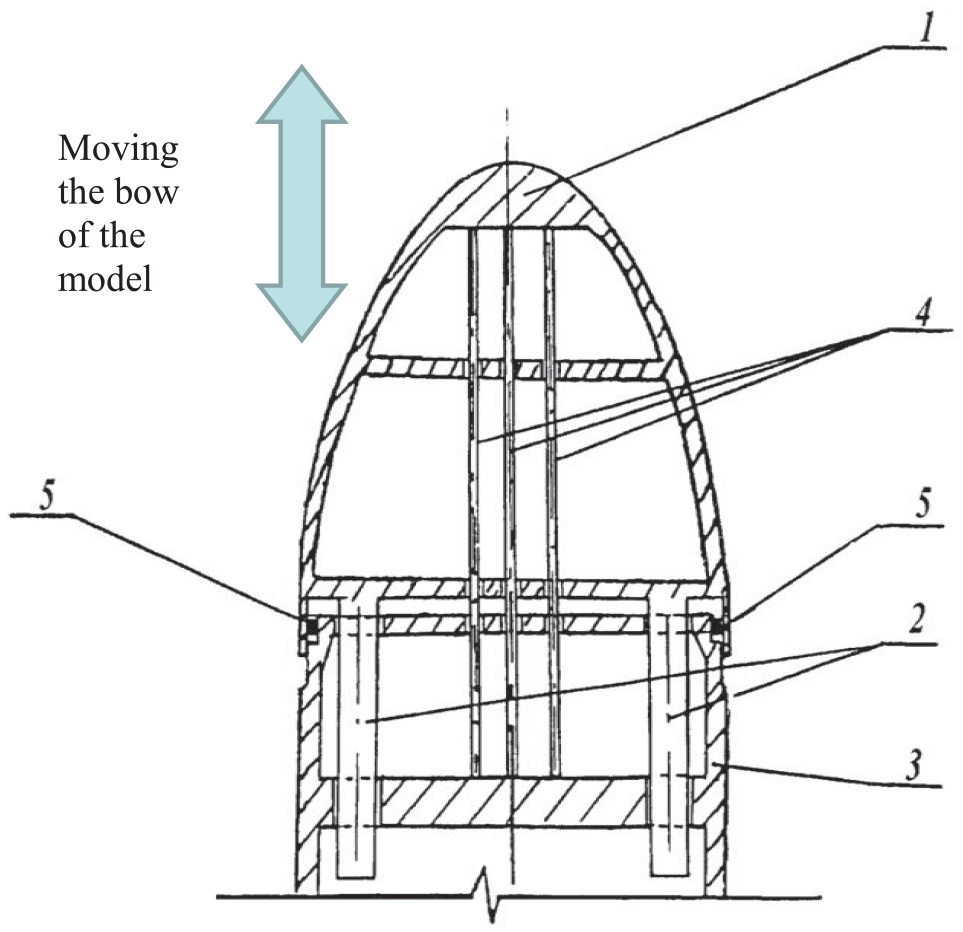
Reduction of hydrodynamic resistance at movement of the vessel due to creation of waves of elastic compression from a nasal surface on the counter liquid: 1 – a nasal part of the case; 2 – guide consoles; 3 – cylindrical part; 4 – elastic rods, 5 – stuffing box.
On the basis of the effect mentioned above, the development of perspective aircraft and submarines with complete laminarization of the boundary layer takes place. This makes it possible to reduce the body’s resistance to the environment by eight times or more.
A similar approach has been used in the design and creation of new LZRracer suits for swimmers. They are made from a special high-tech fabric consisting of interwoven threads of elastane-nylon and polyurethane. The technology is patented by Speedo. A wind tunnel and other NASA test equipment were used to test the suit, and ANSYS software was used to analyse the fluid flow leak.
Friction in shark movements is reduced in a slightly different way. Shark skin is covered with placoid scales (Figure 2). With each movement of the fish, the skin is bent and deformed, the corrugated teeth are shifted relative to each other. At the front edge of the flexible piece of skin a small vortex is formed. If this fragment of skin is treated with a sandblasting machine and thus destroy its surface microstructure, the vortex begins to form much further from the edge. That is, the presence of a microstructure leads to the formation of a rarefaction zone near the surface of the object.

Placoid scales of shark skin.
Thus, the analysis of scientific publications which are devoted to the research of high-velocity motion of bodies in water showed that in all cases the effect of reducing friction forces is achieved by generating elastic waves in different ways. Tesla was one of the first in techniques to draw attention to the role of the wave component of contact interaction in the motion of solids. 24 Unlike conventional turbines, in which the flow, moving, falls on the blade or piston, in the turbine Tesla uses many rigid “perfectly” elastic metal disks that do not cut the vortex flow at an acute angle, and slide parallel to the flow. In this case, they are set in motion due to a special kind of attraction that occurs between the surface of the disk and the moving gas or liquid. This gravity, which is a braking factor for aircraft and other mobile vehicles, is caused by “the push of a liquid into the rough surface of a solid,” 24 in fact, it is a wave component of the force of external friction.
Elements of new ideas are contained in the systemic approach of Khanin, according to whom all processes in nature are implemented in appropriate systems and proceed so that the interaction of their components is oscillatory and try to pass with minimal energy loss, that is, with maximum efficiency. 25 Agreeing with this conclusion, we can assume that the author Hanin 25 for the first time considered the wave channel of energy dissipation as a factor of self-organization and dissipation of external supplied energy.
This conclusion suggests that it is possible to overcome friction forces when moving solid bodies only under the action of inner forces. In our view, the source of these forces is the wave component of external friction.
On the basis of these works, recommendations on the rheological features of the tribosystem surface layer have been developed to create conditions that increase the wave component and allow to achieve conditions of abnormally low friction and wear. In this case, one of the surfaces operating in the tribosystem is a quasi-solid body, while surface layer of the second triboelement is represented rheologically by Shvedov’s model (Figure 3) which is modified by various methods (programmable load, heat flow control, triboactivation by active elements, finishing technologies, etc.).20,26–28 These studies are presented as a scientific paradigm of tribosystems transition from normal mechanochemical friction and wear to abnormally low friction and wear. 27
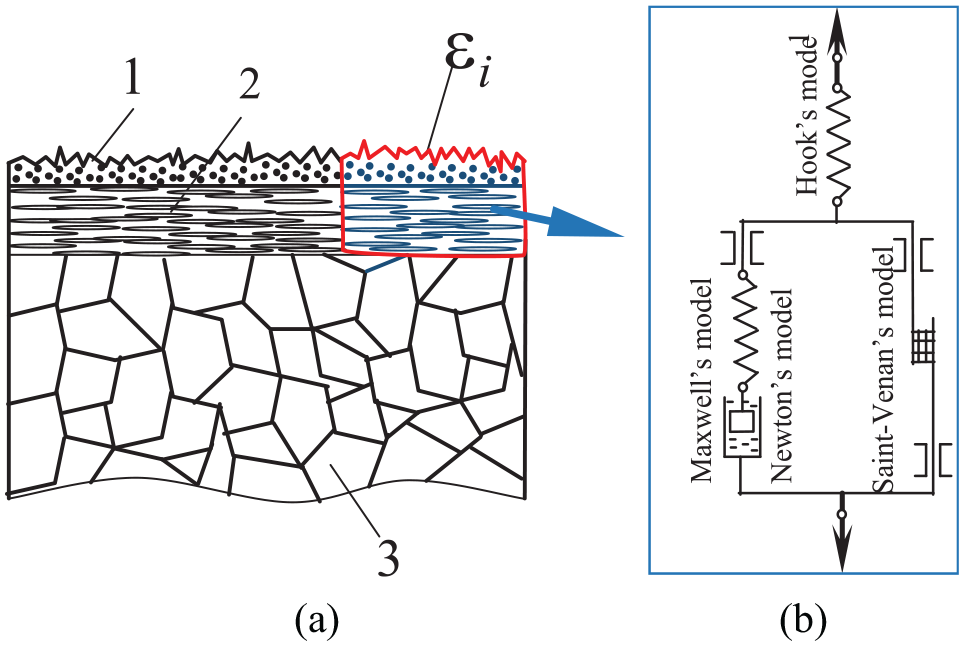
Rheological and fractographic features of the surface layer of triboelements operating under conditions of abnormally low friction and wear: (a) rheological features (1 – quasielastic surface layer of the Hooke’s model (Hooke’s body); 2 – nano-structuring layer (ε
However, it is still unexplored the issue concerning change in the amplitude-frequency response characteristics in the tribosystem during the transition of its operation from ordinary mechanochemical wear to abnormally low friction and wear.
The effect of frequency vibration on friction and wear of the “silicon on silicon nitride” tribosystem is shown by Gutowski. 29 The tribometer allowed to generate both normal and tangential oscillatory modes with respect to the friction surface. It is determined that within the frequency range from 4 to 6 kHz there is a decrease in the friction coefficient from 1 to 0.1, both for the normal and for the tangential components of oscillations, as well as a decrease in wear. Moreover, in this range the amplitude of oscillations does not make a decisive role in reducing the friction force, starting from a certain limit value. The analysis of friction and wear reduction effect was carried out without regard to the physical and mechanical properties of the test materials and the mechanisms of dissipation of the external delivered energy, although the rheology of the materials behavior is taken into account in the kinematic scheme of the tribosystems under study.
Confirmation of the correctness of this approach is shown by Gutowski, 29 the effect of triboelement micro-displacements under vibration under dry friction conditions was also investigated. A large group of materials from glass to structural steel was taken as a research object. An optimum micro-displacement zone was established in which the minimum value of the relative friction coefficient (the ratio of friction coefficient in motion to the coefficient of static friction) was observed for all test materials. Under initial conditions of friction, it is equal to unity, while at friction under certain conditions of micro-displacements it reaches abnormally low values. Unfortunately, no explanation was given for this effect, though modern physical theories were involved.
Analysing the works on the study of ultrasonic and vibrational oscillations in tribology,16,21,22,30 we can conclude that in almost all these works the wave component of friction force, introduced into the expression for friction force with a minus sign, is present in the form of end result at external wave impact on the tribosystem.
Another way to achieve abnormally low friction and wear, more effective from our point of view, is through tribomodification of the surface layer as a result of heat flow control,
21
programmable load,31,32 or special finishing treatment.31,32 In this case, the tribosystem is a moving element – a quasi-rigid body, whilst on a stationary surface the layer is formed with a certain gradient of physical and mechanical properties, close to Shvedov’s model.31,32 Since as a result of the contact interaction of perfectly elastic micro-ledges a stress wave is formed, which participates in the process of energy dissipation which is supplied from the outside, the total friction force will decrease by the value of this wave component
Under certain conditions, it is possible to turn to “negative” friction, as predicted by Veinik. 5
The wave component of the friction force is formed in this case by converting the accumulated internal energy of the surface layer as a result of kinetic interaction. The analysis of this interaction with the use of two-stage scheme leads to formation of the vector value of force impulse.
Using this approach, in Stadnichenko and Troshin’ study,
22
the distribution function of friction force impulses at local sites is approximated by Markov process and is described by Fokker-Planck equation. On the basis of solution of this equation there was obtained expression of the resultant friction force impulse for steady-state operating conditions of the tribosystem under conditions of abnormally low friction and wear. The total expression for the friction force impulse

where
The expression of the force impulse in this case does not reflect self-regulation when achieving equality between molecular-mechanical and wave components of the friction forces when changing external conditions, for example, when the load is changed.
The concept of mechanical quantum

As a result of interaction, the resulting vector value of force impulse of the wave component of the friction force is formed. The resultant power impulse of the molecular-mechanical friction force shifted in phase is similarly formed. Thus, when changing the load, self-regulation in the tribosystem operating under abnormally low friction and wear will be governed by a number of mechanical quanta and a module of canonical energy distribution along the line (surface) of the contact and, consequently, by the structure and topography of the surface layer, which requires experimental confirmation and further theoretical justification from the standpoint of thermodynamics.
The purpose of the article
The purpose of this work to confirm the hypothesis of the possibility of an overcoming of the friction forces at moving solids due to internal forces. The source of these forces is the wave component of external friction. Carry out a comparative analysis of the mechanisms of self-organization of tribosystems operating in conditions of normal mechanochemical wear and abnormally low friction and wear to determine the physical nature of the mechanisms of self-organization of the tribosystem operating in these conditions.
Presenting main material
Experimental studies were performed with the use of friction machine 2070 SMT-1 (2070 CMT-1), sliding friction, material of specimens – steel “30X3B” and bronze “VB23NTs (BБ23HЦ).” Test conditions: boundary lubrication conditions (working fluid consumption – 3.5 L/h). Working environment – aviation kerosene TS-1 (“TC-1”). Linear velocity – 1.36 m/s. Throughout the tests, wear was constantly monitored in real time by the method of acoustic emission (AE).10,11,33
Specimens for sliding friction tests (flat pairs) were made according to the technical documentation for the friction machine CMT1. The initial chemical composition of the materials of the tribosystem is presented in Table 1.
Chemical composition of material of specimens: Steel “30X3BA” and bronze “VB23NTs (BБ23HЦ).”

Each specimen was examined with a device for measuring the parameters of microgeometry JENOPTIK and comprehensive studies of microrelief on a microscope LSDFPM (NAU, Kyiv, Ukraine) is performed. In addition, the hardness of the surfaces (Table 2) and the depth of the surface layer were measured. Measurements on bronze samples were performed after non-abrasive finishing, and on steel – after grinding with diamond paste.
Average roughness values for five specimens of each material.

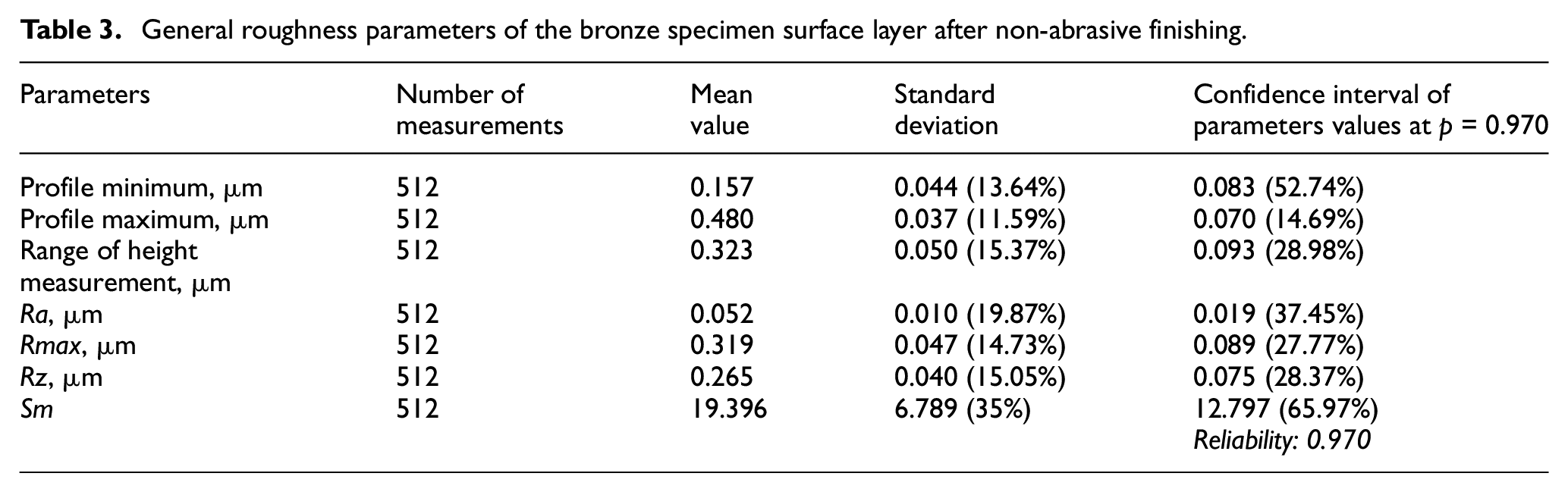
Initially, the test was subject to the basic tribosystem [“30X3BA”–“VB23NTs (BБ23HЦ)”] (using non-abrasive finishing of bronze triboelement for the achievement of required surface cleanliness of the specimens and grinding of the steel specimen with diamond paste). During the tests, the fractographic and microgeometric characteristics of the steel specimen varied slightly and were therefore not used for analysis. In-depth studies of these characteristics were conducted at the Nanotechnology Laboratory of NAU, Kyiv. From the given data it follows that the surface is smooth and practically homogeneous throughout the plane. In prospect, the comparison of roughness parameters at change of loading will be conducted with the use of average values of roughness parameters. The results of tribological tests (for tear-resistance) are presented graphically in Figure 4 as the test average of three identical specimen pairs. The general parameters of surface roughness are given in Table 3.

Friction coefficient μ and temperature in contact zone of the base tribosystem using a non-abrasive finishing treatment of bronze triboelement.
General roughness parameters of the bronze specimen surface layer after non-abrasive finishing.
In the process of tribosystem step loading with increments of 0.2 MPa (specific load), the holding time of 5 min at each stage was provided. The acoustic emission method10,11,33 was used to control the absence of transition to tearing during this period.
After registering the first signs of deviation on more than 50 relative units, the unloading of the tribosystem was performed. Thus, the maximum load-carrying capacity value (3 MPa) was recorded. The maximum temperature value corresponded to 70°C…80°C.
After testing on tear-resistance (load-carrying capacity), studies were carried out on wear resistance at specific loads of 1.6 and 3.0 MPa. The study of weight wear was measured by the laboratory scales VLR 200 with an accuracy of 10−5 g. The wear was measured after 480 min of continuous operation on each load. Additionally, measurements of the wear rate with the application of acoustic emission method were performed using a device developed by the authors.
The study of weight wear at these loads is shown in Figure 5. The figure shows that as the specific load increases due to self-organization processes, the total TS wear decreases. The main mechanism of self-organization is the diffusion of the alloying elements of the bronze specimen, which is confirmed by subsequent studies.

The weight wear of elements of the basic tribosystem [steel “30X3BA”– bronze “VB23NTs (BБ23HЦ)”]: 1, 2 – bronze; 3, 4 – steel; 5, 6 is the total wear of triboelements. Wear diagrams 1, 3, 5 – at specific load of 3.0 MPa, 2, 4, 6 – at specific load of 1.6 MPa.
The analysis of the microgeometric characteristics of the bronze triboelement surface roughnesses before the tests (Table 3) and after them under different specific loads (Tables 4 and 5) indicates that as the loads rise the roughness parameters increase significantly (Ra increases by 22%).
Mean values of microroughness of the bronze specimen after operation under a specific load of 1.6 MPa.

Mean values of the microroughness of the bronze specimen after operation under a specific load of 3 MPa.

The chemical analysis of the basic bronze specimen surface (after a non-abrasive finishing) is shown in Figure 6.

Chemical analysis of the bronze specimen surface: (a) specific load of 1.6 MPa and (b) 3.0 MPa.
The results of chemical analysis show that the effect of wear intensity reducing of the tribocoupling [steel “30X3BA”– bronze “VB23NTs(BБ23HЦ)”] at increasing the specific load from 1.6 to 3.0 MPa is due to processes of self-organization. As a result, a number of processes is activated and, first of all, the phenomenon of segregation, mass transfer, tribochemical reactions with the formation of new phases.
The optimum specific loads for this coupling are loads ranging from more than 1.6 to 3.0 MPa which provide the friction surfaces with such a thermal flux that leads to the violation of classical diffusion laws, and the saturation of friction surface of the bronze specimen with lead (the percentage of lead increases two times).
The study of the amplitude-frequency response characteristics was performed at a specific load of 3.0 MPa.
Measurements of elastic oscillations were performed within the frequency range from 0 to 10 kHz with Brüel & Kjær 4335 broadband accelerometer (measurement error within the entire measurement range is at most 3.5%).
Measurement of amplitude-frequency response characteristics for the investigated tribosystems was performed with the use of Rigol DS1052E oscilloscope, with subsequent data storage in the PC.
The results of amplitude-frequency response characteristics studies at this load are shown in Figure 7.

Amplitude-frequency response characteristics of the tribosystem operating under conditions of normal mechanochemical friction and wear.
The maximum amplitude value of 37 dB was recorded at 573 Hz.
After basic tests, similar tests were performed in the tribosystem using a non-abrasive finishing treatment of the bronze triboelement with the use of mineral of amphiboles (jade) group.27,28 This technology is hereinafter referred to as PE 02–17 (“ПИ 02-17”).
The general roughness parameters of the bronze specimen surface layer after finishing with the use of PE 02-17 technology are given in Table 6.
General roughness parameters of the surface layer after finishing with the use of PE 02-17 technology.

Conducted studies of the surfaces after finishing with the use of PE 02–17 technology showed that fractographically microcontact sites are distributed almost symmetrically on the friction surface. At that, the average value of the roughness by parameter Ra for different specimens is within the range from 0.08 to 0.11 μm, which is doubled in comparison with the surface of substrate material (with standard finishing treatment). In this case, previous experiments have shown that the specific load must be increased by at least 10 times to achieve tearing. Therefore, the tribosystem load at each stage was increased by 2 MPa with a holding time of 5 min.
The value of the specific load is increased 10 times in comparison with the basic experiments to achieve the loads at which the scorring is registered (the value of the maximum bearing capacity of vehicles operating in ANTZ). This was achieved by reducing the area of the bronze triboelement to 48.73 mm2 (Figure 8). On a bronze plate 4 mm thick to a depth of 2 mm, a groove 0.8 mm wide was made, thus, conditions were created to achieve a pressure in the tribocoupling up to 40.8 MPa, at the maximum load that can create a standard friction machine 2070 CMT 1.
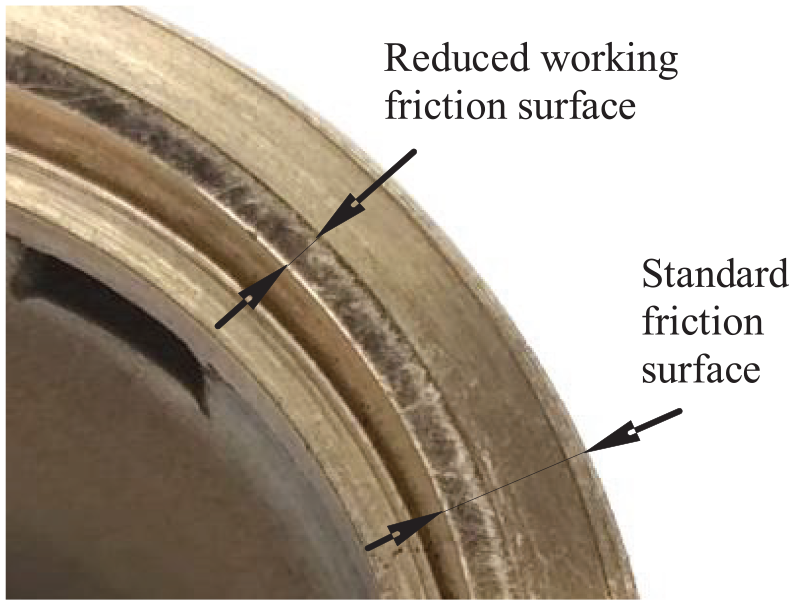
Fragment of a bronze triboelement with a changed contact area to achieve a specific load of 20 MPa.
The process of roughness change occurs due to plastic deformation and wear which is directly related to it under conditions of normal mechanochemical wear. 34 This process extends to the tribosystem limit of stability.
The average values of the measurement results obtained from the test results of the three pairs of specimens are shown in Figure 9.

Friction coefficient μ and temperature T °C in the zone of contact of tribosystem with non-abrasive finishing technology applied to bronze triboelement with the use of mineral of amphibole (jade) group.
The analysis of the obtained results has shown that the use of finishing treatment technology with the use of minerals could ensure the tribosystem operation under conditions of abnormally low friction and wear within the load range up to 20 MPa. When the tribosystem operates under conditions of abnormally low friction and wear, the heat dissipation is near-zero. When the load is increased up to 22 MPa, there is a transition from abnormally low friction and wear to normal mechanochemical friction and wear. In our view, this is caused by the disturbance of the balance between the molecular-mechanical and wave components of the friction force. The friction and wear tests of this TS were carried out under loads of 10 and 20 MPa. After finishing treatment with the use of PE 02–17 technology, there was ensured virtually wear-free operation of the TS over a wide range of loads. It also provides an abnormally low coefficient of friction and virtually no heat dissipation for the test time (480 min). The weight wear of steel and bronze specimens after finishing treatment with the use of PE 02–17 technology was not recorded, though the current measurement method was used, and so it possible to consider this wear was abnormally low.
The chemical analysis of the surface of the bronze specimen after finishing treatment with the use of PE 02–17 technology is shown in Figure 10. The chemical analysis at different loads revealed a slight decrease in the content of silicon and bismuth. In this case, the silicon and bismuth saturates the surface layer during the finishing treatment with the use of PE 02–17 technology. At the basic state (before processing with jade) the content of these elements is within the range of 0.01%. It should also be noted a significant decrease of lead content after such treatment compared to the baseline tests: it decreases more than eight times and practically does not change when the load is changed. This gives rise to the suggestion that self-organization at the load change occurs not by the diffusion mechanism, but as a result of changes in microgeometry, which is confirmed by subsequent studies.
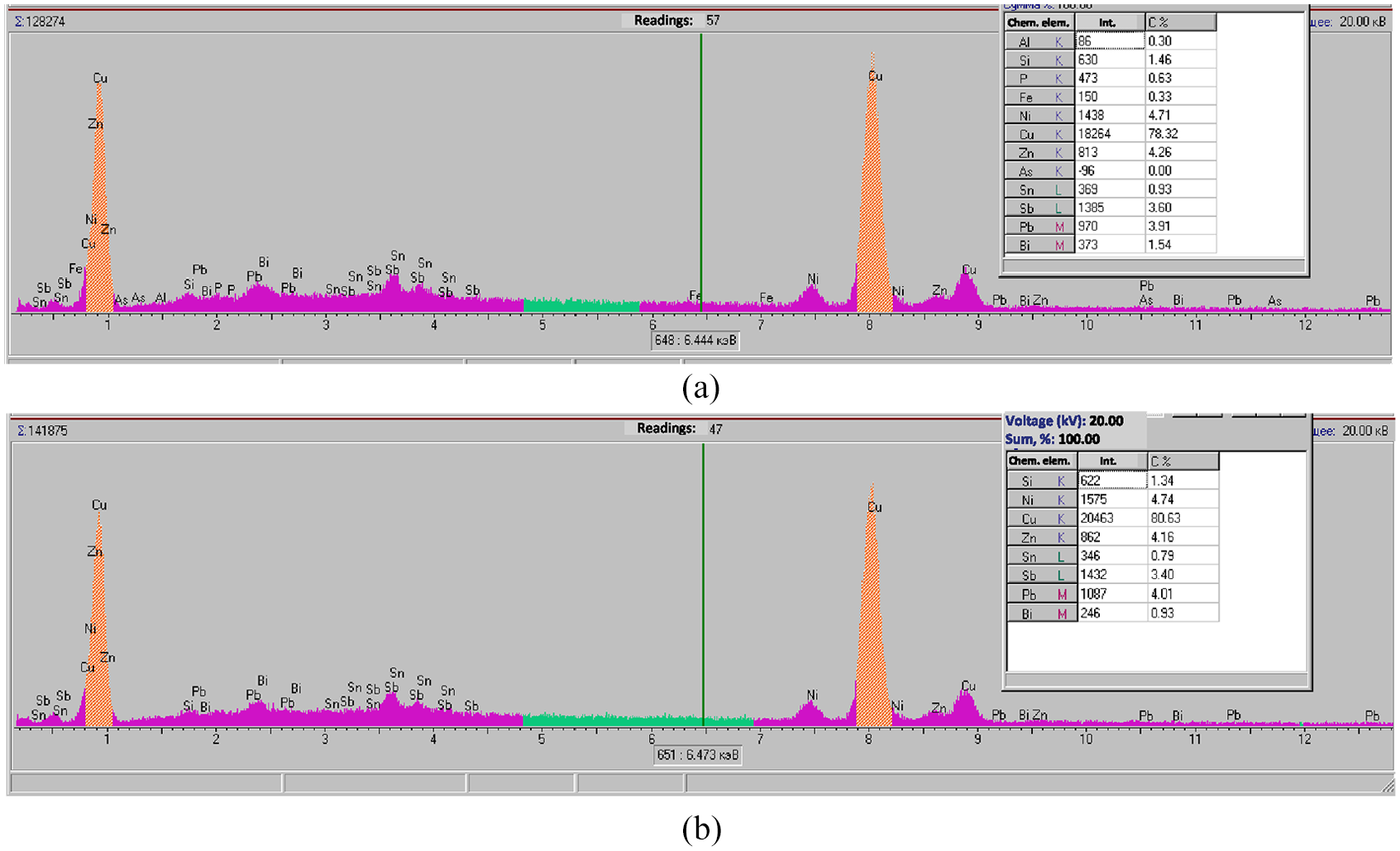
Chemical analysis of the surface of the bronze specimen: (a) load of 10 MPa, and (b) 20 MPa.
The analysis of amplitude-frequency response characteristics under conditions of abnormally low friction and wear was performed for the tribosystem operated at the same load as the basic TS (3.0 MPa). The results of the studies are shown in Figure 12. The amplitude-frequency response characteristic differs significantly from the basic tribosystem (phc.7). The study of the amplitude-frequency characteristics of elastic oscillations in the frequency range from 0 to 10 kHz showed that at normal mechanochemical wear, the maximum value of the amplitudes of oscillations is in the range of 400 to 500 Hz. And at abnormally low friction and wear on the diagram two characteristic maxima are observed: the first from 500 to 700 Hz (is inherent in normal mechanochemical wear, is generated by a molecular mechanical component), and the second is in the range from 6 to 7 kHz (that is an order above) and corresponds to a wave component of friction. Moreover, the maximum values of the amplitudes for these areas have equal values and are 42 dB. Which indicates the achievement of equality between the pulses of force from the molecular-mechanical and wave components of the friction force and explains the presence of abnormally low friction and wear (Figures 7 and 11).
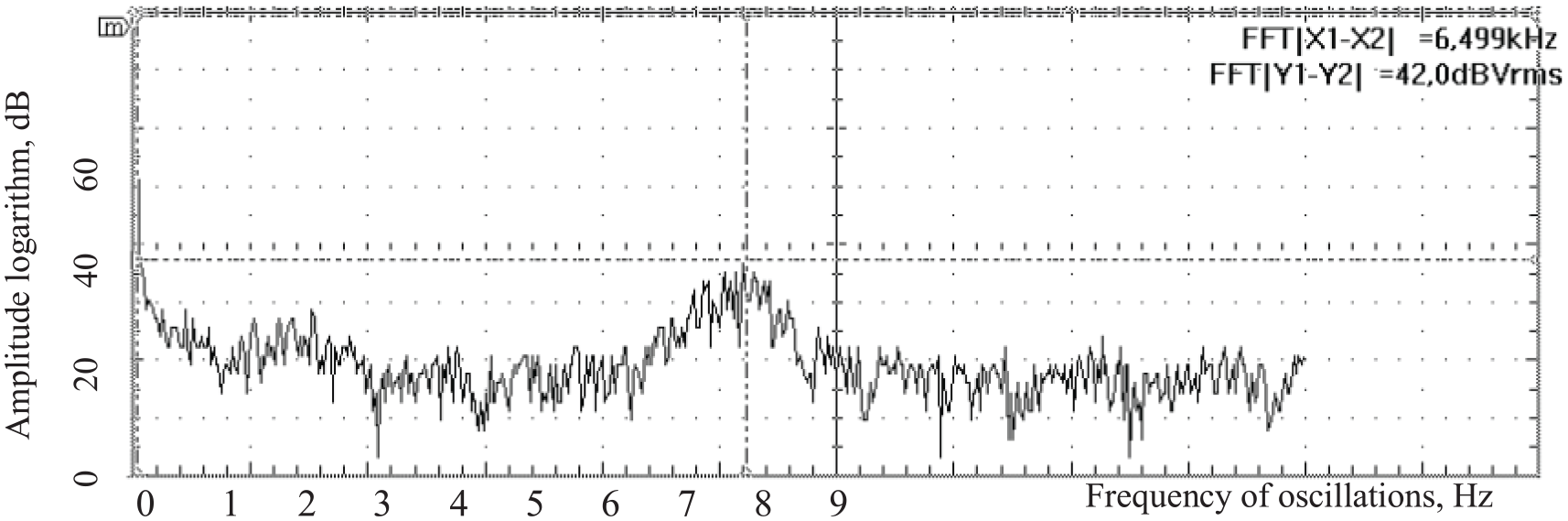
Amplitude-frequency response characteristic of the tribosystem operating under conditions of abnormally low friction and wear.
Thus, the transition from normal mechanochemical wear to abnormally low friction is due to the wave component of the friction force which is virtually within the same frequency range, and this corresponds to studies 30 at external activation by oscillations of the tribosystem.
We can draw the following conclusions on the basis of the research. The analysis of the microgeometric characteristics of the surface roughness of bronze triboelements further treated with jade (Tables 7 and 8) indicates that with increasing loads up to 20 MPa the roughness parameters change significantly (Ra decreases to 60%).
Average values of microroughness of a bronze specimen processed with the use of PE 02–17 technology when operating at a load of 10 MPa.

Average values of microroughness of a bronze specimen processed with the use of PE 02–17 technology when operating at a load of 20 MPa.

For tribosystems operating under conditions of abnormally low friction and wear, the change in microgeometric characteristics is related to the processes of rotational mobility which occurs in volumes larger than plastic deformation at normal mechanochemical wear. The rapid and significant change in microgeometric characteristics can be explained by the anomalous mass transfer in the surface layers and the transition of plastic deformation from the classical mechanism to the mechanism of grain boundary sliding. 35
Based on the results of experimental studies (Figure 4), the self-regulation for normal mechanochemical wear is carried out via the thermodynamic entropy channel. 26 In this case, the conditions of stationary wear are ensured by observing the equal rates of growth and loss of free energy. From the standpoint of structural-energy theory of friction and wear, 34 the equality of the rates of formation and destruction of secondary structures.
In conditions of abnormally low friction and wear, the self-regulation is carried out through the channel of structural entropy which is evaluated by the rheological and fractal perfection of the tribosystem. Common to the first and the second cases is an adherence to the fundamental Le Chatelier’s principle accepted in nonequilibrium thermodynamics, according to which any external influence that drives the system from equilibrium state initiates processes inside it that seek to restore the system to its original state.
By analysing the expression for the force impulse (1), it can be assumed that self-regulation, when changing the external friction conditions, will be performed by nano structuring the surface layer by changing a number of mechanical quanta
The fundamental value that determines the tribosystem stability under conditions of nonequilibrium self-organization is the production of excess entropy P[
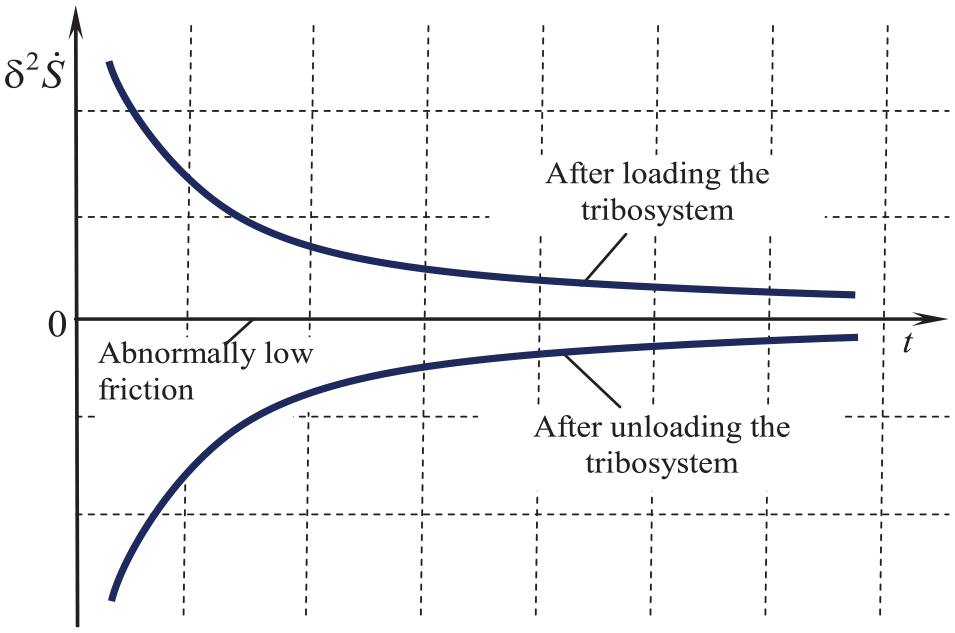
Changes in growth of excess entropy
When we change the load (Figure 12) by increasing or decreasing it, we change the friction specific power
As a result, the balance is disturbed between molecular-mechanical and wave components of the friction forces. According to Le Chatelier’s principle, the return to the equilibrium state in this TS occurs due to the change of the stress tensor

Tribotechnical characteristics in the contact zone of the tribosystem using the technology PI 02 17 when unloading from 24 to 12 MPa: (a) coefficient of friction, temperature, load, and (b) acoustic emission.
With that, the tribosystem passes into the region of “negative” friction, that is direction vector of the friction force is changing. In this case, the equilibrium between the molecular-mechanical and wave components of the friction force is broken. The results of wear rate measurement using acoustic emission method showed (Figures 13 and 14) that the “reduction” of the friction coefficient in this case was accompanied by increase in the temperature and the wear rate.

Tribotechnical characteristics in the contact zone of the tribosystem using the technology PI 02.17 with increasing load from 12 to 24 MPa: (a) coefficient of friction, temperature, load, and (b) acoustic emission.
The physics of wear process has a dramatic difference compared to normal mechanochemical friction, as discussed above. When loading the tribosystem (Figure 12) operating under conditions of abnormal low friction and wear the changes of tribotechnical parameters have the opposite character compared to the unloading (Figures 13 and 14).
The area under the envelope of the friction coefficient, relative to the abscissa axis (Figures 12–14) is the fraction of energy that is “destroyed” by friction in the form of stored latent energy, relative to the work of external forces (energy of external relative motion). When loading, this energy is stored in the surface layer, and after unloading it is “destroyed” from the surface layer and is accompanied by processes of surface destruction (wear) that have different physics. The appearance of wear particles in this case occurs in two stages. At the first stage, an area saturated with atomic-molecular level defects is formed in the subsurface layer, and during the second stage a particle from this area occurs on the surface as a result of a “microblast” (Figure 15(a)) The movement of the wear particles in this case does not coincide with the movement direction of the triboelements relative to each other (Figure 15(b)).

Surface fractography of the triboelement “VB23NTs (BБ23HЦ)” bronze (area of “negative” friction): (a) appearance of wear particles, and (b) their chaotic motion on the friction surface at unloading the tribosystem.
When loading tribosystems operating under conditions of anomalous low friction and wear, changes in tribotechnical indicators have the opposite character compared to unloading (Figure 14).
If the area under the envelope of the friction coefficient relative to the abscissa axis (Figures 13 and 14) is the fraction of energy, which is “destroyed” by friction in the form of stored latent energy relative to the work of external forces (energy of external relative motion), then, when subjected to loading, this energy is stored in surface layer, and after unloading it is “destroyed” from the surface layer and is accompanied herewith by processes of surface destruction (wear) that have different physics. Thus, from a thermodynamic position it is possible to imagine the dynamic (wave) component,
The conducted studies gave the grounds for optimization of the finishing treatment modes at the stage of its development which allow to reduce the level of inner energy accumulation in the subsurface layer that, in our opinion, is the reason of continuous breaking-in during the transition from normal wear to abnormally low wear, and also forms the kind of resistance when changing external friction conditions. The changes in the finishing modes make it possible to reduce the magnitude of the shear stresses in Saint-Venan’s body and to increase the elastic component in Newton’s body in Shvedov’s rheological model (Figure 3).
This tribosystem was subjected to tribotechnical tests according to the scheme outlined above, the test results are presented in Figure 16.
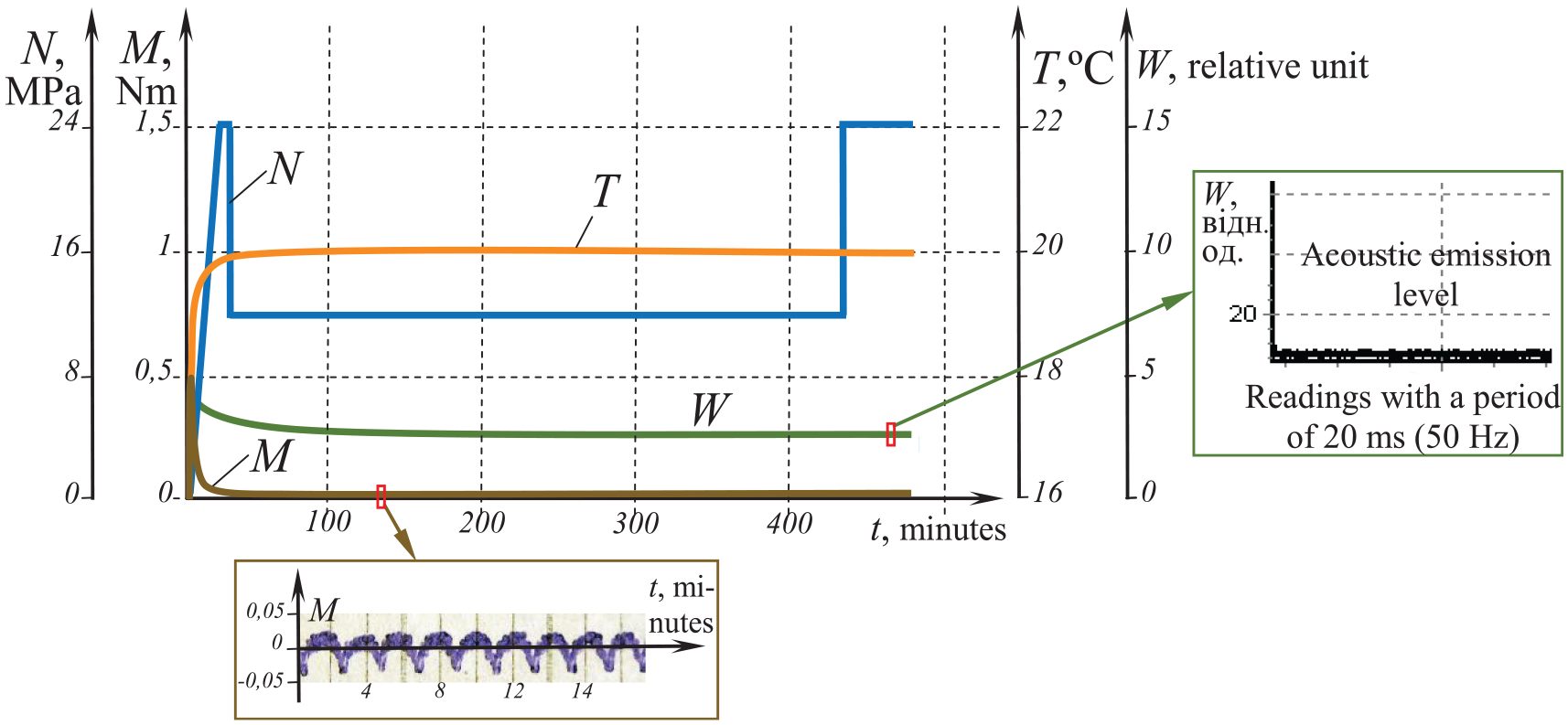
Tribotechnical characteristics (friction torque, M, temperature, T, acoustic emission, W) in tribosystem contact area over time.
Analysis of the test results showed that the technological measures made it possible to obtain a virtually “perfect” tribosystem. After loading the tribosystem, it goes for 5 min in conditions of abnormally low friction and wear (friction moment is supported by the tribosystem at zero level and has wavelike properties and contains a half-period both in range positive and negative the of values of the moment (coefficient) of friction (Figure 16). The average surface temperature in the contact area measured by a non-contact method using a pyrometer, increased from 18°C to 20°C for 8 h of testing, provided that the significant part of this heat is generated by the mounting base of a modernized standard friction machine 2070 SMT-1 (CMT-1), as well as by a submersible pump of the lubrication system. When the load changes (increase from 12 to 24 MPa and decrease from 24 to 12 MPa), the tribosystem almost instantly, without breaking-in, goes to abnormally low friction and wear without additional heat release (T = 20°C).
Thus, self-regulation of the tribosystems operating under conditions of abnormally low friction and wear is carried out through the channel of structural entropy

where
In essence, adhering to Le Chatelier principle under conditions of abnomal low friction and wear reduced to achieve the equilibrium state by adjusting the number of mechanical quanta on the spots of actual contact.
With abnormally low friction and wear, it is appropriate to speak not only about the production of entropy and internal energy of the material, but also about their destruction through the wave channel. The self-regulation principles for the tribosystems of this kind when changing external conditions have their own peculiarities.
For simplicity, let us consider the case, when in the tribosystem the upper movable triboelement is an ideal solid body, while the stationary one consists of homogeneous elements (Figure 1(a)), and the energy exchange occurs according to Shvedov’s rheological model of (Figure 1(b)). Suppose that the functional units in the system are not individual elements, but their units – ensembles

Where j = 1,2,…., n;
fij– a function that describes the rate of getting balance when changing the external conditions of energy exchange between wave components from the molecular-mechanical and wave components of the friction force
gij– a function that describes the violation of this balance.
The nature of the contact interaction on the spots of actual contact is shown in Figure 17.

Specific features of the surface layer of triboelements operating under conditions of abnormally low friction and wear: (a) topography of the friction surface: 1 – nominal contact area; 2 – actual contact spot; 3 – separately interacting elements of the ensemble,
The presence in particular of the anti-gravity component Nwi explains the significant increase in the load-bearing capacity when the TS is converted to abnormally low friction and wear when using the PE 02–17 finishing technology.
For simplicity, let us also state that these reactions to changing external conditions lead to a redistribution of energy exchange between elements of the ensembles and an almost instantaneous change of its structural and functional state. We introduce integral functions

where
Thus, at the first stage of adaptation to the new environmental conditions

where P*1 and P*2– optimal organization of the system before and after its change;
k – proportionality factor;
At the second stage of adaptation, the tribosystem establishes a new organization of probability ensembles that optimally corresponds to a new environmental condition
The initial disorganization of the system during its adaptation to the new environmental conditions is caused by the fact that the formation of a new structure of the surface layer implies a structural restructuring both at the nano- and meso-levels. It has been experimentally established that, depending on the transition to more intense or lighter operating conditions, there is an accumulation or dissipation or production of additional energy resources during structuring.
As a result, in a short time there is an adaptation to the new conditions of external friction, while observing the basic principle of equality between the molecular-mechanical and wave components of the friction forces.
The fundamental thermodynamic condition for achieving this balance is a structural entropy which magnitude is

The structuring that leads to achievement of these conditions are the conditions of “traveling wave” formation, and it has been interpreted in electrical engineering. 39
An experimental confirmation of the validity of this approach is the estimation of topological features of the tribosystem surface layer which operates under conditions of normal mechanochemical wear and after the transfer of this tribosystem to conditions of abnormally low friction and wear with heat flow control (Figure 18). The Fourier analysis of the structural organization of a surface layer, 40 used in this case, makes it possible to estimate the level of orientation of three-dimensional structural elements in two-dimensional space (only small-sized elements are analyzed).

Fourier analysis of the orientation distribution of elementary cells of microrelief surfaces of friction surfaces of the bronze triboelement “VB23NTs (BБ23HЦ),” represented as Regge trajectories: (a) at normal friction, and (b) at abnormally low friction.
This study shows once again the observance of the first and second laws of thermodynamics when the tribosystem is operated under conditions of abnormally low friction and wear. At abnormally low friction and wear, the structural entropy reaches the maximum values possible for a given tribosystem, and the amount of internal energy directly related to the strain is minimized. These conditions are provided by the wave component of the friction force.
At abnormally low friction and wear, the “traveling wave” formation is caused by equilibrium between the integral magnitude of the force impulse from shifted in phase wave and molecular-mechanical components of the friction force. Conducted theoretical and experimental studies have been implemented at PJSC “FED” in manufacture of actuator-generators of AN-148/158/178 aircraft whose durability has increased more than four times. The use of PE 02–17 technology also significantly reduced the heat output of these units.
Summary
Theoretical and experimental studies have confirmed the hypothesis of reducing the friction forces during the movement of solids due to internal forces. It is shown that the source of these forces is the wave component of external friction. Comparative analysis of the mechanisms of self-organization of tribosystems operating in conditions of normal mechanochemical and abnormally low friction and wear allowed to establish the mechanisms of self-organization of the tribosystem and substantiate the technology of modification of the surface layer of bronze samples by mineral treatment of amphiboles (jade). The technology allows to change the rheological construction of the surface layer, which can be described by the Shvedov’s model, and makes possible to convert the energy supplied from the outside through a wave channel (the presence of a wave component of external friction).
It is shown that the structural self-organization, occurs at the conditions of abnormally low friction and wear due to the structuring of the surface layer, and it is aimed to maintain such a mode of operation of the tribosystem, where there is a minimization of friction losses. It has been experimentally proved that with the load increasing the surface is significantly smoothed, in contrast to normal mechanochemical wear.
The study of the amplitude-frequency characteristics of elastic oscillations in the frequency range from 0 to 10 kHz allows to make a conclusion that under the same operating conditions the oscillations have much higher magnitude at abnormally low friction and wear mode. It is experimentally proved that such oscillations are associated with the wave component of the friction force, the presence of which is responsible for the occurrence of abnormally low friction and wear.
Footnotes
Handling Editor: James Baldwin
Declaration of conflicting interests
The author(s) declared no potential conflicts of interest with respect to the research, authorship, and/or publication of this article.
Funding
The author(s) received no financial support for the research, authorship, and/or publication of this article.
