



Abstract
The performance characteristics of the engine and the emission levels with Copra Oil (CPO), Virgin Coconut (cocos nucifera) Oil (VCO), Tamanu (calaphyllum inopyllum) Oil (TMO), and Nangae (canarium indicum) Oil (NGO) are presented. The oils, obtained from naturally grown trees in Vanuatu, were tested as straight vegetable oils (SVOs) in a Diesel engine and the results are compared with those of neat diesel. The oils were converted to their fatty-acid-methyl-esters (FAMEs) using gas chromatography to determine their fatty acid compositions. The brake thermal efficiency with SVOs was found to be comparable to diesel. The structure of the alkyl chain and the carbon-to-hydrogen ratio were also studied. All the oils have Palmitic acid, Capric acid, Caprylic acid, and Oleic acid as the major fatty acids. The CPO and VCO have higher amounts of Oleic acid, which acts as an additive and breaks up the interaction between the major fatty acids at higher temperatures, reducing the viscosity. Emissions of CO2 were lower while those of CO, NOx, and SO2 were higher with SVOs compared to diesel. The results indicate that the local SVOs are good and inexpensive substitute fuels for Vanuatu that can help the country meet the UN’s sustainable development goals.
Introduction
Pacific Island Countries (PICs) do not have indigenous sources of fossil fuels to support their economies.1–3 The use of plant oils in diesel engines will support the utilization of indigenous renewable energy resources in not only achieving sustainable economic development but also promoting “clean and green energy” for preserving the natural environment.4–7 Vanuatu suffers from the disadvantages of small population, distance from the world market, scattered nature of archipelagos and frequent natural disasters. At the same time, coconut (cocos nucifera), tamanu (calaphyllum inophyllum), and nangae (canarium indicum) are good natural resources in Vanuatu.8,9 The use of these neat natural plant oils as alternative fuels (biofuels) in PICs can offer significant potential to offset imported petroleum cost.6,10,11 These plants grow naturally in Vanuatu and it is much easier to utilize these natural resources compared to places where landowners are not willing to grow such crops 12 or where economic models predict an increase in food price as a result of land use for growing such plants. 13 Moving to domestically produced plant oils will help reduce the use of costly fossil fuels, and the development of the plant oil producing industries would strengthen the rural agricultural economy of agriculture-reliant countries. This will also help the country meet a number of UN’s sustainable development goals, such as “Affordable and Clean Energy,” and “Sustainable Cities and Communities” etc. More importantly, the development will balance social, economic, and environmental sustainability. 14
The term biofuel refers to any fuel that is derived from biomass, such as sugars, vegetable oils, and animal fats, etc. Biofuels made from agricultural products (oxygenated by nature) can reduce the PIC’s dependence on oil imports, 10 support local agricultural industries and enhance farming income especially for the rural and remote communities, while offering benefits in terms of sustainability and reduced particulate matter 15 emissions. What is equally important, from an economic point of view is that they can be produced locally. Consequently, they constitute a long term measure to, at least in part, increase energy security and diversity.7,16
The process of combustion of alternative forms of fuel in a diesel engine can prove quite demanding in terms of engine response, system reliability and exhaust emissions compared to neat diesel fuel.6,16,17 Fuel is injected by the fuel-injection system into the cylinder towards the end of the compression stroke. The liquid fuel is usually injected at high velocity in the form of one or more jets through small orifices or nozzles in the injector tip to atomize into small drops and penetrate into the combustion chamber. The fuel vaporizes and mixes with the higher temperature, higher pressure cylinder air. The cylinder pressure and temperature increase further as a result of the combustion of fuel. The resulting high pressure and high temperature gas expands and pushes the piston providing the working stroke. The efficiency of the process depends significantly on the characteristics of the fuel, on the combustion chamber structure, fuel injection system and on the operating conditions.
The direct injection of SVOs at normal temperature – that have higher viscosity may not give the desirable performance and emission characteristics from the diesel engine and adversely affect the durability of compression ignition engines including increased injector nozzle choking, piston ring sticking and dilution of the engine lubricant.18,19 However, it is an economical and convenient solution to the energy requirements of some countries and hence still actively researched. 20 It is reported by Chiong et al. 21 that SVOs can be a good candidate even for gas turbines if the combustion characteristics can be improved.
The use of biofuels such as SVOs is one of the solutions to the increasing energy requirements for transportation and power5,22,23 in developing countries. SVO fuels have the potential to perform just as well as regular diesel fuels and can be used in diesel engines with little modification. With the continued rise of fuel prices, SVOs are likely to become much more popular as a cheaper fuel option in the transportation and power generation industries in developing countries.24,25 Although, transesterification of the biofuels reduces the harmful effects on the engine, the transesterification process itself requires additional energy input and additives which may not be feasible in some of the small PICs.
Some advantages of using SVOs are: engine will last longer, better lubrication inside the engine thus increasing its durability and lower emissions. New regulations require diesel engines to lower emissions considerably; making SVOs more attractive as practical fuels to use since they produce less emissions compared to fossil fuels.26,27
On the other hand, some disadvantages of SVOs are: they contain less energy than diesel, leading to a reduction in engine power output. The energy content per liter of SVOs is approximately 10% lower than that of diesel. Engines running on SVO are therefore expected to achieve about 10% fewer running hours of fuel than diesel.28,29 Other problems include vulnerability to oxidation and chemical stability issues during storage, a tendency to form deposits, corrosion issues, cold flow problems and questionable stability from diverse feedstock.
While it is anticipated that SVO fuels have a high potential of replacing diesel,5,30 it is also well known that SVOs have high levels of kinematic viscosity. The higher levels of kinematic viscosity could offer resistance to fuel flow during fuel injection, affect the spray geometry and hence the atomization process. 31 The purpose of this work is to investigate the characteristics of the straight vegetable oils, produced in a country that has negligible pollution levels, and determine the performance and emission characteristics of a diesel engine using these oils as fuels. The oil-bearing trees grow in tropical countries naturally which produce large quantities of nuts and produce oils in excess of 50% per unit. It is estimated that approximately 290 million coconuts were produced in Vanuatu in 2007. Tamanu oil is produced from wild harvested fruits. Since the nuts are collected after they drop, there is no negative impact upon the life or habitat of the tamanu trees. Neither the land nor any surrounding plants are disturbed as a result of collection. If not collected, the fruits and nuts simply decompose. Thus, tamanu fruit collection is a low impact, environmentally sustainable activity. Canarium indicum is a tall indigenous tree that grows throughout the South Pacific and produces edible nuts as well as timber. The nuts are known in Vanuatu as nangae. In Vanuatu, the main season for the nuts is October to January with peak availability around November. In the most recent agricultural census in Vanuatu, the number of planted trees was 145,317. The advantages of using these oils include: the extraction process does not require sophisticated mechanical or extensive energy requirements and are not harmful to the environment at all. The trees from where these oils were obtained are available in abundance in Vanuatu and the oils have not been tested for performance as fuels till now. Moreover, no additives were used at any stage of testing, as any expensive additives will be a prohibitive factor for using these SVOs in practical engines in a developing country. As of now, Vanuatu generates about 43% of power from renewable sources; however, it needs to be highlighted that in the rural areas, only 17% households have access to electricity. About 16% of the imports bill is due to the fossil fuels. The country has an ambitious plan to move to 100% renewables by 2030 with biofuels one of the major contributors. 32 This will not only help the economy, but will also contribute to the sustainable development of Vanuatu. The country’s import of goods and services consumes 49% of the GDP and it is important to reduce these imports so that a small developing country like Vanuatu can meet UN’s sustainable development goals, that are difficult to achieve 33 by small and isolated countries like Vanuatu that source their petroleum from thousands of kilometers. The present work will give the policy makers an important option of directly using locally produced vegetable oils for power generation and to reduce the country’s dependence on imported petroleum and become self-reliant in power generation.
Oils and testing of their properties
Four different plant oils: coconut and virgin coconut, Tamanu and Nangae were obtained from Vanuatu. Coconut, Tamanu, and Nangae oils were extracted from the dried nuts using the screw press method whereas the virgin coconut oil was extracted from copra mill which was not exposed to much heat. The Tamanu and Nangae plants are not common and testing of the oils from these plants as SVOs will contribute to the global efforts to find new renewable fuels. 34 The above four oils were tested as straight vegetable oils for their properties as well as performance and emission characteristics using a diesel engine.
Properties of fuels
Viscosity measurement
The kinematic viscosity of the fuels was measured with a CANNON-FENSKE viscometer at 28°C in a water bath. Using a pipette, 10 ml of the fuel sample was transferred into the viscometer and allowed to equilibrate for 10 min. A suction bulb was used to draw the fuel in the viscometer capillary above the start mark and allowed to flow under gravity. The time required for the meniscus of the fuel to move from mark 1 to 2 was measured. For each fuel sample, five trials were conducted and the results were averaged.
Density measurement
The density of the different fuels was measured using a 25 ml pycnometer equilibrated in a water bath at pre-set temperatures. The results were recorded five times for each fuel and the average was taken.
Thermal analysis
For finding the calorific value, an IKA calorimeter system, model C200, was used. It was ensured that combustion takes place under specifically defined conditions.
Preparation of Fatty Acid Methyl Esters (FAMEs) by base-catalyzed transesterification method
To 4.25 g of potassium hydroxide (KOH), 100 g of methanol was added and stirred until all the KOH pellets dissolved. This solution was added to 500 g of vegetable oil in a 1 L conical flask which was equilibrated to 60°C. The solution was further stirred for 1 h at this temperature before cooling it to room temperature and transferred to a separating funnel to allow the two fractions to separate. The lower layer containing the glycerol was discarded. The upper layer was the FAME that was used for further analysis. Base-catalyzed esterification proceeds more rapidly and very small amount of free fatty acid 35 is expected to remain. Similar amount also remains when we do a two-step esterification as stipulated in the literature.
Standard solution preparation
The standard FAME solution was purchased from Sigma Aldrich, a German company. To 1 mL of hexane the standard FAME solution was added to prepare solution of concentration 100 mg/mL. This solution was stored at 4°C for gas chromatographic analysis. For the purpose of external standards, the solution was diluted to 50, 20, 10, 5, 2 mg/mL respectively.
Gas chromatography (GC) analysis
Gas chromatographic analysis of FAME was performed on a Shimadzu GC-MS QP 2010 chromatograph equipped with a split/split-less injector. Separations were achieved using a fused silica Zebron ZB-FFAP capillary column (60 m × 0.25 mm ID, 0.25 μm film thickness). Nitrogen was used as the carrier gas at flow rates of 1.99 mL/min and a split ratio of 1:10. The injector temperature was 200°C. The oven temperature was programmed at 80°C for a hold of 10 min and increased to 250°C at a rate of 7°C/min and hold at the final temperature for 10 min. Lab-Solution software was used to control the operation of GC. Standards of fatty acid methyl esters (FAME) were used from Supelco Inc., Bellefonte, PA (Supelco 37 Component FAME Mix) suitable for analysis of plant nut oils including coconut, palm kernel, Babassu and Quri-curi. Other reagents were purchased from Merck, Germany. All determinations were carried out in triplicates. FAME peaks in the different oils were identified by comparing their retention time and equivalent chain length with respect to standard FAME.
Engine performance and emission testing
Experimental set-up
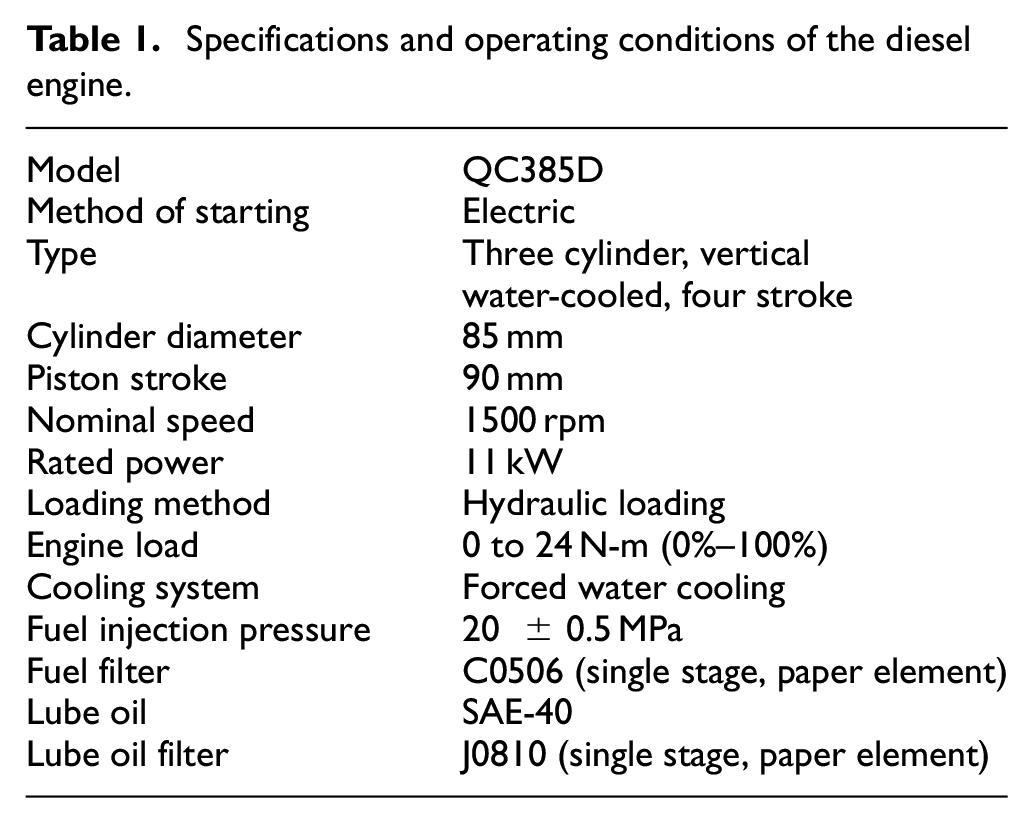
The performance and emission characteristics of the SVO fuels were recorded and compared with those of neat diesel fuel. A Diesel engine, made by Anhui Quanchai Engine Company Ltd., China, was used to conduct the performance tests. A water brake dynamometer, D-100, was coupled with the engine. The torque applied on the engine was displayed and recorded on the Dynosoft monitoring software linked to with an electronic load cell transducer connected to the dynamometer unit. The output parameters of the engine, speed, torque, engine water temperature, ambient temperature, exhaust temperature are also displayed and recorded using the Dynosoft software. The specifications and the operating conditions of the engine are given in Table 1.
Specifications and operating conditions of the diesel engine.
The experimental setup, shown in Figure 1 consisted of engine test bed with three (3) fuel supply sources comprising of two 2000 ml and one 250 ml cylinders located above the engine and having three separate outlet valves. The fuel is gravity fed and at each run the ball valves are either at the open or closed position to allow for the specific fuel run. A photograph of the diesel engine along with the fuel supply sources is also shown in the figure.

Schematic diagram of the experimental set-up showing the engine and the fuel supply sources (left) and a photograph of the engine along with the fuel supply sources (right).
Methodology
Using diesel as the baseline for comparison of performance and emission with the SVO fuels, the first test was performed with diesel; the diesel supply valve was at open position while the SVO fuel supply valves were at the closed positions. The fine tuning load variable adjustment knob was tuned anticlockwise and fixed to five different positions or at approximately 0%, 25%, 50%, 75%, and 100% load or from 0 to 24 N-m. At each adjusted load, readings were recorded for fuel consumption in milliliters per second (three trial readings are taken and then the average of them was used in the calculations), exhaust gas properties with the gas analyzer and the data of rpm, brake power, exhaust gas temperature, ambient temperature, air intake temperature, engine coolant temperature, torque, and oil pressure that were displayed on the computer with Dynosoft software. The above procedure was repeated for the SVO fuels with the diesel fuel supply valve closed during the reading and recording process.
The Diesel and the SVO fuels were used to drive the engine with a constant compression ratio and variable rpm and the performance and emission analysis were carried out. In every test, rpm, brake power, torque, exhaust gas temperature and exhaust gas emissions particularly carbon monoxide (CO), nitrogen oxides (NOx), carbon dioxide (CO2), sulfur dioxide (SO2), and oxygen (O2) were measured. From the initial measurements, brake thermal efficiency, specific fuel consumption, and indicated power were calculated. At each operating condition, the performance characteristics and exhaust emission levels were obtained and the same procedure was repeated for other loads. The uncertainty in the measurements of brake thermal efficiency and Brake specific fuel consumption (BSFC) were estimated using the method presented by Moffat. 35 The maximum error in the estimation of brake thermal efficiency was 2.3% and that in the BSFC was 1.9%. The repeatability of exhaust gas emission measurements was ±1%.
Results and discussion
Properties of fuels
The SVO fuels were used as an alternative fuel to operate a diesel engine. The physical properties of the SVOs and diesel are shown in Table 2. The diesel that is imported in to Vanuatu is Grade 2 as per ASTM D975 standard, whose viscosity is higher than Grade 1 diesel. According to Table 2, kinematic viscosities for the SVOs are higher than diesel at 28°C while density for TMO was found to be the highest of all the oils tested and was about 10% higher than diesel. Our findings are in good agreement with those reported by Hoang. 7 They found kinematic viscosities of pure vegetable oils to be 7 to 10 times higher than diesel. They also reported densities 12% to 15% higher than diesel for these oils. The heating value of all the SVOs is less than that of diesel, which is normally due to the higher oxygen content of biofuels. For pure coconut oils, Hoang 7 reported a heating value of 39.5 MJ/kg.
Properties of diesel and SVO fuels.

Table 3 shows the densities of the pure oils at different temperatures. As expected, the densities decrease with an increase in temperature. The reductions in the densities for the pure vegetable oils from 28°C to 73°C are comparable to those reported by Hoang, 7 and the values of the densities for coconut oil are very similar to those reported by Hoang. 7
Densities of SVOs at different temperatures.

Table 4 shows the viscosities of the oils at different temperatures. It can be seen that the kinematic viscosity of all the SVOs decreases significantly when the temperature was increased from 28 to 73°C. The reduction in the viscosity of SVOs was higher than that of diesel. This behavior is due to the weakening of the inter-molecular interactions such as hydrogen bonding which occurred due to the presence of hydroxyl groups in the fatty acids of the vegetable oils.
Kinematic viscosities of the fuels at different temperatures.

Gas Chromatographic analysis of the fuels
The different fatty acids present in the oils were identified using Gas chromatography by comparing the retention times of the peaks from the methylated form of the oils with those of the standard. Figure 2(a) shows the gas chromatograms of the standard FAMES and Figure 2(b)–(e) those of copra oil, virgin coconut oil, Tamanu oil, and Nangae oil. The FAMES present in the standard used are labelled for each peak in the figure. Table 5 shows the chemical structure of the different fatty acids present in the standard. Separation of FAMES in GC happens according to the molecular weight. For the four oils, the GC chromatograms show the presence of the different fatty acids. By matching the corresponding retention times of the peaks in the oil with those of the standard, the different fatty acids present in the oils were identified. The major fatty acids present in all the oils were Palmitic acid, Capric acid, Caprylic acid, and Oleic acid but in different proportions.

The gas chromatogram of the standard containing the fatty acids and those of the four oils: (a) Standards 19A, (b) Copra oil, (c) Virgin coconut oil, (d) Tamanu oil, and (e) Nangae oil.
The different FAMES present in the standard.

Based on the chemical structure of the fatty acid identified, the C/H ratio was calculated by dividing the number of Carbon atoms by the number of Hydrogen atoms and the C/O ratio by dividing the number of Carbon atoms by the number of Oxygen atoms. The C/H ratio was calculated to be 0.5 for Capric acid, Caprylic acid, and Palmitic acid, while it was 0.528 for Oleic acid. However, the C/O ratio for Capric acid, Caprylic acid, Palmitic acid and Oleic acid increased from 4.5 to 9.5. It can also be seen that CPO and VCO have higher amounts of Oleic acid (Figure 2), which acts as an additive and breaks up the interaction between the four major fatty acids at higher temperatures, resulting in lower viscosities as can be seen from Table 4. The percentages of Carbon, Hydrogen, and Oxygen in the fuels were calculated from the proportion of different fatty acids present in the different oils. The proportion of the fatty acid was determined based on the area of each peak in the chromatogram corresponding to the respective fatty acid to the total area of the four peaks. The results of the analysis are shown in Table 6. It can be seen that the carbon content is much higher in the oils compared to hydrogen and oxygen. This will have a strong influence on the performance and emission characteristics from these oils. Because of the higher carbon content compared to oxygen, the fuels are expected to produce more CO than CO2.
The percentages of carbon, hydrogen and oxygen present in the four SVOs.

Performance characteristics
Performance curves were drawn for various parameters like Ƞbt, BSFC etc. and the results are presented in the following subsections.
Brake thermal efficiency
Brake thermal efficiency is defined as the ratio of the heat equivalent of 1 kW-hour to the heat in fuel per B.P.-hour. It is also known as the overall thermal efficiency of the engine. It can be observed from Figure 3 that the brake thermal efficiency of all the fuels shows the tendency to increase with increasing load. This is due to a reduction in heat loss and increase in power developed with increasing load. 36 The values of brake thermal efficiency are generally comparable for the SVOs and diesel. Hiregoudar et al. 30 reported comparable brake thermal efficiency for soybean oil and diesel. The NGO oil gives a higher brake thermal efficiency at 75% load and full load conditions. The increase in brake thermal efficiency for this fuel is due to the improvement of the combustion process on account of higher oxygen content in the fuel. In case of CPO and VCO, the drop in the brake thermal efficiency at 25% and higher loads is due to lower heating values, higher densities and poor mixing.7,37,38 Similar observation was made by Singh et al. 39 who reported lower efficiencies with virgin coconut oil and crude coconut oil. The heating value of the TMO is higher than CPO and VCO, resulting in a higher brake thermal efficiency. The fatty acids present in all the SVOs tested have a nearly same Carbon to Hydrogen ratio of 0.5 for the TMO and NGO, while it is slightly higher at 0.528 in the form of a higher Oleic acid for CPO and VCO, which contributes to a slight delay in ignition and hence a lower thermal efficiency. 40 At higher loads, Jain et al. 41 recorded a lower brake thermal efficiency for unheated Thumba oil compared to diesel.

Brake thermal efficiencies with the SVOs and with diesel.
Brake specific fuel consumption
Brake specific fuel consumption is the ratio of the rate of fuel consumption to the brake power; it is found to decrease with increasing load. The BSFC is the highest at the no load condition. This is due to a greater increase in brake power with load compared to increase in fuel consumption. 36 The variation of brake specific fuel consumption with brake power is presented in Figure 4. Among all the fuels including diesel, NGO has the lowest BSFC at most of the loads. Hence from BSFC point of view, NGO is advantageous. This is because of the combined effects of higher heating value (39.45 MJ/kg) compared to other SVOs, lower fuel flow rate, and lower density of the NGO compared to other oils.37,38 At 25% load, VCO showed the least BSFC while TMO showed the highest; while at 50% load, NGO has the lowest BSFC and TMO the highest. The general trend in the variation of BSFC with increasing load is similar to the trends reported in the past.7,20,30,39 Experiments conducted with different proportions of biodiesels39,42 showed that BSFC increased with increasing biodiesel content. However, in the present work, the BSFC with SVOs was not significantly different from that with diesel, which is very encouraging. NGO showed lower BSFC overall due to its higher heating value and lower density compared to the other fuels.

Brake specific fuel consumptions of SVOs and diesel.
Fuel consumption
Figure 5 shows the fuel flow rate at all the loads for diesel and the SVOs. Among all the fuels tested, NGO has generally lower average fuel flow rates. This is due to the higher heating value of NGO of all the SVOs, the presence of oxygen and the relatively lower density of this fuel. For VCO, the fuel consumption was lower at lower loads. The relatively higher density, lower viscosity, and lower heating value resulted in higher fuel flow rates of CPO.

Comparison of fuel flow rate of SVOs with diesel.
Emission characteristics
Emission characteristics were studied using the values obtained from emission tests. The emission tests were performed with a portable Horiba gas analyzer, model PG250, shown in Figure 6. The gas analyzer kit consists of a probe and an analyzer. It detects and displays the emitted particles and their constituents in part per million (PPM) or percentage by volume (% vol.). The Horiba Gas Analyzer, model PG-250, measures five components in the exhaust gases, CO, CO2, O2, SO2, and NOx. The range of CO measurements is 0 to 5000 ppm, that of CO2 is 0 to 20 volume%, that of O2 is 0 to 25 volume%, that of SO2 is 0 to 3000 ppm and that of NOx is 0-2500 ppm. The repeatability of the Analyzer is ±1% of F.S.

(a) Horiba gas analyzer and (b) and exhaust probe with connection.
The experimental set up in this respect also involves the thermocouple and probe that is inserted into the engine exhaust outlet pipe, shown in Figure 6(b). When the engine is running, the emission levels of carbon monoxide (CO), nitrogen oxides (NOx), carbon dioxide (CO2), sulfur dioxide (SO2), and oxygen (O2) for the fuels can be measured with the help of this analyzer. The variations in the values of emissions such as CO, NOx, CO2, and SO2 are shown at various loads in parts per million (ppm) in the following sub-sections.
Carbon monoxide
Generally, there are several factors that influence CO emission, such as engine speed, fuel type, air-fuel ratio, fuel injection pressure and fuel injection timing. 38 Another factor is the incomplete combustion when the fuel does not get atomized properly if it has high viscosity. The CO emissions at different loads are given in Figure 7. At no load condition, the SVOs exhibit higher amounts of CO compared to higher load conditions because the air-fuel ratio is too lean for complete combustion to take place. For diesel, the CO emission reduces initially with increasing load and then starts to increase and reaches the maximum at 100% load. Similar observation was made by Hiregoudar et al. 30 It can be seen from the experimental results that the SVOs exhibit higher CO emissions for all the load conditions, especially TMO and NGO. Both these fuels have higher kinematic viscosities at higher temperatures (Table 4); at lower loads the fuel flow rate is less (Figure 5), which could lead to improper spraying (atomization becoming difficult) of these fuels in the combustion chamber due to their higher viscosities, resulting in incomplete combustion. At low and medium load conditions, the CO emissions of SVOs are significantly higher than diesel; a trend also reported by Elango and Senthilkumar. 24 Saha et al. 17 reported higher CO emission levels for rice bran and sesame oils at all the loads. Fuel-rich conditions are expected to be prevalent at higher fuel viscosities, which is the case in the present work, resulting in delayed combustion of some of the fuel and incomplete combustion of the remaining fuel due to the non-availability of sufficient oxygen in some regions of the engine cylinder. 39 At high loads, the temperature in the combustion chamber increases, which reduces the viscosity and results in a reduced difference between the CO emissions with diesel and SVOs. However, the overall high CO presence in the emissions is due to the significantly lower oxygen compared to carbon, as presented in Table 6. Similar findings were reported by Jain et al. 41 who observed higher CO emissions for the unheated vegetable oil compared to diesel at all the loads.

CO emissions at different loads for diesel and the SVOs.
Nitrogen oxide
Nitrogen oxide (NOx) emissions at different loads are presented in Figure 8. NOx is formed by a chain reaction involving nitrogen and oxygen in the air. These reactions are highly temperature dependent.38,40 Since diesel engines operate with good amount of air, NOx emissions are found to be higher in compression ignition 43 engines compared to spark ignition (SI) engines.30,37,40 NOx emissions for TMO and NGO are found to be significantly higher than CPO and VCO at all the loads and slightly higher than the NOx emissions for diesel. This is probably due to lower combustion temperature in the engine cylinder with TMO and NGO. NOx emissions are a serious environmental concern because of their role in the smog formation 44 and some of the previous studies have shown increased NOx emissions with pure biodiesels and biodiesel-diesel blends.24,36,45 Torregrosa et al. 46 reported higher NOx emissions at higher loads for different biodiesel blends compared to diesel, a trend also reported by Wang et al. 47 who attributed to higher combustion temperatures at higher loads. They also reported lower NOx emissions with vegetable oils and attributed it to lower calorific value of the oils. In the present work, CPO and VCO have the lowest heating values as well as NOx emissions.
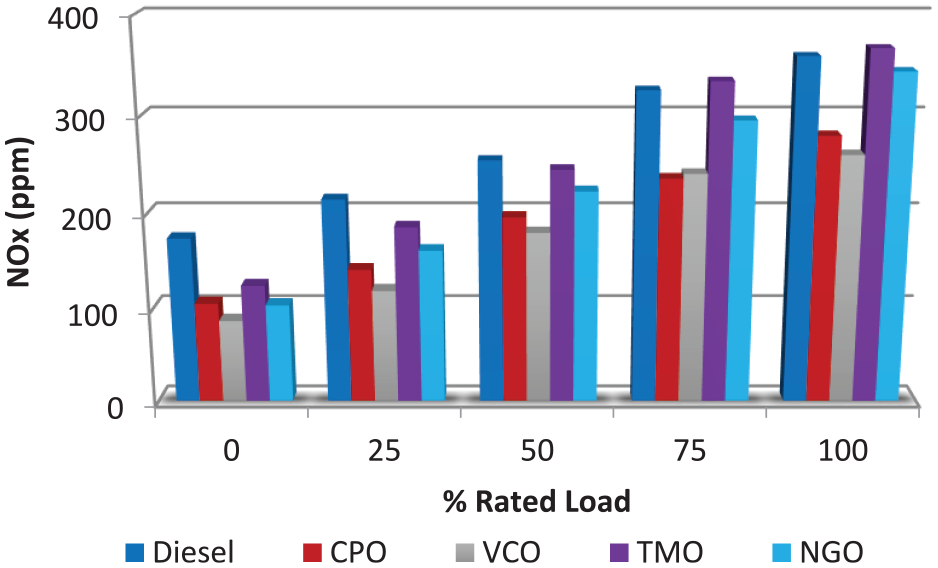
NOx emissions at different loads for the SVOs and diesel.
Carbon dioxide
Figure 9 shows the emission levels of CO2 for the various SVOs and diesel fuel. The CO2 emissions of all the fuels tested have the tendency to increase with increasing load. The measurements reveal that the CO2 emissions for all SVOs are lower compared to diesel at all the loads. The amount of CO2 emitted by the engine is directly related to the thermal efficiency of the engine for the corresponding fuel. 36 SVOs contain lower carbon content as compared to diesel and hence the CO2 emissions are comparatively lower. It is also observed that CPO exhibits lesser amount of CO2 emission than diesel and other SVOs. Lower CO2 emissions for biodiesels and biodiesel-diesel blends compared to diesel were reported by Elango and Senthilkumar, 24 Singh et al., 39 Devan and Mahalakshmi 48 and Chauhan et al. 49 On the other hand, Agarwal and Agarwal 50 reported higher levels of CO2 for unheated Jatropha oil compared to diesel, while Jain et al. 41 reported lower CO2 emissions compared to diesel for Thumba oil. With Butanol-diesel blends, Yusri et al. 51 found reduced, CO, NOx and increased CO2.

CO2 emission at different loads for the SVOs and diesel.
Sulfur dioxide
The sulfur dioxide (SO2) emissions are shown in Figure 10. SO2 is generated from the sulfur present in the fuel. Thus the concentration of SO2 in the exhaust gas depends on the sulfur content of the fuel. Sulfur oxides have a profound impact on the environment being the major cause of acid rains. It is interesting to observe that the SO2 levels remain the same approximately from 25% load to 100% load. That is one of the main advantages of vegetable oils is that they contain very little amount of sulfur, which is a major source of sulfur dioxide emissions from fossil fuels.

Variation of sulfur dioxide emissions with different loads for the SVOs and diesel.
Exhaust gas temperature
Figure 11 shows the variation of exhaust gas temperature with respect to load of the various SVO fuels and diesel. The results show that the exhaust gas temperature increases with increase in load for all the fuels. Similar trend and range of exhaust gas temperatures were reported by Delalibera et al. 6 The amount of fuel injected increases with the engine load in order to provide the power output and hence the heat release with increase in load applied.6,36,38 At all loads, diesel and SVOs are found to have alternate lowest temperature. The SVO fuels contain oxygen which enables the combustion process and hence the exhaust gas temperatures are higher. Moreover, the engine being water-cooled runs hotter which resulted in higher exhaust gas temperatures. Among the SVOs and diesel, CPO has the lowest exhaust gas temperature.

Variation of exhaust gas temperature with different loads for the SVOs and diesel.
The above results show that SVOs can be used directly in CI engines without preheating or by applying any other process of reducing viscosity. While there is some penalty in terms of higher CO and NOx emissions, it is a cost-effective solution for a developing country like Vanuatu. From their work, Agarwal and Agarwal 50 had concluded that vegetable oils’ physical and combustion characteristics are similar to diesel’s and that vegetable oils are safer as they have higher ignition points. Moreover, Since these four plants grow naturally in Vanuatu which has a small population density, there will be no effect on food production or food cost which is experienced by highly population countries. 52
Conclusion
The diesel engine successfully ran on the pure SVO fuels from Vanuatu without any additives. No knocking was observed, implying that the SVO fuels are suited for the D.I. diesel engine. Engine performance and emission results of the SVOs were compared with the results obtained with neat diesel fuel. The following are the main conclusions from the present work:
Brake thermal efficiencies from the SVOs were found to be comparable with diesel.
Tamanu oil, which is a non-edible oil, showed good performance characteristics despite having a high viscosity at the ambient temperature.
The CO2 emissions for the SVO fuels are slightly lower than that of diesel. This is good for the environment in combatting climate change.
The CO emission results for the SVOs are higher than that of diesel for all loads due to a high carbon to oxygen ratio in the SVOs resulting in some of the carbon experiencing incomplete combustion.
The four oils used in the present studies can be used in diesel engines directly without any significant reduction in engine performance. This will be a good solution for a developing country like Vanuatu, where the production of biodiesel using transesterification will consume more time and money.
Footnotes
Acknowledgements
The authors are thankful to the technicians of Engineering, Physics and Chemistry Divisions for their help during the course of this work.
Handling Editor: James Baldwin
Author Contributions
Conceptualization, application for project approval, acquisition of oils, testing and data analysis, preparation of first draft: MJS; Methodology, Supervision, review and editing: MRA; Gas chromatographic analysis, analysis of structure of difference FAMEs, estimation of percentages of Carbon, Hydrogen and Oxygen and discussion of the results on these aspects: DR.
Data Accessibility Statement
Sample data are provided with the manuscript. Full data will be made available upon request and after approval from the respective Ministry.
Declaration of conflicting interests
The author(s) declared no potential conflicts of interest with respect to the research, authorship, and/or publication of this article.
Funding
The author(s) disclosed receipt of the following financial support for the research, authorship, and/or publication of this article: Funds for carrying out this work were received from the University of the South Pacific’s internal research grants.
