



Abstract
The absorbing effect of traditional dynamic vibration absorber (TDVA) is satisfactory only when the natural frequency is close to the excitation frequency. For this defect, a semi-active vibration absorber is designed with magnetorheological elastomer (MRE) as a stiffness element, that its stiffness can be controlled by magnetic field, to widen the frequency band of the absorber. Theory and experiments show that reducing the damp of the absorber can improve the performance of the absorber at the anti-resonance point, but it will cause the vibration of the controlled system at the new resonance point, which caused by the addition of a DVA, to be more intense. For this problem, the compatibilizer: silane coupling agent KH570, is added to the preparation of MRE to reduce material damping, at the same time, the stiffness control strategy is used to eliminate the resonance of the controlled system caused by the addition of DVA. The final experimental results show that the frequency band of vibration reduction has been broadened effectively and the vibration reduction performance has been improved considerably. Moreover, the resonance has been eliminated very well.
Introduction
Dynamic vibration absorber (DVA) was invented in 1902. 1 It is widely used because of its simple structure, excellent performance. However, its application range is limited due to the traditional vibration absorber is not suitable for variable frequency and broadband frequency vibration reduction. 2 Semi-active DVA, which can improve the working performance by adjusting the structural parameters3–10: mass, stiffness, and damping, has been extensively studied and rapidly developed in recent years. However, there are some common problems with these semi-active DVAs. For example, the stiffness of the absorber, designed in Williams et al. 5 can be adjusted to broaden the frequency band of vibration reduction through changing the temperature of the shape memory alloy (SMA), but it responds slowly. The vibration reduction band of the vibration absorber designed in 8 will be widened better by changing the mass of the vibrator, however, by injecting liquid to change the mass of the vibrator not only responds slowly, but also easily causes the vibration energy to diverge. The response speed of the DVA designed in Deng et al. 6 is well improved, however, the performance of the vibration absorber is reduced due to the large damping of the material. Furthermore, a new resonance of the controlled system is caused by the addition of DVA. Magnetorheological elastomer (MRE) is ideal stiffness element as its controllable modulus, response speed of milliseconds, moreover, the problem of easy settlement of magnetic particles is solved. However, the damping of MRE is large, which affects the performance of the absorber at the anti-resonance point. Therefore, Wang et al studied the mechanical properties of MRE through the modulus and damping characteristics of MRE. The results show that the shear modulus increases with the increase of the applied magnetic field, and does not change when it reaches a certain value. 11 Ma et al. applied MRE to the vibration isolation system, and designed an on-off control strategy to control the damping of the vibration isolation system. The experimental results show that the vibration isolator based on MRE has good vibration isolation effect for different excitation forms. 12 Bi et al studied the damping characteristics of MRE. The results show that the damping rate of MRE can reach 214.3% by using the semi-active control strategy at a specific frequency. 13 In terms of nonlinear damping, P. Balasubramanian et al. discussed the dissipation identified by the different models and confirms the major nonlinear nature of damping as a function of the vibration amplitude. 14 M. Amabili derives accurately, for the first time, the nonlinear damping from a fractional viscoelastic standard solid model by introducing geometric nonlinearity in it, and the experimental results present a very large damping increase with the peak vibration amplitude, and the model is capable of reproducing them with very good accuracy. 15
For the problems mentioned above, a semi-active DVA is designed with MRE as the stiffness element and the principle of compatibilizer reducing MRE damping is studied. The problem of resonance of controlled system caused by adding DVA is solved by the stiffness control strategy proposed by our research group before. The final experimental results show that the frequency band of vibration reduction has been broadened effectively and the vibration absorption performance has been improved considerably. Moreover, the resonance caused by the addition of the absorber has been eliminated very well.
Analysis of the stiffness control mechanism of MRE
The mechanism of magnetorheological effect (MR_effect) in MRE is the interaction between magnetic particles in the chain or columnar structure inside the material, which leads to changes in the modulus of the material, that is magnetic dipole theory. 16
Under the applied magnetic field, the interaction force between particles will change the modulus of materials. Unlike Magnetorheological fluid (MRF), structural damage in the MRE is not recoverable, so it mainly works in the pre-yielding stage. 17 Under sinusoidal alternating shearing, the stress and strain of MRE can be expressed respectively as 13 :

Where:
The shear stress can be expanded as follows 18 :

Where:

The change of stiffness in MRE is mainly due to the


Where:
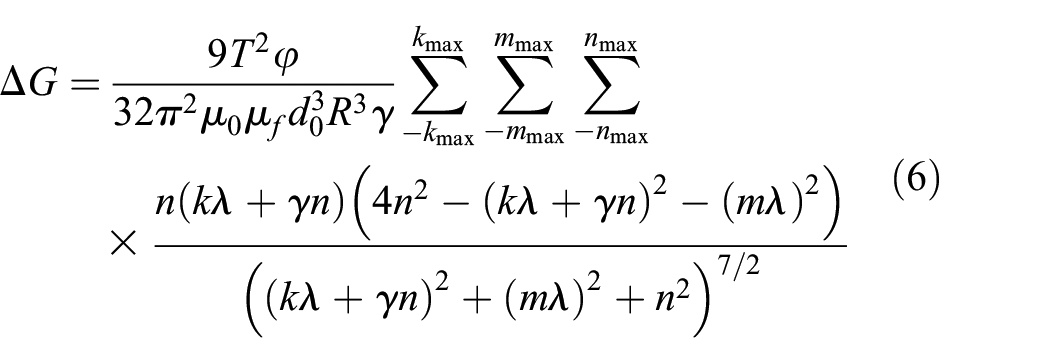
Where:
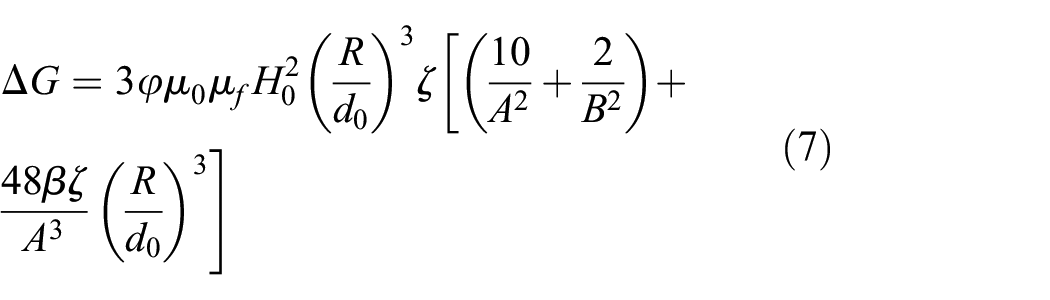
Where:


When


Schematic diagram of magnetorheological elastomer chain structure.
That is the magnetic dipole model. It can be seen from the above equation,
When using MRE as a stiffness element and adopting shear mode, the stiffness can be expressed as:

Where:
Analysis of damping effect on vibration absorber performance of DVA
A two degree of freedom model consisting of the DVA and the controlled system is shown in Figure 2, and the dynamic equation of the 2-DOF system can be expressed as (10):

Where:

Two degrees of freedom system.
By solving the above differential equations, the amplification coefficient of the controlled system can be obtained as follows, 2

Where:
According to the principle of anti-resonance, when the natural frequency of the absorber is equal to the excitation frequency, that is

The vibration characteristics of the controlled system is shown clearly in Figure 3, in which the Magnification factor of ordinate axis description is determined as follows

The parameters used in the simulation are shown in Table 1, and
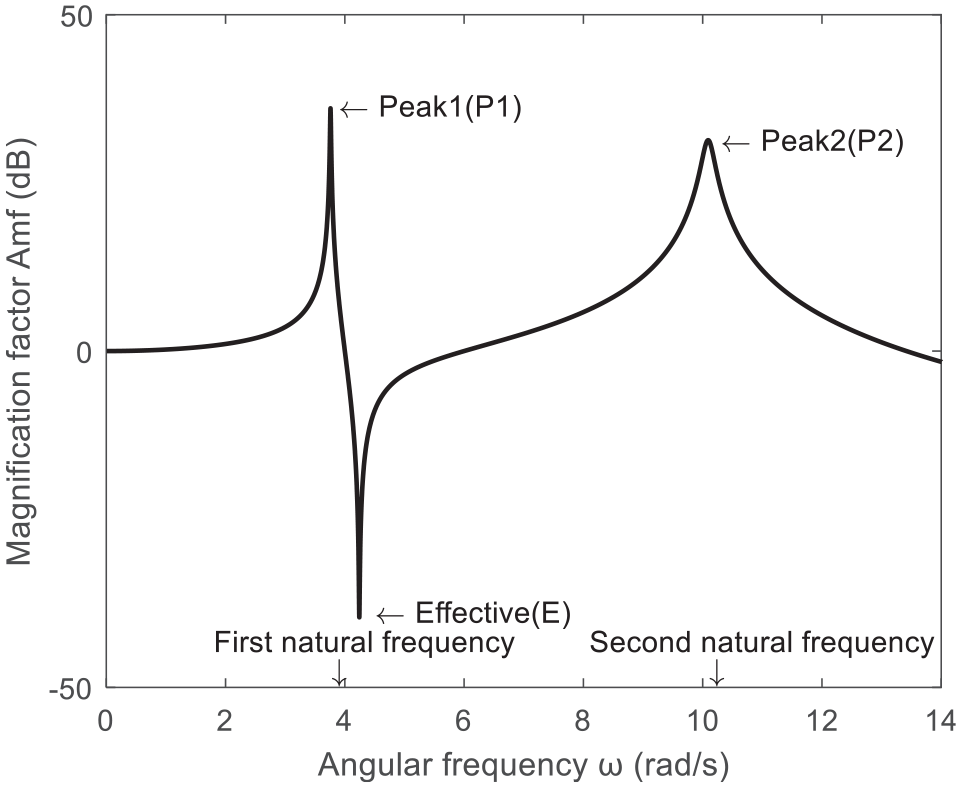
Amplitude-frequency characteristic of controlled system.
Parameters of the system.

It is clearly shown that there are two resonance peaks in the controlled system, and the absorber works best at the anti-resonance point (E).
When the excitation frequency changes, the natural frequency can be changed by adjusting the stiffness of absorber to achieve efficient vibration reduction, then an effective frequency band (
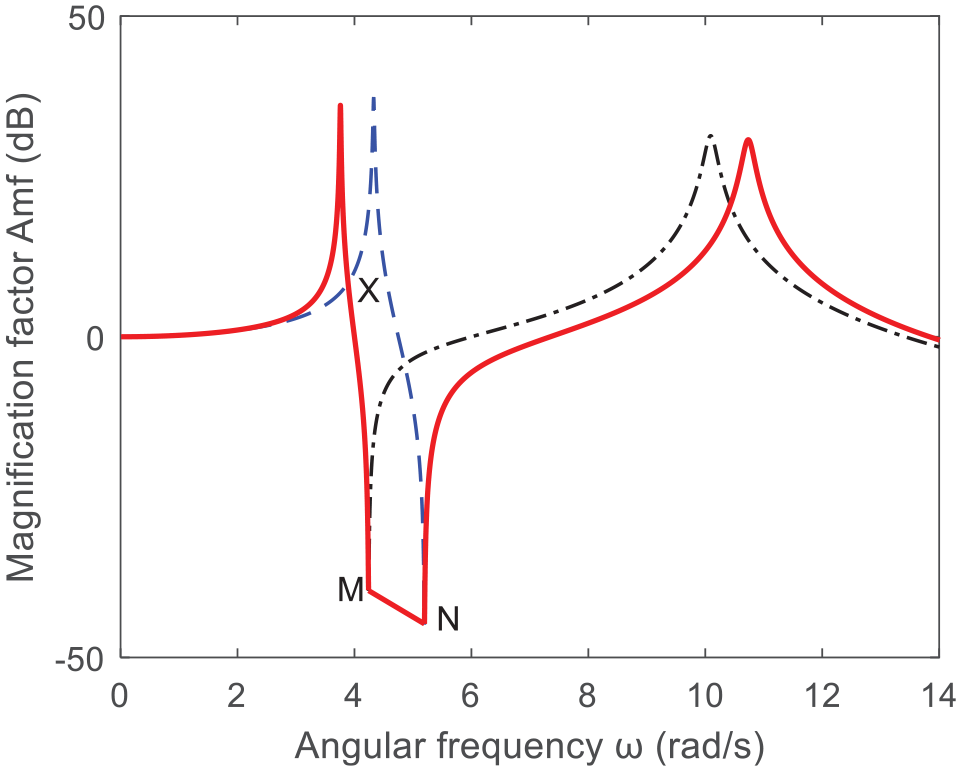
Amplitude-frequency characteristic of controlled system with a variable stiffness ATVA attached.
At the same time, the equation (11) shows that, at the anti-resonance point, the performance of the absorber decreases with the increase of

The amplitude-frequency characteristics of controlled systems with different damping.
Figure 5 also demonstrates the theory that with the decrease of damping, the performance of the absorber at the anti-resonance point is improved, but the vibration at the resonance point is worse.
Study on damping characteristics of MRE
Based on the above analysis, reducing the damping of MRE can improve the vibration absorber performance at the anti-resonance point. Experimental studies have found that the energy is mainly lost in the interface friction between the matrix and the magnetic particles. That is, under the same matrix material, the damping characteristic depends on the interface condition mainly.21,22 In Fan 21 through the observation of the optical microscope photos of the cross-section diagram of the MRE, it is found that the interface compatibility between magnetic particles and silicone rubber was poor when coupling agent was not used, and there were a lot of holes at the interface. However, after coupling agent was used, the holes at the interface disappeared, and the interface compatibility between magnetic particles and silicone rubber was good. Wang 22 shows that the combination of magnetic particles and matrix is weak when coupling agent is not used and there are holes in the interface. This weak bonding surface is easily damaged by shearing, and then a larger gap is formed, resulting in greater energy loss as the relative slip between the magnetic particles and the matrix is larger, which leads to greater damping. The magnetic particles and the matrix are well combined after using coupling agent, and under the shear action, the relative slip of the two phases is weaker and the energy loss is less. So the damping is smaller.
Based on the above research, and in order to reduce the friction between the magnetic particles and the matrix, a silane coupling agent KH570 is added to the preparation of MRE to ameliorate the interfacial conditions and improve the compatibility between the two.
To compare the effect of KH570 on the damping of MRE, the MRE samples with and without KH570 were prepared and the composition of the samples is shown in Table 2.
MRE raw material composition (mass ratio).

The magnetic particles, matrix and silicone oil are Hydroxyl iron powder, RTV-2-Silicone rubber and Polydimethylsiloxane-PMX-200, respectively. The specific composition of raw materials are listed in the literature, 21 and the chemical formula of KH570 is:

Pre-structured treatment is used in the MRE preparation to form a columnar structure so that to improve the MR_effect. The prepared MRE sample is shown in Figure 6.
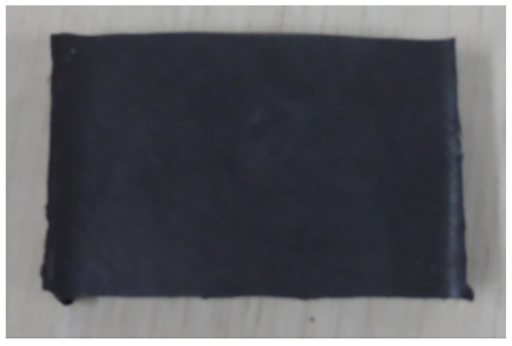
MRE sample.
Mechanical properties of the above samples were tested, respectively. The MRE installation and schematic diagram of test system are shown in Figures 7 and 8.
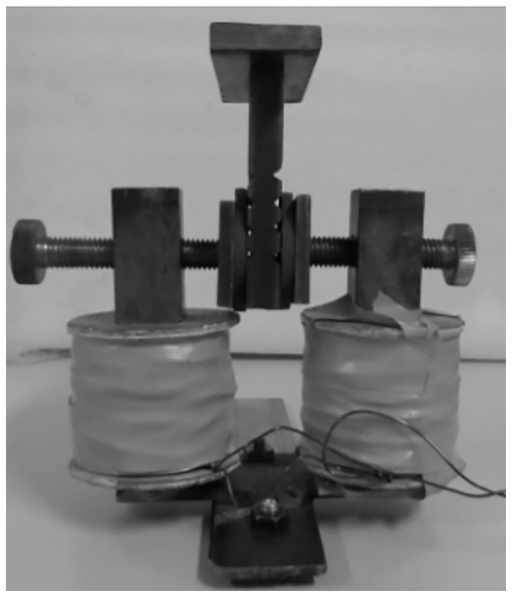
MRE installation diagram.

MRE mechanical performance test diagram.
The mechanical properties of two groups of samples were tested with or without current applied, respectively. In the test, the displacement and force signal can be obtained by the PC, and the relation between the force and the displacement is obtained. Then the following transformation is made.


Where:

(a) No current applied, (b) 1.5 A current applied.
From the above stress-strain hysteresis curves of MRE, it is found that, without current applied, the storage modulus (hysteresis curve slope) of the sample material slightly decreases, and at the same time, the energy dissipation (hysteresis curve area) of MRE is slightly smaller in a cycle period when the silane coupling agent KH570 is used. This indicates that the material damping is reduced. After the application of 1.5A current, the storage modulus of both samples increased correspondingly, however, the storage modulus increased more with KH570, and the energy dissipation in a cycle was still smaller. That is, after the use of KH570, the MR_effect of the material is improved and the damping is reduced, which is consistent with the conclusions of Fan 21 and Wang. 22
Design of DVA based on MRE and study on vibration reduction performance
The DVA based on MRE was designed and an experimental system is built, as shown in Figure 10. In the experiment, two kinds of sample materials with or without KH570 were used as stiffness elements to analyze the amplitude-frequency characteristics of the controlled system. Figure 11(a) without current and Figure 11(b) with current of 1.5A, and the results are shown in Figure 11.

Experimental system.
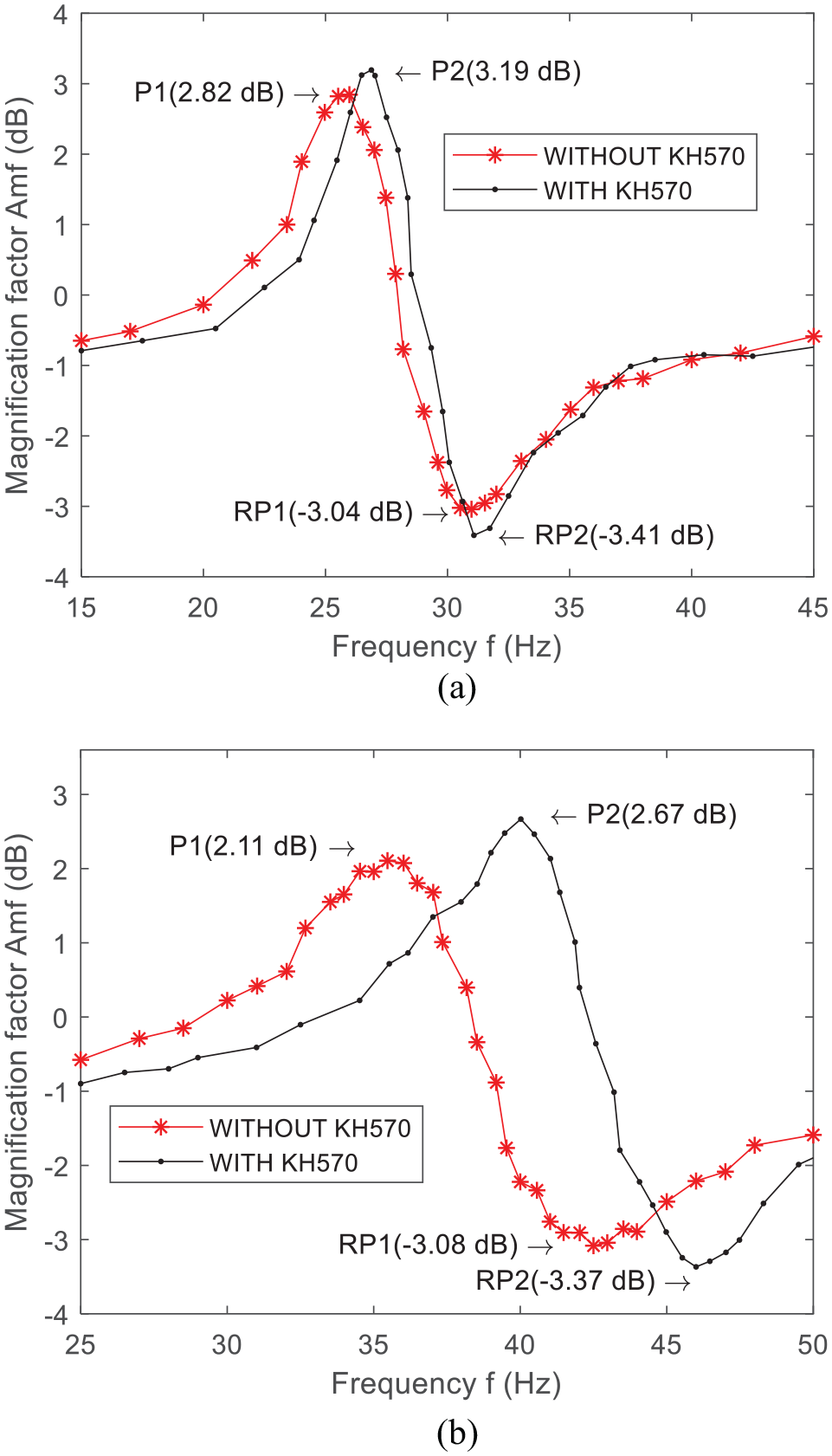
(a) the amplitude-frequency characteristics of controlled system without current, (b) the amplitude-frequency characteristics of controlled system with 1.5 A current.
In Figure11, P1, RP1, P2, and RP2 represent the resonance and anti-resonance peaks of the controlled system with or without KH570, respectively. Without current, their corresponding frequencies are 25.52 Hz, 30.98 Hz, 26.88 Hz, 31.08 Hz, respectively. In the case of current, the corresponding frequencies are 35.47 Hz, 42.5 Hz, 40.02 Hz, and 46 Hz, respectively. It can be seen from Figure 11 that after adding KH570, the vibration reduction effect of the absorber at the anti-resonance point is significantly improved. The Magnification factors, which defined in equation (13), are reduced from −3.04 dB to −3.41 dB and from −3.08 dB to −3.37 dB respectively with or without magnetic field. But the vibration of the controlled system at the resonance point is more intense. The Magnification factors are increased from 2.82 dB to 3.19 dB and from 2.11 dB to 2.67 dB respectively with or without current applied. At the same time, through the action of current, the effective frequency band of the DVA has been broadened by 11.52 Hz (42.5 Hz–30.98 Hz) and 14.92 Hz (46 Hz–31.08 Hz) with or without the KH570, respectively. In order to analyze the frequency-shift characteristics of DVA under the action of current applied, the amplitude-frequency characteristics of controlled system under different magnetic fields are plotted, as shown in Figure 12. In the experiment, the current applied to the excitation coil are 0 A, 0.5A, 1.0 A, and 1.5A, respectively.

(a) The amplitude-frequency characteristic curve of controlled system with different Currents (without KH570), (b) the amplitude-frequency characteristic curve of controlled system with different Currents (with KH570).
As can be seen from Figure 12, with the increase of the applied current, the natural frequency of the DVA increases correspondingly. When the current changes continuously, a continuous and effective vibration absorption band can be formed, as shown in Figure 13. Comparing with Figure 12(a) and (b), it can be found that after using KH570, the effective frequency band of the absorber is further widened to 14.92 Hz, and the performance at the anti-resonance point is better. But at the new resonance point, the controlled system vibrates more intensely.

Frequency expansion effect of vibration absorber (with or without KH570).
As can be seen from Figure 13, the resonance peak, introduced by the absorber added to the controlled system, increases with the decrease of damping, which we do not want. For this defect, Han et al. put forward a mass control strategy for variable mass DVA 23 to eliminate the resonance peak. On the basis of the above control strategy, we put forward the stiffness control strategy, The control strategy for stiffness is as follows

Where,
According to the frequency shift characteristics of the controlled system in Figure 12, the relationship between the applied current and the natural frequency of the DVA can be obtained, as shown in Figure 14.

The relationship between the applied current and the natural frequency of the DVA.
Combined with the above control strategy, the current to be applied can be controlled according to the frequency of excitation, then, the resonance of the controlled system caused by the addition of DVA can be eliminated, the experimental results are shown in Figure 15.

The amplitude-frequency characteristics of the controlled system under the current control.
As can be seen from Figure 15, the resonance of the controlled system are eliminated effectively. Meanwhile, with the application of KH570, the performance of the DVA at the anti-resonance point is improved effectively, on the basis of further broadening the effective frequency band.
Conclusion
In order to solve the problem of narrow vibration reduction frequency band of TDVA, a semi-active DVA based on MRE is designed. In order to further improve the performance of DVA, the influence of the compatibilizer: silane coupling agent KH570, on MRE damping is analyzed. At the same time, the method of eliminating resonance is proposed for the resonance problem of controlled system caused by the addition of DVA. The simulation and experimental results show that:
The designed DVA based on MRE can effectively widen the effective working frequency band, which reaches 14.92 Hz, which is of great significance to improve the performance of DVA under frequency conversion and wide frequency excitation.
The addition of silane coupling agent KH570 in the preparation of MRE reduces the damping and improves the vibration absorption performance of the DVA.
The resonance of controlled system caused by the addition of DVA is effectively eliminated by the stiffness control strategy. This strategy is not only applicable to the DVA designed in this paper, but also to other adaptive DVAs.
To study the relationship between the couplant and damping of MRE and to establish the mathematical relationship between the tow will be the focus of the future research.
Footnotes
Handling Editor: James Baldwin
Declaration of Conflicting Interests
The author(s) declared no potential conflicts of interest with respect to the research, authorship, and/or publication of this article.
Funding
The author(s) disclosed receipt of the following financial support for the research, authorship, and/or publication of this article: This study was supported by the National Key Research and Development Program (Grant No.2018YFB0106401), the National Key Research and Development Program (Grant No. 2016YFD 0700704B), the Key Scientific Research projects of colleges and universities in Henan Province (21A110016).
