




Abstract
This investigation based on electromagnetohydrodynamic flow in microchannels through lightly corrugated walls effects is reported in the presence of variable liquid properties. In microparallel plates, we consider incompressible and electrically conducting viscous fluid. With small amplitudes, the wall corrugations are described by periodic sin waves. The governing equations are rendered dimensionless and solved with the help of the perturbation technique. The analytical solutions for velocity are obtained and analyzed graphically. A connection between flow rate and roughness is acquired by perturbation solutions of the stream function. By utilizing numerical computations, we analyzed the corrugation consequences on the velocity for electromagnetohydrodynamic flow. We graphically clarified the velocity and temperature profiles and their dependencies on all parameters. The three-dimensional velocity and contour distributions shown that the wall roughness can cause changes in the velocity distribution. For in phase the phase difference among the two corrugated walls is equals to 0°, and for out of phase the phase difference is equal to 180° between the two walls. The wave phenomenon of the flow shape becomes obvious with the expansion of the corrugation. The electromagnetohydrodynamic velocities first grow and then reduce. The electromagnetohydrodynamic velocity increases for Reynolds number, Hartmann number, and Darcy parameter. Velocity profile decreases for variable viscosity, velocity slip parameter.
Introduction
Microfluidics is most significant in small-scale electro-mechanical framework. It is used for blending, stream control, division, discovery, and contemplating basic biochemical and physical procedures. Microfluidics assumes significant job in innovative procedures including productive plan of the transfer of mass and heat. In recent years, numerous microfluidic gadgets created, 1 for example, the electro-assimilation micropumps, 2 and electromagnetohydrodynamic (EMHD) micropumps.3,4 The significant microfluidic framework is EMHD micropump which produces the ceaseless stream design. In EMHD micropumps, the siphoning source is Lorentz power, because of the communication among electric and attractive fields. The EMHD micropump in microfluidic frameworks has significant research, for example, stream control in the fluidic systems, siphoning, mixing and blending, microcoolers, and thermal reactors.5–7 Utilizations of EMHD gadgets, for example, liquid siphoning, in fluidic systems the stream control and liquid blending, fluid chromatography and mixing. 8 In microchannels, a lot of the attention is paid toward the numerical and analytical models of EMHD stream.9,10 The impact of electromagnetic fields superficially pressure between parallel plate microchannel is examined by Tso and Sundaravadivelu. 11 Chakraborty and Paul 12 explore the EMHD powers impact on liquid stream for parallel plate microchannel. Nagaraju et al. 13 discussed the impact of second law analysis of flow in a circular pipe with magnetic field effects.
The past investigations dependent on smooth channels. Harshness consistently exists on the outside of channel because of adsorption of different species. Unpleasantness applied in mechanical assembling and biomedical territories.14,15 The impact of roughness together with corrugated walls in microparallel channel for EMHD Newtonian fluid is investigated by Buren et al. 16 The electroosmotic Jeffrey fluid flow is considered between the slit of microchannel by Liu et al. 17 Nagaraju and M Garvandha 18 explored the effect of magnetohydrodynamic (MHD) viscous fluid flow in a circular pipe. In microchannel, Shojaeian and Shojaeian 4 explored analytical solution of mixed electromagnetic gaseous flows. In micropumps systematic and numerical computations of electromagnetic fields investigated by Rivero and Cuevas. 8 Reddy et al. 19 researched the EMHD flow instabilities in a two-phase. The magnetic and electric field impacts are considered on corrugated walls of microchannels in the presence of EMHD effect by D Si and Jian. 20 The Stokes problem for the viscous fluid is examined by Phan-Thien 21 by considering corrugated pipes. The impact of roughness among corrugated plates is investigated by Wang. 22 The method of perturbation is applied by Chu 23 to see the impact of surface roughness for circular microtube having corrugated walls. Gajjela et al. 24 examined the impact of mass transfer in a horizontal pipe with magnetic Newtonian flow. C-O Ng and Wang 25 explored the Darcy–Brinkman flow in the presence of corrugation. The flow depends on the orientation of corrugations as well as the phase difference of corrugations. Govardhan et al. 26 explored the effect of MHD and radiation on mixed convection unsteady flow over the stretching sheet.
Currently, investigation of fluid flows and heat transfer over porous medium has engrossed much attention. It is a fact that porous medium has many real-world examples. Examples of natural porous media phenomena are beach sand, bile duct, sandstone, limestone, rye bread, and wood. In human beings, natural porous mediums are the human lung, gall bladder with stones and in small blood vessels. Some of pathological states, for example, the distribution of full of fat cholesterol and in the lumen of coronary artery’s clogging blood can be measured as alike to a porous medium. Darcy’s law is very much essential in order to study the fluid flow problems in porous medium. Flow of fluid in permeable medium is driven by Darcy’s law, while the liquid in free stream locale is executed by Navier Stokes condition. Different viable applications experience the course through a permeable medium especially in geophysical liquid elements. Hasan et al. 27 deliberated the convective radiative flow of nanofluid through porous medium. Shirvan and Colleagues presented the l investigation and sensitivity analysis of effective parameters on combined heat transfer performance in a porous solar cavity receiver by response surface methodology. The peristaltic flow in a porous medium through an annulus is inspected by Mekheimer and Elmaboud. 29 Rapits et al. 30 and Varshney 31 have tackled issues of the progression of a viscous fluid through a permeable medium bounded by a vertical surface. Mekheimer and Al-Arabi 32 examined nonlinear peristaltic transport of MHD move through a permeable medium. EI-Sayed 33 examined the electrohydrodynamic instability of two superposed viscous and streaming fluids through permeable medium. The stenosed arteries having permeable walls for nanofluid flow are examined by N Akbar et al. 34 The impact of metallic nanoparticles on the flow of blood through stenosed artery having permeable walls is described by Nadeem and Ijaz. 35
Transfer of heat through convective marvels is a fundamental part in specific techniques, for example, material drying, and transpiration cooling process and warm vitality stockpiling. So, it appears to be sensible to consider the convective limit condition in its place of isoflux or isothermal conditions and mixed convection impacts. 36 The impacts of convective boundary for asymmetric channel for the model of peristaltic flows is investigated by Munir et al. 37 Moreover, the Rabinowitsch fluid model along with convective boundary is explored by Sadaf and Nadeem. 38
The principle motivation of this investigation is to deliberate the flow of EMHD viscous fluid with variable viscosity through corrugated microparallel plates having permeable walls. The framework is considered under the impact of Lorenz power which is produced by electrical and attractive field connection. The EMHD equations for viscous fluid under wavy and permeable condition are derived and then analytical solutions for velocity are calculated by applying perturbation. The sundry parameter impacts are analyzed through graphs.
Mathematical formulation
We consider the EMHD flow of viscous, incompressible, and electrically conducting Newtonian fluids between corrugated walls separated by 2H distance. We assumed that the length L of channel in z*-direction and in x*-direction width W and the flow is taken due to Lorenz force. The flow is taken opposite to corrugations of the walls. The wavy upper and lower walls are described by

The periodic sinusoidal describes the corrugations of wavy walls where

Geometrical sketch of EMHD flow in microchannel.
The conservation of mass and momentum equations is expressed as 39


We consider incompressible fluid between microparallel plates which are taken along
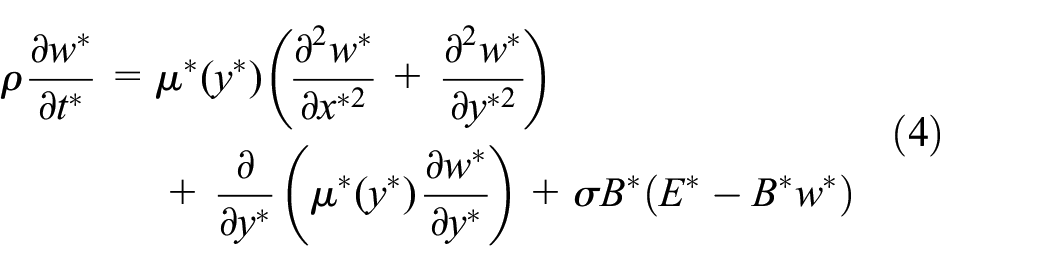
Velocity and electric field in periodical forms are expressed as 40

where real part is denoted by R{};

Non-dimensional variables are defined as

Using equation (7) into equation (6), we get

where

where Re, Ha,

Perturbation analysis
In order to solve equation (10), we consider the perturbation expansion by writing 40

Now using equation (11) into equation (9) and the boundary conditions (equation (10)) are expand by Taylor series about upper and lower wavy wall positions at y = 1 and y = −1 expanded by Taylor series and collecting the coefficients of like power of

along with the corresponding boundary conditions

The first-order perturbation equation is found in the form
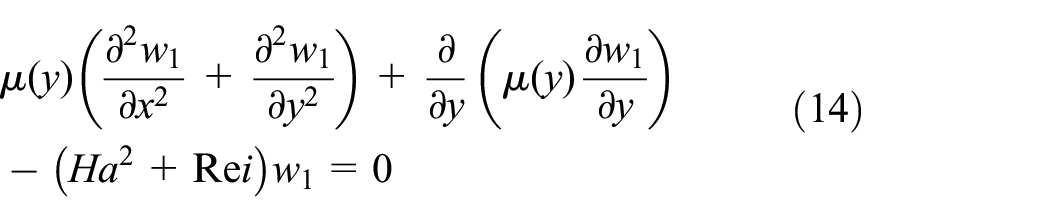
The corresponding boundary conditions are
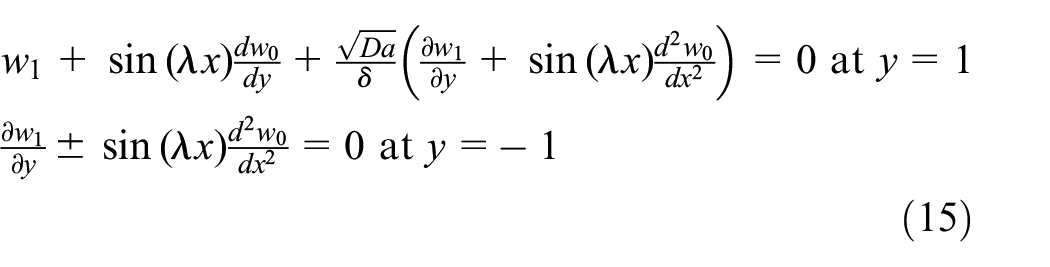
The second-order perturbation equation is found in the form
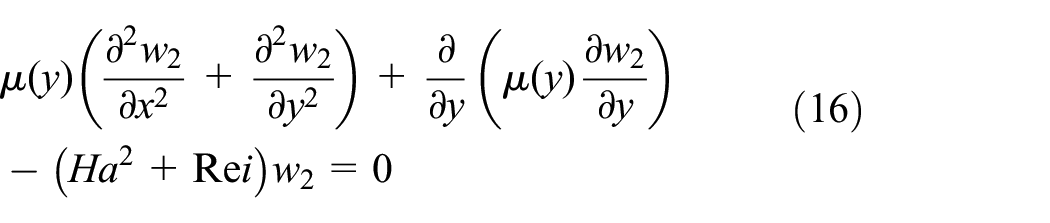
The corresponding boundary conditions are
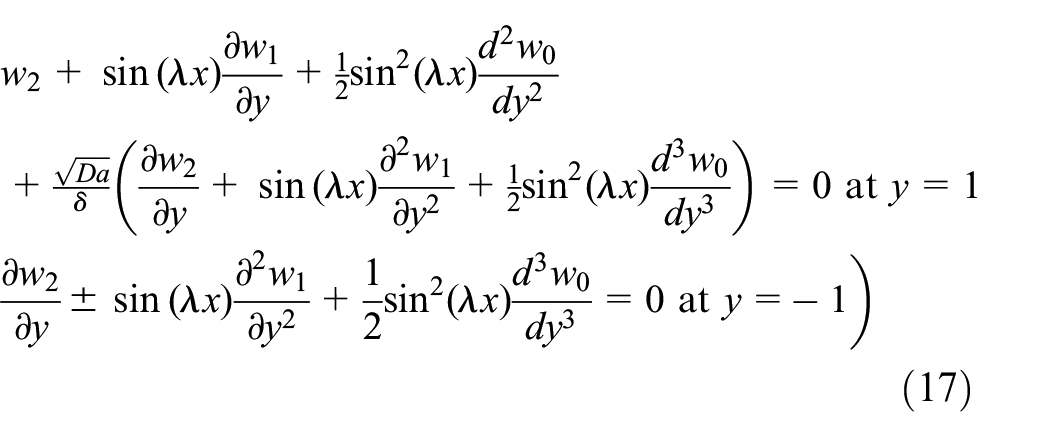
The effect of variable viscosity on flow can be investigated for any given function

Solution of the problem
By solving zero-order system with the corresponding boundary conditions (equation (13)), we obtained

On the base of conditions (equation (15)), we assumed the solution of first-order system as

where
Using equation (20) into equations (14) and (15), we get

The boundary conditions are transformed in the following form

Based upon boundary conditions, the solutions of equation (21) are

First-order problem solution can be expressed as

The boundary conditions (equation (17)) of the second-order system can be simplified using the solution (equations (19) and (24)). Based on boundary conditions, the second-order system solution can be chosen as

where
By utilizing equation (25) into equations (16) and (17), we get the following forms


The boundary conditions are transformed into the following form

and

By utilizing the above boundary conditions, the exact solutions of


Thus, we obtained solution of the second-order system

Collecting equations (19), (24), and (32), the estimated velocity solution can be written as

Volume flow rate
We can defined the volume flow rate per unit width of channel as
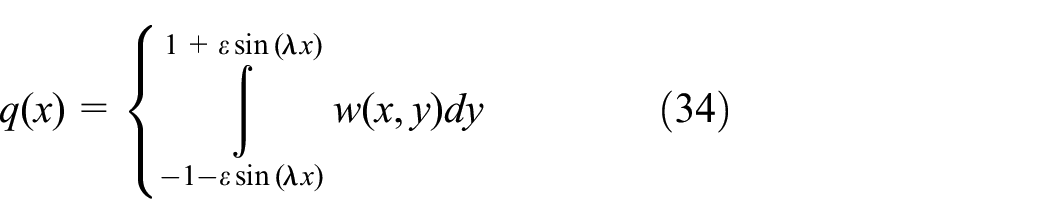
Substituting equation (33) into equation (34) expanded the integrals results by expending the Taylor series in factor

Mean velocity
The mean velocity on average over one wavelength (0,

Inserting equation (35) into equation (36), the mean velocity takes the form

where
Results and discussion
In previous sections, we obtained analytical solutions using perturbation method for velocity and volume flow rate of EMHD fluids bounded by microparallel plates with corrugated walls. For general microfluidic analysis, consider
The three-dimensional velocity and contour distributions for various value of variable viscosity are shown in Figures 2 and 3. In microchannel, the wall roughness can cause changes in the velocity distribution. In Figure 2, the phase difference among the two corrugated walls equals 0°. In Figure 3, the phase difference is equal to

3D velocity distribution and contour for
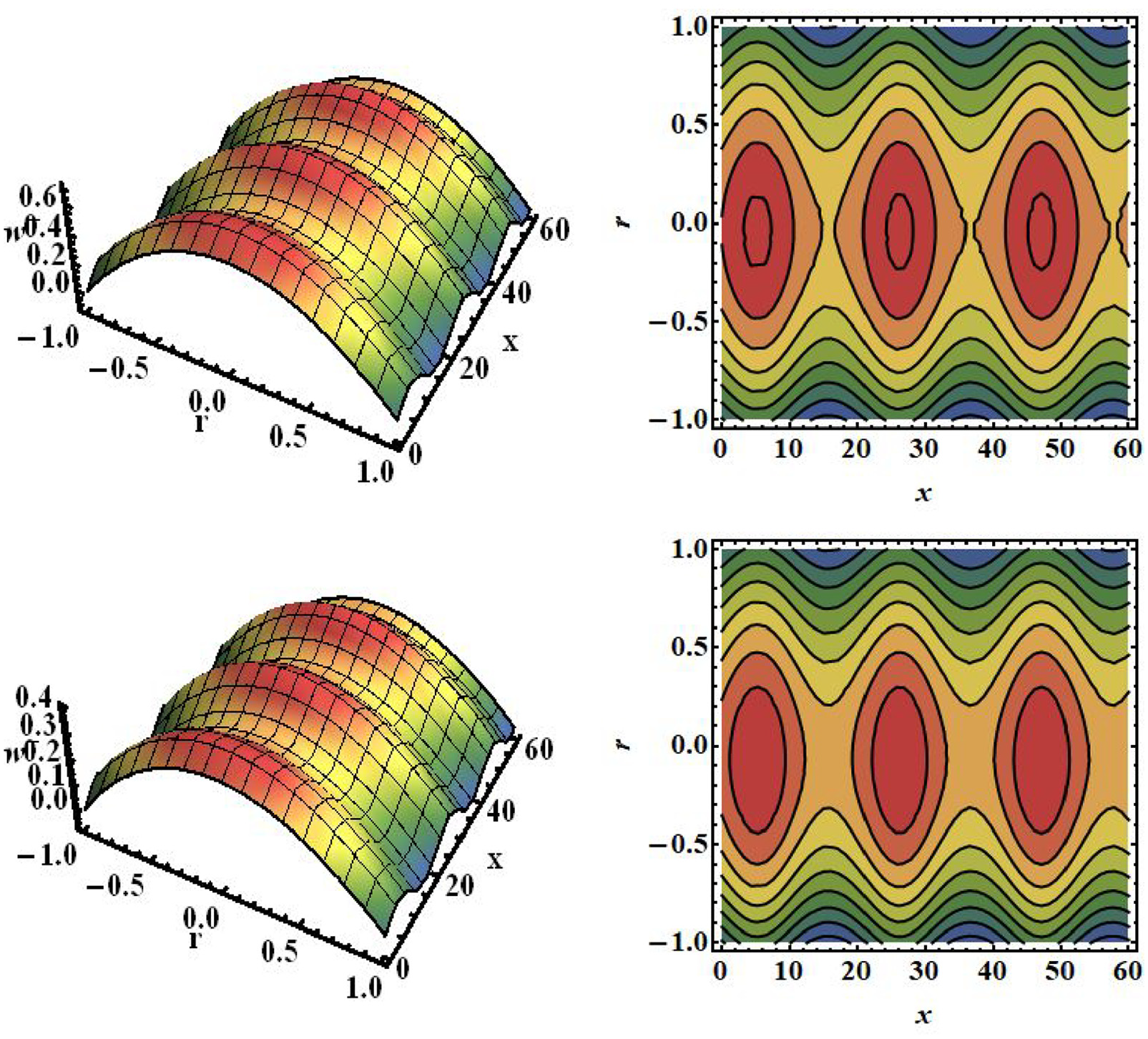
3D velocity distribution and contour for
The two-dimensional (2D) variations of the EMHD velocity

2D velocity profile for distinct values of

2D velocity profile for distinct values of

2D velocity profile for distinct values of

2D velocity profile for distinct values of
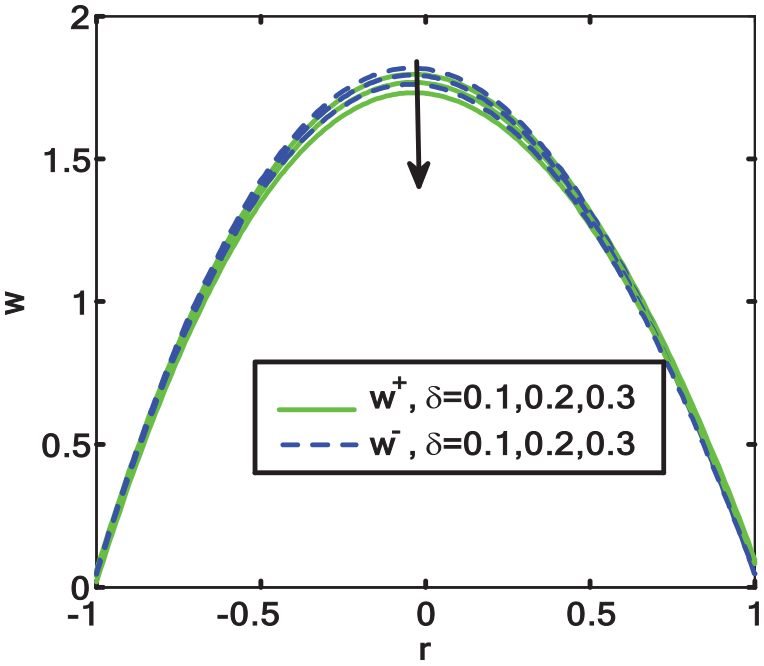
2D velocity profile for distinct values of
Tables description
The impact of mean velocity
Effect of variable viscosity parameter
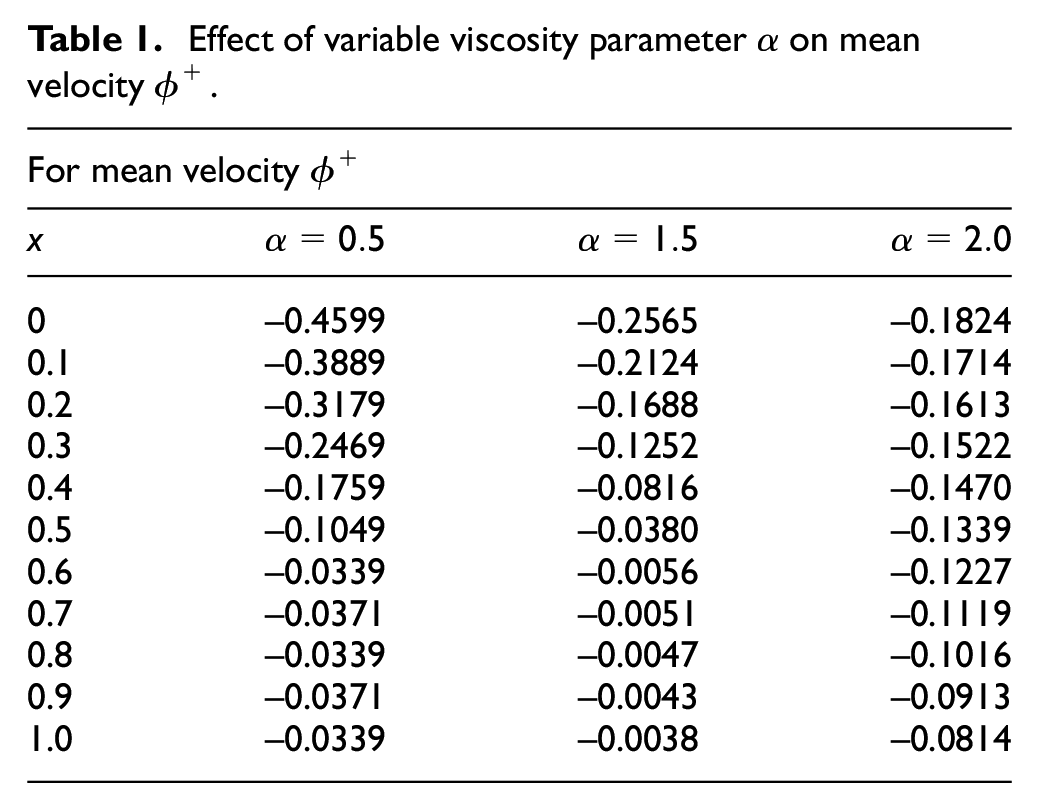
Effect of variable viscosity parameter

Deductions
The present study analyzes the behavior of variable liquid properties on EMHD flow between corrugated walls through microchannel in the presence of porous medium. Under consideration, the liquid is electrically conducting and incompressible. We achieved the analytical solution of velocity
The unobvious effects of wave on the velocity and temperature reduce by small value of
When amplitude
The profile of velocity distribution depends upon the shape of the channel.
With increasing values of the Reynolds number
The EMHD velocity increases with the increasing values of Darcy number.
The EMHD velocity increases with the increasing values of Hartmann number.
The impacts of variable viscosity diminish the velocity profile.
Velocity profile decreases for various values of velocity slip parameter
Wave phenomenon of velocity becomes obvious with increases in the corrugation.
Velocity profile is more prominent in the center of the channel and lesser near the sides of walls in all cases.
Footnotes
Appendix 1
Handling Editor: James Baldwin
Declaration of conflicting interests
The author(s) declared no potential conflicts of interest with respect to the research, authorship, and/or publication of this article.
Funding
The author(s) received no financial support for the research, authorship, and/or publication of this article.
