




Abstract
In the field of curves and surfaces fairing, arbitrary resolution wavelet fairing algorithm made wavelet fairing technology widely extended to general curves and surfaces, which are determined by any number of control vertices. Unfortunately, accurate wavelet construction algorithm for general curves and surfaces still has not been perfect now. In this article, a concrete algorithm for reconstruction matrix and wavelet construction was emphatically studied, which would be used in the multi-resolution fairing process for curves and surfaces with any number of control vertices. The essence of this algorithm is to generalize wavelet construction into the solution of null space, which could be solved gradually and rapidly by the procedures of decomposition and simplification of coefficient matrix. Certainly, the related compactly supported wavelets could be constructed efficiently and accurately, too. In the last of the article, a complex curve and a complex surface case were provided to verify the stability, high performance, and robustness of this algorithm.
Introduction
In the field of reverse engineering (RE), some kinds of complex parts have high requirements for the fairness of their computer-aided design (CAD) models, such as turbine engine blades, supercharger impellers, compressor rotors, aircrafts, high-speed railway, and so on which must meet the aerodynamics requirements, and household appliances, motor vehicles, and so on which must meet the artistic characteristic requirements. The two primary error sources that affect the fairness of CAD models are measuring accuracy, mainly caused by measuring instruments and measuring methods, and the manufacturing accuracy of the parts themselves.
Digitization of these complex parts mentioned above is an important part of RE. Associated measuring accuracy will greatly determine the final accuracy and fairness of reconstructed curves and surfaces. At the same time, the manufacturing accuracy of these parts will also have a great impact to final measuring accuracy. In order to improve the fairness of reconstructed curves and surfaces, fairness operation has always been a good solution and a research focus in the field of RE.
After years of research, there are many kinds of different ways to fair curves and surfaces, such as energy method, the least square method, the circular rate method, the grid-based spline method, and the rebound method. With the development of fairing algorithm and Wavelets theory, a brand-new fairness method, which is usually called multi-resolution fairing (MRF), appeared and provided a new idea to solve this problem.
The multi-resolution analysis (MRA) is a new mathematical tool that cuts up data, functions, or operators into different frequency components, and then studies each component with a resolution matched to its scale. MRA is usually applied to the field of signal and image processing.
1
If taken curves and surfaces as raw signals, they could be faired certainly by MRA theory. Because of this, a technology called MRF appears. The first paper on this topic is published by Quak and Weyrich
2
in 1994. The core idea is to decompose curves into two parts by reconstruction matrixes
Because the scaling translation series of scaling functions used in the above literatures are dyadic, the number of control vertices of curves and surfaces must be strictly limited to 2
j
+ (r− 1) (r is order). Based on this, reconstruction matrixes
In order to extend the applied range of wavelet fairing algorithm to more common curves and surfaces with any number of control vertices, a lot of scholars paid close attention to it. Wang and Zhang 6 constructed the orthogonal non-uniform B-spline wavelets by removing nodes from knot vector according to the given weighting formula. The idea of this algorithm is to change the knot vector to meet the requirements of literature. 2 So as to realize the wavelet fairing and simplification for non-uniform rational B-splines (NURBS) curves and surfaces by DWFA. Based on the discrete norm, Pan and Yao 7 and Sadeghi and Samavati 8 constructed biorthogonal non-uniform B-spline wavelets using least-squares fitting algorithm according to the given knot vector and then achieved the MRF on general free-form curves. Because these algorithms avoid inner product operation, the calculation efficiency has been improved greatly. By constructing the length-preserving projection of curves, Wang et al. 9 deduced the double-scale subdivision equations of multi-scale functions and multi-scale wavelets, and constructed the multi-wavelets on some smooth plane curves. In order to control the better deformation of the curves and obtain the more accurate modeling, Wang and Zhao 10 initially introduced a new concept of reference index of modeling (RIOM) based on wavelet theory. Compared to traditional algorithms, this one takes RIOM as objective function and objective shape, which can quantitatively evaluate objective function value determined by RIOM and ensure the overall shape of the curve at the same time. Fortes and Moncayo 11 and Fortes and Rodríguez 12 overcame the limitation that the control vertices of the curves must be uniformly distributed, and proposed a new MRA method for non-uniform surfaces based on the non-uniform triangulation.
While all these algorithms mentioned above contain approximate calculation, faired curves and surfaces could not be reconstructed accurately. This is not consistent with the essence of MRA. The reason for this is all these algorithms put emphasis on the curves and surfaces, not wavelet construction itself.
Arbitrary scale factors MRA provides a new solution from the view of MRA itself. This is another study field of MRA. Lazar and Bruton 13 discovered the relationship between orthogonal wavelet decomposition and lossless perfect reconstruction (PR). Based on the M-band PR filter, a regular and orthogonal wavelet method for generating arbitrary integer scale factor M was proposed. On the premise that the sum of all the branch sampling factors equals to one, Kovacevic and Vetterli 14 constructed a PR filter by setting a rational sampling factor, which realized the non-uniform splitting. On this basis, Blu 15 presented a design algorithm of orthonormal rational filter banks which allow rational wavelet to transform. Munoz et al. 16 proposed a method-based B-spline to allow continuous WT at any scale, and the complexity of the method is not limited by dyadic or integer scales.
In fact, arbitrary resolution wavelet decomposition and reconstruction of general curves and surfaces is a typical MRA at rational scaling factor, and many scholars try to apply the research results of MRA to fair the general curves and surfaces. Kazinnik and Elber 17 proposed a multi-resolution orthogonal decomposition method for non-uniform B-spline (non-uniform rational (NUR)) spaces. The decomposition of discontinuous surfaces can preserve the global shape of the surface as well as the local characteristics of the surface. An interactive tool was developed that allows editing of NUR surfaces, which can reflect the effects of different strength of the multi-resolution decomposition. Based on the available non-uniform semi-orthogonal B-spline wavelet algorithm, Li et al. 18 and Li and Tian 19 proposed a new curve multi-resolution representation method without the limitation of wavelet multi-resolution representation. This algorithm can be applied to the MRA for any uniform or non-uniform B-spline curves, and reduces the computational cost of construction of non-uniform B-spline wavelets in the process of MRF. Hamm et al. 20 presented a multi-resolution representation method to spline curves with arbitrary knots for non-equally distributed geometric data. By modifying knot vector of NURBS surface through newly proposed T-spline control meshes, Wang and Zhao 21 realized the multi-resolution representation of NURBS surface. Generally, the fairing algorithm that has no special requirement on the number of vertices of curves and surfaces is usually called arbitrary resolution wavelet fairing algorithm (ARWFA).
To ARWFA, the author has achieved the concrete MRF algorithm with any rational scaling factor by direct mathematical derivation, according to the definition of wavelet in literature.22,23 However, the efficiency, quality, stability of wavelet construction are still unsatisfactory and need a further discussion. In this article, we mainly discuss the solution of wavelet construction matrix based on null space.
Basis of MRF
In this article, quasi-uniform cubic B-spline curves were taken as the research object, so the order of curves is r = 4. On the basis of Cox-de Boor recurrence formula, the simplified expression of cubic B-spline basis function can be represented as φ(t) = Nr(t) = N4(t). The knot vector corresponding to the scaling factor m can be expressed as [0, 0, 0, 0, 1/m, 2/m, …, 1 − (1/m), 1, 1, 1, 1]. A set of B-spline basis functions defined by knot vector can be made up of their scaling translation series; that is, φ(mt−k) = N4(mt−k), where k is translation. Set
Similarly, for the objective scale factor n, which is small than m (n < m), there are also a set of B-spline basis functions
The essence of MRF based on MRA is to filter out the high-frequency detail curves gn from fm to get a low-frequency smooth curve fn by the constructed low pass filter banks. That is

The tower structure diagram of decomposition and reconstruction of MRF is shown in Figure 1. Here,

Diagram of multi-resolution wavelet fairing.
For

In equation (2), ⊕ means direct sum. Because any two translational B-spline basis functions at the same scale are not orthogonal, only the orthogonality between

Construction of multi-resolution wavelet
According to equation (1) and the description in the second section, the MRF process of B-spline curve can be expressed as

According to the author’s literature 22


where
In equations (5) and (6),
Description of wavelet construction
On account of Wn ⊂ Vm, each wavelet in wavelet space Wn is a linear representation of B-spline basis functions in linear space Vn, so we have

Taking

If a reasonable matrix
According to equation (8), it can be pre-multiplied by

Furthermore, because B-spline functions

Solution of null space
At the beginning of solution, the characteristics of coefficient matrix
For example, if a quasi-uniform cubic B-spline curve fm with 13 control vertices want to be faired to fn with 8 control vertices, then we have m = 13 − 3 = 10, n = 8 − 3 = 5. So, a perfect corresponding coefficient matrix
Coefficient matrix E8×13.

The elements in Table 1 show that
Because B-spline basis functions are compactly supported, and
According to the wavelet fairing theory, n should be less than m and all non-zero elements focus near the diagonal, so the rank of matrix
Because n < m, the coefficient matrix
Coefficient matrix
Coefficient matrix
Because Rank(
One of the solutions of null space X.

For scale factor m = 10 and n = 5, m−n = 5 wavelets could be constructed by equation (8), as shown in Figure 2. Obviously, all these wavelets are not compactly supported and do not conform to the characteristics of wavelets.

Five unreasonable wavelets constructed based on Table 2: (a) 1st wavelet, (b) 2nd wavelet, (c) 3rd wavelet, (d) 4th wavelet and (e) 5th wavelet.
In order to construct more reasonable wavelets, the solution
Considering that wavelet functions are compactly supported, the solution
Because the solution
Because of the characteristic of coefficient matrix
For an equation set
Expand the equation

So, for qi, each ith column vector of
So, the solution procedure of the equation

Set the rank of matrix
For the situation of Rank(

Extract Rank(
In conclusion, the extraction process of coefficient matrix can be represented by the frame diagram as shown in Figure 3 and the solution procedure of null space could be designed and shown in Figure 4.

Frame diagram for extracting coefficient matrix.
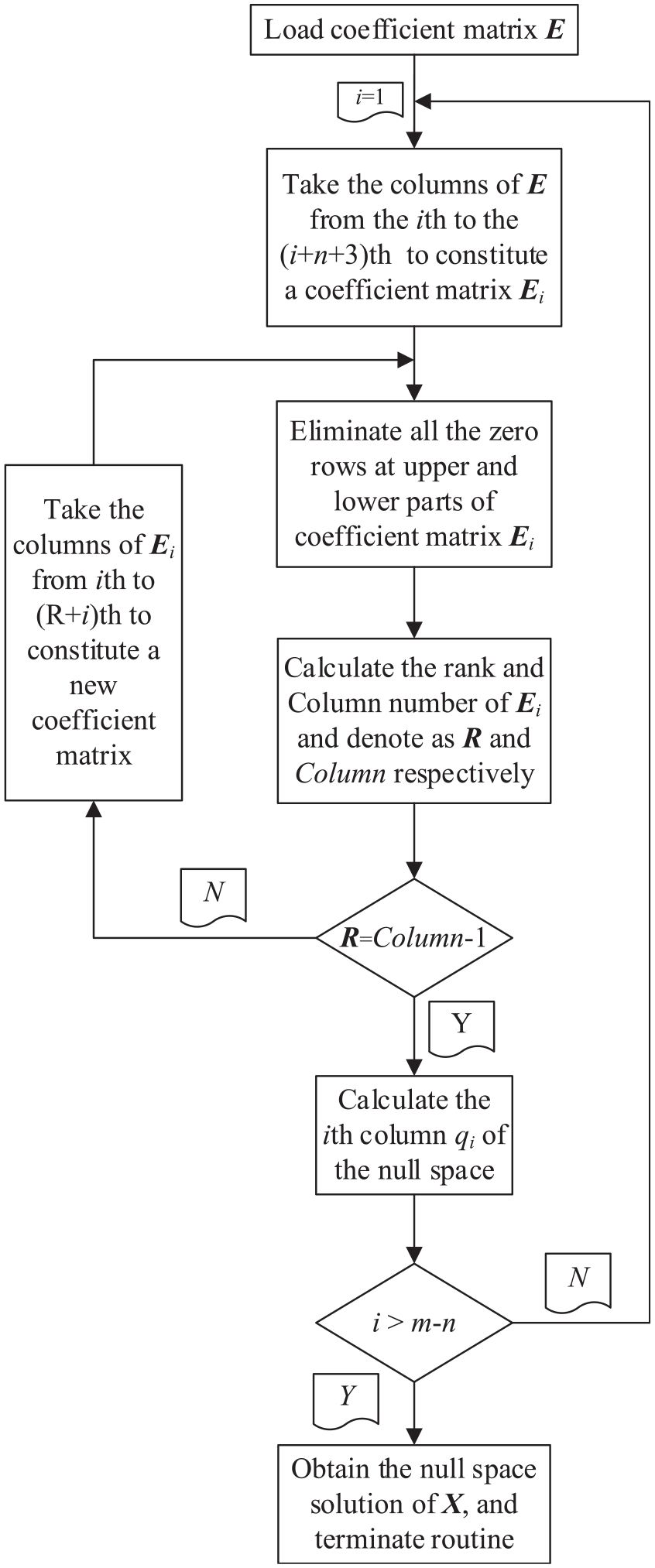
Solution flowchart of null space.
Verification of algorithm
Now taking the coefficient matrix in Table 1 as an example, on the basis of the above algorithm, the null space and the corresponding construction matrix
The specific steps are as follows:
First, 1st–9th, 2nd–10th, 3rd–11th, 4th–12th, and 5th–13th columns of coefficient matrix are taken, respectively, to structure five equation sets.
Second, these five equation sets are, respectively, solved and five untrivial solutions q1, q2, q3, q4, q5 are obtained.
Finally, one of the perfect matrix
Solution X of null space.

Obviously, the resulting matrix
Standardize Table 3 further to make the maximal elements of every column to be 1, as shown in Table 4. Table 4 is just the finally expected construction matrix
The final reconstruction matrix Qmn.

According to equation (8), the final reasonable wavelets was constructed, as shown in Figure 5.

B-splines and constructed wavelets at given scale: (a) B-spline functions at scale factor m = 10, (b) B-spline functions at scale factor n = 5 and (c) wavelet functions at scale factor n = 5.
Figure 5(a) presents m+3 = 13 B-splines corresponding to scale factor m = 10, Figure 5(b) presents n+3 = 8 B-splines corresponding to scale factor n = 5, and Figure 5(c) presents m−n = 5 B-spline wavelets, which are constructed in the process of fairing from scale factor m to n.
Figure 5 indicates that
The constructed wavelets are compactly supported. They can attenuate rapidly to zero after finite oscillations. The reason is that the elements in the bottom left corner and top right corner of construction matrix
The constructed wavelets are symmetrical, except for the finite wavelets at both ends. The reason of asymmetry of wavelets at the both ends is that the each end point of knot vector of quasi-uniform cubic B-spline curve is quadruple.
The constructed wavelets in Figure 5(c) indicate that the construction matrix
Arbitrary resolution wavelet fairing for general curves and surfaces
ARWFA for curve
In order to verify the correctness, accuracy and stability of the algorithm proposed in this article, a complex curve with 120 control vertices, which is no longer conform to the DWFA, was taken to be faired repeatedly and its detail curves were extracted synchronously. The faired curves and corresponding detail curves are shown in Figure 6.

Example of multi-resolution fairing for general curve: (a) original curve at m = 117, (b) faired curve at n = 27, (c) detail curve at n = 27, (d) faired curve at n = 17, (e) detail curve at n = 17, (f) faired curve at n = 7, and (g) detail curve at n = 7.
Figure 6(a) is the original curve determined by 120 control vertices, so the related scale factor is m = 120 − 3 = 117. Figure 6(b) is a directly faired curve determined by only 30 control vertices from 120 control vertices in a single fairing process in 0.636 s. Now, the objective scale factor is n = 30 − 3 = 27 and m−n = 90 wavelets were constructed. Figure 6(c) is the detail curve, which is decomposed from the original curve in the process of wavelet fairing. In order to show the detail curve clearly, Figure 6(c) is magnified 16 times.
Figure 6(d) is a faired curve determined by only 20 control vertices, which is faired directly from the original curve in Figure 6(a) in a single process in 0.769 s. Now, the objective scale factor is n = 20 − 3 = 17 and m−n = 100 wavelets were constructed. Figure 6(e) is the detail curve, which is decomposed from the original curve in the process of wavelet fairing. In order to show the detail curve clearly, Figure 6(e) is magnified six times.
Figure 6(f) is a faired curve determined by only 10 control vertices, which is faired directly from the original curve in Figure 6(a) in a single process in 0.943 s. Now, the objective scale factor is n=10 −3=7 and m−n=110 wavelets were constructed. Figure 6(g) is the detail curve, which is decomposed from the original curve in the process of wavelet fairing. In order to show the detail curve clearly, Figure 6(g) is magnified two times.
The computational efficiency related to different objective scale in this case was researched in Figure 7. The smaller the objective scale is, the more wavelets should be constructed, and the more time it takes. Our surveys indicate that if the fairing process must meet the requirement of man–machine interaction on the computer, fairing time should be limited in 1 s (control line in Figure 7). Fortunately, all operation times shown in Figure 7 are limited to 1 s usually, so the computational efficiency is acceptable and satisfactory.

Analysis of computational efficiency of algorithm.
ARWFA for surface
Now, another surface fairing case will be provided in this section. Figure 8(a) is a supercharger impeller, and Figure 8(b) is one of the blade surface of Figure 8(a) that will be faired.
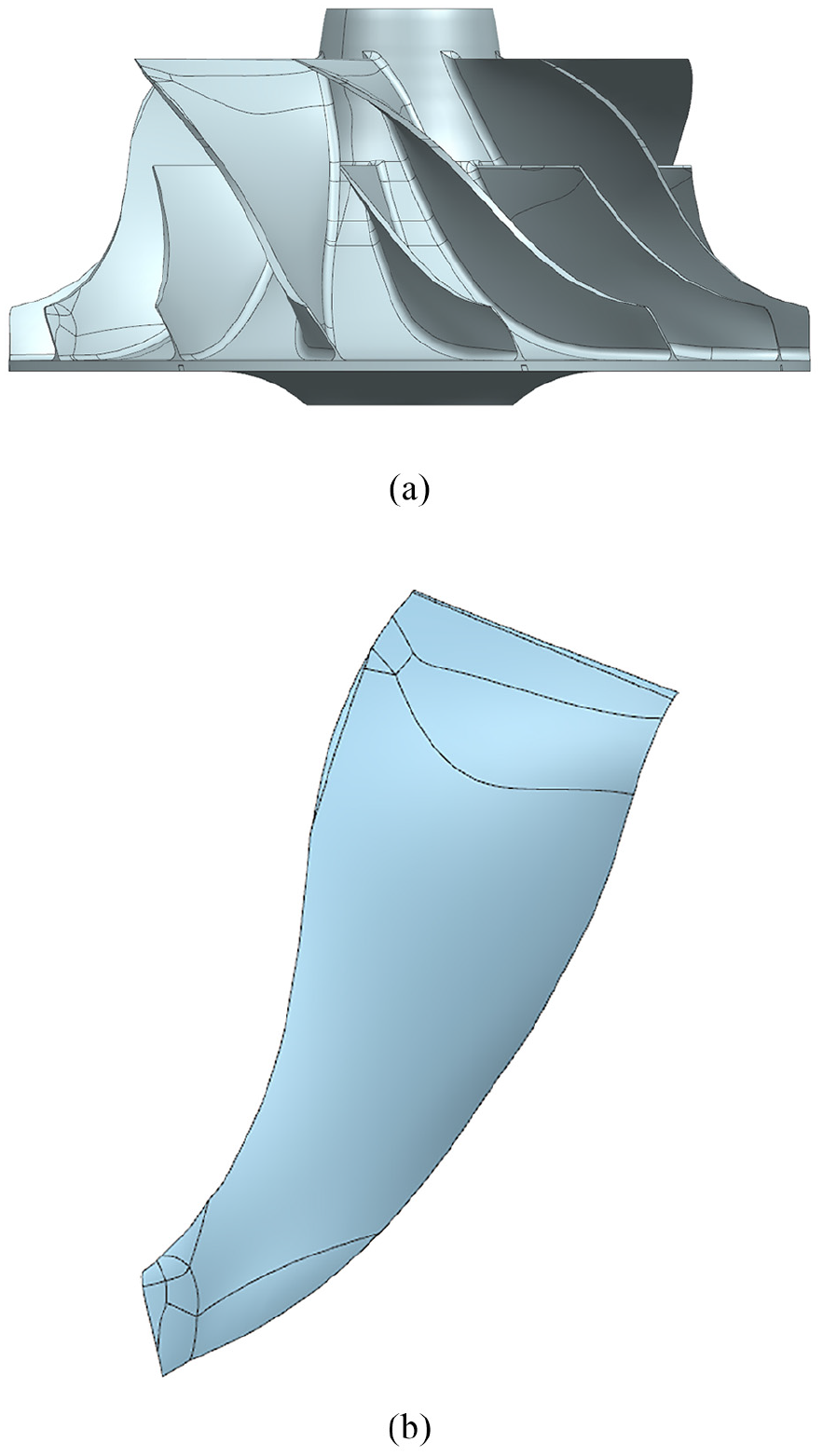
(a) Supercharger impeller and (b) a surface of supercharger impeller.
The corresponding original surface about Figure 8(b), as shown in Figure 9(a), has 4000 (50 × 80) control vertices, where there are 50 control vertices in the u direction and 80 control vertices in the v direction, that is, m1 = 47, m2 = 77.
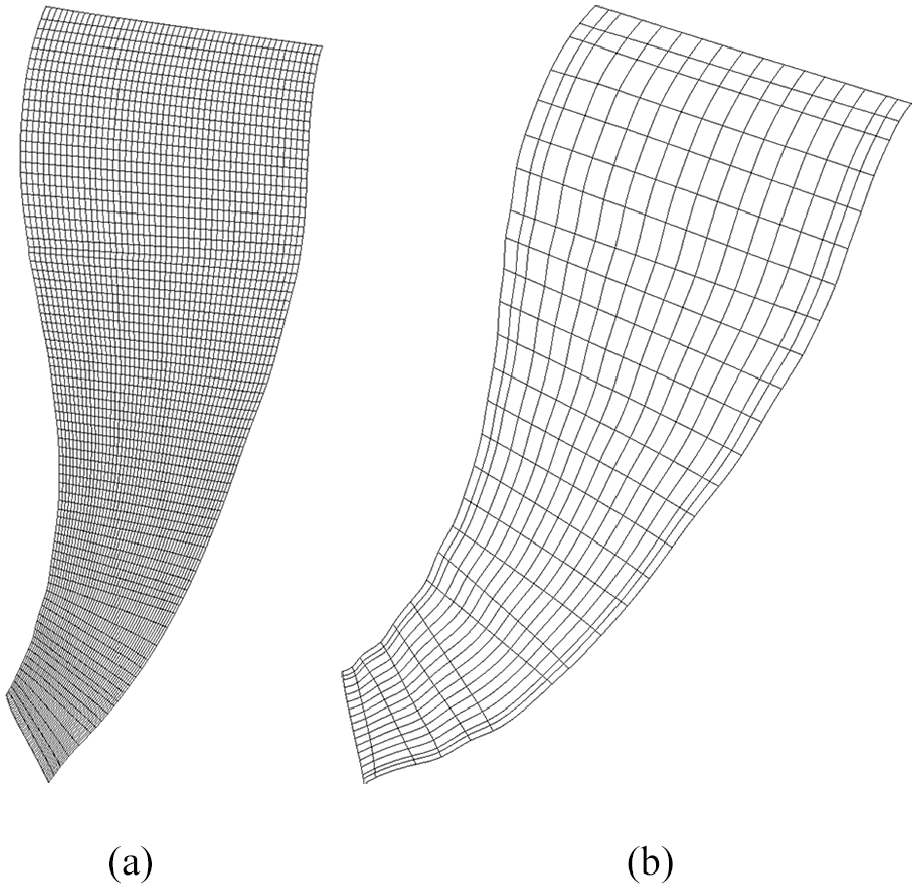
Original surface and faired surface: (a) original surface S50×80 and (b) faired surface S18×26.
According to surface fairing framework based on tensor product method in Figure 10, one low-resolution surface and three high-resolution surfaces could be figured out in the process of ARWFA.

Surface fairing framework.
Set target scale n1 = 15, n2 = 23, after ARWFA, a faired low-resolution surface determined by 468 (18 × 26) control vertices could be figured out by one step, as shown in Figure 9(b), where there are 18 control vertices in the u direction and 26 control vertices in the v direction.
According to surface faired framework in Figure 10, three high-resolution surfaces could be also figured out at the same time, where

Three high-resolution surfaces: (a) details in u direction (
What needs to be emphasized is that original surface
Conclusion
For the faultiness of current reconstruction algorithm of arbitrary resolution wavelet fairing for curves and surfaces, a specific algorithm for matrix construction in the process of MRF to curves and surfaces with any number of control vertices was focused on and achieved successfully in this article. The article has carried on the research mainly from the following several aspects:
The essence of this algorithm is to generalize wavelet construction into the solution of null space. By means of decomposition and simplification of coefficient matrix
The algorithm could be directly applied to the MRA and wavelet fairing for curves and surfaces with any number of control vertices, and truly realized the PR by the ARWFA, which reflects the essence of accurate reconstruction of MRA.
A professional calculation program based on this algorithm has been programmed and tested. The experiment results show that this algorithm has a high executing efficiency, computational stability, and good practical value.
Footnotes
Handling Editor: James Baldwin
Declaration of conflicting interests
The author(s) declared no potential conflicts of interest with respect to the research, authorship, and/or publication of this article.
Funding
The author(s) disclosed receipt of the following financial support for the research, authorship, and/or publication of this article: This work was supported by “the Six Talent Peaks Project in Jiangsu Province” under Grant No. JXQC-006, and “the National Natural Science Foundation of China” under Grant No. 51105175.
