




Abstract
This article reports the linear stability analysis of a thermodynamic-transcritical jet sprayed to a radial electrical field. An asymptotic approach was used to obtain the stability solution of a supercritical jet subjected to electrical field. In order to obtain the solutions for the electrified supercritical jet, the surface tension was decreased and consequently led the increase in Weber number in the linear governing equation of subcritical charged jet. To investigate the role of surface tension and electric stress playing in the destabilizing process when approaching the critical point, the energy budget is performed by tracing the energy sources. It was found that, when the Weber number is increased to a sufficiently large value, the solution will become an asymptotic value, which can be considered as a solution under the supercritical conditions. The electric stress can increase both the maximum growth rate and the dominant wave number of electrified supercritical jet, that is, higher electrical field intensity would enhance the instability of the electrified supercritical jet and decrease the wavelength of the disturbances.
Introduction
When the fluid jet is subjected to an electrostatic electric field, spray may occur on the surface of the fluid due to an imbalance between the electrostatic stress and the surface tension.1–3 This phenomenon is called electrospray and exhibits a few modes that depend on the ratio of electrostatic to surface tension forces, which have different applications in many fields ranging from aerospace microthrust to electrospray ionization mass spectrometry (ESI-MS) technologies. The instability of the emanated jet has great influences on the performance of electrospray for different applications. For ESI-MS technique, the breakup of the jet is favorable, so we need to enhance the instability. In contrast, for electrospinning technique, the electric field and surface tension forces do not break down the slender jet to produce a fine fiber, thus the instability of jet should be damped. There have been many fundamental studies on the electrified jets’ instability. Parkin 4 regarded water jet as a perfect conductor and measured the growth rate of perturbations on it. Hartman et al. 5 proposed an analytical physical model and revealed the relationship between the jet breakup and axisymmetric or varicose instabilities. Turnbull6,7 studied conductive and dielectric jets’ temporal stability in both radial and axial electric fields. Li et al. 8 considered the viscous of liquid jet and established a new model under a radial electric field. For the axisymmetric mode, the experimental results coincided well with the theoretically most probable wavelength. Mestel 9 studied the instability of viscid liquid jets sprayed in the axial electrical field. Ruo et al. 10 found that the asymmetric mode would be excited by the electrostatic repulsion between the free charges on jet surface and the disturbance wavelength is smaller than that of the noncharged jet. Fu et al. 11 and Yang et al. 12 studied the spatial-temporal instability and the breakup of an electrified liquid jet by a linear analysis method. Yang et al. 13 investigated two-modes disturbance instability based on Fu et al.’s work.
All the above studies on the electrified jets are limited to the condition of subcritical low pressure, in which the mechanism of destabilization for a liquid jet is the competition between the electrical stress and surface tension. A multitude of applications of spray operates at supercritical conditions, ranging from internal-combustion engines, rocket engines to biotechnology. In the biomedical field, injecting a nanofluid jet into a supercritical environment is widely used to manufacture time release and coated nanosized particles.14,15 Also, in many power devices, like diesel engines, gas turbines, and rocket engines, the critical pressures of the injected fuel or oxidizer are often exceeded because of the high pressures, which increases public interests in high-pressure combustion to produce high-power energy conversion and thrust.16–19 As is known, the surface tension would decrease when the pressure and temperature get close to the critical point and completely disappear when exceeding the critical point. 20 Hence, it is interesting to see what would happen for the electrified liquid jet when the liquid got close to the critical point and subsequently the surface tension gradually decreased. In these transcritical conditions, the electrical stress would dominate over the surface tension until the surface tension completely disappeared. What the instability characteristics would be when the fluid properties get close to the critical point is of great theoretical interest. However, utilizing electrical force to affect the instability of a supercritical jet is a promising method for flow control in real applications, for example, mixing enhancement in rocket engine 21 or retarding microjet breakup in biotechnology. 22 Therefore, it is desirable to better understand the instability mechanism of the transcritical jets under the action of electrical field.
In this study, a linear stability analysis was performed to understand the breakup mechanism of an electrified liquid jet in a transcritical environment. We emphasized on the instability of the electrified jet in the transition process from subcritical to supercritical condition. During this process, the surface tension does exist but decreases when the condition approaches the critical point. The stability analysis has been done on an electrified cylindrical liquid jet. To obtain the final solution, the surface tension was gradually decreased and hence the Weber number was increased in the dispersion relation. The energy budget was used to analyze the role of surface tension and electric stress in the transition process. The asymptotic analysis was performed to forecast the maximum growth rate at extremely high Weber numbers, considered to be an analogy to the supercritical condition.
Methodology
We consider a viscoelastic liquid jet of radius R, sprayed into a quiescent, inviscid, and incompressible gas medium, for axisymmetric disturbances (as shown in Figure 1). At the beginning of the process, the liquid jet has velocity

The initial viscoelastic liquid jet moves in an earthed coaxial annular electrode for axisymmetric disturbances.
Because the fluid behaves as non-Newtonian fluids in some cases for biomedical manufacturing, the viscoelastic constitutive model was used without the loss of generality. In this study, we focused on Newtonian fluid. The dispersion relation of the electrified Newtonian liquid jet can be obtained by degenerating that of the electrified viscoelastic liquid jet.
A corotational model with the constitutive equation was used to describe the viscoelastic properties of the fluid, in which the stress tensor
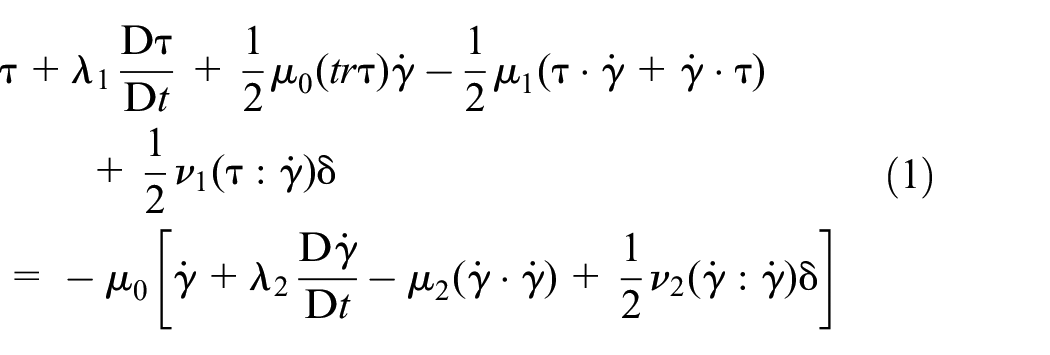
where


Fu et al. 11 focused on the electrified viscoelastic liquid jet and the derivation of dispersion relation for axisymmetric mode can be written as

where k is the wave number of the perturbations in the x direction,
By solving the dispersion equation numerically, it can be found that the liquid jet tends to become unstable when the minimum value of disturbance growth rate is positive.23–29 In supercritical cases, the linear stability analysis method fails to accurately predict the stability of electrified jets. Due to the disappearance of surface tension, which forces the Weber number tends to infinity, the supercritical regime is exceedingly complicated. This made the solution to diverge indefinitely, and no valid solution can be found. Nowadays, the solution to the dispersion equation in the supercritical case is given, the purpose of which is to obtain a solution for exceedingly large Weber numbers. The dispersion equation (4) was solved numerically with commercial calculation software Maple.
To investigate the role of surface tension and electric stress playing in the destabilizing process when approaching critical point, we use energy analysis, which solves the problem by tracing the sources of energy. Lin
30
raised a model to describe the energy budget. A control volume of the liquid is established, which is based on one wavelength

where V and A stand for the control volume and surface area, respectively.
At the interface, the normal stress is continuous; thus, the dynamic boundary conditions in the direction normal to the interface can be written as (equation (11) in Fu et al. 23 )

where
After applying equation (6) to the interface (similar to equations (3.7)–(3.15) in Xie et al. 31 ) and in the axial direction taking spatial periodicity into account, the energy budget equation can be written as

where

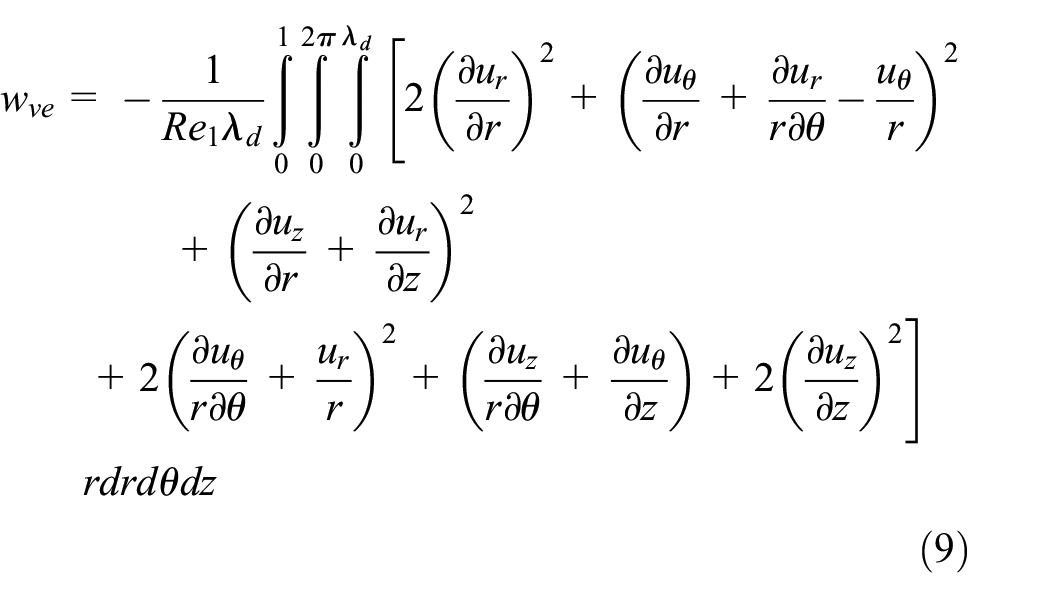





The term
Results and discussion
With the critical point gradually being approached, the value of the surface tension decreases; at the critical point, surface tension completely disappears, which indicates that the Weber number tends to infinity at the critical point. As the jet gradually approaches the critical point, the value of the surface tension decreases. The surface tension completely disappears when it reaches the critical point, which indicates that the Weber number tends to infinity at this point. Hence, to characterize the stability behavior of the electrified jet at supercritical conditions as accurately as possible, the supercritical point was approached here asymptotically. Gradually increasing the Weber numbers and plotting the trends of the growth rate as well as wave number, the stability curves can be obtained, which equals to the process of reaching the critical conditions asymptotically. The peak of the curve stands for the growth rate for the most amplified disturbance.
Figure 2 shows the relationship between the nondimensional temporal growth rate

The dispersion curves of an electrified supercritical liquid jet under a series of increasing Weber number (Re = 82.4, Q = 0.001, b = 100, Eu = 0.1, and λ1 = λ2 = 0).
When Weber number is sufficiently large (>6500), the range of instability also becomes very large. In this study, considering the large time-consuming and the actual purpose, the abscissa-crossing points for these cases were not calculated. As Weber number becomes more than 325,000, the dispersion relation curves corresponding to different Weber number almost overlap. Hence, it can be concluded that the dispersion curve when Weber number approaches infinity almost coincides with one certain curve when the Weber number is large enough (in the order of 105 in this case), that is, when the Weber number is quite large, the dispersion relation curves corresponding to the supercritical condition can be approached.
Energy budget is used to demonstrate the effect of surface tension and electric stress. The rate of change in kinetic energy and various works as a function of wave number are given in Figure 3. It is shown in Figure 4 that the factors playing major roles are the work made by surface tension and electric stress. The work made by surface tension, denoted by

Rate of change in kinetic energy and various work when Re = 82.4, We = 32.5, Q= 0.001, b= 50, and Eu = 0.1.

Rate of change in kinetic energy and various work when Re = 82.4, We = 65, Q= 0.001, b= 50, and Eu = 0.1.

Rate of change in kinetic energy and various work when Re = 82.4, We = 32.5, Q= 0.001, b= 50, and Eu = 0.2.
Figure 6 shows the work done by surface tension when Weber number varies. From the picture, it can be seen from the curves that, although the range of wave number attributing to the stabilization of jet extends as the Weber number increases, the curve generally bends toward the horizontal axis, which means the work done by surface tension decreases. It can also be deduced through the expression of work done by surface tension equation (13) that, when Weber number approach infinity, the work done by surface tension would decrease to nearly zero. That means the attribution of surface tension would disappear as the Weber number increase to infinity, and the dispersion curves would approximate to one limited curve, which is the supercritical jet condition.

Work done by surface tension as Weber number varies, when Re = 82.4, Q= 0.001, b= 50, and Eu = 0.1.
In Figure 7, the relationship between the maximum growth rate and different electrical Euler number is shown. The maximum growth rate changes with Weber number. By varying the surface tension, the Weber number is increased up to 108, which is sufficiently large to be regarded as the supercritical conditions. Four different electrical Euler numbers have been examined, and all of them show an obviously character: as Weber number increases up to the value of 103, the maximum growth rate increase steeply, and then gradually reach an asymptote after We = 104. When Weber number becomes larger than about 105 level, the maximum growth rate does not vary with Weber number. This “platform” value of growth rate represents the growth rate under the supercritical condition for corresponding electrical Euler number. It is not difficult to conclude that the Weber number at which the maximum growth rate reaches the asymptote value is nearly the same for different Euler numbers. At the same time, the asymptote value increases as the Euler number increases, that is, with the increase in Euler number, the maximum growth rate of the liquid jet under supercritical condition increases. Hence, it can be concluded that the applied electrical field would enhance the instability of a jet in supercritical environment, and the maximum growth rate can be obtained by this asymptotic method.

The variation of the maximum growth rate with We for different electrical Euler numbers (Re = 82.4, Q = 0.001, and b = 100).
Figure 8 shows the relationship between the dominant wave number and varying Weber numbers under different electrical Euler numbers. The trend of dominant wave number is somewhat different with that of maximum growth rate. For low Weber numbers, the dominant wave number increases sharply with the growing Weber number. As Weber number increases, the increasing rate of dominant wave number with Weber number reduces. The dominant wave number does not reach an asymptotic value as the maximum growth rate does. And we cannot obtain the dominant wave number at even higher Weber number because the solution would be diverging when increasing Weber number further. However, we can conclude from Figure 2 that the dominant wave number would also approximate to a limited value at infinity Weber number, and this asymptotic behavior in some way represents the behavior of the wavelength of disturbance under supercritical condition. Also, it can be deduced from Figure 8 that the dominant disturbance wave number under a supercritical condition increases as the Euler number becomes larger, that is, the disturbance wavelength in this study becomes shorter as the applied electrical field intensifies under supercritical conditions.
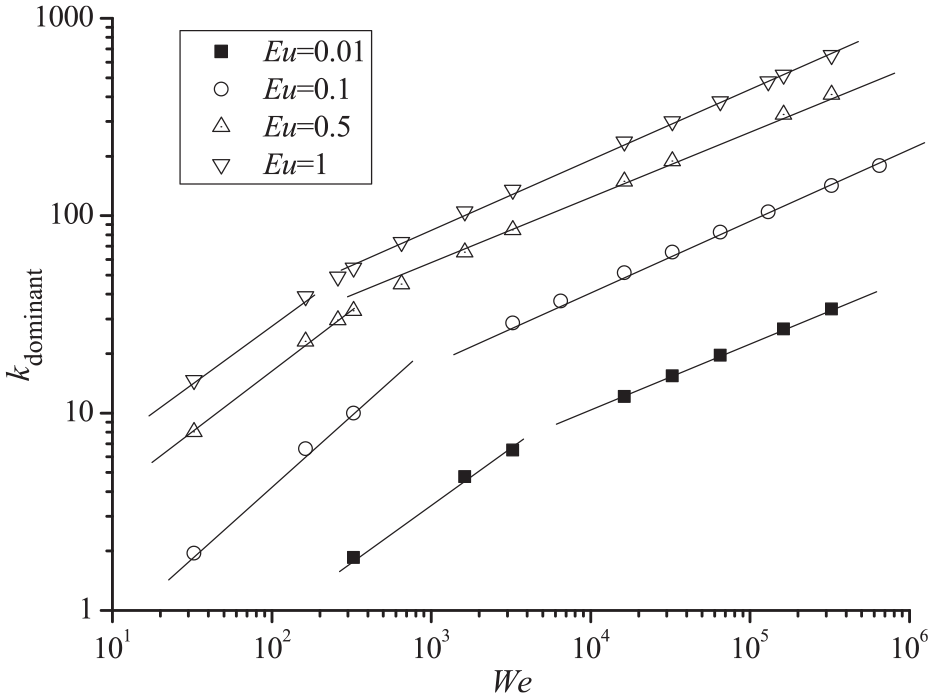
The variation of the dominant wave number with We for different electrical Euler numbers (Re = 82.4, Q = 0.001, and b = 100).
Conclusion
A linear stability analysis method was carried out in this article to study an electrified supercritical jet. The stability solution was found here using an asymptotic approach. Unlike other studies, we obtained the final solutions for electrified supercritical jet in an approximative way. The surface tension was decreased conceptually to approach supercritical conditions, while mathematically the Weber number increased in our governing equations of an electrified subcritical liquid jet. According to our method, as Weber number increases to a sufficiently large value, the solution will converge toward an asymptotic value, which can be deemed to be equivalent solution under supercritical conditions.
The results showed that in the subcritical condition, both the dominant wave number and maximum growth rate increase as Weber number becomes larger.
When Weber number slowly increases and achieves a certain value (up to 105 order in the case here), an asymptote for maximum growth rate appears which is considered as the solution of the supercritical condition.
For dominant, there is no asymptote in the calculated wave number range, but only a decrease in the varying rate of dominant wave number with Weber number is observed. It is expected that the dominant wave number would also approximate to a limited value when Weber number become even larger.
For all electrical Euler numbers, the solution of maximum growth rate is approached asymptotically at around the same Weber number; however, the Weber number at which the varying rate changes for dominant wave number varies for different Euler numbers. The dominant wave number and maximum growth rate for electrified supercritical jet increase with Euler number, that is, higher electrical field intensity would enhance the instability of the electrified supercritical jet and decrease the wavelength of the disturbances.
Footnotes
Appendix
Handling Editor: James Baldwin
Author contributions
P.W. was involved in conceptualization, resources, writing—review and editing, supervision, project administration, and funding acquisition. Z.F. was involved in methodology, software, formal analysis, investigation, data curation, writing—original draft preparation, and visualization.
Declaration of conflicting interests
The author(s) declared no potential conflicts of interest with respect to the research, authorship, and/or publication of this article.
Funding
The author(s) received no financial support for the research, authorship, and/or publication of this article.