



Abstract
This article presents numerical investigations of the solar-assisted hybrid desiccant evaporative cooling system integrated with standard air collectors for applications under the hot and humid climatic conditions of Kuwait city. The objective is to introduce the energy-efficient and carbon-free solar-assisted hybrid desiccant evaporative cooling system to alleviate the principal problems of electricity consumption and carbon emissions resulting from the use of the conventional vapor-compression cooling systems. In the normal building, during cooling load operation, the solar-assisted hybrid desiccant evaporative cooling system can cope with the cooling load particularly sensible by evaporative cooling and latent through desiccant dehumidification. The outcomes of this work indicate that solar-assisted hybrid desiccant evaporative cooling device integrated with air collectors is capable of providing average coefficient of performance of 0.85 and has the potential to provide cooling with energy saving when compared with conventional vapor-compression refrigeration systems. It was concluded that under the intense outdoor environmental conditions (ambient air at greater than 45°C and 60% relative humidity), the delivered supply air from the evaporative cooling was nearly at 27°C and 65% relative humidity. To solve this problem, the system was assisted with conventional cooling coil (evaporator of heat pump) to supply air at comfortable conditions in the conditioned space.
Introduction
Desiccant evaporative cooling systems generally are based on heat-driven open cycles and include aggregate of adsorptive dehumidification and evaporative cooling. In the open cycle, water is used as a refrigerant that is circulated using a pump from the device after imparting the cooling effect and makeup water is provided in its region in an open-ended loop. Generally, regeneration heat is furnished to take away the adsorbed moisture from the desiccant wheel and inlet hot air temperature is generally in the range of 50°C–100°C, depending on the desiccant fabric and the degree of dehumidification. Solar thermal energy, among different applications, can also be used for regeneration and is high quality for use in direct evaporative cooler (DEC) systems mainly fulfilling the cooling demand throughout the mid-afternoon when electricity consumption is at its top while the electric-driven conventional electric-powered chillers are used. For this scenario, the incorporation of solar thermal energy could be inspirational meeting the cooling demand which parallels the provision of solar radiation. Solar air collectors can be used in extracting the energy from solar radiation to run the cooling devices. Consequently, over several years, solar cooling by way of sorption systems is an attractive subject of research for energy saving. In current years, one-of-a-kind techniques of low power cooling have been explored in distinct regions of the world, especially in the developed international locations to alleviate foremost problems of electricity intake and carbon emission from using conventional vapor-compression cooling systems contributing in worldwide warming. Solar cooling proves the first-rate alternative to gain low energy cooling and is a powerful tool to attain the target of constructing energy-efficient buildings.
In the subtropical climate, the air conditioning is essential because of hot, dry summer, and a moderate winter throughout a year. Therefore, the solar cooling would be feasible to handle the sensible and latent cooling loads of buildings. Since solar energy is intermittent, it is necessary to provide auxiliary heating. Evaporating cooling using water supply is optimizing the use of solar energy and minimizing the role of auxiliary heating. Evaporative cooling is mainly used in the hot and dry climate while desiccant dehumidification is a necessity for the outdoor fresh air and indoor latent cooling load. As a result, a solar cooling system combined with evaporative cooling and desiccant dehumidification is a suitable alternative for humans living in the hot and humid climate and needed to be more explored. A detailed literature review in this area was surveyed and is presented here.
Literature review
Smith et al. 1 produced a numerical model of a solar-assisted desiccant cooling device for cooling a building under the climatic conditions of Pittsburgh, Macon, and Albuquerque. Simulations were undertaken to utilize the TRNSYS software program. The authors pointed out that desiccant cooling system is capable to handle the building cooling load within the comfortable zone for most of the cooling season. Joudi and Dhaidan 2 studied the outcomes of a solar-assisted cooling system for a domestic two-story building in Baghdad, Iraq, under various climatic conditions. A computer simulation model was used to assess the performance of the cooling system and its components. It was shown that the simulated system can handle the cooling at acceptable comfortable conditions during summer days in Baghdad.
Mazzei et al. 3 evaluated a desiccant cooling system and a conventional vapor-compression cooling system using computer simulation tool and compared the operating costs involved in both systems. The authors claimed 35% saving in operating cost and decrease of thermal power consumption up to 52% using a desiccant cooling system when compared with vapor-compression cooling system. Niu et al. 4 evaluated four configurations of a hybrid desiccant cooling system under the environmental conditions of Hong Kong. From the results, it was found that the chilled ceiling desiccant cooling system had better cooling performance among the configurations tested. Henning 5 presented an overview of the performance of solar-assisted air-conditioning system for the buildings and pointed out the developments in open and closed heat-driven cooling cycles integrated with solar collectors. It was shown that thermally driven cooling devices utilizing solar air collectors result in significant energy savings provided the systems are properly designed.
Mavroudaki et al. 6 and Halliday et al. 7 conducted independently two feasibility studies of solar-driven desiccant cooling systems under the different climatic zones of European cities. The authors concluded that substantial energy savings can be achieved under all climatic conditions but in highly humid zones energy savings were comparatively less due to the high temperatures required for regeneration of the desiccant wheels. Jain et al. 8 simulated and analyzed the different solid desiccant cooling cycles under the hot and humid climatic conditions of different cities of India. They got different values of coefficient of performance (COP) for each cycle considered. Extensive simulations of these cycles indicated that desiccant cooling cycle based on wet surface heat exchanger exhibited better performance compared to other cycles considered.
Ahmed et al. 9 performed a parametric study experimentally including the effect of the wheel thickness, wheel speed, regeneration to adsorption area ratio, wheel porosity, and the operating parameters such as air flow rate, inlet humidity ratio of the air, and regeneration air temperature on the system performance. The design parameters were optimized under certain operating conditions of Cairo, Egypt. From the experimental results, it was shown that the solar air collector of area of 2 m2 contributed nearly 72.8% of the total regeneration energy at air flow rate of 1.9 kg/min and the regeneration air temperature of 60°C. With the increase of flow rate to 9.4 kg/min, the air collector contribution decreased to 13.7% and regeneration temperature of 90°C was required.
Mei et al. 10 evaluated a desiccant cooling system integrated with a photovoltaic (PV)-solar air heating system designed for the Mataro Library, near Barcelona. It was reported that temperature of 70°C or more can regenerate the sorption wheel effectively in the desiccant cooling system. For the system considered, a solar fraction of about 75% and average COP of 0.518 were obtained during the summer season. Daou et al. 11 examined the feasibility of a desiccant cooling system under different climatic conditions and highlighted the advantages of the system in terms of energy saving and cost reduction. It was established that the desiccant cooling system proved to be a perfect counterpart to other cooling systems. Yong et al. 12 performed an experimental study to test a hybrid desiccant cooling system consisted of a desiccant wheel, an indirect evaporative cooler, and a conventional cooling coil and other components. The system was evaluated under the hot and humid climate of Hong Kong. It was observed that with the increase of flow rate, the COP of the system increased.
Fong et al. 13 evaluated a solar hybrid desiccant cooling system for commercial buildings with high latent cooling load met in the subtropical region of Hong Kong. It was noted that the performance of the solar hybrid desiccant cooling system was better than the conventional air-conditioning system under the tested climate. In another study under the same climatic conditions, Fong et al. 14 proposed a solar hybrid cooling system for high-tech rooms. In this study, the authors evaluated the performance of the solar hybrid cooling system by running dynamic simulations and focusing on the main performance indicators, that is, the solar fraction and the primary energy consumption. It was concluded that the cooling system considered was technically more feasible for the applications having a greater cooling load.
Beccali et al. 15 evaluated the energy and economic performance of the desiccant cooling systems furnished with single glazed standard air collectors and the hybrid photovoltaic/thermal (PVT) collectors under the hot and humid climatic conditions by running hourly simulations. It was found that the desiccant cooling systems integrated with heat pumps and small solar collectors demonstrated better performance. Eicker et al. 16 evaluated the performance of the desiccant cooling systems integrated with solar air collectors installed in the Spain public library and Germany production hall. Through measurements, it was reported that the dehumidification efficiency of the desiccant wheels was 80% and the humidification efficiency of the evaporators was 85%–86%. A two-stage desiccant system installed in China laboratory building exhibited dehumidification efficiency of 88% and the measured heat recovery efficiency of the rotary heat exchangers was reported 62%–68%.
La et al. 17 summarized the technical developments of rotary desiccant dehumidification and air-conditioning system. It was highlighted that the desiccant cooling system evaporative cooling is beneficial in being free from chlorofluorocarbons (CFCs), uses low-grade thermal energy, controls humidity and temperature separately, environment friendly, energy saving, healthy, and comfortable, etc. Goldsworthy and White 18 optimized the design of a desiccant cooling system with an indirect evaporative cooler and evaluated the performance of the solid desiccant indirect evaporative cooler system. It was shown that their cooling system had better performance to achieve substantial energy savings and greenhouse gas emission reduction. Zendehboudi et al. 19 simulated the solar desiccant cooling system using the TRNSYS software under the hot and humid climatic conditions of four different locations in Iran. It was concluded that COP of system considered highly depends on the outdoor absolute humidity.
Lamrani et al. 20 investigated the performance of an indirect hybrid solar dryer of wood using TRNSYS software. The hourly dynamic simulations were conducted using the solar compound parabolic concentrator under the Moroccan climate. From the results, it was found that combination of the solar collector into the dryer system resulted in reduction of energy consumption by the auxiliary heater system and avoided about 34% of CO2 emissions annually. Jani et al. 21 studied the hybrid solid desiccant cooling and the conventional vapor-compression refrigeration air conditioner in typical hot and humid climate in a test room having cooling capacity of 1.8 kW and simulated in TRNSYS environment from March to September. The results were presented in terms of the effects of ambient humidity ratio and temperature on the COP and supply air temperature, the variation in COP at various regeneration temperatures. It was shown that such systems could be used for cooling of building in hot and humid climates. Jani et al. 22 also studied the desiccant dehumidifier integrated with vapor-compression hybrid system using TRNSYS simulations for different configurations during summer season. From the results, it was shown that the proposed system had confirmed a significant decrease in process air humidity at dehumidifier exit while satisfying the comfort conditions in the conditioned room. Sudhakar et al. 23 presented a review of modeling of a solar desiccant cooling system using a TRNSYS-MATLAB co-simulator. It was highlighted that building energy performance scenarios (BEPS) Tools (Energy Plus, TRNSYS, ESP—r, Mathcad) do not provide sub-models for proper control mechanism. The use of TRNSYS-MATLAB co-simulator is a more appropriate simulation tool when compared with other available building energy performance simulators to evaluate the performance of solar desiccant cooling for hot and humid regions.
From the literature and market place survey, it is discovered that few studies have been reported on the solar-assisted desiccant evaporative cooling technology for hot and humid climatic conditions. Moreover, this technology is still not mature enough for its industrial breakthrough at large scale and there is a massive scope for more research in this field to build up the confidence of heating, ventilation, and air conditioning (HVAC) industry for commercialization. This provided the prime inspiration to undertake this study. Solar-assisted hybrid solid desiccant evaporative air-conditioning system has been studied for hot and humid climate using TRNSYS software. Simulations were carried out for a hybrid air-conditioning system, which is in fact a unique configuration with integration of solar air collectors, a rotary solid desiccant dehumidifier, DEC/indirect evaporator cooler (IEC) evaporative cooling unit, a cooling coil (evaporator of heat pump), and heating coil (condenser of heat pump). The complete system has been modeled in simulation studio project for a test room (5 m×5 m×5 m) having a cooling load of 6 kW to study the performance of the system during cooling season during the month of August in a hot and humid climate of Kuwait. Simulated results have been validated with data available in the literature. The effects of variation in important parameters such as regeneration temperature, ambient temperature, humidity ratio, solar fraction, and COP of system have been discussed.
Description of the system
The schematic layout of the proposed hybrid solar-assisted solid desiccant evaporative cooling system is shown in Figure 1. It comprises basically four components, specifically the desiccant wheel (dehumidifier), the direct/indirect evaporative cooling units, the regeneration heat source, and a vapor-compression cooling coil. The solid desiccant adsorbs water vapors from the humid air passing through the desiccant wheel surface porosity. This process occurs due to the difference of vapor partial pressure between the air and the desiccant surface. During the adsorption process, the air temperature increases due to the conversion of sensible heat of condensation and adsorption heat of chemical processes. The function of direct/indirect evaporative cooling units is to cool the dry and hot air (primary air stream) coming out of the desiccant wheel. The primary air stream is cooled sensibly inside the primary channels due to heat transfer with the secondary air flow in the moist channels of the indirect evaporative cooler. The regeneration heat supplies the thermal energy vital for driving out the moisture that the desiccant had taken up duration the absorption process. Other necessary components are cooling coil, fans (supply, regeneration), and variable flow circulating pumps. The main components of the solar-assisted desiccant cooling system with numbering of involved processes are shown in Figure 1.
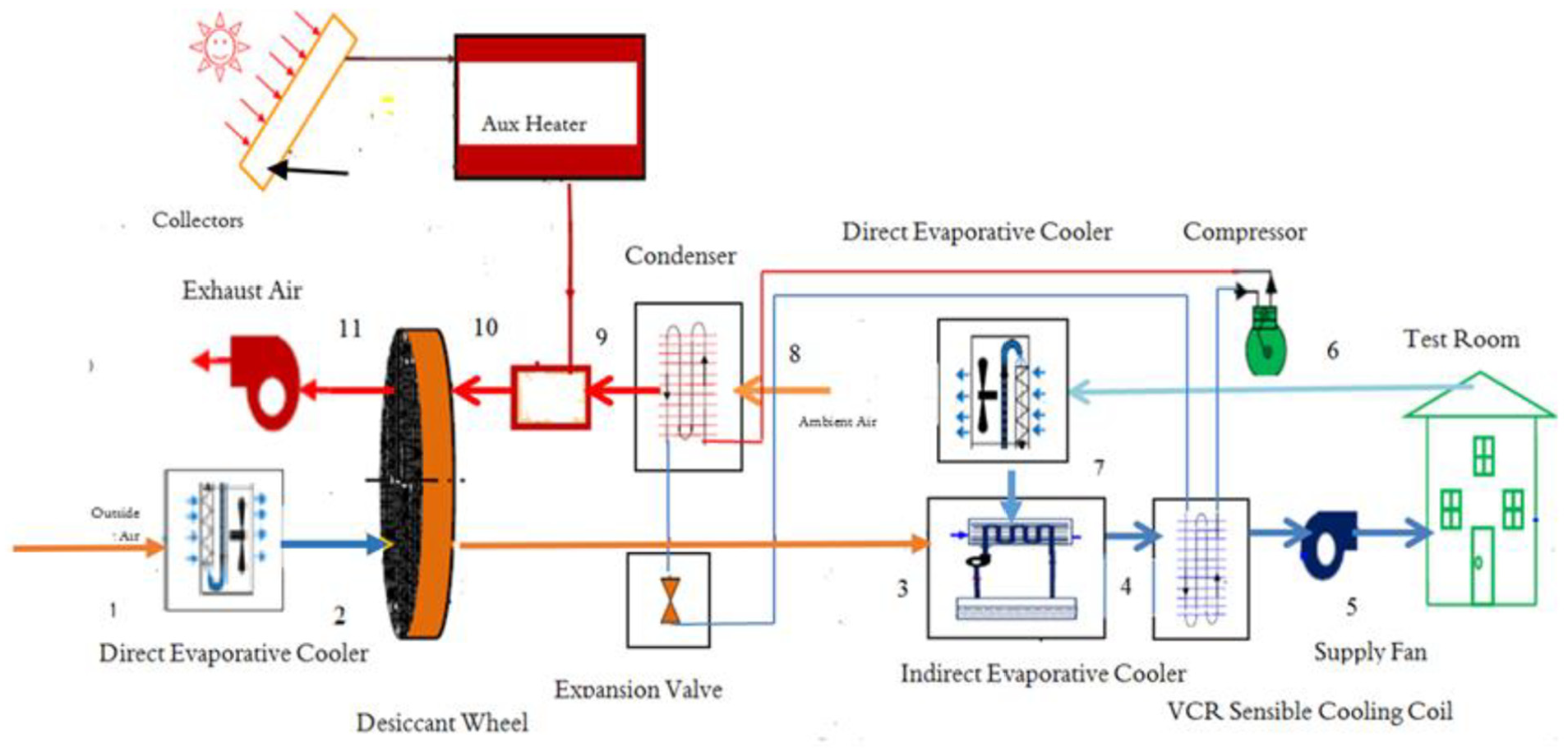
Schematic of the solar-assisted desiccant cooling system in ventilation mode.
The processes of solid desiccant cooling system shown in Figure 1 to provide conditioned air are described here briefly:
Outdoor hot and humid air also known as process air is first of all pre-cooled using DEC (1-2), then is passed through the slowly rotating desiccant wheel where it is dehumidified by adsorption of moisture (2-3). During the adsorption process, the temperature of air rises while leaves the desiccant wheel as dry and hot and enters the primary channels of indirect evaporative cooler where it is cooled (3-4) by the secondary air stream of IEC. A cooling coil usually evaporator of a vapor-compression system (4-5) is coupled with IEC which is used during peak cooling load depending upon the climatic conditions when IEC alone is unable to provide sufficient cooling to satisfy the comfort level of cooling space. During the sensible cooling process through the indirect evaporative cooler and the cooling coil, the temperature decreases but the humidity ratio remains constant.
The return air from the building is cooled (6-7) close to the saturation point using DEC and then is passed through the indirect evaporative cooler as secondary air stream (7). Finally, the desiccant wheel has to be regenerated (8-11) by applying the low-grade heat from the heat source at a relatively low temperature generally from 50°C to 70°C to make the dehumidification process continuous. In the supply air side, DEC (pre-cooler), a solid desiccant wheel, indirect evaporative cooler, and a cooling coil (evaporator of heat pump during peak load) are placed, see Figure 1. On the return air side, the desiccant wheel, a heating coil (condenser of heat pump during peak load), auxiliary heater, and hot air coming from air collectors are integrated before the desiccant wheel for regeneration.
Modeling of the system
A desiccant air-conditioning system is composed of a number of subsystems. The specific models for each subsystem operation are presented here. In the functioning of a desiccant system, the input of the one subsystem is the output of the other, and system sub-models are integrated carefully to the main model of the desiccant system for successful operation.
Desiccant wheel
Thermal performance of a desiccant wheel can be assessed by using Jurinak’s iso-potential characteristic theory. 24 TRNSYS model of a desiccant wheel makes use of this concept to decide the outlet air situations. In this technique, the dehumidification process is modeled in analogy with a simple heat transfer process through the combined potentials F1 and F2. The combined potentials result from the analysis of heat and mass transfer equations in a basic section of the desiccant wheel simplifying the pertinent equations, forming the particular analogy. In this analysis, constant F1 lines coincide with constant enthalpy lines, whereas constant F2 lines coincide with constant relative humidity (RH) lines on the psychrometric chart. 25 The combined potential functions depend on the temperature, RH, thermo-physical properties of the processed air, and the wheel context including the desiccant material, 26 as shown in Figure 2. 27

Dehumidifier process paths. 27
First of all, the model computes the values of the potential functions F1 and F2 of the process air stream at inlet. The ideal outlet temperature of the process air can be determined from the value of the potential function F1 which is same at points P and D* (Figure 2). According to the analogy theory, the efficiency indices of the wheel ηF1, ηF2 with regard to the combined potentials F1, F2 can be calculated in analogy to the energy efficiency of a respective heat exchanger. Given the values of the efficiency indices of the wheel ηF1, ηF2, the temperature and humidity of the processed air at the outlet of the wheel could be calculated, provided a relation explicitly describing the F1, F2 dependence on temperature and humidity is available. Jurinak has expressed such a relation for the working pair of air-silica gel, leading to the formulation of the model presented by equations (1)–(4) 25 for the system presented in Figure 1




DEC
Humidity and temperature of the conditioned space are controlled using evaporative cooling system. In fact, it adjusts the air temperature and humidity to the desired values earlier than being blown into the conditioned space. For the present cooling system, two DECs are used one as pre-cooler and other within the return air facet. The DEC includes inflexible, corrugated material, which serve as the wetted surface. The air passes through those corrugated materials and water drips on and falls through the way of gravity. The evaporative coolers are normally evaluated based on their saturation effectiveness which is defined in the following equation 28

Therefore, outlet temperature is

where Ti is temperature at the DEC inlet, Twb is wet bulb temperature at the DEC inlet, and
The wet bulb temperature is determined using an empirical equation based on the dry bulb temperature (DBT) and the absolute humidity 28

This humidification process is a constant enthalpy process. The enthalpy is a function of the temperature and the specific humidity (w). It is expressed by the relation 28

where T is the dry bulb temperature (°C). As we have noted previously, just above, enthalpy is constant during the humidification, and so the outlet specific humidity can be determined as a function of the enthalpy at the humidifier inlet and the temperature at the dehumidifier

Once specific humidity is calculated, we can calculate the RH as given in the relation

where
Indirect evaporative cooler
For given conditions, the cooling performance of the indirect evaporative cooler may be expressed using the effectiveness defined by

When the inlet air is cooled to its dew point temperature, the maximum effectiveness of 1 is obtained.
The cooling/heating coil/heat pump
The performance of air cooling coil is described by the effectiveness relationship 29

When a heating coil is used, its performance is described by the effectiveness relationship

where
Auxiliary heater
An auxiliary heater or heating coil is used to attain proper regeneration temperature for the desiccant wheel. The desired energy for the auxiliary heater is gained from gas, electricity, or waste heat. In this study, an extremely good electric heater is considered.
Building configuration
The complete system has been modeled in simulation studio project for a test room (5 m × 5 m × 5 m) having a cooling load of 6 kW to study the performance of the system during cooling season during the month of August in a hot and humid climate of Kuwait. To assess the cooling system proposed, room sensible and latent cooling load are calculated using room-energy-balance technique. To determine the return air temperature and humidity locally, an enthalpy balance of air mass in the room, a mass balance of the air mass within the room, and a mass balance of water mass inside the room are carried out using the following equations



where HS,room and HL,room are local sensitive and latent enthalpy of the air mass, respectively;
System performance
The thermal COP of the desiccant cooling system is generally described by the rate of heat extracted by the system from the cooling space and rate of heat regeneration of the desiccant wheel. Therefore, the COP of the system is obtained by the following relation

The cognizance of the thermal COP helps in the assessment for the thermal energy required for the desiccant cooling system which may be met by way of even low energy resources such as solar, waste, and geo. The electric COP of the cycle is described as the ratio of beneficial cooling to the electricity intake of the system.
Numerical simulations
The simulation model of solar-assisted hybrid desiccant cooling system was developed using the TRNSYS software. In the modeling procedure, the specified components of the solar desiccant cooling system were selected and then connected in the assembly panel of the TRNSYS simulation studio environment. Table 1 lists the components with their TRNSYS names (Types). 27
List of the specified components with their TRNSYS names (types).

The TRNSYS simulation studio project was developed for the proposed cooling system with different components and their connections are shown in Figure 3.

TRNSYS simulation studio project of the proposed cooling system.
Weather input file
A typical meteorological year (TMY) weather file 30 for the hot and humid climate of the Kuwait city was selected for dynamic simulations. A TMY document has a complete year’s essential hourly weather variables file. This report is very broad and consists of practically all critical weather variables along with, ambient dry bulb temperature, humidity, direct solar radiation, diffused radiation, precipitation, wind velocity, and other relevant variables. Summer-time climate in Kuwait is characterized by dry and accelerated temperatures.
Simulation conditions
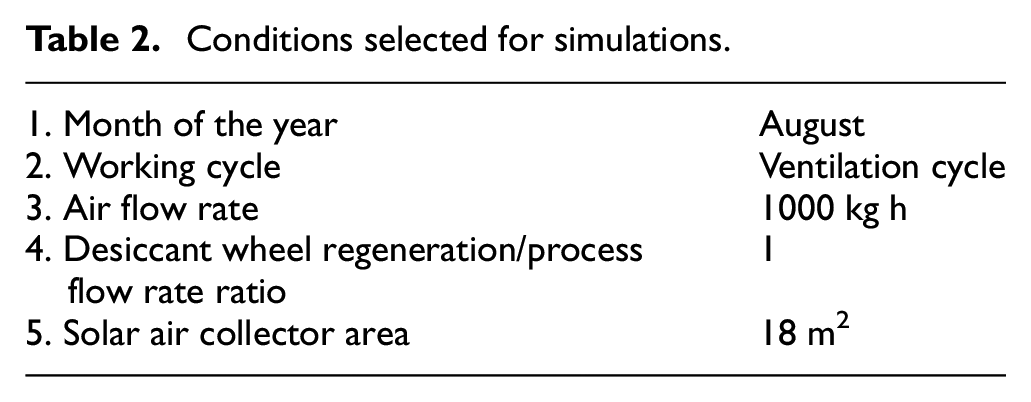
The supply air was pre-cooled and then post-cooled using indirect evaporative cooler and with auxiliary cooling coil (under peak load). The simulation duration was selected for the very hot and humid month of August under the conditions given in Table 2.
Conditions selected for simulations.
Validation of the model
The numerical model has been validated by comparing the results of this study with the experimental study carried out by Fong et al. 13 on a hybrid desiccant air-conditioning system which is integration of rotary desiccant dehumidification and a vapor-compression air-conditioning unit. Figure 4 shows a comparison between this study and that of Fong et al. 13 on a psychrometric chart.

Comparison between the results of the current study (red line) with the experimental measurements (black line) by Fong et al. 13 on psychrometric chart.
The results agree with the experimental measurements for the process air side while for regeneration air side results are not in good agreement and the reasons are further explained. As shown on the psychrometric chart, process 1-2 which represents pre-cooling process and process 2-3 through the desiccant wheel is adsorption process whereas process 10-11 represents desorption process tracks a path that deviates to some extent from constant enthalpy. This is due to fact that temperature at process air outlet arises during dehumidification process 2-3 because of thermal energy carried out slightly by the matrix of the wheel from the regeneration air which is hotter than the process air. Similarly, during the regeneration process 10-11 regeneration air outlet temperature decreases slightly due to the sensible heat transfer to the colder process air in regeneration section.
Results and discussion
The simulations were run to test the system during peak operation (i.e. simulations were run for the month of August). Figure 5 shows the temperature and RH of the ambient air during the month of August.

Temperature and relative humidity of ambient air during the month of August.
Transient representation of the variation of output results of key parameters versus time (hour of the year) obtained through dynamic simulations of the system during the month of August is presented in Figures 6–12. The results of supply line air temperatures such as transient variation of outlet temperatures (T_DEC_out) of pre-cooler, outlet temperatures (T_Dehumid_out) of desiccant wheel, and outlet temperatures (T_IEC_out) of indirect cooler are shown in Figure 6.
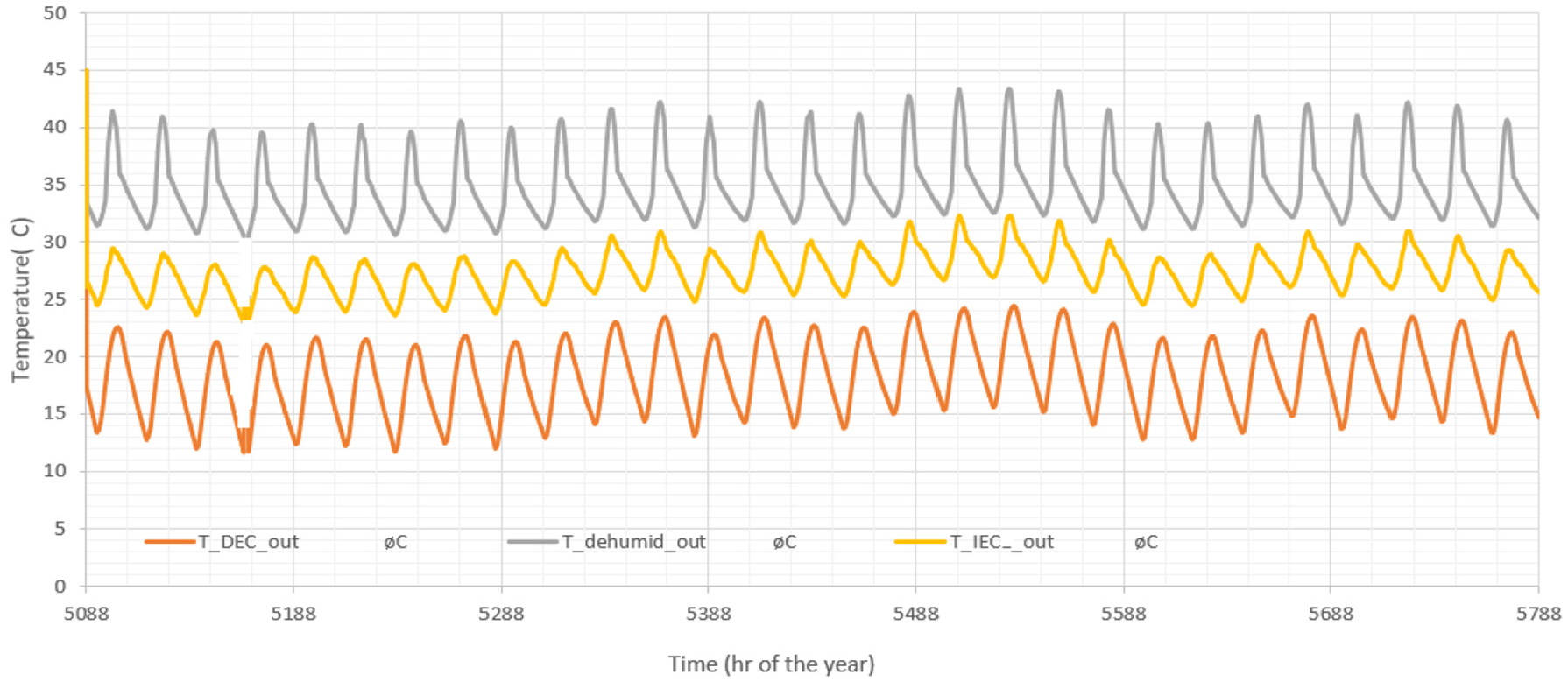
Output temperatures of supply air of pre-cooler (T_DEC_out), dehumidifier (T_dehumid_out), and indirect evaporative cooler (T_IEC_out) during the month of August.

The variation of output relative humidity of supply air of pre-cooler (RH_DEC_out), dehumidifier (RH_dehumid_out), and indirect evaporative cooler (RH_IEC_out) during the month of August.

Variation of sensible air cooling rate of pre-cooler (Q_sens_DEC1-blue color) and indirect evaporative cooler (Q_sens_IEC-yellow color) with time during the month of August.

Latent (dehumidification) air cooling rate of the desiccant wheel.

Variation of average hourly air cooling rate of the system during the month of August.

Variation of temperature of ambient air at inlet of collector (blue color) and at outlet of collector (brown color) during the month of August.

Variation in hourly heating rate (kW) of the solar collectors (blue line) and electric heater heating rate (kW) (light brown) during the month of August.
From Figure 6, it can be seen that the outlet temperature of pre-cooler varies in the range of 23°C–33°C, outlet temperature of desiccant wheel varies in the range of 30°C–43°C, and outlet temperature of indirect evaporative cooler varies in the range of 13°C–23°C. The results obtained evidenced clearly that the system proposed is capable enough to maintain the supply air temperature within the comfort zone during the peak load season for the month of August in Kuwait. The temperature and humidity outputs of the system are important for the occupant comfort. The temperature rise noted during the desorption process in the desiccant wheel is because of two main contributions: (1) While water vapors rise within the moist air are adsorbed within the silica gel-coated matrix of the desiccant wheel, the heat of adsorption is released which raises the air temperature. (2) If the matrix is already hot after passing through the regeneration region, air is heated via heat transfer from the matrix. These two factors cause an increase of outlet temperature of desiccant wheel.
The variation of supply line air outlet RH of pre-cooler (RH_DEC_out), desiccant wheel (RH_Dehumid_out), and indirect cooler (RH_IEC_out) is shown in Figure 7. Figure 7 shows that the supply air outlet RH (RH_IEC_out) of pre-cooler varies in the range of 80%–83%, outlet RH of desiccant wheel varies in the range of 22%–40%, and outlet RH of indirect evaporative cooler varies in the range of 40%–60%. The results of RH show that the desiccant wheel has absorbed the humidity from the supply air effectively and system proposed is capable enough to maintain the supply air RH and temperature within the comfortable zone during the hot and humid climatic conditions of Kuwait. The difference of output values of RH of DEC and desiccant wheel displays the performance level of the desiccant wheel.
The average and maximum values of two main variables to determine the comfort level in the cooling space, that is, temperatures and RH at input and output of the specific components in the supply air stream namely pre-cooler, desiccant wheel, IEC, and cooling coil, are given in Tables 3 and 4.
Average and maximum values of temperatures at input and output of pre-cooler, desiccant wheel, indirect evaporator cooler, and cooling coil.

Average and maximum values of relative humidity at input and output of pre-cooler, desiccant wheel, indirect evaporator cooler, and cooling coil.

RH: relative humidity.
Cooling performance of the system
Figures 8 and 9 show the variation of the cooling performance of the supply line including the sensible cooling, latent cooling, and total cooling obtained through pre-cooler, desiccant wheel, and indirect evaporative cooler during the day and night cycling of the outdoor conditions in the month of August. The variation of sensible air cooling rate of pre-cooler (Q_sens_DEC1-blue color) and indirect evaporative cooler (Q_sens_IEC-yellow color) with time is shown in Figure 8. It is observed that sensible cooling rate of pre-cooler varies in the range of 3.9–6.5 kW while of indirect evaporative cooler varies in the range of 1.8–3.4 kW. Figure 10 shows that average hourly cooling rate provided by the system varies in the range of 1–9.2 kW depending upon the variation of ambient temperature and humidity ratio during the month of August.
Solar thermal energy for regeneration
The variation of ambient air temperature at inlet of the air collector (blue line) and the temperature variation at the outlet of the collector (brown line) is shown in Figure 11. Figure 11 shows that solar radiation absorption by collectors causes temperature rise of air approximately by 60°C which is sufficient for regeneration process of the desiccant wheel in the present case. It is evidenced that use of solar air collectors during daytime when there is a more cooling demand, solar energy is more beneficial to run desiccant cooling systems. The variation in hourly sensible heating rate (kW) of collector (blue line) and the sensible heating rate (kW) of the auxiliary electric heater (light brown) during the month of August are shown in Figure 12.
It is observed hourly solar heating varies in the range of 0–5.5 while electric heating varies in the range of 0–7.8 kW. The hourly variation in total air heating rate (kW) supplied by solar air collectors and auxiliary electric heater for the regeneration of the desiccant wheel is illustrated in Figure 13 which varies in the range of 0.8–7 kW depending upon the ambient conditions.

Variation in total air heating rate (solar + electric) for regeneration of the desiccant wheel during the month of August.
From the results shown in Figures 12 and 13, the solar contribution in the performance of the system can be easily assessed in terms of solar fraction.
Solar fraction is the amount of energy provided by the solar air collectors divided by the total thermal energy required. From Figures 12 and 13, the fraction of power saved during the excessive sunshine days of the month than the cloudier days can be observed. From the series of simulations of the system, it is found that in the present scenario to obtain high solar power contribution of the system, the solar air collector array of area 18 m2 was sufficient to provide the hot air needed for regeneration without storage. Simulation outcomes additionally showed that during midday duration, in properly sunshine hours, the collector outlet temperature was capable to meet the required regeneration temperature of the dehumidifier; however, in the morning and afternoon, the collector outlet temperature needed to be augmented by way of electric-powered heater to obtain the desired temperature.
Thermal performance of the system
Based on the results obtained in Figures 10 and13, the hourly variation in the thermal COP of the system was determined and is shown in Figure 14.
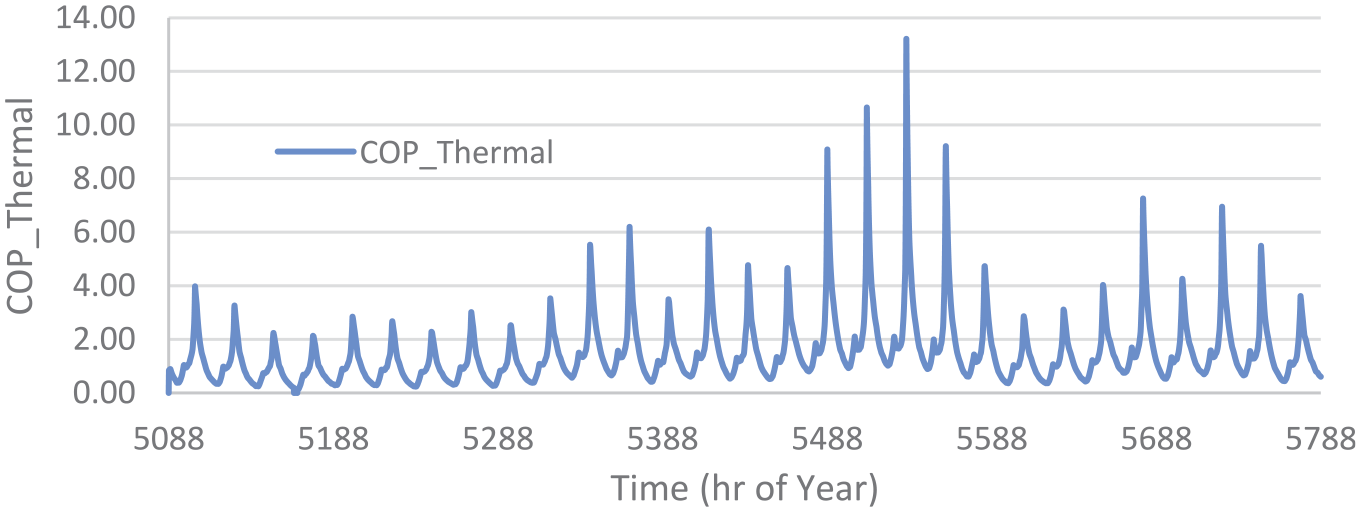
Hourly variation in the thermal coefficient of performance (COP) of the system during the month of August.
From Figure 14, it can be seen that under the Kuwait weather condition, the thermal COP of the proposed cooling system varies in the range of 0–12.5. The value of COP depends on the solar radiation because its value is high for the duration of the high sunshine month of August and has a low value of COP during autumn while solar stays low within the sky. The average values of the main performance indicators of the proposed cooling system also known as outcomes of this study namely total cooling rate, total heating rate, thermal COP, collectors heating rate, electric heating rate, and solar fraction of the system are depicted in Table 5.
Total cooling, total heating, thermal COP, collector heating, electric heating, and solar fraction of the system.

COP: coefficient of performance.
From the results obtained, it can be easily concluded that the proposed cooling system is able to maintain comfortable conditions (in terms of both humidity and temperature) within the targeted cooling space selected. The thermal energy required to run the system was provided by the solar thermal arrays and auxiliary electric heater. The overall average COP was found to be 0.85. This value is a strong indication of the overall efficiency of the system designed along with the high degree of comfort in the building which indicates that the system considered would be suitable most of the time for the hot and humid coastal Kuwaiti climate. This allows the study to move forward in the second stage which involves the construction and testing of this unit under realistic load conditions.
From the outcomes acquired, it was noted that under the intense outdoor environmental conditions, that is, very hot and humid, the system becomes not able to offer comfortable zone cooling. In the course of the peak loads (ambient air at 45°C and 48% RH), the delivered supply air from the evaporative cooling was brought at 27°C and 65% RH. The boundaries of evaporative cooling and the desiccant rotor did no longer leave extensive room for overall performance development. Including extra degrees of desiccant rotors became considered but discovered to increase the electricity consumption of the system and greatly increase the complexity of the system. To solve this problem, a configuration was advanced shown in Figure 1 that included heat pump to both cool the deliver air and reject heat back into the regeneration air flow, lowering the burden at the auxiliary heater. This device is a hybrid among the unconventional solar desiccant with evaporative cooling and the conventional cooling coil under peak loads. The simulation results in the form of inputs and outputs of the main components of the advanced desiccant cooling system using solar air collector and electric heater for heating regeneration for a typical hot day during the month of August are shown in Figure 15.
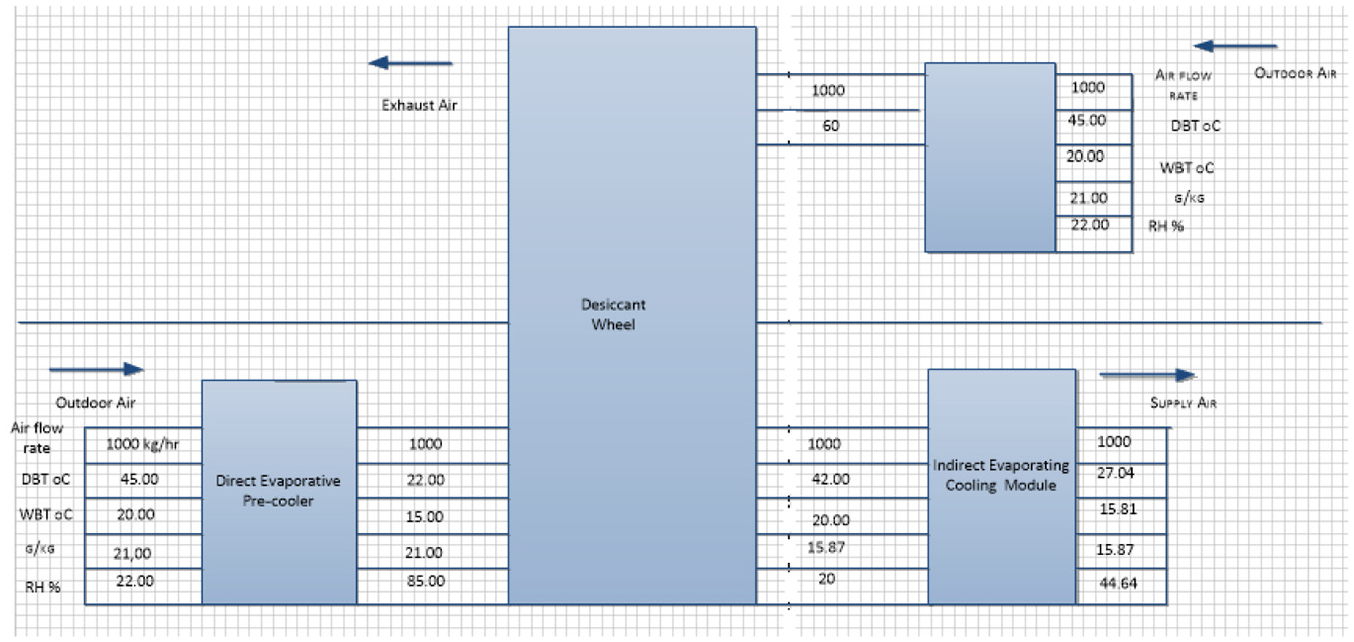
Inputs and outputs of the main components of the desiccant cooling system.
Conclusion
The following results are concluded from the current numerical study performed on the solar-assisted desiccant cooling system:
The pre-cooling is essential to reduce the enthalpy before it passes through the dehumidifier, which in fact saves energy, enhance cooling capacity and COP of the present proposed cooling system.
The simulation results of the proposed system for the climatic conditions of Kuwait coastal regions show that the solar desiccant cooling system can cool the air to comfortable temperature and humidity values in the cooling space. In fact, Kuwait city in summer faces hot and humid climate; therefore, the solar desiccant cooling system is more suitable to provide the conditioned air.
From the series of simulations run, it is found that to obtain high solar power contribution of the system, the sun air collector array of area 18 m2 was sufficient to provide heat needed for regeneration without storage.
The outcome of thermal energy contributed by solar air collectors on the system performance was significant. The results showed that solar-assisted desiccant cooling system is practicable option in the Kuwait climate with solar energy contributing the thermal energy needed for regeneration. Since the solar energy is intermitted, the regeneration process was not achievable during the whole day using the solar energy alone. This dilemma could be solved using the auxiliary electric heating.
From the results obtained, it is evident that the proposed cooling system has the potential to maintain comfortable conditions (in terms of both humidity and temperature) within the targeted cooling space selected. The thermal energy required to run the system was provided by the solar thermal arrays and auxiliary electric heater. The overall average COP was found to be 0.85.
From the outcomes acquired, it was noted that under the intense outdoor environmental conditions (ambient air at greater than 45°C and 60% RH), the delivered supply air from the evaporative cooling was almost at 27°C and 65% RH. To solve this problem, the system was assisted with conventional cooling coil (evaporator of heat pump) to both cool the deliver air and reject heat back into the regeneration air flow, lowering the burden at the auxiliary heater.
Footnotes
Appendix 1
Handling Editor: James Baldwin
Declaration of conflicting interests
The author(s) declared no potential conflicts of interest with respect to the research, authorship, and/or publication of this article.
Funding
The author(s) disclosed receipt of the following financial support for the research, authorship, and/or publication of this article: This work was supported by the College of Technological Studies-PAAET, Shuwaikh, Kuwait.
