




Abstract
Structural systems often exhibit time-varying dynamic characteristics during their service life due to serve hazards and environmental erosion, so the identification of time-varying structural systems is an important research topic. Among the previous methodologies, wavelet multiresolution analysis for time-varying structural systems has gained increasing attention in the past decades. However, most of the existing wavelet-based identification approaches request the full measurements of structural responses including acceleration, velocity, and displacement responses at all dynamic degrees of freedom. In this article, an improved algorithm is proposed for the identification of time-varying structural parameters using only partial measurements of structural acceleration responses. The proposed algorithm is based on the synthesis of wavelet multiresolution decomposition and the Kalman filter approach. The time-varying structural stiffness and damping parameters are expanded at multi-scale profile by wavelet multiresolution decomposition, so the time-varying parametric identification problem is converted into a time-invariant one. Structural full responses are estimated by Kalman filter using partial observations of structural acceleration responses. The scale coefficients by the wavelet expansion are estimated via the solution of a nonlinear optimization problem of minimizing the errors between estimated and observed accelerations. Finally, the original time-varying parameters can be reconstructed. To demonstrate the efficiency of the proposed algorithm, the identification of several numerical examples with various time-varying scenarios is studied.
Introduction
Parametric identification of structural systems is an important research topic in structural health monitoring (SHM).1,2 Thus far, many researches have been conducted on the identification of time-invariant structural parameters.3–6 However, structural systems are inevitable to exhibit time-varying behaviors in their service life. Time-varying structures can be grouped into two categories: fast change systems due to extreme load effect (e.g. strong earthquake) and slow change systems due to material aging or environmental erosion. Therefore, structures could exhibit the abrupt stiffness degradation when they are subject to strong earthquakes or may show slow changing characteristics when they suffer material fatigue and environmental erosion. Therefore, these time-varying structural parameters are a useful indicator of the evolution of structural damage under extreme events. It is essential to identify theses time-varying parameters, which could be useful for damage detection, performance evolution, and remaining service life forecast in engineering practice. Time-varying structural parameter identification based on dynamic responses has received extensive research attention in recent years.7–9
For a linear system, the time-varying system identification methods mainly contain two categories: time-domain analysis and time-frequency analysis. In the time domain, approaches based on the adaptive forgetting factor 10 or track factor 11 have been investigated to online estimate and track the time-varying parameters. Subsequently, adaptive tracking techniques with adaptive factor matrix have been proposed for tracking changes in structural parameters,12,13 but the solution of an optimization problem at each time step needs to update the adaptive factor matrix, leading to computational inefficiency. Compared with time-domain analysis, time-frequency analysis allows the study of structures in both time and frequency domains. Shi and Law14,15 proposed an identification algorithm for linear time-varying systems based on Hilbert transform (HT) and empirical mode decomposition (EMD) method. Wang and Chen 16 further put forward a Hilbert–Huang transform (HHT) method to identify the time-varying stiffness and damping coefficients of multi-story buildings. Bao et al. 17 developed an improved HHT algorithm to identify time-varying systems.
In addition, wavelet multiresolution analysis (WMRA) has been widely adopted for the time-variant properties due to its powerful time-frequency analysis ability.18–20 Ghanem and Romeo 21 utilized a Wavelet-Galerkin-based method to identify the time-varying system, where the differential equation of the structure is established according to the input and output responses of structures. Basu et al. 22 proposed an approach that can online identify variation in natural frequencies and mode shapes of systems arising out of change in stiffness. Wang et al. 23 developed a discrete wavelet-transform-based algorithm using the least-square estimation to solve the scale coefficients and identify the time-varying physical parameters of shear-type structures. Xiang et al. 24 also studied the identification of time-varying physical parameters in a frame structure by the wavelet multiresolution approximation.
While satisfactory identification results for the time-varying structural physical parameters can be obtained by existing approaches based on WMRA, full measurements of structural responses including all structural acceleration, velocity, and displacement responses are requested, which is not practical in engineering practices. To overcome the limitation of full measurements, Kalman filter (KF) 25 is an efficient tool to estimate the structural state with limited acceleration observations. However, conventional KF cannot be applied for tracking the parametric change directly.
Based on the synthesis of WMRA and KF, an identification algorithm is proposed in this article for linear time-varying system identification with partial observations of structural responses. Time-varying structural parameters, such as stiffness and damping coefficients, can be identified using only partial acceleration responses of structures, and displacement and velocity response observations are not required. The proposed algorithm mainly contains three steps: (1) by expanding the time-varying parameters as a finite set of wavelet basis functions, the time-varying problem is converted into the time-invariant with respect to the parameters in the expansions. (2) To overcome the limitation of full observations of structural responses, structural states are estimated by the KF using only partial observations of structural acceleration responses. (3) The time-invariant scale coefficients of the expansion can be estimated via the solution of a nonlinear optimization problem by minimizing the error between estimated and observed accelerations. Then, the original time-varying parameters can be reconstructed. Several illustrative numerical examples with different scenarios of time-varying physical parameters (e.g. sudden jump, gradual changes) are used to demonstrate the efficiency of the proposed identification algorithm.
This article is structured as follows. Section “Brief review on wavelet expansion and reconstruction of a signal” briefly reviews the basis of wavelet expansion and reconstruction for arbitrary time-varying signals. A brief overview of the conventional KF for the identification of structural state is also given in section “A brief review of the conventional KF.” Based on wavelet expansion and the KF approach, a synthesized algorithm is proposed in section “The proposed synthesized identification algorithm” for the identification of linear time-varying systems. In section “Numerical examples,” some numerical examples with different scenarios of time-varying parameters are presented to illustrate the performances of the proposed algorithm. Finally, some conclusions are presented in section “Conclusion.”
Brief review on wavelet expansion and reconstruction of a signal
As illustrated in Figure 1, a discrete signal can be decomposed based on the multiresolution analysis into two components: the detailed signal (passing through the high-pass filter) and approximation signal (passing through the low-pass filter). Then, this decomposition procedure is repeated with the high- and low-pass filter again.

Wavelet multiresolution expansion of a signal.
For a continuous signal

where

The development of orthogonal wavelet bases has opened a new bridge between approximation theory and signal processing. Mathematical approximation suggests choosing a basis that can construct precise signal approximations with a linear combination of a small number of vectors selected inside the basis. As the energy of the signal mainly concentrates on the low-frequency components, one can ignore the detailed component, and a discrete truncated form of equation (2) can be simplified as 23

Based on the advantage of WMRA, the identification of time-varying structural parameters can be transformed into the identification of the time-invariant wavelet-scale coefficients. However, previous methods need the full measurements of structural responses.23,24 To overcome the limitation of full measurements, KF 25 can be used to estimate the full state using partial structural observations.
A brief review of the conventional KF
For the completeness of the proposed algorithm, the KF approach for the estimation of structural full responses is reviewed briefly in this section.
The motion equation of a time-invariant structure system can be expressed in the discrete state space form as

in which
Generally, the limited structural responses could be observed, so the observation equation can be given as

in which
The conventional KF involves two basic procedures. The first one is the state prediction which can be derived from equation (4)

where

The second procedure is the measurement updating as

in which

The error of the estimated

Equations (4)–(10) are the basic procedures of the conventional KF. However, the conventional KF cannot be used to track the structural damage directly.
The proposed synthesized identification algorithm
The procedures of synthesizing the wavelet decomposition and KF for the identification of time-varying structural parameters are derived in this section. For an N-degrees-of-freedom (DOFs) linear dynamic system with time-varying structural parameters, the governing equation can be written as

in which
In this article, it is assumed that the mass matrix
Step 1
The purpose of step 1 is to transfer the identification of a time-varying problem into a time-invariant one. The wavelet multiresolution decomposition of a time-varying signal is adopted for time-varying stiffness and damping parameters.
For the time-varying inter-story stiffness km(t) and cm(t) (m = 1,…, N), these physical parameters at different time point can be seen as discrete serial signals. Thus, the inter-story stiffness km(t) and damping cm(t)

in which km(t), cm(t)
The selection of mother wavelet has a great impact on the identification accuracy. The Daubechies (Db) wavelet family is a suitable wavelet for nonstationary signal analysis.
Moreover, it has been found that the wavelet multiresolution level influences the identification accuracy. To achieve optimal performance in the wavelet analysis, a suitable resolution level of WMRA should be employed. The determination of resolution levels can be considered as a model selection problem. There are various model selection criteria based on the statistical properties of the models. In this article, a selection approach of the proper wavelet multiresolution level called Akaike’s information criteria (AIC) proposed by Akaike 26 is adopted. The optimal resolution levels are determined as those that minimize the AIC and are obtained from a successive minimization performed within the range of predetermined maximum allowable resolution level.
Then, the identification of time-varying parameters km(t) and cm(t) (m = 1, …, N) is transformed to that of the time-invariant scale coefficients

If the full structural responses
Step 2
The motivation of step 2 is to estimate the full structural responses based on the KF approach with partial acceleration response of structures. For the time-varying system described by equation (13), it can be transformed into discrete time state equation using Newmark-β method.
The basic equation of Newmark-β method is given as


By inserting

in which

and
The structural state vector is constructed as

in which

In practice, the partial acceleration responses

where
According to the state equation (17) and the observation equation (19), structural state can be estimated by KF as introduced in section “A brief review of the conventional KF” as follows


From equations (20)–(24), structural displacement

Thus, the estimated accelerations are implicit function of scale coefficient, as
Step 3
The primary work of step 3 is to obtain the scale coefficient

where
The function LSQNONLIN in the optimization toolbox of Matlab is adopted herein for the solution of equation (26) based on the Newton algorithm. The convergence is accomplished when the relative change in the identified parameters is less than the defined tolerance. Then, the optimal scale coefficient can be obtained. Finally, the time-varying stiffness and damping coefficients
The proposed algorithm mainly consists of the above procedures by synthesizing the WMRA and the KF to identify the time-varying structural parameters with the limited measurements. For the ease of understanding, the flowchart of the proposed algorithm is shown in Figure 2.

Flowchart of the proposed algorithm for the identification of time-varying system.
Numerical examples
To validate the performance of the proposed integrated algorithm, a linear three-story shear structure is adopted as the numerical structural model. The structure is subject to the earthquake acceleration input which is generated according to Kanai–Tajimi (KT) spectrum as follows

where the peak ground acceleration (PGA) = 0.1g, and the parameters in the KT spectrum are selected as
Assume that structural mass
Case A: abrupt time-varying case
The abrupt degradation of structural parameters is chosen as the time-varying pattern in this case, and the change of damping elements and stiffness elements was specified as follows
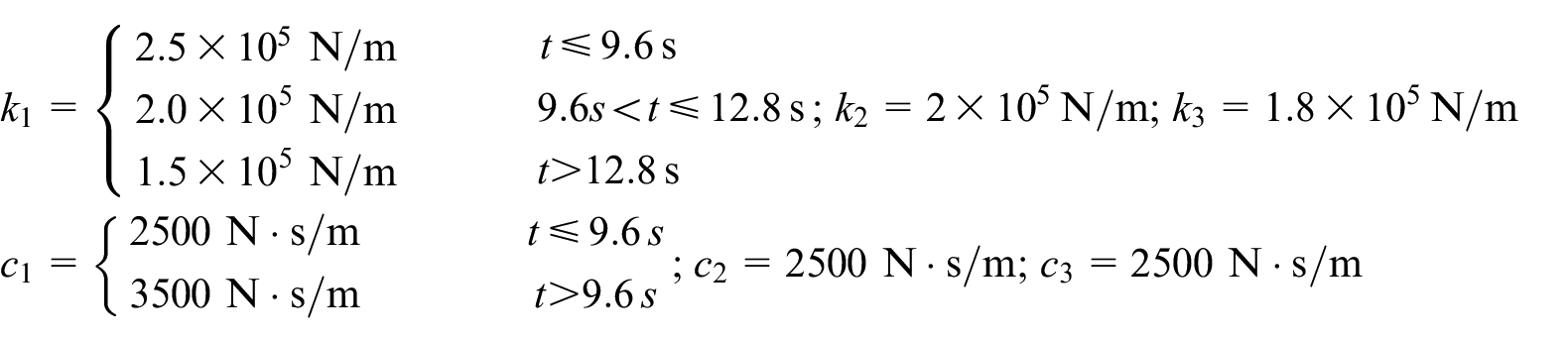
Considering that the Haar (db1) wavelet might be more suitable for tracking the abrupt change rather than slowly, db1 was chosen as the mother wavelet for the abrupt varying case. The KF approach is integrated with the wavelet method in the proposed approach to obtain the full responses. Only the responses at the second floor where has not been observed were displayed in order to save page space. In Figure 3, it could be found that the full responses could be obtained accurately by the KF, and the similar agreement results are obtained at other floors.

Comparisons of identified structural responses at second floor (Case A).
The time-varying structural parameters are identified by the proposed algorithm. The identification results are shown in Figure 4. According to the comparison to their exact variations shown by the solid line, the comparison results show that the proposed algorithm can capture time, locations, and extents of degradations with partial measurements of acceleration responses.

Comparisons of identified time-varying stiffness and damping parameters (Case A).
Case B: gradual time-varying case
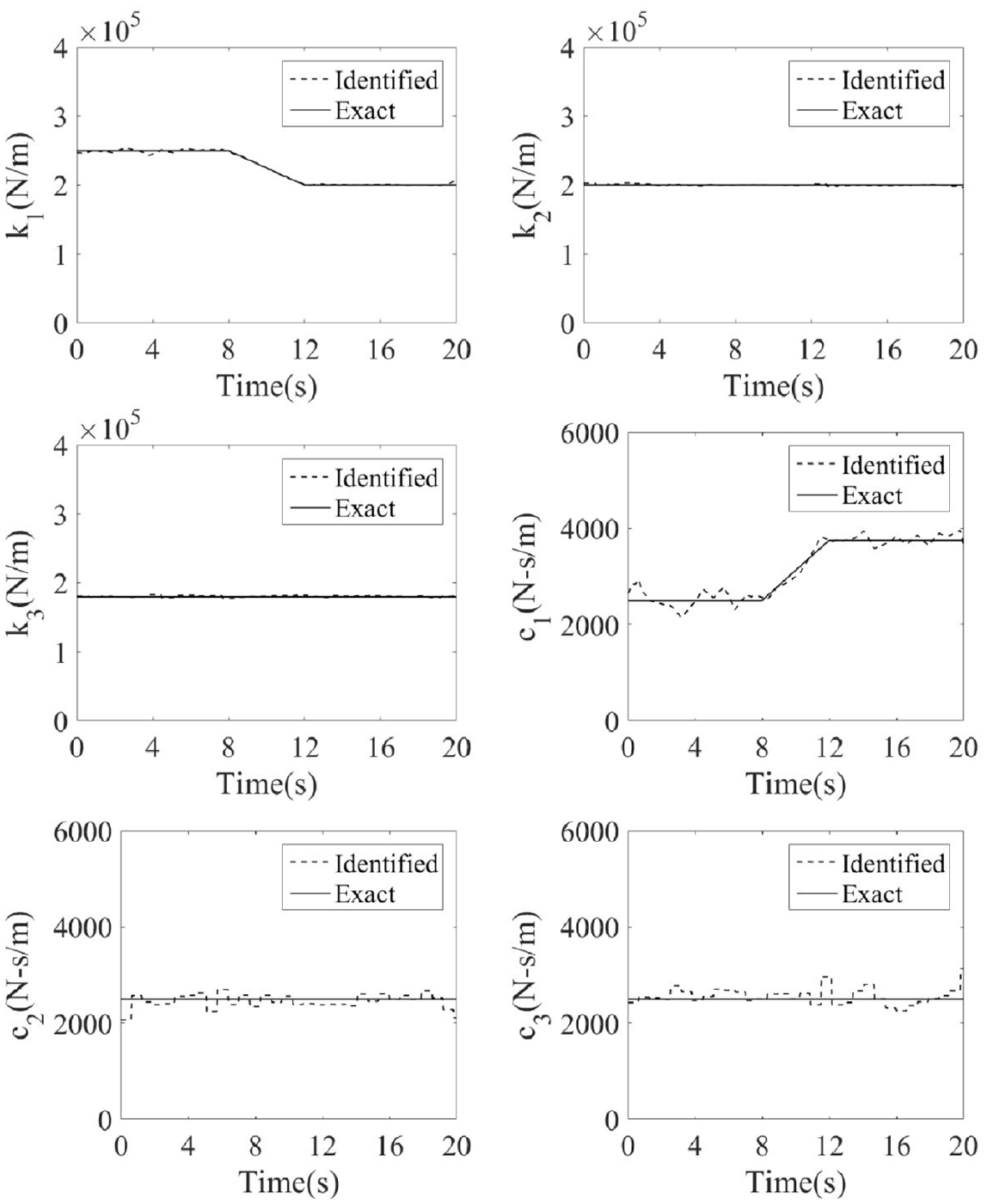
In practice, structural parameters may gradually degrade due to environmental erosion. Therefore, a time-varying scenario with linear gradual degradations of damping elements and stiffness elements is investigated in this case. Assuming that

For the gradually time-varying parameters, db3 is more suitable for tracking the gradually changing. Thus, db3 is chosen as the mother wavelet for this gradually time-varying case. Also, structural responses are obtained by the KF, and the results at the second floor are shown in Figure 5.

Comparisons of identified structural responses at second floor (Case B).
Then, the identification results of the structural parameter are shown in Figure 6. It is demonstrated that the proposed algorithm performs well when the structural parameters are gradually degraded.
Comparisons of identified time-varying stiffness and damping parameters (Case B).
Case C: complex time-varying case
To further validate the performances of the proposed algorithm for the identification of time-varying structural parameters, a numerical example with the complex time-varying pattern is considered. In the case, the stiffness parameter k1 degrades quadratically, k3 varies periodically in sinusoidal form, and stiffness parameter k2 and damping parameter c2 vary abruptly, that is

Based on the proposed algorithm, structural responses can be estimated. The responses at the second floor are shown in Figure 7.

Comparisons of identified structural responses at 2nd floor (Case C).
Then, the identified results of the structural parameters are shown in Figure 8. According to the above results, it is demonstrated that the proposed algorithm can identify time-varying structural parameters with complex forms of degradations.

Comparisons of identified time-varying stiffness and damping parameters (Case C).
Conclusion
Current wavelet-based approaches for the identification of time-varying structural parameters still request the full measurements of structural responses including all structural acceleration, velocity, and displacement responses. In this article, a synthesized algorithm is proposed to identify the time-varying parameters of linear structures using only partial measurements of structural acceleration responses. By using a wavelet-based expansion of the time-varying coefficients, the time-varying parametric identification problem is simplified as time-invariant one concerning the parameters in the expansion. To overcome the limitation of full measurement, KF is integrated to obtain the full structural response with limited acceleration measurement. Then, these time-invariant coefficients can be estimated by minimizing the error between measured and estimated accelerations via the solution of a nonlinear optimization problem.
The proposed algorithm is versatile as it can not only detect abrupt changes but also track the long-term changes (such fatigue) with partial observation. Numerical examples with different scenarios of time-varying parameters validate that the proposed method is effective for tracking the abrupt and gradual change with partial observations of structural acceleration responses.
In practice, it is impossible to precisely measure all external excitations. Therefore, it is requested to research on the identification of time-varying structural systems subject to under unknown excitations. The authors have proposed an algorithm of KF with unknown input for the identification of both structural responses and unknown excitations. It is expected that the proposed KF-UI can be synthesized with the WMRA for the identification of structural time-varying parameters under unknown external excitations.
Footnotes
Handling Editor: James Baldwin
Declaration of conflicting interests
The author(s) declared no potential conflicts of interest with respect to the research, authorship, and/or publication of this article.
Funding
The author(s) disclosed receipt of the following financial support for the research, authorship, and/or publication of this article: The research in this paper is supported by the National Key R&D Program of China via Grant No. 2018YFC0705606.
