




Abstract
Abstract
Soft polymer materials are often used in shock absorption, cushioning, and so on. During the design and development process, determining the mechanical behavior and constitutive properties under static and dynamic loads is important to improve product performance. This study aims to analyze the static mechanical performance of polyvinyl chloride elastomers with different Shore hardness levels. Static and dynamic mechanical performance experiments with loading strain rates of 0.1, 1650, 2000, and 2700 s−1 were performed in polyvinyl chloride elastomers (57A, 52A, and 47A) using an electronic dynamic and static fatigue tester and an improved Split Hopkinson pressure bar. Microstructures were observed by scanning electron microscopy. Results showed that the addition of plasticizers to polyvinyl chloride promoted the crystallization of the polymer. The presence of plasticizer in the crystal also reduced crystallization. The material plasticity, elastic modulus, yield stress, and flow stress increase with increasing hardness/strain rate, whereas the hardness decreases. The mechanical behavior of polyvinyl chloride elastomers under static and dynamic loads exhibited superelastic and viscoelastic characteristics, respectively. The Mooney–Rivlin, Neo–Hookean, and Yeoh models were selected for the superelastic constitutive model, whereas the Zhu–Wang–Tang model was used for the viscoelastic one. Finally, the applicability of the model was explained. This study can provide theoretical model and method support for the design and development of soft polymer materials.
Introduction
Soft polymers, such as polyvinyl chloride (PVC) elastomers, are widely used in military, 1 automobile, 2 marine, 3 aviation, 4 electronic, 5 and other industries (e.g. car crash dummies test, 6 aviation bearing buffer packaging, 7 domestic water pipes, 8 etc.) due to their low production cost, light weight, good impact resistance, and other advantages. In the abovementioned fields, components or materials are often subject to static and dynamic loads. Engineers and technical professionals have developed process optimization and micro-organization analysis for polymer products. During the preparation of materials, the increase in the plasticizer content will promote the crystallization of the polymer,9,10 resulting in changes in the microstructure of the polymer, which indefinitely affects the static and dynamic mechanical properties of the material 11 ; hence, studying the relationship between the static and dynamic mechanical performance and micro-organization analysis will be of great importance to the design and development of polymer materials.
In recent years, test devices, such as universal testing machines and Split Hopkinson pressure bars (SHPBs), have been used to test the static and dynamic performance of polycarbonate/methyl acrylate blend, 12 polyester matrix, 13 polyurethane elastomer, 14 three-dimensional (3D) printing polymer, 15 polymethyl methacrylate, 16 polytetrafluoroethylene, 17 gelatin, 18 polyuria, 19 and other polymer materials. High-speed camera, 20 scanning electron microscope (SEM), 21 high/low temperature environment box22,23 and other devices and digital image technology, 24 remanufacturing assembly technology, 25 pulse shaping technology, 26 and so on are used to analyze the impact deformation, microstructure evolution, and damage mechanism of polymer materials. Experiment on static and dynamic mechanical performance found that (1) the elastic modulus and yield strength of polymers exhibit a significant strain rate effect 27 ; (2) the stress–strain curves under quasi-static and dynamic conditions are susceptible to temperature (i.e. the lower the temperature is, the greater the deviation will be) 28 ; (3) the compression behavior at high strain rate is aligned with the Zhu–Wang–Tang (ZWT) constitutive model, which can be used to reflect the compression response of the polymer at different strain rates. 29
At present, scholars have carried out research on static and dynamic mechanical properties in combination with PVC elastomer materials. However, there are few studies on the effects of different composition ratios on material hardness, microstructure, and static and dynamic mechanical properties during the development of materials. This study aims to reveal the influence of the microstructure of PVC elastomers of different Shore hardness and the changes in the hardness on the static and dynamic mechanical performance of PVC elastomers. The ratio of plasticizer composition is varied in three PVC elastomer materials with three different Shore hardness vales under the load rates of 0.1, 1650, 2000, and 2700 s−1. The effects of plasticizer on Shore hardness, microstructure of PVC elastomers, and static and dynamic mechanical performances are further expounded through microstructure analysis. Finally, the static and dynamic constitutive models of the material are constructed.
Experimental materials
Table of ingredients in the preparation process.

The size of the quasi-static compression specimen was determined to be Φ29 mm × 12.5 mm according to “ISO 7743: 2007” 30 ; the size of the dynamic compression test specimen was Φ8 mm × 2 mm.
Experimental device and method
Quasi-static compression experiment
The quasi-static compression properties of PVC elastomers were measured at room temperature (25°C) by the INSTRON0-E3000 electronic dynamic and static fatigue tester (Figure 1
INSTRON0-E3000 electronic dynamic and static fatigue tester.
During the quasi-static compression experiment with a strain rate of 0.1 s−1, the loading rate of the testing machine was 75 mm/min, and the maximum strain was 0.3. The time–load (F) and time–displacement (ΔL) were measured and recorded during the compression. Three sets of loading experiments were performed for each Shore hardness PVC elastomer, and the average of the load and displacement data at the same time was calculated. According to formula (1), it is converted into stress and strain data. The stress–strain curve was then obtained

Dynamic compression experiment
The dynamic compression experiment of PVC elastomers was performed using an improved SHPB experimental device with a diameter of 14.5 mm (Figure 2
Schematic of the SHPB experimental device.
The bar system is composed of a hard, solid aluminum rod with an elastic modulus of 210 GPa, density of 7.83 g/cm 3 , and wave speed of about 5200 m/s. The length of the impact bar is 200 mm, the length of the incident and transmission bars is 1000 mm, and the length of the absorption bar is 300 mm. Resistive and semiconductor strain gauges (the sensitivity factor of the latter is 55 times than that of the former) were used in the test system. The resistive strain gauge was used to collect incident wave signals on the incident bar, and the semiconductor strain gauge was used to collect weak transmission signals on the transmission bar.
The PVC elastomer’s cylindrical sample was clamped between the incident and transmission bars. A thin layer of Vaseline was applied on the surface to reduce the friction effects on the sample. The coated paper was used as a reshaper, which was placed at the end of the incident bar without holding the sample, to extend the rising front of the incident wave and eliminate the dispersion effect. The stress–strain curves of the sample under different strain rates (1650, 2000, and 2700 s−1) were obtained according to constant strain rate loading method in the Hopkinson pressure bar experiment (i.e. by adjusting the speed of the bullet).
The SHPB experimental device should meet the one-dimensional (1D) strain and uniformity assumptions.
31
The 1D stress wave theory can be used to process the data obtained by the experiment and determine the strain rate 
Experiment results and analysis
Quasi-static stress–strain curve analysis of PVC elastomers
The stress–strain curves of PVC elastomers with three types of Shore hardness (57A, 52A, 47A) at low strain rates (0.1 s−1) are shown in Figure 3
Quasi-static stress–strain curves of PVC elastomers with three Shore hardness.
Change in the tangent modulus of three PVC elastomers.

Dynamic stress–strain curve analysis of PVC elastomers
The experimental data of the dynamic compression of PVC elastomers were processed to obtain the stress–strain curves of PVC elastomers with different Shore hardness values at different strain rates (Figure 4
Dynamic stress–strain curves of PVC elastomers with three Shore hardness levels: (a) 47A, (b) 52A, and (c) 57A.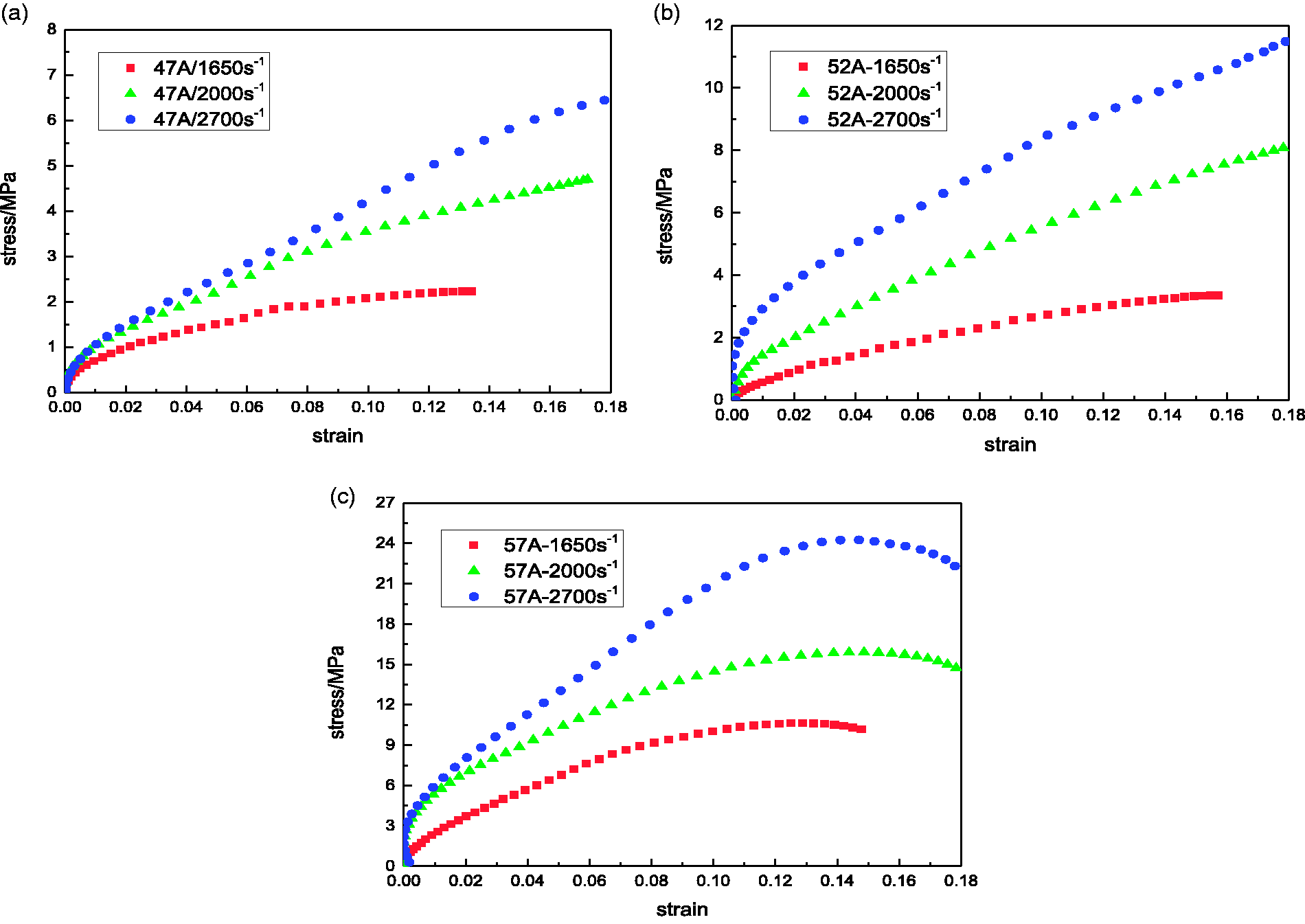
The stress–strain curve of the three PVC elastomers under high strain rate loading conditions demonstrates nonlinear characteristics and can be divided into two stages of elasticity and plasticity. The PVC elastomers in the elastic stage presents a typical high polymer viscoelastic characteristic; the elastic modulus, yield stress, and flow stress increase with increasing strain rate, thereby exhibiting a certain strain rate sensitivity.
When the strain is 0.1, the corresponding point is connected to the origin and the Eg of Young’s modulus is characterized with the slope or the secant modulus. The corresponding point when
Figure 5
Stress–strain curves of PVC elastomers with different Shore hardness: (a) 1650 s−1, (b) 2000 s−1, and (c) 2700 s−1.
Figure 5(a)–(c) shows that the changes in Shore hardness directly affect the dynamic mechanical performance of PVC elastomers; at the same strain rate level, the elastic modulus, yield stress, and flow stress of the PVC elastomers increase with increasing Shore hardness.
Analysis of the microstructure of PVC elastomers
The glass transition temperature (Tg) of a common PVC is above 80°C (i.e. typical plastic material at normal temperature). A control phase is required by the elastomer among PVC molecules; hence, the material cannot be used as a thermoplastic elastomer. The control phases for the PVC elastomers in this work were obtained by adding plasticizers to change the polymerization, the proportion of crystalline phase composition of molecular chain groups, and the entanglement points between irregular molecular chains.
The samples after the brittle fracture of liquid nitrogen were first subjected to a 20-min gold evaporation treatment to reveal the static and dynamic mechanical properties of PVC elastomers with different Shore hardness values at the microscopic level. The microstructure of the sample was tested using ZEISS EV018 SEM (Figure 6
Microstructure of PVC elastomers with different Shore hardness levels: (a) 57A/800X, (b) 52A/800X, (c) 47A/800X, and (d) 47A/1500X.
Figure 6(a)–(c) shows the microstructure diagrams of the PVC elastomer materials with different Shore hardness levels. In Figure 6(a), few plasticizers can be observed in the composition, along with a tight chain crystallization structure. With increasing plasticizer amount, the number of chain structures decreases (Figure 6(b)), and a large number of coarse grains and very few fine grains are distributed in the structure. In Figure 6(c) and (d), a large number of coarse grains with few fine grains are distributed in the structure; as the amount of plasticizer increases, the coarse grains are further refined into fine grains and the number of grains increases.
In material preparation, when plasticizers are added, plasticizer molecules will be inserted in the middle of the molecular chain of PVC resin, thereby increasing the activity of the molecular chain and decreasing the crystallization and the entanglement among the molecular chains, and promoting the crystallization of PVC molecules to increase the plasticity of the PVC elastomers. Therefore, the material hardness, strength, and mold reduction decrease with increasing amount of plasticizer, resulting in the decrease in the PVC elastomers’ static and dynamic mechanical performances.
Constitutive model
Superelastic constitutive model
Three typical superelastic constitutive models, namely, Mooney–Rivlin, Neo–Hookean, and Yeoh models, were selected to describe the behavior of the materials and the superelastic characteristics of PVC elastomers in the quasi-static mechanical experiments. The strain energy function determination of superelastic materials can be represented by a statistical model based on the molecular chain network and a continuum mechanics model based on the phenomenological theory. The latter is more commonly used than the former; the strain energy density function of which can be expressed in the form of strain invariant or main elongation

The Cauchy principal stress corresponding to the principal stretching ratio 
In formula (4), P is a Lagrangian multiplier to be determined, which can be determined by boundary conditions. Nominal stress
Under the condition of limited deformation, the deformation of the material can be described by the left Cauchy–Green deformation tensor 
The deformation gradient 
The three strain invariants of 
Rivlin et al. stated that the relationship between strain energy density function and stress tensor is


In the continuum mechanics model in the phenomenological theory, the strain energy density function with strain invariant is more common, whereas the strain energy density function expressed by strain invariant is more typical in the polynomial form. The series of strain energy density function can be expressed as

Mooney–Rivlin model
Mooney
32
proposed the Mooney–Rivlin model in the form of binomial syllables before the proposal of the strain energy density function in series

This model is used to characterize the mechanical performance of rubber materials in engineering. The mechanical performance of PVC elastomers at low strain rates can be described by this model. By substituting formula (11) into formula (9), then


Mooney–Rivlin model fitting parameters.

Figure 7
Experimental and Mooney–Rivlin model fitting curves.
Neo–Hookean model
The Neo–Hookean model is the simplest superelastic model, which retains only the first item of the Mooney–Rivlin model, that is

Substituting formula (14) and the engineering stress and strain into formula (9), then

Neo–Hookean model fitting parameters.
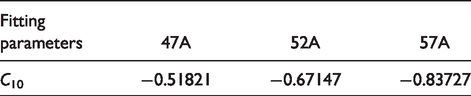
Figure 8
Experimental and Neo–Hookean model fitting curves.
Yeoh model
Yeoh stated that when the strain is large, the second strain invariant exert minimal effect on deformation. This idea resulted in the development of the Yeoh model, which is represented only by the first strain invariant and can be expressed as

Substituting formula (16) and the engineering stress and strain into formula (9), then

Yeoh model fitting parameters.

Figure 9
Experimental and Yeoh model fitting curves.
ZWT nonlinear viscoelastic model
The dynamic mechanical behavior of high-molecular polymers can be described by the ZWT constitutive model,
33
which consists of a nonlinear spring and two Maxwell units. The schematic of the model is shown in Figure 10
Schematic of the ZWT model.

The first three terms in formula (18) correspond to the nonlinear springs, which describe the nonlinear elastic response of the material; E0, α, and β are elastic constants. The fourth and fifth terms are the two Maxwell units, which describe the viscoelastic response of the material. The first integral is used to describe the viscoelastic response of the material at low strain rate loading, where E1 and θ1 are the elastic constant and relaxation time, respectively. The second integral is used to describe the viscoelastic response of the material at high strain rate loading, where E2 and θ2 are the respective elastic constant and relaxation time. When the material is loaded with a low strain rate, the Maxwell unit corresponding to the high strain rate is always in a relaxed state. When the material is loaded with a high strain rate, the Maxwell unit corresponding to the low strain rate is too late to relax. Therefore, the corresponding model expression can be represented as
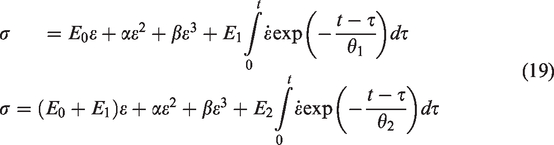
In this study, the loading rate of the experiment can be approximated as constant strain rate loading; thus, formula (19) can be rewritten as

ZWT model fitting parameters.
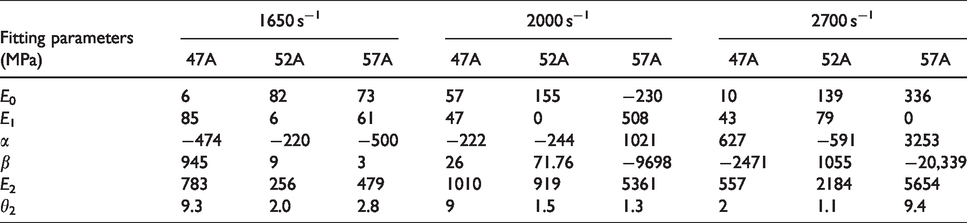
Figure 11
ZWT fitting and experimental curves.
Discussion
In this article, an experimental method for the design and development of soft polymer materials is reported. The mechanical response of PVC elastomer is measured at low and high strain rates, and the structural modification mechanism of PVC elastomer by plasticizer is analyzed from the microscopic angle. The mechanical parameters such as elastic modulus, yield stress, and flow stress of PVC elastomer materials are obtained through experiments. The correlation rules between the above parameters and plasticizer content, material hardness, and other parameters are clarified. Finally, the superelastic and viscoelastic characteristics of PVC elastomers are described separately. In the design and development of soft polymer materials, these parameters and characteristics are the key to clarifying the mechanical behavior of materials under impact loading and improving the performance of shock absorption/buffer components in the automotive, aerospace, electronics, and other industries. These factors are very important for material design and development.
Conclusion
In this study, PVC elastomer materials with three Shore hardness levels (57A, 52A, 47A) were obtained by varying the composition ratio of the plasticizers. The static and dynamic mechanical performances of the three materials were studied at strain rates of 0.1, 1650, 2000, and 2700 s−1. Micro-organization observation was conducted, and the superelastic and viscoelastic constitutive models were constructed. The analysis of the experimental results revealed the following:
PVC elastomers exhibit obvious strain rate effect. Higher load strain rate signifies a more evident reinforcement effect. The quasi-static mechanical behavior of the PVC elastomers with three Shore hardness levels demonstrates superelastic characteristics. The characteristic error described by the Mooney–Rivlin and Yeoh models is small, whereas that described by the Neo–Hookean model is large. In addition, the error in the viscoelastic characteristics of the dynamic mechanical behavior described by the ZWT constitutive model is small. The Shore hardness and the plasticity of the PVC elastomers decreases and increases, respectively, with increasing amount of plasticizer, resulting in the decrease in the value of the mechanical parameters (i.e. elastic modulus, yield stress, and flow stress).
The conclusions of this study can serve as a reference for further research on the static and dynamic mechanical performances of soft polymer materials. Tests at different ambient temperatures should be performed in high-/low-temperature environmental chamber to investigate the effect of temperature on the static and dynamic mechanical performances of PVC elastomers.
Declaration of conflicting interests
The author(s) declared no potential conflicts of interest with respect to the research, authorship, and/or publication of this article.
Funding
The author(s) disclosed receipt of the following financial support for the research, authorship, and/or publication of this article: This work was supported by the Key Natural Science Research Projects of Anhui Higher Education Institutions (Grant No. KJ2016A145), Natural Science Foundation of Anhui Province (Grant No. 1708085ME130), Anhui Education Department Excellent Young Talent Support Project (Grant No. gxyqZD2019057), Open Fund of State Key Laboratory of Vehicle NVH and Safety Technology (Grant No. NVHSKL-201407), and Anhui Province Key Research and Development Project (Grant No. 1804a09020009).
