An incompressible, electrically conducting, bioconvective micropolar fluid flow between two stretchable disks is inspected. Modification versions of Fourier and Fick’s law are accounted through Cattaneo–Christov heat–mass theories. The nanofluid Buongiorno model is also utilized in constitutive equations. The influence of gyrotactic microorganism is also accounted through bioconvection. Similarity variables transform the fluid model into system of ordinary differential equations. The resultant model is then solved through bvp4c method. Results in pictorial and tabular ways are accomplished. It is found that stretching Reynolds number and magnetic parameter slows down the radial velocity at center of the plane. Motile microorganism field is reduced by Peclet number. Micropolar parameters can be useful in the enhancement of couple stresses and in reduction of shear stresses. A comparison is also elaborated with published work under limiting scenario for the validation of numerical scheme accuracy.
The topic of fluid flow through disks is of main concern for scientists due to its significance usage in different fields of industry, chemical, and mechanical engineering processes such as air cleaning machine, centrifugal pumps, turbine machinery, metal pumping, electric power generating systems, jet motors, manufacturing of thin plastic sheets, paper fabrication, and insulating materials. Latest findings of fluid flow between disks are demonstrated in previous works.1–7
Because of growing significance of material flow in the industrial processing, it is impossible to describe shear behavior through the Newtonian relationships. There are quite a few theories existing such as micropolar fluids, dipolar fluids, and simple deformable directed fluids. Micropolar fluids represent fluids consisting of rigid, erratically tilting particles floating in medium where the twist of fluid particles is disregarded. Micropolar fluids improved interest and several classical flows have resolved the property of the fluid microstructure. Micropolar fluids have many realistic applications like analyzing the behaviors of exotic lubricants, the flow of colloidal suspensions, preservative suspensions, liquor crystals, turbulent shear flows, and ancient history. An innovative stage in the assessment of fluid dynamics theory is in the progress.8–11
The nanotechnological development era has gained inconceivable awareness among scientific researchers. The range of the nanoparticle size is less than 100 nm with an interfacial adjacent layer. That layer is actually an integral part of nanoscale matter which is affecting all of its characteristics. The layer of nanoparticles included ions, and organic and inorganic molecules. Practically, the nanoparticles which are also known as ultrafine particles have the characteristics like conductance, uniformity, and optical properties. That is why researchers used these particles in the formation of various electrical and biological materials. Due to such characteristics, scientists used nanoparticles vastly for making different materials in automobile industry, food technology, optical field, electric field, and in biomedicine (tissue engineering, DNA probes, microsurgical technology). Some nanofluids’ promising applications are microelectronics cooling, cooling towers, hybrid-power engine efficiency, home appliance cooling, dug targeting, solar collector, and tunable optical characteristics. Previous works12–15 reflect the significance of nanofluid under various working conditions. Dinarvand and Pop16 applied homotopy analysis method (HAM) and Keller-Box method (KBM) to discuss the thermal features of convective nanofluid through revolving down-pointing cone. Rostami et al.17 computed dual solutions of mixed convective hybrid nanofluid flow which corresponds to vertical plate and examined that hybrid nanofluid thermal transportation rate is larger than regular nanofluid. Abbas et al.18 obtained numerical solutions using the Runge–Kutta–Fehlberg (RKF) method on slip flow of micropolar nanofluid subjected to circular cylinder under gyrotactic microorganisms. Dinarvand19 presented analytical and numerical solutions to discuss thermal characteristics of nodal/saddle stagnation point flow of hybrid nanofluid. Kashani et al.20 numerically investigated time-dependent convective flow of nanofluid via flat vertical plate. Dinarvand et al.21 elaborated thermophysical characteristics of hybrid nanofluid flow through static/moving wedge using the bvp4c method. Dinarvand and Rostami22 analytically elaborated the thermal features of hybrid nanofluid subjected to rotating disk. Nadeem and Abbas23 considered three-dimensional (3D) micropolar hybrid nanofluid around a circular cylinder and concluded that micropolar hybrid nanofluid enhances heat transportation than micropolar nanofluid. Abbas et al.24 analyzed micropolar flow of hybrid nanofluid subjected to exponentially curved stretching channel.
Convey of heat and mass is imperative phenomena in the environment which exist owing to temperature variation within or among the objects. In the last two centuries, the trait of heat transportation has been explored via heat conduction. This representation is not sufficient due to preliminary disturbance of wave felt directly through the entire material. To overcome such complex phenomenon, Cattaneo modified Fourier’s law by including thermal relaxation time. The valuable relevance of heat transportation mechanism is found in space technology, furnace design, nuclear reactor, power plant, glass production, medicine targeting, and heat transfer in tissues.25–28
The generation and enhancement of heat transfer method is the most attention-grabbing topic in these days. In different natural processes, heat transfer process has significance effects. To improve the transportation of heat transfer method, scientists used nanoparticles in bioconvection. Bioconvection is a process in which microorganisms are denser than water. Such type of microorganisms due to up swimming trait is identified as gyrotactic microorganisms like algae. The density stratification of nanofluid in bioconvection presenting the spontaneous pattern formation through instantaneous buoyancy forces, nanoparticles, and microorganisms seems necessary. As a suspension, the accumulation of microorganisms into the nanofluids increases its strength. Such microorganisms also contain oxytaxis, gravitaxis, and gyrotaxis organisms. The movement of motile microorganisms includes a microscopic movement in fluids. A few latest developments in bioconvection field are mentioned in previous works.29–32
Bioconvection of micropolar nanofluid flow confined through stretchable disk is analyzed in numerical way through bvp4c method. The features of Cattaneo–Christov double diffusion are also incorporated. The study is new and not yet reported in existing literature.
Problem formulation
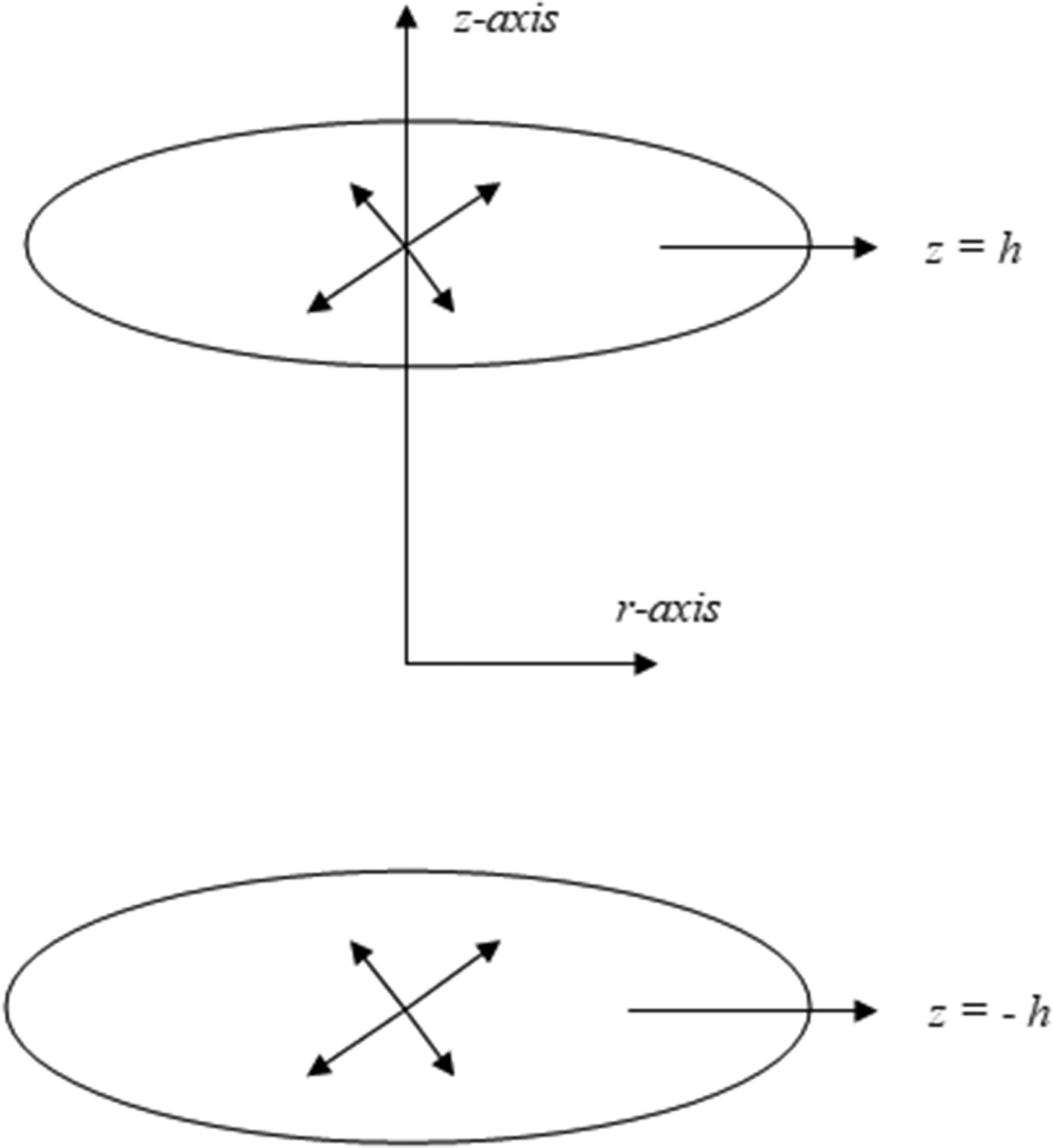
An incompressible, micropolar bioconvective fluid flow confined between two disks is incorporated. The disks are located at and stretch in direction of radial axis (see Figure 1). Perpendicular to flow direction, magnetic field with uniform strength is applied. Magnetic Reynolds number is assumed to be very small so that the induced magnetic field is neglected. The assumption of axisymmetric flow leads to the omission of derivatives along tangential direction. Velocity and microrotation fields are represented by and , respectively. Temperature, concentration, and microorganisms at lower disk are denoted by , and while the upper one has , and , respectively.
Physical illustration of problem.
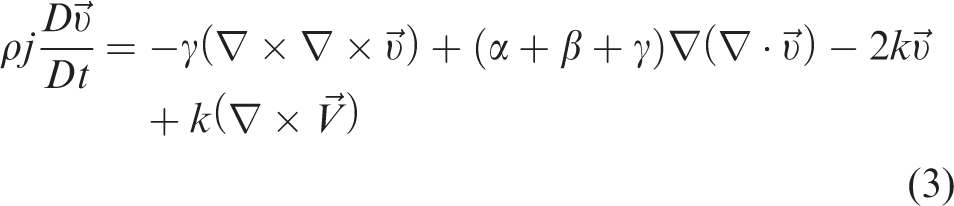
Flow governing equations by considering above assumptions are33
where represents the velocity field, is the material derivative, is the fluid density, is the pressure, is the dynamic viscosity, is the vortex viscosity, is the microrotation, is the microinertia, are the gyroviscosity coefficients, respectively, is the current density, is the total magnetic field, and denotes the electrical conductivity. Moreover, and satisfy the below constraints
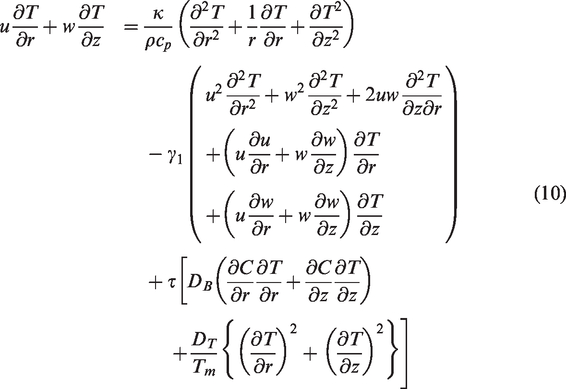
Considering the flow assumptions, we lead to following governing equations33,34
where , , , , , , , , , , , , , , , , , , , , , and represent pressure, vortex viscosity, dynamic viscosity, density, spin gradient viscosity, microinertia density, electrical conductivity, temperature, concentration, microorganisms, nanoparticle ratio of heat and base fluid capacity, specific heat, mean fluid temperature, thermophoretic diffusion coefficient, Brownian diffusion coefficient, concentration relaxation time, thermal relaxation time, maximum swimming speed of cell, chemotaxis constant, microorganism diffusivity constant, lower disk stretching rate, and upper disk stretching rate, respectively. The similarity transformations for velocity, microrotation, temperature, concentration, and microorganisms are defined by34
Equation (6) satisfied under (14) and so depicts possible fluid movement. Equations (7)–(13) by eliminating the pressure term reduce to following
The boundary conditions (13) transformed into the following
where , , , , and are stretching Reynolds number, magnetic parameter, Prandtl number, thermal relaxation time parameter, concentration relaxation time parameter, Lewis number, thermophoretic parameter, Brownian motion parameter, Peclet number, microorganism concentration difference parameter, Schmidt number, vortex viscosity parameter, spin gradient viscosity parameter, microinertia density parameter, and stretching ratio parameter, respectively.
Following Ali et al.,34 the couple stress and the skin friction are defined as
Results with discussion
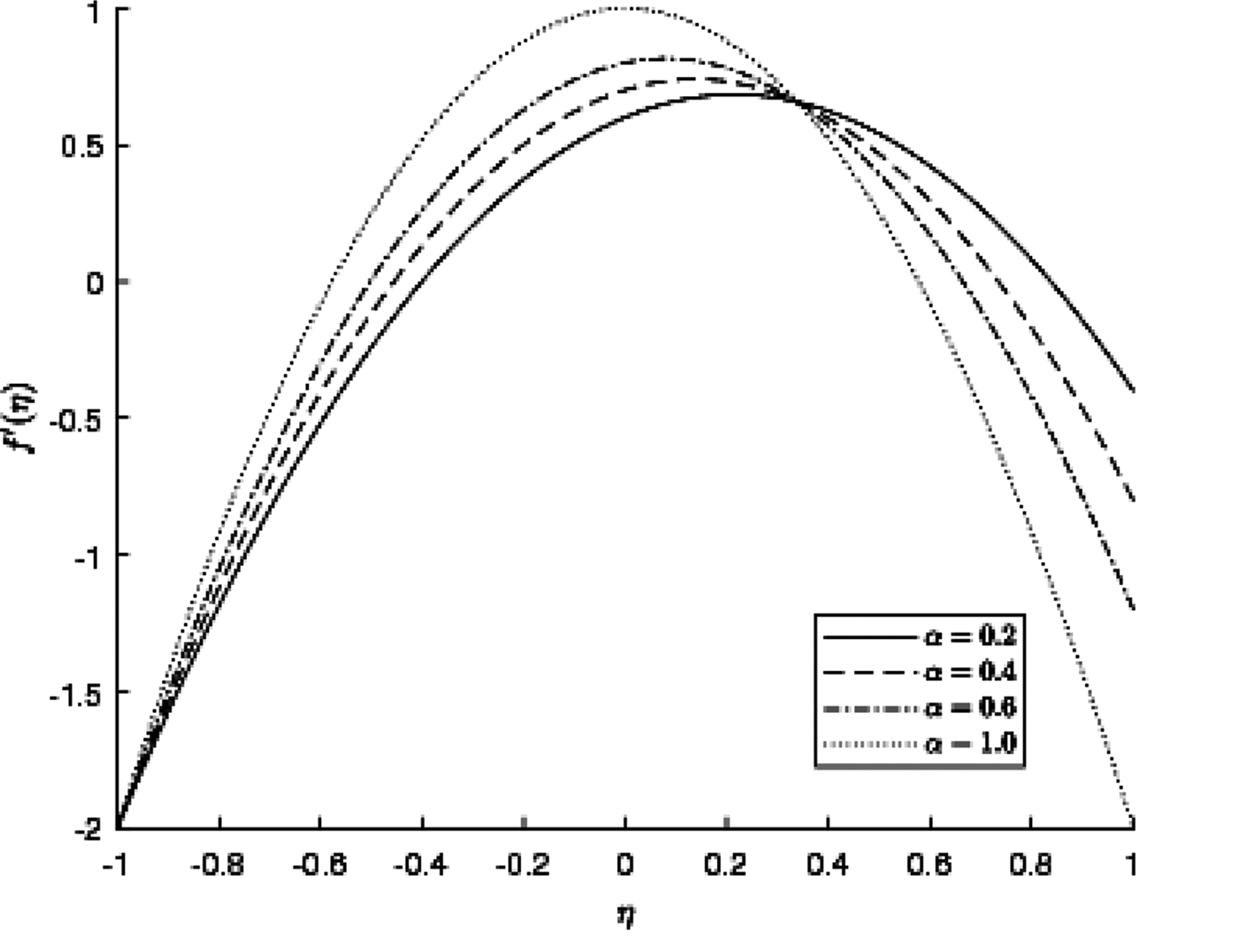
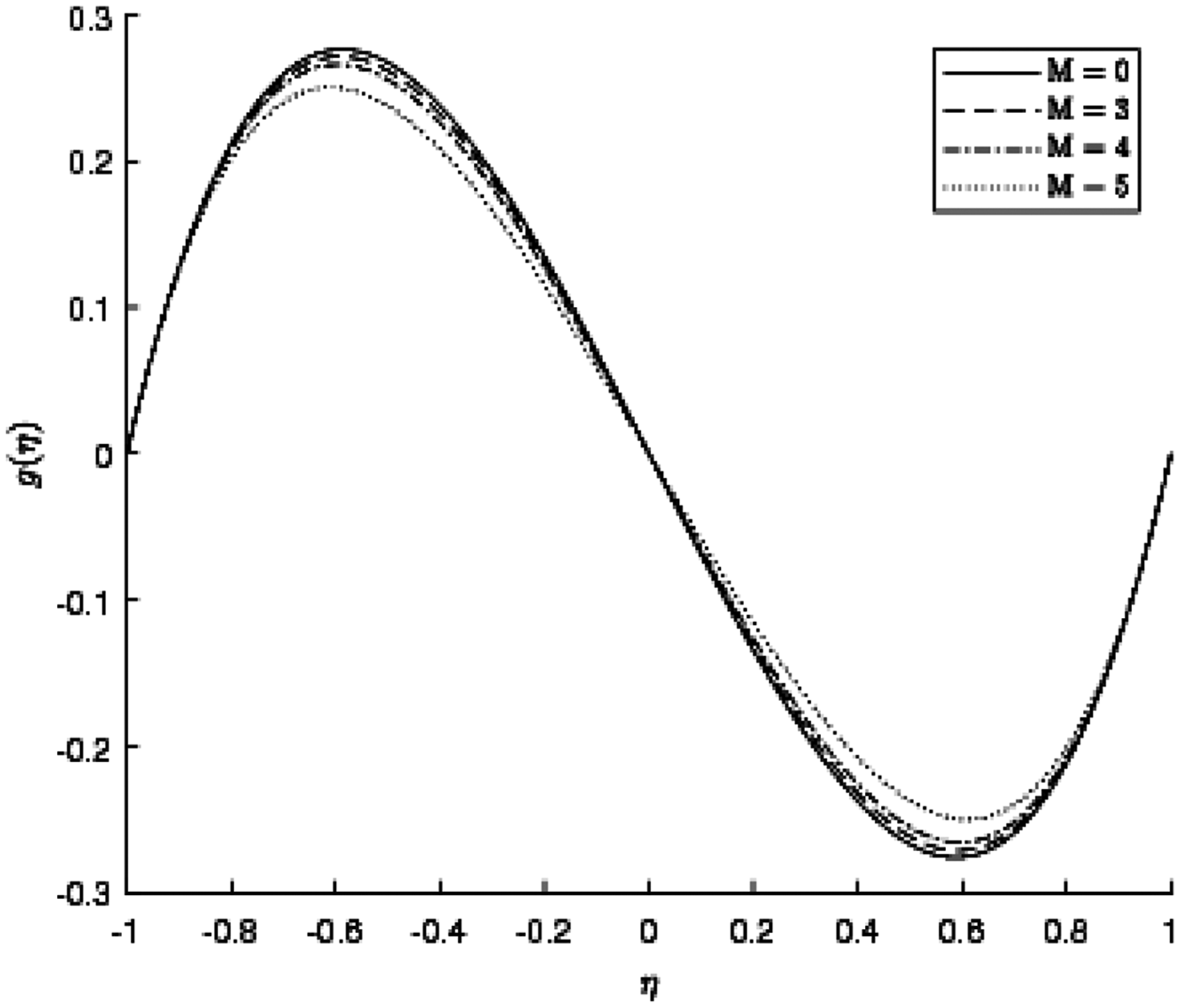
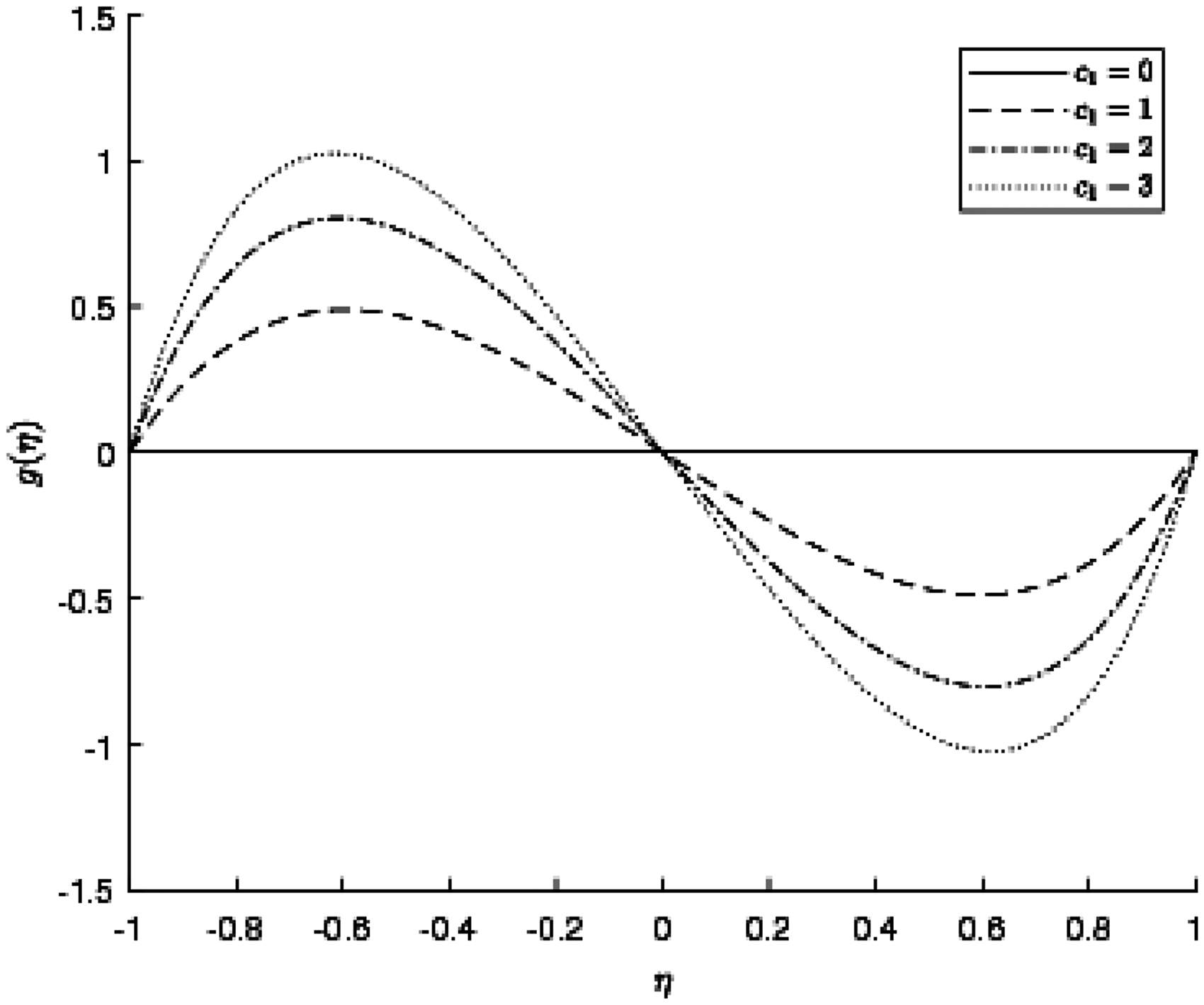
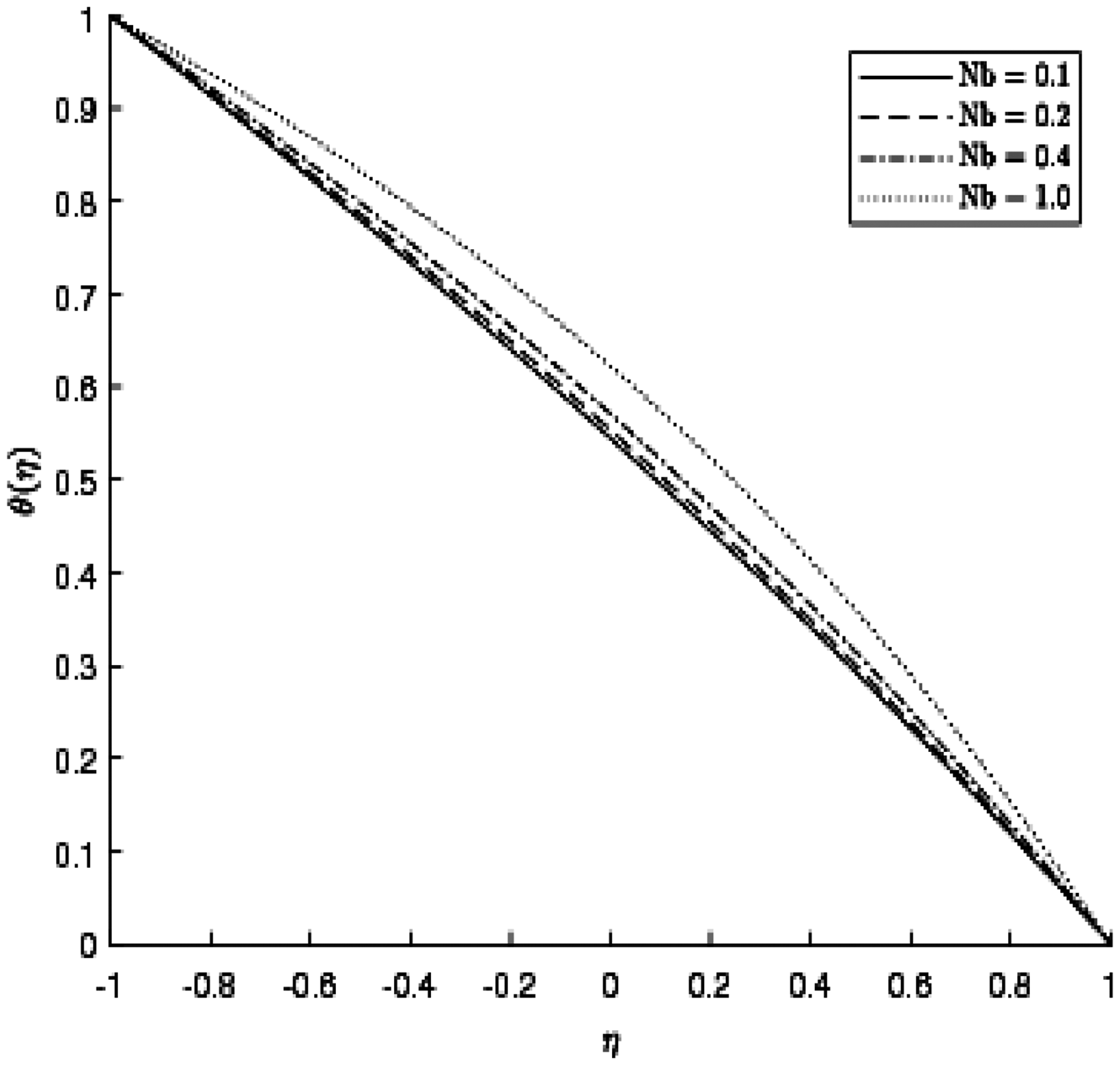
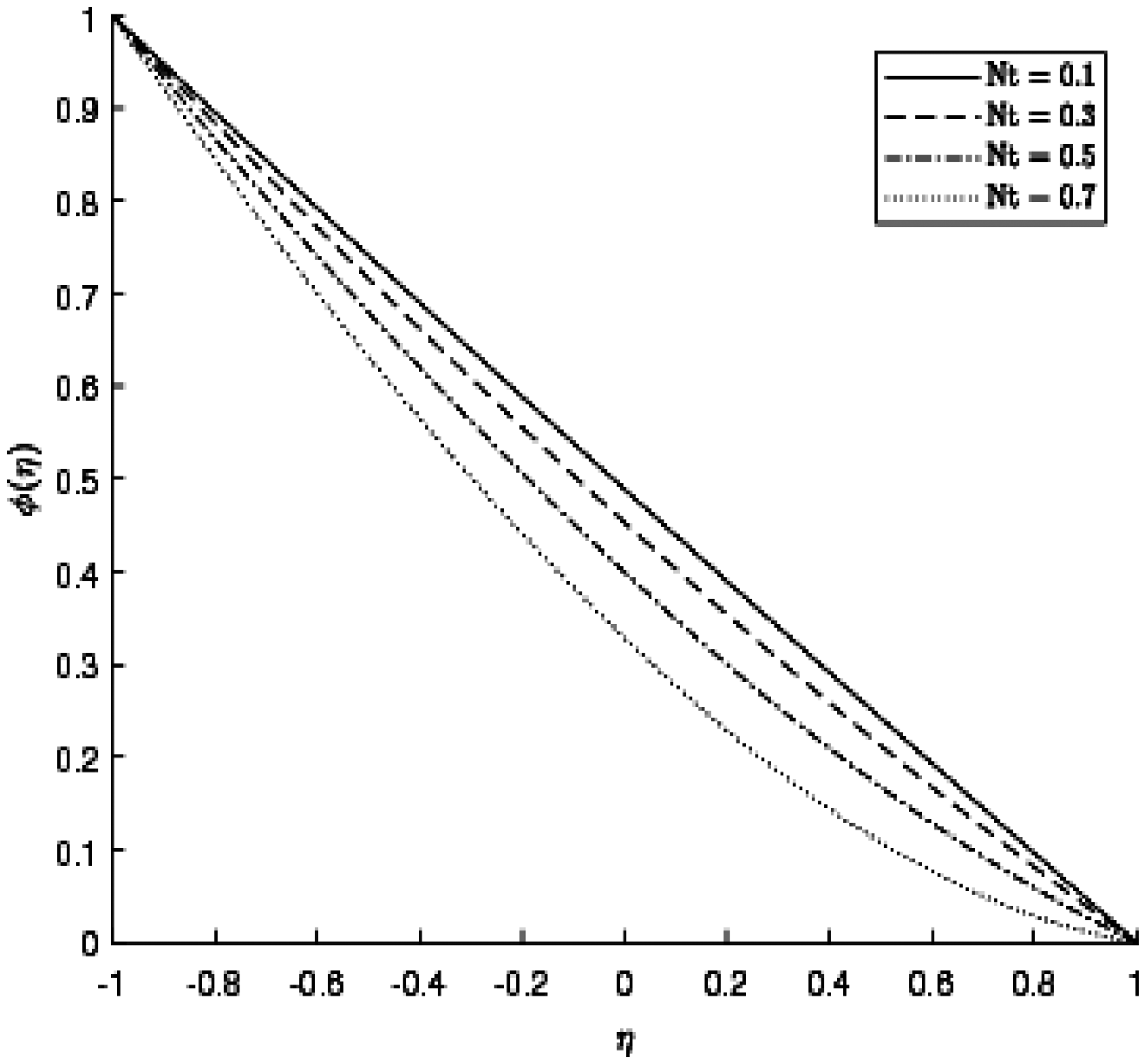
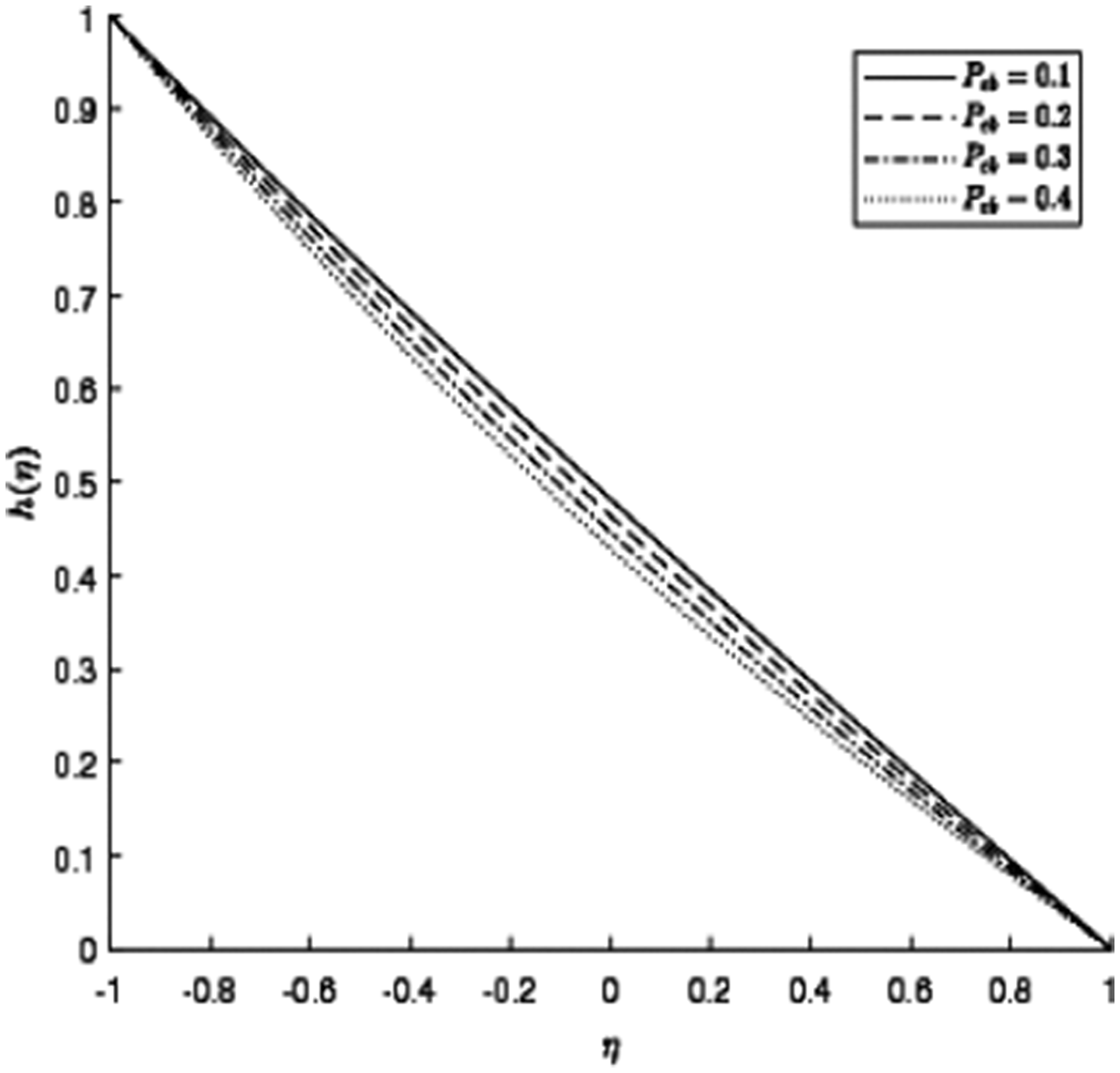
We examined electrically conducting, bioconvective micropolar nanofluid flow between stretchable disks. The impacts of Cattaneo–Christov heat–mass flux theories are also considered. Similarity transformations are adopted to obtain normalized system of ordinary differential equations. The system of equations (15–(19) with boundary conditions (20) is then solved using MATLAB built in function bvp4c method. The technique adopted collocation technique using the three-stage formula, which produces accuracy in solution of C1 continuity. Figure 2 investigates stretching ratio parameter influence on radial velocity. With the increase in values of , the curves shift toward the lower disk. The profiles are of parabolic nature. The symmetric profile is attained against and profiles resemble with stationary un-stretchable disk case.35Figures 3 and 4 are pictured to demonstrate the impact of on . The enhanced magnetic parameter reduced parabolic profiles at central plane and increased close to lower and upper disk. The applied magnetic field creates the Lorentz force in flow field that causes extra resistance due to which at central plane profiles preserve declining trend. Microrotational profiles first rise in central left half and then decay in central right plane owing to increased (see Figure 4). The microrotational magnitude declines for enhanced magnetic parameter due to damping influence, which predicts that intensity of applied magnetic field may be helpful in reduction of angular rotation. Figures 5–7 explain the stretching Reynolds number behavior on , and . For , the axial velocity curves decrease, and for , the profiles enhance by increasing values in Figure 5. Similar to the impact of Figure 3, the profiles expand at the end of disks; however, at central plane, decreasing trend in the radial velocity field is observed through Figure 6. With increased in , the microrotation curves demonstrating opposite behavior on left and right central planes. On left side of the central plane, the microrotational field reduces while on right central plane, the profiles depicting increasing trend (see Figure 7). The fluid rotates in opposite directions owing to shear stresses; therefore, zero microrotation locate position along disks and influence of alter rotations balanced each other. The observation of vortex viscosity parameter on microrotational field is predicted in Figure 8. The microrotation moves the fluid particles in opposite directions. In right plane , the curves enhance, while in left plane , the curves behave in opposite trend for increase values. The case relates to viscous fluid scenario when there is no microrotation of fluid particles; therefore, a straight line is obtained for such case, which also validates our numerical technique. The Prandtl number investigation on temperature field is elaborated in Figure 9. The enlarged Prandtl number results into the enhancement of temperature field. The increased in values produces weaker thermal diffusivity in flow field. Such weaker diffusivity is then responsible in the enhancement of temperature curves (see Figure 9). Thermophoretic parameter behavior on temperature field is examined in Figure 10. Enlarging values correspond to increment in temperature profiles. Figure 11 shows the study of the outcomes on Brownian motion parameter on . Similar to the observation of , the numerous values also tend to enhance the temperature field. Figures 12 and 13 elucidate the effects of and on . One can notice that both the parameters and have opposite influence on concentration filed. In thermophoretic phenomena, the nanoparticles moved from hotter surface to the colder one. As a consequence, nanoparticles’ concentration field shows a decreasing nature for increased values (see Figure 12). Brownian motion is the criss-cross movement of nanoparticles. Such movement enhances particles’ kinetic energy due to collisions between the particles. Therefore, increasing trend of nanoparticles’ concentration field is observed for larger values in Figure 13. Thermal and concentration relaxation time parameter outcome is demonstrated in Figures 14 and 15 on temperature and concentration fields, respectively. In Figure 13, enlarging values contribute to raise the temperature field. However, the numerous values decay in the concentration field. The Peclet number effect on is depicted in Figure 16. Due to enhancement in Peclet number, a reduction in microorganism curves is noticed. Figure 17 involves in exhibiting the impact of on microorganisms. Similar to the observation of , the profiles also demonstrating declining phenomenon (see Figure 17).
Impact of on .
Impact of on .
Impact of on .
Impact of on .
Impact of on .
Impact of on .
Impact of on .
Impact of on .
Impact of on .
Impact of on .
Impact of on .
Impact of on .
Impact of on .
Impact of on .
Impact of on .
Impact of on .
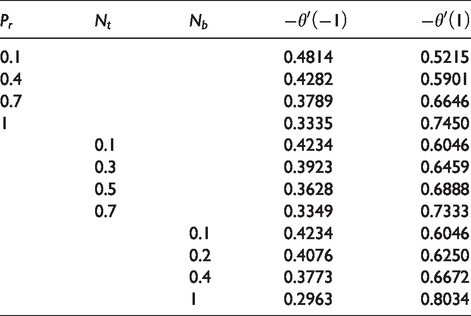
Table 1 presents the impact of , and on shear and couple stresses. Due to symmetry, the numerical values are demonstrated at upper disk only. Increasing values of magnetic parameter and stretching Reynolds number cause an enhancement in shear stresses; however, due to increase in vortex viscosity parameter, a decline in shear stresses is observed. Couple stresses are enhanced by and , while reduced due to increased . The couple stress is zero for the case , showing the validity of our numerical technique. As micropolar fluids demand greater flow resistance owing to vortex and dynamic viscosities, therefore micropolar fluids can be demanding in controlling the flow phenomenon of polymer processes. Heat transfer rate is elucidated in Table 2 for different , and values. All three parameters lift heat transfer rate at upper disk, while at lower disk, we noticed a decline in heat transportation. Table 3 presents mass transfer rate for , and values. Lewis number and thermophoretic parameter enhance mass transfer rate whereas mass transportation rate is decreased for enhanced values at lower disk. At upper disk, mass transportation rate is decayed for enlarged while it increased for enhanced values. Table 4 illustrates the scenario of , and on microorganism rate. The enhancement in Schmidt number, Peclet number, and microorganism temperature difference parameter leads to increase in microorganism rate at lower disk. At upper disk, enhances while and reduce microorganism transportation rate. Table 5 presents the comparison of our numerical scheme with already published work34 under limiting scenario. Table 5 explains excellent validation of our numerical process.
Shear and couple stresses for various for , and .
0
5.9340
1.5079
2
6.1469
1.5102
3
6.4043
1.5129
5
7.1708
1.5207
0
5.9033
1.5056
1
6.3236
1.5191
2
6.7373
1.5300
3
7.1428
1.5387
0
6.1254
0
0.4
6.0222
1.2299
0.7
5.9158
2.0367
1
5.8061
2.7652
Heat transfer rate for , and .
0.1
0.4814
0.5215
0.4
0.4282
0.5901
0.7
0.3789
0.6646
1
0.3335
0.7450
0.1
0.4234
0.6046
0.3
0.3923
0.6459
0.5
0.3628
0.6888
0.7
0.3349
0.7333
0.1
0.4234
0.6046
0.2
0.4076
0.6250
0.4
0.3773
0.6672
1
0.2963
0.8034
Mass transfer rate for , and .
0.1
0.6242
0.3335
0.2
0.6560
0.3491
0.4
0.6914
0.3660
0.7
0.7485
0.3922
0.1
0.5242
0.4784
0.3
0.5866
0.3942
0.5
0.6785
0.2663
0.7
0.7974
0.0923
0.1
0.8150
0.0820
0.2
0.6919
0.2521
0.4
0.6291
0.3359
1
0.5874
0.3823
Microorganism rate for , and .
0.1
0.5827
0.4389
0.2
0.6123
0.4611
0.4
0.6445
0.4851
0.7
0.6945
0.5222
0.1
0.5442
0.4720
0.2
0.5857
0.4412
0.3
0.6284
0.4116
0.4
0.6723
0.3832
0.1
0.5803
0.4476
1
0.6047
0.4187
3
0.6587
0.3546
5
0.7127
0.2904
Comparison of shear and couple stresses for different under limiting scenario.
34
(present)
34
(present)
0
10.5522
10.5522
1.2595
1.2595
0.5
11.4483
11.4482
1.2816
1.2817
1.0
13.7080
13.7081
1.3347
1.3346
1.5
16.6320
16.6320
1.3970
1.3971
2.0
19.8207
19.8208
1.4560
1.4560
Conclusion
Micropolar nanofluid flow problem is investigated in numerical sense via the bvp4c technique. The characteristics of Cattaneo–Christov theories and gyrotactic microorganisms are employed. The main findings are described as follows:
Curves of radial velocity reduced near central plane and increased at both disks against and .
Non-zero increasing values of modify microrotation at and reduce after along positive .
Increased and incremented temperature field.
and values have reverse phenomenon on concentration field.
Enhanced and declined motile micro organisms.
Couple stresses enhanced and shear stresses are reduced for increased values.
and declined heat transportation at while increased at .
A reduction at upper disk and enhancement at lower disk in microorganism rate are noticed for numerous and values.
Footnotes
Handling Editor: James Baldwin
Declaration of conflicting interests
The author(s) declared no potential conflicts of interest with respect to the research, authorship, and/or publication of this article.
Funding
The author(s) received no financial support for the research, authorship, and/or publication of this article.
ORCID iD
Muhammad Kamran Siddiq
Appendix
References
1.
DasA.Analytical solution to the flow between two coaxially rotating disk. Procedia Eng2015;
127: 377–382.
2.
TurkyilmazogluM.Flow and heat simultaneously induced by two stretchable disks. Phys Fluids2016;
28: 043601.
3.
HayatTQayyumSImtiazM, et al.
MHD flow and heat transfer between coaxially rotating disks in a thermally stratified medium. PLOS ONE2016;
11: 1–23.
4.
Mohyud-DinSTUllah KhanSIDarusM, et al.
Unsteady mixed convection squeezing flow of nanofluid between parallel disks. Adv Mech Eng2016;
8: 1–13.
5.
AwatiVBJyotiMBujurkeNM.Series solution of steady viscous flow between two porous disks with stretching motion. J Nanofluids2018;
7: 982–994.
6.
KhanIRehamnKUMalikMY, et al.
On magnetized non-Newtonian rotatory fluid flow field. Adv Mech Eng2019;
11: 1–12.
7.
ChenSZhangJ.Effects of the rotation number on flow and heat transfer in contra-rotating disk cavity with superposed flow. Adv Mech Eng2019;
11: 1–10.
8.
AshrafMKamalMASyedKS.Numerical simulation of flow of a micropolar fluid between a porous disk and a non-porous disk. Appl Math Model2009;
33: 1933–1943.
9.
AshrafMWehgalAR.MHD flow and heat transfer of micropolar fluid between two porous disks. Appl Math Mech2012;
33: 51–64.
10.
AliKAhmadSAliK.Numerical simulation of flow and heat transfer in hydromagnetic micropolar fluid between two stretchable disks with viscous dissipation effects. J Theor Mech2016;
54: 633–643.
11.
GhadikolaeiSSHosseinzadehKHatamiM, et al.
MHD boundary layer analysis for micropolar dusty fluid containing hybrid nanoparticles Cu-Al2O3 over a porous medium. J Mol Liq2018;
268: 813–823.
12.
HashmiMMHayatTAlsaediA.On the analytical solutions for squeezing flow of nanofluid between parallel disks. Nonlinear Anal Model Control2012;
17: 418–430.
13.
AhmedNAdnan KhanUMohyud-DinST.Influence of shape factor on flow of magneto-nanofluid squeezed between parallel disks. Alex Eng J2018;
57: 1893–1903.
14.
JyothiKReddyPSReddyMS.Influence of magnetic field and thermal radiation on convective flow of SWCNTs-water and MWCNTs-water nanofluid between rotating stretchable disks with convective boundary conditions. Powder Tech2018;
331: 326–337.
15.
AhmedJKhanMAhmadL.Swirling flow of Maxwell nanofluid between two coaxially rotating disks with variable thermal conductivity. J Braz Soc Mech Sci2019;
41: 97.
16.
DinarvandSPopI.Free-convective flow of copper/water nanofluid about a rotating down-pointing cone using Tiwari-Das nanofluid scheme. Adv Powder Tech2017;
28: 900–909.
17.
RostamiMNDinarvandSPopI.Dual solutions for mixed convective stagnation-point flow of an aqueous silica–alumina hybrid nanofluid. Chinese J Phys2018;
56: 2465–2478.
18.
AbbasNSaleemSNadeemS, et al.
On stagnation point flow of a micro polar nanofluid past a circular cylinder with velocity and thermal slip. Results Phys2018;
9: 1124–1232.
19.
DinarvandS.Nodal/saddle stagnation-point boundary layer flow of CuO-Ag/water hybrid nanofluid: a novel hybridity model. Microsyst Technol2019;
25: 2609–2623.
20.
KashaniADinarvandSPopI, et al.
Effects of dissolved solute on unsteady double-diffusive mixed convective flow of a Buongiorno’s two-component nonhomogeneous nanofluid. Int J Numer Method Heat Fluid Flow2019;
29: 448–466.
21.
DinarvandSRostamiMNPopI.A novel hybridity model for TiO2-CuO/water hybrid nanofluid flow over a static/moving wedge or corner. Sci Rep2019;
9: 16290.
22.
DinarvandSRostamiMN.An innovative mass-based model of aqueous zinc oxide–gold hybrid nanofluid for von Kármán’s swirling flow. J Therm Anal Calorim2019;
138: 845–855.
23.
NadeemSAbbasN.On both MHD and slip effect in micropolar hybrid nanofluid past a circular cylinder under stagnation point region. Can J Phys2019;
97: 392–399.
24.
AbbasNNadeemSMalikMY.On extended version of Yamada–Ota and Xue models in micropolar fluid flow under the region of stagnation point. Physica A Stat Mech Appl2020;
542: 123512.
25.
RaufAAbbasZShehzadSA.Utilization of Maxwell-Cattaneo law for MHD swirling flow through oscillatory disk subject to porous medium. Appl Math Mech2019;
40: 837–850.
26.
HayatTQayyumSShehzadSA, et al.
Cattaneo-Christov double-diffusion theory for three-dimensional flow of viscoelastic nanofluid with the effect of heat generation/absorption. Results Phys2018;
8: 489–495.
27.
HayatTQayyumSShehzadSA, et al.
Chemical reaction and heat generation/absorption aspects in flow of Walters-B nanofluid with Cattaneo-Christov double-diffusion. Results Phys2017;
7: 4145–4152.
28.
HayatTQayyumSImtiazM, et al.
Flow between two stretchable rotating disks with Cattaneo-Christov heat flux model. Results Phys2017;
7: 126–133.
29.
MosayebidorchehSTahavoriMAMosayebidorchehT, et al.
Analysis of nano-bioconvection flow containing both nanoparticles and gyrotactic microorganisms in a horizontal channel using modified least square method (MLSM). J Mol Liq2017;
227: 356–365.
30.
WaqasMHayatTShehzadSA, et al.
Transport of magnetohydrodynamic nanomaterial in a stratified medium considering gyrotactic microorganisms. Physica B Condens Matter2018;
529: 33–40.
KumarRSoodSRajuCSK, et al.
Hydromagnetic unsteady slip stagnation flow of nanofluid with suspension of mixed bio-convection. Propul Power Res2019;
8: 362–372.
33.
AbbasZMushtaqTShehzadSA, et al.
Slip flow of hydromagnetic micropolar nanofluid between two disks with characterization of porous medium. J Braz Soc Mech Sci Eng2019;
41: 465.
34.
AliKAhmadSAshrafM.On combined effect of thermal radiation and viscous dissipation in hydromagnetic micropolar fluid flow between two stretchable disks. Thermal Sci2017;
21: 2155–2166.
35.
AshrafMWehgalAR.MHD flow and heat transfer of micropolar fluid between two porous disks. Appl Math Mech2012;
33: 51–64.