




Abstract
Working fluid with higher thermal conductivity and tube with better fluid mixing are two crucial elements for heat transfer enhancement in heat exchanger system. Hence, several methods and techniques have been explored to improve heat transfer efficiency, including dispersing nanoparticles into conventional heat transfer fluid and inserting instruments inside the tube of the heat exchanger. Studies have shown that nanofluid can improve heat transfer efficiency of the system due to its higher thermal conductivity and drastic Brownian motion of nanoparticles while inserts within tube can improve heat transfer efficiency by increasing axial velocity of working fluid for better fluid mixing. This article summarized 109 of journals from recent research on heat transfer enhancement of nanofluid flowing inside the tube with inserts as well as discussing the significant parameters that affected the system’s efficiency such as nanoparticles’ volume fraction, Reynolds number and types and configurations of inserts. Ultimately, analysis will be carried out to determine the most suitable modification of twisted tape inserts with the most optimum value of nanoparticle volume fraction for turbulence flow regime. Finally, some problems that need to be solved for future research such as agglomeration and pressure drop are discussed.
Introduction
Heat exchangers are broadly used in many industrial applications such as in refrigeration, automotive, computer chips and solar heat collector’s systems. These heating and cooling processes have consumed undesirable amount of energy and contribute to worsen of climate change. Most of the countries have taken the steps to keep the world sustainable and encourage the industries to participate in Sustainable Energy Campaign. The optimization of heat transfer will help to reduce wastage of energy in various applications. With the increasing awareness for energy saving, heat transfer enhancement has been the subject of interest by many researchers since enhancement in heat transfer rate leads to better performance of the system which is necessary for all thermal application systems. There are three classes of heat transfer enhancement techniques: passive, active and compound method.1–3 Active method is dealing with the use of external power and becomes very limited due to complexity in design and higher manufacturing cost. While passive method is dealing with the internal energy within the system which is by modifying the flow pattern or using a working fluid with superior thermal characteristics. However, the use of this method will consequently increase the pressure drop inside the system. 4 To modify the flow pattern, twisted tapes, wire coils, dimples, ribs, fins and micro fins have been introduced. Modifications in a flow channel include altering the fluid flow with the help of inserts or modifying the thermal properties of the working fluid. 5 , 6 Higher efficiency working fluid can be achieved by inserting nanoparticles with higher thermal conductivity into the working fluid which is called nanofluid. Compound heat transfer method is a hybrid technique that involves both passive and active methods. The involvement of active method adding to a more complex design and less cost-effective that results to limited applications. 6 Hence, this article focuses on the simplest yet effective method for heat transfer augmentation which is the passive method that utilized both twisted tape and nanofluid.
The term nanofluid was introduced by Stephen U.S. Choi which is an engineered colloidal suspension of nanometre-sized particles in a based fluid. The addition of nanoparticles in the fluid is believed to enhance thermal conductivity and reduce heat exchanger pumping power. 7 Numerous numerical and experimental studies have been done on thermal conductivity of nanofluids.8–10 Nowadays, several types of nanoparticles have been employed by researchers in order to improve thermal physical properties of the fluid, including metallic particles (Cu, Au, Fe, Ni and Ag)11–14 and non-metallic particles (Al2O3, CuO, Fe3O4, TiO2 and SiC).15–19 In most cases, water, ethylene glycol and thermal oil were used as based fluid for nanofluid applications. Enhancement of heat transfer performance and energy efficiency in several applications was reported by many researchers in the past years.20–25 There are several parameters that affected thermophysical properties and thermal-hydraulic behaviours of nanofluid such as type of nanoparticle and base fluid, nanoparticle volume fraction, nanoparticle size and shape and particle migration. 26 , 27 The effectiveness of heat transfer using nanofluids can be described by thermophysical properties, including thermal conductivity, thermal expansion coefficient, specific heat, density and viscosity. Even though nanofluid is well-known for its excellence thermal performance and the best substitute as working fluid for energy saving and improvement in various thermal systems, its application is still under question due to the stability issue. Such instability is generally associated with nanoparticles’ aggregation and sedimentation. 28 Due to that, various methods have been proposed for stabilization of nanofluid such as producing nanofluid using physical treatment techniques (stirrer, ultrasonic bath, sonication machine and high-pressure homogenizer) to break nanoparticles’ aggregation, adding surfactant to the nanofluid to prevent aggregation and adding the repulsive forces between nanoparticles by varying the pH number.29–31 Mechanical mixing such as stirrer, ultrasonic bath, sonication machine and high-pressure homogenizer is able to break large agglomerates into smaller diameter particles. Hwang et al. 24 used all these methods to verify versatility of methods to produce stable nanofluids. They concluded that the high-pressure homogenizer was the most effective method to break down the agglomerated nanoparticles suspended in base fluids.
Another approach in passive method for heat transfer augmentation is introducing insert within tube. Insert within tube such as twisted tape can enhance heat transfer rate by increasing axial velocity of the fluid flow inside the tube. Improving tube or insert within tube is capable to alter flow pattern of fluids and enhance the heat transfer which contribute to the reduction in size and cost of the heat transport device. Twisted tapes become the most popular devices for altering the fluid flow due to their low cost, simple installation and promote swirling flow inside tube for better performance of the system. Twisted tapes increase the axial velocity which increase fluid mixing and reduce thermal boundary layer especially near the wall region. 32 However, the presence of twisted tape gave higher perturbation of the fluid that eventually resulted to higher pressure drop. 33 Due to this, selecting a better design and geometries of twisted tape is very crucial to improve the thermal performance of the system especially at higher Reynolds number. Hence, this article will review on several geometries of twisted tapes and discuss on the best configuration that can contribute to highest heat transfer rate with minimal pressure drop. Then, this article will discuss on the effect of both twisted tape and nanofluid to the heat transfer rate of a system and the relationship between these two parameters will be further analysed by looking deeper on how turbulence intensity affected the dispersion of nanoparticles inside the fluid.
Heat transfer enhancement using twisted tape
Heat transfer enhancement techniques are widely applied in various thermal systems in order to reduce the cost, size, weight and most importantly enhancing the performance of the systems. The enhancement of heat transfer can be achieved by inserting a swirl flow device to enhance the convective heat transfer by disrupting the thermal boundary layer near the walls and increase fluid mixing. However, the presence of twisted tape inside the tube can cause higher pressure drop due to higher contact surface between the fluid and the insert. Due to that, researchers have worked on different designs and configurations of twisted tapes to minimize the pressure drops. Bhuiya et al. 34 investigated the effect of Nusselt number, friction factor and thermal performance of heat transfer system by using four different porosities of twisted tapes (RP = 1.6%, 4.5%, 8.9% and 14.7%). From the experiment, the twisted tape with porosity of 4.5% generated higher swirling flow which led to more efficient disturbance of thermal boundary layer along the streamlines that eventually provided the highest heat transfer rate. On other experiment, higher perforation caused less swirling effect while lower perforation produced low agitation in the fluid flow. 35 Rahimi et al. 36 compared the performance of three types of modified twisted tape: perforated, notched and jagged. Results showed that jagged twisted tape gave the highest Nusselt number and better thermal performance followed by classic, notched and perforated twisted tape, and the maximum increase of 31% in calculated Nusselt number and 22% in calculated performance of the jagged insert as compared to the values obtained on the classic twisted tape. The vorticity behind the jagged edges caused swirl flow pattern that can improve fluid mixing and subsequently amplified turbulence intensity.
Another way to increase turbulence intensity inside the flow channel is by introducing wire nails at the twisted tape. Murugesan et al. 37 introduced wire nails in the twisted tape as an alternative for thermal enhancement. They found that twisted tape consisting wire nails produces higher thermal enhancement factor compared to classic one at the same Reynolds number as the presence of wire nails gave higher disturbance in the flow path. Saravanan et al. 38 studied the thermal performance of V-trough solar water heater fitted with three types of twisted tape: classic, with square cut and with V-cut. The presence of the twisted tape induced swirl flow inside the tube and the addition of V-cut at the tape created a stronger secondary flow and longer flow path that subsequently increase the particle mixing effect. Square cut twisted tape, however, has lower thermal performance compared to V-cut as bigger surface area of material was removed which would decrease the axial velocity of the fluid hence lowering the Nusselt number. Inspired by the alternate clockwise and counter-clockwise twisted tape, Man et al. 39 proposed a twisted tape of twisted clockwise and counter-clockwise design. Such twisted manner was to ensure the thermal boundary layer will be disturbed in the entire flow, enhance mixing and eventually increase the performance.
Another interesting design of twisted tape is overlapped multiple twisted tapes (M-TTs). 40 Results suggest that Nusselt number and friction factor increase with the increase in number of tapes (N = 3 to N = 5). Saysroy and Eiamsa-ard 41 in their study obtained the similar results for Nusselt number and friction factor from N = 2 to N = 6, but decreased when N = 8. Multi-channel twisted tape created swirl flow in both core and near-wall region that caused higher turbulence intensity and gave better fluid mixing. However, when N is higher than 6, the M-TTs (height-to-width ratio) resembling a solid rod that eliminated fluid mixing capability. The shape of the inserts approaches triangular shape which expands the thickness of thermal boundary layers at the core and near-wall. This results to lower heat transfer rate and higher pressure loss. This result is in good agreement with Kunlabud et al. 42 who also found out that heat transfer rate and pressure drop were increased with the increase in N. Jafaryar et al. 43 investigated thermal enhancement of heat exchanger with twisted tape with alternate axis. Increase in revolution angle leads to higher temperature gradient but at an expense of higher pressure drop. Increased in revolution angle created stronger secondary vortexes and decreased the thickness of thermal boundary layer that resulted to higher heat transfer rate. Eiamsa-ard and Promvonge 44 found out that twisted tape with serrated-edge insert gave higher heat transfer rate of up to 27% compared to the plain tube. Meanwhile, Piriyarungrod et al. 45 used tapered twisted tape in their studies and found out that heat transfer enhancement and friction loss increase with the decrease in taper angle and twist ratio (TR), respectively.
Nakhchi and Esfahani 46 found that cross-cut twisted tape with alternate axis (CCTA) can increase the heat transfer coefficient up to 23.20%. Another modification made to the twisted tape was by adding circular-rings along the tape. 47 Applying the circular-ring turbulator results in the higher Nusselt number compared to the plain tube. The simultaneous use of a circular-ring turbulator and twisted tape inside the tube gave higher Nusselt number caused by the combination effect of reverse/separation flow by circular-ring turbulator and swirl flow by the twisted tape. Another idea of enhancing thermal performance with twisted tape inserts is by modifying the configuration of the twisted tapes. Piriyarungrod et al. 48 used M-TTs with variation of sizes/width which were placed together inside the tube. Result suggests that the use of M-TTs contributes to higher heat transfer enhancement and friction factor as compared to single twisted tape because of the multi-swirling flows and secondary vortex effects. Meanwhile, Mashoofi et al. 49 used axially perforated twisted tapes (PTTs) inside a double tube heat exchanger and found out that the use of PTT leads to a reduction in pressure drop and enhancement in heat transfer rate. Subsequently, a significant increase in thermal performance enhancement factor (TEF) is achieved.
Most of the modifications made to the twisted tapes were meant to increase swirl flow and turbulence intensity inside the tube that finally gave better mixing and significantly enhanced heat transfer rate of the system. However, not all modifications gave positive effect on the Nusselt number. For some, an increase in undesirable pressure drop is observed such as in notched twisted tape and higher channel twisted tape. Therefore, a comprehensive study using both numerical and experimental methods needs to be done in order to choose the best modification on the twisted tape that is cost-effective, easy to manufacture, has higher Nusselt number and lower pressure drop.
Numerical study of twisted tape using nanofluid
Other than increasing the swirl flow inside the tube, having a good working fluid such as nanofluid is another promising approach in enhancing the heat transfer fluid. Several industrial works have implemented use of nanofluids in many thermal applications. Hence, numerical studies are reviewed in this section in order to get a clear view and detailed summary on the effect of twisted tape inserts with nanofluid to the efficiency of the system. Since turbulence regime is more relevant to the real-life applications, the review will be focused on the fluid flow under turbulence regime and the most suited governing equations for heat transfer analysis. Later on, this section will provide more information about the flow condition, numerical method, type of turbulence model and adopted mesh throughout numerical studies of nanofluid flow inside tube fitted with twisted tape (see Table 1).
Summary of numerical study on thermal performance of nanofluid inside the circular tube with twisted tape inserts.
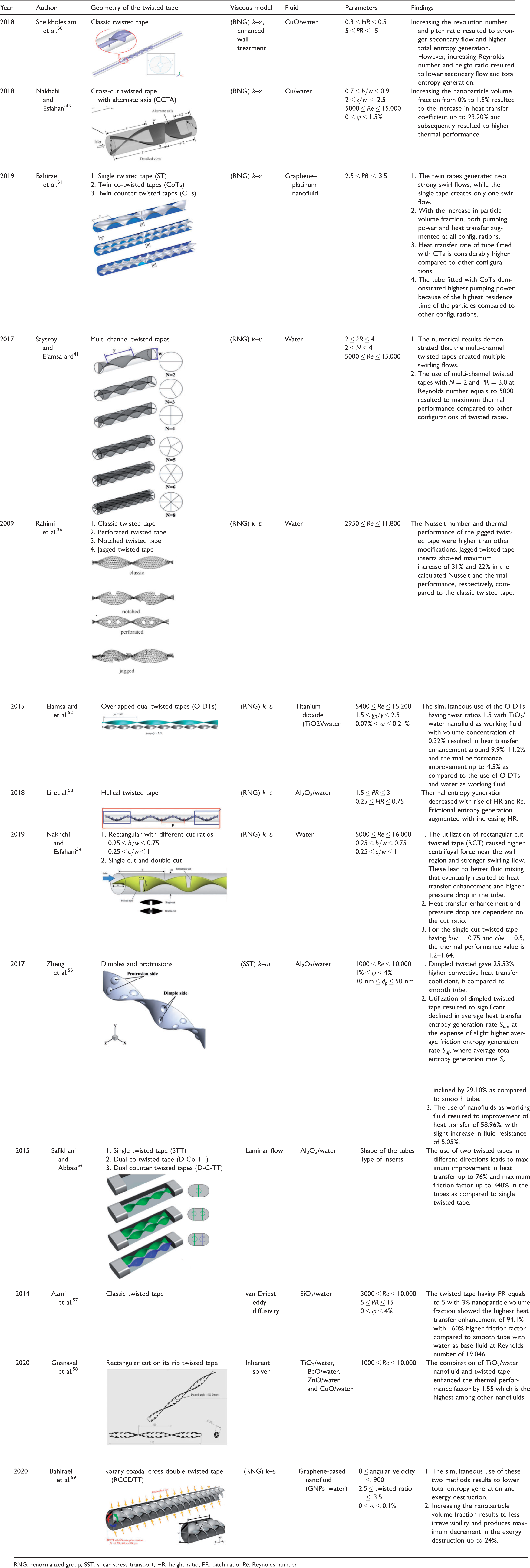
RNG: renormalized group; SST: shear stress transport; HR: height ratio; PR: pitch ratio; Re: Reynolds number.
Simulation condition
This section summarized the most commonly used software for twisted tape inside tube/pipe analysis which is the ANSYS Fluent software. The physical model of the test section for the simulation comprises a smooth circular tube and a twisted tape that is inserted into the tube. Nanofluids enter the test section at an inlet temperature, Tin and flowed through the test section. Most of the simulation analyses were conducted by adopting the following assumptions:
41
,60–64
Velocity inlet condition was applied at the inlet, and the pressure outlet condition was applied at the outlet. The physical properties of working fluid remained constant at average bulk temperature. The constant heat flux was applied at the tube wall at 1000 W/m2. The tube wall and the twisted tape were in adiabatic wall condition (high thermal resistance) and stationary. A mass flow rate of the working fluid was calculated from fluid properties at constant heat flux for the fully developed periodic flow model.
Governing equation
The governing partial differential equations were solved based on the following assumptions: (1) steady three-dimensional (3D) flow and heat transfer; (2) the flow is turbulent and incompressible; (3) fluid properties are constant; and (4) natural convection and thermal radiation are neglected. The general forms of governing equations are as follows: 65
Continuity equation

Momentum equation


Energy equation


The turbulent kinetic energy (TKE), 


Using the enhanced wall treatment method, the following constant for turbulent values near–wall region: 


However, this model is not suitable for flow condition with adverse pressure gradients, high flow curvature or a jet flow because of its inability to accurately predict a small-scale area. In order to find the best model for the given flow condition, Eiamsa-ard et al. 67 conducted a numerical analysis on fluid flow inside circular tube with twisted tape insert using four different types if turbulent model: standard k–ε model, RNG k–ε turbulence model, standard k–ω turbulence model and the shear stress transport (SST) k–ω turbulence model. The analysis was meant to study on thermal behaviour of fluid, and from the result, SST k–ω model gives more accurate result and approaching the experimental data compared to other models. It was because SST k–ω model takes advantage of both k–ω and k–ε such that k–ω was used in the inner region by taking into account the eddy viscosity and switched to k–ε in the free shear flow. Hence, it is more accurate and reliable for a wider class of flows while the RNG k–ε turbulence model performs well for external flow problems around complex geometries. Bahiraei et al. 51 adopted the RNG k–ε for modelling turbulent flow because it can simulate near-wall flows and able to provide greater performance for flows including recirculation and rotation.
Although nanofluid is the mixture of nanoparticles and base fluid which in general a two-phase liquid, it is assumed that the nanoparticles can be easily fluidized and it is valid to be considered as a conventional single-phase (homogeneous) fluid having average physical properties of individual phases. The liquid and the nanoparticle phases are considered in thermal equilibrium having the same velocity. 27 With that consideration, Nakhchi and Esfahani 46 calculated thermophysical properties of nanofluid by the following expressions:
Density
68

Specific heat
69

Viscosity
70

Thermal conductivity
71

The article presented a numerical analysis of Cu/water nanofluid flowing through a smooth circular tube inserted with CCTA. The objective of the study was to conduct a numerical analysis by calculating heat transfer enhancement and friction factor in circular tube equipped with CCTA twisted tape and Cu/water nanofluid as working fluid. Parameters adopted for simulations are nine different geometries of CCTA twisted tape (width ratio (b/w) from 0.7 to 0.9, length ratio (s/w) from 2 to 2.5, Reynolds numbers from 5000 to 15,000 and volume fraction of nanoparticles from 0% to 1.5%). The simulation results showed that the CCTA created higher swirling flow that resulted to better fluid mixing of the working fluid inside the tube which eventually enhanced heat transfer rate and decreased friction factor. The results showed that increasing nanoparticle volume fraction from 0% to 1.5% increased the heat transfer coefficient up to 23.20%.
Mesh generation
Other than selecting a good governing equation, selecting the right mesh to solve the partial differential equation is a key to obtain a more accurate result. Rahimi et al. 36 meshed their model domain that consisted of bent tube and surrounded bath from 1,500,000 to 2,000,000 tetrahedral cells. The region where the velocity and temperature gradients are significant should be meshed into smaller control volume in order to obtain a more accurate result. Hence, the area near the wall region of the bath and twisted tapes was meshed into a fine mesh. Likewise, Nakhchi and Esfahani 46 used tetrahedral and hexahedral grids to generate the mesh in the middle of the tube and at the boundary layers, respectively. Similarly, Alzahrani and Usman 72 used multiple methods such as hex dominant and tetrahedrons depending on the complexity level of the geometries. Ta et al. 73 employed swept meshing to the twisted tape geometry to ensure the accuracy of the results.
In order to make sure that the obtained results were independent of the size and the number of the generated grids, researchers conducted the grid independence test using the Richardson extrapolation technique over grids with different cell numbers. This test was conducted to prove that selected grid was the best, with highest accuracy and lowest computation cost. 55 One of the techniques for grid independence procedure is the Richardson extrapolation technique. Eiamsa-ard and Kiatkittipong 74 adopted the techniques over several numbers of cells: 125,040, 213,720, 493,542 and 600,749 cells to select the most relevant mesh size. The triangular cell was selected to mesh the crucial surfaces region of the simulation which were the tube wall and twisted tape. Local grid refinement was applied in the boundary layers. Based on the results, 493,542 cells are selected for analysis. Another way to verify whether or not the selected mesh is adequately dense for simulation is by comparing the result of several numbers of grids. Nakhchi and Esfahani 46 calculated and compared the average Nusselt number and friction factor of fluid flow inside a circular pipe with twisted tape inserts at Reynolds number of 15,000 with two different cell numbers: 614,273 and 1,202,319. Based on the results, the difference between the Nusselt number and friction factor between those two cells is very low (lower than 0.1%); hence, the lower grid numbers is selected for the simulation.
Tetrahedral and hexahedral are usually used at the near-wall region and also at the middle of the tube (on the edges of the inserts) due to temperature boundary layer region and narrow regions caused by the twisted tape inserts. Most researchers found out that grid numbers between 400,000 and 600,000 are adequately dense to obtain accurate results for simulation purposes.
Effective parameters
Reynolds number, friction factor and Nusselt number are the dimensionless parameters that are used to evaluate the heat transfer enhancement 41
Reynolds number (Re) can be expressed as

While friction factor is calculated using the following equation

Nusselt number can be obtained by following equation

Based on the ANSYS Fluent user’s manual,
65
the area-averaged Nusselt number was obtained by integrating local Nusselt number as follows

Zheng et al.
55
carried out numerical investigation to study heat transfer performance and flow characteristics in circular tubes with dimpled twisted tapes using Al2O3/water nanofluid. The effect of dimples, protrusions, nanofluid volume fraction and nanoparticle diameter was examined. The TR of the twisted tape was kept constant at 3, the depth-to-diameter ratio of the dimple was 0.25 mm, the volume fraction of nanofluid was 1%, 2%, 3% and 4% with diameter varies from 30 to 50 nm, and the range of Reynolds number was 1000–10,000. Unlike previous researchers, Zheng et al. used different approaches to calculate thermal conductivity of nanofluid by taking into consideration the effects of temperature, volume fraction, Brownian motion and nanoparticle diameter for better agreement with experimental data. The effective thermal conductivity was expressed as follows

Nakhchi and Esfahani 54 performed a numerical analysis to investigate flow characteristics and thermal performance of fluid flowing through a smooth circular tube equipped with twisted tapes with different cut shapes (single cut and double cut) under turbulence flow regime. The analysis was performed using (RNG) k–ε with Reynolds number from 5000 to 16,000. Utilization of rectangular-cut twisted tape generated swirl flow from tube wall to the core regions. This leads to better fluid mixing rate which able to enhance heat transfer rate tremendously. The results showed that double-cut twisted tape was more sensitive towards temperature increment at the same cut ratio (b/w = 0.25 and c/w = 0.5). While the thermal performance value for single-cut twisted tape with b/w = 0.75 and c/w = 0.5 was the highest compared to other tested geometries which is 1.2 to 1.64 for Reynolds number ranges from 5000 to 16,000. The temperature contours showed that higher temperature field is produced at the outlet of tube by using deeper rectangular-cut twisted tape. This indicates that higher turbulence intensity was produced in that region that eventually resulted to better fluid mixing. Hence, it was proven that a well-designed geometry of twisted tape is a crucial element for heat transfer enhancement.
Optimization for convective heat transfer plays an important role in energy. Hence, there is a need to investigate the entropy generation during heat transfer process. Li et al. 53 investigated the entropy generation of Al2O3/water nanofluid in a heat exchanger equipped with helical twisted tape using the finite volume method. The effect of height ratio (HR), pitch ratio (PR) and Reynolds number on nanofluid entropy generation was examined. ANSYS Fluent 14 was selected as the simulation tool, and k–ɛ (RNG) model was chosen as the turbulent model. Results indicated that higher Reynolds number with higher HR and lower PR caused higher frictional entropy generation, Sgen,f but lower thermal entropy generation, Sgen,t. Since the value of Sgen,f was too small compared to Sgen,t, changes in Sgen,t were more significant and affected the total entropy generation during the process. This is in agreement with Sheikholeslami et al. 75 who used helical twisted tape, and the results showed that thermal boundary layer thickness decreases with augment of width ratio due to stronger secondary flow and better nanofluid mixing was achieved at lower value of PR. Therefore, geometries of twisted tape play important roles for optimization of heat transfer system.
Eiamsa-ard et al. 52 investigated heat transfer enhancement of TiO2/water nanofluid in a heat exchanger tube inserted with overlapped dual twisted tapes (O-DTs). The effects of Reynolds number, TR and nanofluid’s volume fraction were examined. The TR of the twisted tape was 1.5, 2.0 and 2.5 with particle’s volume fraction of 0.07%, 0.14% and 0.21%. The simulation analysis was conducted for Reynolds numbers in a range from 5400 to 15,200. The analysis was carried out by solving general form of governing equations (equations (1)–(3)). The finite volume techniques were adopted to discretized time-independent incompressible Navier–Stokes equations and the turbulence model. The numerical results indicated that O-DTs with smaller overlapped twisted ratio produced a stronger swirl flow and higher TKE. The simultaneous use of the O-DTs with TR 1.5 and nanofluid with volume concentration of 0.21% resulted to heat transfer enhancement around 9.9%–11.2% and thermal performance improvement up to 4.5% compared to the use of O-DTs alone. Another novel method used the graphene-based nanofluid as working fluid with rotary coaxial cross double twisted tape (RCCDTT). 59 The simultaneous use of these two methods results to lower total entropy generation and exergy destruction. Hence, it was proven that inserting twisted tape to invade the flow inside the tube and using nanofluid with higher thermal conductivity as working fluid can give better improvement on thermal performance of heat exchanger.
Mokhtari et al. 76 performed a 3D numerical simulation to investigate the effect of magnetic field on the heat transfer of ferrofluid inside a tube equipped with twisted tape. The work mainly focused on the flow characteristic and temperature distribution of ferrofluid in presence of non-uniform magnetic field while ferrofluid swirled inside a tube with twisted tape. The analysis was performed by finite volume approach with the SIMPLEC algorithm. Parametric studies were performed to investigate the influenced of various factors such as concentration of nanoparticle, intensity of magnetic field, geometric field, geometric shape of twisted tape and Reynolds number on the heat transfer performance. Results showed that average Nusselt number increased 200% using twisted tape. Furthermore, magnetic field induced by parallel wire and increased volume fraction of nanoparticles result to enhancement of the average heat transfer of the swirling ferrofluid. Very recently, ferrofluid has received a great interest among the researchers for its magnetic ability to enhance heat transfer coefficient. However, most of the research papers conducted the analysis under laminar flow regime and very few carried out under turbulence flow regime which is more relevant for industrial applications.
Based on the reviews, most of the numerical analyses of the nanofluid by assuming single-phase fluid whereby the velocity of the nanoparticle and the base fluid is the same. However, nanofluid is naturally a two-phase fluid, where the nanoparticles and the fluid should be considered as two different phases that pose two different velocities and temperatures which eliminate the validation of earlier assumption of zero slip velocity between the fluid and the particle. Although the two-phase model describes a comprehensive understanding of the function of both liquid phase and solid phase in the heat transfer process, it takes a long time for computation and a high-performance computer is needed for the process. 77 That is why it is rarely employed by many researchers. Moving forward, researchers need to choose the most realistic approach in order to get a better result. Hence, a two-phase model should be used in the analysis to best describe the effect of nanofluid to the heat transfer system with twisted tape inserts. In addition, SST k–ω should be used in simulation analysis as this turbulence model showed better agreement in experimental result for Nusselt number and friction factor values despite of higher computation time for simulation.
Experimental study of twisted tape with nanofluid
Researchers have carried out various experimental studies on heat transfer augmentation by using twisted tape inserts. Raja Sekhar et al. 78 proved that using twisted tapes and nanofluids in the tube, heat transfer enhancement in a horizontal tube increased with Reynolds number and nanoparticle volume fraction. Ponnada et al. 79 conducted an experimental study to investigate the effect of perforated twisted tape with alternate axis (PATT), PTTs and regular twisted tapes (TTs) with TR of 3, 4 and 5 on the heat transfer rate of the system. All the twisted tapes used in the experiments were made of aluminium due to its low cost and easy to manufacture. Result showed Nusselt number increases with the decrease in TR and the presence of twisted tape inside the tube augmented the heat transfer rate up to 33% compared to plain tube. PATT at TR = 3 gave the highest heat transfer augmentation compared to other geometries at the same TR due to the following: (1) higher swirling flow created by twisted tape, (2) perforation modification made on the twisted tape reduced the flow blockage, and (3) periodically changes of swirl direction behind the alternate point caused by alternate axis lead to a strong collision of fluid due to eddy effect in the rear of each alternate axis. Hence, the study concluded that PATT is the best passive element for practical applications as it can save energy and operating cost. Moreover, the performance of the system is believed to be further expanded by simultaneous use of working fluid with better thermal properties instead of water. Therefore, Wongcharee and Eiamsa-ard 80 used CuO/water nanofluid at 0.7% volume fraction with alternate axis twisted tape and able to enhance the Nusselt number up to 13.8%. This improvement was due to higher collision between nanoparticles themselves and also between nanoparticles and the tube wall which lead to an increase in energy exchange rate.
Moving forward in the effort of energy sustainability, researchers have introduced nanofluid as another alternative in heat transfer enhancement due to its superior thermal properties. Zhang et al. 81 conducted a comparative study on twisted tape and concluded that rotating twisted tape gave lower pressure drop compared to stationary one. Qi et al. 82 in their studies used TiO2/water as the working fluid with rotating and static twisted tape inserts. Exergy efficiency of tube inserted with rotating and static built-in twisted tape with nanofluid flowing inside the tube was calculated and analysed. The results showed that the combination of rotating built-in twisted tape and TiO2/water nanofluid showed great enhancement in heat transfer by increasing the heat transfer by 101.6% compared to just using circular tube. This rotating behaviour promoted centrifugal force to the flow direction, which induces more turbulence in a vertical direction that created better mixing of flow from the core to the tube wall region. Rotating twisted tape also produces lower friction factor compared to static because rotating behaviour smoothens the surface of the flow, effectively reducing the flow resistance. 83 However, having the rotating coupling twisted tape inserts in the tube creates undesirable higher pressure drop that leads to deteriorating exergy efficiency at the same mass flow rate. Therefore, there is a need to design a twisted tape that can give minimum exergy deterioration (see Table 2).
Summary of experimental study on thermal performance of nanofluid inside the circular tube with twisted tape inserts.

PR: pitch ratio; RGPR: reducer geometrical progression ratio; GPR: geometrical progression ratio.
So, Wongcharee and Eiamsa-ard 93 studied the effects of three different PRs of twisted tape: 2.7, 3.6 and 5.3 with two different arrangements of twisted direction relative to spiral direction of corrugated tube: parallel and counter arrangements to the heat transfer enhancement. Evidently, heat transfer rate increased with CuO/water nanofluid volume fraction and decreasing TR. In addition, the use of both twisted tapes with corrugated tube in counter design offers higher heat transfer performances than the ones with parallel design. In another study, Hasanpour et al. 94 found out that corrugated tube with V-cut twisted tape gave the maximum heat transfer rate while the PTT produced lowest pressure drop. Thermal performance factor was the highest for V-cut twisted tape. Meanwhile, Qi et al. 84 in their study studied the effects of twisted tape inserts on the thermo-hydraulic performance of triangular tubes. The effects of nanoparticle mass fractions (ω = 0.1, 0.3 and 0.5 wt%), Reynolds number (Re = 400–9000), different structure twisted tapes (P = 25, 40, 55, 65 and 75 mm) on the Nusselt number and resistance coefficient enhancement ratios were experimentally investigated. The schematic diagram of the experimental setup was shown in Figure 1. The results showed that the triangular tube with twisted tape can improve the Nusselt number up to 52.5% and 34.7% at most in laminar and turbulent flow regime, respectively, compared to smooth tube without inserts. Therefore, it can be concluded the triangular tube with twisted tape gave better performance compared to corrugated tube in laminar flow.
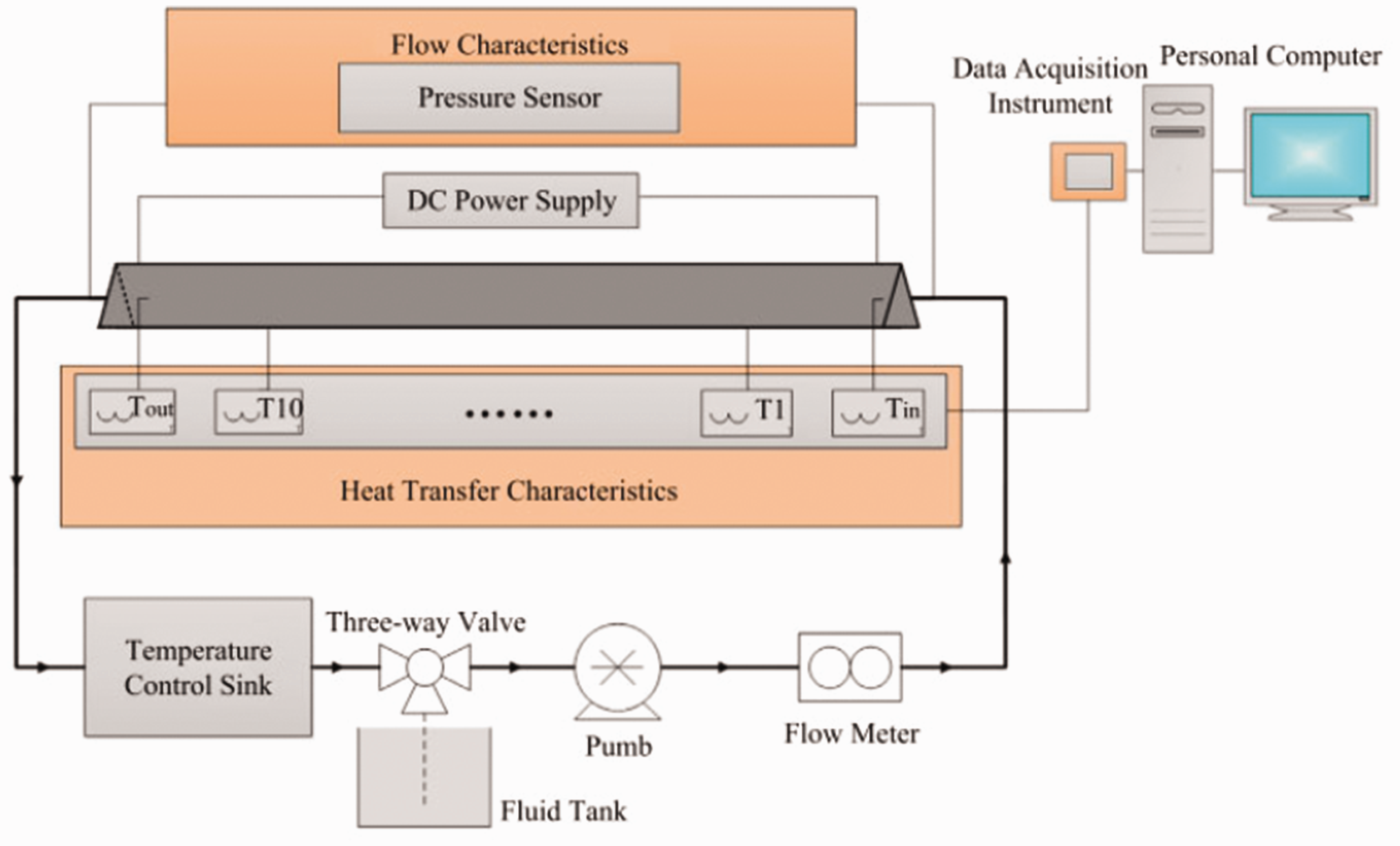
Schematic diagram of the experimental system. 94
Having twisted tape inside the tube will cause undesirable increase in pressure drop. Hence, geometries of twisted tape play the vital role in order to decrease the friction between the fluid and the inserts. Ahamed et al. 35 conducted experimental investigation using PTT inserts under turbulence regime. The experimental setup consisted of inlet and outlet sections, a test section, an air supply system and a heating section. The semi-cylindrical plain tube with 70 mm inner diameter and 1500 mm length was clamped together by flanges at both ends. The results indicated that perforated twisted inserts increased pumping power, heat transfer coefficient and effectiveness up to 1.8, 5.5 and 4.0 times, respectively, compared to the plain tube at same Reynolds number, respectively.
Experimentation is a vital art needed in Nusselt’s analytical solution especially when dealing with flow inside tube with enhanced geometries. 6 Therefore, a good experimental setup played an important role in heat transfer enhancement study. Syam Sundar et al. 85 conducted an experiment using nanofluids and twisted tape inserts as the passive techniques to enhanced heat transfer and thermal efficiency of solar water heater. Twisted tapes were inserted inside the tube in the flat plate connector as shown in Figure 2. The twisted tape was made from 1-mm thick and 9-mm width aluminium strips. 1 mm clearance was set between the inner wall of tube and the width of the tape to allow the smooth insertion of the tapes inside the tube. Result showed a significant enhancement of heat transfer up to 49.75% when a twisted tape of PR equals to 5 with 0.3% volume fraction of Al2O3/water nanofluid is used. This classic design of twisted tape gave the maximum friction penalty of 1.25 times under the same PR and volume fraction compared to plain tube. However, the thermal effectiveness increases up to 76% with the same condition of PR and volume fraction. The results indicated that pressure drop caused by twisted tape insert was very small and did not give much influence to the thermal performance of the system.

Solar flat plate collector with twisted tape inserts. 85
Similarly, in their study, Durga Prasad and Gupta 86 used Al2O3/water nanofluid in a U-tube heat exchanger with twisted tape inserts. The test section consisted of a U-bend double pipe heat exchanger (with inner tube and an annulus tube), flow meters, pump, by-pass valve and inlet and outlet pipe. The twisted tape was made by 1-mm aluminium strip that was twisted on a lathe by manual rotation. The results showed that Nusselt number for 0.03% volume concentration, PR of twisted tape equals to 5 enhanced by 31.28% compared to water and plain tube but increases the friction factor by 1.23. Based on the developed correlations, increased particle volume concentration resulted to enhancement of heat transfer performance. It is in agreement with Farshad and Sheikholeslami 95 who found that dispersing Al2O3 into the working fluid resulted to higher heat transfer performance at the expense of higher irreversibility. However, increasing number of revolutions (N) of the inserts produces significant impact on turbulence mixing that results to better system’s performance.
In the effort of designing the best geometries for twisted tapes, Maddah et al. 87 in their experiment, introduced different twist called geometrical progression ratio (GPR) as new modified twisted tapes to enhance heat transfer rate at different volume fractions of Al2O3/water nanofluid. The test section was located within horizontal double pipe heat exchanger that consisted of 1.5 m pipe with counterflow path whereby the hot nanofluid was applied inside the tube while the cold water was applied directly through the annulus. Utilization of reducer geometrical progression ratio (RGPR) twist with nanofluids increased heat transfer and friction factor from 12% to 52% and 5% to 28%, respectively, as compared to the tube with classic twisted tapes (GPR = 1). However, Khoshvaght-Aliabadi and Eskandari 96 used the same design modification but different types of nanofluid (Cu/water) and found out that increaser geometrical progression ratio (IGPR) gave the best thermal-hydraulic performance compared to other geometries.
Most of the modified modified twisted tape showed the decreasing pattern of overall enhancement ratio values as the Reynolds number increased, however the twisted tape with increasing twist lengths (Low to High) twisted tape showed otherwise. Hence, this added to another interesting fact and advantage of using GPR in the analysis at higher Reynolds number. Due to that, there is a need for another study to look deeper into this modification including the ratio of the reducer factor and the type of nanofluid as they might be the best modification and parameters for turbulence flow regime at higher Reynolds number.
In similar kind of experimental setup, Sarviya and Fuskele 88 used continuous cut edges twisted tape to enhance the heat transfer rate by improving the fluid mixing near the walls of the test section. In an experimental setup for heat exchanger analysis, the length of the inlet section must be made long enough to avoid any flow disturbance upstream of the test section and to obtain fully developed flow. 97 Hence, the developing section of 2.5 m was prepared before the test section, test section of 1 m and calming section of 1 m after the test section. Results obtained indicated that higher heat transfer rates can be achieved using twisted tape inserts with continuous cut edges but at the expense of a higher pressure drop. However, the increase in pressure drop was relatively small compared to heat transfer enhancement. Another example of continuous cut edge techniques was U-cut and V-cut. 98 This modification was made to improve the fluid mixing near the walls of the test section.
Another modification made on twisted tape was spiky-type twisted tape. Khoshvaght-Aliabadi et al. 89 used spiky twisted tape and water-based metallic nanofluid (Cu/water, Fe/water and Ag/water) to enhance the performance of agitated vessel U-tube heat exchanger. The use of spiky twisted tapes leads to an increase in the range of 11%–67% for the heat transfer coefficient compared with the smooth twisted tape while Ag/water nanofluid gave the highest heat transfer enhancement compared to Cu/water and Fe/water nanofluid. Similarly, Chang and Huang 99 in their study used spiky twisted tape with addition of enhanced perforated, jagged and notched winglets in order to add more swirl flow inside the tube for better fluid mixing. Among all those geometries, the V-notched spiky twisted tape generally offered the highest heat transfer enhancement with higher thermal performance factor. An increase in axial velocity will induce longitudinal vortices that result to better fluid mixing in the tube. Another effective way to increase fluid mixing is by using M-TT insert. However, the use of M-TTs leads to considerable increase in friction factor compared to that of single twisted tape. 100 Another finding is by Farnam and Asadollahzadeh 101 who used both twisted tape and twisted tube as passive techniques. The results showed that the maximum performance index of 2.28 was recorded with the use of the twisted tape with lower PR in the twisted tube for the minimum Reynolds number whereas the Nusselt number and friction factor increase up to 168% and 61% of those in the straight tube. The use of these modifications with nanofluid is envisaged to further increase the performance index and need to be taken into account for future research. Interestingly, Esmaeilzadeh et al. 102 found out that twisted tape thickness played a vital role in the heat transfer enhancement and must be included as one of the parameters in future analysis.
Other than twisted tape, X-shaped tape also becomes a promising shape in order to manipulate the fluid flow inside a tube. Paneliya et al. 92 has conducted a comparative study between X-shaped tape and twisted tape. Based on the experimental results, the heat transfer rate produced with X-shaped tape inserts is 1.27 while twisted tape is 1.08 higher as compared to smooth tube. Even though one might argue that the PR and twisted ratio play a vital role in order to create a better swirl flow for twisted tape, the X-shaped tape also should be considered for future research in the effort to increase the efficiency of heat transport system.
Discussion
Heat transfer performance of nanofluid inside circular tube with twisted tape inserts has been studied by various researchers under different geometries, Reynolds number and volume fraction of nanoparticles. Studies showed that smaller PR, lower Reynolds number and higher volume fraction of nanoparticles produce higher Nusselt number. In order to intensify the flow inside the tube, several modifications on classic twisted tape have been made. Perforation and cut edges were the common modifications that can reduce the flow blockage of the fluid and the blank space can create a stronger swirl that result to better fluid mixing. The cross-cut twisted tape creates a periodic change of swirl direction behind the cut, caused by the alternate axis which leads to a strong collision due to recombination of streams in the rear of each alternate axis which eventually results to better fluid mixing for heat transfer enhancement. Other than that, increasing inlet velocity results to significant reduction in surface temperature, which results in less exergy loss and better heat transfer performance. 95
Varun et al.
4
in their review showed the variation of overall enhancement ratio with Reynolds number for different geometries of twisted tape using water as the working fluid. In continuation of that review, Figure 3 is developed to see the effect of the twisted tape geometries on overall enhancement ratio at different Reynolds number using nanofluid as working fluid. The overall enhancement ratio is obtained using the following relation
103


Overall enhancement ratio versus Reynolds number.
Figure 4 is developed to show variation of overall enhancement ratio over nanofluid volume fraction for some twisted tape geometries suggested by various researchers. All values in the graph are calculated for turbulence regime (Re = 10,000) and at PR 3. From the graph, most of the designs show similar increasing trend with the increase in nanofluid volume fraction. This increasing trend may be due to the fact that nanoparticles presented in the base fluid produced higher thermal conductivity and continue to increase with the increase in particle concentrations. However, increasing particle volume concentration will result to higher viscosity of the working fluid which increases the boundary layer thickness that affected performance of the system. 90 , 104 Therefore, an optimum value of nanoparticles volume fraction needs to be achieved in order to obtain the best performance. Even though higher nanoparticles volume fraction can produce higher thermal conductivity, the use of higher concentration of nanoparticles increases the viscosity which may lead to high-pressure drop within the system. 105 Hence, the exergy and entropy analyses need to be conducted in order to investigate the exergy loss due to the presence of nanoparticles and twisted tape. In addition, Sadeghi et al. 106 found out that Al2O3 nanofluid can produce higher heat transfer enhancement compared to SiO2. Cylindrical-shaped nanoparticles have the highest heat transfer enhancement and Performance Evaluation Criteria Index compared to circular shaped due to their larger surface area. This suggested that parameters such as type, size and shape of the nanoparticles play a significant role in heat transfer enhancement and need to be taken into consideration for future research.

Overall enhancement ratio versus nanofluid volume fraction.
Another thing that can be concluded from the graphs in Figure 4 is modification of twisted tape which gives more significant effect on overall enhancement ratio compared to the presence of nanofluid. This may be due to the fact that nanoparticles inside the fluid are not 100% homogenized and thermophysical properties calculated for the working fluid are not the optimum values. Another problem that arises by using nanofluid as working fluid for heat transfer application is the stability problem. Achieving a long-term stability of nanofluid always being a challenge because the nanoparticles will form aggregates due to very strong van der Waals interactions between the particles. Different experimental studies and models have been proposed to study the stability of nanofluid including addition of surfactant, using sonication machine and pH modification. 107 Also, in Figure 4, it can be seen that RGPR showed the highest overall enhancement ratio using Al2O3/water nanofluid and the values increase with the increase in Reynolds number, while other geometries showed otherwise. It is proven that RGPR modification is the promising modification for twisted tape and there is a need for thorough study on other design parameters that associated with this modification including twist angle, depth of wing cut ratio, space ratio and depth ratio. Besides, most of the papers presented the effect of nanoparticles volume fraction to the overall enhancement ratio, but none really study on how the swirl flow induced by twisted tape gives better dispersion on nanoparticles that finally result to higher performance of the system. Due to that, a study on the dispersion behaviour of nanoparticles under turbulence flow regime and how it affects the stability of nanofluid are very important as all of these are the important parameters for heat transfer enhancement.
Other than twisted tape, wire coil inserts were proven to be a good turbulator for dealing with nanofluid. Having the wire coil inserts can increase the irregular and random movement of the particles and the energy exchange rates in the nanofluid. Like twisted tape, wire coil inserts can promote better fluid mixing and efficient development of hydrodynamic boundary layer which consequently results to the improvement of convective heat transfer. 108 Therefore, a more comparative study on twisted tape and wire coil is needed in order to the best inserts for optimum heat transfer enhancement. Other than inserts, having corrugated channel instead of smooth channel can create better fluid mixing of the working fluid. Raheem et al. 109 found out that trapezoidal-corrugated give highest enhancement ratio compared to semicircle and straight channel. Hence, another venture into these design with inserts is needed in order to create higher efficiency heat transfer system.
Conclusion
The gaps and recommendation for future research that can be concluded based on the present review are as follows:
To reach the best modification for twisted tape, more complete experiments and simulations involving a wide range of geometry parameters need to be conducted in the future.
Dispersion and random movement of nanoparticles due to swirl flow induced by twisted tape must be studied in order to know their effect to the overall enhancement ratio.
RGPR gives the highest value of overall enhancement ratio up to 1.8 while low-to-high twisted tape shows increasing value of overall enhancement ratio with Reynolds number. Hence, more studies on increasing and decreasing PR twisted tape from inlet to outlet of the tube are needed in order to create a suitable design for higher Reynolds number.
Since higher heat transfer is achieved through turbulent and swirl flow, a more thorough study on nanoparticles type, concentration and shape needs to be conducted in order to obtain the most suitable nanoparticle for turbulent flow regime.
Effect of modification of twisted tape to the overall enhancement ratio is more dominant (30% more effective) compared to nanofluid volume fraction. However, the simultaneous use of these two passive methods creates 20% better overall enhancement ratio as compared to twisted tape alone.
Footnotes
Handling Editor: James Baldwin
Acknowledgements
The authors thank Muhammad Shazwan for his diligent proofreading of this review article.
Declaration of conflicting interests
The author(s) declared no potential conflicts of interest with respect to the research, authorship and/or publication of this article.
Funding
The author(s) disclosed receipt of the following financial support for the research, authorship and/or publication of this article: This research was financially supported by the Universiti Kebangsaan Malaysia (DIP-2019-019 and FRGS/1/2019/TK07/UKM/01/3), the Universiti Malaysia Perlis and the Ministry of Higher Education.
