



Abstract
The Miller cycle has been proven to be an effective way to improve the thermal efficiency for gasoline engines. However, it may show insufficient power performance at certain loads. In this study, the objective is to exploit the advantages of the Miller-cycle engines over the original Otto-cycle engines. Therefore, a new camshaft profile with early intake valve closure was devised, and two various pistons were redesigned to obtain higher compression ratio 11.2 and 12.1, based on the original engine with compression ratio 10. Then, a detailed comparative investigation of the effects of Miller cycle combined with higher compression ratio on the performance and emission of a turbocharged gasoline direct injection engine has been experimentally carried out based on the engine bench at full and partial loads, compared to the original engine. The results show that, at full load, for a turbocharged gasoline direct injection engine utilizing the Miller cycle, partial maximum power is compromised about 1.5% while fuel consumption shows a strong correlation with engine speed. At partial load, since the Miller effect can well reduce the pumping mean effective pressure, thus improves the fuel economy effectively. In addition, the suppression of the in-cylinder combustion temperature induced by the lower effective compression ratio contributes to the reduction of nitrogen oxide emission greatly. However, the total hydrocarbon emission increases slightly. Therefore, a combination of the Miller cycle and highly boosted turbocharger shows great potential in further improvement of fuel economy and anti-knock performance for downsized gasoline direct injection engines.
Introduction
Over the decades, the world has been nagged by two main troubles including fossil fuel depletion and global climate warming.1,2 It is a widely acknowledged fact that the transport sector, especially from vehicles, is a key factor to eliminate climate change risk. As one of the widely used source powers, the internal combustion engine (ICE) has achieved great success, especially in the automotive industry since its invention. However, its wide application is actually at the prices of energy shortage and substantial harmful emissions.3,4 At the same time, regulations for vehicle emissions and fuel consumption have been increasingly stringent across the world.
Thus, unremitting efforts have been attempted to improve thermal efficiency and reduce fuel consumption in the automobile field. Some scholars pointed out that fuel consumption can be well decreased by the use of alternative fuels, such as the liquefied petroleum gas (LPG). However, their further application is limited by some disadvantages, such as additional tax and additional costs induced by additional equipment. 5 At present, one of the most popular engine technologies to achieve higher thermal efficiency and lower emissions mainly focus on the downsized turbocharged gasoline direct injection (GDI).6,7 Some previous studies claimed that turbocharged downsizing combined with GDI could obtain a 10%–15% improvement in fuel consumption. 8 However, under this circumstance, engine knock, which is a serious restriction to achieve higher thermal efficiency, is likely to occur, compared to their naturally aspirated (NA) counterparts. Numerous investigations have been conducted to suppress engine knock in downsized gasoline engines at high loads, in which the geometric compression ratio (CR) reduction is considered as one of the most typical methods. While this approach is at the costs of fuel economy degradation. Thus, an over-expansion cycle including Miller and Atkinson has earned increasing attention recently. Since compared to the conventional Otto-cycle engines (OCEs), an over-expansion engine can realize a larger expansion ratio to achieve higher thermal efficiency while holding a relatively normal CR to suppress the knock. 9 Compared to the Atkinson cycle, which is achieved by a series of complicated linkage mechanism, the Miller cycle can achieve the same effect by easier variable valve timing (VVT), such as early intake valve closure (EIVC) and late intake valve closure (LIVC). Thus, from an economic and practical perspective, the Miller cycle is more suitable for the application in downsized gasoline engines.
Due to the positive role that Miller cycle plays in the fuel consumption reduction and anti-knock performance for gasoline engines, large numbers of studies have been carried out and thus generated many interesting and instructive results over the several decades. Anderson et al. 10 investigated the first and second law analysis and compared a NA, Miller cycle, SI engine with LIVC to a conventionally-throttled OCE at partial load. The result revealed that as much as 6.3% improvement in the indicated thermal efficiency is obtained with the Miller cycle. Ge et al. 11 conducted a study on the analysis of the air-standard Miller cycle by taking heat transfer loss, friction and variable specific heats of working fluid into account. The result showed that compared to the Otto cycle, the Miller cycle is more efficient and the effects of the three aspects mentioned are important and thus should be analyzed in the practical cycle. It is well-known that gasoline engines often operate at partial loads and a throttle valve is usually used to control the load, which leads to engine pumping loss during gas exchange strokes; thus, a further enhancement in terms of fuel consumption reduction is restricted. To solve this issue, Cleary and Silvas 12 studied the strategy of the EIVC variable valve actuation on practical un-throttled engine operation, and they found a 7% fuel economy improvement. While at high load, Boretti 13 demonstrated that up to 40% thermal efficiency could be achieved in the highly boosted spark-ignition (SI) engine with brake mean effective pressure (BMEP) exceeding 30 bar by the use of pure ethanol, instead of gasoline fuel.
Apart from increasing the thermal efficiency, the low in-cylinder temperature and pressure contributed by the use of the Miller cycle also lower the tendency to knock and nitrogen oxide (NOx) emission. Wei et al. 14 pointed out that the Miller cycle provides good anti-knock performance because of its low in-cylinder temperature induced by the lower effective CR; however, it has a poor dynamic output. Wang et al. 15 experimentally carried out a study on the application of the Miller cycle to decrease NOx emission from a petrol engine and found that, compared with the conventional OCE, the maximum NOx emission diminishment is 46% while at the costs of 13% engine power degradation at full load. Wu et al. 16 dealt with the analysis of a supercharged Otto engine adopted for Miller cycle operation and the result showed that it has no efficiency advantage but does provide increased net work output with a reduced propensity to engine knock problem, compared to the original OCE. Rinaldini et al. 17 experimentally conducted a theoretical study to assess the potential and the limits of the Miller-cycle application into a high-speed DI diesel engine and the results showed that NOx emission can be reduced up to 25%.
As aforementioned, one can see that the Miller cycle does provide good performance in thermal efficiency, anti-knocking, and NOx emission reduction for gasoline engines; however, it should not be ignored that these advantages are actually at the prices of engine power degradation due to the insufficient intake charge induced by EIVC or LIVC. Thus, to better the trade-off between the performances of power and economy of Miller-cycle engines (MCEs), intake boost is necessary at high loads and numerous studies have been conducted in this domain. In the original design of the Miller engine, a supercharged was attempted to compensate for the inadequate power output owing to the shortened compression stroke. 18 Currently, a combined application of split injection and boost pressure into the Miller engine was attempted, and the results showed that the combined method can effectively decrease the knock tendency and increase the engine torque. 14 Li et al. 19 conducted a study on the Miller cycle effects on the improvement of fuel economy in a highly boosted, high CR, GDI engine, and found that the fuel economy is improved without the penalties of reduced torque or power output. Chen et al. 20 conducted a study to investigate the potential of electrically supercharged Miller cycle to improve the thermal efficiency of gasoline engines without power loss. The results showed that compared to the conventional OCE, the highest thermal efficiency is 35.54% with an improvement of 4.32% at 3500 r/min full load operation while the electrical supercharger ensures that the power output is not reduced.
The technology of turbocharging has been widely used in the automobile industry due to its simple structure and less costly while maintaining good performance in improving vehicle fuel economy and power output by recycling the exhaust energy. 21 Thus, with due consideration of the potential of Miller cycle in improving the thermal efficiency and NOx emission reduction as well as the easy availability of turbocharger, this article experimentally studies the effects of the Miller cycle on the performance and emissions of a downsized turbocharged GDI engine by combining the Miller cycle with boosted turbocharging. The mechanism of these effects is discussed compared to the OCE and the details are reported as follows.
Methodology
Experimental setup
The engine selected for this test was a turbocharged GDI four-stroke four-cylinder gasoline engine. Details of the engine specifications are shown in Table 1, and a schematic layout of the experimental setup is shown in Figure 1. As depicted, the engine test bench consists of various different subsystems and instruments, mainly including the GDI system, exhaust gas analyzer, combustion analyzer, in-cylinder pressure sensors, and dynamometer, both of which are controlled by the main control system. The primarily measured parameters and accuracies are provided in Table 2. It is significant to note that different sensors and instruments, including in-cylinder pressure sensors, oxygen sensor, and gaseous analyzer have been carefully selected and then calibrated to make sure that the calibration results are within the range of error, thus ensuring the reliability and accuracy of the test data.
Engine specifications.

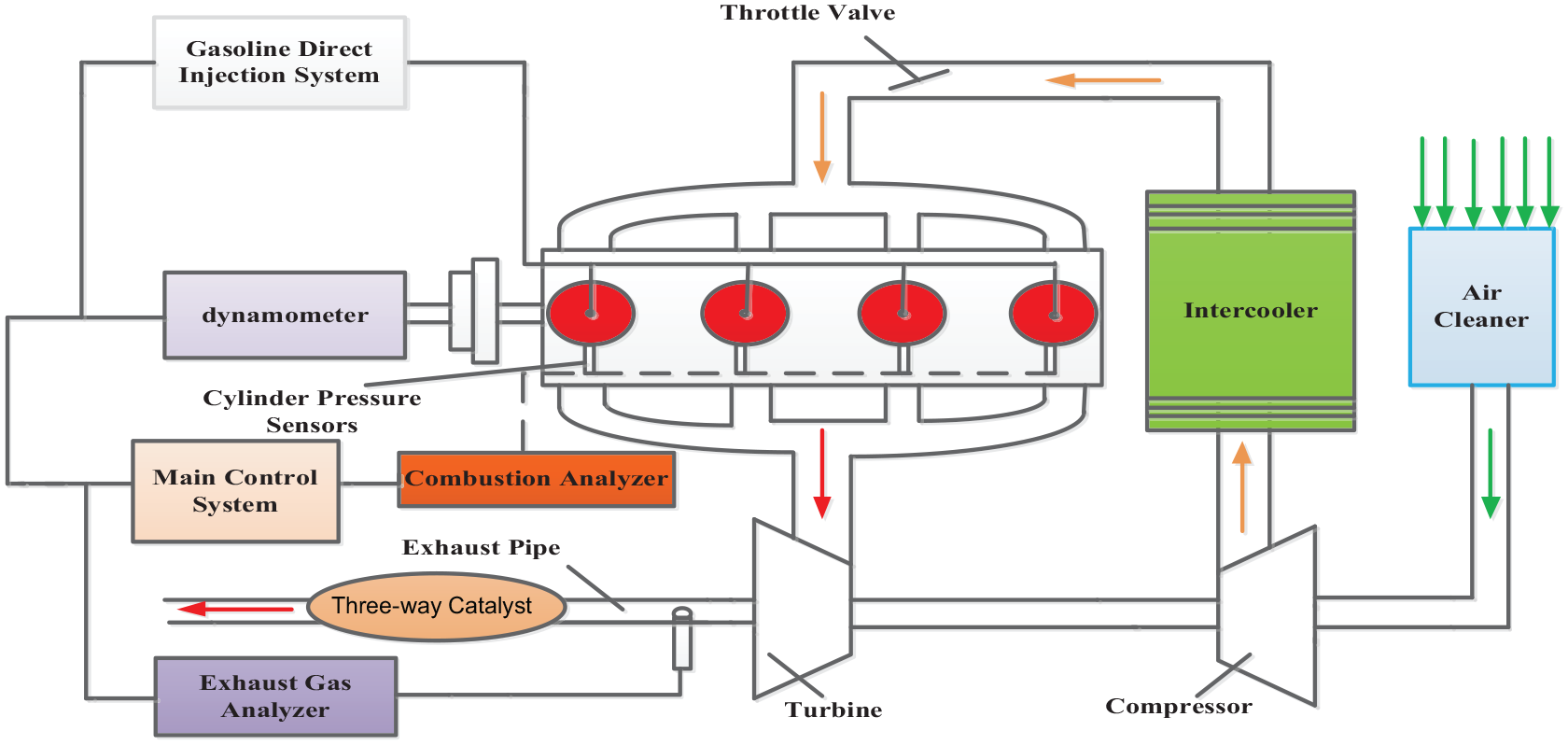
A schematic of the experimental setup for the engine test bench.
Measured parameters and accuracies.

FS: full scale.
MCE
Due to the fact that the cylinder combustion temperature inside MCE is mitigated by the lower effective CR, thus a higher geometric CR can be adopted. Therefore, in this study, the piston shapes were redesigned to increase the geometric CR with the ratios of 11.2 and 12.1 on the basis of the original engine with CR 10, which is depicted in Figure 2. In addition, a new intake camshaft profile was modified to change the Miller rate, which is shown in Figure 3. This aims to study the effects of Miller rate, along with higher CR, on the performance and emissions of a turbocharged GDI engine.

Pistons with three various CR.
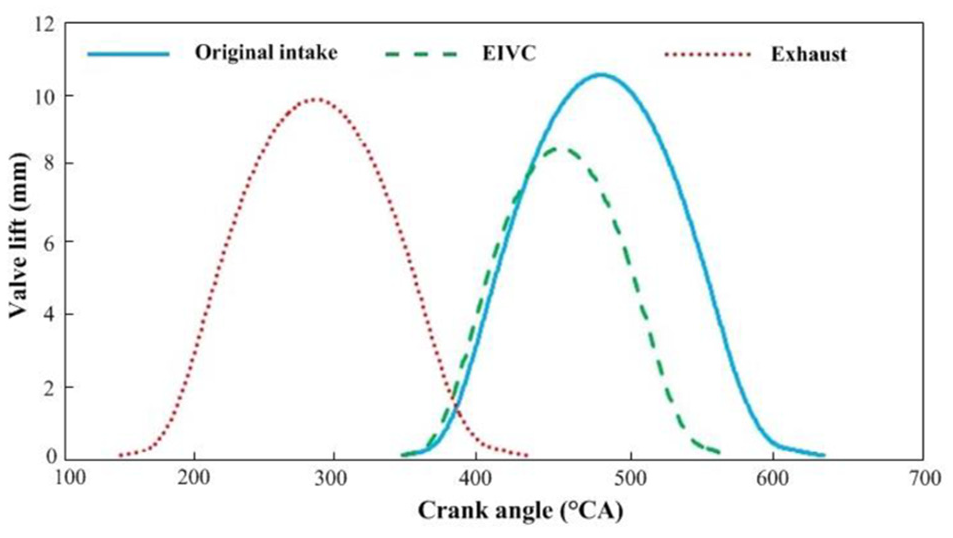
Valve lift profiles for the original and Miller-cycle engine camshaft profiles.
Experimental condition
Based on the engine bench, this experimental research consists of two parts, including the wide-throttle-open (WTO) performance and partial performance tests. In order to compare the effect of various engine speeds on MCE and OCE at WTO operation, the speeds of 2000 and 4000 r/min were selected for the WTO test. However, owing to the fact that the operations of 5 and 8 bar under the speed of 2000 r/min are the widely used conditions for the actual vehicle running, thus they were selected for the partial load test. In addition, in order to eliminate the interferences from other engine systems during the test, the coefficient for variation (COV) of the BMEP was controlled within the range of 4%, the intake temperature after intercooler was controlled at 70°C, and the coolant temperature was kept at 88°C ± 2°C.
Theoretical tool
In this study, EIVC is selected to achieve the Miller cycle; therefore, the piston cannot begin to compress immediately after the bottom dead center (BDC). From a theoretical perspective, it should be considered that the piston begins to compress only after the intake valve is closed. On the basis of this, the actual Miller rate

To demonstrate the better performance of MCE with high CR over the original OCE, the brake-specific fuel consumption (BSFC) and the exhaust emission performance including total hydrocarbon (THC), carbon monoxide (CO), and NOx were compared and analyzed, compared to the original engine. At the same time, analysis of the key factors that may lead to their performance differences such as pumping mean effective pressure (PMEP) and exhaust mean effective pressure (EMEP) has been obtained. To facilitate this study, the definitions of PMEP and EMEP are expressed as

where

where
Results and discussion
After sorting out the test data, the cylinder pressure curves of MCE and OCE and their key performance parameters related to various speeds or loads were compared and analyzed. Figure 4 demonstrates the P–V diagram of the OCE with CR 10 and MCE with CR 12.1 under the condition at 3000 r/min 14 bar BMEP. It can be seen that the peak cylinder pressure of MCE is 75 bar, which is nearly 20 bar higher than that of OCE. This is mainly because the geometric CR is increased from 10 to 12.1, thus contributing to the higher in-cylinder pressure. In addition, both the intake and exhaust pressure of MCE get higher compared to the original OCE, which reduces the pumping loss.

Pressure–volume diagram for original and Miller engines.
Performance comparison of the original OCE and MCE at full load
Figure 5 depicts the WTO performances of BMEP and BSFC between the original OCE with CR 10 and MCEs with higher CR 11.2 and 12.1 at two various speeds of 2000 and 4000 r/min. As one can see, since both the turbocharged engines have the torque platform, BMEP remains almost identical at 2000 and 4000 r/min. While the BMEP of MCE is lower than that of the original OCE, with an average reduction percentage of 1.5%. The main contributor is that compared to the original OCE, MCE has a relatively shorter intake stroke due to EIVC and thus leads to a less intake charge. This indirectly explains the need for boosting intake pressure for MCEs. In addition, it can be seen from Figure 5 that BSFC increases as CR increases to some extent at the speed of 2000 r/min. To explain this, the combustion phase defined by the crank angle (CA) of 50% accumulative heat release (AI50) is introduced. One should note that the gasoline engine is prone to knock at low speed and that higher CR is one of the key contributors to the engine knock. Therefore, the ignition angle should be retarded to adjust the combustion phase to avoid knock. As shown in Figure 6, the AI50 for the EIVC engine with CR 11.2 has been retarded from 30°CA to 33°CA compared with the original one.
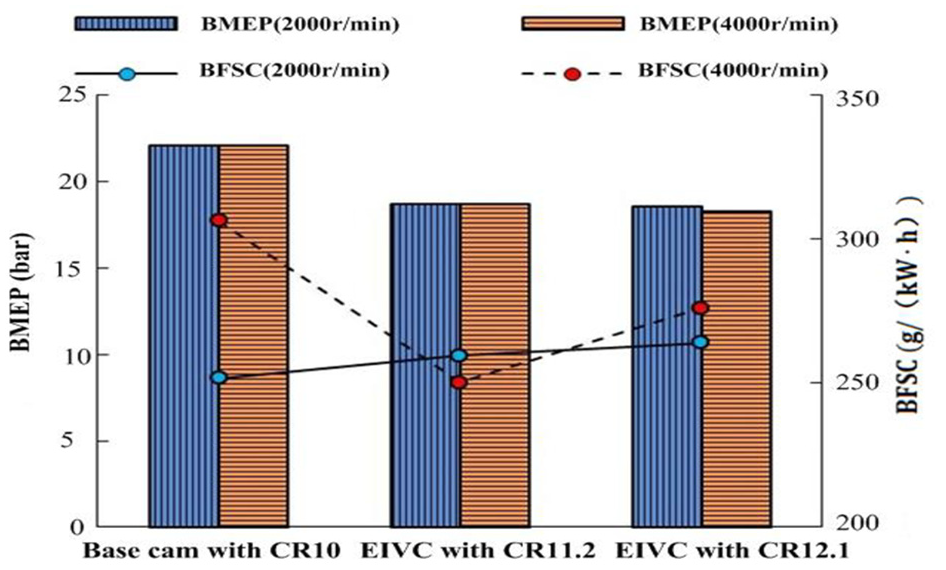
BMEP and BSFC of the original and EIVC engines at full load.

Excess air coefficient and AI50 of the original and EIVC engines at full load.
However, under the condition of 4000 r/min WTO operation, the BSFC of the MCE with CR 11.2 decreases from 305 to
It is generally known that the conventional OCEs reduce the combustion and exhaust temperature by increasing the mixture concentration to avoid a bad effect of the catalytic converter on exhaust emissions. Thus, the excess air coefficient is usually controlled at 0.8–0.9. While for the MCEs, the combustion temperature can be reduced due to its lower effective CR without adding a richer mixture. Therefore, even under the high load condition, the combustion mixture inside the Miller engine cylinders can still close to the chemical equivalent ratio. As shown in Figure 6, the excess air coefficient of MCE is closer to 1 than that of the original OCE, which plays a positive role in the reduction of fuel consumption.
As the engine speed increases, the tendency to knock slows down compared to the low speed. Meanwhile, with the actuation of the Miller effect, the ignition angle can be further advanced even with a higher CR, which greatly improves the combustion phase and further reduces the fuel consumption. As depicted in Figure 6, under 4000 r/min WTO operation, the AI50 of EIVC engine has been advanced by about 5°CA compared to the original one.
However, despite the help of the Miller effect, CR cannot be raised too high due to the constraint of knock, and thus no longer exerts a positive influence on the fuel economy improvement. In fact, when CR reaches to 12.1, the engine has already knocked slightly. Therefore, the ignition angle needs to be retarded or the mixture has to be enriched to a certain extent, which results in higher fuel consumption for the engine with CR 12.1 than that with CR 11.2.
Comparison of the original OCE and MCE at partial load
Due to the fact that the conditions of 5 and 8 bar under the speed of 2000 r/min are the frequently used operation of vehicle actual running, thus the performance and emission of the original OCE and MCE are experimentally carried out at this partial load.
Comparison of engine performance
Figure 7 exhibits the BSFC and spark advance angle of the original and EIVC engine under the conditions of 5 and 8 bar at the speed of 2000 r/min. As illustrated, at partial load, the EIVC engine with higher CR demonstrates an effective role in the fuel economy improvement, with average BSFC reduction percentages by 6.52% for the EIVC engine with CR 11.2 and 5.54% for that with CR 12.1 under the condition of 5 bar, while 3.72% and 4.48% under the condition of 8 bar. Compared to the WTO performance, the excess air coefficients for both the original OCE and MCE are closer to the chemical equivalent ratio under these two partial loads; therefore, the role that the excess air coefficient plays can be excluded. As a matter of fact, compared to the original OCE, the MCE has a lower combustion temperature inside cylinders due to its lower effective CR induced by EIVC. This slows down the tendency to knock and then the ignition angle can be advanced further, which greatly improve the combustion phase especially under lower load condition. As shown in Figure 7, the spark advance angle of the EIVC engine with CR 12.1 has increased from 21°CA to 30°CA at 5 bar, compared to the original one. While when the BMEP reaches 8 bar, the spark advance angle of the EIVC engine with CR 12.1 is slightly retarded because it has shown the trend for slight knock.
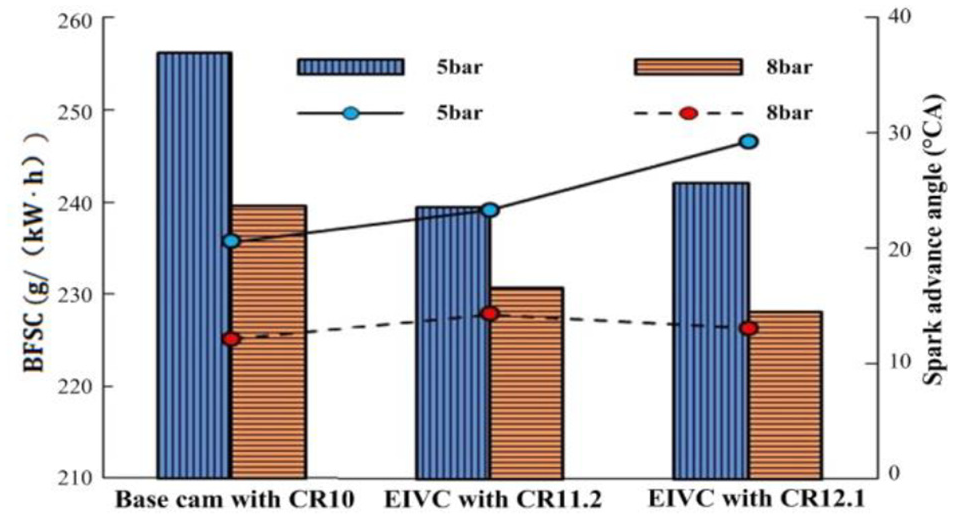
BSFC and spark advance angle of the original and EIVC engines at partial load.
Large numbers of previous studies have mentioned the positive role that the Miller cycle plays in the engine PMEP reduction. Therefore, in this study, the comparative analysis of the PMEP of the original OCE and MCE at partial load was investigated. As depicted in Figure 8, at partial load, the MCE with higher CR shows an effective reduction in PMEP, with average reduction percentages by 34.2% for MCE with CR 11.2 and 31.6% for that with CR 12.1 under the condition of 5 bar, while 22.6% and 32.3% under the condition of 8 bar. This is because the valve envelope angle of EIVC engine is smaller than that of the original OCE; therefore, it is required to increase the opening of throttle at lower loads to ensure the sufficient intake charge at the same working condition, thus reducing the pumping loss effectively. While at high loads, the throttle opening of the original engine is already large, which lowers the potential to reduce PMEP by the use of the Miller cycle.
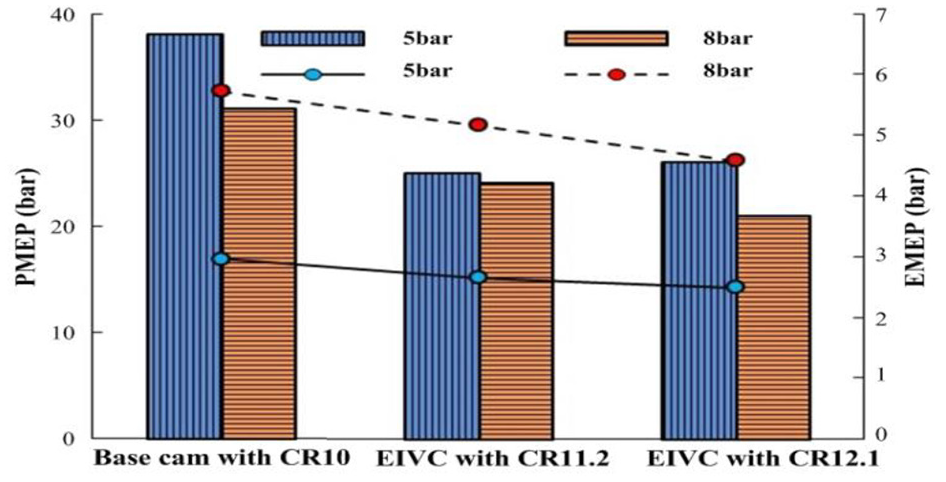
PMEP and EMEP of the original and EIVC engines at partial load.
In order to analyze the effect of EMEP on PMEP reduction, the changes of EMEP in the original OCE and MCE were compared in Figure 9. As illustrated, compared to the conventional OCE, the EMEP of the MCE with CR 11.2 and 12.1 decreases by 10.7% and 16% at 5 bar, respectively, while 9% and 20% at 8 bar, respectively. The reason can be explained by the change in the speed and intake pressure of the turbocharger with the use of the Miller cycle. For MCE, due to its shorter intake stroke, more fresh air needs to be introduced into the cylinder within a limited time. Apart from adopting a wider throttle opening, higher intake pressure is also required. It is can be seen from Figure 9 that compared to the original OCE, both the turbine speed and intake pressure are increased by the use of the Miller cycle. This suggests that the turbocharged MCEs can make greater use of the exhaust energy and then increase intake pressure by increasing the turbine speed, which further reduces the pumping loss. Therefore, it can be concluded that the advanced ignition angle and decreased pumping loss caused by a wider throttle opening and higher intake pressure are the two main contributors to the fuel consumption reduction of MCE at partial load.

Turbine speed and intake pressure of the original and EIVC engines at partial load.
Comparison of emissions
Figure 10 depicts the CO emission of the original OCE and MCE under the partial loads of 5 and 8 bar at the speed of 2000 r/min. It can be seen that compared to the original OCE, the CO emission of MCE reduces slightly but with little fluctuation. According to the previous studies, the formation of CO emission inside cylinders is mainly affected by the fuel–air mixture concentration. 22 While in this study, as mentioned before, the excess air coefficient for both the original and EIVC engines is closer to 1 under partial load condition, which therefore contributes little to the CO emission reduction by the use of Miller cycle.
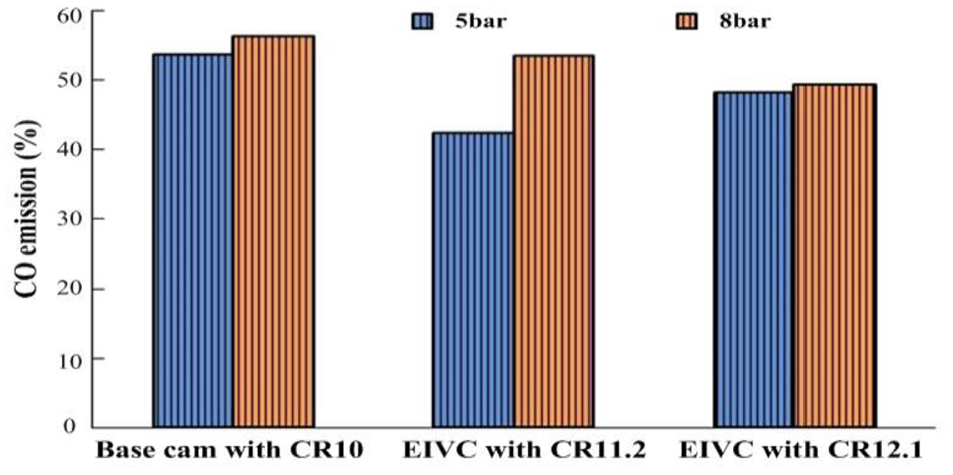
CO emission of the original and EIVC engines at partial load.
Figure 11 shows the THC and NOx emission of the original OCE and MCE under two various partial loads. As demonstrated, compared to the conventional OCE, the NOx emissions of the MCEs with CR 11.2 and 12.1 have decreased by about 18% and 26% at 5 bar, respectively, while 24% and 32% at 8 bar, respectively. Therefore, it can be deduced that the engine utilizing the Miller cycle does show an obvious advantage in NOx emission reduction and the higher the load is, the better effect can be obtained. Large numbers of previous investigations have demonstrated that high temperature and rich oxygen concentration are required for the formation of NOx generated in the gasoline engine cylinders.23,24 Since the combustion temperature inside engine cylinders can be well lowered by the Miller effect, thus greatly contributes to the NOx emission reduction compared to the original one.
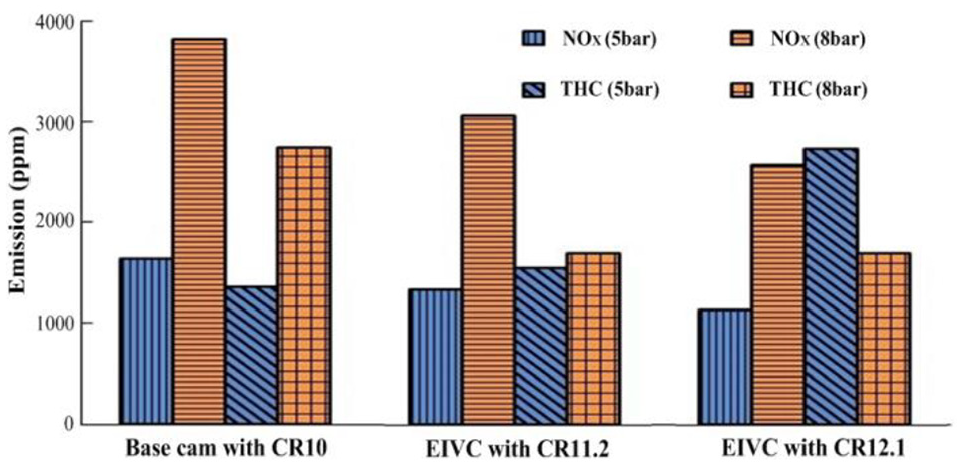
THC and NOx emission of the original and EIVC engines at partial load.
As depicted in Figure 11, the THC emission of the MCE with CR 12.1 is about 2700 ppm at 2000 r/min 5 bar operation, which almost doubles that of the original engine with the value of 1300 ppm. While under the condition of 2000 r/min 8 bar operation, compared to the original OCE, the THC emissions of MCE have decreased from 2700 to 1700 ppm. Thus, it can be deduced that the Miller effect reduces THC emission at higher load while increases THC emission at low load. As CR increases, the modified piston structure of EIVC engine becomes more complicated, which deteriorates the clearance effect. In addition, at lower load condition, the shorter compression stroke of EIVC engine leads to a lower combustion temperature, which exerts a negative effect on the fuel evaporation and blending.25,26 It is mainly these two contributors that lead to an increase in THC emission. However, with the rise of load, the evaporation and mix of the fuel have been improved due to the increased combustion temperature inside cylinders, and the positive effect of a higher CR on the combustion performance becomes prominent, both of which contribute to the THC emission reduction at higher load.
Conclusion
In this article, the experimental study on the effects of Miller cycle with higher CR on the performance and emission of a turbocharged GDI engine was conducted under partial and full load operations, based on the engine bench. The related parameters, including BMEP, BSFC, AI50, PMEP, and EMEP have been continuously measured. On the basis of this, the influence factors for the difference between MCE and OCE were revealed. The conclusions are summarized as follows:
At full load, compared to OCE, the maximum power of MCE is compromised slightly due to the intake air loss resulted from EIVC, with average reduction percentage of 1.5% in BMEP. However, the BSFC has a strong correction with engine speed. To be specific, at 2000 r/min speed, the BSFC of MCE increases slightly. While at 4000 r/min speed, the BSFC of MCE with CR 11.2 decreases from 305 to
Despite the fact that the Miller cycle can provide a good anti-knock performance due to its low in-cylinder combustion temperature caused by the lower effective CR, the knock limit is actually constrained by CR. This helps explain the fact that compared to the MCE with CR 11.2, the BSFC of MCE with CR 12.1 increases by
At partial load, the BSFC of MCE with CR 11.2 and 12.1 has reduced by 6.52% and 5.54% at 5 bar, respectively, while 3.72% and 4.48% at 8 bar, respectively. Apart from the contributor that a larger spark advance angle can be adopted for MCE at partial load, the positive role that the Miller cycle plays in the engine pumping loss reduction also matters. To be specific, the pumping loss of MCE can be reduced not only by the adoption of a wider throttle opening but also a greater use of exhaust energy at partial load.
Since the excess air coefficients of the original OCE and MCE are both closer to the chemical equivalent ratio at partial load, thus contributing little to the CO emission reduction by the use of the Miller cycle. While for the emission of NOx, the combustion temperature inside the cylinders of MCE can be well reduced owing to the lower effective CR, especially at high load, which effectively reduce the NOx emission compared to the conventional OCE, with average reduction percentages by 18% for MCE with CR 11.2 and 26% for MCE with CR 12.1 at 5 bar, respectively, and 24% and 32% at 8 bar, respectively. However, it shows the opposite trend of the THC emission of MCE at 5 and 8 bar, compared to OCE. To be specific, the THC emission increases at low load, while decreases at higher load.
According to what has been discussed above, although a turbocharged MCE does show fuel consumption reduction and thermal efficiency improvement, it is still at the cost of engine torque or power degradation at low- and high-speed operations to a certain extent. Thus, it is most suitable to apply the Miller cycle into a hybrid vehicle at middle-speed range. At the low- and high-speed range, the insufficient torque or power output can be compensated by the help of driven motors. This makes the hybrid vehicles hold a favorable performance both in the economy and power improvement at a larger speed or load range, compared to the traditional gasoline vehicles.
Footnotes
Appendix 1
Handling Editor: James Baldwin
Declaration of conflicting interests
The author(s) declared no potential conflicts of interest with respect to the research, authorship, and/or publication of this article.
Funding
The author(s) disclosed receipt of the following financial support for the research, authorship, and/or publication of this article: National Natural Science Foundation of China (Grant number: 51806143), Ma’anshan Engineering Technology Research Center Open Fund Project (QMSG 202004, QMSG202005), Academic Support Project for Top Talents of Disciplines (Majors) in College (gxbjZD63).
