




Abstract
The deformation and significant settlement of surrounding rock often occur during tunnel construction with the condition of abundant water and weak cementing sand. In order to study the construction method and stability under such soft stratum, this article takes Taoshuping tunnel as the engineering background and puts forward a new tunnel construction method—double-heading advance construction method by comparing the advantages and disadvantages of various traditional construction schemes. The numerical simulation of tunnel construction process using this method is carried out to illustrate the rationality and feasibility of the method. The conclusions are drawn by comparing the numerical simulation results with the field monitoring data analysis. The numerical simulation results show that the maximum settlement value caused by excavation construction is in the parts 5 and 6 of the upper half-section and the part 7 of the central section. The settlement values of parts 5, 6, and 7 accounted for 32.4%, 24.3%, and 18.9% of the total settlement values, respectively. So, the supporting measures for double-heading advance excavation construction of these three parts should be strengthened properly. The stress of the right hance changes greatly before and after the demolition of temporary support. The maximum positive value of stress is 23 kPa and the maximum negative value of stress is −32 kPa. Therefore, the length of temporary bracing should be strictly controlled during construction and the monitoring of the right hance area should be strengthened. Furthermore, it is necessary to strengthen the supporting measures and monitoring in the right spandrel area as the surrounding rock pressure in the right spandrel area is higher than the left spandrel area. The optimum excavation height of the upper half-section in Taoshuping tunnel is determined to be 5.4 m and the reasonable excavation distance between parts 1 and 5 is determined to be 25–30 m by parameter optimization. Finally, the variation law of numerical simulation and field monitoring results is consistent, which shows that the double-heading advance construction method has a better effect on the stability control of surrounding rock, and the rationality and feasibility of this method are validated effectively. Therefore, the double-heading advance method is suitable for tunnel construction in the sand stratum with rich water and weak cementation, and the successful implementation of this method in Taoshuping tunnel also provides a reference for subsequent tunnel construction in the sand stratum with rich water and weak cementation.
Keywords
Introduction
In recent years, there is an increasing trend in the number of mountain tunnels with the rapid development of traffic construction in China. In the construction process, the sand stratum with rich water and weak cementation is often encountered, which is characterized by the low cohesiveness and cementation as well as the poor self-stability.1–5 A lot of practice show that different construction methods will exert different influences on the deformation of surrounding rock and the force of supporting structure. Therefore, it is of great significance to select reasonable methods in the tunnel construction in water-rich and weakly cemented sand stratum to ensure the safety of construction.
Among the existing studies, tunnel construction methods specially for water-rich sandy stratum have not yet been found, but there are many studies on tunnel construction in relevant soft stratum. Given the tunnel construction with a large section in weak stratum, the multi-heading step construction methods are often employed such as cross diaphragm (CRD) method, double-side drift method, and three-bench seven-step excavation method.6,7 In the tunnel construction of weak surrounding rock, based on the shield method, Liu et al. 8 studied the diffusion rules of grouting in shield construction under high water level fine sand geological condition by means of theoretical analysis and numerical calculation. Based on the special geological condition of the water-rich erosive fracture zone of Guangzhou Metro Line 7, Zhang et al. 9 analyzed the geological hazards induced by shield construction under this geological condition and put forward relevant treatment measures. Besides, according to Zhao et al., 10 taking Brenner exploration tunnel as an example, the excavation and construction law of tunnel boring machine (TBM) in fault brittle rock mass was studied by in-depth simulation. Vardakos et al. 11 used Universal Distinct Element Code (UDEC) software to carry out numerical analysis for Shimizu large-section tunnel in Japan, verifying the mechanical construction effect of “TBM heading excavation method,” and they studied the law of surface subsidence at the same time. By the step method, full section method, and CRD method in the excavation of soft rock tunnel, Zhao et al. 12 adopted FLAC3D to simulate the stress of the surrounding rock in the process of construction, and the results showed that the excavation based on CRD method had a good controlling effect on the displacement of surrounding rock. With the engineering background of Chongqing Rail Transit Line No. 3, Zhang and Liu 13 carried out the numerical analysis to study the construction characteristics based on the one-sided and two-sided heading method. Finally, considering the shortcomings of two-sided heading method such as complex construction process and slow progress, they chose one-sided heading method for the tunnel excavation. Wang et al. 14 elaborated the key considerations in the employment of CRD method and center diaphragm (CD) method in the soft rock.
In the process of tunnel construction, the establishment of strict monitoring and measurement provides a means for ensuring safety, which is also a reference for the verification of the stability.15–19 From the perspective of monitoring of the tunnel in soft surrounding rock, the three-dimensional (3D) convergence measurement method was adopted in the construction of Glover double-tunnel three-lane highway tunnel in Slovenia in order to monitor the displacement of tunnel section and the stress of lining and surrounding rock and also to check the stability of New Austrian tunneling method (NATM) construction support. 20 In addition, taking the 200 m2 highway tunnel as the background, Ito et al. 21 employed the TBM method to drive a heading tunnel with the diameter of 5 m first, and then, NATM was used for expanding the large section. According to the displacement that had been monitored, the deformation behavior could be predicted after such expansion. Sakurai et al. 22 combined the parameter monitoring with back analysis method to judge the stability of surrounding rock. By means of on-site monitoring, Han et al. 23 discussed and studied the stress and deformation law of shaft construction in water-bearing soft rock stratum, which guided the design and optimization of shaft. Utilizing the investigation into the convergent deformation of the shallow buried tunnel, Kontogianni and Stiros 24 proposed the final prediction concerning the whole deformation process of tunnel excavation. Water has great influence on the mechanical properties of surrounding rock.25–27 From the effect of underground water on the tunnel construction in soft surrounding rock, Lee and colleagues,28,29 based on an indoor test, theoretical analysis, and numerical calculation, conducted the study on the water-bearing sand tunnel to analyze the influence of groundwater on the stability and supporting structure of tunnel surrounding rock. Zhang and Qiao et al.30,31 also made relevant research on loess soaking induced impacts on a metro tunnel and the safety assessment of tunnel lining.
The above scholars have studied the construction and monitoring methods of tunnels in weak strata, but the applicability of these methods in the construction of tunnels in water-rich soft sand strata has not been studied in relevant literatures. Moreover, due to the complexity of geological conditions in tunnel construction, there is no suitable tunnel construction system specially for water-rich sand strata, and the related construction methods need to be further explored and studied.
With this regard, this article, with the engineering background of the No. 3 intersection of inclined shaft and main tunnel in Taoshuping tunnel in Lanzhou-Chongqing Railway, which is a typical large-section tunnel with rich water and weak cementation, puts forward a new construction method—double-heading advance method based on the comparative analysis of the construction methods of large cross-sectional tunnel in soft surrounding rock and employs the numerical simulation method to investigate the deformation of surrounding rock and stress characteristics of support structure. Besides, through the optimization and analysis of the tunnel construction scheme, this article proposes the optimization suggestion and compares the results of numerical calculation with field monitoring data, which further verifies the rationality and feasibility of the construction scheme.
Engineering situation
Taoshuping tunnel, situated in the eastern terminal of Lanzhou East Railway Station, plays a key role in the construction of Lanzhou-Chongqing Railway. The mileage of the starting point and ending point is DK3 + 435–DK6 + 655, with a total length of 3220 m. It is a single-heading double-line railway tunnel with five inclined shafts, as is shown in Figure 1. The designed length of No. 3 inclined shaft in Taoshuping tunnel is 325 m, and its mileage is DK5 + 040–DK6 + 630. The entrance of the tunnel is lower than the exit, and the terrain fluctuates greatly, which leads to the relative height difference of more than 200 m with an average depth of 60 m. The tunnel excavation span is 14.8 m and the height is 13.4 m. The excavation section area is 180 m2, which is a typical large-section tunnel.

General engineering situation of Taoshuping tunnel.
The stratum of Taoshuping tunnel is mainly composed of quaternary holocene artificial filling sandy loess, upper pleistocene aeolian sandy loess, middle pleistocene aeolian sandy loess, alluvial pebble soil, coarse conglomerate soil, and fine conglomerate soil. The main composition of bedrock is upper tertiary sandstone. Figure 2 shows the stratum distribution of Taoshuping tunnel. The tunnel mainly goes through the sand-mud coarse gravel stratum with weak cementation and orange calcareous cementation fine sand. The surrounding rock is mainly composed of silt and fine sand. The stratum is light red, whose self-stabilization is difficult and fluidity is large. Its cementation and diagenesis are poor, and a calcareous semi-cemented or cemented lens is formed locally. In the process of construction, the tunnel may be confronted with large settlement deformation, easy collapse, and great difficulty in construction. The surrounding rock is identified as Grade VI soft rocks (Figure 3(a)). At the bottom of the tunnel, there is calcareous weak cemented sandstone whose thickness is from 2 to 3 m. In addition, the water level of the tunnel is relatively high with large daily drainage of about 1000 m3 (Figure 3(b)). Groundwater is mainly bedrock fissure water, and part of bedrock fissure water in tunnel is limited by recharge source. Its water-rich degree is poor and it belongs to weak water-rich area.

The stratum distribution situation of Taoshuping tunnel.

Surrounding rock and water gushing conditions of Taoshuping tunnel: (a) fine sandstone and (b) inflow of tunnel water.
Under such geological conditions, each process in the construction of large-section tunnel exerts great influence on each other, which would lead to high construction risk. The main problems in the construction process are as follows:
The large inflow of tunnel water, as well as the strong flow of sand with water, would pose difficulties in the construction process, precipitation, and drainage.
There is no self-stabilizing ability after the excavation of fine sand surrounding rock of Grade VI with weak cementation. The large deformation of surrounding rock and the construction disturbance would cause the collapse of the surrounding rock and the deformation and cracking of the initial support.
The construction procedures are complex with low efficiency. The excavation height and excavation distance of the sidewall may lead to the collapse of surrounding rock.
Tunnel construction scheme
Due to the weak surrounding rock, large section, high groundwater level, and tight schedule of the Taoshuping tunnel, the excavation scheme should be focused on the following:
The groundwater level in the tunnel is high, and the fine sandstone with weak cementation loses its self-stability in case of water. Therefore, during the construction process, the smooth dewatering must be ensured in the tunnel.
During the construction process, it is necessary to ensure that the deformation and stress of the surrounding rock do not exceed the design requirements to ensure construction safety.
There are many steps in the tunnel excavation process, while the working space is small. Therefore, the adopted scheme should be made for the convenience of construction.
The aim of selecting the construction scheme for the large-section soft rock tunnel is to divide the large section into several small sections for excavation and to provide the supporting structure in time. For soft rock tunnel, the commonly used methods are CRD method, double-side drift method, and three-bench seven-step excavation method, or several excavation methods used in combination. Table 1 shows a comparison of these three methods. From Table 1, it can be seen that CRD method and double-side drift method perform well in controlling the deformation of the surrounding rock, but the construction progress is slow and the cost is high, and dewatering is not easy when CRD method is applied. Three-bench seven-step excavation method has advantages over the CRD method and double-side drift method in the construction progress and the cost. However, from the aspect of controlling deformation and dewatering, the settlement of surrounding rock is relatively large and dewatering is difficult when three-bench seven-step excavation method is used. Therefore, it can be concluded that the three construction methods have their own advantages and disadvantages.
Comparison between tunnel excavation schemes.

CRD: cross diaphragm.
From the practical point of view of the project, combining the advantages of the three methods, this article proposes a new tunnel construction method suitable for the water-rich soft strata—double-heading advance construction method. The tunnel section diagram of the double-heading advance construction method is shown in Figure 4 (the unit in the figure is cm). The construction process and key points of this method are as follows:
Excavation of guide tunnels on both sides (parts 1–4): at first, parts 1 and 3 are excavated. At the same time, the initial and temporary support is supplied immediately and then temporary inverted arch is set. Begin to excavate parts 2 and 4 when the construction footage of parts 1 and 2 is from 3 to 5 m, connecting the steel frame quickly and closing the ring in time. The purpose of the excavation of part 1 to part 4 first is to utilize gravity precipitation to enhance the effect of precipitation effectively. The lower hard stratum is excavated first. The steel frame arch foot is stable and the whole settlement is small.
Excavation of the upper half-section (parts 5 and 6): the upper half-section is excavated after the excavation of parts 1–4. Arc heading prepared core soil construction method is adopted in the upper half-section. Specific practices are as follows: excavate part 5 first and excavate the arch in place in one step. The initial upper support must be jointed in place in one step to form a closed loop in order to reduce the disturbance caused by repetitious jointing on surrounding rock. Part 6 is excavated after part 5 has been constructed with 3–5 m safe length. The temporary inverted and CD shall be provided. Meanwhile, timely backfill grouting shall be adopted at back of initial support.
Excavation of soil in central section (part 7): according to the actual situation at site and measurement data, part 7 is excavated when the surrounding rock is in a stable state.
Excavation of inverted arch part (part 8): part 8 is excavated after part 7 has been excavated to the suitable length and initial support shall be provided timely to form a closed loop.

Tunnel section diagram of the double-heading advance construction method: (a) diagram of horizontal section and (b) diagram of vertical section.
The double-heading advance construction method is different from both-side heading method and CRD method. The main advantages are as follows:
First, the purpose of excavating the pilot holes on both sides is to precipitate water, and excavating the double-pilot holes of the bottom first is conducive to more thorough precipitation. The small pilot hole is beneficial to the construction rapidly, and pilot hole of each side is an independent small hole system with a higher safety factor that cut off the influence of groundwater gathering on the core of the tunnel, which will provide a guarantee for the safe construction of the tunnel at the later stage.
Second, the double-heading advance construction method adopts the supporting method of the first foot and the arch later from the bottom to the top, which reduces accumulated large settlement value from the top to the bottom in construction, and solves the problem that the convergence and deformation of the weak surrounding rock are difficult to be controlled.
Third, the time of the convergence and deformation of the surrounding rock in silty sand stratum after tunnel excavation is long. In fact, the double-heading advance construction method starts from the arch feet on both sides and finally completes the excavation and support of tunnel circumferential contour. It can stabilize the face of the tunnel by fully retaining the large core soil, supplementing temporary inverted arch and the middle wall to strengthen support, which could control continuous convergence and deformation in tunnel construction.
Fourth, the upper half-section of the tunnel is formed by one excavation of the arc guide pit and the initial support of the steel frame is joined together at one time. The construction deviation is small, the initial support construction quality is high, and the construction safety is high.
Numerical simulation study
The numerical simulation method is used to analyze the stability of tunnel surrounding rock under double-heading advance construction method by using Midas GTS NX finite element software32,33 to illustrate the applicability of the proposed method in this article to the soft stratum.
3D geological model and parameters
In the 3D finite element model, the vertical direction of the model is Z direction, the axial direction of the tunnel is Y direction, and in the horizontal direction, the X direction is perpendicular to the axial direction of the tunnel. According to the relevant design theory of tunnel, the influence range of tunnel excavation is 3 to 5 times the diameter of tunnel. Therefore, the size of the model in three directions of X, Y, and Z is determined to be 100 m × 60 m × 80 m, which guarantees the accuracy of model calculation. The surface of the model is the free boundary, and the bottom surface is constrained by vertical displacement. The outer boundary of the surrounding rock is the normal displacement constraint of the vertical rock surface.
The surrounding rock of the tunnel is simulated by hexahedron solid element, the lining adopts beam element, and anchor rod adopts rod element. The lining thickness is 350 mm, and the temporary support is 200 mm. The model consists of 81,840 units and 57,806 nodes. In the numerical calculation, the Mohr–Coulomb criterion is applied to the yield criterion of materials. The order of tunnel excavation is shown in Figure 5.

Tunnel excavation sequence of double-heading advance construction method.
The traditional method needs to carry out the full-section vacuum light well-point precipitation in order to guarantee the effect of precipitation. In the double-heading advance construction method, the gravity precipitation can be used effectively through the excavation of the lower pilot tunnel, which greatly improves the effect of precipitation, solves the construction technical problems of water gushing and flow sand in construction, and eliminates the influence of water on the stability of tunnel surrounding rock during construction. Therefore, the influence of water on the surrounding rock of the tunnel is not considered in the numerical calculation process.
According to the geological survey report of tunnel, physical and mechanical parameters of surrounding rock are shown in Table 2.
Parameters of the surrounding rocks and supporting structures in Taoshuping tunnel.

Analysis of stability of construction scheme
Displacement of surrounding rock
Figure 6 is the settlement variation law curve of surrounding rock. It can be shown that during the excavation process with the double-heading advance construction method, the settlement rates of the vault and the left and the right spandrels are relatively flat before the excavation of part 5. But the settlement rate drastically increases during the excavation process of part 5, and the settlement value is large. After the excavation of part 7, the settlement rate tends to be stable. Besides, after 20 steps of excavation of the vault, that is, from the beginning of the excavation of part 5 to the completion of the excavation of part 7, the settlement rate of the vault is slightly larger than those of the left and right spandrels. After the settlement rate tends to be stable, the vault settlement reaches 37 mm ultimately, and the difference between the settlements of the left spandrel and the right spandrel is small, which is stable at 30 mm and accounts for 81% of the settlement of the vault.

Settlement variation law curve of surrounding rock.
Figure 7 shows the convergence variation law curve of surrounding rock. In general, the changes of convergence trends of the spandrels are similar to those of the lower left and the lower right pilot tunnels. After 30 steps of construction, the convergence value of the lower right pilot tunnel has slight fluctuations, leading to continuous changes in the convergence value. From the final convergence value, the difference between convergence values of the lower left pilot tunnel and the lower right pilot tunnel is small and the value stables at 15 mm. However, the spandrel’s convergence value is relatively large. Because part 5 is excavated in place at one time, the convergence and deformation are relatively large, reaching 36 mm. Therefore, during the construction process, support shall be provided timely, and the upper initial steel frame must be jointed in place by one step to form a closed loop to reduce the disturbance on the surrounding rock caused by repetitious jointing.

Convergence variation law curve of surrounding rock.
Figure 8 shows the effect of the eight excavation parts on the tunnel vault settlement under the double-heading advance construction method. From Figure 8, it can be shown that the excavation of part 5 leads to the maximum vault settlement, reaching 12 mm and accounting for 32.4% of the total settlement. The settlements caused by the excavation of parts 6 and 7 are 9 and 7 mm, accounting for 24.3% and 18.9% of the total settlement, respectively. The settlements caused by the excavation of parts 1, 2, 3, 4, and 8 are all around 2 mm. From the analysis of the stage settlement data, the sum of settlement caused by the excavation of three parts—parts 5, 6, and 7, accounts for about 75.6% of the total settlement. Therefore, in the process of tunnel construction, when these three parts are excavated, the supporting measures can be appropriately reinforced, and the excavation step distance between each part should be taken to ensure the safe construction in the tunnel.

Effect on the vault settlement caused by the excavation parts.
Force of supporting structure
Figure 9 is the force nephogram of the tunnel supporting structure. It can be shown that the maximum value of positive bending moment appears on the right spandrel, reaching 35.3 kN·m; the maximum value of negative bending moment appears at the sidewall, reaching 31.1 kN·m; the rock bolt axial force at hance is mainly compressed, and the remaining parts are mainly pulled. The rock bolt axial force at vault reaches a maximum value of 16 kN.
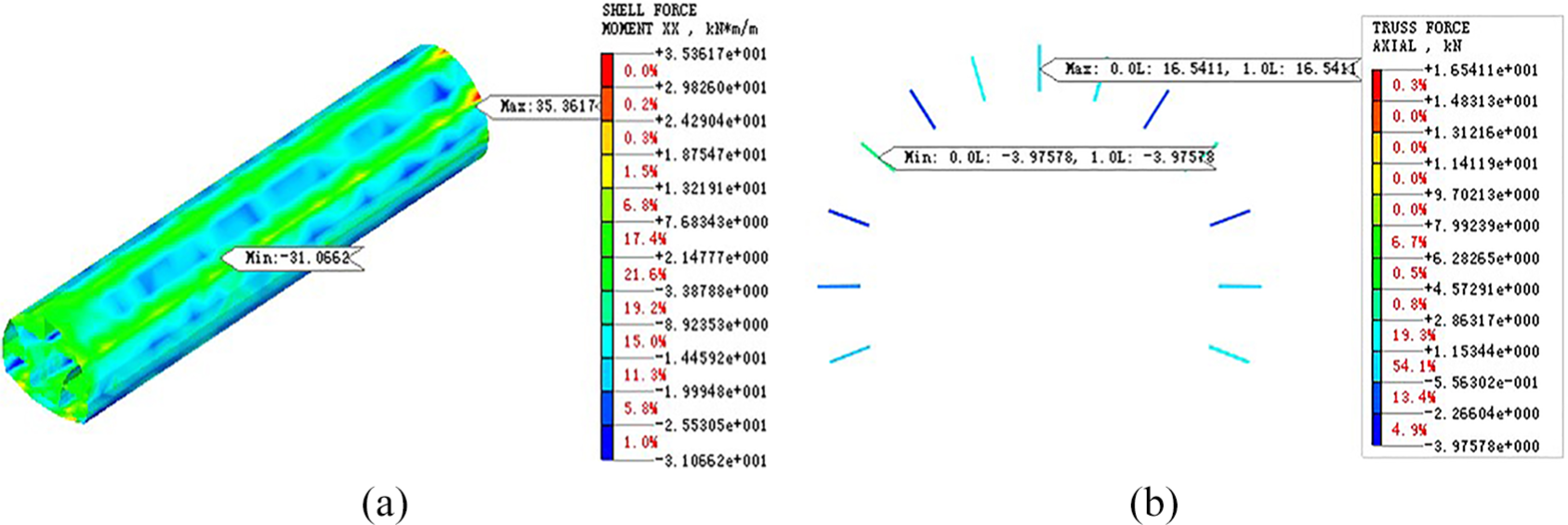
Nephogram of force of tunnel supporting structure: (a) bending moment of shotcrete and (b) axial force of rock bolt.
Figure 10 shows the changes in initial support stress before and after temporary support is demolished. It can be seen that the maximum stress is at the right hance before the temporary support is demolished, reaching 23 kPa. The supporting stress value at the right hance becomes negative and reaches a maximum value of −32 kPa after the temporary support is demolished. The direction of stress value at the right hance has obviously changed before and after the demolition of temporary support. While the direction of support stress value at other parts was not changed, it can be observed that the demolition of temporary support has a great impact on the right hance area. Therefore, the length of the demolition of the temporary support must be strictly controlled during the construction. The monitoring of the right hance area should be strengthened.

Variation law in supporting stress before and after temporary support is demolished.
Plastic zone
Figure 11 shows the plastic zone distribution caused by tunnel excavation. With the gradual progress of tunnel construction, crustal stress is continuously released during the construction process, and plastic deformation occurs in some areas of tunnel surrounding rock.34,35 It can be seen from Figure 11 that the plastic zone is mainly concentrated in arch springing areas and vault areas on the left and right sides. The Taoshuping tunnel is a double-line tunnel with a relatively large span. The plastic zone is relatively large under this construction method. Therefore, it is necessary to install feet-lock pipes during the construction process. On one hand, the load of the upper structure is transferred to the inside of the surrounding rock in order to increase the bearing capacity of the foundation. On the other hand, the feet-lock pipes can strengthen the surrounding rock to ensure safety during the construction process, and at the same time, it is necessary to strengthen field monitoring to observe the changes in the surrounding rock.

Distribution of plastic zone in surrounding rock of Taoshuping tunnel.
By fully retaining and utilizing the large core soil to stabilize the face of the tunnel, the double-heading advance construction method is supplemented by temporary inverted arch and middle-wall measures to strengthen the support. However, the existence of plastic zone can easily lead to instability of temporary support structure and then affect the stability of core soil during the excavation of guide tunnel. The numerical simulation results show that the stress and displacement at the temporary support position are small, and the overall state is relatively stable during the excavation of the left and right guide tunnels. Moreover, because of the timely implementation of temporary support measures, the excavation process of the pilot tunnel has little influence on the core soil of the upper half-section, and the core soil is in a stable state, which plays a very good maintenance role for the stability of the face.
From the above analysis, it can be seen that after the completion of the construction, the surrounding rocks are almost in a stable state, which further demonstrates that double-heading advance construction method is reasonable.
Optimization of construction scheme
Determination of reasonable excavation height of upper half-section
In the process of excavation under the double-heading advance construction method, the space in the middle of the tunnel will be small if the excavation height of the upper half-section is too large, which is not conducive to the construction. If the height of the excavation in the upper half-section is too small, the space in the upper part of the tunnel will be too small. At the same time, the steel frame at the arch needs to be jointed several times, which makes the excavation of the arch in one step more difficult. Considering the above construction factors, the excavation height of the upper half-section should not be too large or too small. The maximum and the minimum are the two critical values of excavation height of the upper half-section. According to the site conditions of Taoshuping tunnel, the minimum designed excavation height of the upper half-section is 5.4 m and the maximum designed excavation height is 6.2 m. Therefore, the reasonable excavation height of the upper half-section is between 5.4 and 6.2 m.
In order to obtain the reasonable excavation height of the upper half-section, three schemes are selected in the above-mentioned range of excavation heights as follows: (1) Scheme 1: the excavation height of the upper half-section is 5.4 m; (2) Scheme 2: the excavation height of the upper half-section is 5.8 m; and (3) Scheme 3: the excavation height of the upper half-section is 6.2 m. Figures 12–14 show displacement nephograms of three excavation schemes.

Displacement nephogram of Scheme 1.

Displacement nephogram of Scheme 2.

Displacement nephogram of Scheme 3.
After the simulation, the displacements of surrounding rock under these three schemes are shown in Table 3.
Displacement comparison of tunnel surrounding rock under different excavation heights.
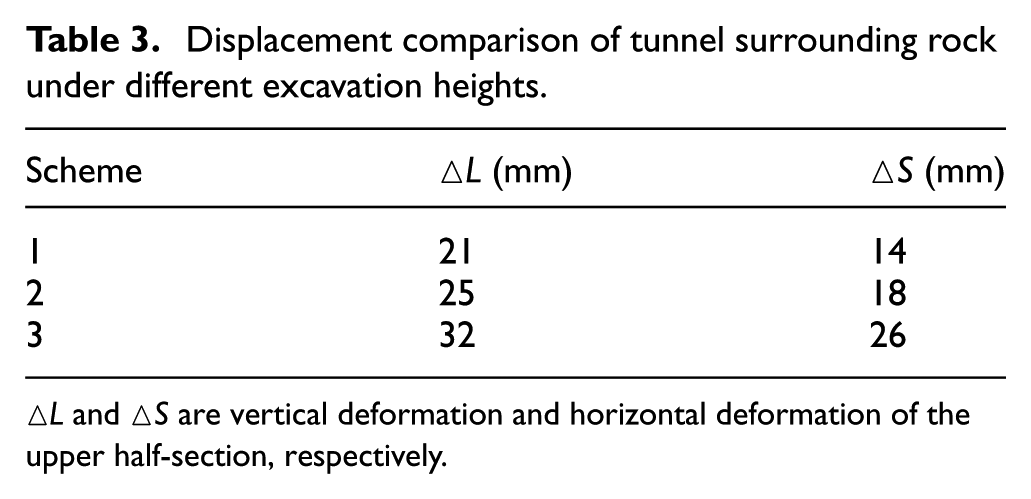
△L and △S are vertical deformation and horizontal deformation of the upper half-section, respectively.
From Table 3, it can be found that
The vertical deformation of the upper half-section increases with the increase in the excavation height. When the excavation height of the upper half-section is 6.2 m, the vertical deformation reaches 32 mm, which is 34% larger than that when the excavation height is 5.4 m.
The regularity of changes of the horizontal deformation of the upper half-section is the same as those of the vertical deformation. When the excavation height is 6.2 m, the horizontal deformation reaches the maximum value of 26 mm, which is 46% larger than that when the excavation height is 5.4 m.
From the above analysis, it can be found that reducing the excavation height of the upper half-section is beneficial to control the vertical and horizontal deformations. However, considering the advanced dewatering of the two holes at the bottom, the upper half-section should not be too small. Therefore, Scheme 1 is adopted in the actual excavation, that is, the excavation height in the upper half-section is 5.4 m.
Reasonable excavation step distance between parts 1 and 5
The step distance between parts 1 and 5 is the key point in the construction process. If the pilot tunnel is too long, and the step distance is too large, it will be difficult to ventilate in the tunnel, which will seriously deteriorate the construction conditions and increase the time of the excavation process of sand production. Moreover, the long pilot tunnel will lead to pipe blockage of spurting concrete and increase the time of the excavation process. If the step distance between parts 1 and 5 is too small when the right and left pilot tunnels are not stable, the excavation of part 5 will easily cause the tunnel collapse.
In order to explore the reasonable excavation step distance between parts 1 and 5, three excavation schemes are optional: (1) Scheme 1: the step distance between parts 1 and 5 is 20 m; (2) Scheme 2: the step distance between parts 1 and 5 is 25 m; and (3) Scheme 3: the step distance between parts 1 and 5 is 30 m. The surrounding rock pressure and deformation under different distances between parts 1 and 5 are shown in Table 4.
From the settlement of the vault and the convergence of the spandrels, it can be seen that the settlement of the vault and the convergence of the spandrels decrease with the increase in the excavation step distances between parts 1 and 5. The settlement of the vault and the convergence of the spandrels in Scheme 3 are only 58% and 53% of those in Scheme 1.
From the pressure of the surrounding rock, the pressures of the left spandrel and the right spandrel first decrease and then increase as the excavation step distance increases. The common point of the three schemes is that the pressure of the right spandrel is greater than that of the left spandrel, of which the pressures of the left and right spandrel in Scheme 2 are the least.
Comparisons of surrounding rock pressure and deformation under different distances between parts 1 and 5.

From the comparison of the results of these three schemes, different excavation step distances have a great impact on the stress and displacement of the surrounding rocks. Considering various factors such as the construction environment and the stability of the surrounding rock, the excavation step distance between parts 1 and 5 should be between that of Scheme 2 and Scheme 3. Therefore, the reasonable excavation step distance between parts 1 and 5 should be 25–30 m.
Suggestions on construction optimization
According to the simulation results of the double-heading advance construction method and the conditions of on-site construction, the following optimizations are suggested for tunnel excavation:
In the water-rich soft sand stratum, the influence of water on construction is obvious, and the principle of pilot tunnel excavation first and then precipitation in tunnel should be strictly implemented. After the excavation of the left and right guide tunnels is completed, the dewatering work in the tunnel should be carried out as soon as possible to minimize the influence of water on the surrounding rock and ensure the tunnel construction in an anhydrous environment.
Due to the advancement of the double pilot tunnels in the lower half-section, the partial construction of the upper half-section will bring such problems as the initial support steel frame to be assembled several times, difficult installation, and poor force of the steel frame, and it will affect the overall support quality. In addition, the construction of fine sandstone surrounding rock should not be divided into multiple steps from the top to the bottom. Every step will make the sand flow and the arch deform. Therefore, the number of steps should be reduced as much as possible.
During tunnel excavation, the optimal excavation height for the upper half-section is 5.4 m, which can not only guarantee the smooth dewatering of the double pilot tunnels but also effectively control the deformation of the surrounding rock.
Considering such factors as construction environment in the pilot tunnel, integrated ergonomics, and the balance during construction, the construction shall conform to design specifications and reasonable safety measures should be taken. The reasonable step distance between parts 1 and 5 is 25–30 m.
During the construction of double-heading advance method, the surrounding rock pressure of the right spandrel is generally larger than that of the left spandrel. Therefore, during the construction process, support measures must be strengthened in the right spandrel area. The number of rock bolts can be appropriately increased, and monitoring and observation of surrounding rock changes must be strengthened.
On-site monitoring and analysis
In view of the geological conditions, construction techniques and structure characteristics of Taoshuping tunnel, the No. 3 inclined shaft section of Taoshuping tunnel is excavated by double-heading advance construction method to meet the design and construction verification requirements of large section and particularity of surrounding rock in Taoshuping tunnel. During the construction, the surrounding rock is monitored, and the selected monitoring items include surrounding rock pressure, arch settlement and clearance convergence. The monitoring results of the typical section DK5 + 180 are analyzed.
The monitoring results and analysis of the surrounding rock pressure
Figure 15 shows the monitoring results of surrounding rock pressure distribution of section DK5 + 180, from which, it can be found that the pressure values at the five measuring points are quite different. As can be seen from the maximum value of the process, the surrounding rock pressure at the vault of DK5 + 180 section is the largest, reaching 123.21 kPa. The surrounding rock pressure at the right spandrel, 109.94 kPa, is slightly less than that of the vault. However, there is no significant difference between the surrounding rock pressures of the left spandrel and the left and right lower pilot tunnels. From the final stability value, it can be seen that the surrounding rock pressure at the vault is the largest among the five measuring points, followed by the surrounding rock pressure at the right spandrel. It should be noted that the surrounding rock pressure of the vault is close to the maximum value after the vault is stable. Thus, it can be concluded that pressure is concentrated in some measuring points of the surrounding rock. From the actual construction situation, it is found that because the surrounding rock at the right spandrel has a slight external squeezing, the surrounding rock pressure at the right spandrel is greater than that at the left spandrel. At the stage of excavation and support, the surrounding rock pressure has a wide range of changes. Therefore, during the construction, the length of the excavation should not be too large, and the initial support should be timely provided. At the same time, it is recommended that the construction be protected against drainage.

Monitoring results of surrounding rock pressure distribution: (a) maximum value of the process (unit: kPa) and (b) final stability value (unit: kPa).
The pressure of surrounding rock is measured by arranging pressure box on site. The accuracy of pressure box is accurate enough to reflect the change of surrounding rock pressure in real time, which fully meets the requirements of guiding actual construction. Compared with the results of numerical simulation, the results of field test are on the small side. This is because the numerical simulation is based on the ideal state. There are some differences between the model and the actual situation, which leads to the difference between the numerical simulation results and the field monitoring results.
The monitoring results and analysis of the surrounding rock deformation
Figure 16 shows the settlement time curve of the tunnel arch. From Figure 16, it can be seen that in the construction process of part 5 of the tunnel, the settlement rates of the vault and the left and right spandrels reach the maximum value, the increase in settlement is the largest, the vault settlement reaches 30 mm, and the left spandrel and right spandrel reach a settlement of 25 mm. After the completion of the excavation of part 5, the settlement rate changes slowly during the following construction process. After the completion of the construction of parts 6 and 7, the settlement amount reaches 41 and 45 mm. After the settlement of the arch reaches a stable level, the vault settlement reaches 50 mm. It can be seen that the maximum settlement caused by the excavation of parts 5, 6, and 7 accounts for 80% of the total settlement. There is little difference in value between the settlement amount of the vault, the left spandrel, and the right spandrel. Therefore, the excavation of the arch is a key control technique in the construction process, during which, the support of the arch and other surrounding parts should be strengthened.

Settlement time curve of the tunnel arch.
Figure 17 shows the clearance convergence time curve of the tunnel. It can be seen that the convergence values of the left and right pilot tunnels have the same variation trend, and the difference between them is small. The convergence value of the lower right pilot tunnel, about 4 mm, is slightly larger than that of the lower left pilot tunnel, indicating that the excavation of the right pilot tunnel has a slight influence on the left pilot tunnel. The clearance convergence of the spandrels is relatively large because of the great influence of the construction of part 5 on the upper half-section, leading to the large convergence of spandrels, and finally, the clearance convergence holds steady at about 40 mm.
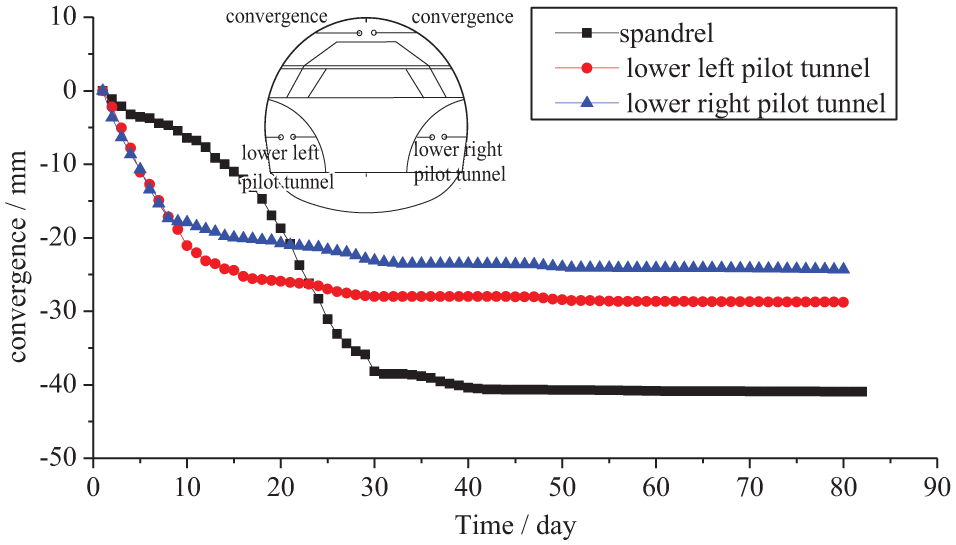
Clearance convergence time curve of the tunnel.
According to “Plan of Railway Tunnel Monitoring Measuring Standardization Management,” Table 5 shows the displacement management levels.
Displacement management levels.

Taoshuping tunnel belongs to the soft rock of Grade VI. From the comparative analysis of on-site monitoring data and displacement management levels, it can be found that although the deformation of the surrounding rock tends to be stable for a long time, the displacements of the vault settlement and convergence are within the normal range, and they change within a reasonable range, which ensures the stability of the surrounding rock and indicates that the double-heading advance construction method is feasible for the tunnel construction.
Comparative analysis between numerical simulation and monitoring results
Figures 18 and 19 are the comparison between numerical simulation and field monitoring of vault settlement and arch shoulder convergence at the section DK5 + 180.

Comparison of vault settlement.

Comparison of arch shoulder convergence.
Figure 18 shows that (1) for the numerical results of the surrounding rock, the settlement of the vault is slow and the settlement value is small before 15 steps of construction; after 15 steps, the settlement rate of the vault increases gradually; after 35 steps, the settlement rate of the vault tends to be gentle and the vault settlement reaches 37 mm. (2) For the field monitoring results, the settlement rate of the vault is lower in 15 days, and the settlement rate of the vault increases rapidly after 15 days, and the settlement rate of the vault tends to be slow after 35 days. The vault settlement reaches 53 mm ultimately. In addition, it can be seen from Figure 19 that the convergence of spandrel from numerical simulation and field monitoring is similar to the vault settlement. From the overall trend, the changing trend of numerical simulation and field monitoring is consistent.
Figures 20 and 21 are the compared results of the maximum displacement and the maximum support stress of the section DK5 + 180 under numerical simulation and field monitoring, respectively. As can be seen from Figure 20, the result of numerical simulation of vault settlement is smaller than that of field monitoring 16 mm, and the numerical simulation results of the spandrel convergence are 2 mm smaller than the results of the field monitoring. From Figure 21, it can be seen that the stress difference between the numerical simulation and the field monitoring at the vault is the largest, and the stress difference at the maximum span is the least, but the change of the five feature points is the same. Because the numerical simulation is established in the ideal state, the mechanical medium of the model is continuous and the mechanical parameters of the model are isotropic, but in the actual tunnel construction, the mechanical parameters of the surrounding rock often show the mechanical characteristics of anisotropic. Therefore, the numerical simulation results are different from the field monitoring results in terms of magnitude.

Comparison of maximum settlement.

Comparison of maximum supporting stress.
From the above analysis, it can be seen that although there is a gap between the results of numerical simulation and field monitoring, the overall change trend is consistent, and the difference of value is small. The settlement is in the range of displacement management grade, and it is proved that double-heading advance construction method in Taoshuping tunnel is feasible.
Discussion
The double-heading advance construction method is a new construction method which is proposed based on the special geological conditions of Taoshuping tunnel. It is suitable for tunnel construction in water-rich, weak cemented silty sand and related water-rich soft stratum. When the surrounding rock is weak and groundwater is abundant, the tunnel construction needs to meet the stability requirements of surrounding rock on one hand with the weak surrounding rock and the abundant groundwater. However, the problem of precipitation should be taken into account. So, the double-heading advance construction method is a more appropriate choice.
Compared with the existing construction methods, the new advanced method proposed in this article can be discussed from the following aspects: first, the new method can effectively control the stability of soft surrounding rock in tunnel construction under soft stratum conditions. Second, the new method has incomparable advantages in precipitation, which is more suitable for tunnel construction in water-rich strata. Third, compared with traditional construction methods, the progress of the new construction method is slow and the construction cost is high. However, water-rich soft stratum belongs to extremely poor geological conditions. In order to ensure the normal construction, precipitation work is particularly important. In this case, it is difficult to meet the requirements of stability and precipitation at the same time if the traditional construction method is still used. The result is easy to cause rework, delay the construction progress, and increase the project cost. From this point of view, the new construction method is more advantageous than other traditional construction methods in terms of schedule and cost control under the specific conditions of water-rich and weak strata, which can provide reference for similar projects.
Conclusion
This study present a new tunnel construction scheme, namely, the double-heading advance construction method, which is suitable for water-rich and consolidated fine sand stratum based on the Taoshuping tunnel project. The construction technology of water-rich and weakly consolidated fine sand tunnel is studied by means of field monitoring and numerical simulation optimization. There are four conclusions as follows:
The maximum settlement value caused by excavation construction is in parts 5 and 6 of the upper half-section and part 7 of the central section. The settlement values of parts 5, 6, and 7 accounted for 32.4%, 24.3%, and 18.9% of the total settlement values, respectively. Therefore, the supporting measures for excavation construction of these three parts should be strengthened properly.
Before and after the demolition of temporary support, the stress of the right hance changes greatly. The maximum positive value of stress is 23 kPa and the maximum negative value of stress is −32 kPa. The length of temporary bracing should be strictly controlled during construction and the monitoring of the right hance area should be strengthened. In addition, the surrounding rock pressure in the right spandrel area is relatively higher than the left spandrel area. So, it is necessary to strengthen the supporting measures and monitoring in the right spandrel area.
After parameter optimization, the optimum excavation height of the upper half-section in Taoshuping tunnel is determined to be 5.4 m and the reasonable excavation distance between parts 1 and 5 is determined to be 25–30 m.
The comparison between numerical simulation and field monitoring results shows that the variation law of numerical simulation and field monitoring results is consistent, which shows that the double-heading advance construction method has a better effect on the stability control of surrounding rock. Its rationality and feasibility are validated, which provides a reference for the tunnel construction in the sand stratum with rich water and weak cementation.
In the actual tunnel construction, the mechanical parameters of the surrounding rock often show the mechanical characteristics of anisotropic. Therefore, the numerical simulation results are different from the field monitoring results in terms of magnitude. However, the numerical simulation results are consistent with the change trend of field monitoring results, which reflects the same law of mechanical parameters. The analysis of comprehensive results shows that the double-heading advance construction method is suitable for the construction of water-rich and weakly cemented silty sand tunnel. The stability of surrounding rock and construction safety can be ensured by this method.
Footnotes
Handling Editor: James Baldwin
Declaration of conflicting interests
The author(s) declared no potential conflicts of interest with respect to the research, authorship, and/or publication of this article.
Funding
The author(s) disclosed receipt of the following financial support for the research, authorship, and/or publication of this article: This paper is supported by the National Natural Science Foundation of China (No. 51578447), the Youth Science and Technology Nova Program of Shaanxi Province (No. 2018KJXX-061), and the Technology Research and Development Project Foundation by the Ministry of Housing and Urban-Rural Development of China (No. 2017K4-032). The financial supports are gratefully acknowledged by the authors.
