




Abstract
Most studies on scheduling problem have assumed that the machine is continuously available. However, the machine is likely to be unavailable for many practical reasons (e.g. breakdown and planned preventive maintenance). Once a machine is not available, the optimal scheme in the deterministic scenario may not be the optimal choice. To address the actual scenario, a scheduling problem with two identical parallel machines, one of which requires periodic maintenance, is considered in this article. For uncertainties in reality, the processing and maintenance time are considered as uncertain variables. A novel method to study the worst-case ratio in an uncertain scenario is proposed. It is shown that the worst-case ratio of the longest processing time algorithm is 3/2 at a high confidence level. Given theoretical analysis results, an modified algorithm is proposed. Finally, numerical experiments are used to verify the feasibility of the modified algorithm.
Introduction
In recent years, scheduling problems with machine availability constraints have aroused increasing attentions. In practice, machine breakdown may often happen during the process operation. If a machine breaks down accidentally, the quality of outputs is likely to be affected. To expand life expectancy of a machine, regular preventive maintenance activities are essential. The machine should stop when undergoing maintenance. The parallel-machine scheduling refers to a typical NP-hard optimization problem. This type of minimization problems concern the performance of any efficient heuristic algorithm over the worst-case choice of inputs. The worst case ensures that approximation algorithms are applicable even in the contexts where there is little or no additional information available about the inputs. The worst-case ratio can be adopted to compare the quality of the algorithm, so it is vital.
Numerous results regarding scheduling problems with interval constraint have been achieved. Note that most of the studies on the interval constraint focuses on the development of algorithms or the worst case bound. Lee
1
considered single-machine and parallel-machine scheduling problems with preventive maintenance, and the worst-case ratios of algorithms under different performance measures were calculated. According to Liao and Chen,
2
a single-machine scheduling problem with interval constraints was investigated, and an efficient branch-and-bound algorithm was proposed. Wang and Cheng
3
analyzed a two-identical-parallel-machine scheduling under the interval constraint to maximize the number of on-time jobs. Liu et al.
4
explored two online scheduling problems with interval constraints. The first one is
Some mentioned literature assumed that there is only one unavailability constraint. However, it is generally impossible that machine failure or preventive maintenance will occur only once. Thus, it is quite meaningful to consider more than one unavailability constraint. Periodic maintenance includes periodic inspections, periodic repairs, and preventive maintenance. If maintenance plans can be arranged in an orderly manner, production efficiency of the enterprise can be improved, and the safety consciousness of workers can be strengthened. Indeed, some of the previously mentioned literature also considered periodic maintenance. But when they discuss this issue, their methods should often be split into many situations. Accordingly, when the number of machines increases, the proposed method is generally inefficient. This article proposes a method that can effectively solve the problem and effectively shorten the certification process.
Almost all existing literature considered this type of problems in a deterministic or random environment. Given the complexity of the real environment, numerous man-made factors exert a potential influence on scheduling horizon. These influences may be uncertain events that cannot be modeled with probability distributions. Experts should be invited to assess the belief degree that an uncertain event will occur. To address belief degrees, Liu 14 established the uncertainty theory. The uncertainty theory is a branch of axiomatic mathematics for modeling human uncertainty, which have many research results of uncertain programming.15–23
In this article, a two-identical-parallel-machine scheduling problem in which one machine is periodically unavailable is studied. The problem is different from that of Xu et al., 8 which is investigated under an uncertain scenario. Besides, there are many cases discussed in Xu et al. 8 The method proposed here is capable of solving the problem effectively and simplifying the proof process. Since the two-parallel-machine makespan-minimization problem without interval constraints is NP-hard, 24 the problem with periodic availability constraints is also NP-hard since the conclusion that an availability constraint complicates the problem. Makespan (the latest completion time of all jobs) is usually regarded as an easy objective function for scheduling problem. However, no polynomial time approximation algorithm with constant worst-case ratio exists unless P = NP even if we assume that at least one machine is available at any time. 25 In fact, some emergencies affect numerous parameters in the production scheduling process. Hence, indeterminacy should be considered by the decision maker. During the production, the processing time of the workpiece and the delivery deadline are affected by factors (e.g. the workshop environment, worker proficiency, order changes, as well as natural disasters). These values cannot be known very precisely. If there are enough historical data, these parameters could be dealt with by means of the probability theory. However, if historical data are unreliable or unavailable, we can make decisions in accordance with the uncertainty theory. Unlike the mentioned literature, the uncertainty theory is introduced into scheduling problems, making more reasonable decisions in the real world. Furthermore, if the scheduling algorithm in a deterministic scenario is still used, the optimal solution obtained may be far from the true optimal solution. Accordingly, this article proposes an effective method to solve the problem under uncertain conditions. Because of the presence of uncertainty, the worst-case ratio is worth analyzing in an uncertain scenario. Owing to the particularity of uncertain scenario, there are few relevant literature. This article attempts to provide a method to analyze the worst-case ratio in an uncertain scenario. Finally, an optimized LPT algorithm is proposed and numerical examples are used to verify its effectiveness.
The main contributions of this article are as follows. (1) The processing time of the job and the maintenance time of the machine are considered uncertain variables, which differ from that of random variables. In the reality of the shop environment, it is more reasonable to consider these factors as uncertain factors. It is considered that all jobs have two selections to be processed by machine 1 or 2, where machine 1 is not always available. (2) Due to the complexity of the uncertain scenario, the deterministic algorithm is no longer applicable, so we design a strategy to assign jobs in an uncertain scenario. The performance boundary of the LPT algorithm in an uncertain scenario is analyzed, and the setting key time instant plays an important role in the proof. (3) Based on the previous theoretical analysis, we propose an optimized LPT algorithm. Numerical experiments show that the proposed algorithm can effectively improve the optimal solution.
The rest of this article is structured as follows. In section “Preliminaries of uncertainty theory,” basic definitions and properties regarding uncertainty theory are introduced. In section “Problem description,” the uncertain parallel-machine scheduling problem periodic constraints is presented. The uncertain worst-case ratio of the LPT algorithm is obtained in section “Worst-case ratio analysis,” and an optimized LPT algorithm based on theoretical analysis is proposed. In section “Numerical experiment,” numerical experiments are performed to verify the feasibility of the proposed algorithm.
Preliminaries of uncertainty theory
Concepts about the uncertainty theory will be introduced as follows.
Let
Axiom I (normality axiom).
Axiom II (duality axiom).
Axiom III (subadditivity axiom).
Besides, the product uncertain measure on the product σ-algebra
Uncertain measure has the following two useful properties: (1) for any events

The uncertain distribution

for any Borel sets
Definition 1
An uncertain variable
Let
Example 1
An uncertain variable

where
Theorem 1
Let

where

where
According to Theorem 1, the following theorem can be gotten.
Theorem 2
Assume that

Definition 2
An uncertain distribution
Problem description
There are

An example.
In practice, numerous parameters are affected by some emergencies. In the process of steelmaking and continuous casting, for numerous uncertain factors (e.g. machine failure, operation error, environmental impact), workers often use their own experience to assess the processing time. Given the difference in proficiency, maintenance workers can only estimate the maintenance time based on their own experience. Thus, the processing and maintenance time are considered uncertain variables following the actual scenario.
Worst-case ratio analysis
Lee 1 considered only one unavailability interval for each machine. Nevertheless, periodic maintenance indicates that there are several unavailability periods. In such scenario, the method proposed by Lee is no longer workable. For the identical parallel-machine scheduling problem, Graham 28 demonstrated that the LPT algorithm exhibits a tight worst-case ratio bound. Some relevant literatures suggested that the LPT algorithm on addressing makespan minimization problem is quite appropriate.5,29,30,31–35
LPT algorithm: Sort all jobs in non-increasing order of their processing times. Each job is subsequently assigned to a machine on which it can be finished as early as possible.
Denote the optimal makespan by
The worst-case ratio of an algorithm
Theorem 3
If two jobs are ranked by their processing times at the confidence level
Proof
Assume that machine
Without loss of generality, it is assumed that uncertain variables
Let

The idea is to set a critical time instant

where “+” denotes

Obviously, that

For

Then

follows from that

According to Definition 1,

Subsequently, according to

and property (equation (1)), it yields

That is,

It is asserted that
Let

If the processing time

Then, there is not a job whose processing time is over

it yields

which is a contradiction by
If there are merely two jobs whose processing time is over

Subsequently

Note that

and

Then, it yields

by equation (1) and

It follows from

that

and

If there is only one job

at the confidence level
Now let the processing time

Note that in the LPT schedule, a job with longer processing time is assigned earlier at the confidence level

and

Then, it yields

by

We will prove that
Otherwise, set

Since

It follows from

that

On the contrary, since

and

it yields

By Axiom II of uncertain measure, it yields

which is a contradiction.
If the last job in machine

or

Note that

or

By equation (1), the conclusion

follows from

and

By Axiom II of uncertain measure, it yields

which is a contradiction.
When

It follows from

and equation (41) that

On the contrary, it yields

by

By Axiom II of uncertain measure, it yields

which is a contradiction.
Accordingly,

Processing time of jobs before
In a word, the uncertain worst-case ratio of the LPT algorithm is 3/2 at the confidence level
To confirm that the uncertain worst-case ratio of the LPT algorithm is tight, we give an example.
For a positive integer

and

where

Take α = 0.9.
According to Theorems 1 and 2, it yields
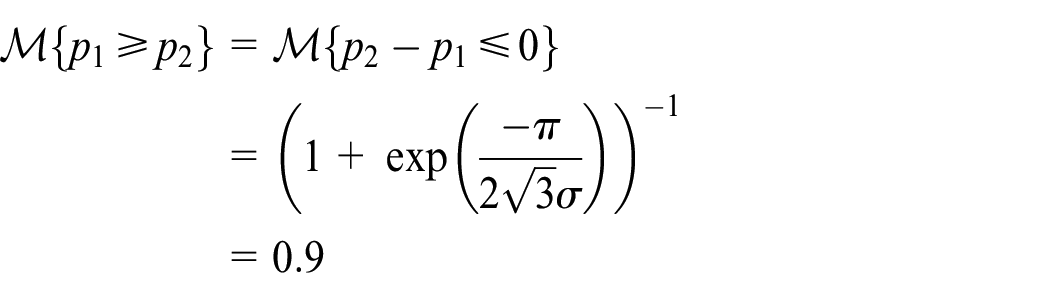
By the same method, we can get the uncertainty distributions of
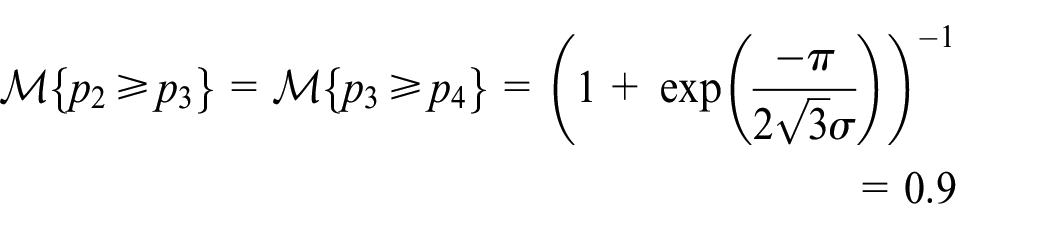
Thus, jobs are sorted as
According to Theorems 1 and 2, it yields

Then, it yields

So, jobs

According to the LPT algorithm, job
According to Theorems 1 and 2, it yields

Then, it yields

According to Theorems 1 and 2, it yields

Consequently

Hence

According to Theorems 1 and 2, it yields

Then, it yields

The optimal schedule assigns

For

that

It follows from

that

which converges to 3/2 as
Remark 1
The condition that
According to Theorem 3, the LPT Algorithm is modified.
Improved longest processing time algorithm (ILPT):
Step 1. Array jobs in descending order of processing time at the confidence level
Step 2. The jobs are arranged according to LPT. When a new job cannot be added in machine 1, the last job (which has the shortest processing time) is arranged in the current batch.
Step 3. Repeat Step 2 until all the jobs are arranged.
Since the gap of each batch is less than that of LPT, ILPT obviously outperforms LPT.
Numerical experiment
To assess the performance of the ILPT algorithm, numerical experiments are performed.
The average-case error (AE) is a vital measure to assess the performance of the algorithm. It is expressed as

where
LS may indicate any greedy method that schedules jobs according to a given priority list. As a matter of fact, LPT can be considered a particular case of LS where the priority list is ordered according to job processing times. Table 1 lists the numerical results of the three algorithms.
Average-case error.

The result reveals that the performances of the three algorithms are being enhanced with the increase in the number of jobs. Besides, in all cases, the performance of the ILPT is superior to the other two algorithms.
Conclusion
In this article, a two-parallel-machine scheduling problem with periodic maintenance was studied. For the existence of non-deterministic phenomena in practice, processing and maintenance time were considered uncertain variables, which is not consistent with problems studied in existing literature. The worst-case ratio of the LPT algorithm under the uncertain scenario was obtained. To analyze the uncertain two-parallel-machine scheduling problem, jobs are sorted by uncertain measure at a relatively high confidence level
For subsequent work, some efficient exact algorithms are worth developing to solve these problems with periodic maintenance. Considerable additional factors (e.g. setup time, due date, and transport time) can be considered uncertain variables. Flow shop, job shop, and open shop problems will be considered. Other performance measures (e.g. total completion time or mean flow time) will be considered as well.
Footnotes
Handling Editor: Dumitru Baleanu
Declaration of conflicting interests
The author(s) declared no potential conflicts of interest with respect to the research, authorship, and/or publication of this article.
Funding
The author(s) disclosed receipt of the following financial support for the research, authorship, and/or publication of this article: This work was supported by the National Natural Science Foundation of China (No. 61673011) and Research Foundation of NIIT (YK18-10-02 and YK18-10-03).
