



Abstract
The phenomenon of soil adhesion occurs when soil-tillage implements interact with soil, which often increases the working resistance and energy consumption. It was found that the membranous leaf sheath of rhizoma imperatae can shuttle in soil, owing to not only its own growth force, but also the anti-adhesion function due to the hydrophobicity and special surface texture. In this article, the microstructure and surface wettability of membranous leaf sheath were studied to reveal its anti-adhesion property by testing. The anti-adhesion mechanism of the hydrophobic surface for the static and dynamic state was analyzed. The biomimetic specimens were designed and fabricated using 65Mn steel inspired by membrane leaf sheaths. The hydrophobic surface was obtained on 65Mn steel by the low free energy modification with myristic acid ethanol solution. For comparison, a 65Mn steel sample without modification was also prepared. A linear soil bin filled with clayey soil with the compaction and gravimetric moisture content of 24.5% dry base was constructed to test the soil anti-adhesion properties of biomimetic specimens. In fixed compacted soil with 24.5% moisture content, the weight of adhesive soil on the modified biomimetic surface measured 50% less than that of the control specimens flat plate surface with modification and NO. 10.
Introduction
Soil-engaging tools are essential for field operations in agriculture and civil engineering. 1 For the soil-engaging components of agricultural machinery, soil adhesion has been an important problem affecting agricultural production, 2 which increased the working resistance and energy consumption of these machines. 3 Improving the efficiency of agricultural operations has always been important for farmers and engineers. 4
For the sake of reducing adhesive forces between soil and surfaces of soil-engaging tools, many scholars have tried different ways to solve the problem, such as optimizing the structure of tools, surface coating, surface shape modification, vibration, lubrication, heating, a flexible structure, electro-osmosis, and magnetization have been investigated.2,3 For instance, ultrasonic and mechanical vibration were applied to reduce soil adhesion.5–7 The modification to the furrowed tines by ultra-high molecular weight polyethylene (UHMWPE) coating can reduce draft force significantly, where the draft force of the UHMWPE-coated tine measured 29% less than that of the steel tine. 4
The soil sticky limit was defined as the minimum moisture content where the soil started to show adherence to steel spatula. 8 McFarlane and Tabor 9 demonstrated that surface tension between moisture and water-engaging implements played a dominant role in adhesive force. Fountaine 10 reported that soil moisture content had a significant influence on the adhesive force between soil and soil-engaging implements. Regardless of the soil adhesion level, many soil animals are able to move freely in soil, which was an inspiration to many scholars working on bionics to design tools with anti-adhesion properties against soil. 11 Tong et al. 12 reported that dung beetle’s cuticle surface did not adhere to dung or soil due to the hydrophobic property of the pronotum surface. Jia 13 researched the cuticles of typical soil animals by scanning electron microscopy (SEM) and theoretical analysis of their wettability and mechanism of anti-adhesion, which indicated that the larger the ratio of the amplitude of the unsmooth surface wave to the period of the surface wave, the stronger the hydrophobicity, the more easily the composite interface between the liquid and the unsmooth surface formed, and the performance of anti-adhesion against soil would be better. Numerous studies14–16 had shown that soil adhesion was related to the material properties of the solid surface. The material with low surface free energy and hydrophobic property had shown weak soil adhesion. They reported that the hydrophobic characteristic along with the porous surface of some animals could be the reason for their ability to anti-adhesion against soil.
In nature, many plants such as lotus leaves, rose petals, marigold petals, rice leaves exhibit an excellent superhydrophobicity which derive from the cooperation of the geometric microstructure and low surface energy. 17 The superamphiphobic surface possess high research value in many fields due to the representative superhydrophobic and superoleophobic wetting behaviors, for example, corrosion inhibition material, the oil pipeline, transportation, and so on.18–20 However, the leaves of these plants have superhydrophobic behavior, that is, they do not have anti-adhesive properties against soil. Moreover, for soil-tillage implements prepared by the material such as 65Mn steel, properties of high strength and wear resistance were required. Yu et al. 21 prepared superhydrophobic surface on X70 pipeline steel through the shot blasting, chemical etching with concentrated hydrochloric acid, and low free energy modification with myristic acid ethanol solution.
The rhizoma imperatae is a weed widespread throughout the world. It is a shade enduring plant with strong adaptability wrapped in the membranous leaf sheath, grown in moist and loose soil. In our previous study, we found that the membranous leaf sheath of rhizoma imperatae can shuttle in the soil, owing to not only its own growth force, but also the anti-adhesion against soil due to the hydrophobicity and special geometrical structure on the surface. Inspired by the anti-adhesive properties of the membrane leaf sheath on rhizoma imperatae, we put forward the idea of designing and fabricating specimens with biomimetic surface texture and hydrophobic properties based on 65Mn steel, which was expected to provide basis for the design of bionic soil-tillage implements.
This work aims to (1) test verify the anti-adhesion property of membranous leaf sheath of rhizoma imperatae, achieved by the combined action of surface structure and hydrophobicity, (2) design and fabricate specimens with biomimetic structure and hydrophobic properties using 65Mn steel, (3) elucidate the anti-adhesion mechanisms on the hydrophobic surface from the two aspects of dynamic and static states, and (4) test verify the anti-adhesion property of the bionic specimens based on 65Mn steel.
The findings of this study are expected to provide basis for the design of bionic soil-tillage implements with decreased drag resistance, reduced energy consumption, and improved working quality.
Materials and methods
Surface morphology of membranous leaf sheath
The fresh membranous leaf sheaths wrapped around the rhizoma imperatae along the front of the growth direction, were used for experiments, as shown in Figure 1. Specimen preparation: complete and no damage membranous leaf sheaths were taken from rhizoma imperatae. The soil and dirt on the specimen surface were removed using pure water by ultrasonic cleaning device. The length of each specimen was 10 mm, and nine samples were prepared after being soaked in fixing agent. After dried in a mercury lamp, the specimens were taped to the slide by acrylic foam tape. The surface morphologies of samples were characterized by SEM (EVO18, ZEISS). The component determination of membranous leaf sheath was done by Fourier transformation infrared spectrometer (FT-IR, Nexus670, Thermo Electron Corp., Beverly, MA, USA).

(a) Rhizoma imperatae and (b) membranous leaf sheath.
Contact angle between membranous leaf sheath and water
As processed above for the specimens, the surface wettability of the membranous leaf sheath was characterized by the water contact angles (CAs) via CA meter (JC2000A Powereach, China) at room temperature. This test was carried out three times for each of the specimens. The total number of specimens was nine. Then, the average value of the data was served as the reported result.
Soil adhesion test of membranous leaf sheath
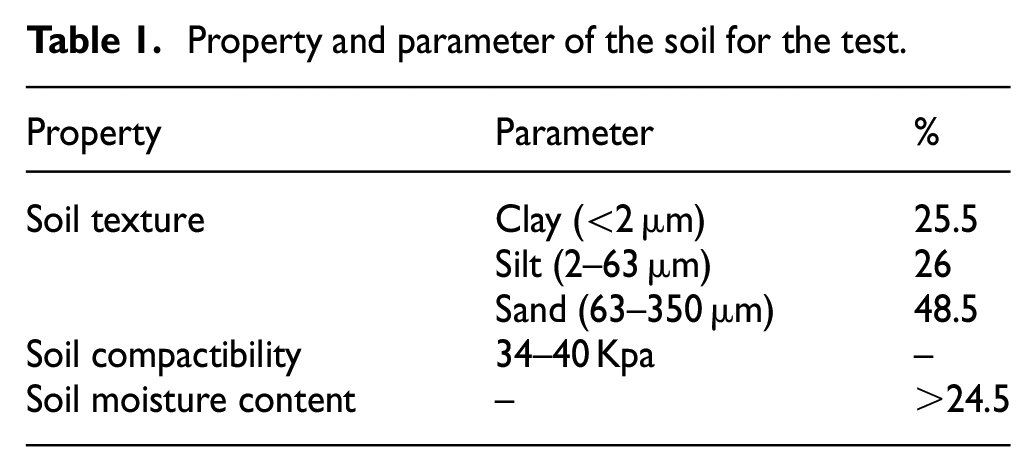
For the purpose of preliminarily understanding whether the membrane sheath had the performance of anti-adhesion against soil, the soil adhesion test was conducted in Key Laboratory of Bionic Engineering (Ministry of Education), Jilin University. Property, and parameter of the soil for the testing was shown in Table 1. As shown in Figure 2, a flat steel-bar sample close to the size of membranous leaf sheath was prepared for comparison. Soil insertion test was just carried out: insert the membranous leaf sheath specimen and flat steel-bar specimen into the heavy clay in similar way, respectively. The depth of the soil inserted is two-third of the length for the two specimens. The test was repeated 10 times for each specimen. The weight of adhesive soil on the specimens was recorded via electronic balance (HANGPING, FA2004, China), then the average values were served as the reported result.
Property and parameter of the soil for the test.

Samples of flat steel-bar (above) and membranous leaf sheath (below).
Fabrication of bionic surface with low free energy
Designing and manufacturing
Inspired by the surface texture of the membranous leaf sheath, only the surface texture was considered rather than the overall structure in this article. The micro-nanostructure surface was infeasible for the soil-tillage implements owing to its poor wear resistance. Furthermore, considering the cost of soil-tillage implements, the surface texture of specimens was manufactured in the millimeter scale. The millimeter scale surface texture of the specimens was fabricated by DK7732 NC wire cutting machine. The size of 65Mn steel specimens was 40 mm × 40 mm × 6 mm. The biomimetic surface texture size was written as B, S, and H (whose dimensions are in millimeters), where B was the width of bar-shaped protuberance, S was the width of groove structures, H was the vertical distance between the top of bar-shaped protuberance and bottom of the groove. The number of the specimens was nine. The computer model of the experimental bionic specimen was shown in the Figure 3(a) and the biomimetic surface texture was shown in Figure 3(b) and the physical samples after manufacture was shown in Figure 4(a). For comparison, a flat plate sample with no processing was also prepared, as shown in Figure 4(b). The oil and dirt on the physical specimen surface were removed using acetone and absolute ethanol by ultrasonic cleaning for 5 min, respectively. Then, the dried specimens were prepared for the next work.

(a) Computer model of the experimental bionic specimen and (b) its surface texture (dimensions in mm).

(a) The physical bionic samples based on 65Mn steel: NO. 1–NO. 9, (b) flat plate sample with no modification: NO. 10, and (c) flat plate sample with modification (FPM).
Surface modification for biomimetic specimens
The raw material used in this work was 65Mn steel and its chemical compositions were listed in Table 2. The yield strength of 65Mn steel is 410 Mpa. The tensile strength is 695 Mpa. The Vickers hardness is 229. The labeled surfaces of biomimetic specimens were modified using myristic acid ethanol solution. The physical properties of myristic acid are listed in Table 3. The concentration of myristic acid ethanol solution was 0.1 mol/L and the soaking time was 72 h. A detailed statistical analysis of this work was given inprevious work. 21 Then, the specimens were dried for 30 min at 85°C using an electronic drying box.
Chemical composition of 65Mn steel (wt.%).

Physical properties of myristic acid.

CA between biomimetic specimens and distilled water
An orthogonal array with nine test units was selected for the experiments. The number of bionic specimens was nine, whose biomimetic surface texture sizes B, S, and H were shown in Table 6. The surface wettability of the biomimetic specimens was characterized by the water CAs via CA meter (JC2000A Powereach, China) at room temperature. Five different points were measured on each specimen and the average value of five measurements was defined as the CA. Then, the average value of the data was served as the reported result.
Verification test of soil anti-adhesion
To test the anti-adhesion properties of biomimetic specimens, a linear soil bin filled with clayey soil was constructed. The soil bin was 0.5 m in length, 0.15 m in width, and 0.1 m in depth. Tests were conducted in the Key Laboratory of Bionic Engineering (Ministry of Education) of Jilin University. For the purpose of reducing the number of experiments and according to the test results of the CA between biomimetic specimens and distilled water, we have taken width B as the basis for selecting the test specimen in this work. Hence, the biomimetic specimens labeled NO. 1, NO. 4, and NO. 9, as shown in Figure 4. For comparison, a control flat plate specimen labeled NO. 10 with no modification and a control flat plate specimen with modification (FPM) equal in dimension to the biomimetic specimens were prepared. The weight of the adherent soil on specimens was tested in a linear soil bin filled with clayey soil. Each experiment was repeated 15 times. Then, the weight of adherent soil was recorded each time and its mean values were served as the reported result finally.
Notice that the machined biomimetic specimens (NO. 1–NO. 9) have a bionic surface texture on one side and all were modified by myristic acid. When one flat solid was inserted into the soil at an inclination, the difference of the soil compaction force appears between the two sides of the flat solid. Hence, in order to avoid the difference of soil adhesion test between the two soil-contacting surfaces due to different inserting soil angles, the specimen was inserted into the soil at an angle of 90°. That was to say, the specimen was inserted into the soil in the direction perpendicular to the horizontal plane of the soil bin. Each specimen was vertically inserted into the soil at the speed of 0.3 m/s, then held for 5 s and finally pulled out at the speed of 0.3 m/s4.
Results of soil texture analysis and compaction value are mentioned in Table 1. The clayey soil moisture content was 24.5%. A handy soil compactness meter (Field Scout, SC-900, USA) was used to examine the soil compaction in different spots of the soil bin. A handy soil moisture meter (Field Scout, TDR-300, USA) was used to examine the soil moisture content in different spots of the soil bin. Soil moisture content was measured before and after compactions and found not to be significantly different. For ensuring that soil compaction remains the same value, a 1 kg roller was rolled over the graded soil after each test. In order to homogenize the soil moisture contents, water was added to the soil while mixing it rapidly and a polyethylene sheet used to cover the soil surface to prevent evaporation and left for about 24 h to allow the moisture content to become homogenized.
Three types of surface were evaluated for soil anti-adhesion individually in the soil bin. They were biomimetic surface with modification (labeled NO. 1, NO. 4, and NO. 9), FPM and the unmodified flat plate surface (labeled NO. 10), respectively, all of which were manufactured based on 65Mn steel. Due to the geometrical design property of the specimens, the maximum penetrable depth was 100 mm. The working depth and horizontal angle were set to 60 mm and 90°, respectively. Before each experiment, the specimens should be cleaned and dried. Each test was repeated 15 times at different positions in the soil bin. Then, the weight of adherent soil was recorded each time via electronic balance (HANGPING, FA2004, China), and finally, its mean weights served as the reported result. To compare mean values, the improvement factor was used and calculated using equation (1) 4

where IMPOV was the improvement of the weight of adhesive soil in percent, MFP and MBT were the mean weight of adhesive soil on flat surface and biomimetic texture surface, respectively.
The theoretical explanation of anti-adhesion mechanism on the hydrophobic surface
Analysis of anti-adhesion mechanism in static state
When a water film is present between the soil and the contact material, the adhesive force can be expressed as 9

where γLV is the surface tension of water (N); θ is the contact angle (°); 4πR is the contact length of water film (mm).
Jia et al. 22 developed this theory. As shown in Figure 5, from the point of view of energy change for the soil adhesion system, when an independent water ring is formed between the soil particle and the solid surface, the energy of adhesion system can be written as

While the CA θ1 between water and soil particles was 0°, that is, θ1 = 0°, then equation (3) can be written as

Therefore, equation (4) shown that as the θ2 changed from 0° to 180°, soil always had adhesive force on the surface of solid material. Moreover, the greater the θ2, the smaller the adhesive force F.
When D = 0, θ2 = 0°, it indicated that the soil water completely wetted the surface of the solid material and the adhesive force F reached the maximum value
When θ2 = 180°, the adhesive force F = 0, which revealed that hydrophobic materials had the effect of reducing adhesion against soil.
Nevertheless, equation (4) shown the analysis of anti-adhesion mechanism in static state; and we learned that the adhesive force F shown in equation (4) was just the adhesive force in normal direction in static state.

Sketch of contact between soil particles, water ring, and solid (θ1: the contact angle between water and soil particles (°); θ2: contact angle between water and solid material (°); R: radius of curvature of soil particles (mm); D: the distance from the outermost edge of the soil particles to the solid material surface (mm); h: vertical projection height of water ring on the soil particle protrusion (mm)).
Analysis of anti-adhesion mechanism in dynamic state
As described in previous section of anti-adhesion mechanism in static state, the adhesive force of soil meniscus was produced by the tension of water ring in the interface system, as revealed by equation (2). However, when the soil moved on the surface of the soil-engaging implements at a constant velocity of v (m/s), as well as the slide occurred between the water ring and the surface of soil-engaging implements, the water ring meniscus would be deformed, 23 as shown in Figure 6(a) and (b).

(a) Sketch map of soil particle meniscus generate tangential resistance in stationary state and (b) in dynamic state (1: soil particle; 2: surface of soil touching part; 3: meniscus of soil water ring; R: soil particle radius (mm); γ: surface tension of soil water (N); θ(t): contact angle (°)).
To facilitate the analysis, we defined the following parameters. θ = θ(ti), i = 0, 1, 2, 3, …, was a function of time, which means CA was changing with time and θ(ti) ∈ [0°,180°]. θ(t0) supposed to be the stationary state of the soil meniscus as shown in Figure 6(a). When the soil particle moved on the surface of the soil-engaging implements at time ti, it supposed that the static CA θ(t0) on the right of the soil particle turned into θ(ti) which defined as advance angle. Obviously there was θ(ti) > θ(t0). At the same time, the static CA θ(t0) on the left of the soil particle turned into θ′(ti) which defined as receding angle. Obviously there was θ(t0) > θ′(t1). Hence, there was always θ(ti) > θ′(ti). When v was higher as well as the normal adhesive force on the interface, θ(ti) might become an obtuse angle while θ′(ti) close to 0° which illustrated that the horizontal part of surface tension γ2 hampered the movement of the soil and that the horizontal part of surface tension γ1 hampered the movement of the soil-engaging implement, simultaneously.
Here, we defined l1, A′SL1 as length and area of γ1, defined l2, A′SL2 as the moving length and area of

In order to facilitate the analysis, supposed

Equation (5) shows that as the soil particle is in dynamic motion, the tangential adhesive force
The interfacial adhesion system is in dynamic state. According to the value of



Taking into account the hysteresis of water film motion, there are always
When
When
Actually,
From equation (9), we can learn that the larger the
Results and discussion
The surface morphology and wettability of membranous leaf sheath
The surface morphologies of membranous leaf sheath samples were characterized by SEM. Photos of the surface morphologies were shown in Figures 7 and 8. It can be learned that the surface morphologies of membranous leaf sheath was a surface texture with the grooves and the bar-shaped protuberances were arranged alternately and in different densities. The width of bar-shaped protuberance on membranous leaf sheath was 100–280 μm, the width of grooves on membranous leaf sheath was 40–110 μm and the depth of the grooves was 5–15 μm. Moreover, the surface of bar-shaped protuberance is glossy and smooth.

Stereoscopic microscope of membranous leaf sheath (40×).

Surface morphology of the membranous leaf sheath (a) 50× and (b) 150×.
The infrared spectrogram of membranous leaf sheath was shown in Figure 9. It can be learned that the absorption peak near 3390 cm−1 was the stretching vibration absorption peak of hydroxyl O–H (weak). The absorption peak at 2800–3000 cm−1 was attributed to the stretching vibration of the C–H bond, 1056 and 1110 cm−1, respectively, correspond to the stretching vibration absorption peaks of the C–O–C bond. These characteristic absorption peaks were consistent with the skeleton structure of cellulose in cotton fabrics.24,25 Moreover, the drying experiment showed that the moisture content of membranous leaf sheath reached 79.97%.

Infrared spectrogram of membranous leaf sheath.
The results of CA between membranous leaf sheath and distilled water were shown in Table 4. The average value was 110.82°, while the maximum CA on the surface of membranous leaf sheath can reach more than 120°, which reveals the surface of membranous leaf sheath had hydrophobic property. A water drop on the membranous leaf sheath is shown in Figure 10. Furthermore, there are no extra ingredients except cellulose in membranous leaf sheath by FT-IR spectrometer. In fact, the effect of wax content on the hydrophobicity of plant leaves is limited. It has been reported that the CA between the surface of pure wax blocks and water is only about 90°.26,27
CA (°) of membranous leaf sheath.

CA: contact angle.

A water drop on the membranous leaf sheath.
Figure 11 represents the comparison test of the soil adhesion between membranous leaf sheath and the flat steel-bar. The result of soil adhesion test for membranous leaf sheath and the flat steel-bar is shown in Table 5. It can be obviously learned that the average weight value of adhesive soil on the surface of membranous leaf sheath was 0.2536 g while the average weight was 1.4744 g on the flat steel-bar, which manifested an 82.80% improvement. The results of soil adhesion test revealed that the membranous leaf sheath had the ability to reduce soil adhesion significantly.

Comparison test of soil adhesion for membranous leaf sheath (left) and flat steel-bar (right).
The mean weights of adherent soil on flat steel-bar and membranous leaf sheath.

Preliminary analysis showed that the unique surface texture of the membranous leaf sheath combined with hydrophobic property led to its anti-adhesion against soil because there was no extra ingredients except cellulose. According to the results, it can be arrived to a conclusion that the membranous leaf sheath of rhizoma imperatae can shuttle in the soil, owing to not only its own growth force, but also the anti-adhesion against soil due to the hydrophobicity and special surface texture.
The surface wettability of biomimetic specimens based on 65Mn steel
The measured CAs of the biomimetic specimens were summarized in Table 6 and the results of optimum experimental design were analyzed in Tables 7 and 8. A water drop on the bar-shaped protuberance and groove is shown in Figures 12 and 13, respectively.
Contact angle (°) of specimens based on 65Mn steel.

CA: contact angle; FPM: flat plate modification.
Contact angle (°) of bar-shaped protuberance.

CA: contact angle.
Contact angle (°) of groove.

CA: contact angle.
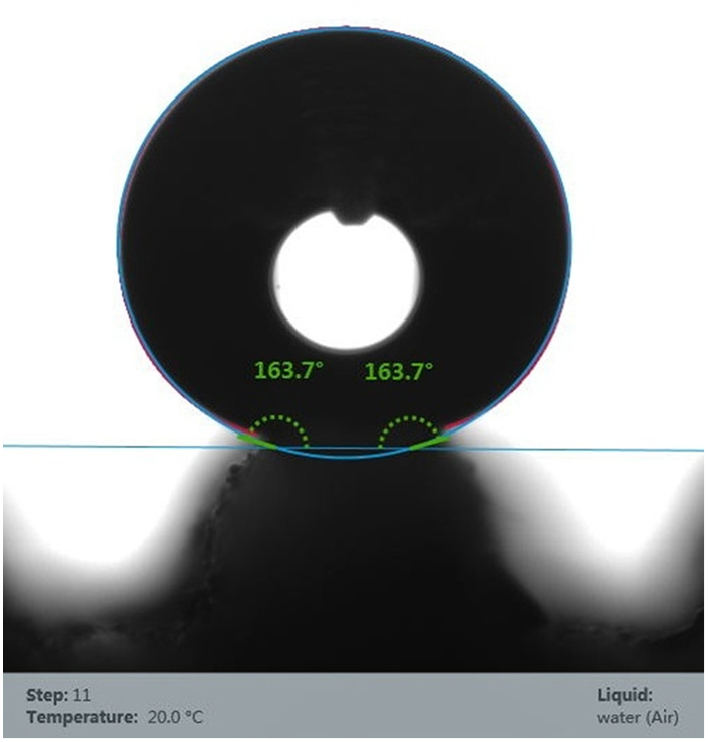
A water drop on the bar-shaped protuberance.

A water drop on the groove.
Table 6 indicates that the biomimetic surface texture, formed by soaking in a fixing agent, can obtain a hydrophobic surface. Moreover, the surface texture sizes B, S, and H are the main influence factors on the hydrophobic property. This was consistent with our initial idea of surface texture contributes to hydrophobic properties. Three principal factors were systematically examined using orthogonal design of experiments, and the analyzed results were used to identify the order of principal factors in increasing the CA. These three principal factors are B/S/H, where B was the width of bar-shaped protuberance, S was the width of groove structures, H was the vertical distance between the top of bar-shaped protuberance and bottom of the groove.
As shown in Tables 7 and 8, Kjn was the sum of the CA for dropping on the bar-shaped protuberance corresponding to factor j and its level n. Yjn was the sum of the CA for dropping on the groove corresponding to factor j and its level n. To assess the preferable level for factor j, the mean values Kjn and Yjn of data were calculated. The larger the Rj (Rj = max[Kj1, Kj2, Kj3] − min[Kj1, Kj2, Kj3] for Table 7 or Rj = max[Yj1, Yj2, Yj3] − min[Yj1, Yj2, Yj3] for Table 8 greater the effect of this factor on CA. M row shown the preferable levels for each factor. F row displayed the order of importance for these factors. S row presented the most preferable set of these factors and levels. Moreover, following conclusions can be obtained from Table 6:
The hydrophobic surface can be obtained by modification of 65Mn steel using myristic acid ethanol, where CA was >120° compared with 65Mn steel, with no processing conditions, where CA was <90°.
The CA of modified bionic specimens was >130°. Moreover, the superhydrophobicity on the specimen surface where CA was >150° when the bar-shaped protuberance size B < 1.6 mm. When the B > 2 mm, the CA decreased significantly. It can be found that the CA was dominated by surface texture size B, when the B > 2 mm, the bar-shaped protuberance can be considered as a plane. This phenomenon can be explained by equations (2)–(4).
The average water CA was about 154.26° when the bar-shaped protuberance size B < 1.6 mm. The largest CA = 163.7° appeared when the bar-shaped protuberance size B = 1.2 mm, which was measured on NO. 3 of the bionic specimen as shown in Figure 12. The largest CA = 131.7° appeared when the groove size S = 0.4 mm, which was measured on NO. 1 of the specimen as shown in Figure 13.
The analyzed results of dropping on the bar-shaped protuberance as shown in Table 7, indicated that: (1) the order of importance of these factors was B > S > H for increasing the CA; (2) the combination of B1S1H2 (B1 = 1.2 mm) was the preferable set of these factors and levels for increasing the CA, which revealed the smaller the width size B of bar-shaped protuberance, the more helpful to increase the CA on 65Mn steel. This was consistent with theoretical analysis demonstrated in detail by Yu et al. 21
The analyzed results of dropping on the groove, as shown in Table 8, indicated that: (1) the order of importance of these factors was S > H > B for increasing the CA and (2) the combination of S1H2B2 (S1 = 0.4 mm) was the preferable set of these factors and levels for increasing the CA, which revealed the smaller the width size S of the groove, the more helpful to increase the CA on 65Mn steel. This was consistent with theoretical analysis demonstrated in detail by Yu et al. 21
Soil anti-adhesion test
Figures 14–16 represent the photos of actual effect of soil anti-adhesion on the testing specimens. Two-tailed (t-test) was used to authenticate the significance of the comparisons. Figure 17 represents the mean weight of adhesive soil for the specimens. Compared to control specimens (FPM and NO. 10), it can be learned that the property of anti-adhesion of the surface with biomimetic surface texture was superior to that without biomimetic surface.

The actual effect diagram of soil adhesion on biomimetic specimen.

The actual effect diagram of soil adhesion on FPM.

The actual effect diagram of soil adhesion on flat plate specimen with no modification (NO. 10).

The mean weight of adhesion soil for the specimens (FPM: flat plate modified by myristic acid).
The test data obtained by each specimen meet the normal distribution. To compare mean values, the improvement factor was used and calculated using equation (1). Results of the statistical analysis were summarized in Table 9. There was a significant (p < 0.001) difference in weight of adherent soil obtained from the modified biomimetic specimens labeled NO. 1, NO. 4, NO. 9 and the control specimens FPM, NO. 10 in all treatments.
Statistical analysis on weights of adhesion soil gathered by testing.
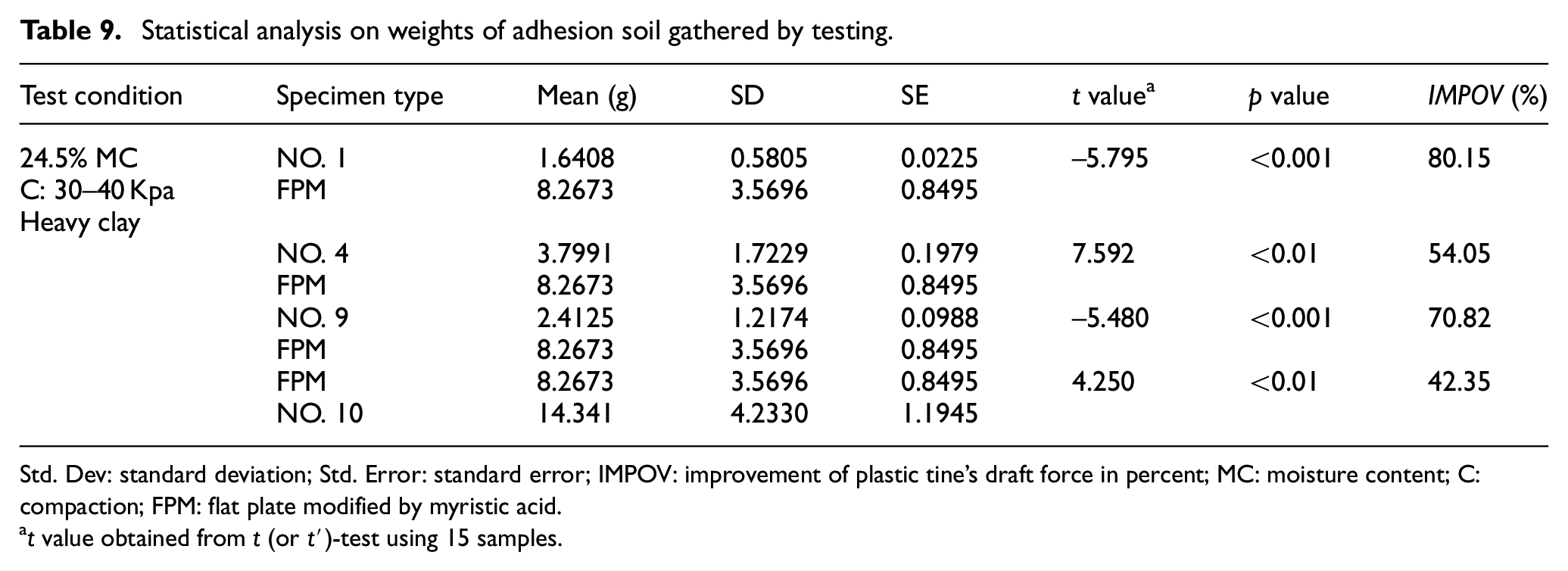
Std. Dev: standard deviation; Std. Error: standard error; IMPOV: improvement of plastic tine’s draft force in percent; MC: moisture content; C: compaction; FPM: flat plate modified by myristic acid.
t value obtained from t (or t′)-test using 15 samples.
Table 9 shows the statistical analysis on weights of adhesion soil, authenticated by two-tailed t-test. We can learn that in the clayey soil (20%–30% moisture content (MC)), the biomimetic specimen with modification of NO. 1 obtained an average weight value of 1.6408 g while the FPM by myristic acid obtained an average weight value of 8.2673 g, which manifested an 80.15% improvement. A 54.05% improvement and 70.82% improvement were manifested for the biomimetic specimens with modification of NO. 4 and NO. 9, respectively. Moreover, the FPM obtained an average weight value of 8.2673 g while the ordinary specimen of NO. 10 with no modification obtained an average weight value of 14.341 g, which manifested an 42.35% improvement. Overall, according to the results, more than a 50% improvement of reducing soil adhesion for the biomimetic specimens with modification compared with FPM or NO. 10. That is to say, compared to the ordinary specimen with no modification, modified biomimetic structure has remarkable anti-adhesion property.
Conclusion
In this article, the anti-adhesion property against soil of the membranous leaf sheath of rhizoma imperatae was tested. It was verified that the anti-adhesive properties against clayey soil of the membranous sheath were the result of combination of its surface texture and hydrophobic property. The anti-adhesion mechanism of the hydrophobic surface for the static and dynamic state was analyzed. To obtain an anti-adhesion surface with traditional steel materials, biomimetic specimens were designed and fabricated using 65Mn steel inspired by surface texture and hydrophobic properties of membrane leaf sheaths. Biomimetic structures with hydrophobic properties were designed and prepared. Moreover, the superhydrophobic surface was obtained when the bar-shaped protuberance size B < 1.6 mm. The results of orthogonal test shown that superhydrophobic surface can be obtained by micro-structure. The modified biomimetic specimens based on 65Mn steel can reduce soil adhesion significantly by testing. More than a 50% improvement of reducing soil adhesion compared with control specimen without any processing. Preliminary tests had proved that the bionic specimens can reduce soil adhesion, especially under the condition of clayey soil with high moisture content. However, the quantitative analysis of soil adhesion and the dynamic behavior of soil adhesion under different soil conditions have not been studied intensively and this is also the focus of our future work. Soil implements with the properties of hydrophobicity and biomimetic surface texture can reduce soil adhesion. Particularly, a bionic subsoil digging shovel device can be developed to burrow underground with drag-reducing properties in the clayey soil with high moisture content. Furthermore research on such implement is currently ongoing.
Footnotes
Handling Editor: James Baldwin
Declaration of conflicting interests
The author(s) declared no potential conflicts of interest with respect to the research, authorship, and/or publication of this article.
Funding
The author(s) disclosed receipt of the following financial support for the research, authorship, and/or publication of this article: This work was supported by National Key Research and Development Project of China (Grant No. YS2016YFNC050065, Grant No. 2016YFD0701601), the National Natural Science Foundation of China (Grant Nos 51805338, 51875242, and 51865051), the Youth Top-notch and Innovation Talent Support Program of Shihezi University (Grant No. CXBJ201904).
