




Abstract
Hydrodynamic journal bearing is an important part of rotary machine and faces many challenges such as high rotating speed, heavy specific pressure, and large temperature rise with the development of industry. These challenges lead to notable thermal and elastic deformations of the journal bearing. Surface texture has been proved to be a valid method to promote bearing lubricating properties. However, effects of thermal and elastic deformations on lubricating properties of the textured journal bearing have not been clearly analyzed. Based on this, the article presents a method to transform thermal–structural–fluid interaction into thermal–structural interaction and thermal–fluid interaction based on textured journal bearing model. Cavitation and temperature-viscosity effects are also considered. Based on this method, action mechanisms of surface texture on lubricating properties are discussed considering elastic and thermal deformations, and effects of elastic and thermal deformations on the textured journal bearing are also investigated. The results show that the load carrying capacity and the maximum oil film pressure of the textured journal bearing both increase when elastic and thermal deformations are considered. Optimal texture parameters can enhance the backflow effect in dimples and restraint cavitation phenomenon in the oil film rupture region. Meanwhile, inertial and cavitation effects caused by surface texture have significant effects on elastic and thermal deformations of the journal bearing.
Keywords
Introduction
Hydrodynamic journal bearings are important supporting component of the star gear transmission in geared turbofan engines. To make the structure of star gear transmission compact, the bushing is rotating instead of the shaft when the journal bearing works. Meanwhile, it operates under a large-eccentricity regime because of high specific pressure. These severe conditions and the movement characteristic have great influences on oil film pressure and temperature rise. Under these circumstances, thermal and elastic deformations of the journal bearing are significant, and they affect bearing lubricating properties conversely. Therefore, it is necessary to study effects of thermal and elastic deformations on lubricating properties of journal bearing.
So far, there has been research on bearing thermal–fluid–structural interaction (TFSI) method. Dobrica and Fillon 1 and Yang and Jeng 2 established numerical models based on Reynolds and Laplace equations. Although heat conduction between solid and fluid was considered in this model, thermal deformation of the journal bearing was not considered. According to the numerical method, Chauhan et al. 3 analyzed the influence of physical properties of oil on bearing properties. Their results showed that oil with a lower viscosity and density could avoid the thermal degradation of lubricant. Zhang et al. 4 carried out research on bearing thermohydrodynamic lubrication when thermal effect of the fluid is considered and investigated differences between numerical calculations and experimental results under the high-eccentricity state. Although thermal effect was studied in the above analyses and research, bearing thermal and elastic deformations were not considered.
To analyze effects of elastic deformation on bearing lubricating properties, a fluid–structure interaction (FSI) method for the journal bearing was developed by Liu et al. 5 This method adopted computational fluid dynamics (CFD) technique. Based on the CFD-FSI methodology, Wang et al. 6 found that elastic deformation increased with increasing rotating speed and decreasing Poisson’s ratio for the water-lubricated journal bearing. Dhande and Pande 7 proposed that the peak pressure was decreased due to cavitation effect when elastic deformation was considered. Lin et al. 8 used also the CFD-FSI approach to study effects of recess configuration on lubricating properties, and their work revealed that ladder-type recess could help journal bearings inhibit oil temperature rise and cavitation effect. According to the CFD-FSI methodology, Huang et al., 9 Lin et al., 10 and Li et al. 11 developed transient FSI models and carried out a series of studies.
Effects of thermal deformation on journal bearing lubrication were discussed by Michaud et al. 12 Their results showed that the range of oil film thickness was increased due to thermal deformation. Coupling effects of thermal and elastic deformations on bearing lubrication were studied by some scholars. Sharma et al. 13 presented a numerical model for the smooth journal bearing considering combined influence of thermal and elastic deformations according to Reynolds, energy, and thermoelastic deformation equations, but their model neglected thermal and elastic deformations of the journal. Linjamaa et al. 14 developed the numerical model for smooth journal bearing when thermal and elastic deformations were considered. It was proved theoretically that elastic deformation was beneficial to lubricating properties of journal bearings while thermal deformation was unbeneficial. These numerical methods considering coupling effects of thermal and elastic deformations were based on Reynolds equation that was suitable for smooth bearings. However, Dobrica and Fillon 15 and Cupillard et al. 16 both found that Navier–Stokes equation was more valid than Reynolds equation for textured journal bearings, because inertial effect neglected by Reynolds equation but emphasized by Navier-Stokes equation was improved for textured journal bearings.
Recently, surface texture was attention from scholars and considered as an important method to improve bearing lubricating properties. Tala-Ighil et al. 17 adopted numerical calculation method to confirm that bearing performance could be promoted by surface texture. Tala-Ighil et al. 18 analyzed effects of texture distribution on bearing lubrication. Their results showed that the appropriate texture distribution could inhibit cavitation effect, and enhanced bearing carrying capacity. Lin et al. 10 and Wang et al. 19 both established CFD-FSI models for textured journal bearings, but thermal deformation of the bearing was not considered in these models.
From the above analyses, bearing elastic and thermal deformations could affect lubricating properties of the journal bearing, especially textured journal bearing. The mechanisms of elastic and thermal deformations on texture journal bearing also affect optimal texture parameters. Although the numerical models based on Reynolds equation were developed, they were not applicable to textured journal bearings. Meanwhile, there is little research on effects of thermal and elastic deformations on lubricating properties of textured journal bearing based on Navier–Stokes equation. There is also rare research on journal bearings with the movement characteristic that the journal is fixed and the bushing is rotating.
In view of this, this article presents a numerical model considering thermal and elastic deformations according to CFD-TFSI methodology. This model is based on Navier–Stokes, energy, and thermoelastic deformation equations, so it is suitable for textured journal bearing with the movement characteristic. Inertia and cavitation effects are both considered in company with temperature-viscosity effect. Based on this model, action mechanisms of texture surface on lubricating properties are discussed, and effects of elastic and thermal deformations on the textured journal bearing are also analyzed. The work perfects the TFSI theoretical method of textured journal bearing under extreme working conditions to a certain extent.
Numerical model and governing equations
Figure 1 shows textured journal bearing geometry with the fixed journal and rotating bushing. 20 The bearing width is 100 mm. Outer diameter and inner diameter of the bushing are 100 and 80 mm, respectively. The oil groove has a depth of 2 mm and length of 50 mm. The wrap angle of oil recess is 40°. Square texture is arranged on the journal. Texture length is 50 mm, and the starting angle and the wrap angle of surface texture are 60° and 40°. When the bushing is rotating, lubricant flows into the clearance through two holes whose diameters are 5 mm. Texture spacings in two directions are both kc. w is the width of surface texture. The texture area ratio is defined by


Textured journal bearing geometry.
The solution of hydrodynamic lubrication is based on the numerical solution of Navier–Stokes equation obtained from momentum and continuity equations. Assuming incompressible and Newtonian lubricant, Navier–Stokes and energy conservation equations are written as follows



The temperature-viscosity relationship is governed by 19

There are three forms of the oil film thickness in different locations. In the texture region, the oil film thickness consists of bearing clearance, depth of texture, and bearing deformations. In the oil groove region, the depth of texture is replaced with that of oil groove. In other regions, the oil film thickness is composed of the journal clearance and bearing deformations

where δe and δt represent elastic and thermal deformations of the journal bearing, respectively. hc is the depth of dimple. ε and c are eccentricity and radius clearance of the journal bearing, respectively. Ω = 1 is used to represent the area where texture exists.
The subscript of i is used to distinguish the bushing and the shaft. The equation of elastic deformation is governed by

Total elastic deformation δe is expressed as

The thermal deformation equation is governed by 21

where αri is thermal expansion coefficient relating to the reference temperature, Ti is bearing temperature, Tr is the reference temperature, and l0i is the element length at reference temperature. In this article, the reference temperature is set to 300 K.
Total thermal deformation δt is expressed as

When TFSI model is used, there exists thermal transmission between fluid and solid. The heat transferred is related to the contact area, thermal conductivity, and temperature difference

The interfaces between solid and fluid meet the following conditions
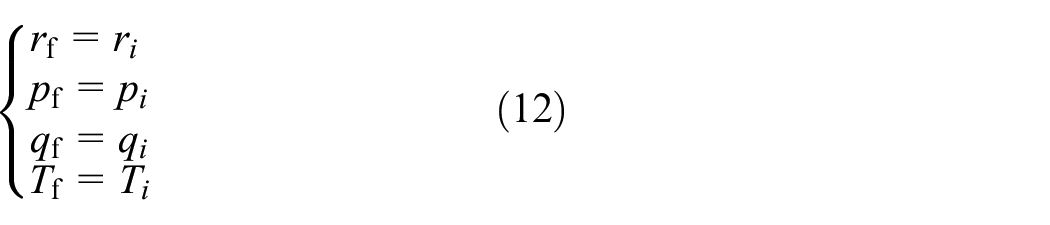
where r, p, q, and T are displacement, pressure, heat flux, and temperature, respectively. The subscript f represents the fluid.
TFSI calculation
In this article, TFSI problem is translated into thermal–structural interaction (TSI) and thermal–fluid interaction (TFI) problems in ANSYS Workbench. In the solid region, coupled-field elements, SOLID226 and SOLID227, are used to calculate thermal and elastic deformation.
The CFD-TFSI calculation procedure is shown in Figure 2. Momentum, continuity, and energy equations are solved for fluid domain. Pressure and temperature obtained from fluid domain are inputs of solid domain. Elastic and thermal deformation equations are solved for solid domain, and they change oil film thickness in turn. Then, fluid domain needs to calculate again based on changed oil film thickness until results converge. Finally, oil film pressure, temperature, thickness, and thermal and elastic deformations are obtained.

Flowchart of calculation.
Three-dimensional model of the texture journal bearing and boundary conditions
A three-dimensional (3D) structure of CFD-TFSI model is established in Figure 3. In the model, oil way of the shaft is simplified because the oil way does not affect results of the model when oil supply pressure is constant. 21 Boundary conditions of the CFD-TFSI model are also shown in Figure 3. Pressure inlet and outlet are applied to fluid domain. Relative to atmosphere pressure, oil supply pressure is 105 Pa, and outlet pressure is 0 Pa. Density and specific heat capacity of the lubricant are 860 kg m−3 and 2000 J kg−1 K−1, respectively. The rotating speed of 9000 r/min is applied to the outside surface of oil film. In solid domain, end faces of the journal are fixed due to the structure of star gear reducer. Convection heat transmission to air occurs on outside surface and end faces of the journal bearing. The convective heat transfer coefficient between the journal bearing and air is 750 W m−2 K−1. The boundary condition of fluid–solid interface is applied to outside surface of the journal and inner surface of the bushing. Thermal conductivity between the bushing and the lubricant is 45 W m−1 K−1, and thermal conductivity between the journal and the lubricant is 42 W m−1 K−1. In addition, the bushing has a density of 7400 kg m−3, an elastic modulus of 120 GPa, and a thermal expansion coefficient of 2.3×10⁻⁵ K−1. The shaft is made of alloy steel that has a density of 7850 kg m−3, an elastic modulus of 211 GPa, and a thermal expansion coefficient of 1.2×10⁻⁵ K−1. Eccentricity and attitude angle of the journal bearing are 0.9 and 29.5°, respectively.

The geometry for the film and journal bearing.
Validation of the numerical method
For this numerical model, tetrahedron elements are adopted in the solid region, and hexahedral elements are used in the fluid region. There are four layers of grids along oil film thickness, texture depth, and oil groove. Results of mesh independence are shown in Table 1. The differences of carrying capacity and peak oil pressure are very small when mesh numbers of lubricant and solid are 259836 and 555826, so mesh number of 815662 is adopted in this analysis.
Bearing performance of diverse mesh numbers.

According to the bearing geometry in Bendaoud et al., 22 numerical results are obtained based on the above method. To validate the numerical method, the contrastive results with published results in Bendaoud et al. 22 are shown in Figure 4. Numerical results obtained by the numerical method in this article are closer to experiments in the reference. Therefore, the calculation method proposed by this article is reliable.

Comparison with published results: 22 (a) pressure profile in the bearing mid-plane (speed 2000 r/min, load 2000 N) and (b) friction coefficient.
Results and discussion
Effects of surface texture on lubricating properties
To analyze the mechanism of surface texture on bearing journals, lubricating properties of the journal bearing with diverse depths and area ratios are discussed. The journal bearing geometries with texture area ratios of 20%, 25%, and 30% and texture depths of 0.05, 0.10, and 0.15 mm are established, respectively.
Figure 5 shows lubrication performances of journal bearings with different texture depths and area ratios. When texture area ratio is 25%, the maximum film pressure and bearing carrying capacity both reach the maximum values. The maximum oil film temperature and flow rate also reach peak values when the texture area ratio is 25%. From results of Figure 5, the bushing has greater deformation than the journal due to the combined effects of elastic modulus, structural stiffness, and thermal expansion coefficient. Bushing and journal deformation trends are contrary. Because the journal bearing produces compression deformation due to oil film pressure and expansion deformation owing to oil film temperate rise. It can also be deduced that elastic deformation is the dominant factor in bushing deformation, and thermal deformation is the dominant factor in journal deformation. Meanwhile, it can be seen that friction coefficient and power loss reach the minimum values when surface texture area ratio is 25%. Because oil flow rate is greater under this condition, and the journal bearing has a superior lubrication.
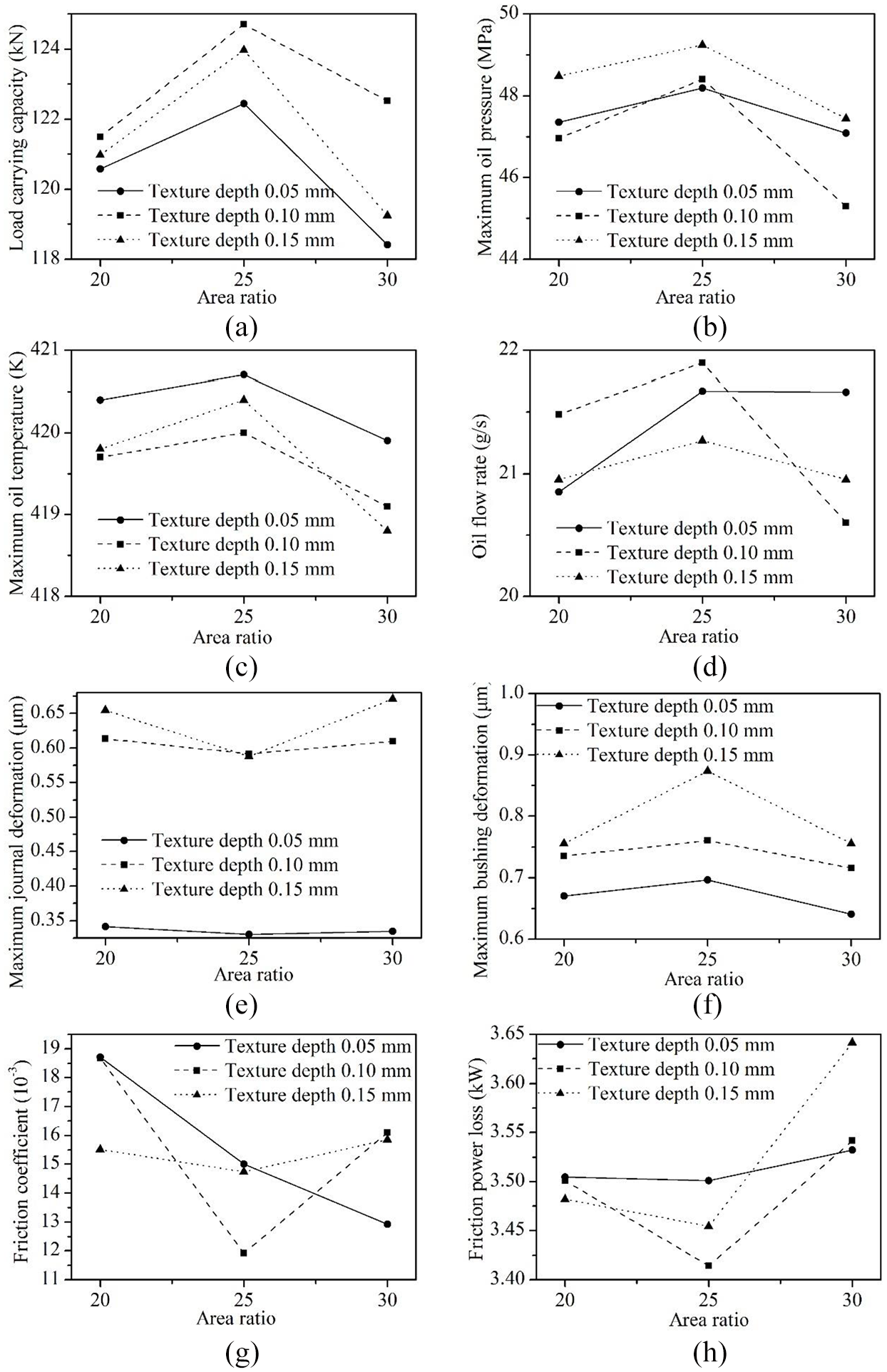
Bearing performance of different texture depths and area ratios: (a) load carrying capacity, (b) maximum oil film pressure, (c) maximum oil film temperature, (d) oil flow rate, (e) maximum journal deformation, (f) maximum bushing deformation, (g) friction coefficient, and (h) friction power loss.
The results of Figure 5 are mainly related to oil pressure and temperature distributions. Then, Figure 6 shows oil pressure and temperature contours of textured journal bearings with three texture area ratios when texture depth is 0.10 mm. In Figure 6(a), oil film pressure distribution in texture region extends along the texture edge, and it means that surface texture changes oil film pressure distribution in texture region. Meanwhile, oil film pressure drops at the slowest speed when surface texture area ratio is 25%. The result means that oil film rupture is subdued for texture area ratio of 25%. When texture area ratio increases to 30%, though maximum oil film pressure area enlarges, the maximum pressure value declines. It means that too large texture area ratio will hinder the increase in the oil film pressure. In Figure 6(b), oil film temperature reaches the peak value in oil film rupture region because oil can release much heat when cavitation of the lubricant occurs. Meanwhile, oil film temperature distributions in the texture region also extend along the texture edge. That is because that the thermal motion of lubricant in the dimple is enhanced because of the backflow effect so that film temperature is increased. This phenomenon alleviates when surface texture area ratio of 25%.

Pressure and temperature contours under three texture area ratio conditions: (a) pressure contour and (b) temperature contour.
According to results of Figure 6, circumferential film pressure and temperature profiles in the middle cross section are given in Figure 7(a) and (b), respectively, and axial film pressure and temperature profiles in the region of peak pressure and temperature are shown in Figure 7(c) and (d), respectively. Angles between peak film pressure and temperature regions and Y-axis are, respectively, 195° and 240°. Compared with the journal bearing with a smooth surface, film pressure and temperature of textured bearings have ladder distributions when the circumferential angle is from 120° to 200°. It means that the oil results in an extra pressure and temperature in dimples, which accords with results of Figure 6. Oil film has the maximum pressure, and the maximum temperature reaches to the minimum value when texture area ratio is 25%. That is because the optimum surface texture area ratio is benefit to strengthen lubricant backflow, and then accelerate fluid thermal motion and promote fluid heat exchange. However, oil pressure is less than the smooth journal bearing when texture area ratio increases to 30%. That is because continuously increasing backflow effect hinders hydrodynamic lubrication. Compared with the smooth bearing, axial film pressure and temperature of textured bearings are asymmetric. The asymmetry is the greatest when texture area ratio is 25%.

Oil film pressure and temperature distributions of diverse texture area ratios: (a) circumferential oil film pressure, (b) circumferential oil film temperature, (c) axial oil film pressure, and (d) axial oil film temperature.
The results of Figure 5 also indicate that texture depth also affects lubricating properties of textured journal bearings. Figure 8 shows circumferential and axial film pressure and temperature profiles of texture bearings with diverse texture depths when texture area ratio is 25%. From Figure 8(a) and (b), film pressure of smooth bearing is less than that of textured bearings, and film pressure and temperature of textured bearings also have ladder distributions when the circumferential angle is from 120° to 200°. In this region, the journal bearing with texture depth of 0.05 mm has the minimum film pressure and maximum film temperature, and journal bearings with texture depths of 0.10 and 0.15 mm have similar film pressure and temperature distributions. It means that the improvement of bearing performance by texture depth is limited. Seen from Figure 8(c) and (d), oil film pressure distributions are also asymmetric when texture depths are 0.05 and 0.10 mm, and oil film temperature distributions offset to one side.

Oil film pressure and temperature distributions of diverse texture depths: (a) circumferential oil film pressure, (b) circumferential oil film temperature, (c) axial oil film pressure, and (d) axial oil film temperature.
Effects of thermal and elastic deformations on lubricating properties
The journal bearing results in compression deformation under oil film pressure, and expansion deformation under oil film temperature rise. When only thermal deformation is considered, the journal bearing works under the mixture lubrication state due to bearing thermal expansion, which is unsuitable for the model in this article. Then, in order to analyze effects of thermal and elastic deformations, bearing performance is discussed when thermal and elastic deformations are both considered, and only elastic deformation is considered.
From results of Figure 5, surface texture with the depth of 0.10 mm and the area ratio of 25% has the most significant impacts on the journal bearing. Therefore, Figure 9 shows deformation contours of the textured journal bearing on the three cross sections of z = 25, 50, and 75 mm. It can be seen that bearing deformation is smaller when elastic and thermal deformations are considered, because compression and expansion deformations of the journal bearing can offset each other. The difference of three cross sections is small when elastic and thermal deformations are considered. In this situation, bearing deformation results from the combined effect of oil film pressure and temperature. However, deformation of the cross section of z = 50 mm is greater than others considering only elastic deformation. That is because bearing deformation resulting from oil film pressure and oil pressure in the region is the heaviest.

Deformation contour of the three cross sections.
Figure 10 shows circumferential deformation profile in the central cross section and axial deformation profile in the region of peak pressure. Results of Figure 10 validate the above discussions.

Deformation distribution of different cases: (a) journal circumferential deformation, (b) bushing circumferential deformation, (c) axial journal deformation, and (b) axial bushing deformation.
Figure 11 shows film pressure and temperature contours of two cases. Their oil film pressure contours are similar, and oil film pressure distributions in the texture region extend along texture edge. It means that the backflow effect exists in dimples whether thermal deformation is considered or not. Temperature contours in Figure 11(b) have significant differences. For the case of only elastic deformation, heat generated by frictional resistance and cavitation phenomenon is only dissipated by side leakage. However, heat brought away by side leakage is less than heat generated by friction in oil film convergence region. Excess heat accumulates with lubricant flowing in oil film rupture region. However, for the case of both thermal and elastic deformations, heat generated by frictional resistance is transferred in time through side leakage and thermal transmission between solid and fluid. The heat generated by cavitation phenomenon accumulates in the region of oil film rupture, so film temperature of this region reaches the maximum value.

Pressure and temperature contours under different conditions: (a) pressure contour and (b) temperature contour.
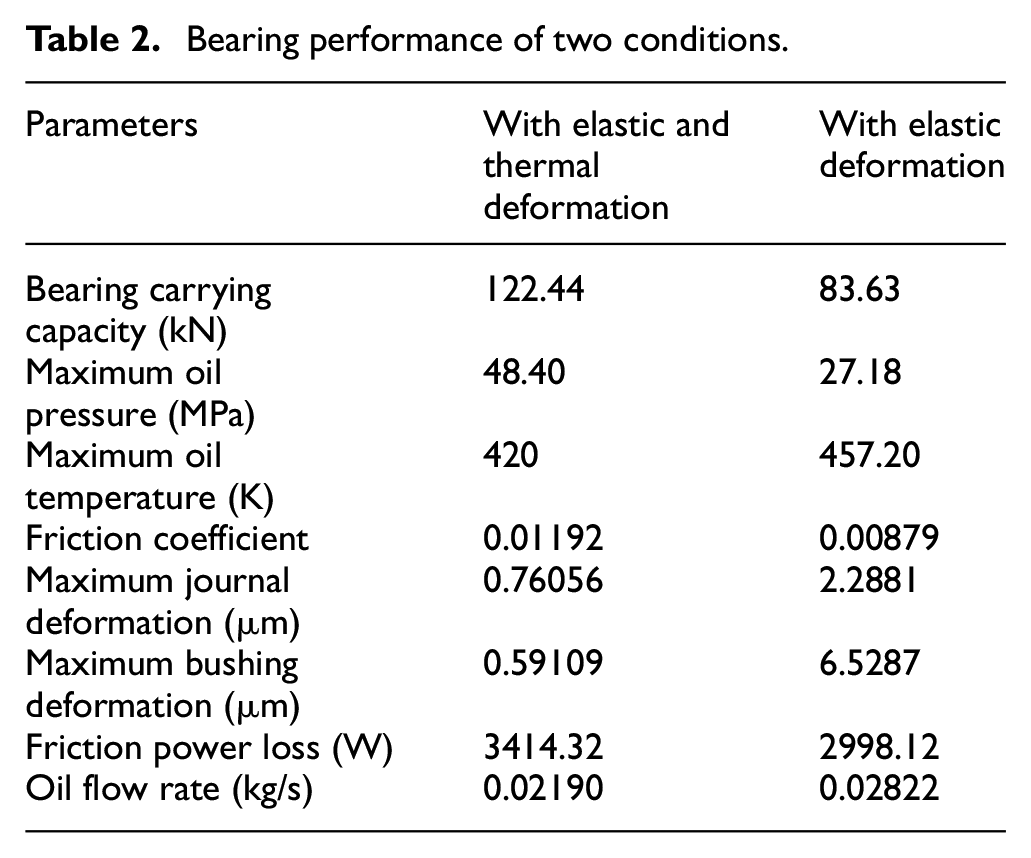
Table 2 shows bearing lubrication properties of two cases. When thermal deformation is considered, the journal bearing deformation is smaller and oil film thickness is thinner. So, the bearing has a greater peak pressure and bearing carrying capacity. Heat generated cannot be released in time without considering thermal deformation, so that the maximum oil temperature is higher for this case. In addition, friction power loss is smaller due to a lower friction coefficient considering only thermal deformation. The greater deformation could make the oil film thickness increase and provide a superior lubrication without considering thermal deformation, so friction coefficient is lower.
Bearing performance of two conditions.
Conclusion
A textured journal bearing numerical model is developed based on CFD-TFSI methodology under high-speed, heavy specific pressure, and high temperature rise conditions. Inertial and cavitation effects of the lubricant are taken into through Navier–Stokes equation and Schnerr–Sauer model. Based on the model, effects of surface texture and thermal and elastic deformations on lubricating properties are investigated. Following main conclusions can be drawn:
Effects of elastic and thermal deformations of journal bearing could be taken into account through transforming TFSI into TSI and TFI. The validity of this method is verified by the experimental and numerical results.
When thermal and elastic deformations are considered, texture area ratio and depth can affect bearing lubricating properties by inertial and cavitation effects of lubricant. Their influence on lubricating properties is similar. The reasonable texture area ratio and depth can enhance the inertial effect of lubricant in textured region and restrain the cavitation effect in oil film rupture region.
For the textured journal bearing, thermal deformation and elastic deformation are the same order. Thermal deformation enhances the peak film pressure and the bearing carrying capacity, but it also increases oil film temperature and bearing friction coefficient. Therefore, materials with a greater coefficient of thermal expansion should be chosen when load carrying capacity is a key to improve bearing performance. Materials with a lower coefficient of thermal expansion are more suitable for the case of higher temperature rise and friction resistance.
Footnotes
Appendix 1
Handling Editor: James Baldwin
Declaration of conflicting interests
The author(s) declared no potential conflicts of interest with respect to the research, authorship, and/or publication of this article.
Funding
The author(s) disclosed receipt of the following financial support for the research, authorship, and/or publication of this article: This work was supported by the National Natural Science Foundation of China (grant numbers 51975475 and 51505384) and the Natural Science Foundation of Shaanxi Province of China (grant number 2017JM5032).
