




Abstract
In order to effectively reuse the design knowledge of product family life cycle development and support holistic and rapid individual product design, this article presents a new meta-model-based systemic customization design method for complex product systems within a product-pedigree. The proposed method aims to synthetically analyze the common and adaptive customer demands and product features of a product-pedigree of complex product systems and to quickly respond to the changing demands based on knowledge accumulation in the field of customization design. The key to implement such a method is (1) to construct a product-pedigree-oriented product meta-model with a four-layered architecture where it is possible to achieve a high degree of abstraction of product and (2) to develop a special technique for configuring the meta-model of the complex product systems. We have tested the proposed method with the rapid design of product-pedigree of a high-speed train’s bogies as an illustrative example. In this work, a rapid customization design prototype system has been developed and applied to the design of a high-speed train’s bogie to illustrate how to construct a product meta-model and how to conduct configuration design on different layers and variant design for generating new products.
Introduction
Complex product systems (CoPS) are high-tech integrated products, systems, or facilities including machinery, computer, electronic, material, and network communication fields, for example, aerospace system, ship, weapon and equipment, automobile, high-speed train, and other high-end equipment; they have the following characteristics: high cost, large scale, technically complex, single-piece or small-batch customization, and technology intensive. 1 With the increasingly dynamic, diversified, and personalized development of the global market, the traditional order-based development pattern of CoPS is difficult to rapidly respond to complex and ever-changing market demands. The challenges designers are facing are twofold: (1) customer demands and environment demands are not only intertwined but also complex and varied under the influence of space and time, which makes it difficult for manufacturing companies to quickly and effectively update their products based on dynamic trends in demand; (2) the accumulation and reuse of research and development (R&D) knowledge are insufficient; as a result, there is a large amount of repetitive work in the process of design iteration and modification, so as that the efficiency of development is low and the development process is not effectively controlled. 2 Therefore, how to quickly and effectively customize the product to meet the complex and changing market demands based on the accumulated knowledge is crucially challenging in the field of engineering design. 3
The typical customization design method is based on module combination and parametric design supported by a massive feature library, which is centered on two-dimensional (2D) drawings or three-dimensional (3D) models, so it is difficult to integrate with design processes, standards, and experiences to form a normative innovative R&D paradigm. 4 Product model is regarded as a basis for realizing knowledge reuse and sharing, which plays a core role in customization design. 5 Generally, designing a CoPS needs a long-term development process in a complex evolutionary way and products also form a huge product spectrum. There are many common and adaptive technologies of CoPS and massive and constantly evolving knowledge, so it is difficult to develop a reasonable product model to support the customization design. In fact, the design of a CoPS is a transformation, evolution, and formation process of multi-stage and multi-level information; therefore, we need to construct a powerful product model to support the customization design of CoPS. For example, in order to meet different demands of high-speed trains, there are computer-aided design (CAD), computer-aided engineering (CAE), product data management (PDM), and other software platforms for supporting the customization design of a high-speed train’s bogie. However, most of the knowledge is distributed in various software systems in the form of tacit knowledge forming information islands, which makes the design process often disrupted and difficult to make a quick response to the changing needs based on knowledge accumulation.
In this article, we propose a meta-model-based systemic customization design method of CoPS to solve the above problems. Our contributions are as follows:
We advise a systemic customization design method. First, the product-pedigree is defined based on the definition of pedigree biological genetics. Second, based on the idea of genealogy, we propose a method for constructing and describing the product-pedigree, which is constructed from three dimensions: the product demand pedigree, the evolution pedigree, and the characteristic pedigree. Finally, we analyze the characteristics of common technology and adaptive technology of CoPS, which provides a foundation to establish a product model supporting the customization design.
We propose a product-pedigree-oriented product meta-model construction technology of CoPS. On the basis of the constructed CoPS product-pedigree, the definition and modeling processes of a product meta-model are given.
Based on the product-pedigree and meta-model, we propose a rapid customization design technology for CoPS based on configuration design and variants. A customization design prototype system has been developed and applied to the design of a high-speed train’s bogie.
The article is organized as follows. Section “Literature review” gives a brief review of related literature. Section “The systemic customization design method” introduces a new systemic customization design method including the product-pedigree description method, product-pedigree-oriented product meta-model, and related key enabling technologies. Section “Prototyping and testing of key enabling technologies” shows the prototyping of the proposed method and testing of key enabling technologies with a case study. Section “Conclusion and future studies” concludes the article with discussions for further work.
Literature review
According to the system design theory and the whole life cycle design theory, the product design process includes several stages such as demand analysis, concept design, and detailed design. 6 In the product requirement analysis stage, the customer demands are mapped to design objectives and accurate product design specification (PDS) as the input to a conceptual design. 7 The main task of conceptual design is to clarify the PDS, establish the functional structure, search for appropriate principle solutions, and synthesize these into a product conceptual design scheme. 8 In the detailed design stage, design considerations are given to the specific structural type, connection mode, processing and assembly ability to form geometric shapes, and components of the product based on the design scheme generated by the conceptual design. 9 The properties of a product model are very different between the conceptual design stage and the detailed design stage. Current studies on product models including structure, geometry, features, and their integration are mainly focused on the detailed design; therefore, they cannot provide effective support for the conceptual design.
In order to support the rapid design of CoPS, product models have evolved from structure-oriented, geometric-oriented, feature-oriented, and knowledge-based models to integrated product models.10,11 The typical integrated product models include STEP (Standard for the Exchange of Product model data), 12 CPM (Core Product Model), 13 MOKA (Methodology and tools Oriented to Knowledge-based engineering Applications), 14 and PPO (Product-Process-Organization Model). 15 The application of meta-model in the field of design was originally in the field of software design. 16 For example, the Object Management Group (OMG) used the meta-model as the standard core concept of the Unified Modeling Language (UML). 17 The meta-model is an information description of how to establish the model, the semantics of the model, and how to integrate and interoperate with each other, which is a normative definition of the modeling environment, grammar, and semantics of a particular domain; therefore, it is commonly called as the model of model. 18 With the R&D ideas in the field of software design being introduced into the field of industrial design, the R&D model based on the meta-model has also been introduced. Ulrich Sendler 19 clearly stated that the meta-model is the main typical modeling method of the entire product life cycle in Industry 4.0. The meta-model has obvious advantages in the information sharing, exchange, model reuse, and other aspects of the virtual prototype of a CoPS. Morita et al. 20 believe that a meta-model can be used as a model to express other submodels, especially resource types and attribute types of Resource Description Framework (RDF). Männistö 21 studied concept modeling based on the method of meta-model for mass customization and evolution of product families.
The reason why the meta-model can effectively support the design of a CoPS is that the design of a CoPS is a multi-stage, multi-level information conversion, evolution, and formation process. Meta-models are used in complex product design processes, which are based on the transformation and evolution process and the abstract description of the data forms and data manipulation methods in this process. Essentially, a meta-model to be developed is an abstract expression of a specific product model, while studying such an abstraction covers the common R&D technology of a product family or product-pedigree. The meta-model is merely an abstraction of the form rather than an abstraction of the substantive content. Therefore, it is difficult to form an effective accumulation of design knowledge, design experience, and design specifications based on the meta-model; thus, it is difficult to respond quickly to diversified and personalized demands.
Due to the constantly changing environment, users, and technology requirements, there are inevitable upgrade and elimination of products in a product evolution process. 22 Especially, the manufacturing market is continuously subdivided in today’s dynamic global market, and it is impossible for companies to occupy all markets with a single product. 23 Therefore, how to effectively integrate the common characteristics of a product-pedigree and the different characteristics of demand traction and quickly form a spectrum product that meets a specific market are key issues for the R&D of CoPS. At the same time, existing mainstream studies of configuration design basically follow Mittal and Frayman’s 24 configuration definition, namely, the configuration design is to select and assemble components to form a product based on fixed, predefined components and their relationship. However, the configuration design cannot fully support the rapid product scheme and design under the influence of dynamic, changeable, and individual requirements for CoPS. In order to solve the above problems, this article proposes a rapid customization method for CoPS based on the analysis of product-pedigree and product meta-model.
The systemic customization design method
We propose a meta-model-based customization design method for CoPS. It has three components: (1) a system description method of product-pedigree to support the analysis of the characteristics of common technology and adaptive technology of CoPS, (2) a product-pedigree-oriented product meta-model construction technology of CoPS to form a design space of CoPS, and (3) a rapid customization design technology for configuration design and variant design of CoPS.
Construct product-pedigree of CoPS
With the changing customer demands and market conditions, CoPS not only shows a vertical single-generation relationship but also begins to diversify horizontally, which will form a huge product-pedigree and present challenges for the existing R&D model of CoPS. The key objective of the research into product-pedigree is to clarify product evolution rules and identify relatively stable common characteristics and to change adaptability in the evolution process, so that a customization design scheme can be rapidly generated based on the R&D knowledge in the future new product development process. This plays such a key role in sustaining profit and growth and enables marketers to predict more accurately which attributes of a product’s performance will be most highly valued in the future products. Therefore, we construct a product-pedigree graph from an original product including three steps as follows.
The definition of product-pedigree of CoPS
We define a product-pedigree of CoPS as an information graph to be used to express the macro classification, evolutionary context, and development trend of products with historical development and lineage. It consists of pedigree demand information, pedigree product information, and pedigree relationship information as shown in Figure 1.
Pedigree demand information is the pedigree clustering of personalized and diversified future development demands of a product, which is regarded as the basis for top-level design analysis and solution. When designing a new product or a new product series, pedigree demand information is an initial input to the product-pedigree. It could be temporarily stored in the root node as indicated in Figure 1. In responding to this request, a new product will be developed in due course, and once a new product design is completed, this information will be converted as part of the new pedigree product information.
Pedigree product information is the version-related design specifications of existing mature products and strategic products. It is related to and embedded with each product node such as PF10, describing how the product was developed by providing relevant information on market and user demand, enabling technology and technology chosen, and the product key feature profiles. This part will be described in detail in the next section.
Pedigree relationship information includes the mapping relationship between the market demand and the series products, and the evolutionary relationship between the family members. The relationships among all products on a product-pedigree are presented as a graph or a tree along the time dimension.

Schematic diagram of product-pedigree of CoPS.
In our previous studies, we proposed the progressive modeling of a product family which has a time dimension to record the evolution of products. 25 The progressive product family model with multiple development directions only lay the structure foundation for the product-pedigree, and it still needs to be enhanced with pedigree product information models. In our opinion, without the product information model, the product-pedigree structure itself will play a limited role in new product development. Therefore, we propose an information model that can be integrated with our product-pedigree progressive structure. As shown in Figure 1, integrating the structure and the product information model finally forms a complete product-pedigree of CoPS.
Constructing and describing the product-pedigree information model from three dimensions
In order to make products respond to changing customer demand in time, we choose information to be included in the model from three dimensions: demand dimension, technical dimension, and feature dimension. As a component of the product-pedigree information model is open to add additional dimensions, such as cost dimension, which can be added as needed. The traditional product-pedigree model only reflects the composition of the product-pedigree structure and its evolutionary relationship, but does not reflect the demand, technology, and feature information related to product developments in the pedigree. On the basis of the traditional product-pedigree model, we add the information for each product in the pedigree. The information can help designers to review and understand (1) what demands were required to meet, (2) what are the enabling technologies available then and the reasons on the chosen technologies in use, and (3) what are key product features as results to meet the demands as well as their relationships. The product information combined with the structure information of the product-pedigree can make the insight of their evolutionary relations more intuitive, so as to improve the efficiency of new product design. In order to ensure that the information model can accurately reflect the relationships among demand changes and product technical, functional, and structural characteristics, we use axiomatic design (AD) technology 26 to construct the product-pedigree information, as shown in Figure 2.

The construction method of the pedigree product information model.
As we proposed and described above, the pedigree product information model is a new concept and a component to construct a product-pedigree information model. Because we focus on the customization design method, its key components are related to demand, enabling technology and product feature dimensions (see Figure 2). If necessary, this concept and the information can be extended to include more design, even manufacturing information to construct a whole life cycle information model of a product-pedigree.
As for the constructing methods to realize the model as shown in Figure 2, some existing design and modeling methods can be used. For completeness, we describe some realization methods for each information dimension as follows.
On the demand dimension, first, with the assistance of unstructured interviews 27 and fuzzy Kano model, 28 the dynamic and diverse demands of the product portfolio are collected and analyzed separately. Unstructured interviews are most useful when focusing on specific issues and areas, while the fuzzy Kano model is widely used to determine the priority of the dynamic demand, which is the basis for the demand classification. After specifying demands and market characteristics, we use multidisciplinary requirements modeling technology 29 to establish a multi-tier demand classification model, in which the number of layers depends on the research object.
On the technology dimension, the product development historic data such as design decisions on technology selections will be collected and analyzed. Key technologies used and the reasons to use them will be identified and their trends to support future products will be predicted along with their abilities to satisfy the dynamic and diverse demands. For example, we analyze the technology used in existing product families systematically and define the mapping between the demand domain and the technology domain by AD. However, AD technology ignores the technical information in the mapping process of demands and product functional features. Thus, we first extract the technical information contained in the product and added it to the mapping process. Then, through the analysis of changes in the product development process, we conclude the technology evolution development context of product family members to suit the mapping relationship with the developing demands. Then the continuous advancement of product technology features and their relationships with demands are described to form the technology dimension information model.
On the feature dimension, to build the feature dimension information model, we extract the functional and structural features of the product portfolio and use AD to establish their relationship with the technical dimension. In this way, we establish a mapping from the demand dimensions (demand domain) to the technical dimensions (technology domain) and then to the feature dimensions (structural domain). Then, the feature classification tree is constructed by categorizing the features of key technology modules and the axis diagram of main technical parameter series is formed by summarizing the major technical parameters of products. Then integrating the demand, technology, and feature dimension information models, we establish an information graph of a 3D product-pedigree to express the classification, evolutionary context, and development trend of products with historical development and lineage.
The analysis of the characteristics of common and adaptive technology of CoPS
We can extract the common and adaptive technology features of series product members based on the information model of a 3D product-pedigree. According to system engineering and axiomatic design theory, the common technical features are defined as a set of universal features that describe the core functions, common structures, and principles of CoPS, while the adaptive technical features are defined as a set of continuous changed features with the evolution of demand and technology. According to the change of demand, the feature corresponding to invariable demand and technology is the common feature, and the feature with constant demand but changing technology or both changing is the adaptability feature.
Establishing the product-pedigree-oriented product meta-model
With the support of the common and adaptive feature sets of the information model of a 3D product-pedigree, we propose a product-pedigree-oriented product meta-model construction method by introducing the idea of meta-model in UML. The construction of a product meta-model is an abstract process of product-pedigree information to realize an abstract description and semantics of the model and to integrate and interoperate information, which can capture the core information and relationship of CoPS and also can effectively support the product configuration design, parametric design, and variant design.
A key to meta-model modeling is to establish relationships among objects, attributes, and object concepts of the design domain of the product-pedigree based on the 3D information model of the product-pedigree. The product meta-model is constructed based on the abstract information and degree of common features, which is divided into meta meta-model layer (M3), meta-model layer (M2), model layer (M1), and instances layer (M0), as shown in Figure 3.

Four-layered meta-model modeling.
In Figure 3, the meta meta-model layer (M3) is the highest abstraction level, which defines the description language for the product meta-model, including meta-class, meta-attribute, and meta-relationship. Meta-class describes the basic elements of the meta-model, such as object and function. Meta-attribute describes meta-model element design object attributes, such as functional attributes and relational attributes. Meta-relationship describes the relationships of meta-model components, such as inheritance relationship and semantic relationship.
The meta-model layer (M2) is an instantiation of the meta meta-model layer (M3), which describes the components of class, attribute, and operation. A class describes the behavior rules of an object, which is a cohesion package of the composition of certain metadata, such that the various motors are abstracted as a class-drive system in which the property items have abstracted description including power and torque. The meta-model layer is divided into common class and adaptive class. The common class is necessary, while the adaptive class is optional for a product meta-model. It can not only achieve the inheritance of common information of the product-pedigree, but also provide a good model support for the evolution of products.
The model layer (M1) is an instantiation of the meta-model layer (M2) including objects of class, which describes the language of the defined model. For example, the drive system class can be instantiated as three-phase asynchronous motors and also as “permanent magnet synchronous motors.” The model can further define its own attributes and operations based on inherited meta-model properties. For example, the three-phase asynchronous motor can define synchronous speed, slip property, and so on.
The instance layer (M0) is an instantiation of the model layer (M1), namely, the assigning process of the model layer. For example, the three-phase asynchronous motor is instantiated as the “Y80M1-2.” The attribute of the instance layer is detailed including the items and values of attributes.
The level of abstraction of the four-layered architecture of the meta-model is decreased in turn from top to bottom, but the description information of the model is continuously enriched and refined. This approach solves the problem of knowledge sharing, reuse, and interoperability from commonality (macro) to adaptability (micro).
A rapid customization design technology of CoPS
Based on the product-pedigree-oriented product meta-model, we propose a rapid customization design technology for configuration and variant design of CoPS. Its implementation process is shown in Figure 4.

The implementation process of rapid customization design technology.
According to Figure 4, the implementation process of the rapid customization design technology is divided into four major components.
Demand mapping
First, it makes use of the quality function deployment (QFD) method 30 to achieve the mapping from customer demands to PDS and then classifies the PDS into common and adaptive attributes of demands based on the mechanism of demand classification defined in the 3D information model of product-pedigree.
Configuration design of the meta-model layer
The process of configuration design is actually forming a configuration scheme of classes in the meta-model layer. According to an adaptive attribute of demands, a corresponding adaptive class is selected in the meta-model layer, and then the adaptive class is combined with the common class to form a complete configuration scheme of class. The configuration design of this layer is a reuse process of the common and adaptive knowledge of the product-pedigree.
Configuration design of the model layer
The process of configuration design is actually generating a configuration scheme of objects in the model layer. According to the various common and adaptive attributes of demands, a corresponding set of common objects or adaptive objects is, respectively, selected in the model layer to form a configuration scheme of objects that meets the demands. The configuration design of this layer can obtain the configuration scheme with different principles and different behaviors to realize the innovation of CoPS.
Configuration and variant design of the instance layer
In the process of configuration design of the instance layer, a similarity calculation method based on attribute values is used to match the attribute values of PDS in the first step with the attribute values of the corresponding instances. If the matching is successful, the corresponding instance is chosen. Otherwise, the instance with the highest similarity is selected for variant design, and then a new instance after modification is stored in the instance database to match.
Prototyping and testing of key enabling technologies
With the development of personalized and diversified market demands and advances in technology of a high-speed train’s bogie, a high-speed train’s bogie not only shows a vertical single-generation relationship, but also begins to diversify horizontally, which will form a huge product family pedigree and present a challenge for the existing R&D model of a high-speed train’s bogie. In this article, we take a high-speed train’s bogie as an example to develop a prototype system of rapid customization design and test the above key enabling technologies.
Architecture of the prototype system
Based on the proposed implementation process of the rapid customization design method and technology combined with the knowledge management and visual technologies, the prototype system of customization design for high-speed train bogies adopts the C/S framework and object-oriented technology. The front-end application layer of the system is developed using VS2008 C#, and the back-end supporting database is developed with SQL Server 2012. The CATIA V5R22 software is regarded as a visualization platform for the product digital prototype. The CAA V5R22 is used as a variant design development tool for secondary development. The design framework of the entire system is divided into four layers: the user interaction layer, the functional layer, the data storage and service layer, and the hardware and software layer. The architecture of the prototype system is shown in Figure 5.

The architecture of the prototype system.
In Figure 5, the hardware and software layer provides the application environment and requirements of hardware and software for the rapid customization design system of a high-speed train’s bogie. The data storage and service layer is regarded as a data foundation in the system and used to support the function layer, which includes 3D product-pedigree information, product meta-model data, and other design resource data. The functional layer is the core of the entire system and mainly includes design data management, demand analysis, configuration design, and variant design. The user interaction layer provides interfaces between product developers and the rapid customization design system.
Testing examples
A series of high-speed train products have been developed in the last decade in China. Since 2012, the authors have cooperated with China National Automobile Group to systematically sort out the demand, technology, and product characteristic data of its typical products. We take the bogie of a high-speed train, the most important subsystem of a high-speed train, as an example to verify the effectiveness and feasibility of the proposed method.
Step 1
According to our construction and description method of the product-pedigree, we first establish a 3D information graph of the product-pedigree of a high-speed train’s bogie by synthesizing the information of demands, technologies, and features based on the historical data of a high-speed train’s bogie, as shown in Figure 6.

The information graph of the 3D product-pedigree of a high-speed train’s bogie.
In the demand dimension, we conduct regular unstructured interviews with relevant enterprises and customers regarding the interactive and evolving demands of specific complex products and collect dynamic market demands and their evolutionary trends. Based on the results of the demand collection, we develop a fuzzy Kano’s questionnaire for the periodic Kano survey. Then the fuzzy Kano model is used to determine the priority of the dynamic demand. After that, the multidisciplinary requirements modeling technology is used to classify the demand. Due to the formation of the product portfolio responding to demand changes, we describe the evolution pattern of the product demand and build the market demand spectrum under the influence of dynamic change in the market demands. Thus, we analyzed the demands and market characteristics of the high-speed train in China. The three-tier demand classification model is presented to describe demand information. The first layer is the operating condition of the high-speed train. The second layer is the different requirements of operating speed. The third layer is the various natural conditions.
In the technology dimension, the technology features of bogies are studied. The continuous advancement of development technology features and their relationships with demands is described.
In the feature dimension, the functional and structural features of bogies, such as axle weight, wheel diameter, and thread type, are analyzed, and the features are organized according to their correspondence with demands and technology classification.
Step 2
Based on the product-pedigree of a high-speed train’s bogie, we mainly focus on the design and implementation of the product meta-model, customization, and variant design, as follows:
1. Product meta-model management
Based on object-oriented programming, the product meta-model includes objects, attributes, constraints, relations, and methods. The objects correspond to the product tree structure of a high-speed train’s bogie. The attributes correspond to the demands’ parameters, technology, and structural attributes of a high-speed train’s bogie. Constraints are the various functional and structural limitations of an object. Relationships are the restrictions among attributes. The methods are the meta-model’s own operation methods. According to the relationships among the five components, the view of the product meta-model of a high-speed train’s bogie is shown in Figure 7.

The view of the product meta-model of a high-speed train’s bogie.
According to Figure 7, the analysis of each component of a high-speed train’s bogie is as follows:
<Objects> is a set of design objects for a high-speed train’s bogie, including Product (e.g. high speed train’s bogie), Subsystem (e.g. frame module, axle module, first suspension, and secondary suspension), Assembly (e.g. axle box composition, gear box, and air spring), and Part (e.g. wheel, axle, and bearing).
<Attributes> is a set of object attribute parameters, containing the relevant attributes in requirement, function, behavior, structure (shape, size, topology, etc.), performance (dynamic properties, structural strength, stiffness and stability, etc.), material (material class, material grade, etc.), and interface (internal interface parameters, external interface parameters). Each attribute consists of attribute name, type, value, unit, and so on.
<Constraints> is mainly to define other design requirements beyond performance, such as standard specifications, energy conservation, and cost. The constraint attribute set of object includes geometric, functional, structural, and assembly constraints.
<Relationships> is a set of inclusion and mapping relationships, including structural hierarchy relationships among product design objects, product design semantic information, and meta-model components.
<Methods> represents a set of operation methods for objects, attributes, constraints, and relationships in the product meta-model. It is a means of meta-model transformation and supports the basis of product dynamic design, including gain, modify, add <Addition>, delete, quote, function, extract, and group.
Based on the view and construction technology of a product meta-model, a meta-model management module of a high-speed train’s bogie is established, as shown in Figure 8.

The interface of the product meta-model of a high-speed train’s bogie.
The management module of a product meta-model mainly includes the management functions of product meta-parameter code (M3), product meta-model class (M2), product model (M1), and product instance (M0). The product meta-parameter coding is based on the composition and attribute classification of a product meta-model. The tree template of the product meta-model class is built based on the relationships of the product meta-model view, which mainly includes the functions of browsing, editing, adding, and deleting the tree node. The behavioral and principle model of a product is constructed based on the tree template of a product meta-model in the model layer. The product instance module is mainly for constructing an example of a product meta-model by recording and storing the values of model parameter items.
2. Configuration and variant design
Based on the meta-model management module, we developed a high-speed train’s bogie fast design system to help configuration and variant design. The interactive interface of configuration design based on a product meta-model is shown in Figure 9. According to the common and adaptive PDS items that are obtained based on the transformation and classification of customer demands, first, after the design node has been selected in the product structure tree, we select the common and adaptive classes of the meta-model by the configuration design on the meta-model layer; second, we select the common and adaptive objects of the model by the configuration design on the model layer; then we select the corresponding instances by the configuration design on the instance layer.

The interactive interface of configuration design.
By calculating the instance similarity, if the value of instance similarity is equal to 1 so that the instance meets the customer demands, and the digital prototype of this bogie instance and related data are directly outputted; otherwise, the bogie instance with the highest similarity is extracted as the basis of a variant design. As shown in Figure 10, the variant design and parametric design of the wheelset module are used as an example to illustrate the variant design function. First, the desired design parameters of a wheelset are input and then a new wheelset model is generated by implementing the CATIA CAA batch program of variant design.
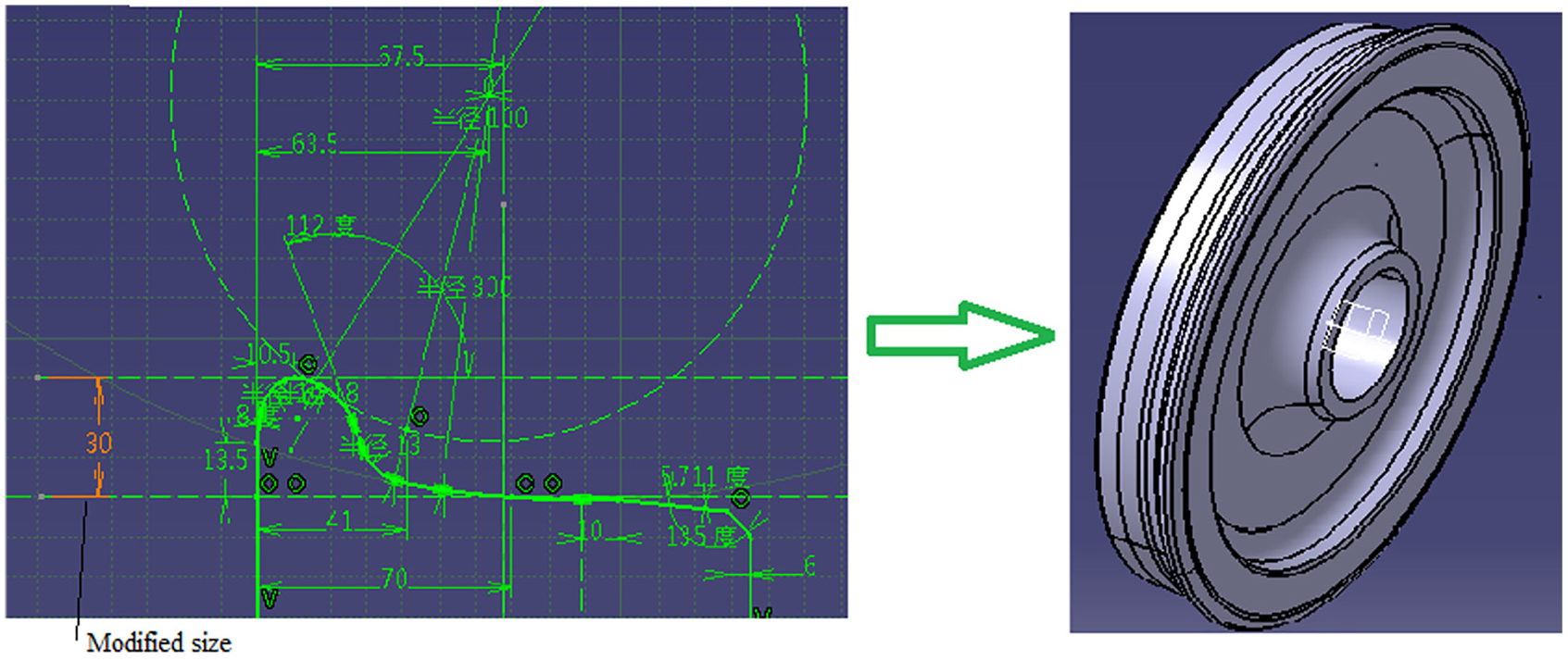
The parametric variant design of a wheel.
In the fast customization design system of a high-speed train’s bogie, when we input different types’ demand parameters, the main design parameters can be obtained by the meta-model and a 3D model of a certain bogie is developed in CATIA rapidly. As shown in Figure 11, when inputting different operating speeds of 350 or 250 km/h, we can acquire the corresponding bogie models conveniently.

The 3D model of 350- and 250-km/h bogie.
According to the above method, the fast customization design system of a high-speed train was developed and applied in two companies of vehicle manufacturing. Company 1 applied the rapid customization design system of a high-speed train in the scheme design and technical design of the A-type prototype, which required 99 designers working 127 days. Compared with the traditional development method that required 126 designers working 171 days, it can help the company to save about 27% of manpower and shorten the design cycle of a high-speed train by about 34.6%. Company 2 applied the rapid customization design system of a high-speed train in the scheme design and technical design of the B-type prototype, which required 102 designers working 77 days. Compared with the traditional development method that needed 160 designers working 115 working days, it can help the company to save about 36% of manpower and shorten the design cycle of a high-speed train by about 33%. 31 Therefore, the application of a fast customization design system of a high-speed train can significantly reduce the investment costs in terms of manpower and reduce the product design time.
Discussion
As demonstrated in the case study, we have obtained product meta-models and results of customization design supported by configuration and variant design in multi-layers of the product model. The result is coincident indicating that it is a feasible method and its prototype system is useful. We can summarize our observations as follows.
First, the case study shows that our modeling method can realize the accumulation and reuse of product design knowledge based on the unified and abstract description. The construction method of the product-pedigree-oriented product meta-model is helpful to realize the common and adaptive analysis of a product, which provides a demand-driven dynamic evolution model for CoPS. The previous product model schemes tend to organize the static information of product function, behavior, and structure at the unit level of granularity 13 and they lack effective integration of the product model with the dynamic design process, 32 which is difficult to support design reuse in the process of new product development.
Second, the advantage of the customization design method based on the meta-model is to realize the flexible configuration design in multiple abstract layers of the product model. The traditional configuration design technology is through selecting and assembling components to form a product based on fixed, predefined components and their relationship.24,33 However, the fixed configuration design knowledge cannot fully support rapid product design under the influence of the dynamic, changeable, and diverse requirements for CoPS. In recent years, the research focus of the field is gradually shifting to how to acquire and analyze dynamic requirements and technical knowledge to update the configuration model information. For instance, research topics include integrating expert knowledge and discovering new knowledge in configuration 34 or exploring how to improve the efficiency of design module capture and representation for product family reuse. 35
Conclusion and future studies
In this article, a new rapid customization design method based on a product meta-model for CoPS has been proposed and a prototype system design tool has been developed, which is significant for the common and adaptive analysis of the product-pedigree of CoPS and a quick response to the changing demands based on knowledge accumulation in the field of customization design. Based on the proposed product-pedigree concept, the product meta-model is presented as a framework to gain the abstraction information of four layers, guiding and supporting the configuration design of different layers and variant design and generating new products.
Our case study of a high-speed train’s bogie shows that (1) the construction and description method of the product-pedigree and product meat-model is feasible and applicable in CoPS engineering design and (2) the development of a rapid customization design system based on a product meta-model is a useful tool to realize the rapid and effective analysis and design of CoPS.
In the future, construction and research of the product-pedigree of a high-speed train’s bogie is a long-term task. It is necessary to constantly improve the entire pedigree system based on the changing market demands. At the same time, the evolution and development of the product-pedigree is expanded and improved along with the development of new products. At present, the product-pedigree is still in the stage of chart representation. It is necessary to further abstractly and theoretically construct the theoretical model of the product-pedigree and to improve the theory and system of the product-pedigree. The meta-model of a high-speed train’s bogie is based on the analysis of common and adaptive technologies which represent a huge category. However, there is no complete summarization analysis. The common and adaptability technologies of a high-speed train’s bogie need to be further improved and strengthened in order to sum up the intrinsic technology laws and tap adaptive technology strategies so as to continuously improve the product meta-model and enrich examples (or instances). Only in this way can we more effectively and rapidly support the R&D of new products of CoPS.
Footnotes
Handling Editor: James Baldwin
Declaration of conflicting interests
The author(s) declared no potential conflicts of interest with respect to the research, authorship, and/or publication of this article.
Funding
The author(s) disclosed receipt of the following financial support for the research, authorship, and/or publication of this article: This work was supported by The National Key Research and Development Program of China (Grant No. 2017YFB1201102).
