



Abstract
In this article, a vortex-induced vibration prediction model of a flexible riser conveying two-phase flow, including geometric and hydrodynamic nonlinearity, is established. A van der Pol wake oscillator is utilized to characterize the fluctuating lift forces. The finite element method is chosen to solve the coupled nonlinear fluid–structure interaction equations. The natural frequencies of the flexible riser are calculated to validate the method through comparisons with results from the literature. The modal analyses show that geometric nonlinearity has a significant effect on the natural frequency, and the critical internal velocity is reduced than those in linear analyses. The impacts of the gas volume fraction as functions of cross-flow velocity on the synchronization region, the displacement amplitudes, and the maximum stresses and frequency spectra have been investigated. The results show that an increase in the gas fraction results in the linear increase in natural frequencies and a wider synchronization region, and an increase in liquid flow rate led to the slight decrease in displacement amplitude and maximum stress within a small flow range.
Keywords
Introduction
Offshore oil and gas exploration and production have attracted researcher’s interest in the marine fluid-conveying riser, such as transporting oil, natural gas, and other resources, due to the action of the severe ocean environment loads. One of the most important environmental loads coursed by vortex-induced vibration (VIV) present some intriguing nonlinear dynamic phenomena, such as lock-in, jumping, and chaos. However, these fluid–structure interaction (FSI) excitations have a significant effect on fatigue damage and reduction in lifetime of the flexible riser. Therefore, the VIV responses of the fluid-conveying riser need to be investigated, especially the pipe conveying two-phase flow.
The VIVs of elastically supported rigid cylinders and long flexible pipe have been investigated theoretically and experimentally in the last decade.1–4 The related reviews have been documented in the literature.5–9 For rigid cylinders, some researchers examined the turbulent flow properties of a stationary cylinder 10 and VIV response of a motion cylinder. 3 Facchinetti et al. 11 presented a refined wake oscillator to describe the cross-flow (CF) of an elastically supported rigid cylinder and revealed that the acceleration coupling can qualitatively and quantitatively predict VIV. Moreover, geometric and hydrodynamic nonlinearity properties are very important to the accuracy of response amplitudes with a combination of both CF and in-line (IL).12,13 To calibrate the wake oscillator model, Postnikov et al. 14 proposed a new 2 degree-of-freedom wake oscillator model to represent the hydrodynamic force which is defined as being proportional to the square of the magnitude of the relative velocity between the CF velocity and cylinder.
For the VIV prediction models of flexible cylinders, some excitations of flexible fluid-conveying risers, such as pulsating fluid and base excitations, were discussed in the literature.15–18 Srinil 19 constructed a CF VIV prediction model for variable-tension vertical risers under linear shear current, and numerical predictions are good coincidence with some published experimental and computational results. However, these models ignored the effect of geometric and hydrodynamic nonlinearities.
Therefore, a three-dimensional (3D) VIV prediction model of a flexible pipe with geometric nonlinearity had been established and investigated.20,21 Based on the model, a 3D phenomenological VIV model of a long flexible pipe placed within uniform currents, including geometric and hydrodynamic nonlinearities, was constructed and analyzed by finite difference method (FDM), 22 and accurate prediction results were obtained by comparison with experimental data. 23 Recently, 3D VIV prediction models for a flexible riser under linearly sheared currents 24 and a marine viscoelastic riser subjected to uniform flow 25 were analyzed. It has to be mentioned that these studies payed little attention to the effect of internal fluid.
The flow-induced vibration (FIV) responses of pipe conveying internal flow only containing a kind of fluid have been well investigated by many researchers in the last few decades.26–30 He et al. 31 adopted nonlinear hydrodynamic force to describe the CF VIV responses of a fluid-conveying pipe with a top-end excitation under uniform currents. Furthermore, nonlinear dynamics of the 3D VIV prediction model for a flexible fluid-conveying pipe were performed. 32 In addition, with respect to pipe conveying two-phase flow, Pettigrew and Taylor 33 reviewed the two-phase FIV mechanism and analyzed the effect of dynamic parameters. Monette and Pettigrew 34 presented a modified two-phase model and validated it with experimental data. Generalized integral transform (GITT) method was adopted to analyze the dynamic characteristics of a flexible riser conveying two-phase flow by An and Su. 35 Based on the method, Ma et al. 36 constructed a pipe transporting two-phase flow model using the Timoshenko beam theory. However, there are no research that focus on the VIV of pipe conveying two-phase flow.
In this article, a VIV prediction model with a combination of both CF and axial (AX) motions for a flexible pipe transporting two-phase flow, including top tension and nonlinear hydrodynamic forces, is established in section “Mathematical models.” The validation of model and method are discussed in section “Model validation.” The frequency analyses and nonlinear dynamic responses are investigated in section “Parametric investigations and discussions.” In section “Conclusion,” some conclusions and suggestions are summarized.
Mathematical models
Vibration model of a fluid-conveying riser
In our research, it is assumed that a perfectly straight riser at its vertical static equilibrium under the effective weight is fully immersed in water. The flexible riser is placed in uniform currents aligned with the z direction, as shown in Figure 1.
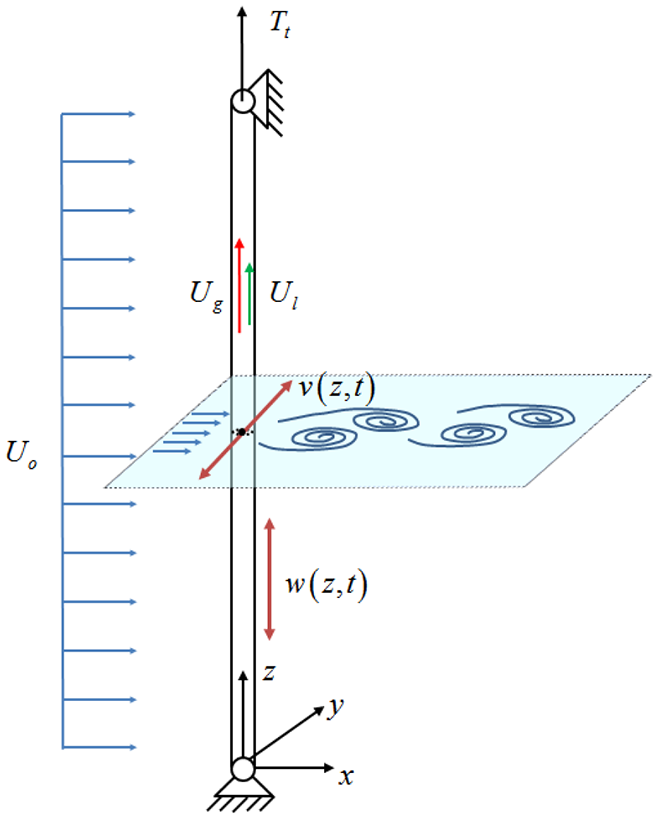
A schematic model of the flexible riser subjected to internal two-phase fluid and VIV.
Following Meng et al., 37 the nonlinear partial-differential equations of CF motions of a flexible pipe can be expressed as follows


where
The simply supported boundary conditions of the flexible fluid-conveying two-phase pipe are expressed as follows


Nonlinear hydrodynamic force model
Following the literature,14,31 the CF hydrodynamic force applied on the riser,


where


Sectional hydrodynamic force of pipe. Drag force
Considering the relative velocities of the CF around the riser CF motion

The time-varying lift coefficients are expressed by the wake variables

where
Two-phase flow model in riser
It is noted that two-phase flow in vertical risers extensively existed in ocean engineering, and there are some flow regimes, for example, bubbly slug, annular, or churn flow. Furthermore, two-phase flow mixed gas and liquid widely existed in oil and gas production. Therefore, our objective in this article is to explore the effect of oil–gas mixtures on the VIV dynamic responses. The two-phase flow model takes into account the velocity and physical characteristics of each phase. The parameters, including

where
To express the relationship of physical characteristics between liquid and gas, some essential parameters, including the volume of gas (Vg) and liquid

An improved slip-ratio factor model in which the slip factor K was expressed as a function of

Model validation
In order to validate our method, a long flexible riser model with L = 7.9 m was calculated to compare with the results of Meng et al.;
37
it should be mentioned that their model ignored the nonlinear terms of equation (2) and only considered single-phase fluid. Physical parameters of the flexible riser related to numerical analyses are formulated in Table 1, it should be noted that the length of the riser is 7.9 and 38 to investigate the influence of the length of the riser on nonlinear dynamics of riser. The nonlinear partial-differential equations (1) and (2) in combination with equation (8) are solved by finite element method (FEM).
32
Initial conditions are assigned in the initial state for the flexible riser
Physical parameters used for numerical study.

The hydrodynamic force term on the right side of equation (2) is removed to estimate the eigenfrequencies of a flexible riser. The foremost three natural frequencies of a flexible pipe with L = 7.9 m are calculated by modal analyses, as illustrated in Figure 3. It is found that there is a similar change in which the frequencies are decreased with increasing internal fluid velocities for both with and without nonlinear cases. It is also obvious that the frequency results with and without nonlinear terms are extraordinary inconformity with increasing internal fluid velocity. Furthermore, it can be inferred that the critical internal fluid velocity with nonlinear terms is much lower than that without nonlinear terms.
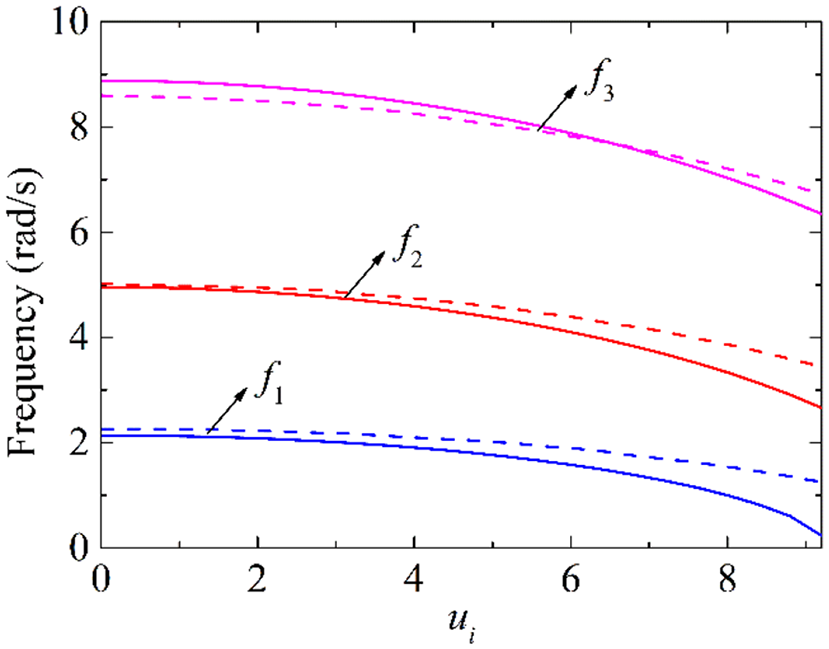
Frequency comparison of the flexible riser with increasing internal fluid velocity with (solid lines) and without (dashed lines) nonlinear terms when L = 7.9 m.
Parametric investigations and discussions
Frequency analysis of the flexible riser
Model analyses are performed to investigate the influence of gas fractions and flow rate of liquid on the foremost four natural frequencies of a flexible riser conveying two-phase flow for L = 7.9 m and L = 15.8 m, as illustrated in Figure 4. Figure 4(a) and (b) shows, respectively, the first four frequencies as functions of gas fraction for varying the length of the riser. It is found that there is linear increase in the first four frequencies with the increase in gas volume fraction for both two kinds of length, and the rates of change in natural frequency are larger with increasing mode order. Besides, it is also revealed that an increase in the length of the riser leads to the dramatical decrease in natural frequency.

Natural frequencies of the flexible pipe for mode 1 (blue), mode 2 (red), mode 3 (magenta), and mode 4 (purple) with increasing gas fraction: (a) L = 7.9 m and (b) L = 15.8 m.
Displacement responses
The next investigation only considers L = 7.9 m, and the effect of CF velocity on the displacement amplitudes of the riser for varying gas fractions and liquid flow rate is illustrated in Figure 5(a) and (b), respectively. Inspecting the plotted curves in Figure 5(a), it is found that there are the first lock-in regions of displacement amplitudes when the CF velocity is between 0.2 and 0.55 m/s for both

Maximum CF displacement amplitudes (A/D) of the flexible pipe for various (a) gas volume fraction
For the liquid flow rate, it is noted that the first lock-in regions of displacement amplitudes are the same for all cases of liquid flow rate due to the fact that the range of flow rate is low. It is also observed from Figure 5(b) that an increase in the gas fraction is accompanied with the decrease in displacement amplitude, this is because an increase in liquid flow rate leads to the increase in natural frequency of the riser by modal analyses. Moreover, it is also found that the displacement amplitude is decreased with an increase in the liquid flow rate.
In order to investigate the lock-in regions shown in Figure 5(a) for

Space-time varying responses of CF displacements (v/D) for (a)
To judge the periodic of the riser, time traces and frequency spectra of the pipe’s midpoint corresponding to Figure 6 are depicted in Figure 7. It can be seen from Figure 7(a) that the CF displacement responses are aperiodic although the CF velocities are within the lock-in region due to the effect of nonlinearity. In addition, it is concluded from Figure 7(b) that an increase in CF velocity leads to the increase in response frequency of the flexible riser.

Time traces and corresponding frequencies of the pipe’s midpoint for
Stress responses
The effects of gas volume fraction and liquid flow rate on the bending stress can be evaluated by equation (13). The positive and negative sign, respectively, denotes compressive and bending stresses in the CF direction

The influences of CF velocity on the displacement amplitudes of the riser for varying gas volume fractions and liquid flow rates are shown in Figure 8(a) and (b), respectively. Inspecting Figure 8, it is found that the law of bending stress variation is the same with that of displacement amplitude. It should be noted that two lock-in regions result in the sharp decrease in bending stress with the increase in flow rate.

Maximum CF bending stresses (Pa) of a flexible pipe for various gas volume fractions
Lock-in phenomenon
To investigate the frequency of the resonance region, the first and foremost two lock-in regions influenced by CF velocity for
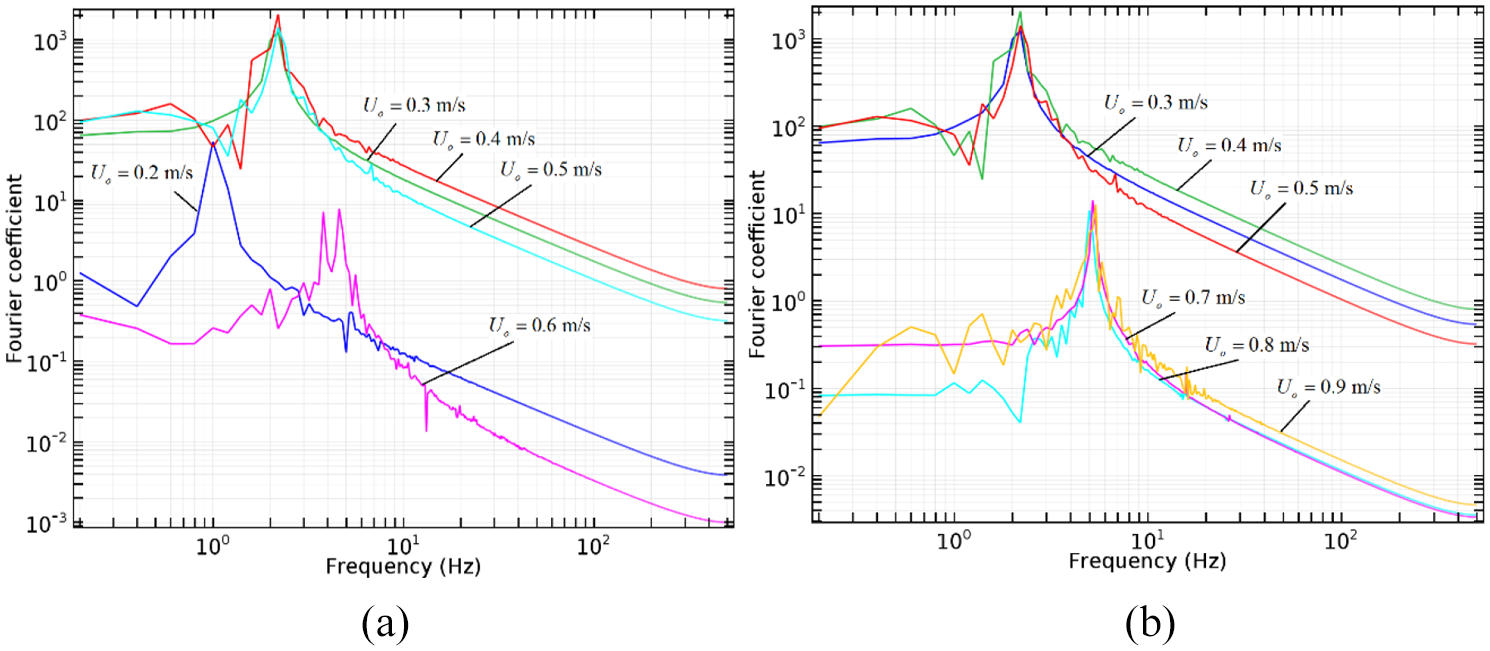
The frequency of first two lock-in regions for a flexible riser for (a) the first and (b) the foremost two lock-in regions when
Conclusion
A VIV model with a combination of both CF and AX motions of a flexible riser conveying two-phase has been established and solved by FEM to investigate the effect of gas fraction and liquid flow rate on the displacement and stress of a riser. It is noted that the geometric and hydrodynamic nonlinearities are also considered in our model. By modal analyses, it was demonstrated that the nonlinear terms of the flexible riser have an important effect on the natural frequency, moreover, an increase in gas volume fraction results in linear increase in natural frequencies and an increase in the length of the riser results in a decrease in natural frequency.
Then, nonlinear dynamic analyses were carried out to investigate the effects of gas volume fraction and liquid flow rate on the displacement amplitudes, the maximum stresses, and the lock-in region with various CF velocities. The results revealed that the gas fraction of internal fluid has a significant impact on the displacements and stresses for varying CF velocity, and an increase in the liquid flow rate results in the decrease in displacement and stress within the first resonance region. In addition, it was also found that an increase in gas volume fraction leads to a right shift in the first resonance region and a wider synchronization region. Furthermore, the time traces of the riser depicted that the dynamic responses present aperiodic. Overall, it was concluded that gas volume fraction and liquid flow rate should be paid more attention to prevent the lateral vibration of a flexible pipe conveying two-phase fluid for various CF velocities and lengths of the riser.
Supplemental Material
author_change_request – Supplemental material for Nonlinear vortex-induced vibration dynamics of a flexible pipe conveying two-phase flow
Supplemental material, author_change_request for Nonlinear vortex-induced vibration dynamics of a flexible pipe conveying two-phase flow by Wenwu Yang, Xueping Chang and Ruyi Gou in Advances in Mechanical Engineering
Footnotes
Appendix
Handling Editor: James Baldwin
Declaration of conflicting interests
The author(s) declared no potential conflicts of interest with respect to the research, authorship, and/or publication of this article.
Funding
The author(s) disclosed receipt of the following financial support for the research, authorship, and/or publication of this article: The authors acknowledge the supports of the Natural Science Foundation of China (grant no. 51674216) and the Post-Graduate Innovation Fund of Southwest Petroleum University (grant no. CX2014BY02).

References
Supplementary Material
Please find the following supplemental material available below.
For Open Access articles published under a Creative Commons License, all supplemental material carries the same license as the article it is associated with.
For non-Open Access articles published, all supplemental material carries a non-exclusive license, and permission requests for re-use of supplemental material or any part of supplemental material shall be sent directly to the copyright owner as specified in the copyright notice associated with the article.
