



Abstract
In the field of journal bearings, the microtexture processing technology of the bush inner surface has become an effective way to improve the performance of journal bearing. The two-dimensional finite element model of microtexture surface with different shapes of friction pairs is established based on the Navier–Stokes (N-S) equation, and the effect of lubrication conditions on the frictional performance of friction pairs is analyzed. Four microtextures that are radial grooves, circular pits, local reticulation, and circumferential grooved microtexture are processed by laser microcarving on the surface of specimen, and three different lubricating medium conditions are set up with high-viscosity oil, low-viscosity oil, and oil–solid mixture, and the effect of lubrication condition and texture shape on the wear reduction of the microtexture friction pair is studied. Results show that the concave microtexture and the radial groove can improve effectively the friction performance of the friction pair. The microtexture can effectively store the lubricating medium and wear abrasive particles in the mixed lubrication, and avoid effectively the second wear, and its average friction coefficient of radial groove microtexture is 22%, 30% lower than that of high- and low-viscosity lubricating media, respectively. Both theory and experiment have proved that the effect of microtexture on high-viscosity lubricant is better than that of low-viscosity lubricant.
Introduction
For improving the performance of journal bearing, the traditional methods mainly include optimization of bearing structure and optimization of lubrication mode.1–3 Surface coating technology has gradually become an effective method to improve bearing performance with the continuous development of precision machining technology.4,5 The optimization for the structure and lubrication conditions of the journal bearings are limited by the bearing structure and the application conditions. The coating technology mainly relies on advanced material technology, and its processing cost is high. Surface microtexture, also known as surface micromodeling technology, is also called biomimetic non-smooth surface in agricultural engineering, and it has been extensively studied and applied in journal bearings. 6 A large number of theoretical and experimental studies have shown that the inner surface of the surface microtexture bearing is improved in both lubrication and tribological properties, compared with the smooth surface of the friction pair. However, there is still a lack of systematic research on the specific optimal parameters, the mechanism of wear reduction, and the regularity of performance improvement.
In the theoretical calculation, Siripuram and Stephens 7 established the surface microprotruding and microgroove structure model based on the Reynolds equation and analyzed the influence of the surface microtexture area ratio on the friction coefficient of contact surface. Marian et al. 8 established a theoretical model of the textured surface of an infinitely wide rigid shaft and analyzed the influence rules of the texture surface on the rigid rotation axis. Khatri and Sharma 9 indicated that the influence of couple stress lubricant is significantly more in textured journal bearing than that of non-textured journal bearing. In view of the dynamic lubrication problem of the macroscopic texture surface, Han et al. 10 studied the mechanism of the dynamic pressure formation, and the effect of the geometric morphology and the geometric parameters of microtexture on the lubrication performance of the friction pair. Lu et al. 11 established the finite element calculation model with different cross-section microstructures, and investigated the effect of geometry and dimension of surface texture on the fluid lubrication performance.
In the experimental, Etsion and Sher 12 first proved that the surface of partial surface microstructure friction pairs can reduce the friction coefficient of friction pairs. Chen et al. 13 have studied the influence of triangular microstructure on the friction and wear rules of TiN coating, by processing microstructure on the TiN coating of die steel. Hua et al. 14 used the friction pair of GCr15 bearing steel in contact with ring and ring as the research object, and studied the friction properties of different lubrication methods, texture densities by orthogonal experiment. In Lin et al., 15 the surface microtexture was obtained by electrochemical treatment of 316 stainless steel, the texture surface was treated by ion nitriding, and the tribological behavior of friction pair was studied. Yagi and Sugimura 16 showed that the incorporation of a single dimple on the pad surface increased the convergence ratio between the surfaces, produced load capacity, and reduced the friction. Wang et al. 17 used laser processing system to process the microtexture of different densities on the surface of H13 steel, and studied the friction and wear properties of microtexture friction pair at different loads and speeds under the grease lubrication condition.
Based on the Navier–Stokes (N-S) equation, four finite element models of two-dimensional frictional pairs with different shapes are established. Under the condition of four microtexture shapes, and high- and low-viscosity lubricants, the specific influence of microstructure on the tribological properties of friction pairs is discussed. Then, the contact friction pair with ring and ring contact is used to simulate the contact form of journal bearing, and the effectiveness of the surface microtexture to the friction pair performance improvement is verified experimentally, under three lubrication conditions and different microtexture shapes. In the experiment, the solid–liquid mixing lubrication state makes up for the effect of microtexture storage debris and lubricating medium, which cannot be embodied in the theoretical analysis. Therefore, it is of great significance to study the optimized shape of microtexture and the influence of lubricating medium on the tribological properties, which can optimize the bearing performance, improve the working efficiency of mechanical equipment, promote the development of the mechanical innovation, and save the resources.
Establishment of theoretical model for microtexture friction pairs
The governing equation
Under the actual conditions, because of the lubrication flow complexity of micropits in the surface, and the structure type is pit type (about the Z plane symmetry), the two-dimensional surface microdimple model is taken into account. The size of single micropit is small, the influence of the surface curvature and roughness of the friction pair is ignored, the wall surface is simplified as a plane, and the rotation speed is simplified to a straight line motion on the upper wall. Assuming that the lubricant is an uncompressed Newton fluid, no volume force, lubricant viscosity and density are constant, the working environment is constant temperature, the flow is laminar and steady flow, the basic calculation control equation is as follows


where p is the pressure on the fluid microelement, Pa; τxx, τyx, and τzx are the components of the viscosity stress τ, Pa; ∇ refers to the gradient operator; fx, fy, and fz indicate the unit force in three directions, m/s2; respectively.
The bearing capacity of bearing friction pair F can be obtained by the integral of the oil film pressure acting on the friction pair of journal bearing in the oil film area

Friction force equation Fc of journal bearing friction pair is obtained as following

where N is the angular velocity of axis, L is the width of friction pair, R is the radius of friction pair, C is the radius clearance, μ is the viscosity of lubricant oil, and H is oil film thickness.
The establishment of single microtexture model
It is difficult to solve the governing equations directly by analytical method, so the numerical calculation is used to discretize the equations. In this article, ANSYS software is used as the main solution, and the finite volume method is used to solve it. Two-dimensional fluid calculation model of single microtexture friction pair is established by Gambit software; taking the friction pair of rectangular microtexture and 45# steel as an example, as shown in Figure 1, the optimized model calculation parameters are shown in Table 1. The upper wall slides and has no slip, the lower wall is fixed, and the inlet and outlet are periodic pressure inlet boundary and periodic pressure exit boundary conditions, respectively.

The single microtexture calculation model.
The calculation parameters of theoretical model.

Figure 2 shows the microtexture of different shapes. On the basis of the analysis of the rectangular microtexture, the microtexture of different shapes for triangle, arc, and trapezoid is compared and analyzed. The maximum depth of triangular microtexture is h0, the trapezoid microtexture depth is h0, the edge length of the bottom is l/2, the radius of the circular microtexture is h0, and the other dimension parameters are the same as that of Figure 1.

Single microtexture of different shapes: (a) triangular microtexture, (b) trapezoid microtexture, and (c) circular microtexture.
Introduction of experiment
Friction pair specimen
In order to simulate the actual contact state of friction pair for sliding bearing more accurately, the contact pairs are used as ring–ring contact pairs, as shown in Figure 3; there are the rotating upper sample and the fixed lower sample and they are made of 45# steel material. The hardness (HRC) of friction pair is 55–58 and the roughness Ra is 0.1. The surface microtexture consists of four shapes—pits, radial grooves, circumferential grooves, and local reticulation—as shown in Figure 4(a)–(d), respectively.

The physical map of the upper and lower specimen for the ring–ring friction pair: (a) upper specimen and (b) lower specimen.
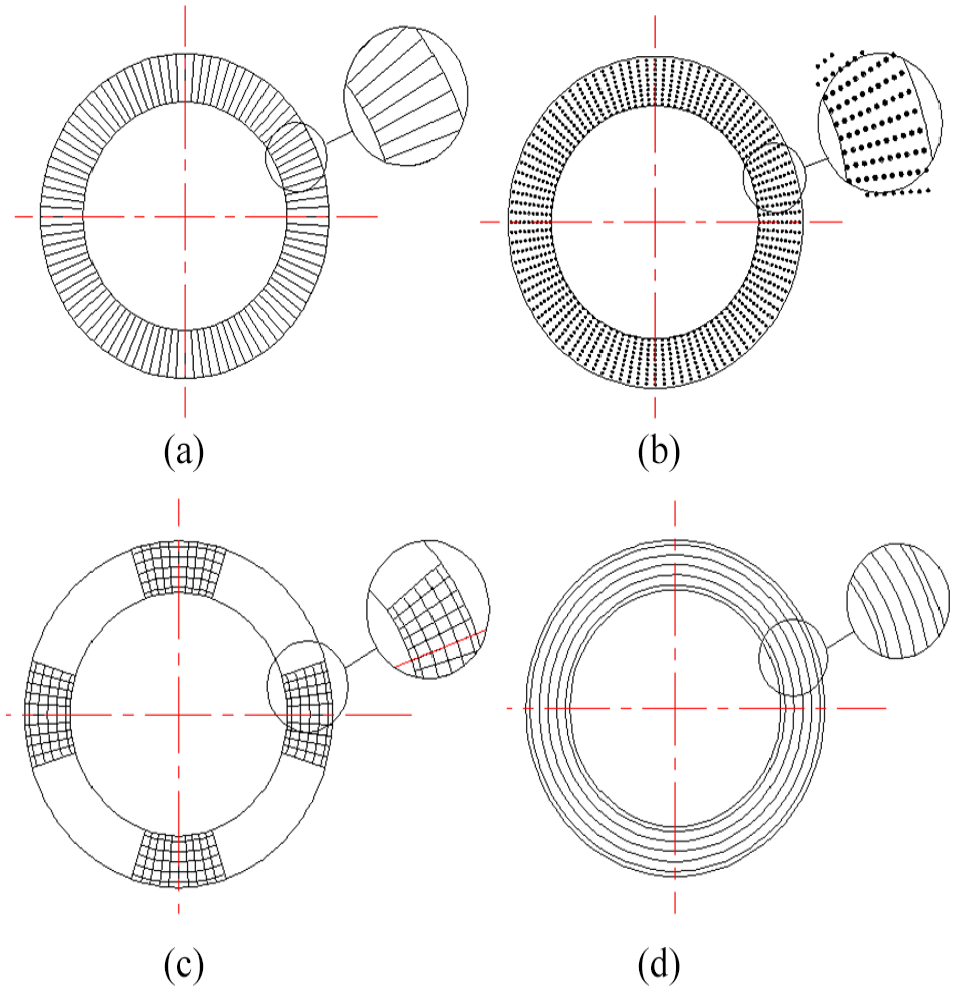
Schematic diagram of microtexture workpiece in different layouts: (a) radial grooves microtexture, (b) pits microtexture, (c) local reticulation microtexture, and (d) circumferential grooves microtexture.
Experimental method
The vertical universal friction and wear testing machine that can realize the friction on the contact surface at different loads, speeds, and lubrication conditions is used. The oil lubrication adopts two kinds of lubricating oil—with high-viscosity and low-viscosity—in the experiment. The high-viscosity lubricating oil adopts 68# anti-wear hydraulic oil, and its measured kinematic viscosity (at 40°C) is 69.05 mm2/s; low-viscosity lubricating oil uses 5# lubricating oil, and its kinematic viscosity (at 40°C) is 5.5 mm2
Analysis on the theoretical results of microtexture friction pair
Figure 5 shows the pressure distribution of different micropits along the x direction (y = –0.019 mm) for high- and low-viscosity lubricating oils. In Figure 5, the H- shows high-viscosity lubricating oil and L- indicates low-viscosity lubricating oil, for example, the pressure curve of rectangular texture shape under the high-viscosity lubricating oil is shown by H-rectangle. It can be seen from the diagram that the existence of texture can effectively produce dynamic pressure effect, which is consistent with Wang et al. 18 It can be also seen that the pressure fields of triangle pits are the largest under the condition of high- and low-viscosity lubricating oils. High- and low-viscosity lubricating media cannot change the change rule of pressure, but can only change the pressure value. The overall pressure distribution of oil film in the high-viscosity lubricating oil is greater than that of the low-viscosity lubricating oil, which shows that the dynamic pressure effect of microtexture is more obvious when the high-viscosity lubricating oil is used, and high-viscosity lubricating oil is more beneficial to the pressure effect of microfabric.

The pressure distribution of different microtextures along the x direction (y = –0.019 mm).
Figure 6 shows the friction of different textures under different lubricating oil viscosities. The distribution of frictional force shows that the triangular micropits have less frictional force and produces significant dynamic pressure effect under different lubricating oils, and this is consistent with the pressure analysis of Figure 5 that the effect of dynamic pressure of triangular micropits is the best. The friction force of the oil film in the high-viscosity lubricating oil is obviously higher than that of the low-viscosity lubricating oil. This is because the molecular shear of high-viscosity lubricating oil is stronger and the overall viscosity of the oil film is greater, and the existence of microtexture cannot affect the intermolecular viscosity of lubricating oil, which is consistent with the analysis result of the viscosity effect on pressure.

Friction of different microtexture shapes.
Analysis of experimental results on microtexture friction pair
The mechanism of surface texture friction pair can improve effectively the friction performance of friction pair, which mainly includes three aspects: under dry friction condition, microtexture can store tiny abrasive particles produced during friction process, and reduce effectively the damage of two different wears to friction surface; under the condition of fluid lubrication, the microtexture can store the lubricating medium, which can produce additional fluid dynamic pressure effect, increase the bearing capacity of friction surface, and improve the bearing capacity and stability of the friction pair effectively; under the condition of mixed lubrication, microtexture can suppress abrasive wear, produce hydrodynamic pressure effect, and improve the lubrication conditions of friction pairs. As shown in Figure 7, the anti-friction mechanism of microtexture includes fluid dynamic pressure effect, storage of abrasive particles, and so on; microtexture can also store solid lubricant particles, transfer lubricant abrasive particles to contact surface by the friction extrusion effect and thermal effect, and better improve the performance of friction pairs. In the theoretical analysis, the main analysis is the dynamic pressure effect of microtexture under the lubrication state of high- and low-viscosity lubricating oils, and it cannot reflect the effect of the storage wear particles and the lubricating medium of the microtexture. Therefore, the mixed lubrication state of the oil and solid is set up in the experiment, the anti-wear effect of the microtexture is analyzed more comprehensively, and the effect of high- and low-viscosity lubricating oils in the theoretical analysis is further verified.

Schematic diagram of the mechanism for friction and wear of microtexture.
Experimental analysis of microtexture under different lubrication conditions
Figure 8 shows the variation of friction coefficient with time under different forms of microtexture and high-viscosity oil, and the experimental time 0–10 min and 10–30 min are initial wear stage and stable wear stage of friction pairs, respectively. The friction coefficient of the specimen with smooth surface is smaller than that of the surface micropits and the circumferential grooves, and the friction coefficient of smooth surface has no obvious difference with the friction coefficient of the radial grooves and local reticular microtexture in the initial wear phase of the friction pair. However, the friction coefficient of smooth surface is relatively stable with a relatively small fluctuation range; at the initial stage, the hydrodynamic pressure effect cannot improve obviously the lubrication performance of the friction pair, and the friction property of the friction pair is not improved obviously by the surface microtexture. In the stable wear stage, the friction coefficient of the specimen with the radial groove and the concave microtexture is obviously smaller than that of the smooth specimen. This is because the dynamic pressure effect produced by the radial groove and the concave microtexture that reduces effectively the friction coefficient; microtexture can store lubricating oil and abrasive particles, reducing effectively the occurrence of the two different wears. The overall friction coefficient of the local reticular microtexture reduces slightly, and the friction reduction effect is not obvious. The circumferential groove microtexture does not reduce effectively the friction coefficient of the friction pair, because the microtexture of the circumferential groove cannot produce effectively the dynamic pressure effect, and the circumferential groove aggravates the abrasion of the wear surface with the progress of friction, which leads to the increase in the friction coefficient. The effect of surface microtextures with different distribution forms can also be shown clearly from high-viscosity histogram of Figure 11; the effect of microtexture of concave and radial grooves is most obvious, which can reduce friction coefficient by 16% and 11%, respectively. Figures 8 and 11 show that a reasonable distribution of the surface microtexture can reduce effectively the friction coefficient of the friction pair, ensure the full oil supply of the lubricating oil, and improve the friction performance of the friction pair, which is consistent with the theoretical results and Han et al. 10 and Wang et al. 18

The friction coefficient of friction pairs under different forms of microtexture and high-viscosity oil.
Figure 9 shows the change law of friction coefficient under different forms of microtextures lubricated by oil–solid mixed lubricant. In the mixture of oil and solid lubricants, the mixture ratio of lubricating oil and solid lubricant is 3:1, the lubricating medium after mixing is greased, and the experiment is carried out with the method of smearing lubrication. The friction coefficient of friction pairs with radial grooves and microtextures during lubrication is much less than that of smooth surfaces. The friction coefficient of the friction pair with the circumferential groove microtexture is slightly larger than the smooth surface in the stable wear stage, and the friction coefficient of the local mesh microtexture has no obvious difference with the smooth surface. The above experimental results show that radial groove microtexture has better wear resistance, the mixed lubricant can form a stable oil film with smaller shear strength between the upper and lower parts, and the oil film can avoid the direct contact of the rough convex peak on the friction matrix while producing the dynamic pressure effect; the friction process separates the friction matrix effectively and reduces the contact friction coefficient of friction pair. Although the peripheral microtexture and the local reticular microtexture have a certain effect on storing lubricants and storing wear particles, their local fluid dynamic pressure effect is not obvious, which reduces the overall friction performance.
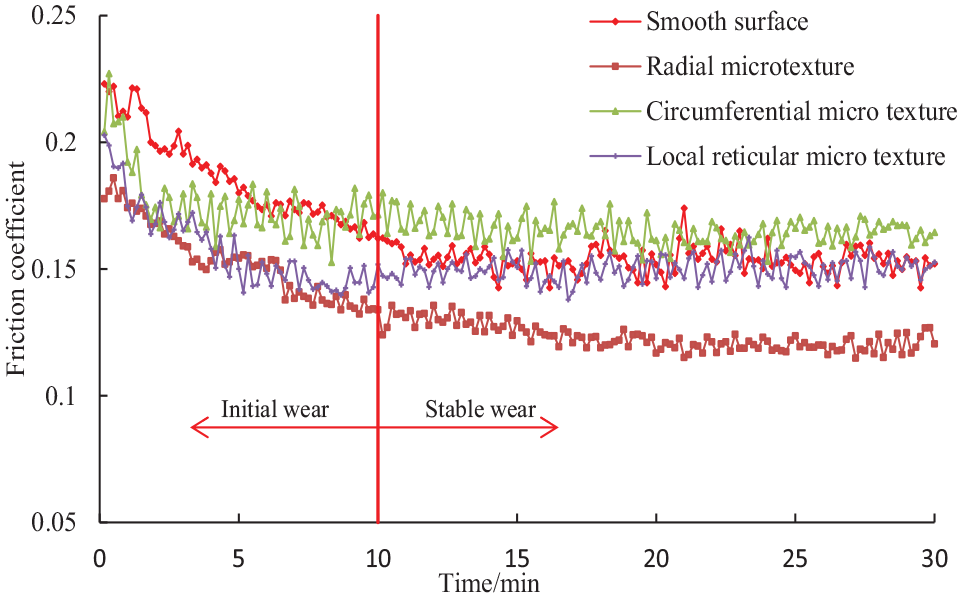
The friction coefficient of friction pairs under different forms of microtexture and oil–solid mixing lubrication.
According to friction coefficient under different forms of microtexture in Figure 8, the dynamic pressure effect of radial groove and pits microtexture is the best. At the same time, combined with the results of theoretical analysis, the existence of high- and low-viscosity lubricating media will not change the change rule of the friction pair characteristics for different texture shapes and only change the value of friction pair parameters; so, only the friction coefficient of the radial groove and the pits microstructure is analyzed in Figure 10, which has better dynamic pressure effect. As can be seen from Figure 10, the friction coefficient for the two forms of microtexture in the initial and stable wear stages is slightly smaller than the smooth surface, and there is no obvious effect. This shows that the lubricant film formed by the microtexture has less bearing capacity when the low-viscosity oil is lubricated, the contact between the microroughness peaks of the contact surface is easy to damage the formed oil film, the dynamic pressure effect of surface microtexture is weakened, the formation of the stable, and effective lubricating oil film is decreased. This is consistent with the fact that dynamic pressure effect of microtexture for the high-viscosity lubricating medium is more distinct than low-viscosity lubricating medium in the theoretical analysis.

The friction coefficient of friction pairs under different forms of microtexture and low-viscosity oil.
Figure 11 shows the average friction coefficient under different forms of microtexture friction pairs and different lubrication modes in the steady wear stage. In high-viscosity lubricating oil, the effect of the radial groove and the concave microtexture is the most obvious, the local reticular microtexture can also reduce the grinding effect, and the microtexture of the circumferential groove increases the friction coefficient of the friction pair, which is in accordance with the law reflected in Figure 8. When low-viscosity lubricants are lubricated, the effect of microtexture of different shapes is not obvious. When oil and solid lubricants are lubricated, the overall friction coefficient of friction pair is less than that of the pure oil lubrication, and the existence of microtexture can more effectively play the role of the solid lubricant, for example, the friction coefficient of smooth surface is lower by 13% than that of high viscosity, the friction coefficient of radial groove microtexture under oil–solid lubrication is 22% lower than that of high viscosity, and the friction coefficient of the circumferential groove microtexture friction pair in oil–solid mixed lubrication is about 22% lower than that in the high-viscosity oil lubricated state. The mechanism of microtexture anti-friction is analyzed from two aspects, on one hand, the hydrodynamic lubrication effect of high-viscosity lubricants is more effective in reducing friction in microtexture friction pairs, for example, the friction coefficient of concave microtexture at high viscosity is about 15% lower than that of low-viscosity; on the other hand, the lubrication effect of oil–solid mixed lubricants is better in the microtexture friction pairs, and the oil–solid mixture in the microtexture concave can be transferred to the contact surface of the friction pair with the extrusion effect and thermal effect of the friction, which can form a composite lubricant film. The solid lubricants in the composite oil film can be fully dispersed in the oil film and give full play to the anti-friction effect of molybdenum disulfide, which can better hold the wear abrasive grains into microtexture and reduce the second wear on the surface by wear abrasive particles. Based on the above analysis results, the effect of different texture shapes is as following: Pits microtexture > Radial groove microtexture > Local reticular microtexture > Circumferential groove microtexture. The effect of microtexture under different lubrication conditions is as following: Mixed lubrication > High-viscosity oil lubrication > Low-viscosity oil lubrication.

The average value of friction coefficient for different specimens in stable wear stage.
Analysis of wear on the surface of the specimen
Figure 12 shows the wear conditions of different specimen surfaces at high-viscosity lubrication. Figure 12(a) shows a local magnification of the wear for a microtexture smooth specimen. Figure 12(b)–(e) show a partial 100 times image of the radial groove microtexture, the concave microtexture, the local net microtexture, and the circumferential groove microtexture wear. Considering the analysis of Figures 8 and 11, the effect of the concave and radial groove microtexture on the friction reduction is most obvious, so the emphasis is focused on the analysis of the wear under the two operating conditions. In contrast to Figure 12(a)–(c), it can be seen that the surface of the specimen has obvious wear marks in the direction of friction, and there is a clear furrow-like grinding mark; however, the furrow grind mark depth for the specimen of Figure 12(b) and (c) with microtexture is much lighter than the smooth specimen of Figure 12(a), and the relative width of the furrow is narrower, which indicates that the dynamic pressure effect of the surface microtexture and the effect of oil storage can effectively reduce the wear surface. In contrast to Figure 12(b)–(e), it can be seen that the friction surface has furrow grinding, also has the obvious abrasive wear and adhesive wear, and has obvious abrasive exfoliation phenomenon; but the abrasive wear traces produced on the surface of micropits are much smaller than those on smooth surfaces, and the effect of wear reduction for micropits is best. The whole grinding effect law of microtexture for different shapes is as following: Pits microtexture > Radial groove microtexture > Local reticular microtexture > Circumferential groove microtexture, which is in accordance with the distribution of the friction coefficient in Figure 8.

The local enlargement of surface wear for different friction specimens: (a) local large map of smooth specimen, (b) the local magnification of the radial groove (100×), (c) the local magnification of the pits (100×), (d) the local magnification of the local reticulation (100×), and (e) the local magnification of circumferential grooves (100×).
Conclusion
In order to investigate the influence of surface texture on the lubrication characteristics of journal bearing friction pairs, the two-dimensional finite element model of smooth surface and microdimple surface with different shapes of microtexture is established, based on the N-S calculation equation of the fluid; the effect of hydrodynamic lubrication on the frictional performance of friction pairs under different lubrication conditions is analyzed. The contact friction pair with ring–ring contact is used to simulate the contact form of the sleeve bearing, and the friction and wear experiment is carried out by the universal friction and wear tester, the effectiveness of the surface microtexture on the friction pair performance is verified under different lubrication conditions. The mechanism of microtexturing in the mixed lubrication state of oil–solid lubricating media is supplemented, which is unexplained by theoretical calculation. The main conclusions are as follows:
In the experiment, the friction reduction effect of the radial groove and the concave microtexture is the most obvious, and the effect of the local reticular microtexture is not obvious, but the microtexture of the circumferential groove leads to the increase in the friction coefficient. The whole grinding effect law of different microtexture shapes is as following: Pits microtexture > Radial groove microtexture > Local reticular microtexture > Circumferential groove microtexture.
Reasonable arrangement of microtextures can reduce effectively the friction under different lubrication conditions; the triangular micropits are the optimal shape, which have less frictional force and produce significant dynamic pressure effects under the viscosity of different lubricating oils through comparison with references and analysis. Under the condition of mixed lubrication, the effect of friction on friction pairs is most obvious due to the storage of solid lubricant particles by microtextures. Both theoretical analysis and experimental results show that compared to low-viscosity lubrication condition, the friction pair can play more effective on the microtexture under the high-viscosity lubrication condition. Comprehensive theoretical analysis and experimental results show that the effect of microtexture under different lubrication conditions is as following: Mixed lubrication > High-viscosity oil lubrication > Low-viscosity oil lubrication.
Supplemental Material
Authorship-change-request-form – Supplemental material for Tribological properties of surface microtexture friction pairs under different lubrication conditions
Supplemental material, Authorship-change-request-form for Tribological properties of surface microtexture friction pairs under different lubrication conditions by Lili Wang, Xingtang Zhao, Shaohui Guo and Min Wang in Advances in Mechanical Engineering
Footnotes
Handling Editor: James Baldwin
Declaration of conflicting interests
The author(s) declared no potential conflicts of interest with respect to the research, authorship, and/or publication of this article.
Funding
The author(s) disclosed receipt of the following financial support for the research, authorship, and/or publication of this article: This work was supported by the grant from China Postdoctoral Science Foundation Funded Project (No. 2017M612304); Shandong Provincial Postdoctoral Innovation Foundation (No. 201701016); Qingdao Postdoctoral Research Funded Project; Shandong Province Key Laboratory of Mine Mechanical Engineering, Shandong University of Science and Technology (No. 2019KLMM208); SDUST Research Fund (No. 2015JQJH104); Study Broad Fund Sponsored by Shandong Province Government and Shandong University of Science and Technology.

References
Supplementary Material
Please find the following supplemental material available below.
For Open Access articles published under a Creative Commons License, all supplemental material carries the same license as the article it is associated with.
For non-Open Access articles published, all supplemental material carries a non-exclusive license, and permission requests for re-use of supplemental material or any part of supplemental material shall be sent directly to the copyright owner as specified in the copyright notice associated with the article.
