



Abstract
Balloons made by cut fabric pieces are widely used in space research. To predict the blasting pressure of a balloon, we propose a novel method based on the non-contact test strain at a low internal pressure. The three-dimensional digital image correlation technique is introduced to measure the surface strain of the balloon. Representative regions of the balloon are selected as the test regions. A correction factor is proposed that accounts for the relationship between the internal pressure and the surface strain for the actual and the ideal balloon. By combining the maximum surface strain at a given internal pressure and the correction factor, we can predict the blasting pressure of the balloon. A blasting test is carried out to verify the feasibility of the predictive method. When the value of the ratio of the maximum test strain to the limiting strain reaches about a reference value, the absolute value of the deviation percentage between the predicted blasting pressure and the actual blasting pressure is less than 10%. The blasting pressure for balloon can be predicted accurately. This method does not require the balloon to be inflated to a high internal pressure, which improves the practicality of the prediction.
Keywords
Introduction
Balloons made by cut fabric pieces are widely used in space research. The blasting pressure of balloons is one of the important indicators of their usefulness. Blasting tests of the balloons that have three gore angles were conducted by NASA in November 2007. The blasting pressure of the balloon increased with the angle of the gores. 1 The asymmetric distortions and the unsafe rupture phenomenon of the pumpkin-shaped balloon were at one time the main research concern of NASA. 2 The cleft formation of a balloon was simulated and studied.3,4 At present, there are very few papers predicting the blasting pressure, and the actual blasting pressure of the balloon is usually obtained by the blasting test.
A biaxial material test apparatus and photogrammetric three-dimensional (3D) shape measurements were used to analyze the structural deformation of high-altitude scientific balloons. 5 Photogrammetry was used to study measurements of the thin-film strain of the balloon, and the results indicated that the photogrammetry strain measurement was accurate and practical.2,6 Photogrammetry data and other measurements were recorded to validate the analytical models that predict the general balloon shape and specifically the shape of the inflated radio frequency (RF) reflector. 7 The surface strain and the configuration of the balloon were generally obtained by digital photogrammetry. The strain and displacement of only a single point could be obtained. The continuous full-field strain of the local surface of the balloon could not be obtained.
A 3D digital image correlation (DIC) system for deformation measurement in experimental mechanics has been developed, which can give both in-plane and out-of-plane displacement/strain fields.8,9 By using DIC, the deformation behaviors of local domains of F82H joint specimens welded using inert tungsten gas and electron-beam welding were evaluated during the tensile and fatigue testing. 10 A stereo-DIC system was used to quantify the global relative wing shape for four geometrically identical wing designs using flexibility as the parameter. 11 In a tensile test, multi-axial behavior was obtained by DIC.12–15 Characterization of non-linear properties for composite materials was obtained by using DIC and finite element analysis.16–18 During mechanical testing of hard and soft tissues, the DIC technique could measure full-field surface strains.19–22 As can be seen from the above studies, the DIC has proven to be a powerful non-contact technique for measuring 3D displacement/strain fields on any 3D object.
The balloon is made by cut fabric pieces including 12 gores. The material properties of the warp and weft directions of the fabric are obtained by the tensile test. The 3D DIC technique is introduced for the surface strain measurement of the balloon. Representative regions of the balloon are selected as the test regions. A correction factor is proposed to handle the relationship between the pressure and the strain of the balloon in the ideal and the actual state. The ideal balloon is a whole balloon without seams. The actual balloon is made by cut fabric pieces with seams. By using the non-contact test strain results, we propose a novel method to predict the blasting pressure of the balloon. Then, a blasting test is carried out to verify the feasibility of the predictive method. Finally, the factors that influence the accuracy of the predictive method are discussed.
Geometry model
The balloon is made by cut fabric pieces. The cut fabric pieces of the balloon consist of two end pieces and 12 gores. End pieces are symmetrically arranged at the north and south poles of the balloon. The splicing tapes are formed after splicing between the gores, which defines the seams.
The balloon is made of Vectran fiber fabric, and the material properties of the fabric are obtained by the uniaxial tensile test along the warp and weft directions, as shown in Table 1. The reference standard for the tensile test is GB/T 3923.1-2013. The size of Vectran fabric sample is 50 × 200 mm. The stress–strain curves of the tensile tests for the samples are shown in Figure 1. Assume that the balloon is an ideal spherical balloon. The ideal balloon is a whole balloon without seams. So, the relationship between the surface stress and strain of the ideal balloon can be described by equation (1)

where
Material properties of Vectran fiber fabric along the warp and weft directions.

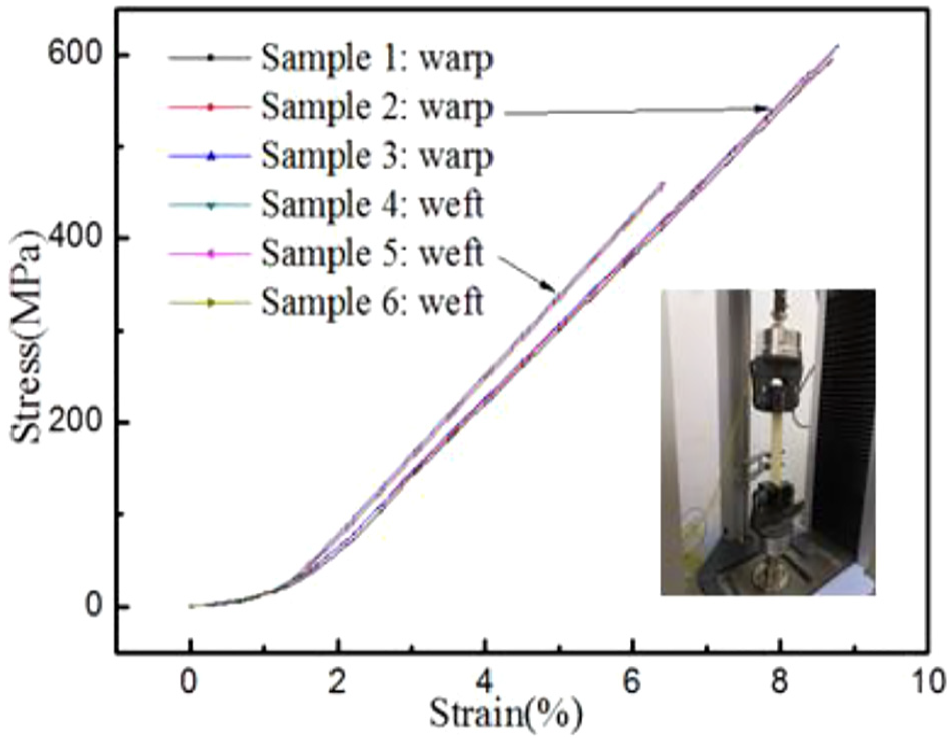
The stress–strain curves along the warp and weft directions.
The elastic modulus
Strain test
The 3D DIC technique is introduced to test the surface strain of the representative regions of the balloon. Figure 2 shows the schematic diagram of the balloon. The representative regions include the equatorial seams, the north–south poles, and the 60° of north–south latitude. DIC generally refers to a class of non-contacting methods that acquire images of an object in digital form and perform image analysis to extract sensor plane motions that can be converted into full-field measurements on the corresponding object. One of the most commonly used approaches employs random patterns and compares subregions from “deformed” and “non-deformed” images to obtain a full-field of sensor plane measurements. 23 Using 0.2-kPa internal pressure as the initial pressure, the strains of the balloon are obtained for the different internal pressures. The initial pressure of the balloon is the lowest internal pressure that maintains the shape. Figure 3 shows the test chart of the surface strain of the balloon.

The schematic diagram of the balloon.
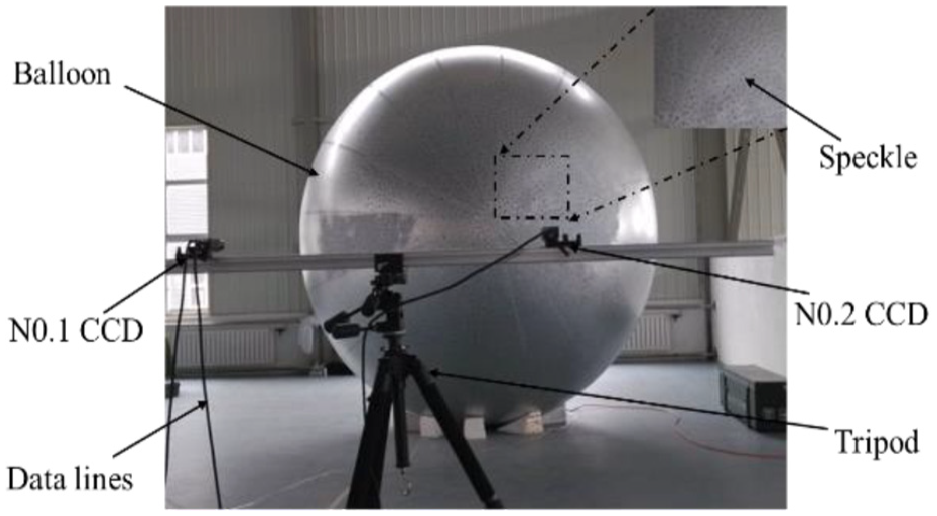
Test chart of the surface strain of the balloon.
Testing process
In the process of the surface strain test of the balloon, the flow of the strain test is determined. Figure 4 shows the flow chart of the strain test, including selection of the test regions, creating speckle images, calibration, data collection, and data analysis. The representative test regions, including the equatorial seam, the north–south poles, and the 60° of north–south latitude, of the balloon are selected. The strains of these three regions basically reflect the situation of the balloon. In the region of the equatorial seams, two adjacent gores are selected as the main test region. Then, the region of the north–south poles is selected as the next test region. Based on the results of the strain of the north–south poles, the gore with the largest strain on the edge is selected. Finally, the strain test is carried out on the region of the 60° of north–south latitude of the gore selected by the previous step. Based on the result of the strain test of these regions, the maximum value of the surface strain of the balloon is obtained at a given internal pressure, and the maximum value of the surface strain is used to predict the blasting pressure of the balloon.

Flowchart of the strain test of the balloon.
Before collecting the surface image data of the balloon, it is necessary to create speckle images on the test regions of the balloon. The surface of the test regions must be treated before continuing. The test regions are sprayed with a layer of white matte paint. The thickness of paint is not too high. Then, the black spots, which have different shapes, are randomly painted using a black ink pen on the test regions. The black spots are the speckles. The sizes of the speckles are generally controlled at about 5 pixels. The double charge-coupled device (CCD) cameras are used for testing the surface strain of the balloon. At the same time, the system is calibrated with the calibration plate before data collection.
Data analysis
The first principal strain clouds of these test regions are obtained at different internal pressures. Figure 5 shows the test results of the test regions at 8.2-kPa internal pressure. The first principal strain is described as

First principal strain cloud of the each region at 8.2-kPa internal pressure. (a) The region of equatorial seams, (b) the region of north–south poles, and (c) the region of 60° of north–south latitude.
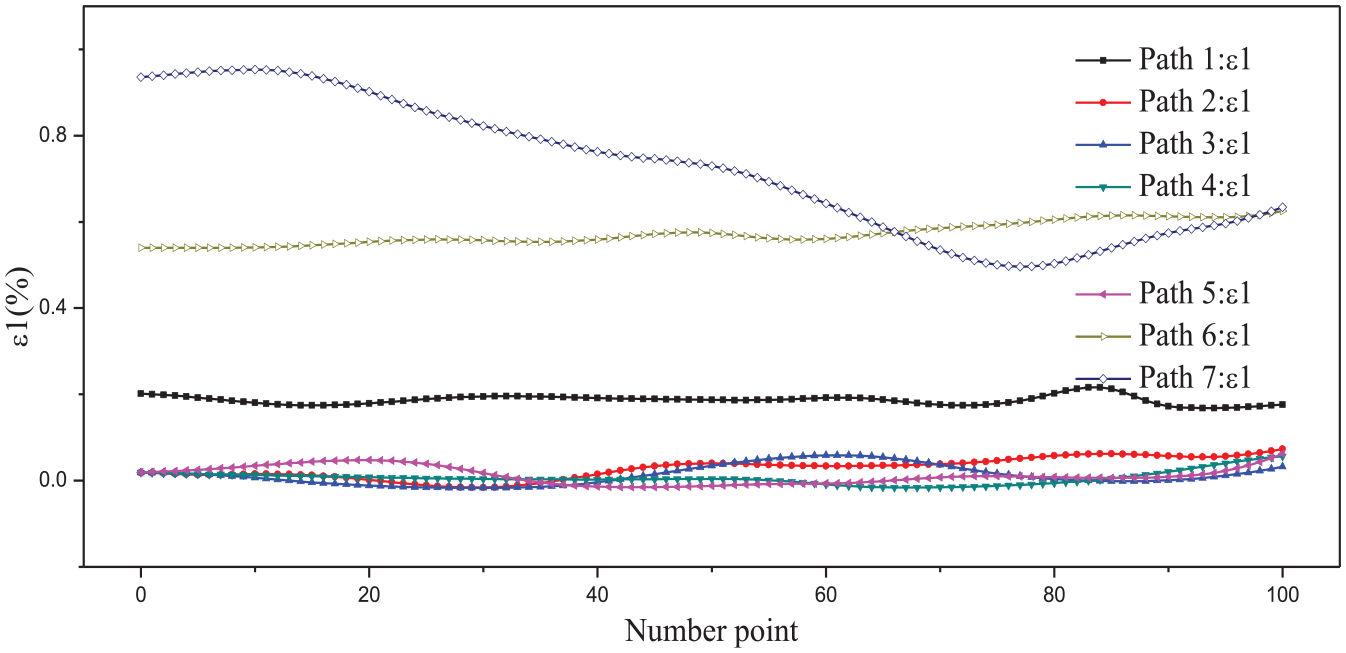
First principal strain along each path.
The largest value of the first principal strain
In this article, the radius
Predictive method of the blasting pressure
Based on the analysis of the strain data of each test region, the maximum test strain occurs near the 60° of north–south latitude of the balloon. The value of the test strain of the balloon is far more than the theoretical value with the same internal pressure. Therefore, the actual blasting pressure of the balloon will be greatly reduced. So, it is necessary to predict the actual blasting pressure of the balloon. By using the results of the non-contact test strain, we propose a method to predict the actual blasting pressure of the balloon.
Assume that the relationship between the pressure and the strain of the ideal balloon and the actual balloon is defined as equation (2)

where
In this article, the initial pressure

According to equation (1), the ideal blasting pressure of the ideal balloon is 101.24 kPa. So, the blasting pressure of the balloon can be obtained by equation (2) to give 54.1 kPa. The predicted blasting pressure of the balloon is described as
The blasting pressure of the balloon can be predicted using the hypothetical relationship between the pressure and the strain of the balloon in the ideal and actual states. By using the maximum test strain at 8.2-kPa internal pressure, the 54.1-kPa blasting pressure of the balloon is predicted.
Validation and discussion
Finally, the blasting test of the balloon is carried out. Then, the actual blasting pressure of the balloon is acquired. An elastic net is used to limit the rotation of the balloon, and a barometer is used to record the internal pressure of the balloon at any time. The actual blasting pressure of the balloon is 59.0 kPa. The actual blasting pressure of the balloon is described as

So, according to the above description, the deviation percentage

So, the ratio

Before and after photos of the balloon blast.
The speckle image information of these test regions of the balloon is also collected at the internal pressures 4.2, 5.2, 6.2, and 7.2 kPa. So, the values of the first principal strain of the point

The ratio
The blasting pressure prediction and the blasting tests are carried out for several balloons. The results are shown in Table 2. For balloons made by different fabric cutting pieces, the deviation percentage
Results of blasting pressure prediction for several balloons.
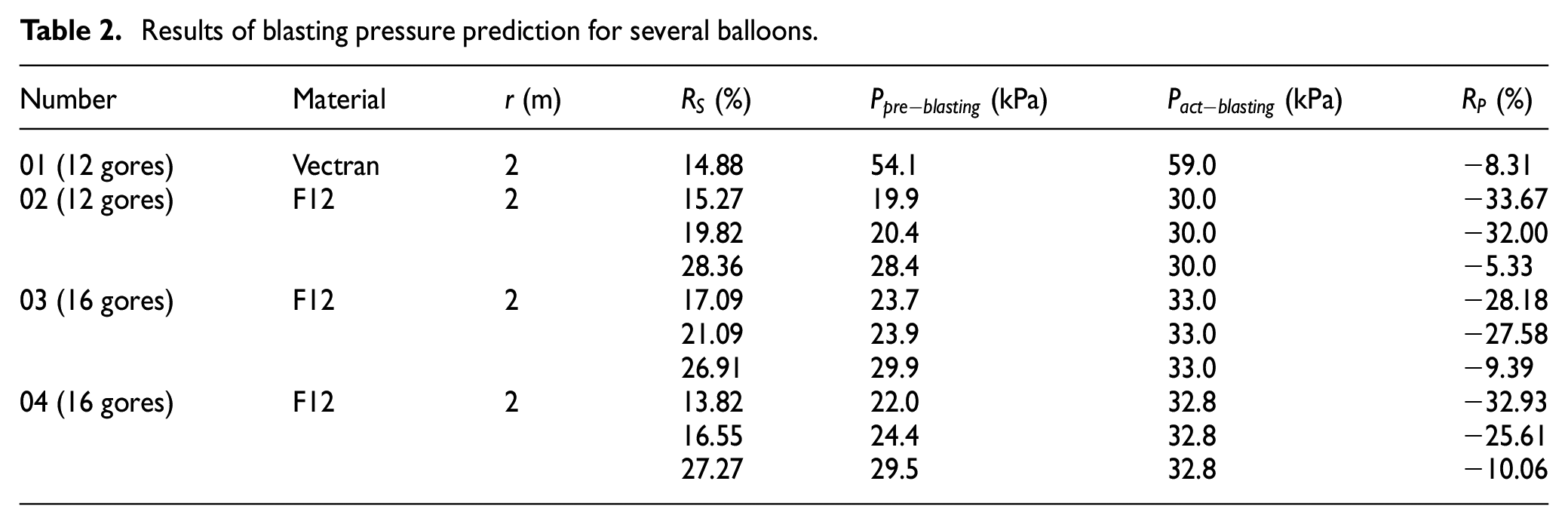
An important conclusion can be obtained from this analysis. For the balloon made by cut fabric pieces, the maximum surface strain can be obtained by the 3D DIC technique at different internal pressures. By using the hypothetical relationship between the pressure and the strain of the balloon in the ideal and actual state, the blasting pressure of the balloon can be predicted. The deviation percentage
Conclusion
Based on the non-contact test strain at a given internal pressure, we propose a novel method to predict the blasting pressure of the balloon. The balloon is made by cut fabric pieces. Representative regions are selected as the test regions; these include the equatorial seams, the north–south poles, and the 60° of north–south latitude. The first principal strains of the test regions of the balloon are obtained using a 3D DIC technique at different internal pressures. A correction factor is proposed for the relationship between the internal pressure and the surface strain for the actual and the ideal balloon. By combining the maximum surface strain at a given internal pressure and the correction factor, we can predict the blasting pressure of the balloon. The prediction method of the blasting pressure for the balloon includes two cores: one is the relationship between the internal pressure and the surface strain for the actual and the ideal balloon and the other is the reference value of the ratio of the maximum test strain to the limiting strain. The blasting test is carried out to verify the feasibility of the predictive method. Finally, the factors that influence the accuracy of the predictive method are discussed. The blasting pressure prediction and the blasting tests are carried out for several balloons.
For the balloon made by fabric cutting pieces, the deviation percentage between the predicted blasting pressure and the actual blasting pressure is related to the ratio of the maximum test strain to the limiting strain of the material. When the value of the ratio reaches about a reference value, the absolute value of the deviation percentage is less than 10%. The blasting pressure for balloon can be predicted accurately. This method does not require the balloon to be inflated to a high internal pressure, which improves the practicality of the prediction for the blasting pressure.
Footnotes
Handling Editor: James Baldwin
Declaration of conflicting interests
The author(s) declared no potential conflicts of interest with respect to the research, authorship, and/or publication of this article.
Funding
The author(s) disclosed receipt of the following financial support for the research, authorship, and/or publication of this article: This work has been supported by the “Foundation for Innovative Research Groups of the National Natural Science Foundation of China” (Grant No. 11421091) and the “Fundamental Research Funds for the Central Universities” (Grant No. HIT.MKSTISP.2016 09).
