This article, describes two-dimensional magnetohydrodynamic steady incompressible viscous power law nanofluid comprising gyrotactic microorganisms adjacent to a vertical stretching sheet. The governing non-linear partial differential equations are lessened to a set of non-linear ordinary differential equation using similitude transformation. The non-dimensional boundary value problem is then solved under spectral relaxation method. The influences of different parameters such as buoyancy convection parameters , magnetic field parameter M, power law parameter , Prandtl number , modified Prandtl number , thermophoresis parameter , Peclet number , Lewis number , Brownian motion parameter , bioconvection Lewis number , and bioconvection constant on flow convective characteristics phenomena are explored via plots and tables. The skin friction factor, rate of heat transfer, rate of mass transfer, and the density number of the motile microorganisms near the surface are also computed. Our results are compared with the existing results to support our model. Residual error analysis is determined for showing the convergence rate against iteration. Our result showed that the momentum thickness reduces as the value of induces and thermal boundary thickness increases as the value of induces. We also revealed that the density of the motile microorganisms is a reducing function of and concentration boundary layer induces with the increase of , whereas its thickness close to the surface decreases with increasing of . Also, the stream line patterns are exhibited to the impact of physical sundry variables.
The boundary layer motion (Newtonian and non-Newtonian) and transfer of heat for a viscous fluid has numerous industrialized and engineering demands such as petroleum industries, geo-thermal energy extractions, plasma studies, cooling liquid metals, and magnetohydrodynamic (MHD) generators. Sakiadis1 has studied the boundary layer Blasius motion due to surface supplying with constant speed from a slit into a liquid at relaxes. Erickson et al.2 extended the above work to see the phenomena of temperature due to its implications on polymer sector. Crane3 has investigated analytically the flow over a stretching sheet. Rajagopal et al.4 studied non-Newtonian model using similarity technique to clarify flow profiles close to the surface. Dandapat and Gupta5 discussed the non-Newtonian flow model close to the surface analytically to predict the energy transfer phenomena. Rajagopal et al.6 investigated non-Newtonian flow model adjacent to a stretching sheet by considering a uniform free stream velocity. Anderson and Dandapat7 expanded the results of Crane.3 Andersson et al.8 described the problem of MHD convective flow process through stretching surface. Cortell9 has reported the power law model for unsteady solution adjacent to stretching surface with various boundary conditions. Similarity solution has been done by Chen10 to describe the non-Newtonian convective transfer of heat under heat flux condition. Prasad et al.11 analyzed the hydromagnetic effects by taking non-Newtonian fluid and extended the analysis owing to a vertical stretching surface. Ferdows and Hamad12 solved non-Newtonian flow of MHD problem under stretching surface by considering nanofluid properties and showed flow features for further development of numerical results. Non-Newtonian power law model investigated by several investigators including previous studies13–19 through a stretching surface.
Nowadays, nanofluid study attracts considerable attentions. The idea behind its popularity is very simple. As we know that the common fluids (water, ethylene glycol, and engine oil) have low heat transfer abilities as they have the low thermal conductivity, therefore for improving heat transfer capabilities, nanofluids plays a very vital role as it contains metal in it. The term “nanofluid” has been first suggested by Choi etal.20 as he used engineered colloids (consists of nanoparticles) comprising base fluid. Nowadays, nanofluid comprising gyrotactic microorganisms has attracted many authors to investigate their various effects on fluid flow problem. Microorganisms plays a very important role for reducing greenhouse effect. Microorganisms are more effective for absorbing carbon dioxide other than plants. Platt21 first introduced bioconvection concept which is now a subdivision of biological aspects of fluid dynamics. Bioconvection has numerous applications in biological and biotechnology sciences. A phenomenon which arises when microorganisms (which are thicker than water) swim upward on average is known as bioconvection. This phenomenon occurs due to upward swimming of the microorganisms, such as gyrotactic microorganisms and similar algae, elaborate and tend to focus on the superior portion of the fluid layer, consequently, producing a top substantial density stratification that often becomes wobbly. The thought of bioconvection nanofluid is to emphasize the study that describes the impulsive pattern formation and density stratification produced by the concurrent edge of the denser self-propelled microorganisms, nanoparticles, and buoyancy forces. These microorganisms might comprise gravitaxis, gyrotaxis, or oxytaxis organisms. The assistance of gyrotactic microorganisms into nanofluid enhances mass transfer, microscale mixing, exclusively in micro-volumes, and improve nanofluid stability. Chamkha and Khaled22 studied MHD effects on thermal and solutal transfer across a stretching sheet.
Chamkha et al.23 analyzed natural bioconvection boundary layer flow of a nanofluid containing gyrotactic microorganisms along a vertical flat plate. Bioconvection flow of a nanofluid containing gyrotactic microorganisms past a vertical slender cylinder is studied by Mallikarjuna et al.24 Waqas et al.25 scrutinized heat and mass transfer impacts on bioconvection flow of a second-grade nanofluid. Khang et al.26 analyzed macroscopic modeling for convection of hybrid nanofluid with magnetic effects. Waqas et al.27 studied hydromagnetic flow of Williamson nanofluid in the presence of gyrotactic microorganisms. Bioconvection systems have been studied depending on the mechanism of directional motion and these phenomena have been proposed in the literature by previous studies.28–35 They focused on nanofluid comprising gyrotactic microorganisms and reaffirmed that the subsequent large-scale velocity of fluid caused by self-propelled motile microorganisms.
Buongiorno36 proposed a new model which is focused on the mechanism of velocity of nanoparticles. After studying seven slip mechanisms, he found that if the turbulent effects are absent then the thermophoresis and Brownian diffusion parameters play a vital role in the flow regime. Porous medium-free convection flow past a horizontal surface containing gyrotactic microorganisms has been studied by Aziz et al.37 Dinarvand et al.38 considered Buongiorno’s model to study the nanofluid stagnation point flow. Dinarvand et al.39 used homotopy analysis method (HAM) to clarify the nanofluid flow sourrounded by a vertical surface.
In this work, novelty of this study is two-dimensional (2D) MHD boundary layer flow, heat, and mass transfer of an electrically conducting power law nanofluid comprising gyrotactic microorganisms over a stretching sheet. We set as test function to satisfy the boundary condition for Gauss–Seidal iterative process during the numerical simulation using SRM through the use of MATLAB. In the next section, we present the mathematical model and numerical results to predict the problem physical parameters inside the fluid flow phenomena.
Model equations
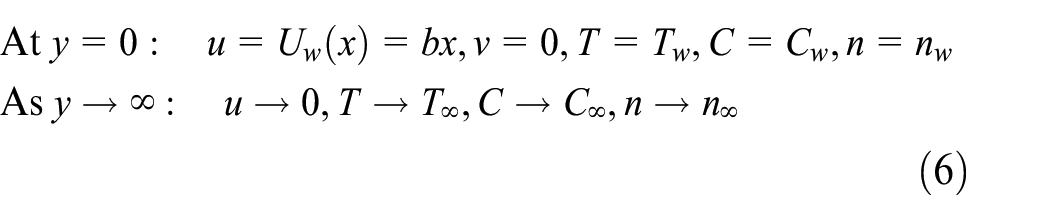
Consider a 2D MHD steady incompressible non-Newtonian nanofluid comprising gyrotactic microorganisms over a stretching sheet. The flow velocity acts along the and axes, respectively. The x-direction is along the sheet surface and y-direction is normal to it. The transverse magnetic field is uniform. Induced magnetic field is omitted due to small Reynolds number. The velocity at the continuous stretching surface is supposed to be linear function of x. Under these conditions, the boundary layer partial differential equations (PDEs) governing the momentum, heat, concentration and microorganism are written as8,9,40
and the boundary conditions are
Here, is the fluid temperature, is the free stream temperature, is the acceleration due to gravity, is the heat source/sink parameter, is Brownian diffusion coefficient, is thermophoresis coefficient, is the magnetic field strength, is the electrical conductivity, is the density of the motile microorganism, is the specific heat at constant pressure, is the concentration at the surface, is the concentration in the free stream, is the diffusivity of the microorganisms, is the effective heat capacitance, is the constant maximum cell swimming speed.
For a similarity analysis for equations (1)–(6), consider the following similarity variables as in previous studies8–10,40
The boundary conditions for the surface and in the distant regime are given by
Here, the parameters are defined as:
Magnetic field parameter,
Modified Prandtl number,
Prandtl number,
Peclet number,
Brownian motion parameter,
Thermophoresis parameter,
Lewis number,
Bioconvection Lewis number,
Bioconvection parameter,
Buoyancy convection parameter due to temperature,
Buoyancy convection parameter due to concentration,
Buoyancy convection parameter due to microorganism,
Local Grashof number based on variable temperature,
Local Grashof number based on variable concentration,
Local Grashof number based on variable microorganism,
The quantities of most interest are the skin friction factor , rate of heat transfer (local Nusselt number ), rate of mass transfer (local Sherwood number ), and the density number of the motile microorganisms .
These are given by
where is the surface shear stress, is the surface heat flux, is the surface mass flux, is the surface motile microorganism flux. Using these, equation (13) yields
SRM and comparison
For numerical investigations, we used an efficient numerical technique called SRM for solving our transformed ordinary differential equations (ODEs). The key concept of this technique is the use of trail function and test functions.41,42 For trial function, we use Chebychev polynomials and for test function we used the following assumptions
The discretization procedure is very similar to Gauss–Seidel discretization idea. In the presence of Joule heating and viscous dissipation, Motsa and Makukula42 investigates the steady von Karman flow using SRM of a Reiner–Rivlin fluid. Over a stretching surface for Maxwell fluid, Shateyi43 used the SRM to solve the MHD flow and heat transfer. Using the similar technique, Shateyi and Makinde44 studied stagnation point flow of an incompressible fluid. With binary chemical reaction and Arrhenius activation energy complex, non-linear system of equations of incompressible flow has been resolved using SRM technique by Awad et al.45 over a stretching surface. Haroun et al.46 have applied SRM to unsteady MHD combined convective motion of a nanofluid past a stretching/shrinking surface in the occurence of heat source, internal fraction, and thermal diffusion and diffusion thermo effects.
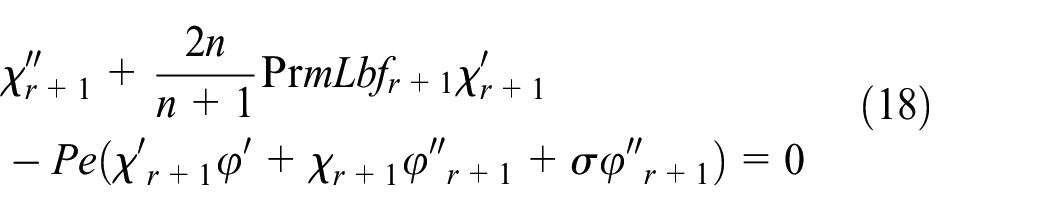
Now, for our model, we discretize the transformed equations (8)–(11) using the following SRM algorithm:
Reduced the order from three to two by taking and defined the transformed equation in terms of , and the functions which are in second-order need not be required to reduce the order.
Rewrite the transformed equation involving iteration notation.
In equation for , the scheme is developed by considering that only linear terms in are evaluated in current i.c. r + 1 iteration level and all the other terms (linear and non-linear) in are assumed to be known from previous iteration (noted as r). Non-linear terms in are evaluated as previous iteration level.
In equation for , all the linear terms in and all the terms in are calculated in current iteration level (as the update is available for ) and other terms will use the value of previous iteration.
In similar manner, the value of will be evaluated.
The corresponding boundary conditions are written as
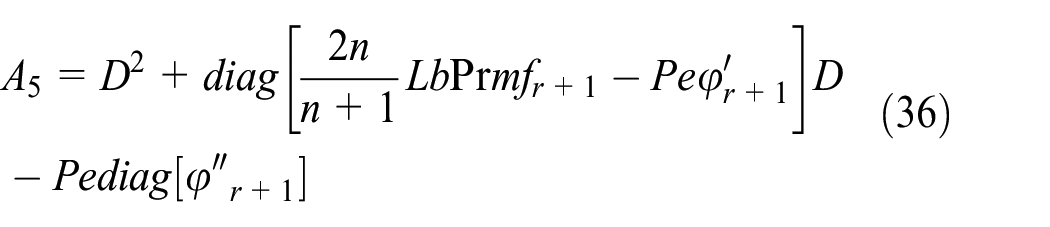
Applying the Chebychev spectral collocation method we have
where
where I stands for an identity matrix and diag[] stands for diagonal matrix size , here indicated number of grid points, , respectively, the subscript r defines the iteration number. In this study, we take N = 80 collocation point. These values gave accurate result for all the quantities of physical interest. Starting from the initial approximation, the SRM scheme is repeatedly solved until the following condition is satisfied
where is a prescribed error tolerance which, in this study, is taken to be .
The accuracy of our SRM computations is examined with existing results8,10 by setting and varying the value of n and . The results are seen with better agreement as presented in Table 1.
In order to see the significance of the problem parameters, namely, Prandtl number , magnetic field parameter , Peclet number , Lewis number , bioconvection Lewis number , Brownian motion parameter , thermophoresis parameter , buoyancy convection parameters and bioconvection constant , the computation of our study has performed for various values of these parameters. In SRM technique, we used Gauss–Seidal discretization process and Chebychev collocation process to grid generation for our transformed equations (8)–(11) and employing the MATLAB to get our required calculations. We consider the non-dimensional parameters arbitrarily and set in the numerical computations
Figure 1 describes the velocity, temperature, concentration, and microorganism profiles for different values of power law parameter . The profiles are plotted against the similarity variable . We observe a cross flow in the velocity profiles at in Figure 1. The value of n has no significant effect on the profiles near the wall but it does change the velocity profiles at . For the dynamic region, , the rise of propelled to increase in the momentum layers as a little cause for the slightboost of the frictional forces. However, for , the opposite case happens as power law parameter rises. From the figure, it can be easily observed that temperature, concentration, and volume fraction of gyrotactic microorganism profiles are thinning of the thermal, concentration, and microorganism layers that satisfy the boundary conditions.
Profiles of for various values of with .
Figure 2 illustrates the effect of on the velocity, temperature, concentration, and gyrotactic microorganism profiles. Figure 2 shows that increase of magnetic field strength leads to decrease in the velocity profile and the fact is that the Lorentz force arising in this case reduces the flow boundary layer. However, the temperature, concentration, and gyrotactic microorganism thin layer increases for various values of the magnetic parameter. We also observe a large effect on the velocity but a relatively small influence on the other profiles and this is due to the fact that the magnetic forces are strongly related with velocity boundary.
Profiles of for various values of M with .
Figure 3 describes the velocity, temperature, concentration, and microorganism profiles at various values of buoyancy convection temperature parameter . The value of correspond to a vertical downward flow, whereas corresponds to a vertical upward flow. The momentum boundary layer induces as the value of induces. We observe that temperature, concentration, and gyrotactic microorganism profiles decrease as the buoyancy convection parameter increases. Note that the effect of buoyancy convection concentration parameter has no significant effect on the flow fields.
Profiles of for various values of λ1 with .
Figure 4 describes the velocity, temperature, concentration, and gyrotactic microorganism profiles for different values of buoyancy convection microorganism parameter . From the figure, it is clear that temperature, concentration, and volume fraction of gyrotactic microorganism profiles decrease with the growth of the buoyancy convection parameter. However, the velocity profile is raised by enhancing .
Profiles of for various values of with .
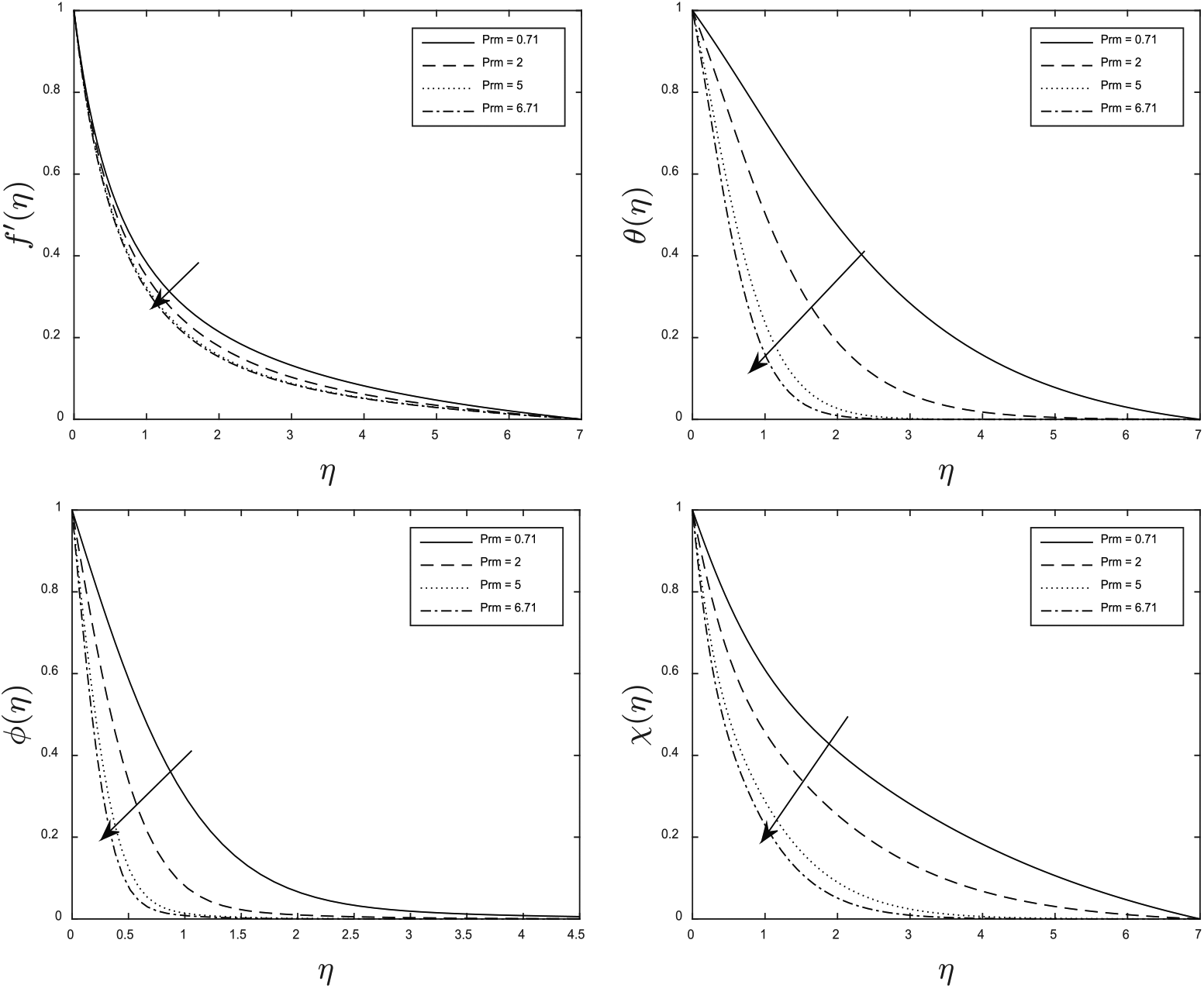
Figure 5 describes the velocity, temperature, concentration, and gyrotactic microorganism profiles for diverse values of modified Prandtl number. It is found that for all the cases, that is, velocity, temperature, concentration, and volume fraction of gyrotactic microorganism boundary layer declines with the rise of the modified Prandtl number. Physically, Prandtl number signifies the thickness of thermal boundary layer and thickness of hydrodyanamic boundary layer, depending on whether it is equal to one, or more than one or less than one. If it is equal to one, it signifies that thickness of thermal boundary layer is equal to that of velocity boundary layer. Hence, it is the ratio of momentum diffusivity to thermal diffusivity. It tells us how fast the thermal diffusion takes place in comparison to momentum diffusion and also it tells us the relative thickness of thermal boundary layer to momentum boundary layer. If Prandtl number is small, it tells us that thermal diffusion is dominant in comparison to momentum diffusion. That is, for a given fluid flow problem, the flow conditions remain the same, if we want higher heat transfer rate we have to use a fluid that has lower Prandtl number. Furthermore, higher dismisses the thermal boundary layer thickness.
Profiles of for various values of with .
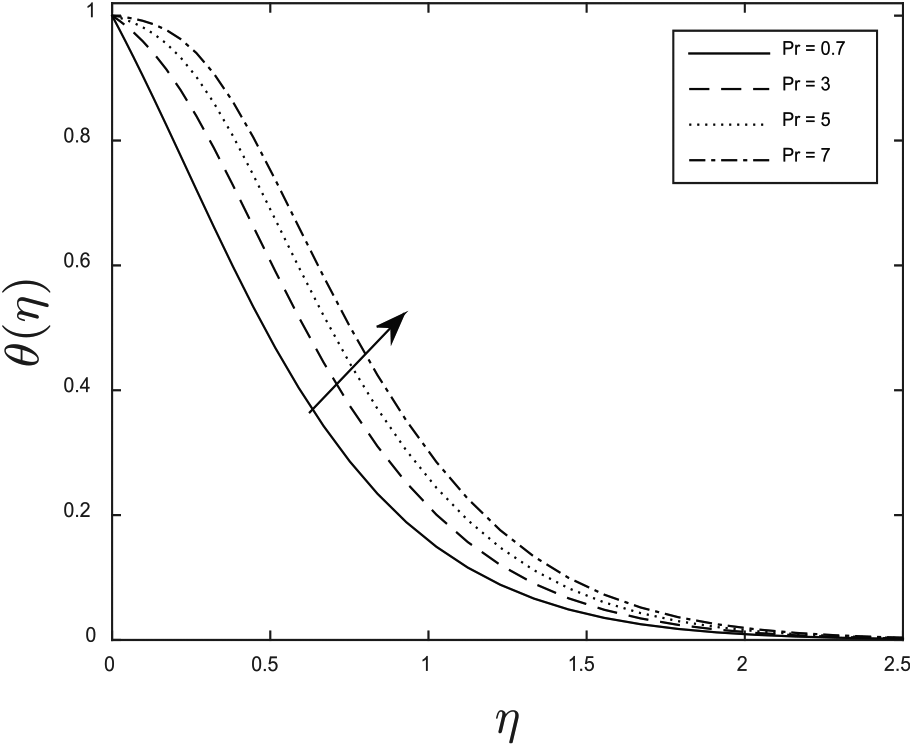
Figure 6 shows the temperature effects of Prandtl number on temperature profile. It is noted from the figure that boundary layer temperature thickness induces with the enhancement of Prandtl number.
Profiles, for different values of Pr with .
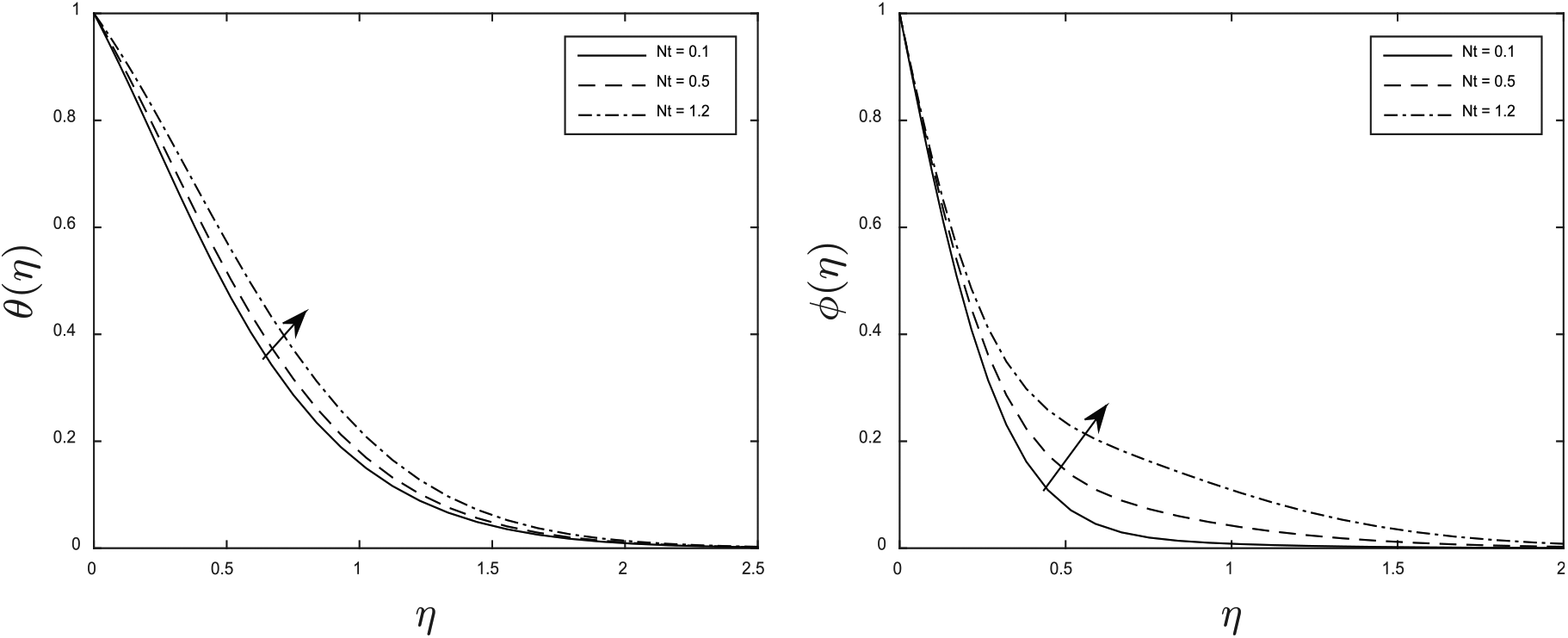
Figure 7 illustrates the temperature and concentration profile for different values of thermophoresis parameter . The value of can be positive or negative. Positive values correspond to hot surface and negative values correspond to cool surface. The nanofluid velocity and motile microorganism profile are not affected with . As the value of increases, the temperature and concentration profile increases.
Profiles of and for different values of Nt with .
Figure 8 describes the temperature and concentration profiles for different values of Brownian motion parameter . The nanofluid velocity and motile microorganism profile is not affected with . From Figure 8, it is clear that the rising value of leads to increase the temperature boundary layer but decreases the concentration boundary thickness. The features of Brownian motion physically depend on the unsystematic movement of liquid particles on the surface and rise in Brownian motion boosts the unsystematic motion of liquid particles, which formed much heat. Hence, the liquid temperature and associated thermal boundary layer thickness enhance. In addition, growing values of thermophoresis parameter physically means that the smallest nanoparticles are dragged away from the warm surface to the cold surface. Therefore, the higher number of small nanoparticles is dragged away from the warm surface due to which liquid temperature rises.
Profiles of and for various values of with .
Figure 9 describes the concentration and the gyrotactic microorganism profiles for different values of Lewis number . The surface shear stress and Nusselt number are not influenced by any change of , so the nanofluid velocity and temperature are not affected too. From the figure, we can see that increase of results in decreasing concentration profile, whereas a cross-over is noted in microorganism profile at as shown in the figure. For the dynamic region, , the growth of leads to decline in the microorganism boundary layers, whereas for the reverse take place as increases. In fact, the Lewis number is inversely proportional to the Brownian diffusion coefficient. Here, larger values of Lewis number correspond to small diffusivity and so concentration distribution declines.
Profiles of and for different values of Le with .
From Figure 10, we observed reduction in the boundary layer thickness of the motile microorganism for rising values of the Peclet number , bioconvection Lewis number , and bioconvection parameter .
profiles for different values of with .
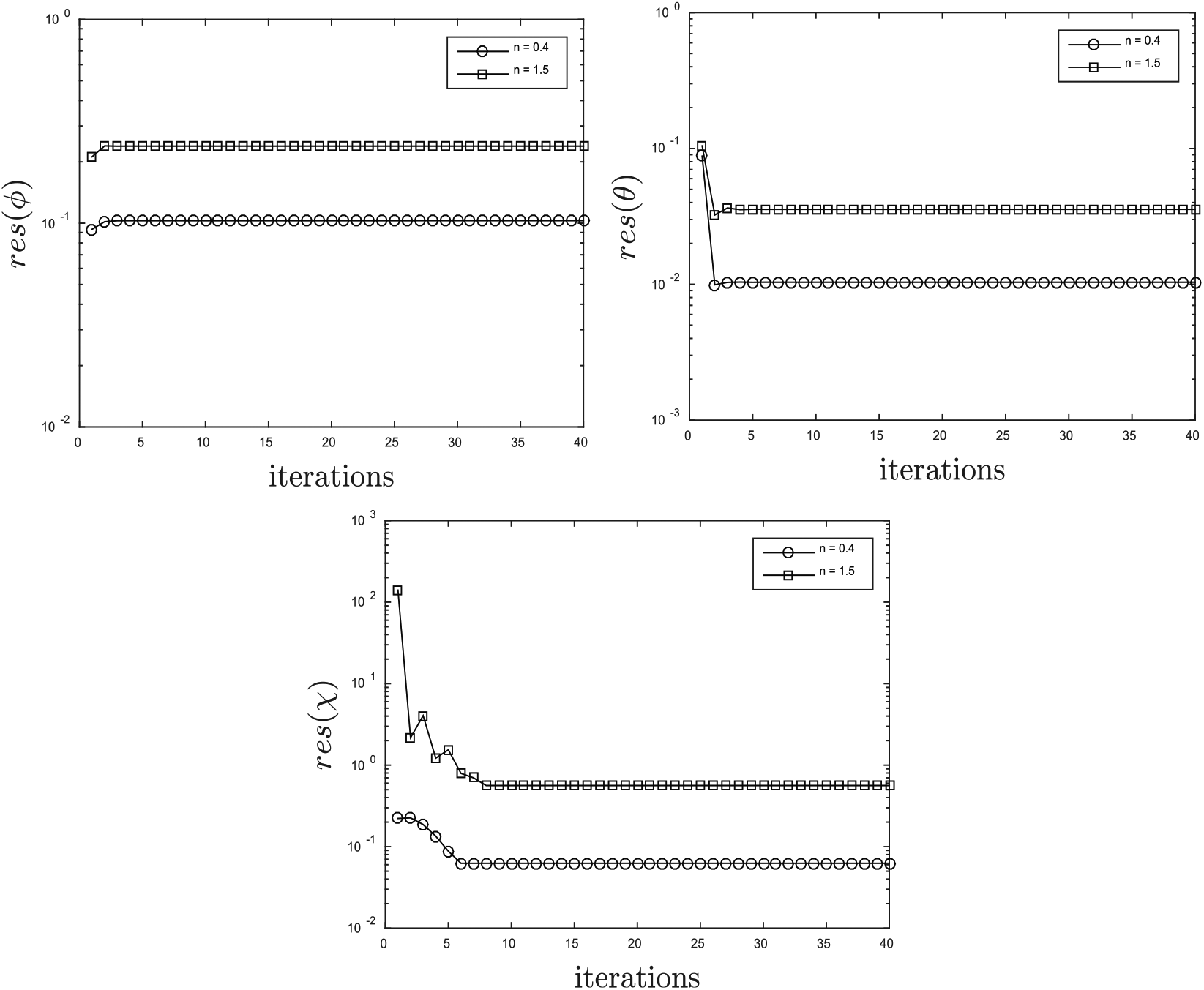
Figure 11 shows the residual error of equations (8)–(11) against iterations for different values of power law parameter. The residual error of takes linear shapes and are iteration dependent. The increasing value of n leads to decrease in the residual error for and accelerates the convergence, where for faster convergence achieved for lower values of n.
Residual error of against iterations for different values of .
Figure 12 illustrates skin friction, Nusselt number, Sherwood number, and the density number of the motile microorganism, respectively, for different values of magnetic parameter. The values are plotted against the power law parameter n. As the value of magnetic parameter increases, shear stress decreases. However, temperature, concentration, and microorganism gradient profiles are increasing function of the magnetic parameter.
Skin friction, Nusselt number, Sherwood number, and the density number of the motile microorganisms for different values of M.
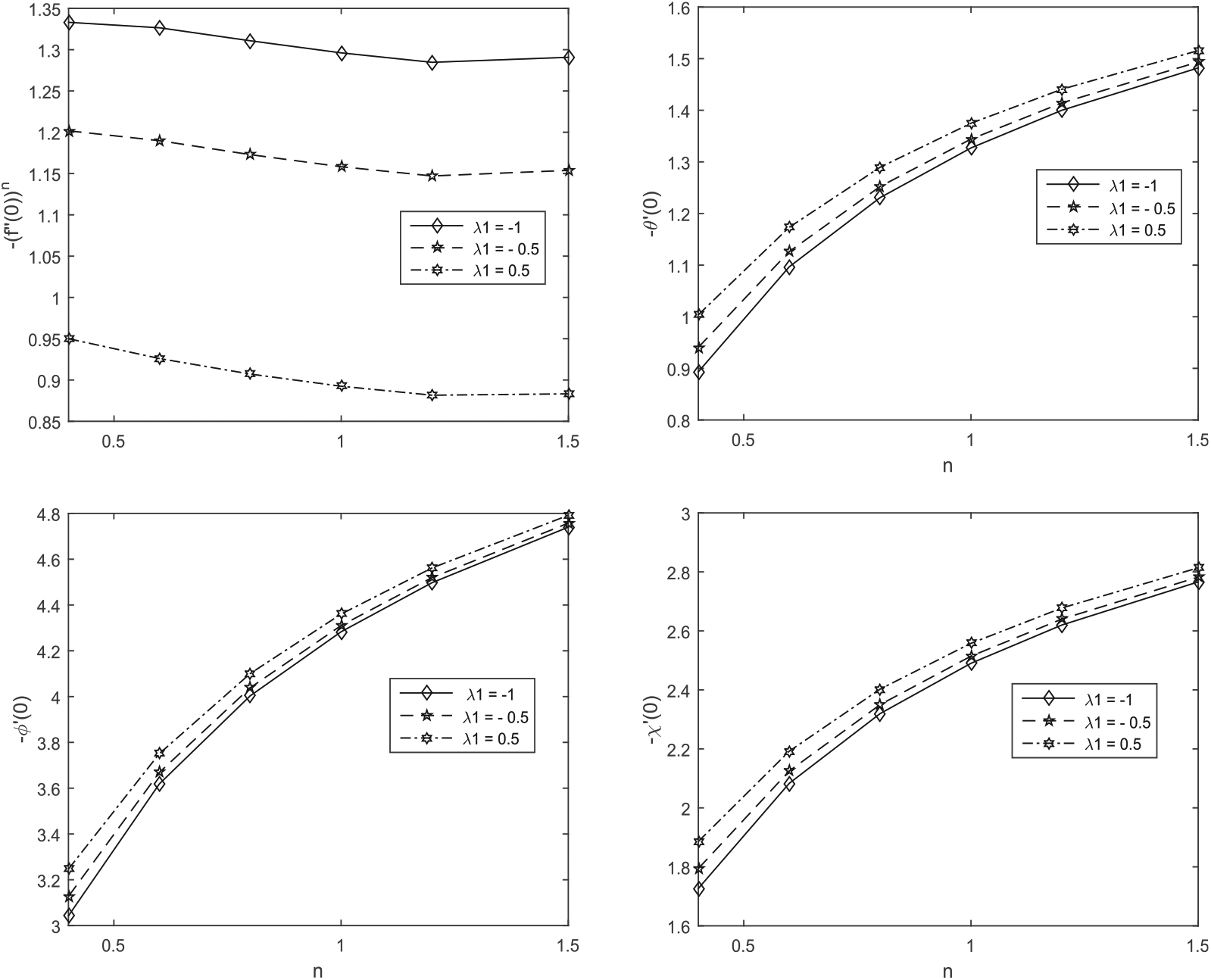
Figure 13 describes skin friction, Nusselt number, Sherwood number, and the density number of the motile microorganisms, respectively, for different values of Buoyancy convection temperature parameter. As the value of increases, shear stress also increases. However, temperature, concentration, and microorganism gradient profiles decrease as increase.
Skin friction, Nusselt number, Sherwood number, and the density number of the motile microorganism for different values of .
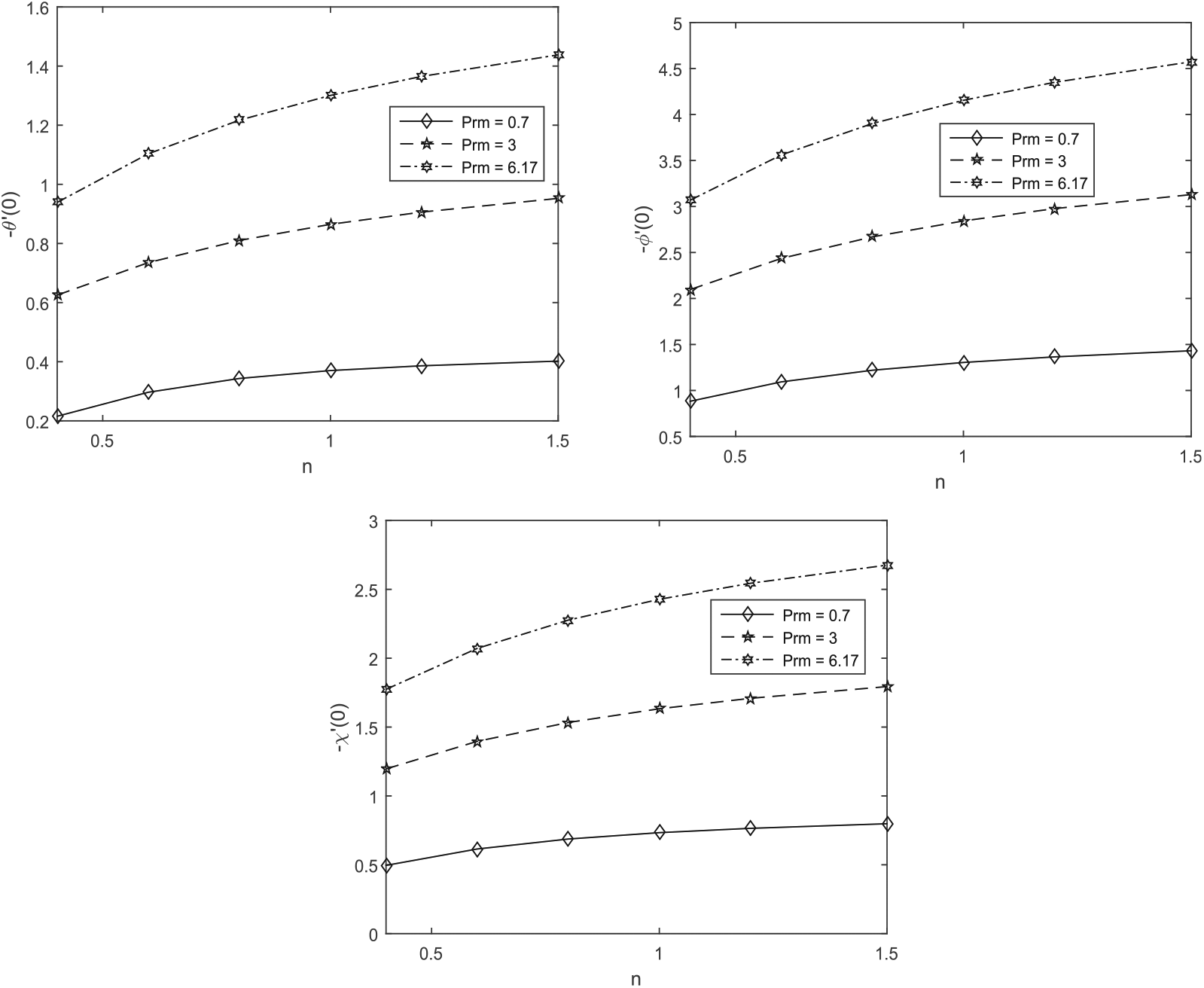
Figure 14 illustrates Nusselt number, Sherwood number, and the density number of the motile microorganism, respectively, for different values of modified Prandtl number. These numbers are decreasing function of modified Prandtl number.
Nusselt number, Sherwood number, and the density number of the motile microorganism for different values of .
Figure 15 illustrates the density number of the motile microorganism for different values of bioconvection Lewis number. These number are decreasing function of Le.
Density number of the motile microorganism for different values of .
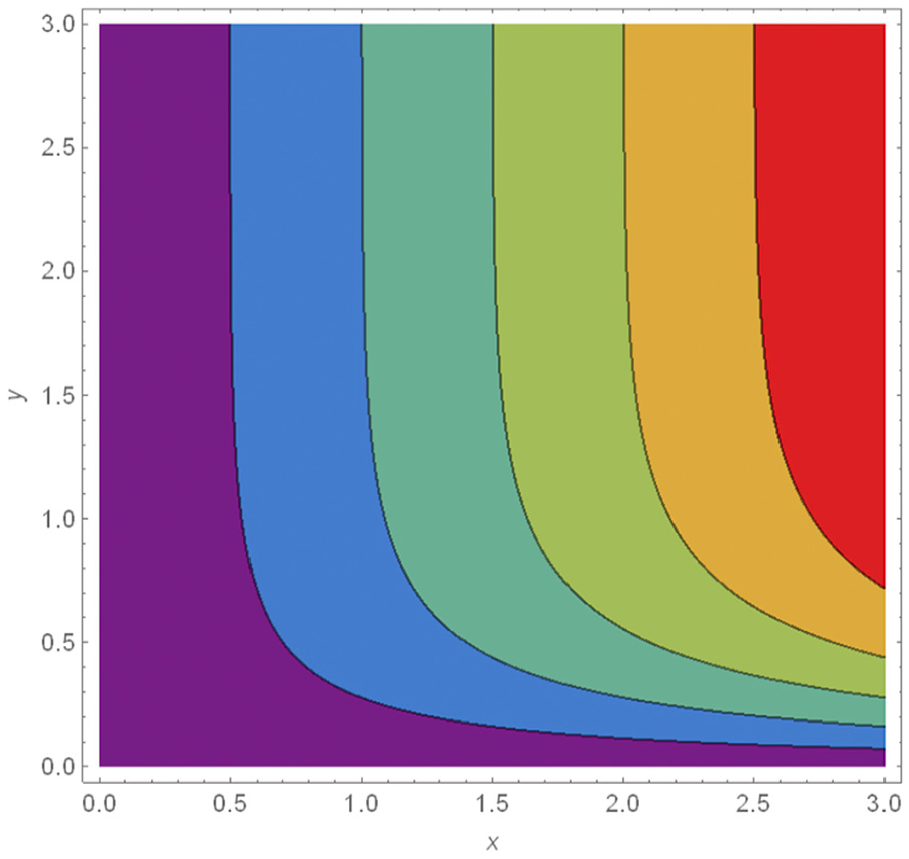
Finally, the stream line patterns are elucidated in Figures 16–20. From these figures, we observe that the liquid is pushed toward the sheet surface by the electromagnetic Lorentz force (magnetic field). As the streamlines concentrate there, the fluid accelerates to preserve continuity. Under the impact of applied magnetic variable, the particle transport accumulated along the stretching sheet, whereas the reverse behavior is found for the power law index number .
Stream lines for .
Stream lines for .
Stream lines for .
Stream lines for .
Stream lines for .
Conclusion
This work examines two-dimensional (2D) hydromagnetic steady incompressible flow, transfer of heat and mass in a viscous power law nanofluid comprising gyrotactic microorganisms over a vertical stretching sheet. The effect of magnetic field, Brownian diffusion, and thermophoresis are taken into account. By employing transformation for velocity, temperature, concentration, and microorganisms, the basic equations governing the flow and heat transfer were converted to a set of ODEs and solved by applying SRM. Effects of parameters, residual error, the skin friction factor, rate of heat transfer, rate of mass flux, and the density number of the motile microorganism have been examined. Some conclusions obtained from this investigation are summarized as follows:
enhance the temperature field for both stretching and shirking sheets.
is a decreasing function of .
reduce the temperature field for both stretching and shirking sheets.
The density of the motile microorganisms is a decreasing function of .
The concentration decreases with the increase of while increases with the increase of .
The residual error of , , , are iteration dependent.
Footnotes
Appendix 1
Handling Editor: James Baldwin
Declaration of conflicting interests
The author(s) declared no potential conflicts of interest with respect to the research, authorship, and/or publication of this article.
Funding
The author(s) received no financial support for the research, authorship, and/or publication of this article.
ORCID iD
M Ferdows
References
1.
SakiadisBC. Boundary layer behavior on continuous solid surfaces: I. Boundary-layer equations for two-dimensional and axisymmetric flow. AICHE J1961; 7: 26–28.
2.
EricksonLEFanLTFoxVG.Heat and mass transfer on moving continuous flat plate with suction or injection. Ind Eng Chem Fund1966; 5: 19–25.
3.
CraneLJ.Flow past a stretching plate. Z Angew Math Phys1970; 21: 645–647.
4.
RajagopalKRNaTYGuptaAS.Flow of a viscoelastic fluid over a stretching sheet. Rheol Acta1984; 23: 213–215.
5.
DandapatBSGuptaAS.Flow and heat transfer in a viscoelastic fluid over a stretching sheet. Int J Nonlin Mech1989; 24: 215–219.
6.
RajagopalKRNaTYGuptaAS.A non-similar boundary layer on a stretching sheet in a non-Newtonian fluid with uniform free stream. J Math Phys Sci1987; 21: 189–200.
7.
AnderssonHIDandapatBS.Flow of a power-law fluid over a stretching sheet. Stab Appl Anal Contin Media1991; 1: 339–347.
8.
AnderssonHIBechKHDandapatBS.Magnetohydrodynamic flow of a power-law fluid over a stretching sheet. Int J Nonlin Mech1992; 27: 929–936.
9.
CortellR.A note on magnetohydrodynamic flow of a power-law fluid over a stretching sheet. Appl Math Comput2005; 168: 557–566.
10.
ChenCH.Effects of magnetic field and suction/injection on convection heat transfer of non-Newtonian power-law fluids past a power-law stretched sheet with surface heat flux. Int J Therm Sci2008; 47: 954–961.
11.
PrasadKVDattiPSVajraveluK.Hydromagnetic flow and heat transfer of a non-Newtonian power law fluid over a vertical stretching sheet. Int J Heat Mass Tran2010; 53: 879–888.
12.
FerdowsMHamadMAA. MHD flow and heat transfer of a power-law non-Newtonian nanofluid (Cu–H2O) over a vertical stretching sheet. J Appl Mech Tech Phy2016; 57: 603–610.
13.
BhattacharyyaKMukhopadhyaySLayekGC.Slip effects on an unsteady boundary layer stagnation-point flow and heat transfer towards a stretching sheet. Chinese Phys Lett2011; 28: 094702.
14.
BhattacharyyaKMukhopadhyaySLayekG.Effects of partial slip on boundary layer stagnation-point flow and heat transfer towards a stretching sheet with temperature dependent fluid viscosity. Acta Tech2012; 57: 183–195.
15.
AhmedJBegumAShahzadA, et al. MHD axisymmetric flow of power-law fluid over an unsteady stretching sheet with convective boundary conditions. Results Phys2016; 6: 973–981.
16.
PalDMandalG.Mixed convection–radiation on stagnation-point flow of nanofluids over a stretching/shrinking sheet in a porous medium with heat generation and viscous dissipation. J Petrol Sci Eng2015; 126: 16–25.
17.
PopIPopIMohamed IsaSSP, et al. Unsteady viscous MHD flow over a permeable curved stretching/shrinking sheet. Int J Numer Method H2016; 26: 2370–2392.
18.
KhaliliSDinarvandSHosseiniR, et al. Unsteady MHD flow and heat transfer near stagnation point over a stretching/shrinking sheet in porous medium filled with a nanofluid. Chinese Phys B2014; 23: 048203.
19.
RajotiaDJatRN.Three-dimensional magnetohydrodynamics axisymmetric stagnation flow and heat transfer due to an axisymmetric shrinking/stretching sheet with viscous dissipation and heat source/sink. Chinese Phys B2014; 23: 074701.
20.
ChoiSUSZhangZGYuW, et al. Anomalous thermal conductivity enhancement in nanotube suspensions. Appl Phys Lett2001; 79: 2252–2254.
21.
PlattJR.“Bioconvection patterns” in cultures of free-swimming organisms. Science1961; 133: 1766–1767.
22.
ChamkhaAJKhaledARA. Hydromagnetic combined heat and mass transfer by natural convection from a permeable surface embedded in a fluid satural porous medium. Int J Numer Method H2000; 10: 455–477.
23.
ChamkhaAJRashadAMKameswaranPK, et al. Radiation effects on natural bioconvection flow of a nanofluid containing gyrotactic microorganisms past a vertical plate with streamwise temperature variation. J Nanofluids2017; 6: 587–595.
24.
MallikarjunaBRashadAMChamkhaA, et al. Mixed bioconvection flow of a nanofluid containing gyrotactic microorganisms past a vertical slender cylinder. Front Heat Mass Transf2018; 10: 21.
25.
WaqasSHKhanSUHassanM, et al. Analysis on the bioconvection flow of modified second-grade nanofluid containing gyrotactic microorganisms and nanoparticles. J Mol Liq2019; 291: 111231.
26.
KhangNTBhattiMMAliJA, et al. Macroscopic modeling for convection of hybrid nanofluid with magnetic effects. Physica A2019; 534: 122136.
27.
WaqasSHKhanSUImranM, et al. Thermally developed Falkner-Skan bioconvection flow of a magnetized nanofluid in the presence of motile gyrotactic microorganism: Buongiorno’s nanofluid model. Phys Scripta. Epub ahead of print 27August2019. DOI: 10.1088/1402-4896/ab2ddc.
28.
KuznetsovAV.Bio-thermal convection induced by two different species of microorganisms. Int Commun Heat Mass2011; 38: 548–553.
29.
KuznetsovAV.The onset of thermo-bioconvection in a shallow fluid saturated porous layer heated from below in a suspension of oxytactic microorganisms. Eur J Mech B-Fluid2006; 25: 223–233.
30.
NieldDAKuznetsovAV.The onset of bio-thermal convection in a suspension of gyrotactic microorganisms in a fluid layer: oscillatory convection. Int J Therm Sci2006; 45: 990–997.
31.
AvramenkoAAKuznetsovAV.Stability of a suspension of gyrotactic microorganisms in superimposed fluid and porous layers. Int Commun Heat Mass2004; 31: 1057–1066.
32.
AllouiZNguyenTHBilgenE.Numerical investigation of thermo-bioconvection in a suspension of gravitactic microorganisms. Int J Heat Mass Tran2007; 50: 1435–1441.
33.
MahdyA.Gyrotactic microorganisms mixed convection nanofluid flow along an isothermal vertical wedge in porous media. Int J Mech Aerosp Ind Mechatron Manuf Eng2017; 11: 829–839.
34.
ThamLNazarRPopI.Steady mixed convection flow on a horizontal circular cylinder embedded in a porous medium filled by a nanofluid containing gyrotactic micro-organisms. J Heat Transf2013; 135: 102601.
35.
KuznetsovAV.The onset of nanofluid bioconvection in a suspension containing both nanoparticles and gyrotactic microorganisms. Int Commun Heat Mass2010; 37: 1421–1425.
36.
BuongiornoJ.Convective transport in nanofluids. J Heat Transf2006; 128: 240–250.
37.
AzizAKhanWAPopI.Free convection boundary layer flow past a horizontal flat plate embedded in porous medium filled by nanofluid containing gyrotactic microorganisms. Int J Therm Sci2012; 56: 48–57.
38.
DinarvandSHosseiniRPopI.Unsteady convective heat and mass transfer of a nanofluid in Howarth’s stagnation point by Buongiorno’s model. Int J Numer Method H2015; 25: 1176–1197.
39.
DinarvandSAbbassiAHosseiniR, et al. Homotopy analysis method for mixed convective boundary layer flow of a nanofluid over a vertical circular cylinder. Therm Sci2015; 19: 549–561.
40.
BabuMJSandeepN.Effect of nonlinear thermal radiation on non-aligned bio-convective stagnation point flow of a magnetic-nanofluid over a stretching sheet. Alex Eng J2016; 55: 1931–1939.
41.
CanutoCHussainiMYQuarteroniA, et al. Spectral methods in fluid dynamics. Berlin: Springer, 1988.
42.
MotsaSSMakukulaZG. On spectral relaxation method approach for steady von Krmn flow of a Reiner-Rivlin fluid with Joule heating, viscous dissipation and suction/injection. Cent Eur J Phys2013; 11: 363–374.
43.
ShateyiS. A new numerical approach to MHD ow of a maxwelluid past a vertical stretching sheet in the presence of thermophoresis and chemical reaction. Bound Value Probl2013; 2013: 196.
44.
ShateyiSMakindeOD. Hydromagnetic stagnationpoint flow towards a radially stretching convectively heated disk. Math Probl Eng2013; 2013: 616947.
45.
AwadFGMotsaSKhumaloM. Heat and mass transfer in unsteady rotating fluid flow with binary chemical reaction and activation energy. PLoS ONE2014; 9: e107622.
46.
HarounNASibandaPMondalSMotsaSS. On unsteady MHD mixed convection in a nanofluid due to a stretching/shrinking surface with suction/injection using the spectral relaxation method. Boundary value problems2015; 2015: 24.