




Abstract
The purpose of this article is to investigate the flow of Maxwell fluid with nanoparticles, that is, molybdenum disulfide and graphene with ramped temperature condition at the boundary, and engine oil is considered as base fluid. Furthermore, molybdenum disulfide and graphene nanoparticles are uniformly distributed in the base fluid. The problem is modeled in terms of partial differential equations with physical initial and boundary conditions. To make the system of governing equations dimensionless, we introduced some suitable non-dimensional variables. The obtained dimensionless system of equations is solved using the Laplace transform technique. From graphical analysis, it can be noticed that the velocity is high with isothermal wall temperature and lower for ramped wall temperature. These solutions are verified by comparing with the well-known published results. In addition, the physics of all parameters of interest is discussed through graphs. The mathematical expressions for skin friction and Nusselt number are mentioned and the obtained results are presented in tabular form. Finally, the effect of molybdenum disulfide and graphene nanoparticles is briefly discussed for the flow and heat profiles for Maxwell nanofluid.
Keywords
Introduction
The topic related to nanofluids is getting more attention in the last three decades in the field of science as well as in engineering and biological sciences. The conventional base fluids, for example, kerosene oil, engine oil (EO), water, polyethylene glycol, and ethylene glycol, are used for thermal transport purpose. They have low thermal conductivities as a result of which the heat transfer rate is reduced. The first scientific attempts have been discussed by Maxwell 1 who explained the process of suspending some micro-sized solid particles in the base fluids. However, there were some limitations in Maxwell’s process of suspended micro-sized solid particles. Afterward, Choi 2 introduced the concept of nanofluid which was accepted, and now nanotechnology is used in biological and engineering sciences. Nanoparticles are dispersed uniformly in different base fluids to increase the heat transfer rate of the base fluids. The dispersion of nanometer-sized particles is better than micro-sized particles because of some valid reasons such as nanoparticles are more stable as compared to micro-sized particles. Nanofluids have many useful applications in physical phenomena due to high thermal conductivities. For example, nanofluids are used in different machinery and automobiles for coolant purpose, in biomedicines, food processing, and so on. Carbon nanotube is used for the purpose of heat transfer, biomedicines, and lubrication processes in the grinding parts of the machinery.3,4 Loganathan et al. 5 were the first to investigate the closed-form solutions for the flow of nanofluids. Li et al. 6 discussed the applications of molybdenum disulfide (MoS2) and graphene nanoparticles and used these nanoparticles for the hydrogen evolution reaction. Samnakay et al. 7 and Liang et al. 8 explained some applications of graphene and MoS2 nanoparticles and proposed a mechanism for rechargeable batteries.
In the modern world, many simple and complex machines are used to perform different processes in industries and many other fields of sciences. Mostly, in all machinery, there are different lubricants used for lubrication purposes to reduce friction inside the machine parts. Furthermore, an enormous number of nanoparticles are used to enhance the thermal conductivities of lubricants due to which machines are able to work for a longer period of time.9,10 Zhu et al. 11 investigated strain tuning of optical emission energy using MoS2 nanoparticles. Guo and Dong 12 investigated molecular engineering synthesis using graphene nano-sheet and discussed some analytical and energy applications regarding the graphene nanoparticles. In addition, graphene nanoparticles are used for different purposes in biomedical sciences and material sciences.13–15
Recently, in nanotechnology, different nanoparticles are used to improve the thermal performance of lubricants. In the present study, spherical shape MoS2 and graphene nanoparticles have been dispersed in EO. The heat produced in the grinding parts of the machine is reduced due to these nanoparticles. MoS2 and graphene nanoparticles are able to enhance the heat transfer rate and the lubrication of the EO.16,17 Furthermore, some other applications and scientific works on MoS2 are reported by Gul et al., 18 Kato et al., 19 and Mao et al. 20 The capacity of heat in nanofluids, thermal performance of nanofluids, and the volume thermal expansion coefficients were investigated after some experiments in the laboratory by Liu et al. 21 and Ding and Xiao. 22 In addition, we also considered the effect of graphene nanoparticles in the base fluid EO. Some physical properties and applications related to graphene nanoparticles are discussed and explained by Katz et al. 23 Yoon et al. 24 discussed the stabilization of oil emulsions, and Wang et al. 25 reported some applications of graphene in biological science. Kuila et al. 26 investigated some applications and functions of graphene in chemical technology.
The problems resulting from the flows of incompressible non-Newtonian fluids have been of great and increasing interest. These non-Newtonian fluids have been discussed by researchers due to the increasing interest in such fluids in the last five decades. Maxwell fluid is one of the non-Newtonian fluids and it was originally modeled by Maxwell 27 to obtain the visco-elastic behavior of air through the dynamical theory of gases. In physical situations, many fluids, such as glycerin, crude oils, EOs, and some other polymeric materials, behave like Maxwell fluids. The Maxwell fluids with some interesting applications and properties have been discussed by Jordan et al. 28 Denn and Porteous 29 studied the Couette flow of Maxwell fluid between two infinite parallel plates. Karra et al. 30 investigated the flow of Maxwell fluid with relaxation time and viscosity. Vieru and Zafar 31 analyzed Couette flow of Maxwell fluid with slip boundary conditions. Some more physical uses and applications of Maxwell fluid are mentioned in the previous studies.32–34
All the aforementioned works used uniform wall temperature conditions, but there are some real-world problems which are not completely explained by isothermal wall temperature. The non-uniform wall temperature (ramped temperature) is applied in industries and some other physical applications such as the phase transition process of different materials/production, air conditioning processes, photovoltaic instruments, the phenomenon of nuclear heat transfer control, heat transfer in building, heat transfer in the turbine blades, and some useful applications in electric circuits. Due to increasing interest in these issues, many researchers investigated different problems: such as Chandran et al. 35 published their work on natural convection near a vertical plate with ramped wall temperature. Some other applications of non-uniform wall temperature were investigated by Ali et al., 36 Kataria and Patel, 37 and Narahari et al. 38
From the given literature survey, it can be noted that no work is reported to have obtained the exact solutions of Maxwell nanofluid with the effect of non-uniform wall temperature at the plate. Therefore, this study focused on obtaining the closed-form solutions for Maxwell nanofluids. Furthermore, MoS2 and graphene nanoparticles are uniformly distributed in EO, and the fluid flow is along an infinite vertical plate with ramped wall temperature conditions at the boundary. In this study, solutions of Maxwell nanofluids have been compared for ramped and isothermal temperature on the boundary. The effect of MoS2 and graphene nanoparticles is shown through graphs which show that MoS2 is more effective as compared to graphene in the EO. Various parameters of interest are discussed through graphs. The numerical values are obtained for skin friction and Nusselt number and mentioned in tabular form. Finally, a brief discussion describes the behavior of the heat transfer rate and fluid flow with the increment in the volume fraction parameter
Mathematical modeling
The unsteady flow of Maxwell nanofluid over an infinite vertical flat plate with ramped wall temperature at the boundary is considered in this study. The fluid occupies the space
After some time when

Physical sketch of the model and coordinate system.
Under the assumed conditions in this study, the governing equations are expressed in the following form 39


the corresponding initial and boundary conditions are

where
Thermo-physical properties of engine oil, graphene, and MoS2. 39

MoS2: molybdenum disulfide.
The effective thermal conductivity of nanofluids is given by Kakac and Pramuanjaroenkij 40 and Oztop and Abu-Nada 41 as
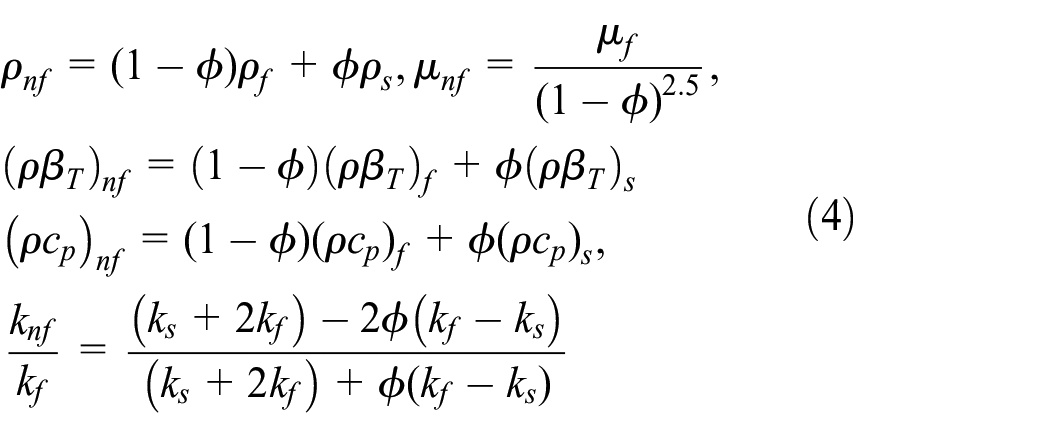
where
To make the system of equations dimensionless, the following non-dimensional variables have been used 42

After dimensional analysis, the governing equations of the problem are given as
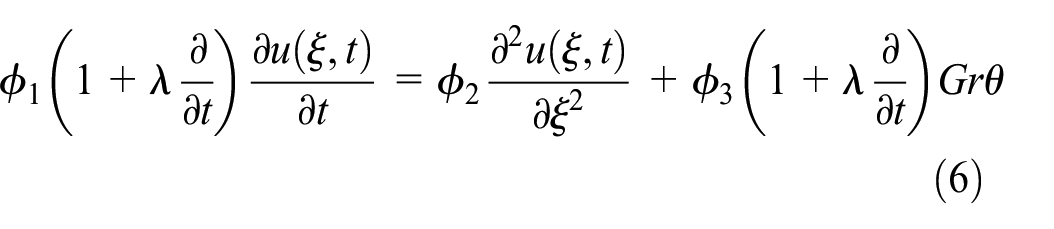

From equations (6) and (7), we get the following form


Corresponding dimensionless initial and boundary conditions are given as follows
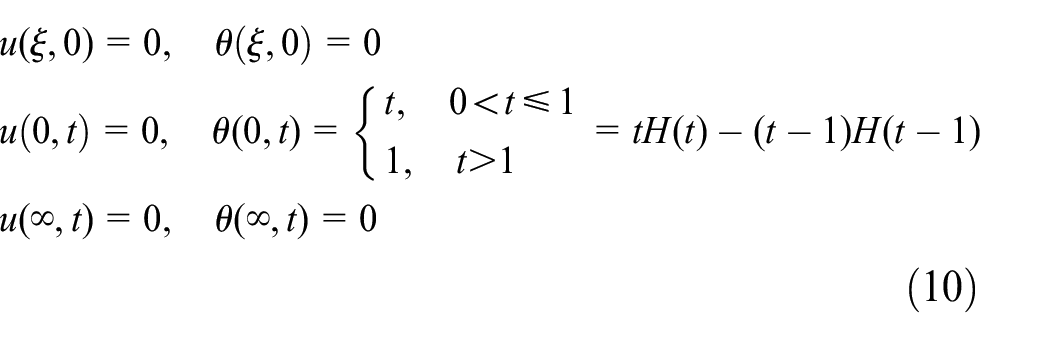
where
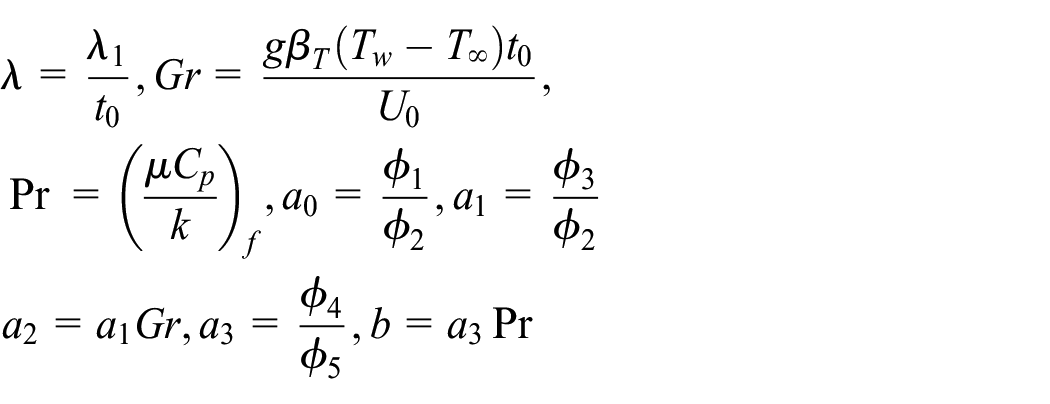


Exact solutions
Applying the Laplace transform to equations (8) and (9), using the given initial and boundary conditions from equation (10), we get the transform solutions as


By taking the Laplace inverse transform technique to equations (11) and (12), we get the solutions for uniform and non-uniform (ramped wall) temperature at boundary which are mentioned in the following sections: “Solution for energy equation with Ramped wall temperature,”“Solution for energy equation with isothermal wall temperature,”“Solution of velocity profile for ramped wall temperature,” and “Solution of velocity profile for isothermal wall temperature.”
Solution for energy equation with ramped wall temperature

Solution for energy equation with isothermal wall temperature

where

Solution of velocity profile for ramped wall temperature


Solution of velocity profile for isothermal wall temperature


where


The inverse Laplace transform of equations (20) and (21) can be written as


Nusselt number and skin friction
The mathematical expressions for Nusselt number and skin friction of the present study are evaluated for both the cases ramped and isothermal wall temperature which are given in the following sections: “Nusselt number” and “Skin Friction.”
Nusselt number
The expressions of Nusselt number for ramped and isothermal wall temperature conditions are determined from equations (13) and (14) and are given as follows


Equivalently, we can write as


where
and

Skin friction
The corresponding expressions of skin friction for ramped and isothermal wall temperature conditions are determined from equations (17) and (19) and are given as follows


Limiting cases
The solutions obtained in the given problem can be verified by reducing these solutions to the already published papers. The limiting cases of this study are explained in the following sections.
In the absence of ramped temperature
By considering the isothermal boundary conditions at the plate, our obtained solutions were reduced to the following form

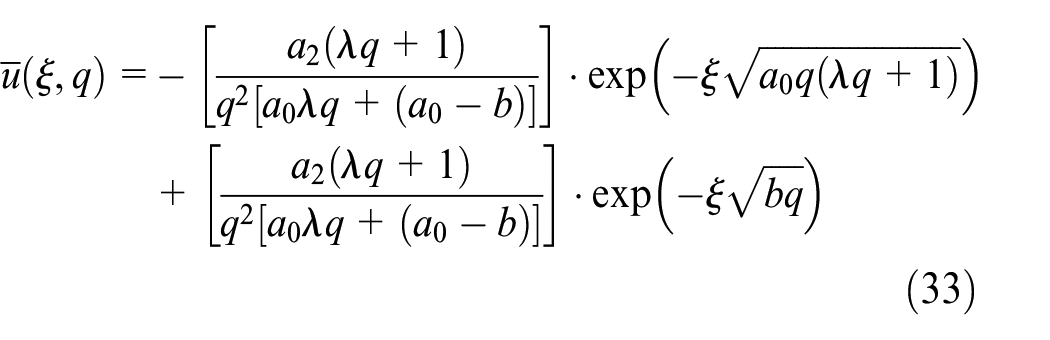
By taking the inverse Laplace transform using convolution theorem and some calculi, we get the following solutions which are quite identical to solutions obtained by Aman et al 39


Newtonian viscous fluid
In the absence of Maxwell fluid parameter


Velocity and temperature solutions for isothermal wall temperature


By applying the inverse Laplace transform of equations (38) and (39), we get


Velocity and temperature solutions for ramped wall temperature
By taking the inverse Laplace transform of equations (36) and (39), we get

where


where

Special case
Solution for Newtonian viscous fluid
In this case, if we want to investigate pure viscous fluid without dispersing nanoparticles, we remove the thermal and mechanical parameters of nanofluids with those of viscous fluid and then the solutions obtained in equations (13)–(23) reduce to the solution independent of nanoparticles. These solutions will be reduced to Newtonian viscous fluid by putting
Results and discussion
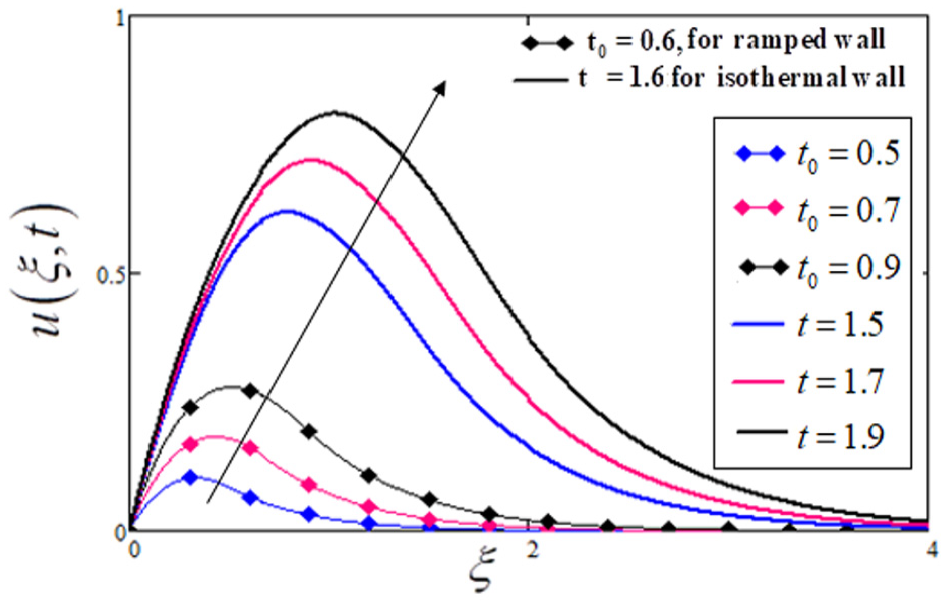
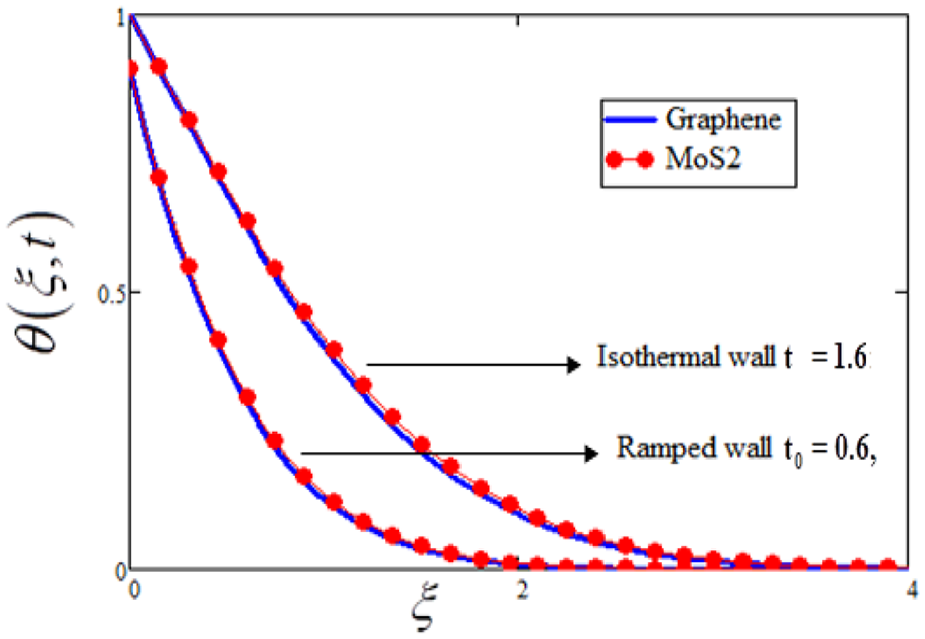
In this study, the thermal performance of MoS2 and graphene nanoparticles is investigated in EO which is taken as the base fluid. The comparison of velocity and temperature profiles for MoS2 and graphene nanoparticles is shown through graphs. The fluid flow is considered along an infinite vertical plate with non-uniform wall temperature. From graphical results, one can identify easily that the magnitude of Maxwell nanofluid velocity is greater for isothermal temperature and magnitude of fluid velocity is smaller for non-uniform or ramped wall temperature as shown in graphs. The Laplace transform technique is used to find the exact solutions for the governing equations with the corresponding boundary conditions. From the graphical analysis, various embedded parameters are discussed. Furthermore, the present study is focused at analyzing the effect of MoS2 and graphene nanoparticles which are dispersed uniformly in EO. The behaviors of different parameters on velocity profiles are investigated. Figures 2–5 are the graphs that are plotted for volume friction parameter

Variation of volume fraction parameter

Effect of Maxwell parameter
Effect of time

Comparison of MoS2 and graphene nanoparticles on velocity profile when

Effect of different values of

Effect of time
Comparison of MoS2 and graphene nanoparticles on temperature profile when

Comparison of this study’s results with those obtained by Aman et al. 39

Comparison of Maxwell fluid and Newtonian viscous fluid.
Figure 2 depicts the variation in velocities with ramped temperature and isothermal temperature for different values of
Figure 3 displays the effect of Maxwell fluid parameter
Figure 4 discusses the effect of time
Figure 5 displays the comparison of velocity profile for MoS2 and graphene nanoparticles for ramped and isothermal wall temperatures. It is observed that the magnitude of velocity profile is more for graphene-based nanofluid near the plate. As this distance increases from the plate, the MoS2-based nanofluid gained maximum velocity but graphene-based nanofluid velocity reduced. Furthermore, it can be noticed that the effect of MoS2 and graphene-based nanofluid on velocity profile is quite similar for ramped and isothermal wall temperatures.
Figure 6 discusses the behavior of nanofluid temperature by increasing volume friction parameter
Figure 7 shows the behavior of time
Figure 8 shows the comparison of MoS2 and graphene nanoparticles on temperature distribution. From the figure, it can be seen that EO has higher temperature with MoS2 as compared to graphene nanoparticles dispersed in EO.
Figure 9 shows the comparison of the present study and the solutions obtained by Aman et al. 39 From the figure, it is clear that our solutions are very similar to the work of Aman et al, which verifies our solutions.
Figure 10 displays the comparison of Maxwell nanofluid with Newtonian viscous fluid. Graphically, we have observed that the velocity obtained by Newtonian fluid is higher as compared to Maxwell nanofluid.
Skin friction for Maxwell nanofluid is evaluated and mentioned in Table 2, which shows the effect of the parameters involved, namely,
Skin friction for ramped and isothermal wall temperature.
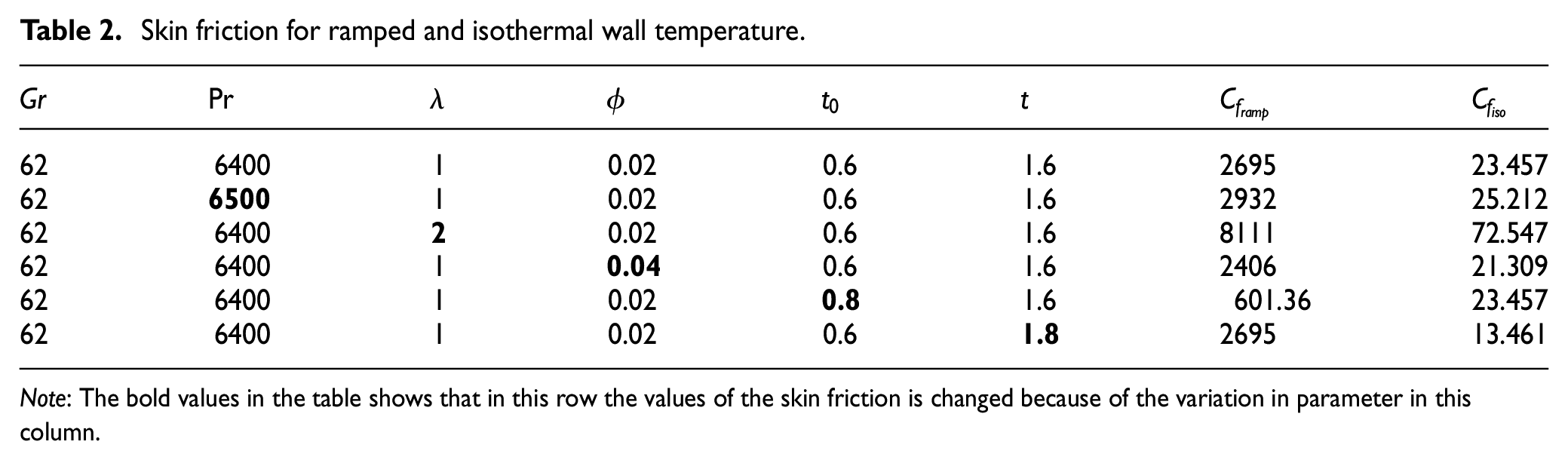
Note: The bold values in the table shows that in this row the values of the skin friction is changed because of the variation in parameter in this column.
Variation in the rate of heat transfer (Nusselt number for ramped and isothermal wall temperatures) for graphene and MoS2 nanoparticles.

MoS2: molybdenum disulfide.
Concluding remarks
This study focused on calculating the closed-form solutions for heat transfer flow of Maxwell nanofluids with ramped wall temperature conditions at the boundary. The Laplace transform technique is applied to obtain the solutions for velocity and temperature distributions. The heat transfer rate of MoS2 and graphene nanoparticles is analyzed in EO. Furthermore, the solutions obtained for non-uniform wall and constant wall temperatures are discussed through graphs. From the figures, it can be observed that the magnitude of velocity is smaller for non-uniform wall temperature and greater for isothermal wall temperature. The skin friction and Nusselt number are evaluated and presented in tabular form.
The following are the main results obtained from this study:
Increasing the volume of nano-sized solid particles results in decrease in the Maxwell nanofluid velocity.
The magnitude of velocity and energy profile are smaller for non-uniform or ramped wall temperature and greater for constant wall temperature.
Heat transfer rate of MoS2 is greater than graphene nanoparticles.
By increasing
By increasing
Newtonian viscous fluid velocity is higher than Maxwell nanofluid velocity.
Footnotes
Handling Editor: James Baldwin
Declaration of conflicting interests
The author(s) declared no potential conflicts of interest with respect to the research, authorship, and/or publication of this article.
Funding
The author(s) received no financial support for the research, authorship, and/or publication of this article.