




Abstract
The analysis of fluid flow near the wellbore region of a hydrocarbon reservoir is a complex phenomenon. The pressure drop and flow rates change in the near wellbore with time, and the understanding of this system is important. Besides existing theoretical and experimental approaches, computational fluid dynamics studies can help understanding the nature of fluid flow from a reservoir into the wellbore. In this research, a near wellbore model using three-dimensional Navier–Stokes equations is presented for analyzing the flow around the wellbore. Pressure and velocity are coupled into a single system which is solved by an algebraic multigrid method for the optimal computational cost. The computational fluid dynamics model is verified against the analytical solution of the Darcy model for reservoir flow, as well as against the analytical solution of pressure diffusivity equation. The streamlines indicate that the flow is radially symmetric with respect to the vertical plane as expected. The present computational fluid dynamics investigation observes that the motion of reservoir fluid becomes nonlinear at the region of near wellbore. Moreover, this nonlinear behavior has an influence on the hydrocarbon recovery. The flow performance through wellbore is analyzed using the inflow performance relations curve for the steady-state and time-dependent solution. Finally, the investigation suggests that the Navier–Stokes equations along with a near-optimal solver provide an efficient computational fluid dynamics framework for analyzing fluid flow in a wellbore and its surrounding region.
Keywords
Introduction
In the petroleum industry, the fluid flow phenomena at the vicinity of a wellbore are very important since most of the important quantities such as pressure drop, flow rate, formation damage, and so on are expected in this region. 1 In fact, the flow near a wellbore is more complex than the reservoir region far away from wellbore and could be nonlinear since sudden pressure drop can occur due to natural or artificial fractures or high permeable formation or perforation tunnels.2,3 Darcy’s equation describes reservoir fluid flow in the regions where the flow phenomena are linear. In contrast, Forchheimer equation describes nonlinear fluid flow through porous media.4–7 Nonlinear flow behavior in the near wellbore regions may have a significant influence on oil and gas production of the hydrocarbon reservoir.7–9 Holditch and Morse 10 investigated the near wellbore fluid flow using a model of fractured porous media, and concluded that over prediction of the flow rates happened when the linear equation was considered. Their study also showed that the hydrocarbon production had a 50% decline over the life of the well when the nonlinearity of the flow was neglected. Therefore, further research can be performed using three-dimensional (3D) Navier–Stokes equations (NSE) toward the study of near wellbore fluid flow.
Most of the existing models assume steady-state flow in the study of oil and gas flows of a reservoir.11,12 In fact, during the production stage, the flow behavior becomes complex and pressure changes with time which has an influence on the productivity index.11,13,14 Note that the productivity index is the relation among the flow rates of a well and pressures of wellbore and reservoir. Moreover, time-dependent nonlinear flow has significant influence on the inflow performance which affects the productivity index. Thus, the time-dependent models based on the NSE are more reliable since they cover the detailed physics of the flow, including linear and nonlinear flow properties.11,15 A brief literature review shows that there is a growing interest to use the NSE in the field of petroleum industry. Narsilio et al. 16 investigated various reservoir properties using the NSE. Ahammad et al. 17 studied fluid flows through porous media using the NSE. Ahammad and Alam 18 investigated miscible fluid flow through porous media using the NSE. Therefore, the NSE can be used to study reservoir flow in order to optimize the hydrocarbon production. 16 Appropriate techniques and algorithms help to accurately solve this model to study flow in hydrocarbon reservoir. 11
Recently, computational fluid dynamics (CFD) has attracted researchers to study the fluid flow in a hydrocarbon reservoir. The availability of high performance multicore computing resources has made it possible to utilize the NSE for CFD investigations of some technological aspects of hydrocarbon reservoirs. Byrne et al. 19 studied the fluid flow through a perforated open-hole tunnel of a vertical well using CFD methodology. The formation damage of asymmetric distribution around a well was simulated with CFD by Byrne et al. 14 Molina and Tyagi 3 performed a CFD investigation to study the fluid flow for the different formation layers and Frac-Paking zone. Szanyi et al. 20 studied a near wellbore of a horizontal well for steady-state flow using a pressure-based (segregated) on control volume technique with NSE.
The present investigation explores the benefits of using 3D NSE to study pressure drop and fluid flow phenomena at the near well-bore. The aim of this research is further advancement of the application of the 3D NSE with CFD methodology in the field of petroleum industry. In this regard, the results based on NSE will be compared with Darcy and Forchheimer equations.
In section “CFD model for near wellbore simulation,” we present the important techniques for investigating fluid flow in the vicinity of a vertical wellbore. Notably, the CFD analysis of near wellbore region requires appropriate mathematical formulations. We briefly outline the mathematical equations for the flow through porous media which represent the near wellbore flow with necessary boundary conditions in sections “Governing equation for flow through porous media” and “Boundary conditions.” Sections “Pressure calculation using Darcy model” and “Pressure calculation using pressure diffusivity equation” describe the analytical solution to calculate pressure for steady-state and time-dependent conditions, respectively. In section “Solution technique of NSE for flow in porous media for linear and nonlinear flow,” the potential solution technique to solve the model equation for the flow through porous media based on NSE in the is described. The numerical simulations are analyzed in section “Numerical results and discussions.” The model is verified with existing analytical solutions. Finally, the performance of the model is investigated and analyzed with pressure drop and inflow performance relationship (IPR) curves studies, and flow direction is studied with streamline behavior and discussed in the numerical results section.
Methodology
CFD model for near wellbore simulation
The diagram of a commonly used computational design for a near wellbore simulation is shown in Figure 1. The average length, height, and wells depth of a hydrocarbon reservoir are

(a) A computational design of reservoir along with a vertical wellbore and (b) the near wellbore region of a reservoir which is similar to the rest of the simulation in this research.
Governing equation for flow through porous media
We consider the volume averaged NSE for slightly compressible flow to investigate the flow behavior in the near wellbore region of a reservoir as (see Szanyi et al., 20 ANSYS, 21 Azadi et al., 22 Ahammad and Alam 18 )


where

in the expression for

Here, the unit of
Boundary conditions
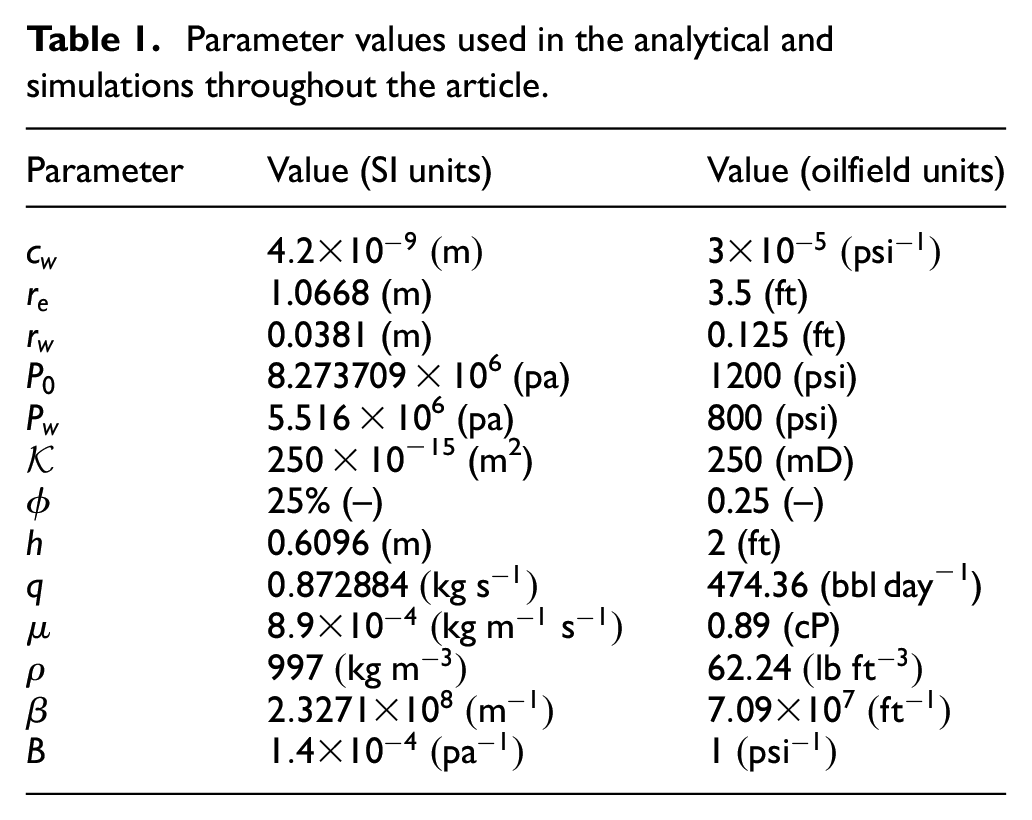
As shown in Figure 1(a), we consider a near wellbore region for the present CFD simulations. The dimension of the near wellbore reservoir and other parameters are listed in Table 1. We assume inlet at the outer boundary of the near wellbore region and outlet at the wellbore surface as described in section “CFD model for near wellbore simulation.” The boundary condition at the inlet of the present CFD simulations is

The boundary condition at the outlet is

where a constant flow rate is presented.
Parameter values used in the analytical and simulations throughout the article.
Initial pressure in the reservoir is assumed to be uniform, thus

Top and bottom layers of the computational domain are considered as wall, so no flow boundary condition is used here.
Pressure calculation using Darcy model
Assuming the flow is steady-state, and linear from reservoir end to wellbore surface, then classical Darcy model has the form

For the isotropic reservoir, equation (8) can be written polar coordinate as

Integration of equation (9) leads to the analytical solution of Darcy equation for a steady-state condition as 24

where

Pressure calculation using pressure diffusivity PD equation
As we assume that flow occurs in radial direction, the mass conservation equation for radial flow with true velocity is

Darcy equation can be combined with mass conservation equation to obtain PD equation. Thus, combining Darcy equation, for example, equation (8) with the mass conservation equation (12), one-dimensional diffusivity equation for slightly compressible fluid takes the form as8,25

where total compressibility

which is known as the PD equation in reservoir studies, where

Now converting the variables in oilfield units, the above equation becomes (see for details, chapter 2, p. 25, of Economides 24 )

Solution technique of NSE for flow in porous media for linear and nonlinear flow
In the element-based finite volume method, the first discretization involves the spatial domain using a mesh. The generated mesh is used to construct finite volumes. The relevant quantities such as mass, momentum, and energy are expected to conserve on the mesh. Mesh generation is important in CFD simulations since capturing the physics of flow, accuracy, and convergence depends on mesh size and time step. 27 The meshing tools in ANSYS CFX v17.2 are used to generate the mesh in this research.
The discretization of the governing equation on a complex geometry is tricky. The higher resolution scheme based on the upwind method is used for the spatial discretization. 27 For the time integration, implicit backward Euler scheme is used since it is unconditionally stable. 27
ANSYS CFX uses the collocated grid where the values of all variables are calculated at the cell centers. This grid has the advantage of converting the mesh to other coordinate systems easily considering the complexity of the domain. 21 Moreover, collocated grid arrangement stores the vector and scalar variables at the same locations, so it requires less computer memory. 28 However, this technique arises the pressure–velocity decoupling issue, and Rhie and Chow 29 interpolation method is used to handle the issue.28,30 The velocity–pressure coupling solver is used in this research where the system of linear equations is solved using an algebraic multigrid technique. Algebraic multigrid technique transforms a system of discrete equations for a coarse mesh by summing the finer mesh equations. The process is performed on virtual grid cells during the iterations and re-refined the mesh to obtain an accurate solution. This technique is less expensive with higher convergence rates since the discretization of the nonlinear equations is solved only once on finer mesh. 27 The algorithm is implemented in ANSYS CFX and the advantage of this algorithm is utilized in this research. Here the algorithm is summarized as follows:
Step 1. Initialize with
Step 2. Take latest value of
Step 3. Apply Rhie and Chow interpolation technique for
Step 4. Solve the coupled system of equation for
Step 5. Apply Algebraic Multigrid technique to solve the system of equations until convergence criteria fulfill.
Step 6. Solve the other variables of interest (if any).
Step 7. If time reaches at a maximum level then stop otherwise go back to step 2, and repeat the same.
IPR formulation
The present near wellbore model based on NSE is expected to perform as like other models such as PD equation. We study the IPR with the present numerical solutions using NSE. The IPR is defined as the relationship between the well production rate and flowing pressure of the well. It has importance to the production engineers since depending on this relation they have to adjust the pressure at separator or pipeline junction.
24
The IPR curves can be three types: steady state, transient, and pseudo-steady state. The IPR curves calculated by the present simulations will be compared to the analytical solution. First, we derive IPR formulation with the parameters listed in Table 1 for linear

where

Numerical results and discussions
Near wellbore reservoir model setup
The present near wellbore model setup is verified with the Darcy equation and PD equation in the following sections.
Verification with Darcy model for steady-state condition
In this section, we consider NSE for linear flow model with the steady-state condition to simulate near wellbore flow for a simple case. As described in section “Methodology,” a simple homogeneous reservoir with a wellbore at the center is considered. The performance of CFD results with NSE is verified with the analytical solution of the Darcy equation (i.e. equation (11)).
Parameters for this simulation are chosen for an idealized hydrocarbon reservoir and the values are listed in Table 1 where water at 25°C is considered. In addition, we choose

Validation of CFD model based on Navier–Stokes equations for linear model
Verification with the solution of pressure diffusivity equation
According to a brief literature review, we see the near wellbore flow has a nonlinear tendency.4–7 Here, we compare the pressure which is calculated using NSE for current numerical simulations with the analytical solution of PD. The parameter values for the simulations are listed in Table 1. The pressure is calculated using NSE for nonlinear

Comparison of pressure distributions calculated by NSE equations, and analytical solution of PD equation for nonlinear
Flow characteristic at the near wellbore
In this section, we discuss the fluid flow phenomena at the near wellbore region for different flow rate scenarios.
Flow behavior at near wellbore region
The fluid flows start from far away from the wellbore region of a reservoir where the flow obeys Darcy’s law, and the fluid pressure decreases as the fluid moves toward the wellhead through the wellbore. Mostly, the pressure drop occurs at the near wellbore, and the mean flow of a reservoir fluid is along the radial direction which causes fluid velocity to increase continuously at wellbore region.
2
The flow phenomena at the near wellbore of an idealized reservoir are investigated with different flow rate scenarios considering linear and nonlinear flow models. The parameter values are listed in Table 1 with variation of flow rate,
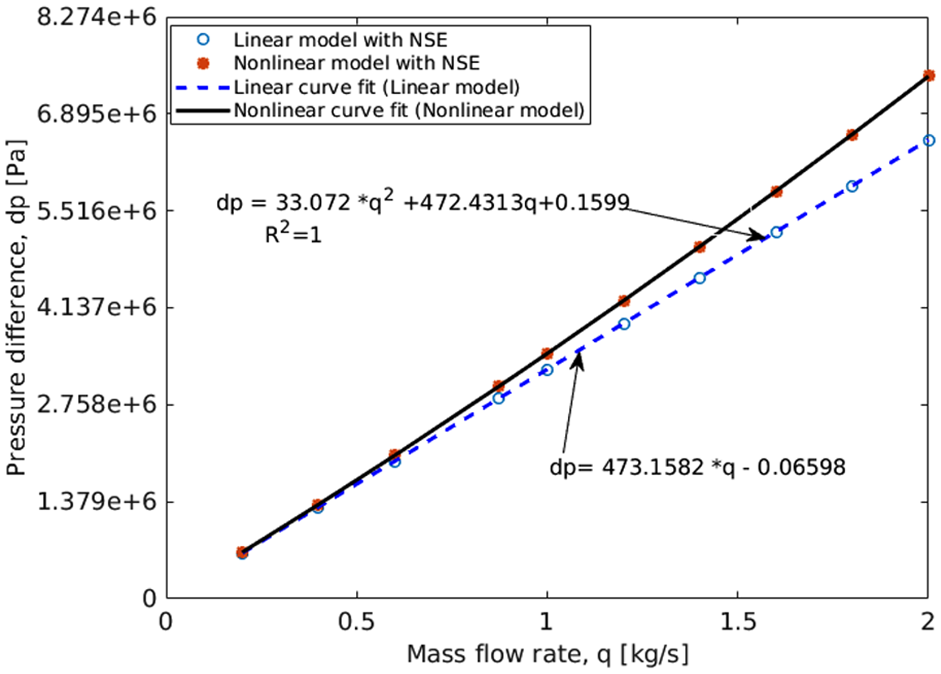
Comparison of pressure drop as a function of flow rate at the wellbore surface.
The pressure drop at the wellbore depends greatly on the well flow rate, and the life of the reservoir depends on the optimum production rate. Over time, the flow and pressure decreasing rates depend upon the various reservoir parameters. This study focuses on the near wellbore flow phenomena where the flows are mostly nonlinear. We see the pressure drop increases with time for both linear and nonlinear flows, shown in Figure 5. The prediction of pressure drop by linear flow model at the early time is about

Pressure drop analysis at the near wellbore with linear
Flow direction
Here, we consider nonlinear model with
Streamlines may give a more detailed description of mass flow across the wellbore region since they provide information both on the magnitude and direction of flow velocity at a given point in time. The streamlines are plotted along a vertical plane of the reservoir and presented in Figure 6. We see the magnitude of the velocity is higher at the near wellbore compare to the reservoir end. The fluid velocity is gradually increasing from the reservoir end to the wellbore region. This indicates the fluid is flowing in a constant flow rate to the radial direction of the reservoir.
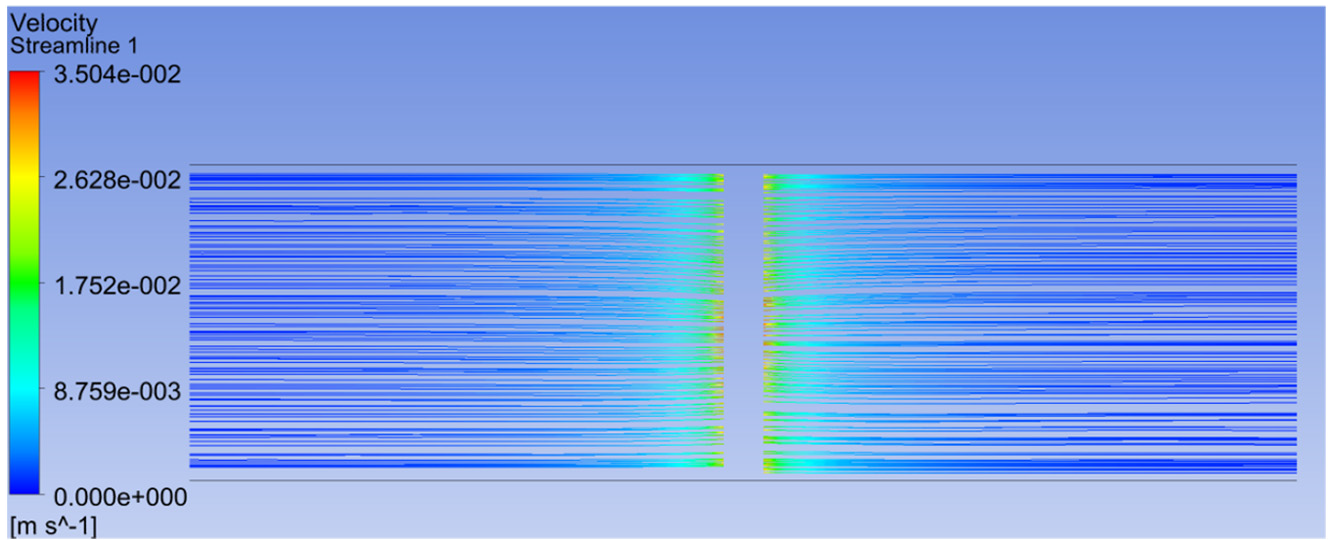
The streamlines along a vertical cross section of the domain representing flow direction.
Inflow performance relation analysis
In this section, we consider linear and nonlinear model based on NSE to investigate the inflow performance at the near wellbore. The inflow performance relation is investigated for two scenarios: linear and nonlinear flow models. First case, we consider CFD simulations for linear model
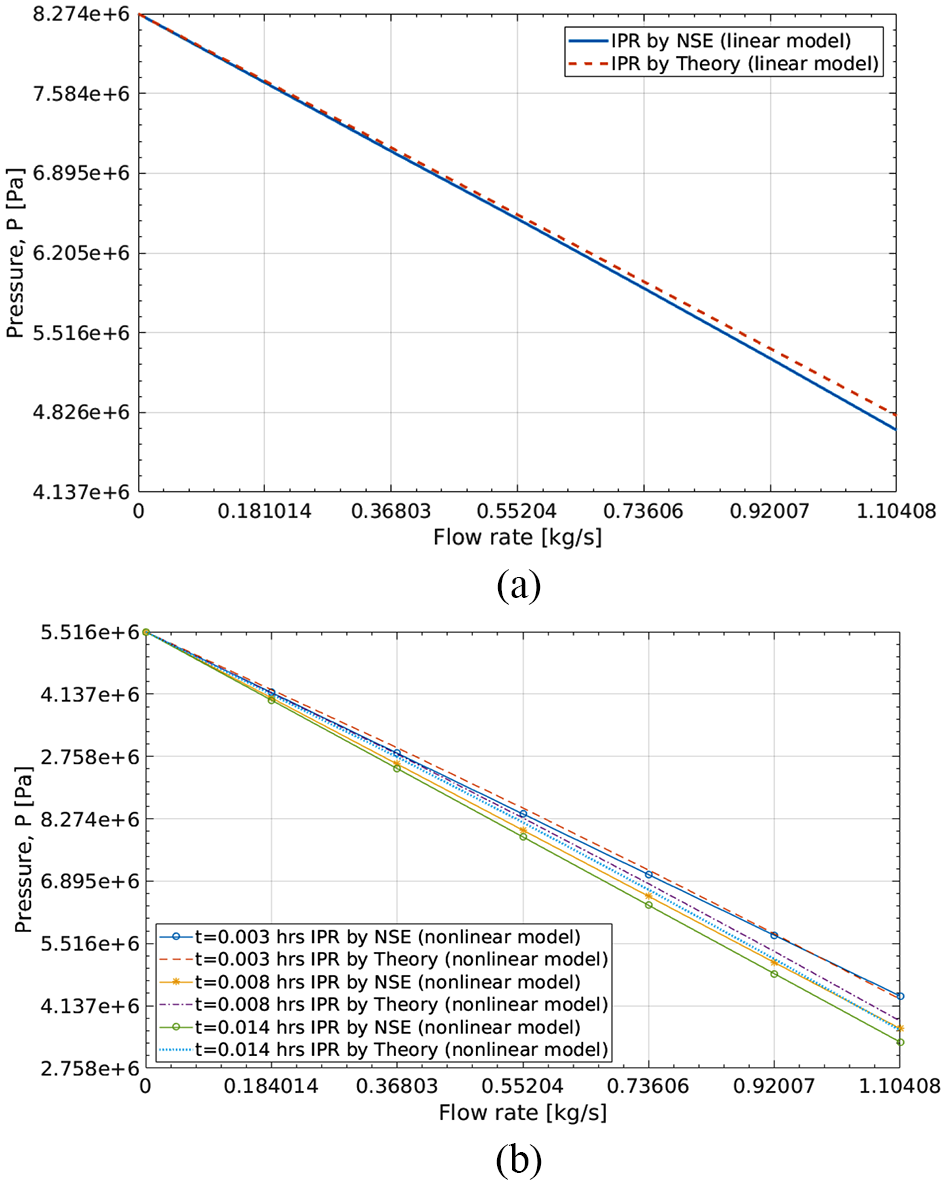
Comparison of the IPR curves: (a) steady-state IPR curves with theory and (b) time-dependent IPR curves with theory.
The proposed CFD modeling based on NSE can be used for better determination of the future behavior of a reservoir and can explain the various production scenarios of a reservoir and help production engineering to maintain the pressure at separator or transport pipeline.
Pressure distribution analysis using NSE
The CFD modeling based on NSE delivers the promising results, including pressure and velocity distribution in the near wellbore model as well as 3D flow patterns. In this section, we discuss the characteristics of pressure distribution for different conditions such as flow rates. The pressure distribution help understand the process of reservoir fluid flow through a reservoir to the wellbore.
Different flow rates for linear flow model
The pressure distribution for linear flow model (

Contour plots of pressure distribution along a vertical plane of the reservoir for steady-state linear model

Pressure profiles for different flow rates of steady-state linear model
Different flow rates for nonlinear flow model
In this section, we study the influences of production rates and production time on the fluid flows of a reservoir, and pressure drop at the near wellbore using the nonlinear model
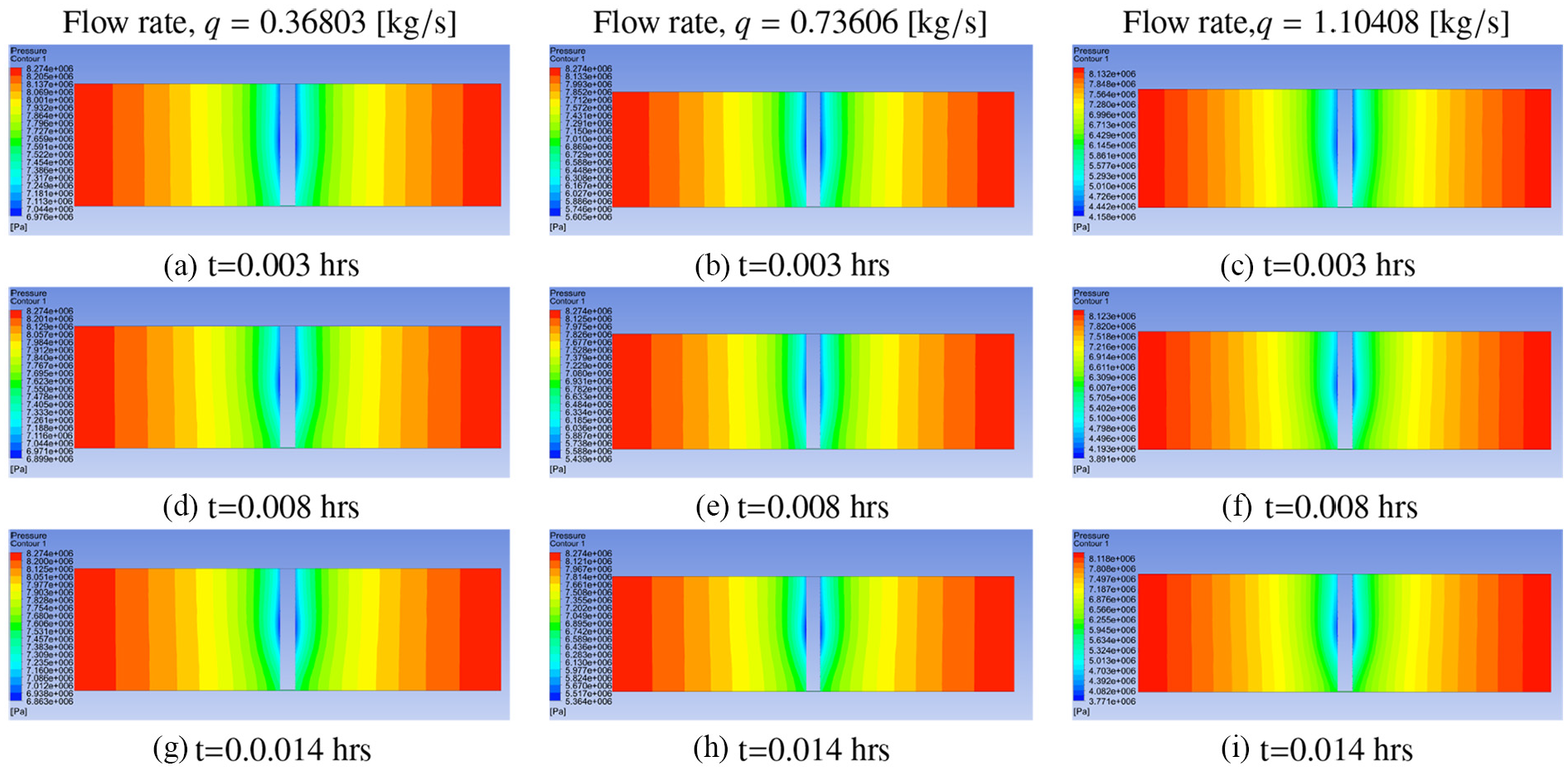
Pressure distribution contour plot along a vertical plane for different flow rates for the simulations of nonlinear model

Pressure distributions as a function of radial distance to the wellbore for nonlinear flow model
Finally, we follow that higher pressure drop occurs for the higher flow rate. This indicates to the production engineers that more attention needs to be drawn to maintain optimal pressure at all stages. This is the sign of turbulent flow at the wellbore for high flow rate, and nonlinear model is more suitable to study flow at near wellbore.
Conclusion and future work
This study investigates modeling of fluid flow phenomena around the near wellbore of a reservoir using 3D NSE. The pressure-based velocity–pressure coupled solver is applied to get a robust, accurate numerical solution of NSE. We verify the present model with existing analytical solutions and other models. Then, we study the nature of the fluid flows around the near wellbore for a steady-state and time-dependent solution. In this study, we extensively investigate the flow behavior near the wellbore with pressure, streamlines, and IPR curve analysis. This study will help to understand the pressure drop near the wellbore for different flow scenarios and the IPR utility in solving everyday production problems and confirm the possibility of time-dependent IPR curves. Time-dependent IPR curves are dependent on the production history, so it helps for future forecasting of the reservoir life. The extension of this model is under process to study the formation damage with different skin zones using coupled wellbore-skin-reservoir approach and transient flow analysis at the near wellbore of a reservoir. In addition, the model can be extended for a horizontal well with formation damage and other features such as sand control.
Footnotes
Appendix 1
Handling Editor: James Baldwin
Declaration of conflicting interests
The author(s) declared no potential conflicts of interest with respect to the research, authorship, and/or publication of this article.
Funding
The author(s) disclosed receipt of the following financial support for the research, authorship, and/or publication of this article: We acknowledge the financial support from the National Science and Research Council (NSERC), Canada and Memorial University of Newfoundland, Canada. M.A.R. also acknowledges Qatar National Research Fund (a member of the Qatar Foundation) for the grant NPRP10-0101-170091. Statements made herein are solely the responsibility of the author. M.J.A. acknowledges School of Graduate Studies, Memorial University of Newfoundland, Canada for scholarships.
