




Abstract
In this article, the free vibration of a functionally graded carbon nanotube–reinforced plate with central hole is investigated by means of the independent coordinates-based Rayleigh–Ritz method. For the proposed method, the kinematic and potential energies are substituted into Lagrange’s equation in order to obtain the equation of motion. However, the total energies are computed by the difference of energies between the hole domain and the plate domain. By applying the displacement matching condition at the hole domain, two coordinate systems are coupled. For the Rayleigh–Ritz method, the mode shape functions of uniform beams are assumed as admissible functions. By this method, convergent results can be obtained with certain number of terms of admissible functions. The present results clearly reflect the effects of the carbon nanotube distribution type, carbon nanotube volume fraction, hole size, and boundary condition on the nondimensional natural frequencies. The provided results show that the present method is efficient in studying the vibration problems of functionally graded carbon nanotube–reinforced plate with central hole.
Background introduction
Carbon nanotubes (CNTs) have received more and more attention since the last decade because of their excellent properties, especially for Young’s modulus and shear modulus. Because of their excellent properties, the CNTs are taken as one kind of promising reinforcement materials for manufacturing lightweight, but high-strength composite materials. In many practical applications, the composite plates are often required to open holes for specific design purposes. Since opening holes reduces both structural weight and stiffness, it is of vital importance to study the dynamic response of plates with open holes for the sake of design requirement as well as structural safety. Moreover, when applying the CNT reinforcements, the CNTs are usually distributed functionally through the thickness. The functionally graded (FG) properties make the analysis harder than the uniformly distributed case. Therefore, it is very meaningful to develop mathematical model to analyze the functionally graded carbon nanotube (FG-CNT)-reinforced plate with open holes.
The mechanical modeling of CNT-reinforced laminated composite structures has been widely studied since the recent decades. The modeling works of FG-CNT-reinforced plates are based on the conventional FG plates and shells.1–5 The Eshelby–Mori–Tanaka approach6–8 is normally used to estimate the effective material properties of composites reinforced by CNT. Sobhani Aragh et al. 8 also used the Eshelby–Mori–Tanaka approach to evaluate the effective properties of elastic isotropic medium with CNTs for vibration analysis of cylindrical panels. Zhang and colleagues9–11 conducted the study of flexural strength of cylindrical panels with FG properties by means of the first-order shear deformation theory and conducted the detail parametric studies. Mehrabadi and Sobhani Aragh 12 analyzed the stress of FG cylindrical shell reinforced by agglomerated CNTs which is subjected to mechanical loads. Zhang and colleagues13–16 also investigated the postbuckling of FG-CNT-reinforced plates under axial compression, where the translation and rotation of edges are elastically restrained. For the free vibration, Yas et al. 17 investigated the three-dimensional vibration of CNT-reinforced cylindrical panels with FG properties. The free vibration of FG-CNT-reinforced triangular plates was also studied by Zhang and colleagues18–21 using the first-order shear deformation theory and element-free, improved moving least-squares (IMLS)–Ritz method. The free vibration of quadrilateral laminates with CNT-reinforced layers was later investigated by Malekzadeh and Zarei. 22 The Rayleigh–Ritz method 23 was also commonly adopted to study the vibration problems of rectangular nanoplates. The parameter effects, such as CNT volume fraction and distribution type, thickness to width ratio, aspect ratio, and boundary condition, on the natural frequencies have been well revealed in these works. The large-amplitude free vibration based on the Euler–Bernoulli beam theory and nonlinear geometric relation was studied by He et al. 24 for CNT/fibers/polymer laminated beams. And for FG-CNT-reinforced beams with piezoelectric layers, Rafiee et al. 25 also investigated the large-amplitude free vibration for the temperature load and electrical load. Ke et al. 26 used an iterative approach to study the nonlinear vibration problem of FG-CNT-reinforced beams by means of Ritz method. Shen and Xiang 27 studied the nonlinear vibration of FG-CNT-reinforced cylindrical panels resting on elastic foundations in thermal environments.
The aforementioned works are all about the CNT-reinforced plates and shells without open holes. When the structures have open holes, the modeling work becomes different and more complicated. The rectangular plates with rectangular cutouts were studied by Ali and Atwal 28 with a Rayleigh–Ritz method–based approach. Using the partitioning method and orthogonal polynomials as admissible functions, Lam and Hung 29 investigated the vibrations of plates with stiffened openings. Similar problems were also studied by Paramasivam, 30 but with the finite difference method. The isotropic plates with circular holes have also been studied by many literature works. 31 However, the circular geometry of holes results in more complicated calculations for the static and dynamic analyses. The least-squares point-matching method was adopted by Hegarty and Ariman 32 and Lee and Lim 33 to analyze a rectangular plate with circular hole under polar coordinate. The discrete Ritz method was advanced by Liew et al. 34 for analysis of vibration of rectangular plates with cutouts. Kwak and Han 35 studied the vibration of isotropic plates which have rectangular and circular holes by means of an independent coordinate coupling method.
Until now, many literature works have introduced the uniform plates and shells with holes, while the FG plates with open holes have not been comprehensively studied yet, especially for the FG-CNT-reinforced composite plates. Therefore, we study the vibration of FG-CNT-reinforced plate with central hole by means of a simple independent coordinate coupling method based Rayleigh–Ritz approach 36 in this article. For the CNT-reinforced composite materials, the effective material properties are evaluated by the extended rule of mixture. The proposed approach adopts two coordinate systems for the plate and hole domains that are independent and later coupled by applying the displacement matching condition at the hole domain. By means of Lagrange’s equation, where the total energies are computed by the energy difference between the plate and hole domains, the equations of motion can be obtained, which further forms a standard eigenvalue problem. Different types of beam mode shape functions are taken as admissible functions in both in-plane directions. The numerical results are given for four types of CNT distributions. The effects of CNT volume fraction, hole size, and boundary condition on the nondimensional frequencies are investigated. With the proposed method, it is computationally accurate and efficient to solve the free vibration problem of FG-CNT-reinforced plate with central hole.
Statement of the problem
Consider a rectangular CNT-reinforced plate with rectangular hole shown in Figure 1; the geometric dimensions are denoted by the symbols a, b, and h for the length, width, and thickness, respectively. The length and width of the hole are represented by ah and bh, respectively. Two coordinates are shown in the figure as well, where (x, y, z) and (xh, yh, zh) represent the coordinate system for the plate and hole, individually. Different CNT distributions are considered as shown in Figure 2, where the CNTs are assumed to be FG through the thickness only. As shown in Figure 2, UD defines the uniform distribution of CNT through the thickness; FG-V, FG-O, and FG-X define three different distributions of CNT through the thickness. Based on these distribution assumptions, the volume fraction of CNT through the thickness can be expressed as follows, where




where

and mass fraction of CNT is denoted by

Coordinate systems of a rectangular plate with a central rectangular hole.

Four types of CNT distributions through the thickness with central hole: (a) UD, (b) FG-V, (c) FG-O, and (d) FG-X.
The extended rule of mixture is used to estimate the material properties of FG-CNT-reinforced composite



where the superscripts CNT and m represent the material properties of CNT and matrix material, respectively. The efficiency parameters of CNT are defined by
Poisson’s ratio


where the volume fraction of the matrix

The constitutive relation for the CNT-reinforced plate is given by

where
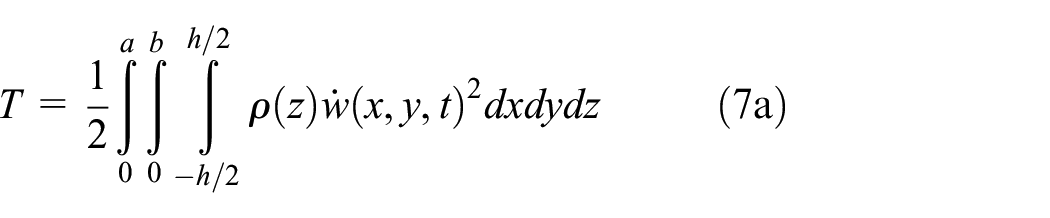

and for the hole domain


where

Introducing the nondimensional coordinates for both the plate coordinate and the hole coordinate as follows


Therefore, the deflections of the plate and the hole can be expressed using the assumed mode method as follows


where Φ and Φ h are admissible functions consisting of n and nh terms, respectively. They are represented by the following forms




The energy equations can be expressed as following using the expressions of equation (7). For the plate domain


where


and for the hole domain


where



The coefficients α and αh are denoted by α = a/b and αh = ah/bh in the above two equations. To solve the free vibration problem, the nondimensional mass matrix and stiffness matrix given by equations (12) and (13) have to be obtained first, so that the eigen-problem can be solved. Thus, using the valuable separation, the admissible functions (equation (11a) and equation (11c)) are divided into two separate admissible functions and expressed as follows


First, we calculate the nondimensionalized mass and stiffness matrices for the plate domain. Substituting equation (14a) into equations (12e) and (12f), the following equations can be obtained


where i, j = 1, 2, …, m and the coefficient matrices X i and Y i are denoted by the integrations of admissible functions and given by the following forms
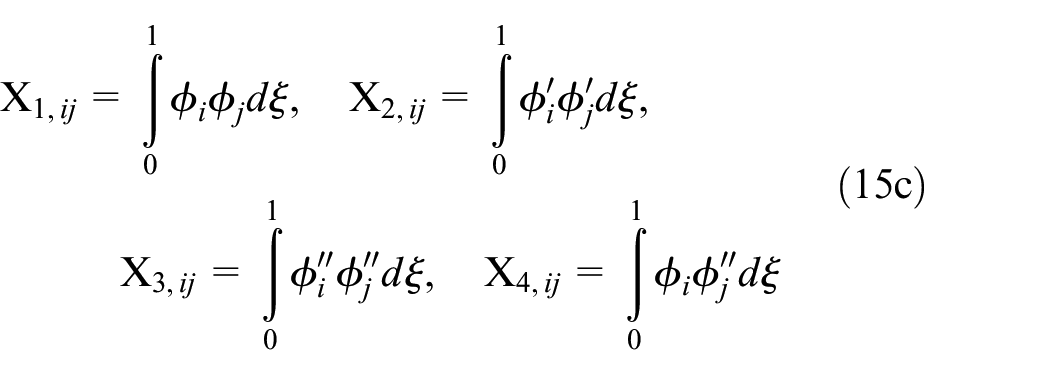

where i, j = 1, 2, …, n. Assuming that N separated admissible functions are adopted in both the x and y directions, the total combination of admissible functions is N2 that is n. By denoting the admissible functions for the x and y directions as


Thus, the coefficients in equation (15c) and (15d) can be found by solving N2 integrations as follows





where i, j = 1, 2, …, N. And, the coefficient matrices can be represented by the following expressions


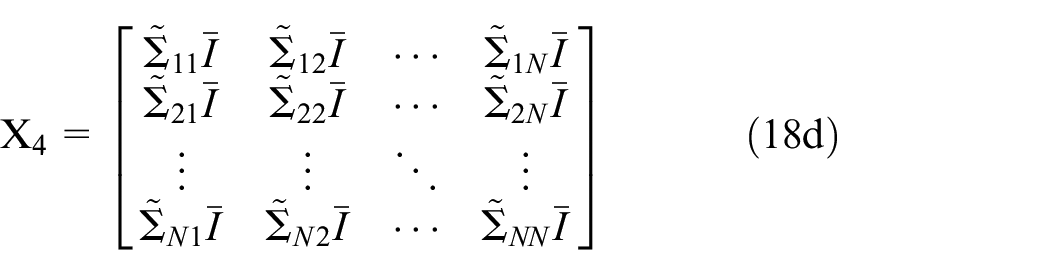


where
For different boundary conditions, the admissible functions can be selected from different mode shape functions of beam. The details are introduced as following three cases:
1. Simply supported condition

2. Clamped condition

where λi = 4.730, 7.853, 10.996, 14.137, …,
3. Free-edge condition


By substituting equations (19)–(21) into equation (17a)–(17d), N2 integrations can be computed for different boundary conditions. The coefficient matrices X i can be consequently obtained from equation (18a)–(18d). The same method can be adopted for calculating the matrices Y i . Thus, the the nondimensionalized matrices can be obtained from equation (15a) and (15b). It should be noted that using different admissible functions represents the different boundary conditions of the plate. Thus, different admissible functions can be combined, and the model is valid for various boundary conditions.
After that, it has to calculate the nondimensionalized matrices for the hole domain by repeating the above same method. While, for the hole domain, the free edge boundary type is used only since four edges of the hole are free. For the sake of brevity, they will not be introduced again. By applying the displacement matching condition, we can get

Using equations (10) and (14), equation (22) can be expressed by

Multiplying

According to the orthogonal property of the eigenfunctions, equation (24) can be simplified as

Equation (25) can be rewritten into the matrix form as follows

where Sh is the coordinate transformation matrix which has the dimension of nh by n. The above equation represents the relation between the matrices in two coordinate systems. Two coordinate systems have to satisfy the following geometric relation

Thus, substituting equation (27) into equation (25), the transformation matrix can be obtained using the numerical integration. The total kinetic and potential energies are defined by the energy difference between the plate domain and the hole domain. And, with the help of equation (26), they can be calculated as follows


where


Equation (29) can be rewritten as following equation by using the nondimensional variables


where


The equation of motion can be calculated by substituting equation (28) into Lagrange’s equation that forms a standard eigenvalue problem as follows

The above eigenvalue problem can be solved with equations (30) and (31). The natural frequencies and the corresponding modal shapes can be obtained.
Numerical results and discussion
The numerical examples of FG-CNT-reinforced plates with central hole will be demonstrated in this section, and the numerical results will be discussed to reveal the effects of CNT distribution type, CNT volume fraction, hole size, and boundary condition on the nondimensional natural frequencies. The material properties
37
of the matrix and CNT are shown in Table 1. The efficiency parameters of CNT are defined in Table 2. For numerical study, simple assumptions that
Material properties of CNT and matrix materials.

CNT: carbon nanotubes.
CNT efficiency parameters with respect to different volume fractions.

CNT: carbon nanotubes.
First, we present the results for the case of four-edge simply supported (SSSS) square plate without hole. The results are obtained with the volume fraction of CNT equivalent to 0.11 and for four types of CNT distributions. The natural frequencies are nondimensionalized by
Nondimensionalized natural frequencies of four-edge simply supported (SSSS) CNT-reinforced functionally graded square plate without hole,

CNT: carbon nanotubes.
Nondimensionalized natural frequencies of four-edge clamped (CCCC) CNT-reinforced functionally graded square plate without hole,

CNT: carbon nanotubes.
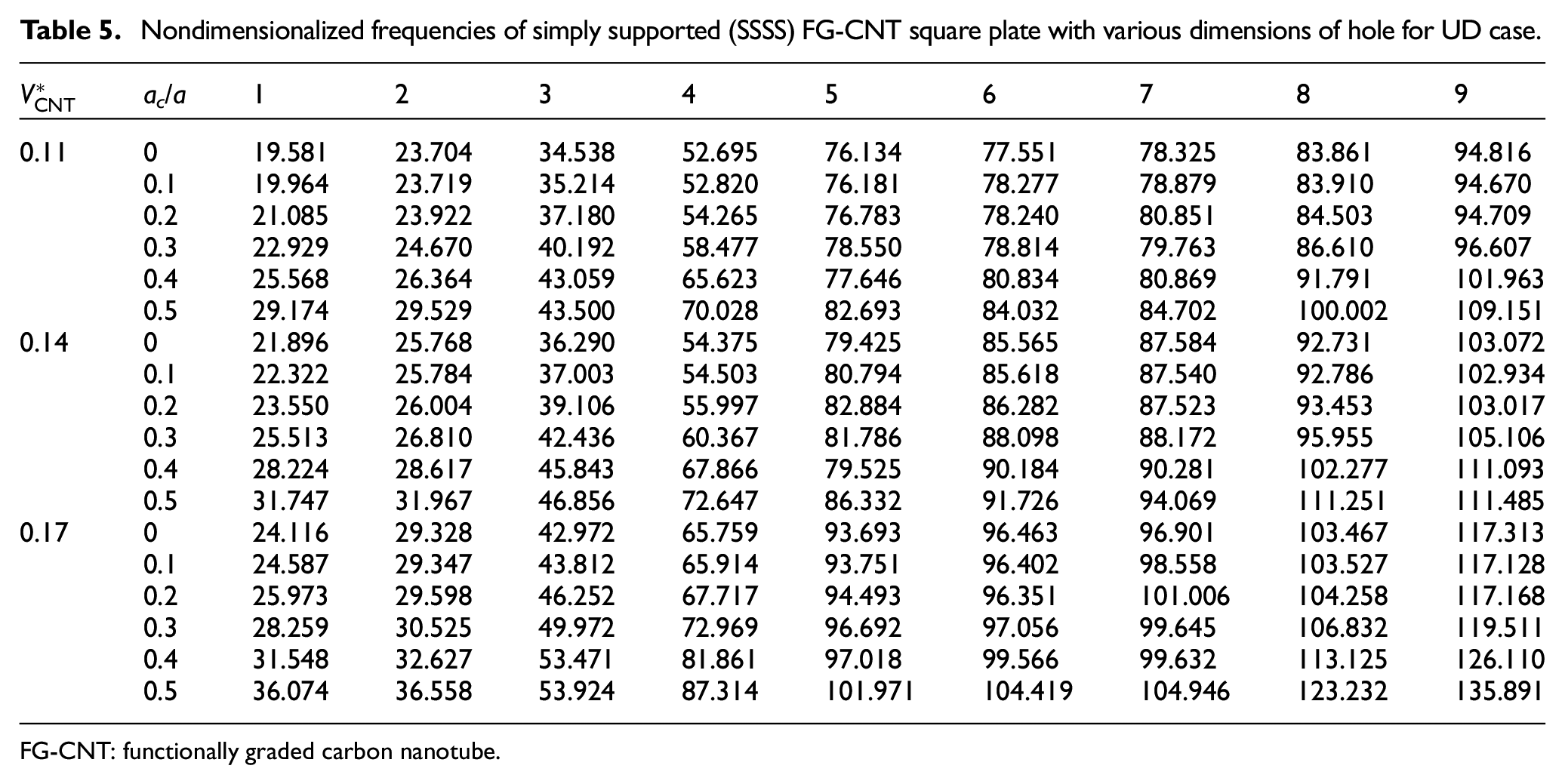
Next is to examine the effects of CNT volume fraction, distribution type, and varying hole size on the nondimensionalized frequencies. The SSSS boundary condition is examined first as well, and the corresponding frequency results are given in Tables 5–8 for the cases of UD, FG-V, FG-O, and FG-X, respectively. In Table 5, the frequencies of the UD case are demonstrated. Two factors, CNT volume fraction and varying hole size, are investigated. It can be found that increasing the CNT volume fraction, the nondimensionalized frequencies increase significantly due to the factor that the strength of the CNT is much larger than the matrix. The square hole is predefined to be located at the geometric center of the plate. Therefore, the natural frequencies also increase significantly if increasing the hole size. When the hole size is 0.5, which represents the ratio of ah/a, the nondimensionalized fundamental frequencies are 29.174, 31.747, and 36.074 for the volume fractions of 0.11, 0.14, and 0.17, respectively, that are 49%, 45%, and 50% larger than the corresponding cases without hole. Table 6 gives the results of FG-V plate with central hole. The CNT volume fraction and hole size are also investigated. The values of the nondimensional frequencies are very close to the previous UD case. Similar comments on the effects of volume fraction and hole size can be made according to the previous case. Increasing the CNT volume fraction also enhances the natural frequencies. Increasing the hole size, the dimenisonalized natural frequencies also increase significantly, but not linearly. Tables 7 and 8 give the frequency results for the FG-O and FG-X cases, respectively. It is also found that with the existence of the central hole, the frequencies of the FG-X case also present largest values among four types, while FG-O case present smallest values. This is due to the factor that if the CNTs distributed close to the surface, it enhances the stiffness of the plate, which will increase the frequencies in turn. However, when the CNTs distributed close to the midplane, it reduces the stiffness and decreases the frequencies. Therefore, the effect of CNT distribution types has been well demonstrated by the given results.
Nondimensionalized frequencies of simply supported (SSSS) FG-CNT square plate with various dimensions of hole for UD case.
FG-CNT: functionally graded carbon nanotube.
Nondimensionalized frequencies of simply supported (SSSS) FG-CNT square plate with various dimensions of hole for FG-V case.

FG-CNT: functionally graded carbon nanotube.
Nondimensionalized frequencies of simply supported (SSSS) FG-CNT square plate with various dimensions of hole for FG-O case.
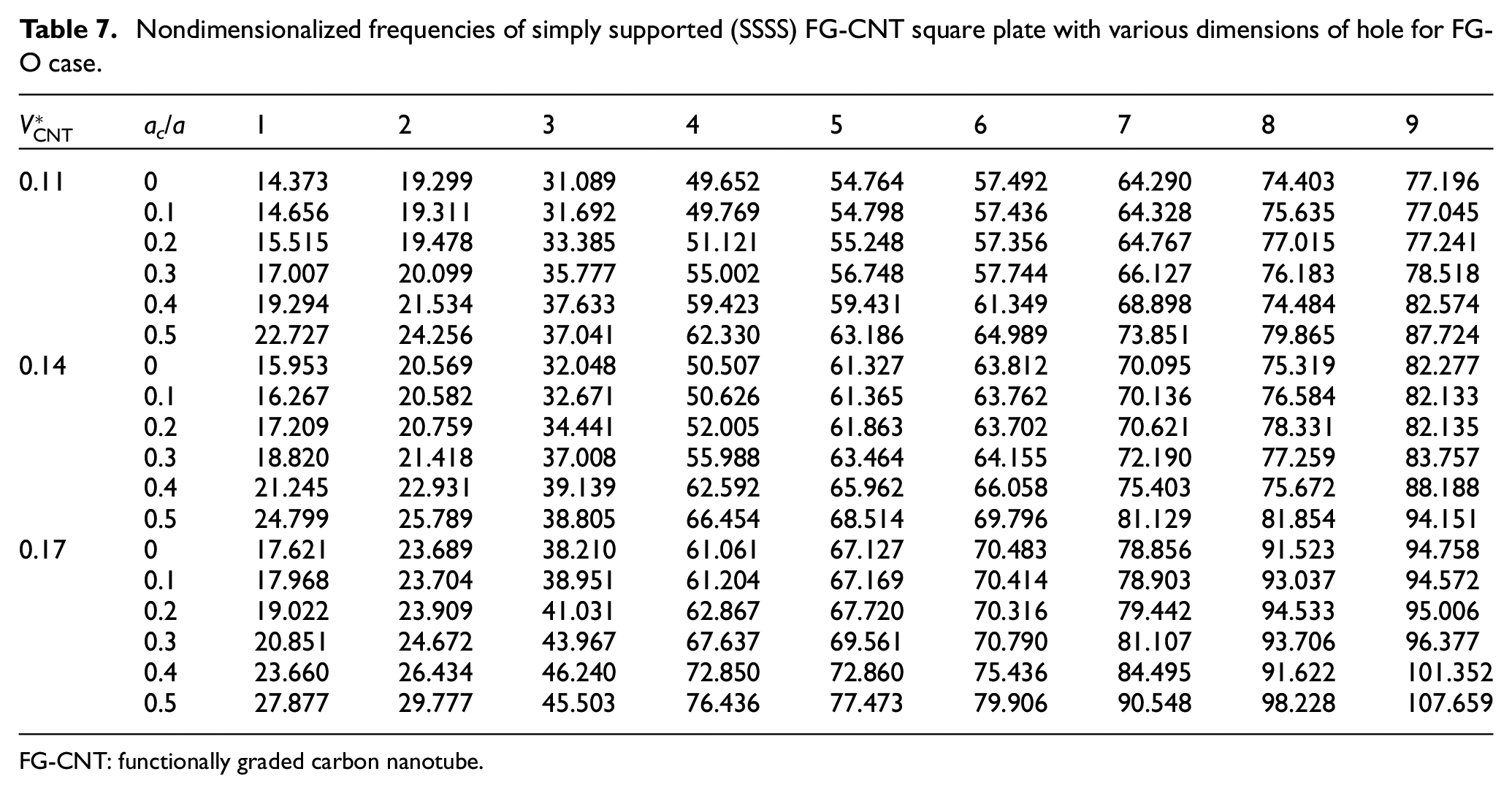
FG-CNT: functionally graded carbon nanotube.
Nondimensionalized frequencies of simply supported (SSSS) FG-CNT square plate with various dimensions of hole for FG-X case.

FG-CNT: functionally graded carbon nanotube.
The CCCC boundary condition case is examined as well, and the corresponding results are given in Tables 9–12 for the cases of UD, FG-V, FG-O, and FG-X, respectively. The square hole is also predefined at the middle of the square plate with varying dimensions. First, the present nondimensionalized frequencies are much larger than the frequencies of the simply supported boundary conditions. Second, with the same amount of CNTs, the FG-X plate possesses larger stiffness than the other three cases. Thus, the FG-X case presents the largest frequencies as well for the CCCC boundary condition. Third, the frequencies change significantly along with the varying hole size. Significant increment can be observed when increasing the hole size. These conclusions are very close to the previous SSSS boundary condition case. Therefore, by these results, the effects of CNT distribution type, CNT volume fraction, and hole size on the first nine natural frequencies are well demonstrated for the CCCC boundary condition. The conclusions are also clearly given according to the present results.
Nondimensionalized frequencies of clamped (CCCC) FG-CNT square plate with various dimensions of hole for UD case.

FG-CNT: functionally graded carbon nanotube.
Nondimensionalized frequencies of clamped (CCCC) FG-CNT square plate with various dimensions of hole for FG-V case.

FG-CNT: functionally graded carbon nanotube.
Nondimensionalized frequencies of clamped (CCCC) FG-CNT square plate with various dimensions of hole for FG-O case.

FG-CNT: functionally graded carbon nanotube.
Nondimensionalized frequencies of clamped (CCCC) FG-CNT square plate with various dimensions of hole for FG-X case.

FG-CNT: functionally graded carbon nanotube.
Concluding remarks
In this work, we presented an approximate approach for predicting the free vibration problem of FG-CNT-reinforced plate with central hole. The present approach is based on two independent coordinates and the Rayleigh–Ritz procedure. The beam mode shape functions are adopted as the assumption of admissible functions. Various boundary conditions are considered, and the total energies are defined by the energy difference between the plate domain and the hole domain. The equation of motion is derived by applying Lagrange’s equation and further forms a standard eigenvalue problem. The numerical results well demonstrate the effects of CNT distribution types, CNT volume fraction, and hole size on the nondimensional natural frequencies. Some of the results are validated by the existed literature works to verify the correctness of the present methodology. This work is easy to implement and computationally efficient in calculating the FG-CNT-reinforced plate with varying size of central hole. The provided results can be used as references in engineering design of CNT-reinforced plate when required to open holes.
Footnotes
Handling Editor: Hai Zhang
Declaration of conflicting interests
The author(s) declared no potential conflicts of interest with respect to the research, authorship, and/or publication of this article.
Funding
The author(s) disclosed receipt of the following financial support for the research, authorship, and/or publication of this article: This work was supported by the National Natural Science Foundation of China (grant no. 11702150), Ningbo Natural Science Foundation (grant no. 2016A610056), the research fund from Ningbo University (grant nos XYL16008 and XYL17019), and the K C Wong Magna Fund through Ningbo University.
