




Abstract
Based on analyzing the problem of the screen with circular, linear, and elliptical trajectory, the spatial Lissajous trajectory has been put forward. The article analyzes the dynamic theory of the spatial Lissajous trajectory screen, and the virtual simulation with discrete-element method is applied to study the solid migration rules. A discrete-element model is developed based on the JKR contact model which takes into considerations viscous forces of contacting particles. Two important factors, migration velocity and filter ratio, are selected to describe the working performance of the vibrating screen. The research results show that the spatial Lissajous vibrating screen has approximate solid migration velocity like the linear vibrating screen, but the filter rate of spatial Lissajous trajectory is the highest. Therefore, the spatial Lissajous trajectory vibrating screen can reduce the phenomenon of screening blockage, and the advantage will be more evident in the case of high drilling fluid viscosity, high mesh number, and serious screen blockage.
Introduction
The vibrating screen is a key equipment for separating granular materials based on size and is often used extensively in mining, building, agriculture, metallurgy, drilling, and other industries. 1 The vibrating trajectory is the most important factor of a vibrating screen. So researchers never stop to explore the appropriate trajectories of the screen. As we know, the common vibrating trajectory is circular, linear, and elliptical as shown in Figure 1(a)–(c). According to the trajectory of movement, screens can be divided into three types: linear vibrating screen, circular vibrating screen, and elliptical vibrating screen.2,3 These three types of trajectory generate vibration in the longitudinal plane.4,5 So granular materials are only stressed in the x and y axis direction by the sieving force, but in the z axis direction without force. The difficult sieving and anomalistic critical particles will easily produce the blocking and influence the screening efficiency and processing performance.

Four types of trajectory of vibrating screen: (a) circular trajectory, (b) linear trajectory, (c) elliptical trajectory, and (d) special Lissajous trajectory.
The discrete-element method (DEM), which was developed by Cundall and Strack 6 in the 1970s for modeling the behavior of assemblies of disks and spheres, can monitor the movement and interaction of all particles in the granular system. 7 DEM has been widely used in the study of segregation of granular medium system fields, such as mining, construction, pharmaceuticals, food production, and so on.8–12 In addition, the successful applications of DEM not only have given an insight to study the granular systems but also have got positive results to promote the development of vibrating screens.13,14 The reliability of numerical simulation using DEM has been proved by plenty of simulations of industrial particle flows.9,12,15–17 Simulations and experiments of the linear vibrating screen are relatively mature.18–20 The characteristics of linear screen based on a two-dimensional (2D) and three-dimensional (3D) model were studied, and the effects of the screen size, frequency, and amplitude on the screening efficiency were analyzed and verified by experiments.21–24 Most of these studies concentrate on finding the relationship between the microscopic information and macroscopic process using DEM.25–27
Aiming to develop a new type of screen with better screening efficiency and processing performance, the spatial Lissajous trajectory has been put forward as Figure 1(d). In this study, the article will analyze the dynamic theory of the spatial Lissajous trajectory screen, and the virtual simulation with DEM will be applied to study the solid migration rules.
Dynamic theory of the spatial Lissajous trajectory vibrating screen
The structure of screen box, exciting motor, and spring are simplified, and the corresponding coordinate system shown in Figure 2 is established. Based on the way of parametric design, the 3D model of the spatial Lissajous trajectory vibrating screen is established, which is shown in Figure 3.
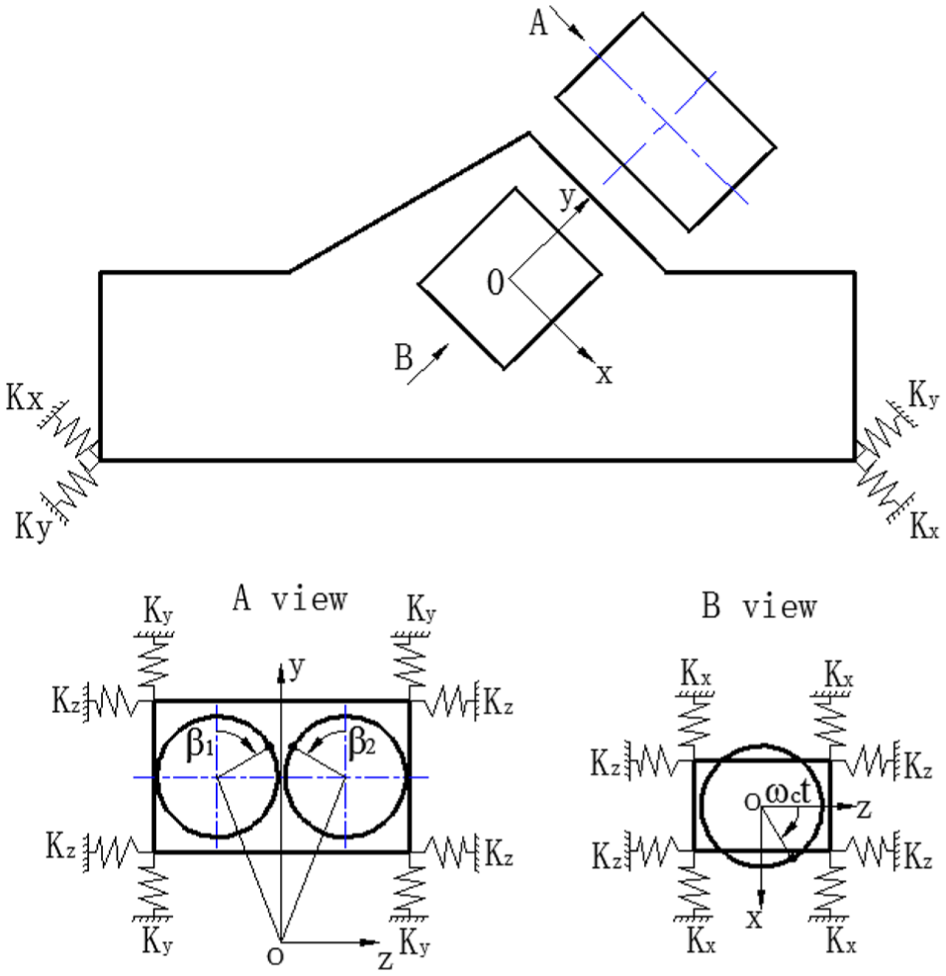
Simplified figure of the spatial Lissajous vibrating screen.

The 3D model of the spatial Lissajous trajectory vibrating screen.
Neglecting the damping force and supposing that there is no phase difference between the two linear vibration motors, the differential equation of motion of the sieve box along the three directions of x, y, and z is as follows

where
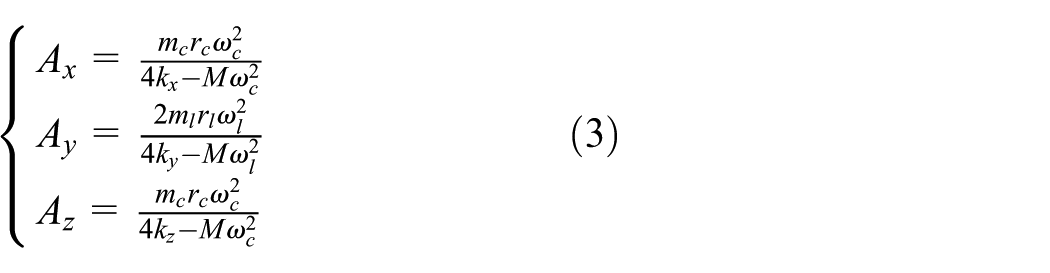
According to the solution method of ternary quadratic differential equation, the steady state solution is as follows

DEM simulation
Model of vibrating screen
The simple model of the vibrating screen is established in the simulation, and the value of mesh aperture is 0.83 mm × 0.83 mm, which is shown in Figure 4.

DEM model of the vibrating screen.
Simulation parameters
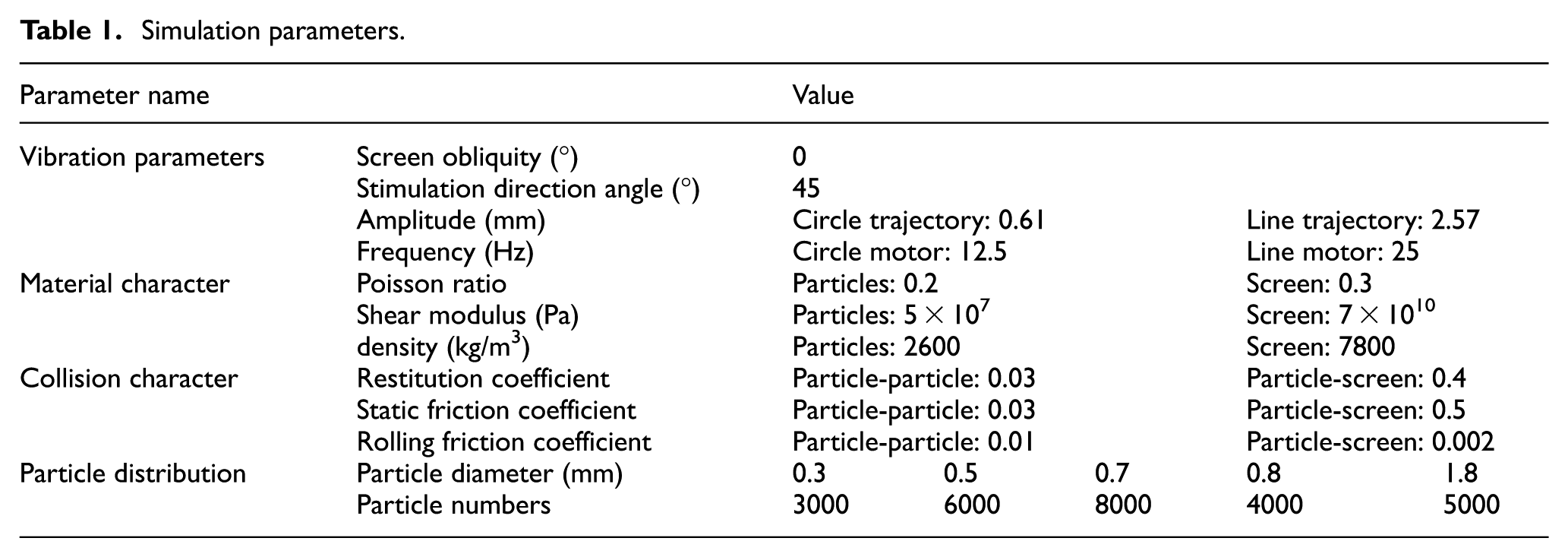
In this work, the simulation is achieved based on the JKR contact model. The main parameters are shown in Table 1, which come from the experimental data and other research results.
Simulation parameters.
Results and comparison
Migration velocity
Figure 5 is the particles migration on the spatial Lissajous trajectory vibrating screen by throwing motion, and it can be seen that particles can migrate forward, which shows that the principle of spatial Lissajous trajectory vibrating screen is correct.

The particles migration on the spatial Lissajous trajectory vibrating screen.
Particle migration velocity is an important index of the performance of vibrating screen. Because of the randomness of particle-to-particle collision, the migration velocity of single particle is irregular. So the average migration velocity of particle group is used as the index.
In order to compare the migration velocity of linear, elliptical, and spatial Lissajous trajectory vibrating screen, the three migration velocity curves are obtained, which are shown in Figure 6. The fluctuant lines are the dynamic curves, conveying velocity of particle group, while the smooth lines are the curves disposed.
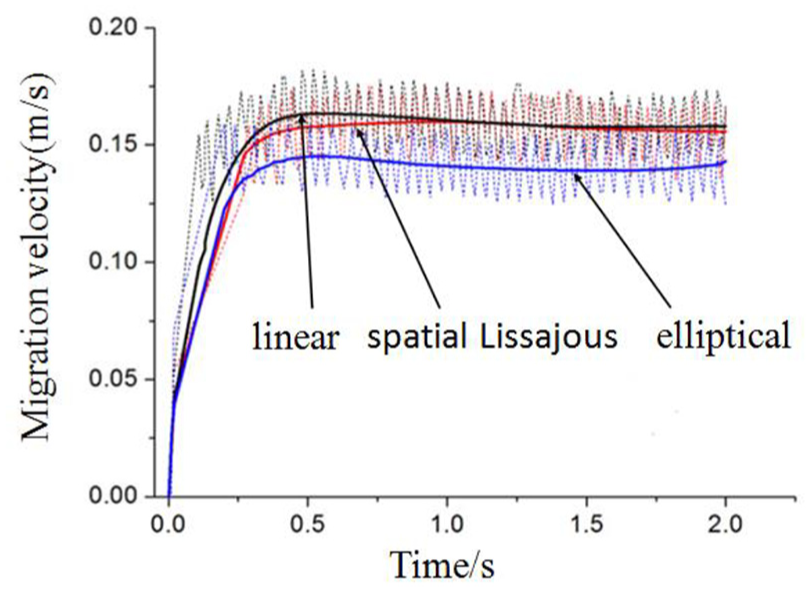
The particles migration velocity with three different vibrating trajectories.
It can be seen from Figure 6 that the migration velocity of solid particles in the elliptical trajectory is the lowest compared with that in the linear and spatial Lissajous trajectories. The migration velocity difference of the linear and spatial Lissajous trajectories in migration direction is very small. Relatively speaking, the solid particle migration velocity of spatial Lissajous trajectory is easier to reach a stable state.
Filter ratio
In the process of screening, not all of the particles can pass through the screen. Only partly small particles can be transported out from the right side outlet by the particle-to-particle and particle-to-screen interactions.
When there is a viscous force on the surface of the particles, the particles will form clusters between them, as shown in Figure 7. Small particles will adhere to large particles. Under the influence of the viscous force, medium-sized particles are easy to penetrate through sieve holes. While smaller particles are easier to form clusters, which will hinder their passing through the screen holes.

The particles viscous situation.
In this work, the research on filter ratio is mainly aimed at those particles whose diameter is smaller than the mesh of the screen. The filter ratio is defined as
Four kinds of particles’ filter ratios with different vibrating trajectories.

From Table 2, it can be seen that the filter rate of spatial Lissajous trajectory is the highest, while that of elliptical trajectory is the lowest. Because of the increase of a circumferential exciting force, there exists a circumferential acceleration vector when particles contact the screen surface, which makes it easier for particles to penetrate through the screen hole and reduces the phenomenon of screening blockage.
Conclusion
A new-type spatial Lissajous trajectory is put forward, and the 3D model of the spatial Lissajous trajectory vibrating screen is established.
DEM simulation results show that the solid particles can migrate forward, which shows that the principle of spatial Lissajous trajectory vibrating screen is correct. And the migration velocity approaches a stable value gradually.
The spatial Lissajous vibrating screen has approximate solid migration velocity like the linear vibrating screen, but it can reduce the phenomenon of screening blockage. Therefore, the advantages of spatial Lissajous trajectory vibrating screen will be more evident in the case of high drilling fluid viscosity, high mesh number and serious screen blockage.
Footnotes
Handling Editor: James Baldwin
Declaration of conflicting interests
The author(s) declared no potential conflicts of interest with respect to the research, authorship, and/or publication of this article.
Funding
The author(s) disclosed receipt of the following financial support for the research, authorship, and/or publication of this article: The authors are grateful for the financial support from the Hubei Provincial Department of Education in China (grant no. D20171303).
