




Abstract
The natural convection of non-Newtonian fluids between parallel plates has many engineering applications such as heat exchangers, cooling of electronic equipments, nuclear reactors, solar devices, polymer processing industries, food industries, and petroleum reservoirs. Numerical solution is introduced to solve the governing equations of natural convection of non-Newtonian (Rivlin–Ericksen) fluid flow and heat transfer under the influences of non-Darcy resistance force, constant pressure gradient, dissipation, and radiation. The novelty of this article is to solve this problem between parallel plates channel instead of one plate. The fluid flows between two heated parallel plates that are kept at constant temperatures. Second-order accurate finite difference schemes transform the coupled non-linear differential (momentum and energy) equations to linearized system of algebraic equations. Some comparisons are made to study the convergence and stability of the present results. Effects of parameters of fluid and heat on the velocity field, temperature, skin friction factor, and Nusselt number are illustrated and discussed. The present results and their comparisons with available results are listed and shown in tables and figures. The present results show that the numerical solution is of good agreement with previous analytical and numerical solutions.
Keywords
Introduction
The effects of parallel plate channel, non-Darcy medium, on natural convection of non-Newtonian fluids and heat transfer are studied because of their importance in engineering applications. The numerical methods associated with error analyses are very important tools to solve highly non-linear differential equations when the analytical solutions are impossible or more complicated and when we need comparisons with analytical and experimental methods. Iterative techniques are required to solve the linearized differential equations to achieve an appropriate accuracy. The finite difference method (FDM) is widely used to solve the linear and non-linear differential equations because of the simplicity of this method. Experimental results of the present solution are not available, but some comparisons with available analytical and numerical results are made for special cases to show the validation of the present solution. Another validation of present solution is made by error analysis.
The natural convection of non-Newtonian fluids has been studied by many authors.1–11 The natural convection problem between vertical flat plates for a certain class of non-Newtonian fluids has been carried out by Bruce and Na. 1 Rajagopal and Na 2 introduced a numerical solution for natural convection flow of Rivlin–Ericksen fluid and heat transfer between parallel plates. The effects of the non-Newtonian nature of fluid on the skin friction and heat transfer have been studied.
The free convection of a non-Newtonian fluid between two parallel vertical flat plates was studied. 3 The governing equations are transformed to ordinary differential equations, which are solved using homotopy perturbation method (HPM). The comparison between the results from HPM and numerical method is in well agreement. The results show that the HPM is a powerful approach for solving non-linear differential equations. Also, it can be found that increasing dimensionless non-Newtonian viscosity parameter leads to increase in velocity and temperature profiles, while opposite trend is observed when Prandtl number and Eckert number increase. A homotopy analysis solution is presented for the natural convective heat transfer of a third-grade, non-Newtonian fluid flowing past an infinite porous plate through Darcy–Forchheimer porous medium. 4 The governing equations are transformed to a one-dimensional form. Their results indicate that a rise in third-grade viscoelasticity, suction, thermal conductivity, and permeability boosts velocities and temperatures, but increasing the Forchheimer parameter decreases velocities and also temperatures because of resistance. The method is a useful tool for non-linear problems in science and engineering. Farooq et al. 5 presented He’s HPM to solve a non-linear coupled system of ordinary differential equations that arises in the fully developed natural convection flow of a third-grade fluid between two vertical parallel walls. The same problem is also solved by a numerical method (Runge–Kutta method of order 4) using the software MAPLE. The numerical results obtained by these methods are then compared and an excellent agreement is observed. Kargar and Akbarzade 6 used the HPM for the study of natural convection flow of a non-Newtonian fluid between two vertical flat plates. The effects of the non-Newtonian nature of fluid on the heat transfer are studied. The governing boundary layer and temperature equations for this problem are reduced to an ordinary form and are solved by HPM and numerical method. Velocity and temperature profiles are shown graphically. The obtained results are valid for the whole solution domain with high accuracy. Rashidi et al. 7 used the differential transformation method (DTM) to solve the governing equations of natural convection flow of third-grade non-Newtonian fluids. Their method reduces the computational difficulties of several methods (such as the homotopy analysis method (HAM), variational iteration method (VIM), Adomian decomposition method (ADM), and HPM). Etbaeitabari et al. 8 introduced an analytical heat transfer assessment and modeling in a natural convection between two infinite vertical parallel flat plates. They developed a new technique independent of small parameter and it depends on VIM technique. Murar 9 studied the natural convection flow in a vertical channel in the presence of non-linear radiation and viscous dissipation. The Rosseland approximation is considered in the modeling of the convection-radiation heat transfer, and the temperature of the walls are assumed constant. He used the FDM to solve the governing coupled equations. Siddiqa et al. 10 studied the natural convection flow of a two-phase dusty non-Newtonian power law fluid along a vertical surface. The continuity, momentum, and energy equations are solved numerically with the aid of implicit FDM. Numerical results are listed for the fluid and heat quantities, such as rate of shear stress, rate of heat transfer, velocity and temperature profiles, isotherms, and streamlines. The problem is modeled by considering contaminated oil as a working fluid, which is under the influence of several fluid and heat parameters. A modified viscosity model is used to incorporate the non-Newtonian fluid into the analysis. Coordinate transformations are applied to solve the governing equations of the problem using two-point FDM. They studied and computed the skin friction and Nusselt number. Jyoti 11 used the HAM to study the third-grade fluid with natural heat convection between two vertical plates. The effects of Eckert number, Prandtl number, and viscoelastic parameter on the flow are shown and discussed. The HAM results and convergence are compared with previous results, which show good agreement. The effects of physical parameters on the flow are presented in table and graphs, and are discussed in detail.
The aim of this work is to study and compute the effects of non-Darcy resistive force with radiation on the natural convection flow of non-Newtonian Rivlin–Ericksen fluid flow and heat transfer with dissipations. The novelty of this article is to solve this problem between parallel plates channel instead of one plate. Second-order accurate finite difference schemes are applied to solve the coupled non-linear differential (momentum and energy) equations. Linearization technique is applied to transform the non-linear linearized ones. Iterations are used to achieve convergence and stability of linearized governing equations with boundary conditions. Skin friction and Nusselt number are computed using fourth-order accurate finite difference schemes to reduce the roundoff errors which arise in numerical methods.
Formulation of the problem
Consider a non-Newtonian fluid flow in a non-Darcy porous medium between two vertically parallel plates as shown in Figure 1. The two stationary plates are kept at constant but different temperatures
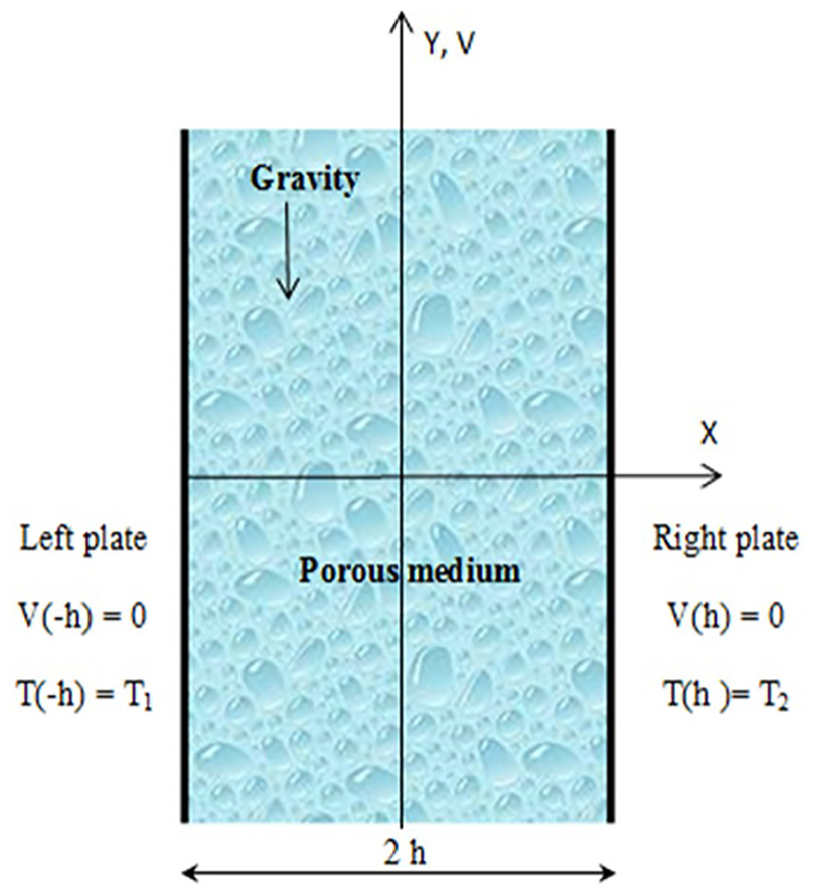
Problem geometry and boundary conditions.
According to above assumptions, the governing (momentum and energy) equations are written, respectively, as2,4,12


The boundary conditions are shown in Figure 1, and they are written as

The radiative heat flux is approximated using Rosseland approximation 13 as

Using Taylor expansion of

To introduce a general solution for any case of dimensions and scales, the following quantities are chosen2,4,6

Under the above assumptions (equations (4) and (5)) and quantities, the dimensionless forms of governing equations (1 and 2) with boundary conditions (equation (3)) are rewritten as



The method of solution (FDM)
The system of coupled non-linear ordinary differential equations (6 and 7) with boundary conditions (equation (8)) are solved for the flow velocity and temperature using the FDM. The following linearized form should be applied because of nonlinearity in this system


where bar notation refers to the iterated terms which transform the system (equations (6) and (7)) to a linearized one.
The finite domain of solution (


The skin friction factor and Nusselt number factor are two important fluid flow and heat transfer parameters because of their very importance in the engineering applications, as they can be used to improve the shape and efficiency of many equipments in aerodynamics. These parameters are computed after solution the governing equations. The skin friction factor is defined as in Eckert and Drake 15

Nusselt number is defined as the ratio of the convective conduction to the pure molecular thermal conductance. 16 Thus, the Nusselt number at left plate may be written as

The dimensionless forms of these factors are written as


Fourth-order difference schemes should be applied on equations (16) and (17) to minimize roundoff errors in computations. These schemes can be deduced by Taylor’s expansion of independent variables (
Thus, the dimensionless skin friction factor and Nusselt number are discretized as


Error analysis
Experimental results of present solution are not available, but some comparisons with available analytical and numerical results are made for special cases to show the validation of the present solution. Another validation of present solution is made by error analysis.
It is preferred to use previous results as an initial guess for linearized terms to achieve fast convergence of the present work. For large number of subintervals (
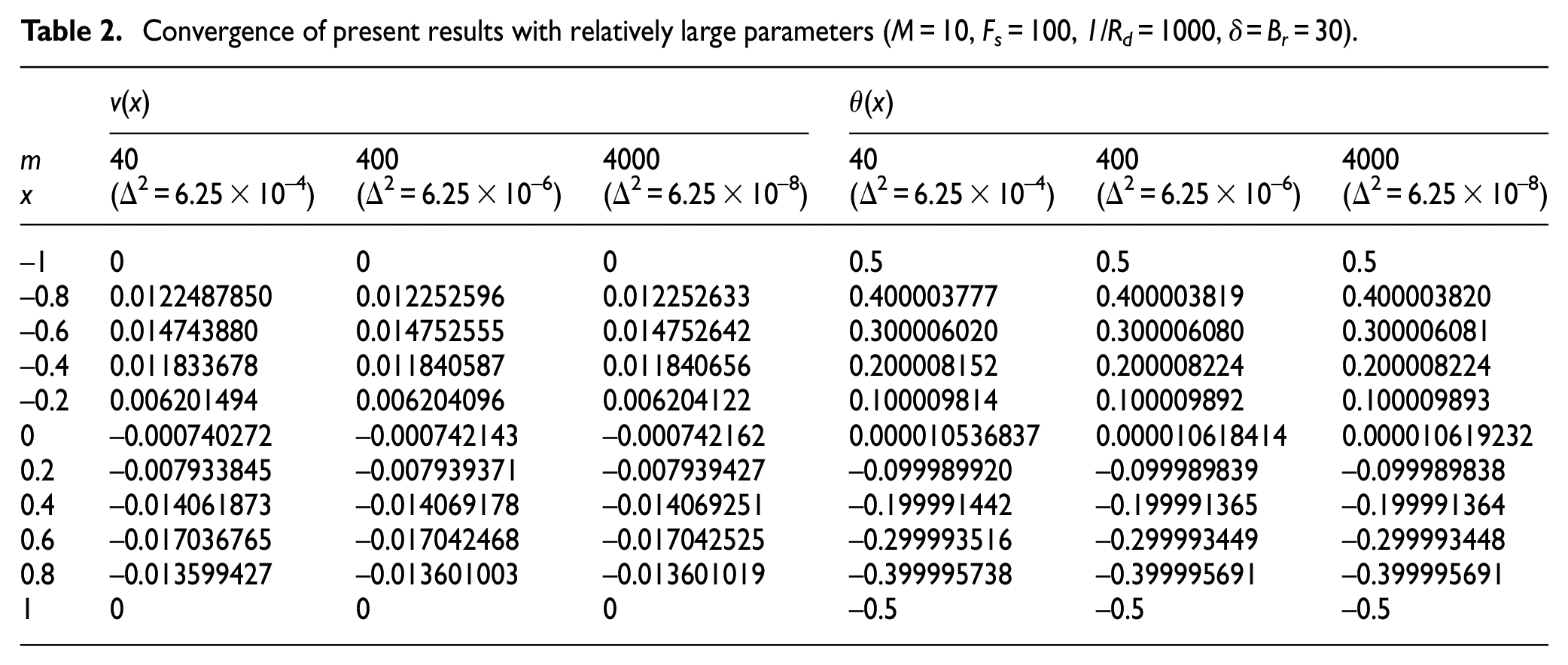
Tables 1 and 2 illustrate the convergence of the present solution depending on the influences of v and θ by number of subintervals (m = 40, 400, and 4000) which give orders of truncation error (
Convergence of present results with relatively small parameters (M = Fs = Rd = δ = Br = 1).

Convergence of present results with relatively large parameters (M = 10, Fs = 100, 1/Rd = 1000, δ = Br = 30).
Tables 3–6 illustrate good agreements of present results with earlier literature works.6,7,11,14 It is observed that the absolute difference between present results and DTM
7
and HAM
11
is less than
Comparison of velocity with earlier literature works (M = Fs = 0, 1/Rd = 0, δ = 0.5, Br = 1, m = 5000).

HPM: homotopy perturbation method; HAM: homotopy analysis method.
Comparison of temperature with earlier literature works (M = Fs = 0, 1/Rd = 0, δ = 0.5, Br = 1, m = 5000).
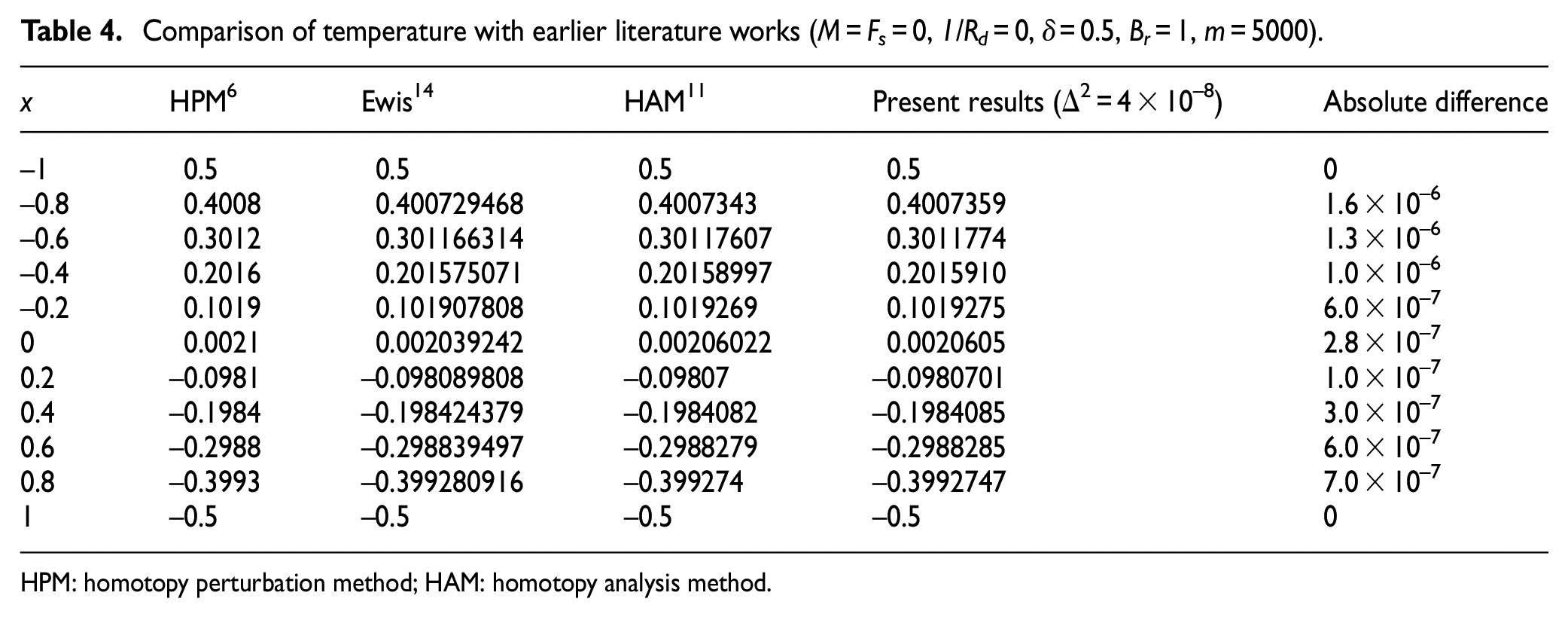
HPM: homotopy perturbation method; HAM: homotopy analysis method.
Comparison of velocity with earlier literature works for different values of δ (M = Fs = 0, 1/Rd = 0, Br = 1, m = 1000).

MDTM: multi-step differential transformation method.
Comparison of temperature with earlier literature works for different values of δ (M = Fs = 0, 1/Rd = 0, Br = 1, m = 5000).
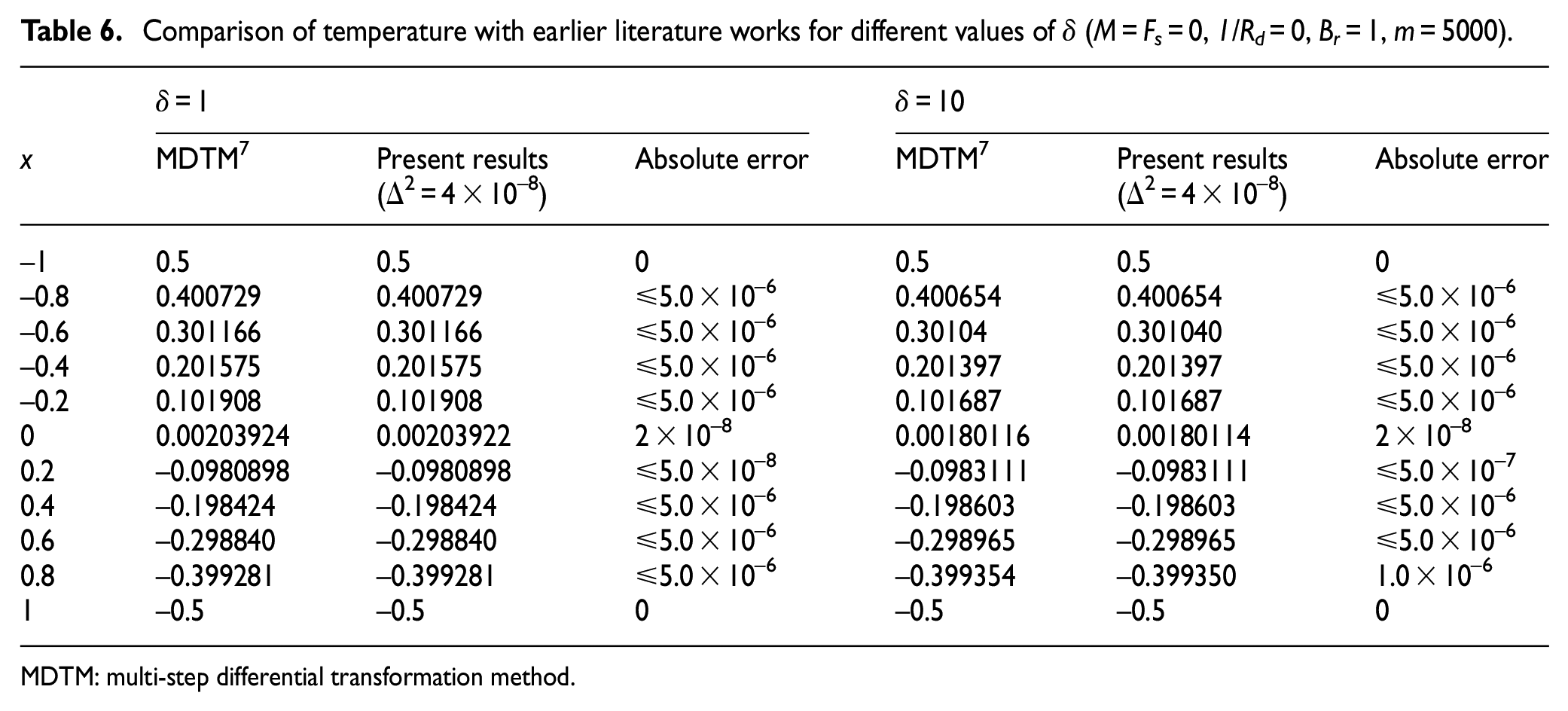
MDTM: multi-step differential transformation method.
Tables 7 and 8 show effects of fluid flow and heat transfer parameters on the friction factor (
Effects of flow and heat parameters on the friction factor

Effects of flow and heat parameters on the Nusselt number

Calculations of the velocity
The variations of velocity

Variation of
The variations of
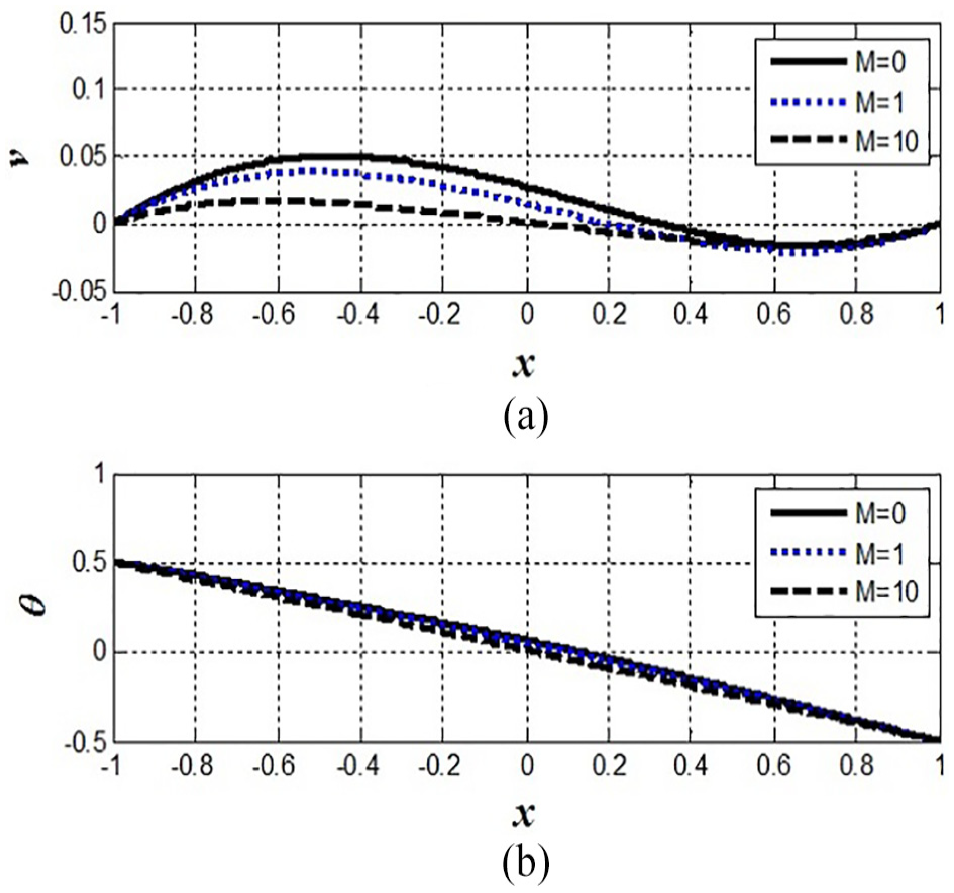
Variation of
Figure 4 shows the variations of

Variation of
The effect of viscoelastic parameter

Variation of
The effect of Brinkman number

Variation of
Conclusion
The natural convection of non-Newtonian (Rivlin–Ericksen) fluid flow and heat transfer under the influences of non-Darcy resistance force, constant pressure gradient, dissipation, and linear radiation is studied. The novelty of this article is to solve this problem between parallel plates channel instead of one plate. The coupled non-linear governing equations of the problem are solved using second-order accurate FDM. The effects of parallel plate channel, non-Darcy medium, fluid’s velocity, temperature, friction factor, and Nusselt number are illustrated and discussed. Experimental results of present solution are not available, but some comparisons with available analytical and numerical results are made for special cases to show the validation of the present solution. Another validation of present solution is made by error analysis, which validates the stability and convergence of present results. The present results and their comparisons with available results are listed and shown in tables and figures. The present results show that the numerical solution is of good agreement with previous analytical and numerical solutions. It is observed that increasing Forchiemer, Darcy, and viscoelastic parameters decrease velocity and temperature because they represent resistance forces. It is also observed that increasing radiation and Brinkman parameters increase velocity and temperature because they represent sources of energy. The friction factor increases with increasing Brinkman and viscoelastic parameters, but it decreases with increasing Forchiemer parameter. It is also observed that the Nusselt number decreases with increasing Brinkman and viscoelastic parameters, but it increases with increasing Forchiemer parameter. In general, variation fluid variables are influenced by problem’s parameters more than temperature.
Footnotes
Appendix 1
Handling Editor: James Baldwin
Declaration of conflicting interests
The author(s) declared no potential conflicts of interest with respect to the research, authorship, and/or publication of this article.
Funding
The author(s) received no financial support for the research, authorship, and/or publication of this article.
