




Abstract
15CrMoG steel is a type of heat-resistant steel frequently used in boiler and piping systems. Creep properties of the 15CrMoG steel at service temperatures are not much documented due to the difficulties in obtaining long-term creep data. Herein, the creep behavior and the cavity evolution of 15CrMoG steel were investigated based on 20,000 h of creep tests at varied temperatures. Creep curves were analyzed to elucidate the creep behavior and creep rupture mechanism of the 15CrMoG steel. A continuum damage model was adopted to fit the rupture stress versus creep time data, and the results showed the reliability of this model in describing the creep behavior and predicting the creep life. The creep rupture stress at 20,000 h decreased significantly with the increase in the temperature in the tested temperature range. The cavitation in the 15CrMoG steel samples occurring during the creep tests was also examined by microscopic analysis, the results of which confirmed that the cavitation evolution is responsible for the reduced mechanical performance and finally creep rupture of the steel. This work provides valuable high-temperature creep data of the 15CrMoG heat-resistant steel and insights into evaluation and prediction of long-term creep behavior at high temperatures.
Introduction
High-chromium steels are frequently used as the materials for high-temperature boilers in power plants designed for ultra-supercritical steam parameters.1,2 Among these, the 15CrMoG steel is a type of pearlitic steel with high creep resistance and long creep rupture lives at the temperature of ∼500°C that are expected for boilers in power plants.3,4 Creep is usually responsible for the deformation of steels operating at high temperatures. 5 Instability of microstructure under creep mainly accounts for the sudden creep strength drop in the long rupture time.6,7 Therefore, studies on creep behavior and microstructure evolution of those materials are attracting ever-increasing interest.8,9 However, the creep behavior and the accompanying creep cavitation damage are always tedious to obtain in a laboratory environment due to the long testing time required. Although studies on high-temperature creep of martensitic and austenitic heat resistant steels have been reported frequently,10–12 there are few creep data available for the 15CrMoG steel after long-term exposure to high temperature. In this work, high-temperature creep tests were conducted for 15CrMoG steel samples under different conditions over a long period of up to 20,000 h. The effects of applied stress on the creep behavior of the 15CrMoG steel were studied. Since continuum damage mechanics is a promising tool to developing creep models applicable for large stress and temperature range, 13 a continuum damage model (CDM) framework was utilized to describe the high-temperature creep of the 15CrMoG steel. Moreover, the creep cavitation was examined to reveal the effects of cavities evolution on the creep behavior of the 15CrMoG steel during long-term period. This work was aimed at providing high-temperature creep experimental data and insights into the creep behavior prediction of 15CrMoG steel.
Experimental
Materials
The 15CrMoG steel sampled from new boilers of a power station was used for study. The chemical composition of the steel was determined by an Optical Emission Spectrometer (ARL 4460; Thermo Scientific), and the results are shown in Table 1.
Chemical composition of the 15CrMoG steel (as %).

Creep tests
Tensile creep tests at different temperatures were conducted in the open air using an electronic high-temperature creep and rupture testing machine (GWT2105; MTS) under constant loads to investigate the creep properties of the 15CrMoG steel. Rectangular specimen with the size of 50 mm × 15 mm × 3 mm were used. For each creep test, two samples were measured. The scheme of specimen geometry for creep tests and the instrument for the creep tests are shown in Figure 1.

(a) Scheme of a 15CrMoG steel sample for creep tests. (b) Photograph of an electronic high-temperature creep and rupture testing machine for the creep tests, with a sample in the measurement.
Metallographic analysis
15CrMoG steel samples were ground and polished using an automatic polish-grinding machine (Tegramin-30; Struers), and processed using a metallographic mosaic machine (CitoPress-10; Struers). Then, the samples were imaged using an inverted optical microscopy (GX51; Olympus).
Scanning electron microscopy observation
Scanning electron microscopy (SEM) for the 15CrMoG steel samples under creep testing was performed using a JSM-7401F field emission scanning electron microscope (JEOL) to observe the cavities formed inside the samples. The samples were degaussed, mosaicked, and Pt-coated at a sputtering rate of 1.5 μm min−1 prior to observation.
Results and discussion
Creep behavior
The creep rate was plotted against creep time at a temperature of 550°C under different nominal stresses, as shown in Figure 1. In all cases, the relatively high creep rate decreased rapidly with increasing time and strain to a minimal value in the initial transient (primary) creep region. At the applied stress of 90 MPa, steady-state (secondary) creep region where the creep rate kept nearly constant was recognized following the transient creep region. Then, the creep rate increased sharply with time and strain, typical of accelerated (tertiary) creep. 14 When the stress increased from 120 to 180 MPa, in contrast, no evident steady-state creep was observed, and the creep rate tended to grow dramatically immediately after reaching the minimum. The changes of creep rate in the data range were more pronounced with decreasing applied stress. Enhancing the applied stress tended to reduce the steady-state creep region and led to earlier occurrence of accelerated creep region. It is clear that the creep behavior in short- and long-term regions was totally different.
As the applied stress was increased from 90 to 180 MPa, the minimal creep rate rose from ca. 7 × 10⁹ s−1 to ca. 106 s−1 (Figure 2(a)). The creep rate increased with the increase in the applied stress, as expected, and the time to rupture tended to decrease. From Figure 2(b), it was found that the strains at which the creep behavior changed seemed not to depend significantly on the applied stress when the stress was in the range of 120–180 MPa. The transient creep region ended at the strains below 2% in all cases. While at the strains larger than 3%, all the samples entered the accelerated creep region. Besides, ductility of the samples in the long-term creep region diminished with the decrease in the stress.
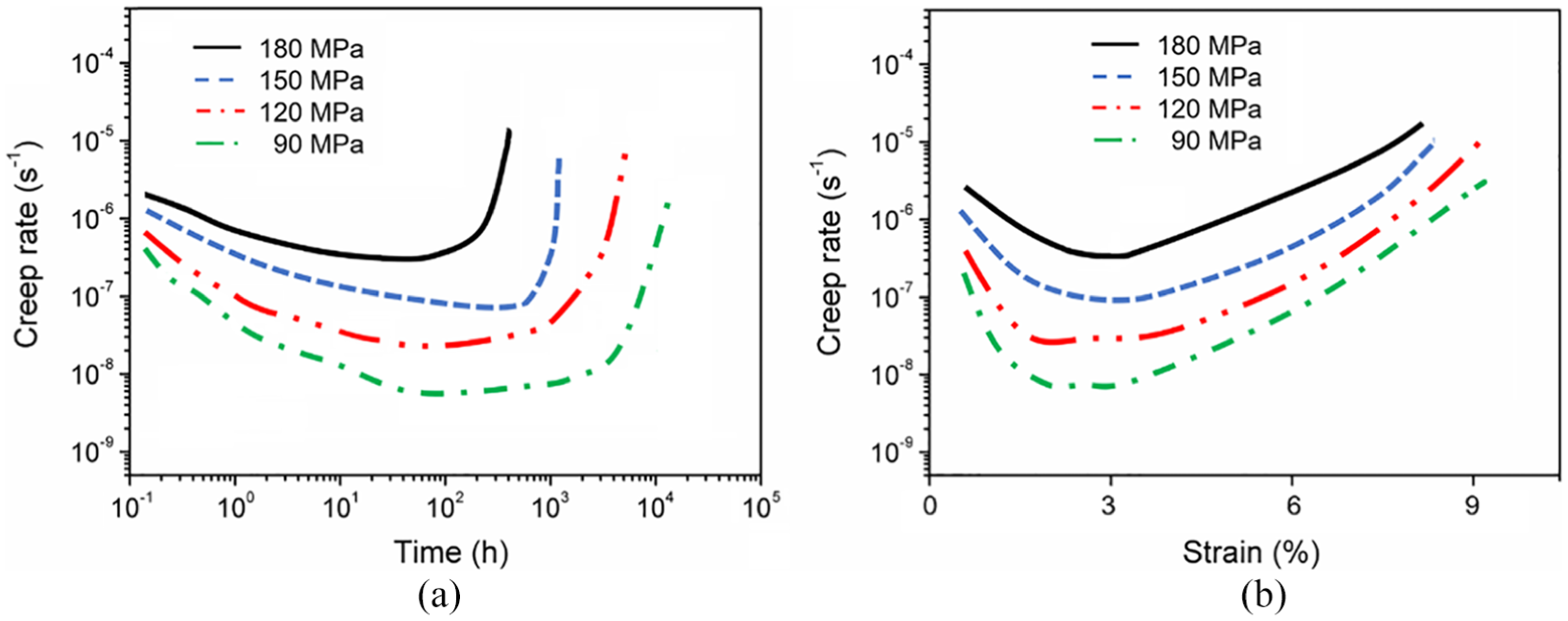
Creep rate versus time (a) and creep rate versus strain (b) curves at 550°C and four different stresses.
For steel materials strengthened by second-phase particles, the minimum creep rate versus applied stress plots can be divided into three regimes based on the values of the stress exponent n,15,16 which has been defined by the following formula 17

where
The stress dependence of the minimum creep rate is indicated in Figure 3. The plots show good linear fit with regression coefficients of 0.988–0.992 for the whole applied stress interval at the tested temperatures. It is clear that the stress exponent n decreased with the increase in the temperature. The n values in the stress data range remained constant at all the temperatures, implying that no decrease in the n value ascribed to creep strength breakdown occurred. Moreover, the n values exceeded 7 at all the temperatures in this study, indicating that the Orowan mechanism dominates the bypass of second-phase particles. These n values were fairly high at 500°C and 450°C for power-law creep, which were attributable to the existence of threshold stress.15,21,22

Minimum creep rate versus applied stress for 15CrMoG steel at different temperatures. The data are linearly fitted, and the n values denote the slopes of the fitting lines.
The metallographic structure of an original steel samples and a steel sample after creep test at 550°C for 20,000 h is shown in Figure 4 for comparison. Unspheroidized pearlite (dark regions) in which the carbide is lamellar can be clearly observed in Figure 4(a). In contrast, Figure 4(b) shows dispersion of the carbide at grain boundaries of pearlite and ferrite (light regions), indicating occurrence of pearlite spheroidization in the sample subjected to long-time creep.

Metallographic images of an original steel sample (a) and a steel sample after high-temperature creep testing for 20,000 h at 550°C (b).
Creep modeling and data analysis
Creep rupture strength is one of the most critical properties for heat-resistant steels in service. In this work, a set of CDM equations 23 was utilized to investigate the time-dependent creep rupture strength of 15CrMoG steel at several temperatures
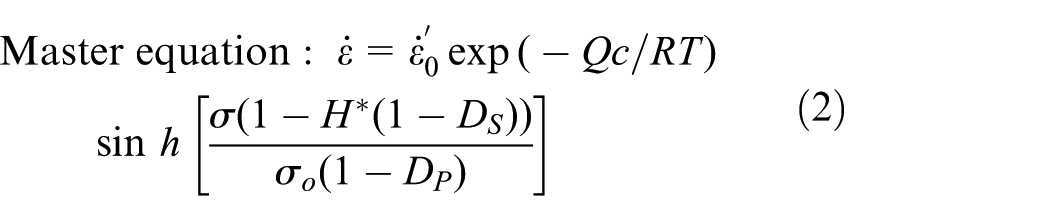



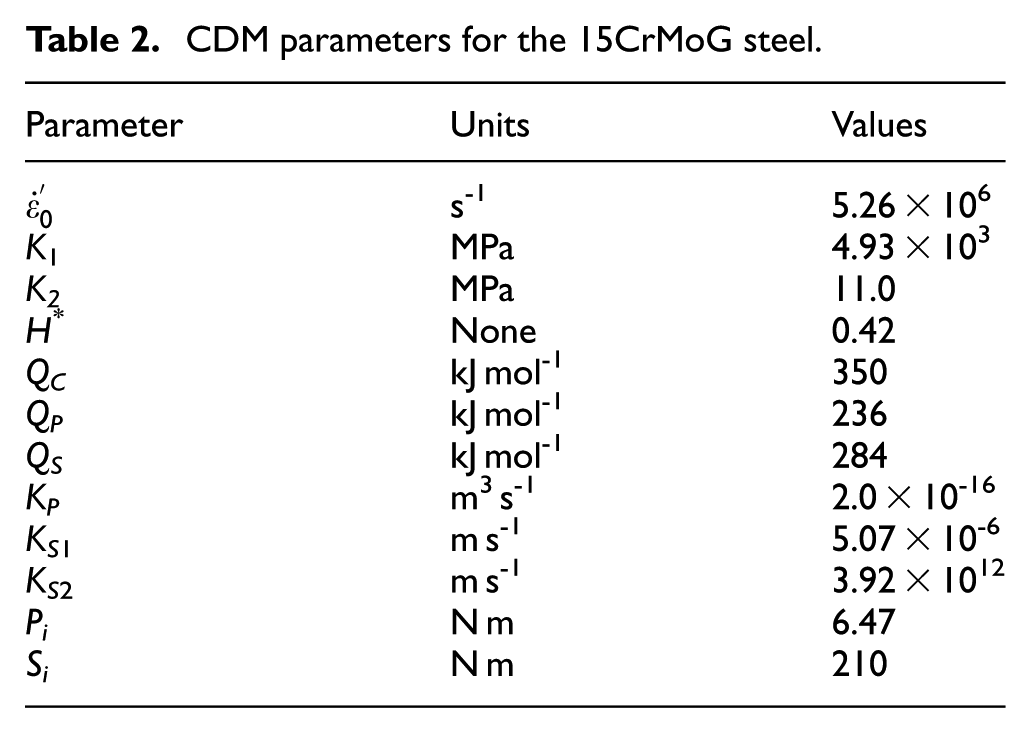
In the equations above,
CDM parameters for the 15CrMoG steel.
The experimental creep data and the CDM model prediction results of rupture stress versus creep time for the 15CrMoG steel at three selected temperatures over a period of 20,000 h are shown in Figure 5. According to the recorded data of the creep tests, the rupture stress at each temperature decreased with increasing creep time. At the initial stage of the creep tests (<50 h), the rupture stress diminished at a relatively low rate. Afterwards, the rupture stress showed a little more rapid decrease, at a rate keeping nearly constant in the data range. As the temperature rose, the rupture stress became lower, as expected. At the creep time of 20,000 h, the stress was 62, 37, and 28 MPa at the temperature of 500°C, 550°C, and 600°C, respectively. It was found that the CDM model prediction curves agreed well with the experimental data at all the temperatures, demonstrating the reliability of the CDM model for predicting the long-term creep behavior and creep life of 15CrMoG steel.
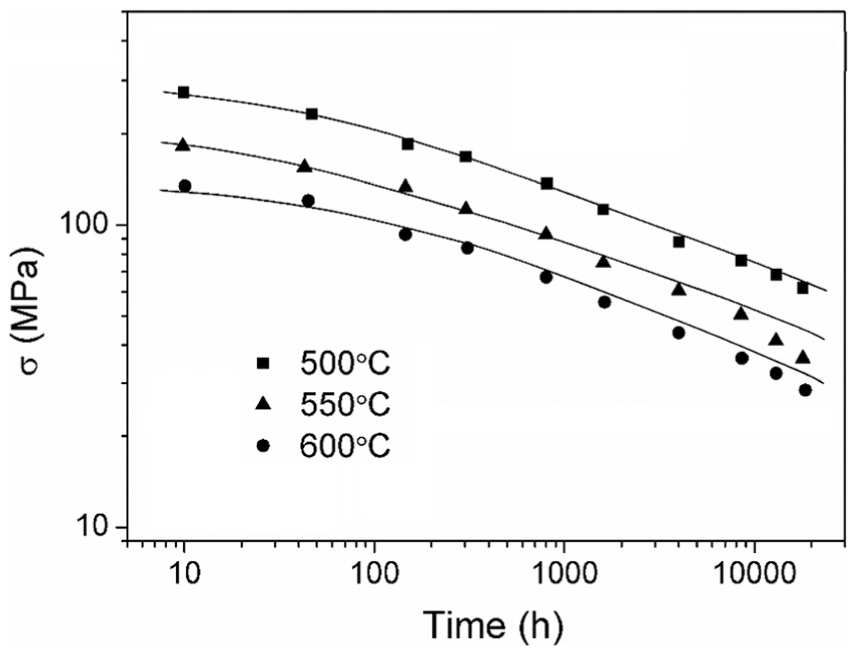
Long-time creep test results (scatters) as well as CDM predictions (curves) for 15CrMoG steel at selected temperatures.
The changes of 20,000-h creep rupture strength with the creep temperature are depicted in Figure 6. With the increase in the temperature from 400°C to 600°C, the 20,000-h creep rupture strength showed significant decrease from 133 to 31 MPa, indicating that temperature exerts great effects on the creep rupture life of the 15CrMoG steel. At high temperatures, typical of the operating conditions of power plant boilers, the creep properties of the steel become fairly sensitive to the temperature variation. Therefore, comprehensively understanding the creep properties of 15CrMoG steel plays a critical role in safe operation of boilers.

The 20,000-h creep rupture strength of 15CrMoG steel versus creep temperature.
Creep cavitation
Creep damage evolution can differ greatly in various materials. However, some common characteristics can be found, including the general order and appearance of damage stages from separate cavities to aligned cavity chains, cavity growth and coalescence into small microcracks, and finally into macroscopic cracks that become detectable in standard non-destructive inspections. 24 To investigate the creep cavitation, the samples subjected to 20,000 h of creep testing at 550°C were cut into pieces of 5 × 3.5 mm2 and were observed by SEM. A typical SEM image used for creep damage quantification is shown in Figure 7. Cavities with an average size of 3–4 μm are clearly seen in the sample. Further analyses indicate that the density of cavities ranged from several hundred to several thousand per square millimeters (Figure 8(a)). It is evident that the cavity number decreased with increasing distance from the sample edge. The average diameter of the cavities did not show significant changes with the increase in the distance from the sample edge (Figure 8(b)). The cavities had a narrow size distribution, and would grow and coalescence into larger cavities or cracks. These results demonstrate that a certain amount of cavities have formed inside the steel when the creep test lasts for a period of 20,000 h at a high temperature, which leads to reduced mechanical performance of the steel after long-term exposure to high temperature.
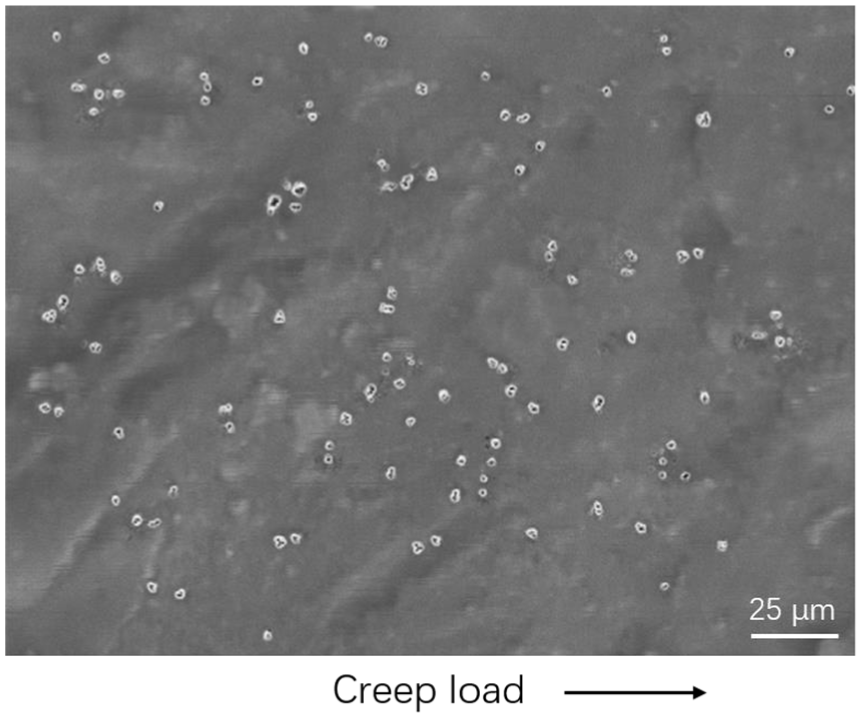
Typical SEM micrograph of a 15CrMoG steel sample after high-temperature creep testing for 20,000 h at 550°C, showing obvious creep cavitation. The arrow indicates the creep load direction.
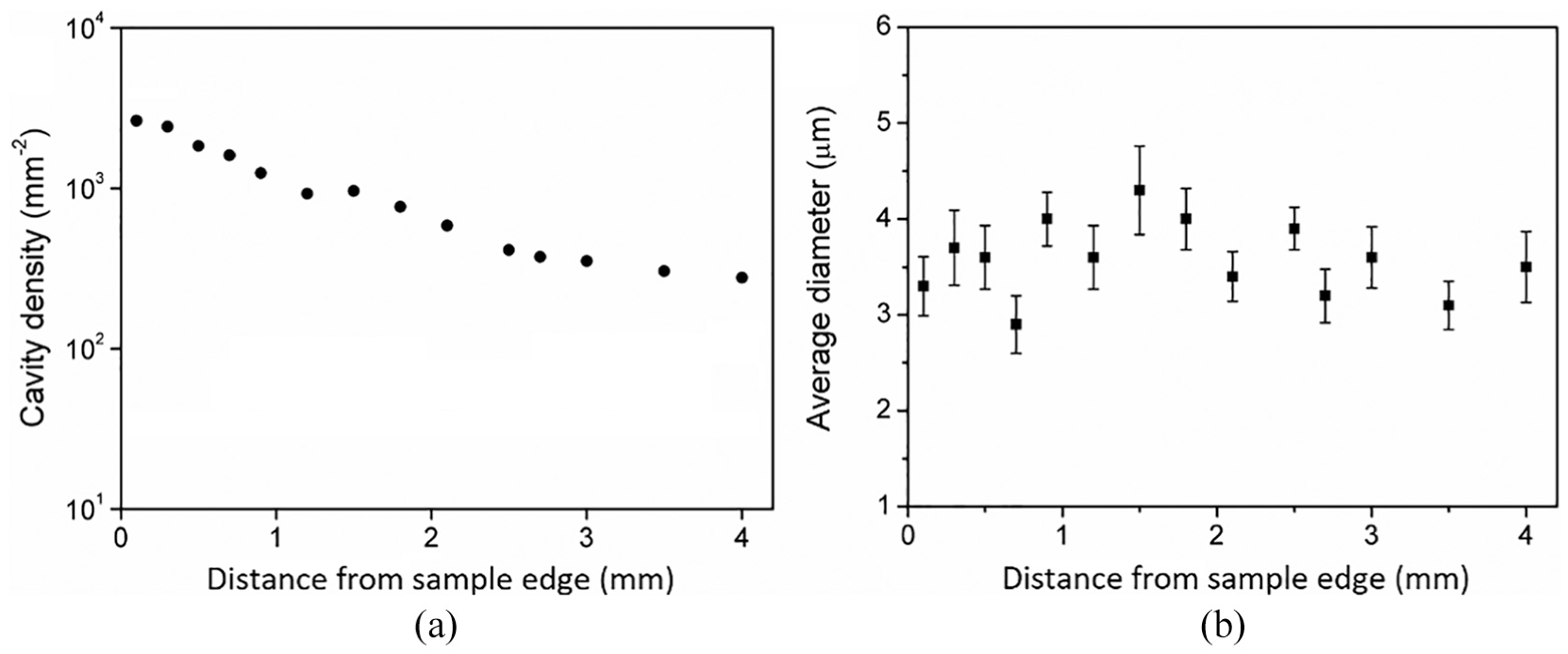
Cavity density (a) and average cavity diameter (b) in the 15CrMoG steel sample with the size of 5 × 3.5 mm2. The creep cavitation was quantified on areas of 241 × 186 μm2 along the creep direction. The data in plot (b) are presented as the average ± standard deviation.
Furthermore, the average diameter of the cavities at different time points during the creep process was determined based on SEM analysis, as depicted in Figure 9. On the initial stage, cavities are gradually formed, with relatively small sizes. As the creep tests proceeded, the size of the cavities increased from several hundred nanometers to several micrometers. These results agreed well with the established theory that cavities grow and coalescence into larger ones during a creep process. It is concluded from the above findings that prediction of high-temperature creep behavior at long times is indispensable for safety assurance of the 15CrMoG steel in service.
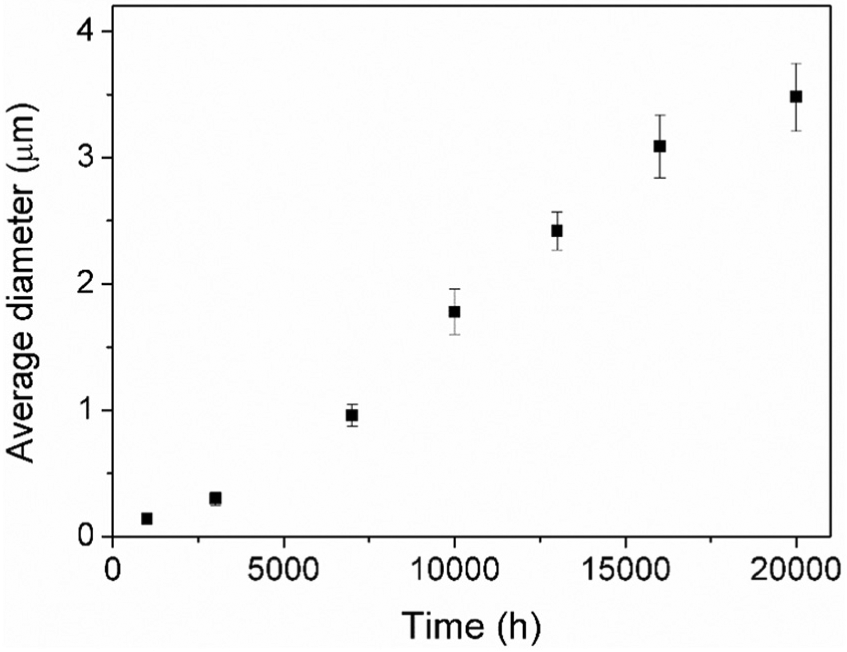
Changes of average cavity diameter in the 15CrMoG steel with creep time at 550°C. The data in plot (b) are presented as the average ± standard deviation.
Conclusion
In summary, the creep behavior and cavitation evolution of 15CrMoG steel during a long time period of up to 20,000 h at different temperatures have been investigated. Creep data have been obtained from the long-term creep tests. The creep curves reveal the characteristic creep behavior of 15CrMoG steel, and the Orowan mechanism was found to dominate the bypass of second-phase particles during creep. CDM modeling was used for fitting the creep rupture stress versus creep time data, the results of which demonstrate the reliability of the CDM modeling in predicting the creep behavior at long times. The changes of rupture stress at 20,000 h with the temperature indicate the great influences of temperature on the mechanical properties of 15CrMoG steel during high-temperature creep processes. The cavitation inside the 15CrMoG steel evolves with prolonged creep time. Gradual growth of the cavities gives rise to deteriorated mechanical properties and finally rupture of the steel at long times. This study provides solid creep data and useful methods for evaluation and prediction of the high-temperature creep behavior of 15CrMoG steel.
Footnotes
Handling Editor: James Baldwin
Declaration of conflicting interests
The author(s) declared no potential conflicts of interest with respect to the research, authorship, and/or publication of this article.
Funding
The author(s) disclosed receipt of the following financial support for the research, authorship, and/or publication of this article: This work was financially supported by the AQSIQ Science and Technology Project (grant no. 2017QK037), the Quality and Technology Supervision of Zhejiang Province (grant no. 20170251), the Taizhou Science and Technology Project (1017GY15), and the National Key Research and Development Program of China (grant no. 2017YFF02 10702).
