




Abstract
The characteristics of the residents’ travel in the information age have changed. The existing urban traffic demand forecast is mainly proceeded using the land property. Based on the main contents of urban residents’ travel survey and the characteristics of traditional residents’ travel demand, this article analyzed the dynamic changes of travel characteristics and the main influencing factors of travel formation of future residents. Combined with the travel influence factor weight of travel generation forecast stage established by the analytic hierarchy process, such as the land use, travel mode composition and travel choice, the location influence coefficient in the model of population, land use, and travel generation in city was modified to characterize the dynamic state of travel demand of residents in the phase of travel generation stage. Then a “dynamic” method for forecasting and analyzing traffic travel demand was put forward to apply to the prediction and evaluation of travel demand in Guilin. The results showed that it can reflect the dynamic characteristics of residents’ travel compared with the traditional travel demand prediction.
Introduction
With the arrival of the information age, the travel of urban residents began to be subtly influenced by the information of various traffic factors. The increasing flexibility of residents, the diversity of travel modes, and the access to transportation information have an impact on residents’ travel characteristics.1,2 The existing traditional urban traffic demand forecasting method, mainly according to the previous urban residents’ trip survey analysis, is based on its characteristics, the basis of the nature of land use on trip generation forecasting, and the urban traffic demand forecasting. This method is mainly limited to the investigation and trip survey mainly because daily cycle is long. The investigation and analysis results cannot reflect real-time status, and the land use in trip generation phase will only, as a single trip generation, influence factors, and not the actual representation of residents’ travel characteristics of the dynamic in the future. Therefore, in order to study the future of traditional urban traffic demand forecasting method, improvement is needed in the following fields: application and the city’s economic development, transportation development policy, residents travel characteristics, such as the need for complete infrastructure survey, analysis of future urban land use, transportation and travel choice of influence factors, and the relationship between trip generation forecasting. 3 Using big data to predict urban traffic demand and the carrying capacity of the urban traffic demand in the future. And analyze the rationality of urban road network to ensure that data accuracy of urban traffic demand forecasting method and interpretation of traffic state formation mechanism is reasonable.4,5 Shades et al. 6 analyzed the factors influencing the choice of travel destinations for self-driving travel and found that travel distance, number of travel groups, and mastery of travel information will affect the choice of travel destinations; Beckenl and Schiff 7 studied the relationship between travel distance and travel expenses and considered that travel distance has the highest impact on traffic travel.
Dynamic characteristics of urban residents’ travel needs
Relying on the project group “the passenger flow forecast of the cloud rail construction in Guilin city,” the residents of Guilin city were surveyed, which had a sample of 10,000, with 1% sampling rate. The survey included information on family and personal data related to urban residents and travel information during the survey period. Resident trip survey contains the main content of the basic features: (1) the family; (2) personal characteristics; (3) survey, a survey of the basic characteristics of travel; (4) the work plan. 8 According to the survey data of residents, while travelling to Guilin, the following characteristics of residents’ travel were obtained and analyzed: the beginning and the end of the trip point distribution, characteristic of the residents of travel, travel mode characteristics, residents’ travel time characteristic, frequency characteristic and the resident trip OD distribution, and so on. In addition, the information data are used to calculate the choice of travel mode for urban residents according to their needs. Different travel times and different travel purposes can also be calculated for different travel data. The choice of travel destinations and the travel modes of Guilin residents are shown in Figure 1 and Figure 2.

The purpose of residents’ travel.
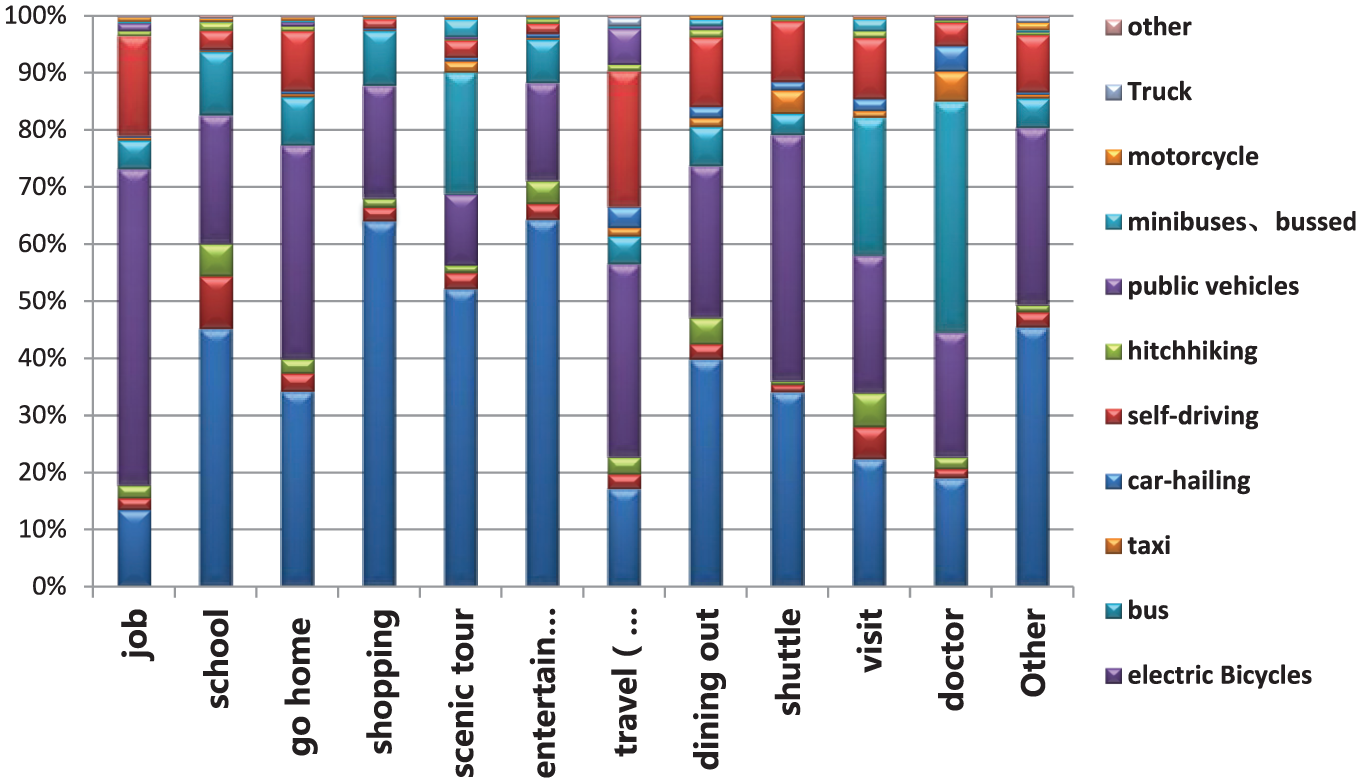
The choice of travel mode for different travel purposes.
Analysis on the change of the characteristics of the residents’ travel needs
According to the investigation of the proceeds of the travel demand for traditional residents’ travel characteristics, usually results mainly by day traffic survey as the foundation, it is concluded that residents travel demand characteristics in this article, referred to as “static” travel demand characteristics, generally can be summarized as three kinds of elements, respectively, travel frequency, travel, and transportation distribution. In the future, residents’“travel will change, and there will be ‘dynamic’ changes in the characteristics of traditional residents” travel. The main changes are as follows:
Travel frequency
The increase and decrease of the number of residents in this area mainly refer to the choice of residents in certain situations (such as weather change, job adjustment, temporary outings, etc.). Compared with the traditional means of travel investigation, it is impossible to obtain the characteristics of such residents’ travel accurately. In the future, the survey of the travel times can be supplemented and analyzed.
2. Trip distribution
Mainly embodied in the location, traditional travel purpose of trip distribution in terms of land use is given priority, as the future is not just attracted by the land use residents’ trip distribution. Faster development of transportation and regional advantages of construction of large transportation facilities will attract people’s choice of travel, and so, building of urban district, including land use and convenient transportation, is required. It also suggests that the municipal district of trip distribution to regional land use status quo and future transportation structure and comprehensive influence the distribution of residents’ travel convenience.
3. Travel mode distribution
Diversity: The traditional way to travel is still occupied the main body, but with the emerging cause and application of the means of transportation, such as shared cycling, net about car, brought more convenient travel for urban transportation, residents travel mode. The choice of travel modes of residents will undoubtedly change, and the distribution of residents’ travel modes will become more diverse.
Analysis on the factors influencing residents’ travel
Based on the tradition and the “dynamic” under the premise of resident travel demand characteristics analysis, we put forward three kinds of main factors affecting city dweller, and provide trip generation model of the coefficient of correction factors influencing indicators.
Land impact analysis
Based on the traditional land use urban traffic demand forecasting, mainly single city land utilization, different nature of the land represents the residents’ attraction and travel purpose (includes 13 kinds of purposes) for research and analysis. Based on traffic demand forecast related “big data” depth development and mining use, we can use the status quo and the future land use planning in data applied to the “four stages” method of traffic generation in order to predict in different traffic plot.
2. Analysis of the impact of urban travel mode
Different urban residents’ travel have different degree of difference. In addition to the characteristics of the residents’ own travel choice, different partition of the city development and the different construction of the transportation have influence on residents’ travel. In the era of “big data,” emergence of new type of transportation is the way not only includes the construction of urban subway and “sharing bike,” which were previously did not contact way to travel. The traditional way of traffic composition really has a certain pattern of shocks. It is necessary to analyze the impact of travel mode on traffic generation from the analysis of urban traffic pattern and construction use.
3. Impact analysis of residents’ travel choices
Existing research mainly analyzes the residents’ travel choice from microscopic influence factors. The analysis of the residents’ travel choice behavior of the characterization of the urban transportation demand provides theoretical basis for the traffic demand forecast. 7 Study says residents travel characteristics, embodied in the traveler characteristics, and all the way to travel consumption, cost, on-time, safety, comfort and convenience, and the actual choice as the main factors affecting people’s subjective random characteristics. The direct influence factors can be mainly divided into two aspects: travel and traveler.
Travel characteristics (objective): The characteristics of travel, such as travel time, travel expenses, travel distance, and other characteristics, are generally available to analyze the travel characteristics of data acquisition. There will be different travel purpose with different land use in the future, to a certain extent, which reflects the impact of land use for travel purpose.
Traveler characteristics (subjective): As the main body of the trip, the traveler’s characteristics have a predictable impact on the travel, and different residents have different trips. For example, individual citizens having a private car or other motor vehicle transportation also includes the basic characteristics of the individual, the family attributes (family composition, income, etc.), and their living conditions. The residents consider dynamic travel purpose needs and preferences, such as the daily change is the embodiment of the dynamic traffic demand. 9
Study on the demand analysis method of “dynamic” traffic travel of residents
This article embarks from the residents in the study of influence factor analysis, combined with classic four-stage method of demand forecasting, in trip generation forecasting phase, revised the influence coefficient characterization of residents “dynamic” transportation demand, making demand forecasting process and the results more in line with the actual demand, and improved the efficiency of urban planning management.
The traditional traffic travel prediction method is usually based on the urban land use nature as a function, which represents the amount of daily traffic generated and attracted by different urban land in a certain period of time. The traditional model mainly considers the influence of land properties on traffic occurrence and attraction. This paper will introduce the urban residents’ travel mode and the residents’ travel choice behavior as auxiliary influence factors in the traffic travel generation forecasting stage, and model the traffic travel generation with the land nature. The model not only predicts the scale of travel from the objective factors of land use, but also analyzes the relationship between travel generation and the travel factors, and increases the travel choice behavior of residents as the subject of behavior. This subjective and important influencing factor The travel generation model is established from both the subjective and objective aspects. 10
Generate the demand forecasting of travel for land use, and have about “location potential energy” 11 travel generates demand relation model. Its main idea is based on a specific area of the location, use inside the village land for each type and size and strength, to determine the traffic of trip generation. Drawing lessons from the idea, this article summarizes the “four stages” method, which is the main influencing factor for each stage of land use, transport, and choosing three kinds of transportation, the artificial influence analysis, applied to traffic trip generation phase, is put forward based on the land use of “regional influence coefficient,” using the method of analytic hierarchy process (AHP) 11 to influence coefficient “level” of the village, in the hope that it can be more accurate, scientific, and reasonable actual trip generation forecasting.
Existing traffic demand forecasting is mostly for land use function, for trip generation forecasting research area of traffic plot, the traffic inside the village of various land properties, utilization, and activity factors such as size and traffic generation closely relates in together. For the division of traffic in the city, geographical location, area of land use status of community residents, transportation structure and travel choice factors such as. 9 It is necessary to correlate coefficient modification in land use of traffic travel demand model for the increase of urban travel demand forecasting precision. The main models are simplified as follows:
Travel product model
According to the urban economic development trend of the study area, combined with the survey data of residents’ travel surveys and the predicted number of urban residents’ population predictions, the number of travels per capita of urban residents in the planned year is predicted, and the total number of trips generated by the urban residents in the planned year is obtained.12,13

where A represents planning annual urban overall travel production, P represents the total number of urban population in planning years,
2. Model and coefficient correction of travel production (a) Model of residents’ travel production
According to the relationship model between land use and travel production volume

where A represents the total amount of urban travel, αi represents traffic plot coefficient, Ri represents the area of residential land within the traffic area, n represents the number of traffic plots.
Here, we will take the status quo of traffic plot of residential land area and the amount of travel to extrapolate coefficient of traffic plot. Then by applying AHP, by the degree of important relationship between trip generation influence factors, we refer to the expert opinions in the AHP to relate to obtain the coefficient of traffic area location influence coefficient.
(b) Apply the correction factor to the hierarchical analysis
The specific application of AHP is mainly as follows. The evaluation indicators are established according to the selection principle of indicators such as “scientific, comparable, practical, qualitative and quantitative”. Then, using the expert scoring method, the relative importance of the index is calibrated using the 9-level 14 scale. Finally, the analytic hierarchy method is used to construct the judgment matrix to calculate the weight value of each index. The specific steps of AHP are as follows:
Hierarchical model: According to the research objectives and research results, the correlation between each evaluation index is determined, and a hierarchical structure with target layer and factor layer is established.15,16
Constructive judgment matrix: According to the scale of 1–9 scale shown in Table 1, the two comparisons are made, which constitute the judgment matrix table. The value in the matrix table is a reciprocal matrix.17,18
(1)
Determination of weight values: First, the eigenvector of the maximum characteristic root and the characteristic root of the above judgment matrix are obtained. Then the maximum eigenvector is normalized and the weight value is obtained.19,20
Determination of weight values: The consistency test was performed by measuring the deviation consistency of the matrix.
(1)
Table of judgment matrix scales.

RI table of values.

Once the evaluation index value was obtained by the AHP, the expert opinion in the reference method corrected the influence coefficient of the location of the traffic area and completed the prediction of the residents’ travel products.21,22 The first stage of “four stages” method is the first step of trip generation forecast, which is the beginning of the forecast. This revision also affects the subsequent to predict the accuracy of the work. This article adopts the combination of qualitative and quantitative methods of traditional AHP to predict the influence factors of reasonable evaluation. 23
Travel attraction model
According to the relationship between land use intensity and travel attraction model

In the formula, G represents the total amount of urban travel attraction; Ai represents I transport community travel attraction (person/day); αi represents the land use coefficient of the i transportation community; N represents the number of traffic zones; Ci, Ri, Mi, Wi, Ti, Ui, Si, Di, Gi, Ei as i internal traffic village public facilities, residential, industrial, warehousing, international transportation, municipal facilities, square, parking lot, special land, green land and waters, and other land area (m2); Ri within transportation district public facilities, residential, industrial, storage and external traffic, municipal facilities, square, parking lot, special land, green land and waters, and the amount of land for him to travel to attract weight value, corresponding to the Ci, Ri, Mi, Wi, Ti, Ui, Si, Di, Gi, Ei.
Forecast analysis of traffic demand of residents in Guilin city
Based on the research project “Guilin cloud rail construction prediction,” research subject for city residents, the main research content is, based on the survey of the residents in Guilin and the above proposed residents’“dynamic” traffic travel demand analysis method, to analyze residents’“dynamic” transportation demand forecasting in planning year, and compare with forecast results.
Forecast of “dynamic” traffic travel generation in planning year
The traditional forecast of residents’ travel products
According to the survey data of urban residents of Guilin, the average daily trips of the residents of Guilin in 2012 and 2018 were 2.21 times and 2.38 times, respectively. By “the urban comprehensive traffic plan of Guilin city” and connecting with the data of other similar urban population travel in China, the average number of trips of the residents of Guilin scheme area in 2022 will be 2.5 times, respectively. According to formula (1) and the current situation of residents’ survey and travel rate analogy, the annual number of residents’ trips in the city of Guilin was predicted to be 3.425 million person-days in 2022.
The prediction of residents’ travel production and the correction of “location influence coefficient.”
The amount of travel in the traffic area
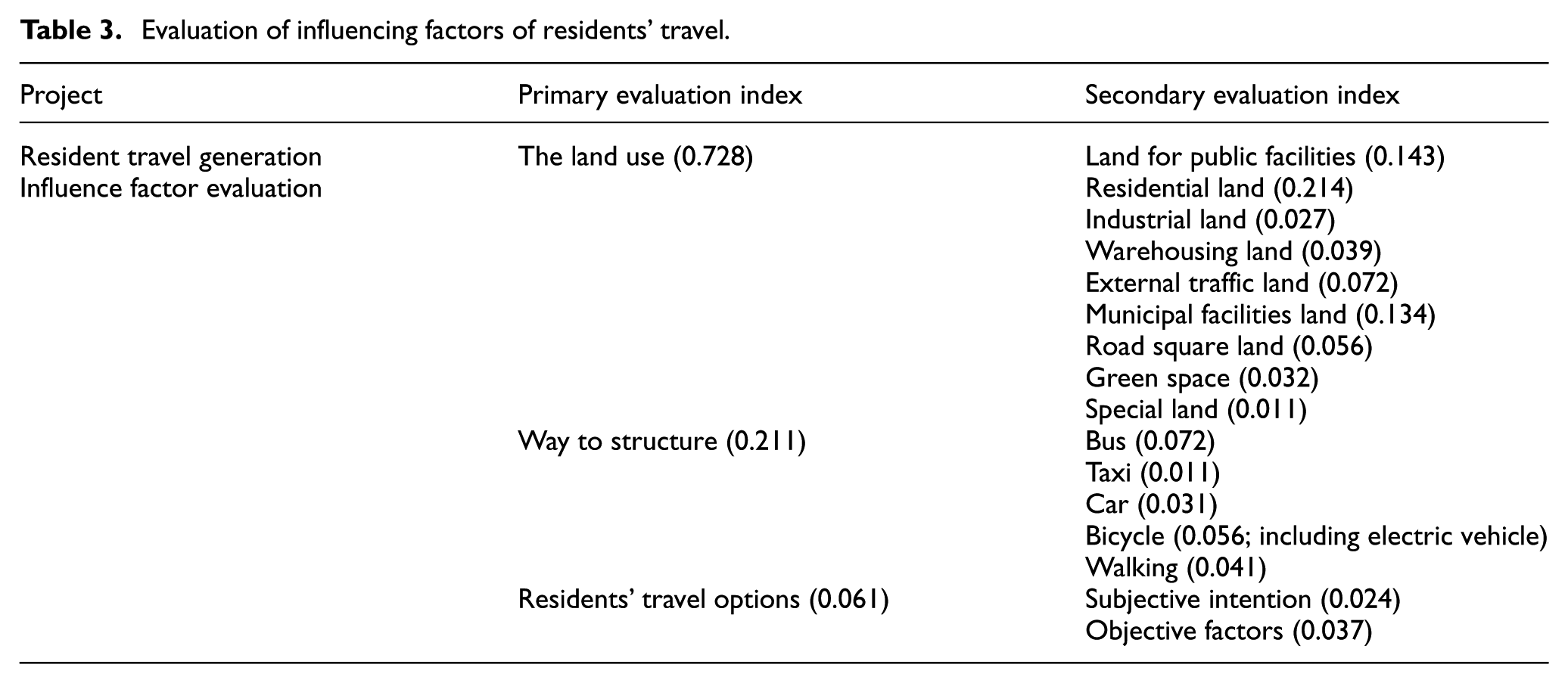
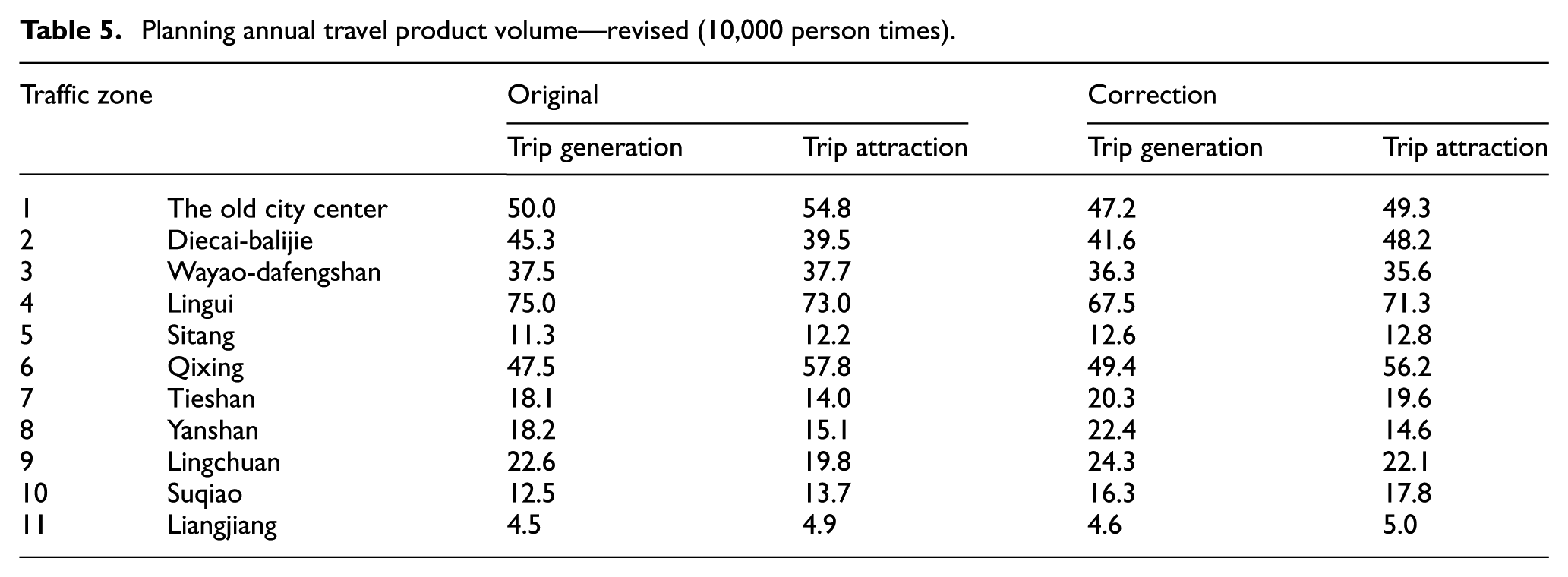
According to the current situation of residents’ travel volume and the area of residential land in each district, the current travel coefficient of the traffic community is reversed by formula 2. The resulting coefficients are then corrected based on expert opinion. The factors influencing the evaluation index and residential location influence coefficient are shown in Table 3 and Figure 3. Planning in the urban traffic district of the existing traffic “location influence coefficient” plot coefficient, the new residential location influence coefficient is compared with the old district. From the aspects of land use, transportation accessibility influence analysis to estimate the location of the analogy results are shown in Figure 4. According to the model calculation formula (2), as shown in Figure 4, and the residential land area of the transportation community in the planning year that the amount of transportation is produced in the traffic area, as shown in Table 5.
Evaluation of influencing factors of residents’ travel.
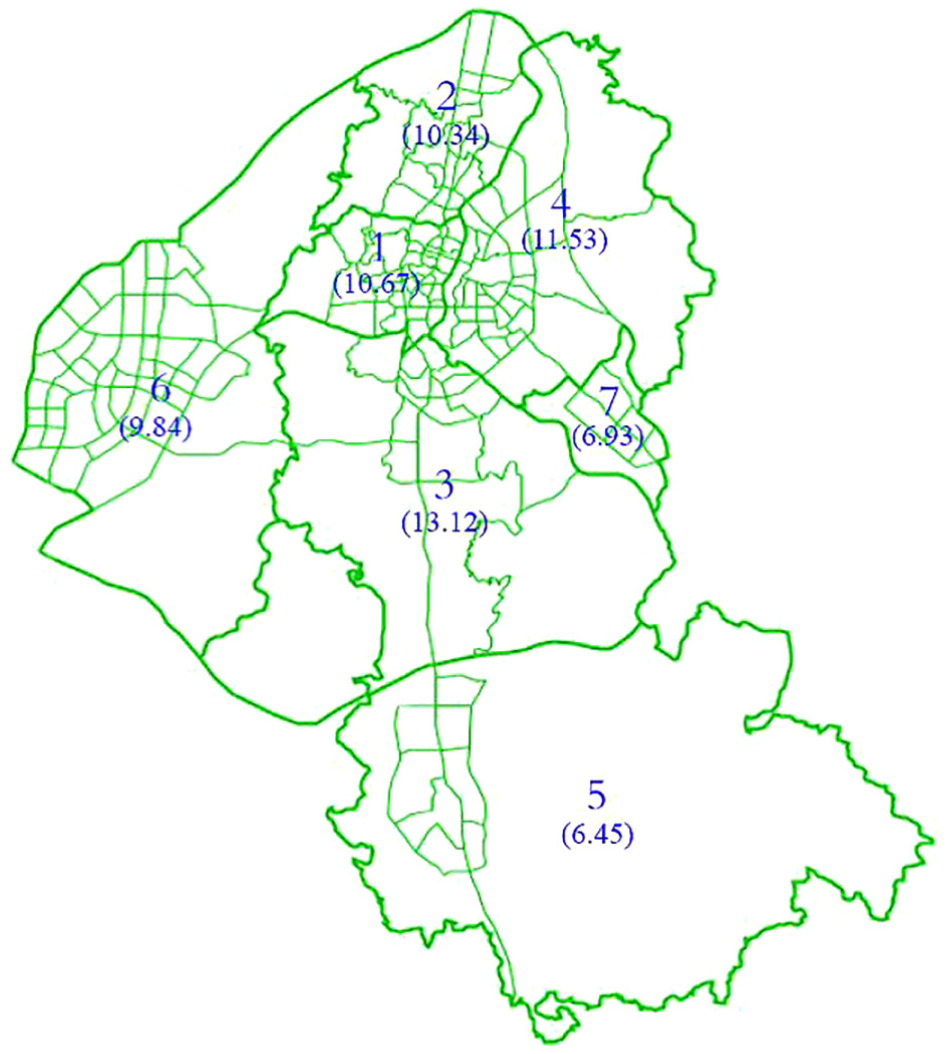
The influence factor of the location of traffic area in Guilin (revised).
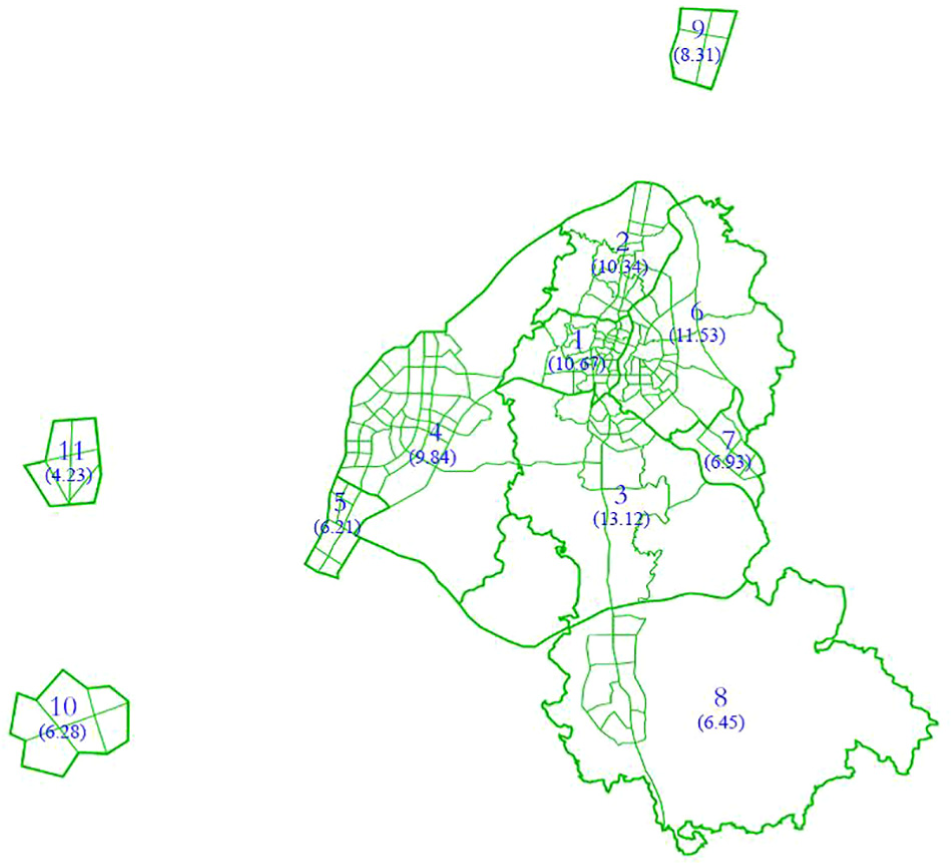
The influence coefficient of the district location in Guilin planning year.
Resident travel attraction forecast
As information land use planning in cities is most difficult to collect, this article will take the amount of land use to attract traffic area, referred traffic engineering survey of the project group of southeast university without nature of land use of traffic attraction weight value. Combined with the present survey results of residents’ travel, we compared and estimated the traffic attraction weights of all kinds of urban land in Guilin (Table 4).
The area of residential land in the planning year of Guilin.

According to formula (3), we can calculate the travel attraction amount of each traffic area in the planning year before and after the correction of Guilin city, as shown in Table 5.
Planning annual travel product volume—revised (10,000 person times).
Comparison of traditional and “dynamic” traffic generation forecasts
According to Table 5, discharge of traffic area 1, 2, 4 and attract amount has increased, the rest of the every part of community has reduced. The change is mainly due to community correction “location influence coefficient,” which contains in addition to plot the future land use and the development of the transportation way and the influence of the residents’ travel change in the future, are affecting the trip generation forecasting. As the status quo and future core plot 1 and 4, the living area of future land use development and all kinds of convenient transportation such as discharge of there will be more attractive, while village 2 because foreign hub construction and commercial land use development have more trip generation and attraction. Because of the different land use properties in industrial areas and higher education districts, the degree of development of various modes of transportation in the community is different, and the residents’ willingness to travel is also different. Compared with the residential areas 1, 2, 4, the traffic generation and the amount of attraction will inevitably be smaller. From the angle of the predicting factors, it is suggested that the future of residents under the big data, is affected by many factors of “dynamic” transportation.
Conclusion
This study’s predicted results, compared with traditional forecast results, show that the development in land use, transportation, and travel choice, under the influence of certain dynamic changes have taken place in traffic generation and provide a theoretical basis for the urban traffic management and prediction methods. Application of the urban dynamic traffic travel demand forecasting method, the city should have a complete data collection and analysis ability about urban transportation development balanced and common residents travel characteristics, which makes prediction results more meaningful. It can also be used for other urban dynamic traffic demand forecasting models in the future.
Footnotes
Handling Editor: James Baldwin
Declaration of conflicting interests
The author(s) declared no potential conflicts of interest with respect to the research, authorship, and/or publication of this article.
Funding
The author(s) disclosed receipt of the following financial support for the research, authorship, and/or publication of this article: This research was funded by National Natural Science Foundation of China (Grant 71861006), National Natural Science Foundation of China (Grant 51608268), and Guangxi Natural Science Foundation (Grant 2014GXNSFBA118255].
