




Abstract
Rubber sealing ring is one of the most widely used seals. It is always stored for a period of time before put into use, especially in aeronautic and aerospace applications. It is necessary to evaluate the storage lifetime of rubber sealing rings. However, due to the long storage lifetime of rubber sealing rings, two issues need to be handled, including model uncertainty and lack of storage lifetime data. A Bayesian model averaging based storage lifetime assessment method for rubber sealing rings is proposed in this article. The Gamma distribution model and Weibull distribution model are selected as the candidate models and combined based on Bayesian model averaging method. The Bayesian model averaging method is applied to handle the model uncertainty. Considering the lack of storage lifetime data, the degradation data are utilized to give the priors of model probability and distribution parameters based on the similarity principle. The results indicate that the proposed method has smaller minus log-likelihood value and is better than the other discussed method, considering both goodness of fit and complexity.
Keywords
Introduction
Seal is one of the most important components for hydraulic system of aircraft, fuel system of aircraft, and and so on.1,2 Furthermore, the seals are widely used in centrifugal compressors, pumps, and blowers. 3 Generally, the seals are used to prevent leakage of sealed liquid. The leakage caused by failure of seal is very harmful and dangerous. 4 Precisely, evaluating reliability and lifetime of seals is essential for improving the reliability of the systems, even the aircraft.
Several methods have been proposed to evaluate reliability and lifetime of seals. Zhou and Gu 5 applied artificial neural networks in lifetime evaluation of mechanical seals. Leakage rate and temperature of sealing zone are selected as performance indicators. The accelerated degradation tests (ADTs) have been carried out to obtain degradation data, which were processed based on wear equation. The artificial neural networks are trained by the processed degradation data and used to predict the residual lifetime of the mechanical seal. The simulation results show that the artificial neural networks can be used to evaluate the lifetime of mechanical seals precisely under enough experimental data conditions. Sun et al. 6 proposed a lifetime evaluation method for mechanical seals based on the wear failure mechanism and fractal geometry theory. The topography parameters of sealing surface, including waviness and roughness, are used to indicate the degradation of mechanical seals. The degradation data of the mechanical seals are obtained experimentally. The relationship between the topography parameters and the degradation of mechanical seals has been obtained. The method is validated by actual mechanical seal degradation data. Zhou et al. 7 proposed a fatigue lifetime calculation method for lip seal based on stress analysis. The method is focus on the seal failure caused by material fatigue. The rain-flow counting method is used to evaluate the fatigue lifetime of the seals. Based on the proposed method, the effects of the seal–shaft interference on the seal lifetime have been analyzed. Liu et al. 8 proposed a vibration signal processing–based performance degradation analysis method for mechanical seals. The root mean square of vibration signal of mechanical seal is considered as the indicator of the mechanical seal performance. A wavelet filter is used to reduce noise in the vibration signal caused by cavitation. Simulation results show that the root mean square of vibration signal increases with the increasing film thickness. All above researches are focusing on evaluation and prediction of the seal service life. However, besides evaluation and prediction of service life, it is also important to evaluate the storage life of the seal.
For example, the rubber sealing ring is one of the most widely used kind of seals, as the main sealing elements and auxiliary sealing elements.9–12 Generally, the seals are always stored for a period of time, before put into use, especially in aeronautic and aerospace engineering. 13 The performance of the rubber sealing rings continuously degenerates with the aging of rubber material during storage in air. 14 Similar methods have been proposed in previous works15–18 to evaluate the storage life of rubber sealing rings. The ADTs were carried out to obtain the degradation data. The permanent compression ratio is used to indicate the degradation of the rubber sealing rings. The fitting curve function of the degradation indicator is used to extrapolate the rubber sealing ring storage lifetime. Guo and colleagues19,20 has studied the degradation process of rotary lip seal during storage. Based on the experimental results, it can be seen that the root mean square roughness becomes smaller during the rubber sealing rings storage and aging in oil. Furthermore, the sealing performance degrades with the decrease of the roughness, resulting in the rubber sealing rings performance degrading during storage. The storage temperature is an important factor effecting the degradation rate. The relationship between degradation rate and storage temperature can be described by the Arrhenius equation. The similar observations are also presented in Brown and Soulagnet. 21 Based on above researches, it can be seen that the rubber sealing rings are always kept in air and are not applied any load during storage, so the rubber aging is the only degradation factor. Hence, the storage life only depends on the storage temperature, normally the ambient temperature. Generally, the storage temperature is low, so the storage lifetime is very long.
Due to the long storage lifetime of the rubber sealing rings, it is difficult to obtain enough storage lifetime data and evaluate the storage lifetime of the seal rings precisely. Generally, the storage degradation data of the rings are more easily to be obtained compared to the lifetime data. In most cases, the ADTs are applied to obtain degradation data. 22 Due to the limited understanding of the degradation mechanism, limited understanding of failure mechanism, and the lack of lifetime data, the storage lifetime distribution model of rubber sealing rings is difficult to be determined and the distribution model uncertainty issues are inevitable. However, it is difficult to find related researches on storage lifetime assessment for rubber sealing rings considering the uncertainty issue.
Generally, Akaike information criterion (AIC) 23 and Bayesian information criterion (BIC)24,25 can be used to select the best fitting model. However, the model selecting criterions cannot be used to handle the model uncertainty, especially for the small lifetime data conditions. 26 Generally, the model uncertainty can be handled by evidence theory,27,28 adjustment factor method, 29 and model averaging method.30,31 The model averaging method is always combined with Bayesian inference method and extended into the Bayesian model averaging (BMA) method in the reliability engineering.30,31 In order to access the lifetime evaluation with multi-distribution fusion, the BMA method presents the information by random variables and fuses the predicted results based on the candidate distribution possibilities.32–35 Liu et al. 36 have used BMA method to combine the candidate models, focusing on degradation process. The ability of the proposed method on the s-credibility degradation data analysis is focused. The authors argued that BMA method can handle the model uncertainty issue well. Additional researches on adapting BMA method to handle the model uncertainty can be found in Droguett and Mosleh 37 and Kabir et al. 38
Considering the handling abilities of model uncertainty and the data fusion, the BMA method is used in this article. There are some issues need to be handled in this kind of applications. One of the most important issues is how to obtain the parameter priors based on the accelerated degradation data. The main contributions of this article are as follows:
Gamma distribution model and Weibull distribution model are selected as the candidate distribution models for rubber sealing rings storage lifetime and fused based on the BMA method.
Considering the lack of lifetime data, the priors of storage life distribution parameters are obtained from the degradation data based on the similarity principle, and the distribution parameters are evaluated by fully Bayesian method.
This article is organized as follows. Section “Preliminaries” preprocesses the ADT degradation data based on Arrhenius model and presents the basic knowledge of BMA method and the basic assumption. In section “The distribution model set,” the candidate distribution models are selected and the degradation data are processed. In section “The BMA-based lifetime assessment method,” the priors of distribution parameters and model probability are obtained based on the similarity principle. The storage lifetime of rubber sealing ring is evaluated based on the proposed method and the effectiveness is validated. Section “Conclusion” concludes the article.
Preliminaries
Preprocessing of the ADT degradation data
As shown in Figure 1, a typical lip seal consists of a metal frame, a spring ring, and a sealing lip. The metal frame is used to support the rubber ring, the spring ring is used to provide the pre-tightening force, and the main sealing lip is used to seal the fluid based on the reverse pumping principle. 39 The reverse pumping effect is based on the rough sealing lip surface and the asymmetric profile of sealing lip. 40 The reverse pumping rate is used to indicate the sealing performance. The roughness of sealing lip and the reverse pumping rate decrease during storage. 41 Generally, the reverse pumping rate decreases with the decrease of the sealing lip surface roughness. The reverse pumping rate is small enough the seal is leak. Hence, the reverse pumping rate can be used to indicate the performance of rotary lip seal during storage.

Schematic of typical lip seal.
Due to the long storage lifetime of rotary lip seals, the ADT is carried out to obtain enough degradation data. Generally, because the seal rubber degradation is sensitive to temperature, temperature is selected as the accelerating factor. Normally, the relationship between the aging rate and accelerating factor can be described by failure physical models, such as Arrhenius model, 42 Eying model. 43 Furthermore, this relationship can also be described by empirical models, such as inverse power law model,44,45 hazard regression model. 46 The Arrhenius equation is a formula for the temperature dependence of reaction rates. Arrhenius equation gives the dependence of the rate constant of a chemical reaction on the absolute temperature. Consistently with the data source, 19 the relationship between the rubber aging rate and the storage temperature is described by Arrhenius model, as

where k is the rubber aging rate, A is a constant, R is gas constant, T is storage temperature, and E is the activation energy of the seal rubber.
The relationship between degradation rate and temperature is given by

where k1 is the degradation rate under temperature T1 and k2 is the degradation rate under temperature T2.
Hence, the relationship between the storage lifetime and the storage temperature is given by

where t2 is the storage lifetime under temperature T2 and t1 is the storage life under temperature T1.
The ADT degradation data presented in Guo et al. 19 is used in this work. In order to obtain the relationship between storage temperature and degradation rate, the rotary lip seals were kept in storage under different temperatures until reach the specified state. The degradation time under different storage temperatures is displayed in Table 1.
The degradation times under different storage temperatures.

In Guo et al., 19 three groups of degradation tests have been carried out on the rotary lip seals. The storage temperatures are 288, 298, and 308 K, respectively. In the presented work, the degradation test under 288 K storage temperature is considered as the degradation test under normal stress, and the degradation tests under 298 and 308 K storage temperatures are considered as the ADTs.
The degradation dataset is shown in Figure 2, where Q(t) is the reverse pumping rate after storage time t and Q0 is the initial reverse pumping rate. Furthermore, the failure threshold is set as 75% of the initial reverse pumping rate. It should be noted that this threshold is not the reverse pumping rate which means the seal is failure. It is the reverse pumping rate which means the reliability of the aging seal cannot meet the demand of the systems. It can be observed that the storage lifetimes of the rubber sealing rings under 308, 298, and 288 K storage temperatures are given by

Based on the relationship between the storage lifetime and storage temperature described in equation (3), the equivalent storage lifetimes under normal storage temperature are given by


The reverse pumping rates under different storage temperatures.
The degradation indicator q(t) is defined based on the reverse pumping rates, as

Hence, the degradations of the rotary lip seals during storage are shown in Figure 3.

The degradations of the rotary lip seals under different storage temperatures.
Basic assumption and BMA-based method
Based on the definition of failure rate in reliability engineering, it can be assumed that the failure rate curve of the tested components and the performance degradation curve are cognate curves, as equation (7). Hence, the priors of lifetime distribution shape parameters can be provided by degradation data

Remark
This assumption is intuitive and reasonable based on the definition of the failure rate. Some similar assumptions can be easily found in related researches.47,48 The same assumption can be found in Peng. 48 Weibull distribution model is selected as the lifetime distribution model for the milling head. Considering the lack of lifetime data, the priors of storage life distribution parameters are obtained from the degradation data based on the similarity principle, and the distribution parameters are inferred by fully Bayesian method. The proposed method is demonstrated more precise and flexible for practical use than others.
Based on the above assumption, the main method of the proposed BMA-based storage life assessment method for rotary lip seals is shown in Figure 4. Because it is assumed that the failure rate curves are related to performance degradation curves, the distribution parameters are related to the degradation data. So, the priors of the distribution parameters and the model probability can be obtained from the degradation data based on the similarity principle. Using the proposed method to evaluate the storage lifetime of rubber sealing ring, four steps need to be performed. First, the candidate models are selected based on the related engineering experience, lifetime data, and degradation data. Second, the priors of distribution parameters and model prior probability are obtained from the degradation data based on the similarity principle. Third, the distribution parameters and model probability are inferred by fully Bayesian inference method, based on the above priors and the storage lifetime data. Finally, the storage lifetime is predicted by each candidate model and fused based on the BMA method.

The proposed BMA-based storage life assessment method for rotary lip seals.
The distribution model set
Due to the limited understanding of the rubber sealing rings failure mechanisms, it is difficult to determine the storage lifetime distribution model based on the failure mechanism. Therefore, the BMA method is applied to handle the model uncertainty issue, in which the predicted results from each possible distribution model are fused based on the model probabilities. Using the BMA method to evaluate the storage life of rubber sealing ring, the candidate models need to be determined first. There are several frequently used lifetime distribution models for mechanical components, such as Gaussian distribution, Gamma distribution, exponential distribution, Rayleigh distribution, Weibull distribution, general Gamma distribution, and log-normal distribution. When the shape parameter is one, the Weibull distribution becomes to be exponential distribution. When the shape parameter is two, the Weibull distribution becomes to be Rayleigh distribution. The lifetime must be positive, so the Gaussian distribution is not suitable. Considering the parameter size and the parameters meaning, scale controlling, and shape controlling, general Gamma distribution and log-normal distribution are also not suitable for this application. Hence, the Gamma distribution and Weibull distribution are selected as the candidate storage lifetime distribution models of rubber sealing rings.
Gamma distribution
The cumulative density function (CDF) of Gamma distribution model is given by

where
The probability density function (PDF) of Gamma distribution model is given by

where f1 is PDF of Gamma distribution model.
The failure rate function of Gamma distribution model is given by

where h1 is the failure rate function of Gamma distribution model.
Based on the assumption, the following relationship is satisfied

where q1 is approaching curve function.
The fitting results for the tested samples are given by equations (12)–(14), and shown in Figure 5


where q1, i is the curve fitting function of ith tested sample; γqi and kqi are the curve fitting parameters based on nonlinear least squares method.

Fitting results of q1 (a) under 288 K, (b) under 298 K, and (c) under 308 K.
Weibull distribution
The Weibull distribution is widely used in reliability engineering to describe the products lifetime distribution, especially mechanical products.48–50 The CDF of Weibull distribution model is given by

where λ and β are Weibull distribution model parameters; the vector
The PDF of Weibull distribution model is given by

where f2 is the PDF of Weibull distribution model.
The failure rate function of Weibull distribution model is given by

where h2 is the failure rate function of Weibull distribution model.
Based on the assumption, the following relationship is satisfied

where q2 is approaching curve function.
The fitting results are given by equations (19)–(21) and are shown in Figure 6


where q2, i is the curve fitting function of ith sample; λqi and βqi are the curve fitting parameters based on nonlinear least squares method.
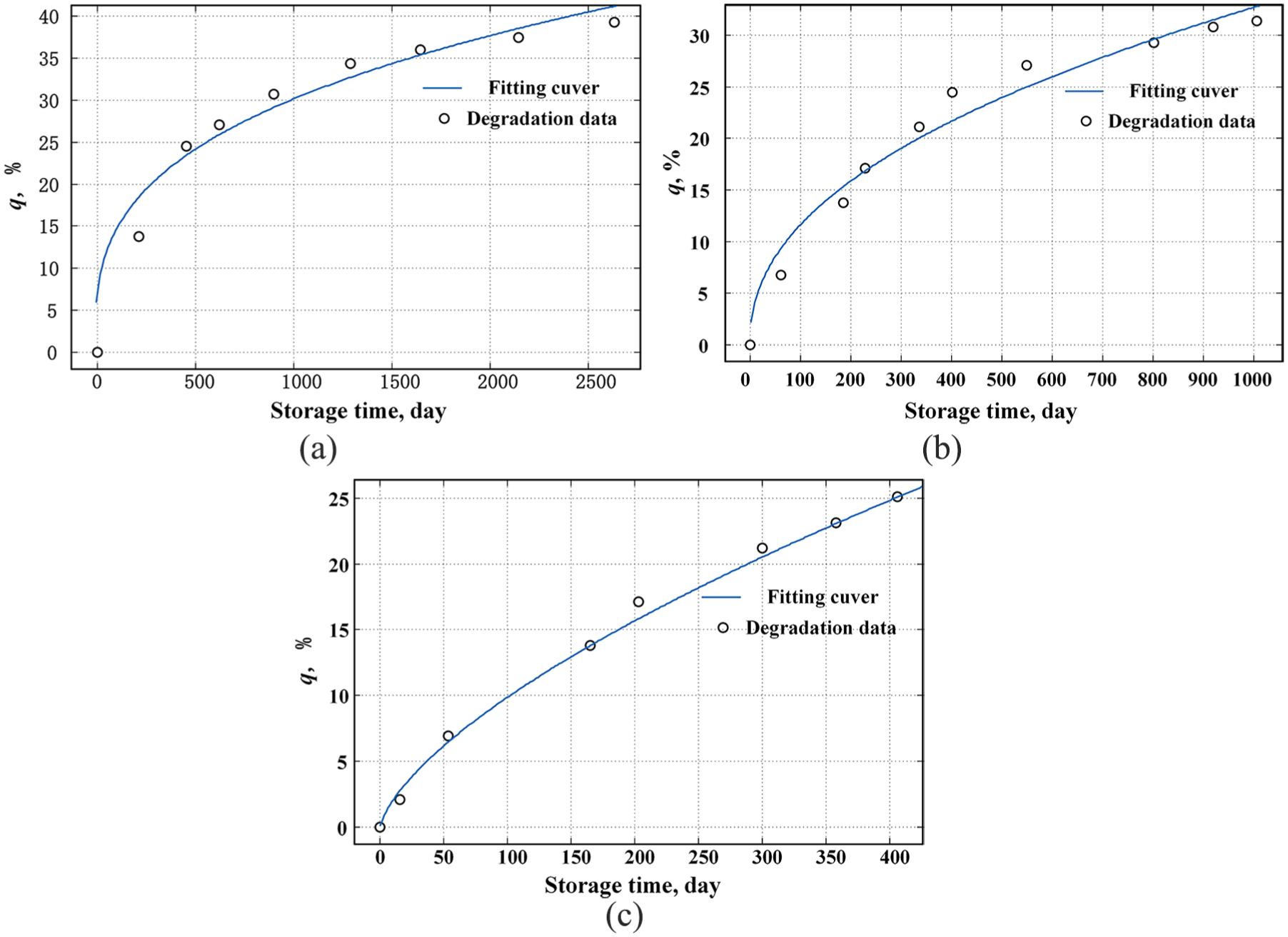
Fitting results of q2 (a) under 288 K, (b) under 298 K, and (c) under 308 K.
As shown in Figures 5 and 6, the goodness of fit of the failure rate function of Weibull distribution model is better than that of Gamma distribution model, but we still cannot select one of them as the true model, because the difference of goodness of fits between the two candidate models is not obvious enough. Hence, the distribution uncertainty needs to be considered. The BMA method is a generalization of model averaging method by combining the model averaging method with Bayesian inference method. In order to access the lifetime evaluation with multi-distribution fusion, based on Bayesian framework, this method presents the information by random variables and fuses the predicted results based on the candidate distribution possibilities. The BMA method is used in this article to evaluate the storage lifetime of rotary lip seal due to its ability to quantify the uncertainty.
The BMA-based lifetime assessment method
Normally, degradation data and lifetime data can be obtained from degradation tests. In the presented method, the lifetime data are seemed as sample data, which directly reflect the storage lifetime of the tested samples. The degradation data are seemed as related information and used to give the priors. It should be noted that because the lifetime distribution is used to evaluate the tested samples, only the lifetime data can be used to build the likelihood function.
The fully Bayesian inference method is used to evaluate the distribution parameters, including shape and scale parameters. Using Bayesian inference method, generally, priors of the parameters can be set based on physical meaning or/and engineering experience. However, under non-prior information conditions, the non-informative prior is frequently used. Furthermore, it is common to use both informative prior and non-informative prior in one application, because the Bayesian inference can inference the sample date and the priors. Certainly, the priors are more precise; the evaluated results are more precise. To fully use the sample data, the priors of model probability and shape parameters are given based on similarity principle. However, in the presented application, it is difficult to find the information about the scale parameters. Hence, the model prior probabilities and priors of shape parameters are given based on similarity principle. The non-informative priors of scale parameters are used.
Model prior probability
As discussed above, the failure rate of the candidate distribution model is related to the curve fitting function, so it is reasonable to utilize the degradation data to give the model prior probability. The tested degradation of the reverse pumping rates vector is expressed by

where N is tested samples size.
The predicted degradation of the reverse pumping rates vector from the fitting curve function qk is expressed by

The Euclidean distance between the tested degradation and predicted degradation from the fitting curve function is used to reflect the fitting error, as

The similarity measure, Sk, is defined as

Based on the similarity principle, it can be assumed that the model prior probability is positively related to the similarity measure. Hence, the model prior probability for kth candidate model π(Mk) is given by

where nM is the candidate model size.
The model prior probabilities for Gamma distribution model and Weibull distribution model in this application are given by equations (27) and (28)


Parameter priors
Gamma distribution
The likelihood function of Gamma distribution model is given by

where ν = 1/γ is scale parameter of Gamma distribution model,
Based on the assumption, equation (11), the priors for the scale parameter of Gamma distribution model are provided from the curve fitting results of parameter kq as

where


The priors for the shape parameter of Gamma distribution model in the presented application are given by

There is no related priori information about the scale parameter ν for Gamma distribution model, so the non-informative prior is adopted to the scale parameter, equation (34). It should be noted that generally, the uniform distributions with large interval are used to describe the non-informative priors. However, the bounds of the uniform distributions are normally set based on lifetime data and/or engineering experience

Weibull distribution
The likelihood function of Weibull distribution model is given by

where
Based on the assumption, equation (18), the priors for the scale parameter of Gamma distribution model are provided from the curve fitting results of parameter kq, as

where


The priors for the shape parameter of Weibull distribution model in the presented application are given by

There is no related priori information about the scale parameter η for Weibull distribution model, so non-informative prior is adopted to the scale parameter as

Parameters estimation
The fully Bayesian inference method is used to estimate the model probabilities p(M) and distribution model parameters



where M1 means the Gamma distribution model, M2 means the Weibull distribution model,
Discussions
The posteriori estimates of the model probability and distribution model parameters are obtained based on Markov Chain Monte Carlo (MCMC) simulation method using software OpenBUGS. Generally, the Gelman–Rubin ratio can be used to indicate the convergence of the computation. The Gelman–Rubin ratio is closer to 1 the computation is more convergent. The plots of the Gelman-Rubin ratios of the parameters are illustrated in Figure 7, which suggest that the values of the parameters become stable and converge after about 300,000 iterations. Therefore, a total of 200,000 iterations, from 300,001 to 500,000, are selected as samples from the posterior distribution.
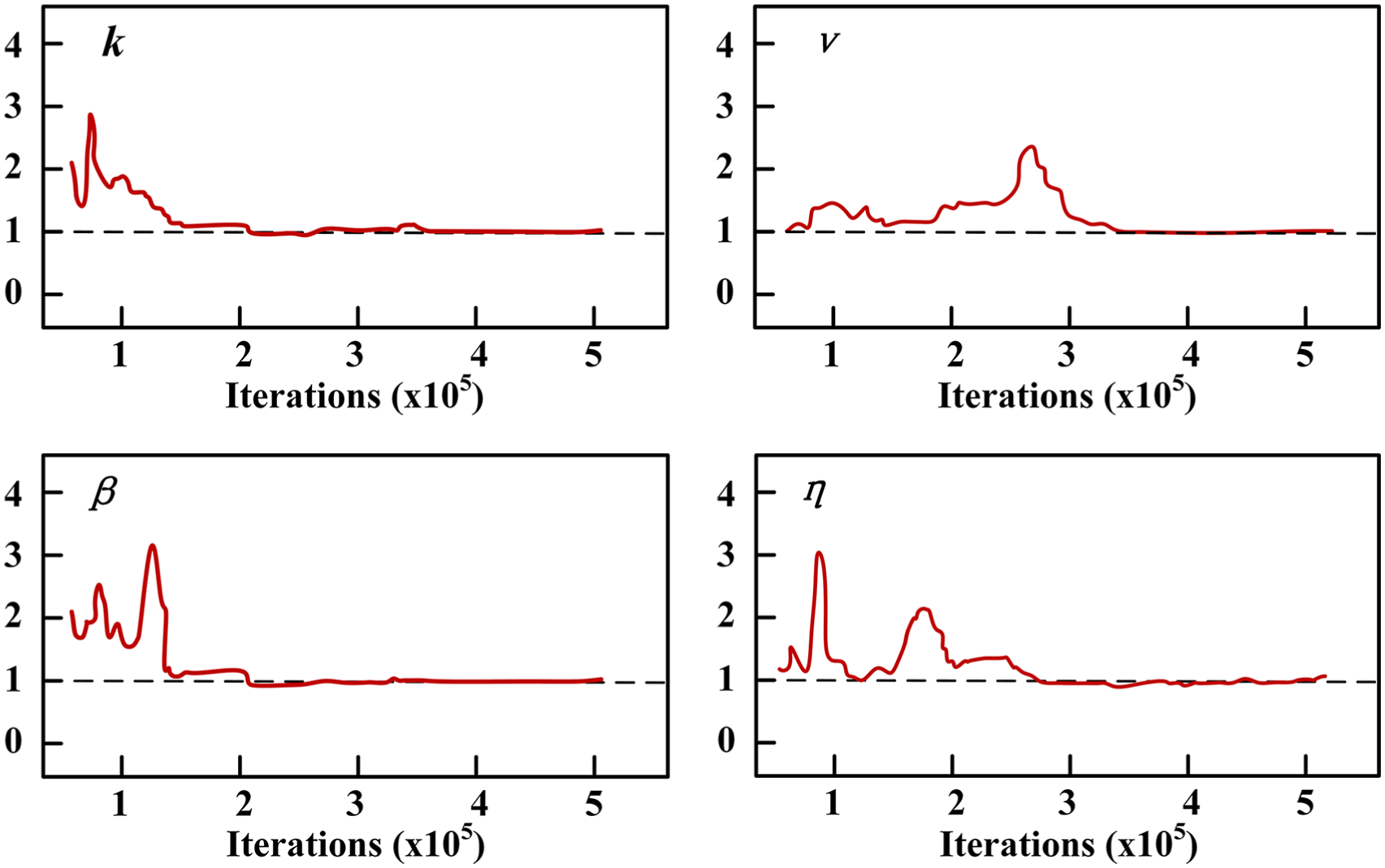
Gelman–Rubin ratio of k, ν, η, and β.
The posteriori estimates of the model probability are shown in Figure 8. It can be seen that both Gamma distribution model and Weibull model are possibly the storage lifetime distribution model for rubber sealing rings. Hence, it is necessary to consider the model uncertainty in storage lifetime assessment of rubber sealing rings, especially under small life data conditions.

MCMC simulation results of the model probability.
The MCMC simulation results for the distribution parameters are displayed in Table 2. Generally, the mean values of the posterior distribution are used to estimate the distribution parameters. The unreliability of rubber sealing rings after storage t days is given by equation (44)

MCMC simulation results of the distribution parameters.

MCMC: Markov Chain Monte Carlo.
The comparisons of predicted results of different methods are displayed in Table 3. The proposed method considers the model uncertainty, so the proposed method has smaller minus log-likelihood value and is a better model considering the goodness of fit. Furthermore, the proposed method utilized the degradation data to obtain the model prior probabilities and priors of distribution model parameters, so the proposed method is more precise in predicting storage lifetime of the rubber sealing rings. It indicates that the proposed method can be more widely used in engineering practices. The prior for the compared BMA-based method is shown in Appendix 1.
Comparisons of the predicted results under different methods.

AIC: Akaike information criterion; BIC: Bayesian information criterion; BMA: Bayesian model averaging.
Generally, the AIC and BIC are frequently used to describe the appropriateness of the model for fitting a dataset, considering both goodness of fit and complexity of the model. Furthermore, the AIC provides a criterion to estimate both the goodness of fit and estimation complexity of the selected model, while the BIC not only considers these two factors but also includes the effects of the sample size. Hence, the AIC and BIC are introduced to discuss the effectiveness of different models. The definition of AIC value is AIC = 2k– 2l
Conclusion
A BMA-based storage lifetime assessment method for rubber sealing rings is proposed in this article. Considering the model uncertainty, Gamma distribution model and Weibull distribution model are selected as the candidate lifetime distribution models and fused based on BMA method. In order to handle the lack of storage lifetime data, the degradation data are utilized to obtain the parameter priors and the model prior probability based on similarity principle. The distribution parameters are estimated by fully Bayesian method.
A storage ADTs dataset, which includes three failure samples, is used to demonstrate the effectiveness of the proposed method. It can be seen that the goodness of fit of the proposed method is better than the compared method. An important distinguishing feature is that the predicted lifetime of the proposed method is more precise. As degradation data are used, the predictions of the proposed methods are more practicable. The further work will focus on the approach to estimate the storage lifetime of rubber sealing rings using degradation data under zero failure sample conditions.
Footnotes
Appendix 1
The non-information priors of compared BMA-based method are given as follows. The priors for the shape parameter of Gamma distribution model are given by
The priors for the scale parameter of Gamma distribution model are given by
The priors for the shape parameter of Weibull distribution model are given by
The priors for the scale parameter of Weibull distribution model are given by
The model prior probabilities for Gamma distribution model and Weibull distribution model are given by
Handling Editor: Zhaojun Li
Declaration of conflicting interests
The author(s) declared no potential conflicts of interest with respect to the research, authorship, and/or publication of this article.
Funding
The author(s) disclosed receipt of the following financial support for the research, authorship, and/or publication of this article: This study was co-supported by the National Natural Science Foundation of China (51620105010, 51875015, 51575019), Natural Science Foundation of Beijing Municipality (L171003), and Program 111.
