




Abstract
Nanomaterial, as a new emerging material in the field of civil engineering, has been widely utilized to enhance the mechanical properties of cementitious material. Nano-SnO2 has presented high hardness characteristics, but there is little study of the application of nano-SnO2 in the cementitious materials. This study mainly investigated the hydration characteristics and strength development of Portland cement paste incorporating nano-SnO2 powders with 0%, 0.08%, and 0.20% dosage. It was found that the early-age compressive strength of cement paste could be greatly improved when nano-SnO2 was incorporated with 0.08% dosage. The hydration process and microstructure were then measured by hydraulic test machine, calorimeter, nanoindentation, X-ray diffraction, scanning electron microscope, and mercury intrusion porosimetry. It was found that the cement hydration process was promoted by the addition of nano-SnO2, and the total amount of heat released from cement hydration is also increased. In addition, the addition of nano-SnO2 can promote the generations of high density C-S-H and reduce the generations of low density C-S-H indicating the nucleation effect of nano-SnO2 in the crystal growth process. The porosity and probable pore diameter of cement paste with 0.08% nano-SnO2 were decreased, and the scanning electron microscopic results also show that the cement paste with 0.08% nano-SnO2 promotes the densification of cement microstructure, which are consistent with the strength performance.
Introduction
Cement-based material, as one of the common and widely used building materials in the world, is a nanostructured, multi-phase, composite material with going-on hydration. 1 Research has shown that more than 70% hydration products of cement-based material is C-S-H (xCaO·SiO2·yH2O) gel with nanostructure, which plays an important role on the strength of the hardened paste. 2 In the hardened cement paste, the main contribution to strength is the nanometer size (10−9 m) effect of nanoscale chemical bonding which exists among C-S-H gel. 3 Recently, nanotechnology has attracted considerable scientific interest due to the new potential uses of particles in nanometer scale. The addition of nanoparticles can dramatically improve properties such as compressive strength and microstructure comparing with conventional grain-size materials of the same chemical composition. 4 The application of nanomaterials in cement-based materials is a new and promising research field. Since then, several application researches of nanomaterials in cement-based materials have been investigated. It was found that the water absorption of cement mortar could be reduced by 93.47% with SiO2 at polymethylhydrosiloxane (PMHS) as a surface treatment compared with the control sample. 5 The effect of silica fume as a dispersion of SiO2 on the hydration and hardness properties of cement was also studied. 6 It was found that the addition of silica fume improved the early and late compressive strength and promoted the hydration degree of cement. Barbhuiya et al. 7 found that Al2O3 had no effect on the strength at the early age, whereas Al2O3 promoted the increase of calcium hydroxide crystals and the densification of cement microstructure. The addition of TiO2 was found to promote cement hydration, reduce porosity, enhance compressive strength, and reduce shrinkage. 8 There is also research investigating that the early compressive strength was able to be significantly improved by the MXene. 9 The previous research results revealed that the hydration properties have been changed more or less after the addition of nanomaterials.
Nano-SnO2, as a kind of material with high hardness, strong corrosion resistance, and good chemical and thermal stability, has attracted the attention of many research laboratories in the field of gas sensors (mainly alcohol) and electronic component.10,11 Tsuruta et al. 12 found that the gas-sensitive device made of SnO2 worked at 500°C for a week and kept its structure intact while its 500°C thermal cycle could be completed within 10 s. And nanoneedle-assembled SnO2 has more quicker gas response and recovery. 13 The Mohs hardness of nano-SnO2 is 7–8, which has potentiality to promote and increase the strength development when it was added in the cement-based materials. But there is little study on the application of nano-SnO2 in cement-based materials. In view of these advances, the aim of this study is to investigate the effects of nano-SnO2 on the characteristics of cement paste. Then, the effects of nano-SnO2 on the compressive strength, nanoindentation, hydration heat, hydration products, morphology of hydration products, and pore structure were also measured. It is anticipated that the results would provide guidance on the application of nano-SnO2 on the cementitious material.
Materials and experiments
Materials
The component analysis of P.I 42.5 Portland cement (Qufu United Cement Company, China) used in this study is shown in Table 1. The preparation process of nano-SnO2 is with reference to Mazloom et al., 14 and the transmission electron microscopy graph of nano-SnO2 particles is shown in Figure 1. Figure 2 is the result of nano-SnO2 particle size distribution. It is apparent that the particle size of nano-SnO2 is in the range of 50 to 70 nm. Most of the nano-SnO2 particles are found to be well dispersed, but some agglomeration still occurs. Mixing water was distilled water.
Chemical composition of P.I 42.5 Portland cement.


TEM image of nano-SnO2.
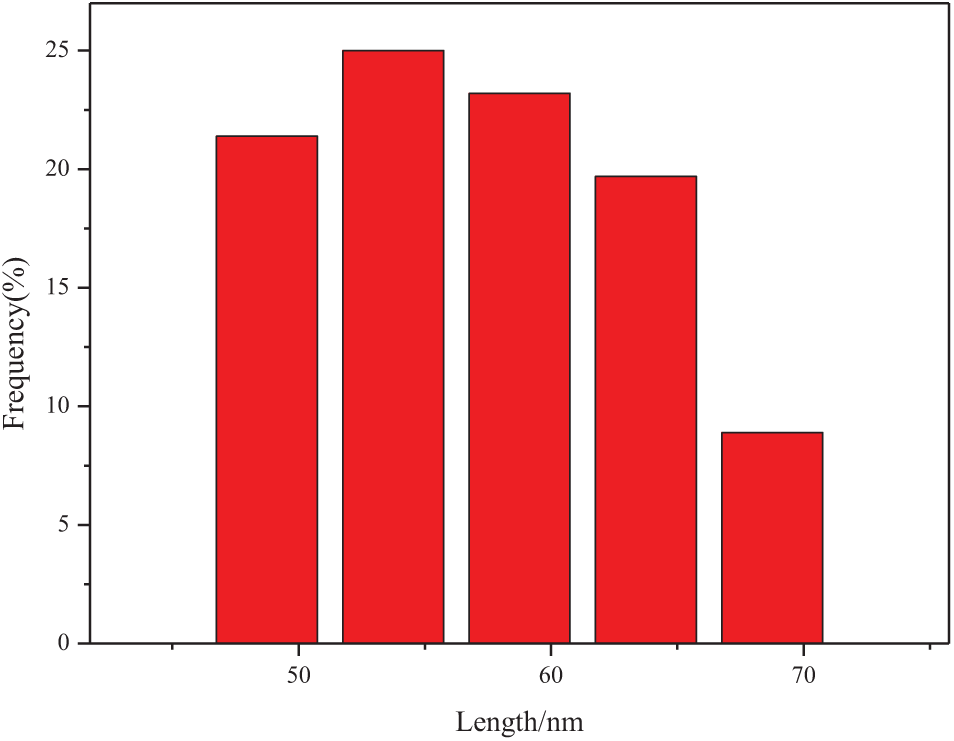
Nano-SnO2 particle size distribution.
Mix proportion and experimental methods
Mix proportion
In this experiment, the nano-SnO2 was added at 0.00%, 0.08%, and 0.20% dosage by weight of cement. Nano-SnO2 and distilled water were weighed according to the mix proportion and put it into a clean beaker. Then the beaker was put in an ultrasonic cleaning instrument, for dispersing for 5 min to prepare dispersion liquid. The dispersion of nano-SnO2 in different dosage (0.00%, 0.08%, and 0.20%) and different environments (with and without Ca(OH)2) is shown in Figure 3. As can be seen from Figure 3, the dispersion of nano-SnO2 with different dosage in different dispersing environments has little difference at 30 min. The water–cement ratio is 0.35.15–17 The cement was then added into the dispersion liquid, and the mixture was stirred at low speed for 2 min and then at high speed for 2 min in the cement paste mixer after pausing for 15 s. The cement paste was immediately poured into a 20 mm × 20 mm × 20 mm mold for the compressive strength tests and cured in saturated lime water at room temperature. After 24 h, the specimens were removed from the mold and cured at 20°C ± 1°C and 95% relative humidity until testing compressive strength. After compressive strength test, the samples for the microscopic tests are packed in small bottle with anhydrous ethanol to prevent the cement hydration reaction. Microstructural properties of hydrated cubes were evaluated at the age of 1, 3, and 7 days.

Dispersion of different dosage of nano-SnO2 in water and Ca(OH)2 solution.
Rheological measurements
The rheological parameters of cement paste were characterized by Modular Compact Rheometer (MCR302, Anton Paar Co, Austria). Before testing, the cement paste was prepared according to Chinese Standard GB/T8077-2000. And two rheological parameters of yield stress and plastic stress were used to characterize the rheological properties of cement paste.
Compressive strength
The compressive strength of the cement paste was measured based on GB/T17671-1999 (The National Standard of the People’s Republic of China) by using a WDW-20 hydraulic test machine (Jinan Ruijin Experimental Instrument Co., China). All of the specimens were cast in 20 mm × 20 mm × 20 mm cubic samples, and the average compressive strength of cement paste was assessed by using three cubic samples. The loading rate of the test was controlled by 0.5 mm/min.
Hydration analysis
The hydration exothermic rate of each paste was measured by TAM Air calorimeter (TA Instruments Co., USA) to assess the effect of nano-SnO2 on the hydration of cement paste. Samples were prepared with a water–binder (w/b) ratio of 0.5, with mixtures (cement was evenly mixed with nano-SnO2 of 0.00%, 0.08%, and 0.20% dosage in advance) and mixing water at a temperature of 20°C. Binding material-cement and nano-SnO2, total of 4 g was added in the 20 mL disposable glass ampule, and water (2 g) was loaded in the syringe(s), the admix ampule is first equilibrated in the TAM Air calorimeter with the materials separated for 30 min. Pushing the syringe(s) with stirring the cement paste, the reaction can then be initiated by manually injecting the water from the syringe(s) into the glass ampule. Then, the hydration exothermic rate within 72 h was tested.
Nanoindentation measurement
To determine the effect of nano-SnO2 on the nanoscale mechanical properties of cement paste, a statistical nanoindentation technique was applied. Young’s modulus of cement pastes was measured by the Hysitron TI Premier Nanoindenter (BRUKER Co. Germany). The operating conditions of the instrument were operated as follows: the load force resolution was less than 1 nN, the displacement resolution was less than 0.01 nm, and the standard Berkovich diamond indenter was used. The distance between the indentation lattices is 10 µm to ensure the independence of the adjacent indentation points the elastic modulus and hardness of samples could be obtained by using the test lattice of 8 × 8 and using 5-2-5(s) loading mode at the same time.
X-ray diffraction analysis
X-ray diffraction (XRD) was used to analyze the hydration products phase of cement pastes. The samples dried at 70°C for 2 h were crushed and grounded to powder. XRD (D8 ADVANCE, Bruker, Germany) tests were conducted with a powder diffraction method, with Cu Ka, voltage 40 kV, and current 40 mA. Scan range was set from 5° to 80° with the speed of 0.02°/step and 0.4 s/step.
Scanning electron microscope test
Scanning electron microscope (SEM, JSM-6390LVH, Jeol, Japan) was used to analyze the morphology of cement paste. Small fractured samples at every hydration age were soaked in anhydrous ethanol to stop hydration and dried at 60°C for 4 h. Then, the sample was coated with 20 nm of gold to make it conductive.
Mercury intrusion porosimetry test
Mercury intrusion porosimetry (MIP, GT-60, American Quantachrome Instruments Company, Florida, USA) was used to test the pore structure of cement paste modified by nano-SnO2. Small fractured samples at 28 days were soaked in anhydrous ethanol to stop hydration and then dried at 80°C for 2 h.
Results and discussion
Rheological property
The curves of shear stress to shear rate of cement paste with different contents of nano-SnO2 are shown in Figure 4. From Figure 4, it can be seen that with the addition of 0.08% nano-SnO2, the shear stress of the cement paste presents insignificant change compared to the reference sample without nano-SnO2. With the dosage of nano-SnO2 increased to 0.20%, the shear stress of the cement paste was increased about 8% compared to the reference sample, indicating that the cement paste becomes a little viscous with the increase of nano-SnO2 content.

Effect of nano-SnO2 content on the shear stress of cement paste.
Compressive strength
The modification effect of nano-SnO2 on cement can be expressed through its influence on the macroscopic mechanical properties. The effects of nano-SnO2 with different dosage of 0.00%, 0.08%, and 0.20% by the weight of cement on the compressive strength of cement paste are shown in Figure 5. It is revealed that the rate of compressive strength gains of paste with adding nano-SnO2 is enhanced at early ages. However, the higher the nano-SnO2 dosage, the lower the enhancement, especially at 3 days of 0.20% dosage; the compressive strength decreased a little compared with the sample with 0.08% dosage nano-SnO2. The compressive strength of cement pastes with 0.08% nano-SnO2 dosage was increased by 41.1%, 4.4%, and 10.6% at 1, 3, and 7 days, respectively. To explore the reasons for the strength gain characteristics of the cement paste, the early-age hydration characteristics of Portland cement paste were further evaluated in the following experiment.

Compressive strength with nano-SnO2 at different cured ages.
Hydration heat
The cement paste hydration exothermic rate with 0.00%, 0.08%, and 0.20% dosage of nano-SnO2 within 72 h is shown in Figure 6(a). It has been known that Portland cement hydration is an exothermic process. 18 Clinker mineral can immediately dissolve in water, and 3CaO·Al2O3 (abbreviated as C3A) first occurs to hydrate and form ettringite rapidly in the presence of gypsum. Therefore, the first exothermic peak appeared around the tens of minutes. After that, with the increase of the amount of AFt, the hydration rate of C3A becomes to decrease. The hydration exothermic rates also slowed correspondingly. In the following 10 h, 3CaO·SiO2 (abbreviated as C3S) begins to hydrate and generate C-S-H and Ca(OH)2 phase, accompanied by heat release, and then, the second exothermic peak appears. It can be found that with the increase of nano-SnO2 content, the rates of hydration heat tend to be accelerated. This may be caused by the nucleation effect of nano-SnO2, which is related to the smaller particle size of nano-SnO2. There is a large number of small particles distributed in the matrix, which provided the nucleation of new hydration products. The hydration rate reached the highest value with the content of 0.20% nano-SnO2. It could be found from Figure 6(b) that with the increase of nano-SnO2 content, the total amount of heat released from cement hydration also increases, indicating that nano-SnO2 could promote the Portland cement hydration process.

(a) Hydration heat release rate and (b) hydration heat release of reference cement paste with content of nano-SnO2.
Nanoindentation
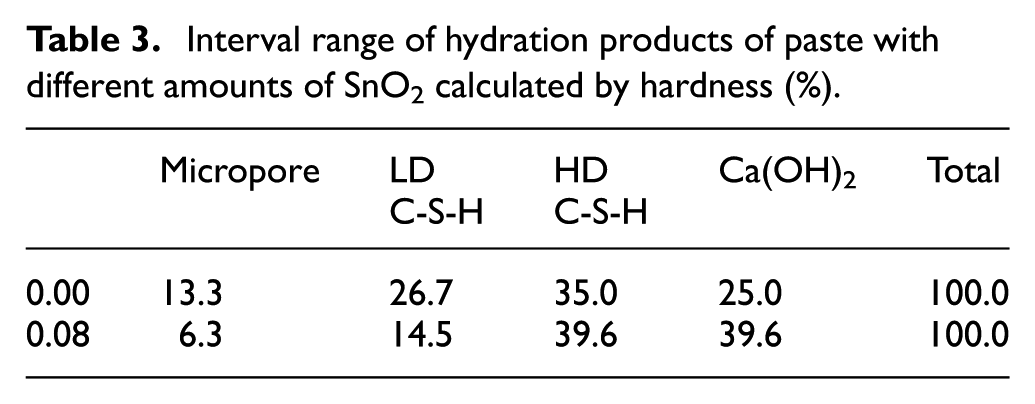
The nanoindentation reflects the resistance of local plastic deformation ability, which is also an important mechanical performance index, and elastic modulus of the material is also reflected. To investigate the effect of nano-SnO2 on elastic modulus of cement at 28 days, the elastic modulus contour map of the cement pastes with 0.00% and 0.08% dosage of SnO2 is shown in Figure 7(a) and (b). It is generally believed that the elastic modulus is not higher than 50 GPa. According to the method of literature, 19 the modulus of elasticity 0–13, 13–26, 26–39, and ÿҰ39 GPa can be expressed as micropore, low density (LD) C-S-H, high density (HD) C-S-H, and Ca(OH)2. The part above 50 GPa can be regarded as a complex of unhydrated particles and hydrated products. In order to compare the effect of nano-SnO2 on hydration structure, the zone range of 0–39 GPa is selected and studied. The interval of hardness is divided into 0–0.45, 0.45–0.83, 0.83–1.31, and 1.31–2.0 GPa, 19 which can be expressed as micropore, LD C-S-H, HD C-S-H, and Ca(OH)2, respectively. Figure 7(c) and Table 2 are the results of the ratio of C-S-H gel calculated through elastic modulus results. Results show that LD C-S-H and HD C-S-H accounted for 40% and 60% of gel, respectively, in the control samples. When 0.08% of nano-SnO2 is added, the proportion of the ratio is 24.2% and 75.8%. The results of the ratio of C-S-H gel calculated by hardness are shown in Table 3. As can be seen in Table 3, HD C-S-H and Ca(OH)2 were promoted to form with the addition of nano-SnO2, especially when the production of Ca(OH)2 was greatly increased. Through the nanoindentation result analysis of elastic modulus results and hardness, it is clear that the addition of 0.08% nano-SnO2 can promote the generation of HD C-S-H and Ca(OH)2, which made a big contribution to the compressive strength increase.

(a) Contour map of indentation on modulus in GPa (0.00%), (b) contour map of indentation on modulus in GPa (0.08%), and (c) elastic modulus distribution.
Interval range of hydration products of paste with different amounts of SnO2 calculated by elastic modulus (%).

Interval range of hydration products of paste with different amounts of SnO2 calculated by hardness (%).
XRD
XRD analyses were used to investigate the composition of hydration products. Figure 8 illustrates the XRD analysis of cement paste with 0.00%, 0.08%, and 0.20% dosage of nano-SnO2 at 3 h, respectively. It was found that ettringite, portlandite (Ca(OH)2), C2S (2CaO·SiO2), and C3S were the major phases for all the mixes. After incorporating nano-SnO2, XRD pattern of the hydration products still has characteristic diffraction peaks of these substances; there are no new characteristic peak and new phase compared to the control sample with 0.00% nano-SnO2. And it can be found that when nano-SnO2 was added, the Ca(OH)2 peak (2θ = 18°) begins to appear, but the peak of Ca(OH)2 (2θ = 18°) is not obvious in the control sample at 3 h. Combined with the “Hydration heat ”section, it indicates that the addition of nano-SnO2 can promote the formation of Ca(OH)2, illustrating that nano-SnO2 can promote the early hydration of cement. In order to further study the properties of cement, more tests need to be done.

XRD pattern of 3 h hydration products of fly ash cement paste with different contents of nano-SnO2.
Morphology
To further explore the role of nano-SnO2 in enhancing the early-age mechanical properties of cement paste, morphology of cement hydration products of different age periods was observed by SEM. Figure 9(a)–(f) represents the SEM images of cement paste with 0.00%, 0.08%, and 0.20% nano-SnO2 dosage cured for 3 and 7 days. With the addition of nano-SnO2, it could be found that the hydration product structure becomes more compact, especially in the sample with 0.08% content of nano-SnO2 at 3 and 7 days. Based on the present research literature, nanomaterial-modified cement-based-materials generally showed three effects: nucleation effect, filling effect, and chemical function.20–22 From the “XRD” section, XRD analysis shows that there is no new phase appearing in the sample with the addition of nano-SnO2, that is, no chemical function observed in the cement hydration process with the addition of nano-SnO2. And the nucleation effect of nano-SnO2 in the crystal growth process can be obvious obtained from the “Hydration heat” section (hydration heat analysis). As we know, the structural defects affected the compressive strength; the denser the combination of hydration products, the higher the compressive strength of cement paste. And the SEM results show that the cement paste with 0.08% nano-SnO2 presents much denser structure; thus, the compressive strength of a sample with 0.08% nano-SnO2 was significantly increased, as shown in Figure 5.
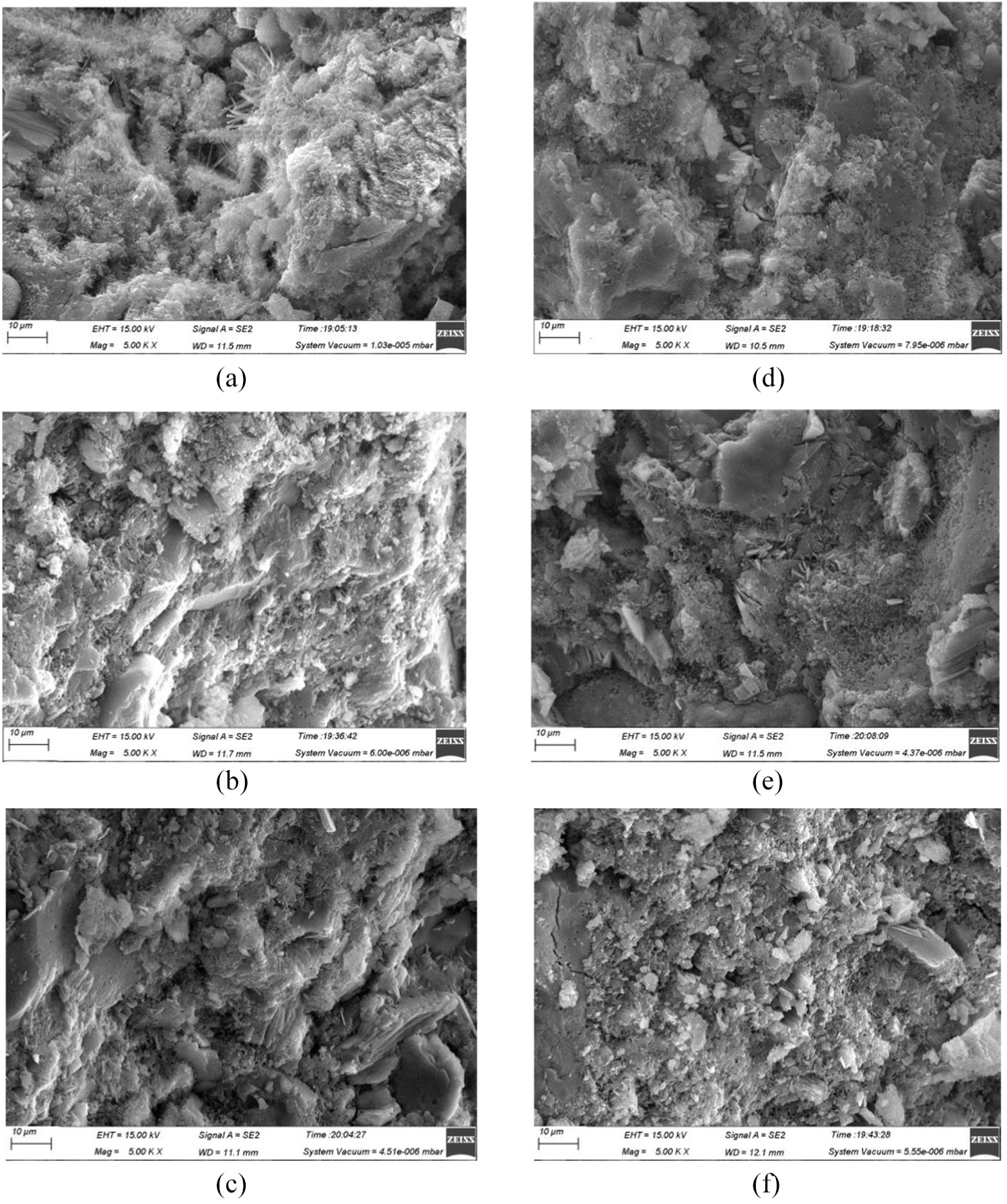
SEM micrographs of cement hydration products at 3 and 7 days with 0.00%, 0.08%, and 0.20% dosage of nano-SnO2: (a) 0.00%, 3 days; (b) 0.08%, 3 days; (c) 0.20%, 3 days; (d) 0.00%, 7 days; (e) 0.08%, 7 days; and (f) 0.20%, 7 days.
Pore structure
The pore structures of cement hydration products have a significant effect on the compressive strength. 19 Figure 10 shows the pore size distribution of cement hydration products in 3 days with 0.00%, 0.08%, and 0.20% dosage of nano-SnO2. The specific surface area and pore structure parameter of cement hydration products at 3 days with 0.00%, 0.08%, and 0.20% dosage of nano-SnO2 are shown in Table 4. The most available apertures of hydration products with 0.00%, 0.08%, and 0.20% dosage of nano-SnO2 were 0.0792, 0.0636, and 0.0832 µm, respectively. With the addition of 0.08% dosage nano-SnO2, pore size was refined and pore structure becomes denser. However, the most available aperture of cement pastes with 0.20% dosage nano-SnO2 was larger than the sample with 0.08% and 0.00% dosage of nano-SnO2. The surface area and cumulative pore volume of cement stone become smaller with the addition of 0.20% dosage nano-SnO2. It could also be found in the “Hydration heat” section that the hydration speed of a sample with 0.20% dosage nano-SnO2 was faster than the 0.08% and 0.00% dosage nano-SnO2 in the earlier stage.
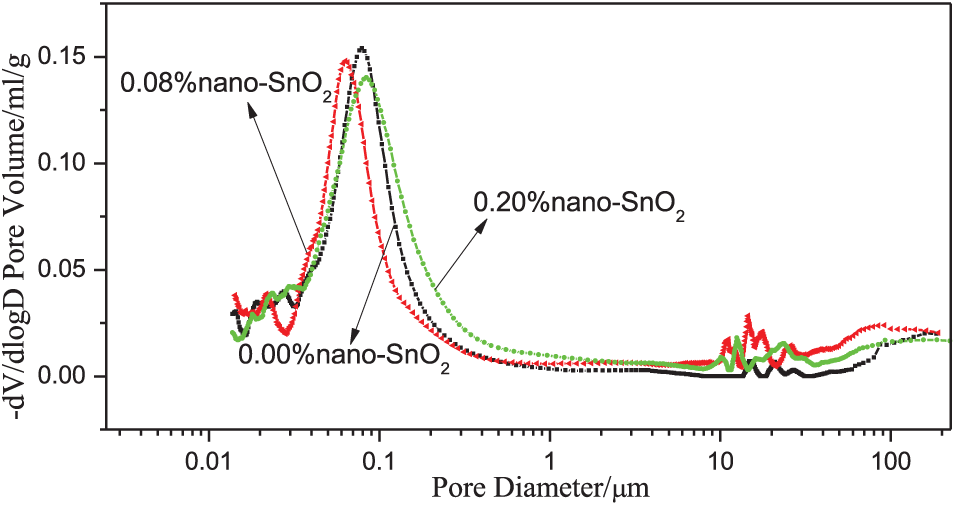
Pore size distribution of cement hydration products at 3 days with 0.00%, 0.08%, and 0.20% dosage of nano-SnO2.
Specific surface area and pore structure parameter of cement hydration products at 3 days with 0.00%, 0.08%, and 0.20% dosage of nano-SnO2.

Conclusion
The effect of nano-SnO2 on the early-age hydration of cement paste is first investigated in this study. Based on the above experimental results, the main findings of this study, which are useful information about the effect of nano-SnO2 on the cement-based material properties, can be summarized as follows:
The early-age compressive strength of cement paste was improved by the addition of nano-SnO2. In the case of cement paste samples incorporating nano-SnO2, the sample with 0.08% dosage by weight of cement exhibited the largest compressive strength strain among the investigated mixes. Compared to the control sample, the compressive strength of samples at 1, 3, and 7 days with 0.08% dosage was improved by 41.4%, 4.4%, and 10.6%, respectively.
Portland cement hydration process was found to be promoted by the addition of nano-SnO2. The total amount of heat released from cement hydration is increased with the increase of nano-SnO2 content. There is no new phase of sample with nano-SnO2 compared to the control sample. The addition of nano-SnO2 can promote the generation of HD C-S-H and reduce the generation of LD C-S-H, indicating the nucleation effect of nano-SnO2 in the crystal growth process, which is related to the compressive strength value change.
Appropriate dosage of nano-SnO2 decreases the porosity and the most probable pore diameter. The SEM results also show that the cement paste with 0.08% nano-SnO2 presents much denser structure, which is consistent with the macro-mechanical strength performance.
Footnotes
Acknowledgements
We also greatly appreciate Miss Syafira Cardosha, who modified the language of the manuscript.
Handling Editor: Grzegorz Golewski
Declaration of conflicting interests
The author(s) declared no potential conflicts of interest with respect to the research, authorship, and/or publication of this article.
Funding
The author(s) disclosed receipt of the following financial support for the research, authorship, and/or publication of this article: This work was financially supported by the National Natural Science Foundation of China (No. 51872137), Scientific and Technological Project of Henan Province (No. 162102310424), and Natural Science Foundation of Henan Province (No. 162300410118).
