




Abstract
The study investigates the forced nonlinear vibration characteristics of an axially moving printing paper web with variable density in the lateral direction. The nonlinear governing equations of the web can be obtained by the von Karman large deflection thin plate theory. The vibration equations are discretized using the Bubnov–Galerkin method. The fourth-order Runge–Kutta technique is used to solve the differential equations of the nonlinear system. The phase-plane diagrams, time histories, bifurcation graphs, Poincare maps, and power spectrum are employed to analyze the influence of density coefficient, velocity, and aspect ratio on the nonlinear dynamic behavior of the moving paper web. The stable working region and the divergence instability region of the web are obtained. The research provides a theoretical foundation for improving the dynamic stability of a moving paper web.
Keywords
Introduction
In printing, the surface density of a printing web corresponding to each printout is different. In addition, the ink and fountain solution used during the printing process will affect the density of the web surface, and the uneven thickness of the substrate will change surface density, the vibration characteristics of printing webs will change, and in this manner, the web is prone to wrinkling, tearing, and surface scratches; as a result, the overprint accuracy and printing quality will reduce. 1 Therefore, it is important to investigate the nonlinear vibration characteristics of a web with variable density.
The axially moving systems include plates, beams, strings, and webs. Many scholars have studied the dynamics of axially moving systems. Specifically, mathematical modeling, solution methods, parameter vibrations, external excitation systems, elastic supports, and different boundary conditions are mainly analyzed in axially moving systems. Mote 2 first discussed the nonlinear vibration problem of axially moving strings, and the effect of axial velocity on vibration was emphasized. Wickert and Mote 3 then studied the response of moving loads on moving strings. Pakdemirli et al. 4 studied the transverse vibration of axially accelerated strings. The equation was established based on Hamilton’s principle, and the Galerkin method was applied to discretize partial differential equation. The Floquet theory was used to analyze the stability of strings. Chen et al.5–7 systematically studied the nonlinear vibration characteristics of axially moving viscoelastic strings based on the fourth-order Galerkin truncation and the method of multiple scales. The effects of average speed, speed, and speed variation frequency on system stability were analyzed. Kesimli et al. 8 analyzed the characteristics of nonlinear vibration of a multi-supported axially moving string. Pellicano and Vestroni 9 investigated the nonlinear dynamics of simply supported beams, bifurcation, and stability analysis on the subcritical and supercritical velocity ranges. Öz et al. 10 applied the method of multiple scales to study the nonlinear vibration characteristics of axially moving beams. Ghayesh and colleagues11–13 systematically studied the nonlinear dynamics of beams with variable velocity and intermediate elastic support, and the nonlinear resonance response and global dynamics of the system at subcritical velocity were also studied. Tang et al. 14 studied the nonlinear steady-state oscillation response of axially accelerated viscoelastic beams by the method of multiple scales. Yang et al. 15 applied the finite element method to study the linear free vibration and nonlinear forced vibration of axially moving viscoelastic plates. Wang et al. 16 studied the dynamic characteristics and stability of a paperboard with elastic point support and elastic edge constraint. The extended Hamilton principle was used to establish the equation of the system, and the meshless Galerkin method was used to discretize equation. The critical speeds were obtained in different conditions. Wang and Zu 17 analyzed the effects of some key parameters on nonlinear behaviors of functionally graded rectangular plates with porosities and moving in thermal environment using the method of harmonic balance. Marynowski18,19 applied the Galerkin method and the fourth-order Runge–Kutta technique to analyze nonlinear vibration and stability of an axially moving paper web. Lin and Mote 20 investigated the nonlinear vibration of a web with little bending stiffness and subjected to a transverse load. Zhao and Wang 21 analyzed the large deflection vibration of a web by the Galerkin method and the differential quadrature method. Soares and Gonçalves 22 examined the nonlinear vibration of a pre-stretched hyper-elastic annular web under finite deformations by the shooting method and the finite element method. Gajbhiye et al. 23 studied the large deflection vibration of a rectangular, flat thin membrane using finite element method. Li et al. 24 investigated the stochastic dynamic response and reliability analysis of orthotropic membrane structures under impact loading by the perturbation method. In addition, the influence of parameters such as impact velocity, preload, and radius on structural reliability was also analyzed.
Recently, there have been many publications dealing with the linear vibration of the membrane with variable density, but few publications about the forced nonlinear vibration characteristics of a printing web with variable density. Jabareen and Eisenberger 25 investigated the transverse vibration of a non-homogeneous membrane with variable density by the dynamic stiffness method. Subrahmanyam and Sujith 26 analyzed the perpendicular movements resulting in vibration of annular membranes with continuously variable density. Willatzen 27 established a general quasi-analytical model based on the Frobenius power series expansion method to analyze the vibration of solid circular and annular membranes with continuously varying density. Ma et al. 28 studied the vibration control of the moving web with variable density by the sub-optimal control method. Buchanan 29 analyzed the stability of the circular membrane with linear variation density in the diameter direction.
In the following research, the nonlinear vibration and stability of the moving printing paper web with variable density in the lateral direction based on von Karman large deflection thin plate theory are investigated. The fourth-order Runge–Kutta technique is adopted to solve the differential equations, and the effects of the density coefficient, aspect ratio, and moving speed on the nonlinear vibration of an axially moving web with variable density are analyzed.
Establishment of vibration model of a variable density web
Figure 1 shows the principle model of a moving paper web; the web is soft and has no bending stiffness. The web moves in the x-direction with a moving speed of v; the width direction of the web is in the y-direction; and the transverse vibration direction is in the z-direction. Supposing
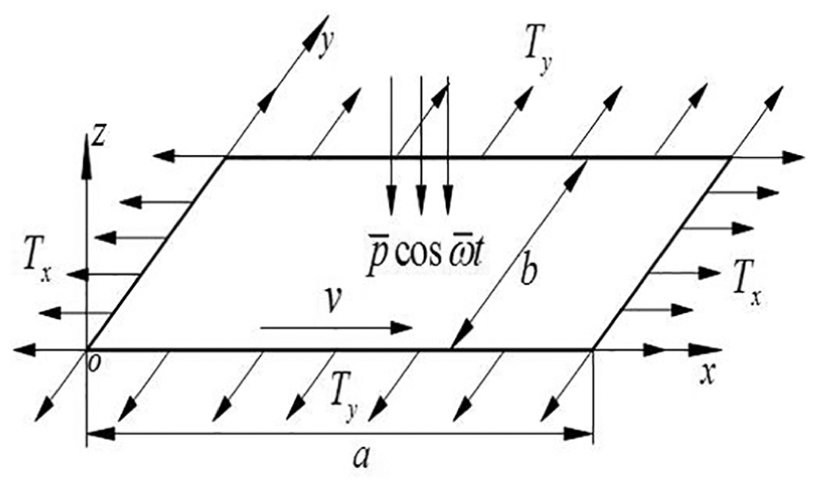
Mechanical model of the axially moving web.
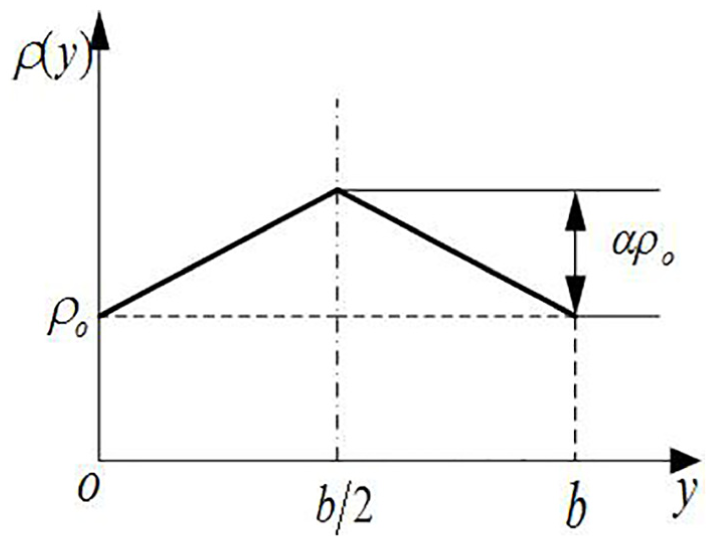
Law of a moving web with varying density.
Equilibrium differential equations can be defined as 30

Elastic surface differential equation is expressed as

where Nx, Ny, and Nxy denote the web inner forces per unit length and λ is the damping coefficient.
The system compatibility equation is expressed as

where
The inner force function of the paper web is expressed as

where
The web units are independent from each other, so the following is obtained

According to von Karman large deflection thin plate theory, 30 the nonlinear forced vibration equations can be stated as follows


The density function ρ (y) can be denoted as

Another form of ρ (y) is

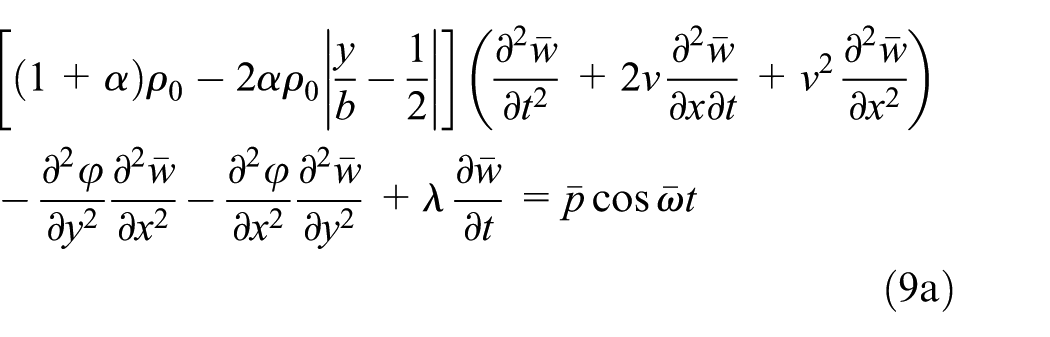
Equation (8) is substituted into equation (6) to obtain the nonlinear forced vibration equations of the moving paper web with variable density

Introduce the dimensionless quantities
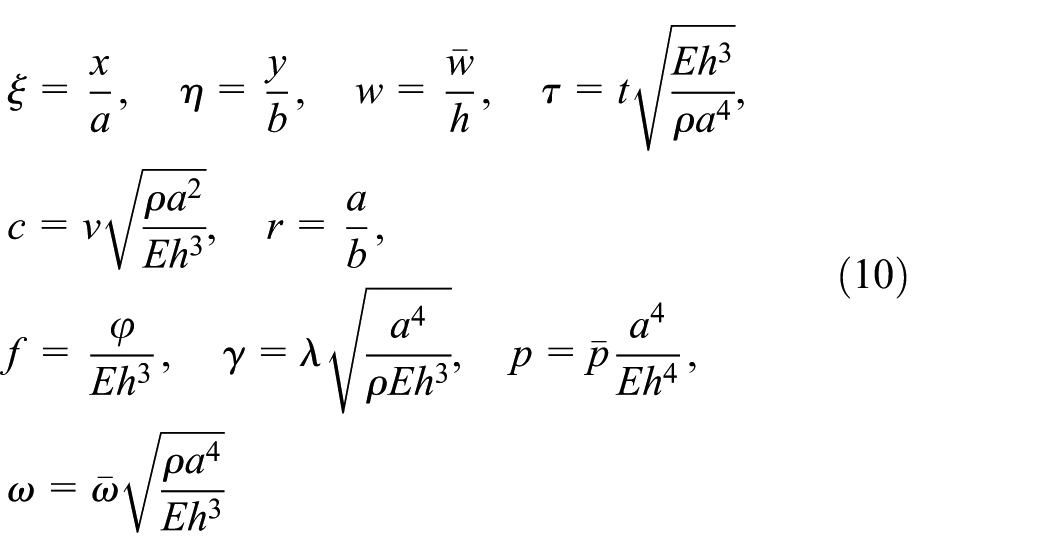
where γ is the dimensionless damping coefficient.
The dimensionless nonlinear vibration equations of a web with variable density are obtained


The boundary conditions can be denoted as


Separation of the variables
When considering partial differential equations of the nonlinear system, the Bubnov–Galerkin method can be used to separate the time variable and displacement variable. Respectively, they are 31


When m = n = 1, we obtain


Take a displacement function to meet the boundary conditions

Substituting equations (16)–(18) into equation (11b) yields

The solution of equation (19) is obtained

Substituting equations (18) and (20) into equation (11a) and adopting the Bubnov–Galerkin method, we obtain
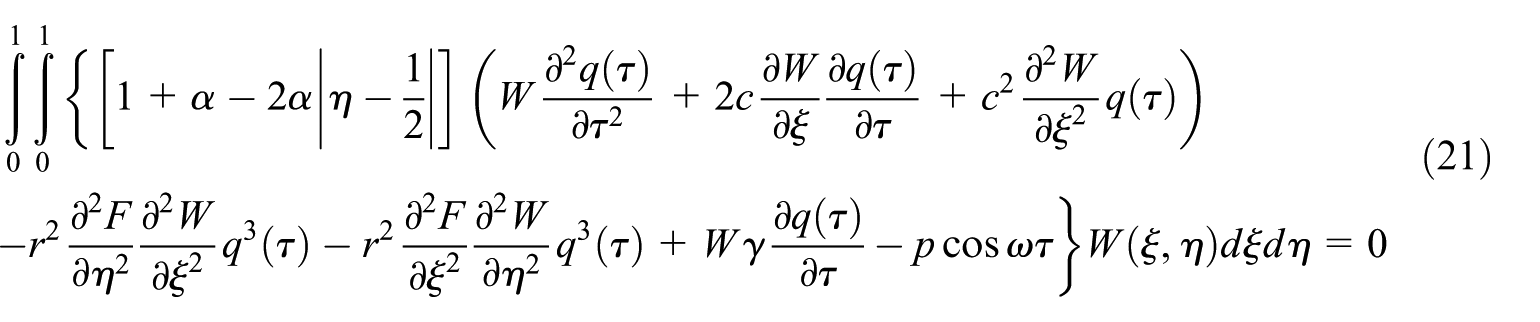
The nonlinear vibration ordinary differential equation of the moving web with variable density can be expressed as

where


The parameter variables are introduced

The state equation of the system is

Numerical results
The fourth-order Runge–Kutta technique is used to determine the characteristics of nonlinear vibration in a moving printing web. The basic parameters of the printing web are commonly used in the printing.
Effects of density coefficient on nonlinear vibration characteristics
Shown in Figure 3 is the displacement bifurcation graph of density coefficient; when the non-dimensional excitation frequency ω is 1, external excitation amplitude p is 0.4, dimensionless damping coefficient γ is equal to 0.1, dimensionless speed c is 0.3, and aspect ratio r = 1, (0.01, 0) is taken as the initial value and the range of density coefficient is

Displacement bifurcation graph of density coefficient (ω = 1, γ = 0.1, r = 1, c = 0.3, p = 0.4, initial value is (0.01, 0)).
Figure 4 shows the bifurcation diagram of density coefficient and displacement when the initial value is (0.001, 0). As can be seen from Figures 3 and 4, the system motion process is significantly different due to the different initial values. It indicates that the nonlinear vibration of the membrane is sensitive to the initial conditions.

Displacement bifurcation graph of density coefficient (ω = 1, γ = 0.1, r = 1, c = 0.3, p = 0.4, initial value is (0.001, 0)).
Effects of speed on nonlinear vibration characteristics
As illustrated in Figure 5, for the displacement bifurcation graph of dimensionless speed, when γ = 0.1, r = 1, ω = 1, α = 0.2, and p = 1, (0.01, 0) is taken as the initial value and the span of dimensionless speed is

Displacement bifurcation graph of speed (ω = 1, γ = 0.1, r = 1, α = 0.2, p = 1).
Figures 6 and 7 show the time histories, phase-plane diagrams, Poincare maps, and power spectrum under different dimensionless speeds when c = 0.36 and c = 0.42, respectively.

Time histories, phase-plane diagrams, Poincare maps, and power spectrum (ω = 1, γ = 0.1, r = 1, α = 0.2, p = 1, c = 0.36).
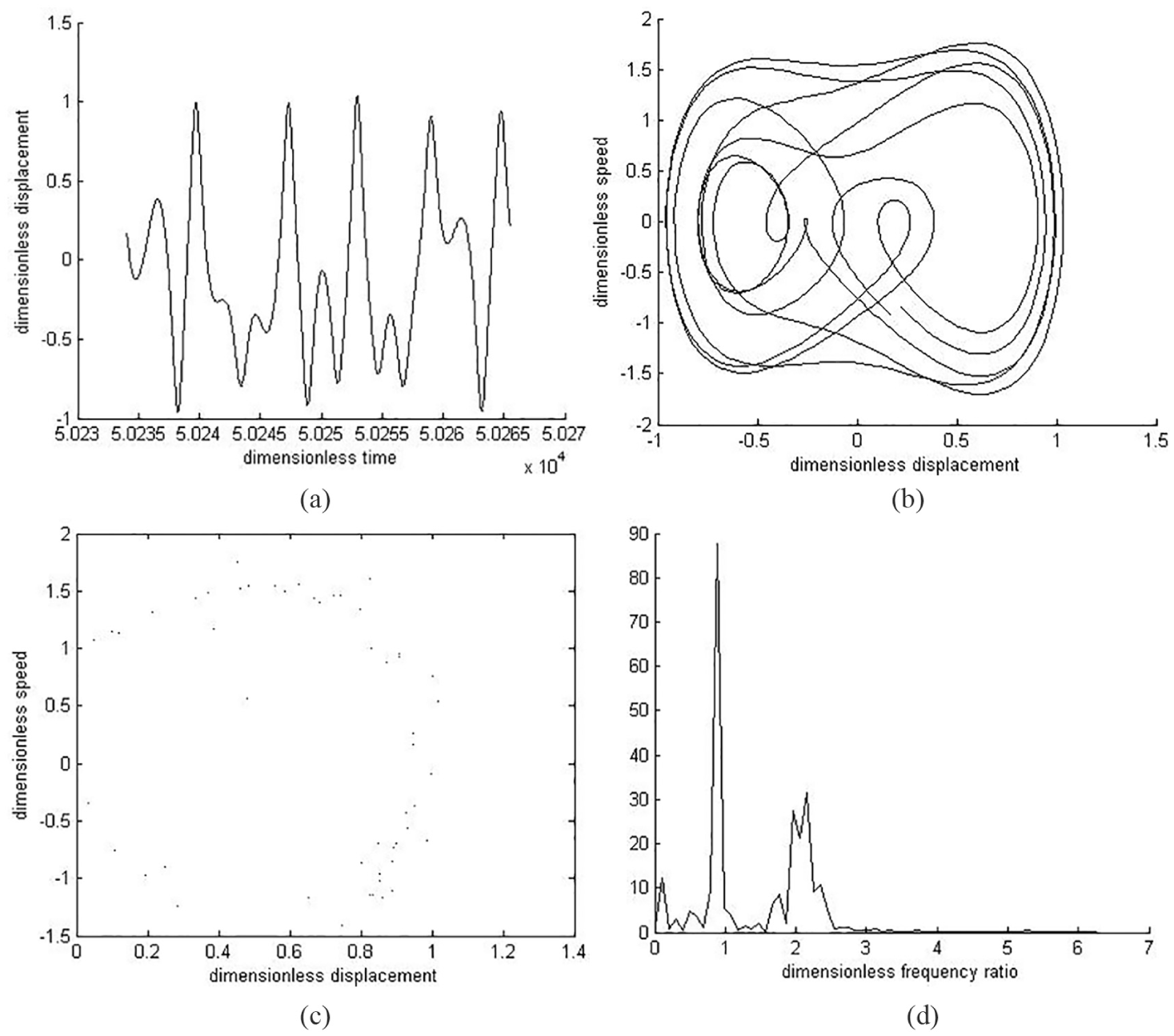
Time histories, phase-plane diagrams, Poincare maps, and power spectrum (ω = 1, γ = 0.1, r = 1, α = 0.2, p = 1, c = 0.42).
As seen in Figures 6 and 7, when c = 0.36, it has a large number of regular closed graphics in the phase-plane diagrams, the Poincare maps contain a few discrete points, and power spectrum is discrete, so the system is in multiple periodic motion. When c = 0.42, the phase-plane diagram is not closed, the Poincare map contains a lot of dense points, and power spectrum is continuous, so the system is in chaotic motion.
Effects of aspect ratio on stability
As shown in Figure 8, for the displacement bifurcation graph of aspect ratio, when ω = 1, γ = 0.1, c = 0.3, α = 0.2, and p = 1, (0.01, 0) is taken as the initial value and

Aspect ratio and displacement bifurcation graph (ω = 1, γ = 0.1, c = 0.3, α = 0.2, p = 1).
Figures 9–12 are all about time histories, phase-plane diagrams, Poincare maps, and power spectrum when r = 0.88, r = 0.9, r = 0.98, and r = 1.1, correspondingly. It is clear from the figures that the aspect ratio increases gradually, and the system transforms from a state of double periodic motion to quadruple periodic motion, and following this, it enters a state of multiple periodic motion and finally ends up in a state of chaotic motion.

Time histories, phase-plane diagrams, Poincare maps, and power spectrum (ω = 1, γ = 0.1, α = 0.2, p = 1, c = 0.3, r = 0.88).

Time histories, phase-plane diagrams, Poincare maps, and power spectrum (ω = 1, γ = 0.1, α = 0.2, p = 1, c = 0.3, r = 0.9).
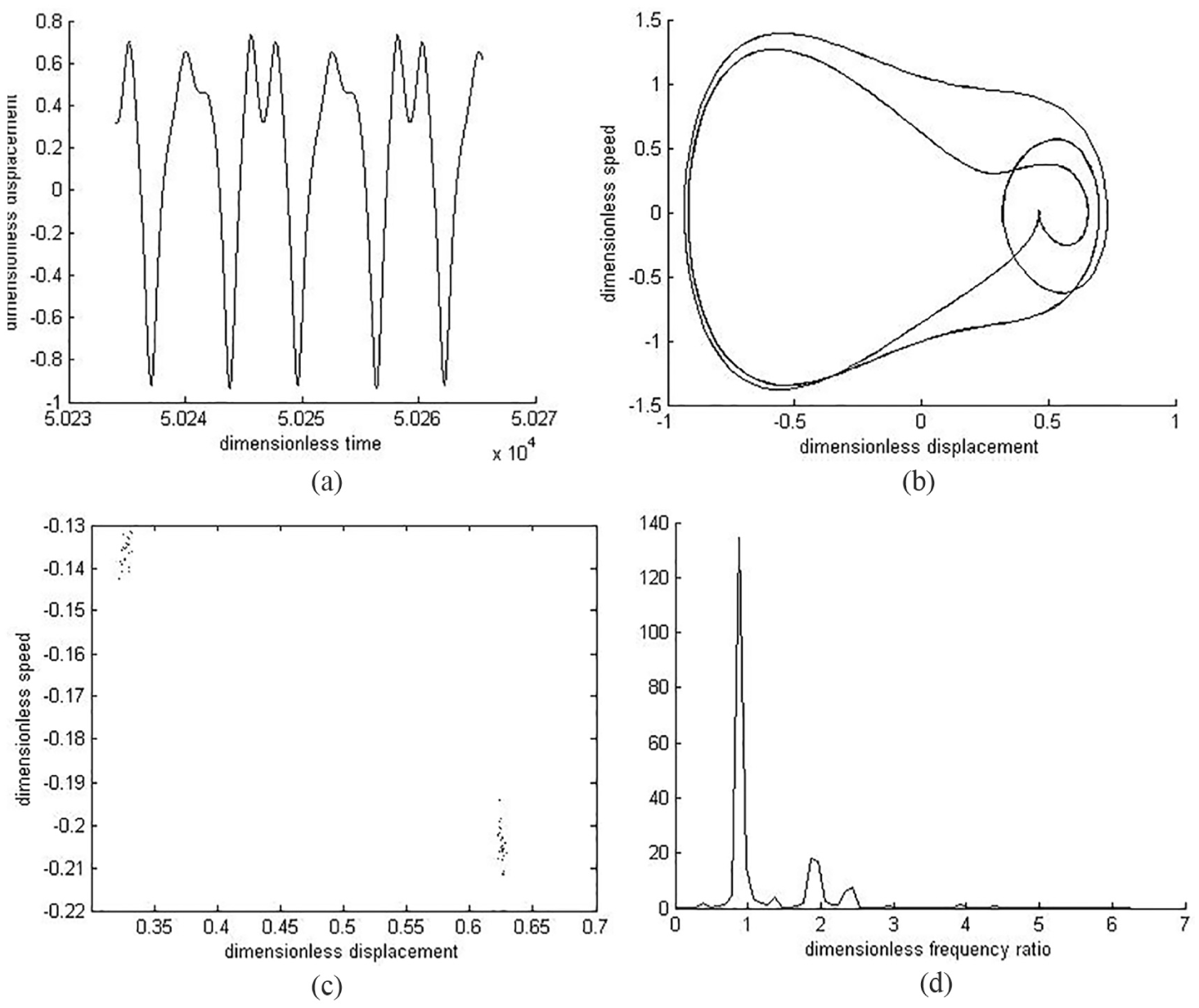
Time histories, phase-plane diagrams, Poincare maps, and power spectrum (ω = 1, γ = 0.1, α = 0.2, p = 1, c = 0.3, r = 0.98).

Time histories, phase-plane diagrams, Poincare maps, and power spectrum (ω = 1, γ = 0.1, α = 0.2, p = 1, c = 0.3, r = 1.1).
Conclusion
In conclusion, the fourth-order Runge–Kutta technique is employed to analyze the forced nonlinear vibration of a moving paper web with variable density. The effects of the density coefficient, speed, and aspect ratio on the dynamic behavior of a moving paper web are studied. It is evident that
When the density coefficient is the control parameter, the web is in a stable working region when the density coefficient is
When the dimensionless speed is the control parameter, dimensionless speed at the regions
When the aspect ratio is the control parameter, the aspect ratio at these regions is
Footnotes
Handling Editor: James Baldwin
Declaration of conflicting interests
The author(s) declared no potential conflicts of interest with respect to the research, authorship, and/or publication of this article.
Funding
The author(s) disclosed receipt of the following financial support for the research, authorship, and/or publication of this article: This study was supported by the National Natural Science Foundation of China (No. 11272253), the Natural Science Foundation of Shaanxi Province (Nos 2018JM5023, 2018JM1028, 2018JM5119, 2018JM1033), the PhD Innovation fund projects of Xi’an University of Technology (Fund No. 310-252071702), the Central University Special Funds of China (No. 310812171003) and Xi"an Science and Technology Project 2018 (No.201805037YD15CG21(26)).
