




Abstract
304 stainless steels were prepared by aluminothermic reaction method; first steels are annealed at 1000°C and then rolled at 700°C for different deformation. The microstructures evolution and mechanical properties were distinguished in details. It was found that the steel contains nanocrystalline/submicrocrystalline/microcrystalline austenite and submicrocrystalline ferrite. After rolling to a thickness reduction of 30%, 50%, and 70%, the mechanical properties of the rolled steels were substantially increased, as the deformation increased from 30% to 50%, the tensile strength increased from 650 to 1110 MPa, the yield strength increased from 400 to 665 MPa, and the elongation increased from 8% to 8.5%.
Keywords
Introduction
304 stainless steel considered as a wide variety of applications due to its excellent weldability, corrosion resistance, and formability. But its low yield strength. Recently, many approaches have been suggested to improve the strengthening of the steel without loss more ductility such bimodal grain size distribution, 1 nano-twinned structure, 2 heat treatment, 3 the strain-induced martensitic transformation, 4 and lamellar structure. 5 In general, the yield strength of alloys could be highly enhanced by precipitation, grain refinement, and phase transformation. It is found that deformation under conditions of warm working could obtain good ductility and high tensile strength in steel. Z Yanushkevich et al. 6 and F Chen et al. 7 have described that grain refinement could be obtained by variation the rolling direction in multi-pass rolling, which was useful to the formability of the alloy sheets. At high rolling speed, dynamic recrystallization (DRX) can be stimulated and further enhanced by increasing thickness reduction.8,9 As the microstructure was refined, both ductility and strength of the samples were improved by DRX. YW Kim et al. 10 have affirmed that the degree of DRX is related to the rolling temperature. Therefore, warm rolling under conditions of deformation is a very efficient way to enhance the mechanical properties of the alloys and metals.11–13
The objective of the present work is to investigate the effect of rolling thickness reduction on tensile properties and microstructure of nanocrystalline/microcrystalline 304 stainless steel prepared by the aluminothermic reaction method. After being rolled, the mechanical properties of the steels were significantly increased. Tensile strength and elongation of the steel were optimized with 825 MPa and 21.5%, respectively.
Experimental details
Specimen preparation
304 stainless steel was prepared by the aluminothermic reaction method; the dimensions of the casting steel were approximately Φ120 mm × 15 mm. According to the previous research, the casting steels content of nano- and microcrystalline austenite phases and a little δ ferrite. The samples were cut into 60 mm × 50 mm × 5 mm from the cast steel using a wire-cutting machine, and then the samples were polished with 600 mesh sandpaper. First, the authentic steels were annealed at 1000°C. Then the steels were rolled at 700°C to a thickness reduction of 30%, 50%, 70%, respectively; the thickness reduces to 2.1, 1.5, and 0.9 mm, respectively. Finally, all of the rolled steels were annealed at 400°C for 2 h to release the stress. After annealing, the samples were air cooled and then mechanically polished to rid of the surface oxide formed during rolling and annealing.
Microstructure characterization
The surface of the sample strips was etched and then polished with the etching solution (10 g FeCl3 + 140 mL HCl + 160 mL H2O) for 35 s; the corrosion products (FeCl3) dissolve into the etching solution. The sample was flooded in the etching solution and kept shaking during the process of corrosion. After being etched, the samples were put into hot water for 3 min and cleaned by an ultrasonic wave cleaner in the alcohol with 5 min to remove the corrosion products further.
Finally, the samples were examined by JSM-6700F scanning electron microscope (SEM), and the operating electric current and voltage were 10 μA and 8 kV, respectively. A sheet specimen was cut from the rolled steels, so ground into thin foils with less than 100 μm by sandpaper and then punched into plates by a puncher, the diameter of the plates was 3 mm. Finally, the plates were thinned to proper thickness by twin-jet electro-polishing in an electrolyte of 2% perchloric acid and ethanol at room temperature. The specimens were examined on a JEM-2010 transmission electron microscope (TEM; JEOL Ltd.); the operating voltage was 200 kV.
Hardness test
The specimens with the thickness of 10 mm × 10 mm were cut from rolled steel by electrical discharge machine (EDM). The specimen was polished by sandpaper of 1000 mesh and then was examined on the HBR Victorinox optical hardness tester; the load was 294 N and the loading time was 12 s.
Tensile test
The specimens with the thickness of 1 mm were cut from the rolled steels via wire-cutting machine. The surface of the specimen was polished by sandpaper of 600 mesh and then was examined on the Shimadzu AG-10T tester; the transiting speed is 0.2 mm/min, the result of the tensile tests was the average value of three times, and the standard deviation should be less than 5%.
Results
Microstructure evolution
Figure 1 shows the SEM microstructure of 304 stainless steels after rolling with different thickness reductions; the black strip phase is the ferrite phase and the white phase is the austenite phase; few small black dots in the images are Al2O3 particles. In order to comprehend the evolution of structure and the change of mechanical properties in 304 stainless steel, JW Fu et al. 14 have investigated microstructure evolution in AISI 304 stainless steel. They found that the microstructure consists of ferrite phase and austenite phase. When the thickness reduction was 50%, the ferrite phase is extended along the rolling direction, after rolling to a thickness reduction of 70%, appeared small strips of the ferrite phase. From high magnification SEM image (Figure 1(b), (d), and (f)), it is seen clearly the nano grain ferrite increase with increasing thickness reduction is about 23, 32, and 45 nm with 30%, 50%, and 70% deformation, respectively.

SEM images of the steels with 30% (a, b), 50% (c, d), and 70% (e, f) thickness reduction: (a), (c), and (e) SEM images, and (b), (d), and (f) high magnification SEM images.
The grains of the ferrite phase of the steel contain the nanocrystalline and submicron crystalline. After rolling to a thickness reduction of 30%, 50%, and 70%, the subgrain size of the ferrite is about 325, 297, and 360 nm and the volume fraction of the ferrite phase decreased, which is about 14%, 13%, and 12%.
Selected area electron diffraction (SAED) pattern, typical bright TEM images, dark field TEM images (obtained from the first bright diffraction ring, indicated by the circle), submicron crystalline austenite, and the grain size distribution of the nanocrystalline of the steel strips with different thickness reductions are given in Figures 2–4. The brightest areas in the bright field TEM images are microcrystalline austenite, the big darkest grains are submicron crystalline austenite, and the small darkest grains are nanocrystalline austenite; the brightest areas in the dark field TEM images are nanocrystalline austenite.

Bright field TEM image (a), SAED image (b), dark field TEM image (c), grain size distribution of submicron crystalline, and (d) grain size distribution of the steel strip with 30% thickness reduction.

Bright field TEM image (a), SAED image (b), dark field TEM image (c), grain size distribution of submicron crystallinee, and (d) grain size distribution of the steel strip with 50% thickness reduction.

Bright field TEM image (a), SAED image (b), dark field TEM image (c), grain size distribution of submicron crystalline, and (d) grain size distribution of the steel strip with 70% thickness reduction.
The nanocrystalline phase was exhibited by diffraction rings in the SAED pattern; the microcrystalline phase was exhibited by spots and indexed to be fcc-austenite. The grain size of the nanocrystalline austenite increases from 25.6 to 83.4 nm, with the increasing thickness reduction. After rolling with 50% thickness reduction, the grain size of submicron crystalline austenite decreases from 232 to 195 nm and disperses better. After rolling with 70% thickness reduction, the submicron crystalline austenite decreases from 195 to 150 nm. And the nanocrystalline grain grows up to 83 nm.
Mechanical properties
Representative engineering tensile stress–strain curves of the casting 304 stainless steel and the steels with different deformation are shown in Figure 5, and main tensile properties are summarized in Table 1. The tensile strength, yield strength, and elongation of the casting 304 stainless steel are about 650 MPa, 400 MPa, and 8%, respectively. After annealing to 1000°C, tensile strength, yield strength, and elongation increased to 946 MPa, 656 MPa, and 9.2%, respectively. Then, after rolling deformation 30% the yield strength, tensile strength decreases, but the elongation increases, which is about 940MPa, 632MPa, and 9.3%, respectively. When the deformation was 50% tensile strength, and yield strength increasing rapidly about 1110 and 665 MPa, respectively, but the elongation decreases to 8.5% with increasing deformation to 70% thickness reduction, the tensile strength and yield strength which are about 825 and 560 MPa, respectively, but the elongation increase to 21.5%. The hardness of all conditions was measured at room temperature, and results are shown in Figure 6, the cast steel showed lower hardness than other specimens, and the annealing increased the hardness value of the steel. Next, the hardness reached a maximum value after rolling with 30% and 50% and then was decreased when the thickness reduction was 70%.

Engineering tensile stress–strain curves of the casting steel and steel strips with different thickness reductions (a); the tensile strength, yield strength, and elongation of the steels (b).
Mechanical properties of casting steel, annealing, and steels with different thickness reductions.

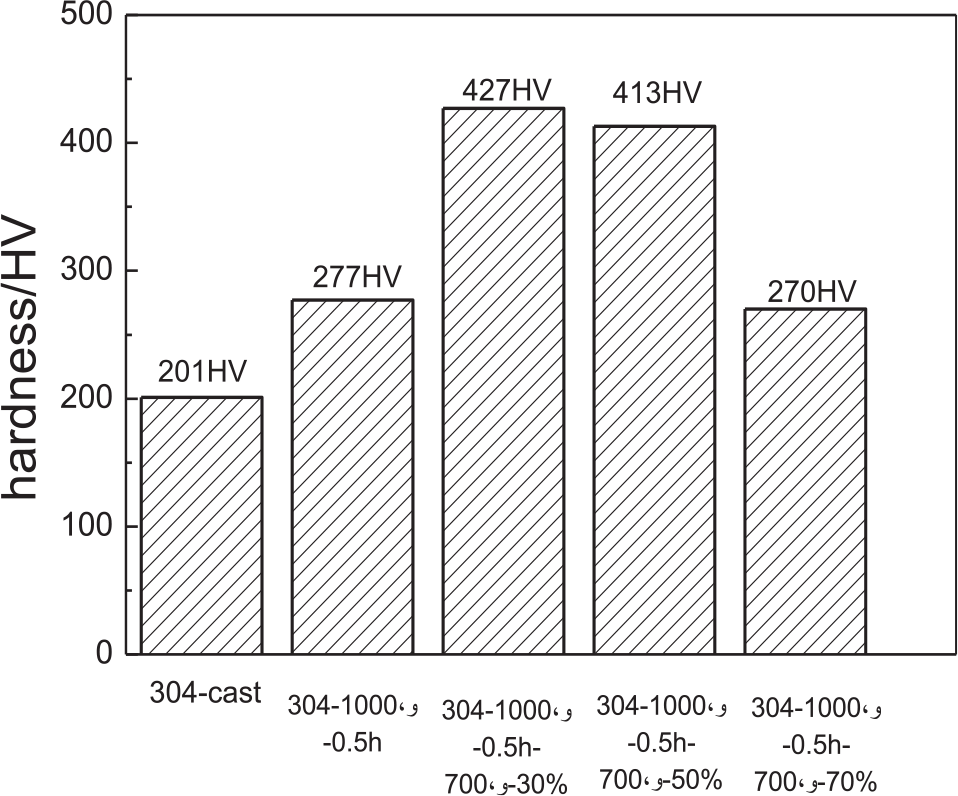
Histogram of mechanical properties.
Discussion
The present investigation is focused on the effect of hot rolling on the tensile properties and microstructure evolution of 304 stainless steel. Compared with casting steel, microstructure and tensile properties of cast steel were reported formerly.15–17 The cast steel consists of nanocrystalline and microcrystalline austenite phases which prepared by an aluminothermic reaction and the effect of the rolling process on the grain size is complicated. After rolling, the mean grain size of the nanocrystalline increased speedily due to the annealing during the process of rolling, but the mean grain size of submicron crystalline austenite decreased due to continuous DRX. The results show that the mean grain size of submicron crystalline austenite decreasing in the 304 stainless steel through multiple rolling at 700°C is correlated with the development of a type of continuous DRX.
During the Hall–Petch relationship, when the grain size decreases, the strength increases.18–20 Therefore, after rolling with 70% deformation, a portion of the grain broke down to nanocrystalline; it can be seen from Figure 4(a) that the nanocrystalline grain dispersed uniformly in the matrix. The mean grain size of nanocrystalline is 85.5 nm, and the volume fraction of nanocrystalline grain increased. The effects of rolling thickness reduction on the hardness of annealing steel are shown in Figure 6; as shown in Figure 6, increased hardness when the deformation was 30% and 50% is related to the production of the nano-grained structure, while decreased hardness when the deformation was 70% is due to the grain growth. For instance, the strain rate is not at all fixed during hot rolling, and it decreases rapidly when the maximum strain is approached. 21
Conclusion
The present study was designed to determine tensile properties and the effect of rolling thickness reduction on microstructure and of nanocrystalline/microcrystalline 304 stainless steel. The results of this study indicate that the nanocrystalline grains grow up after rolling to a thickness reduction of 30%, 50%, and 70% at 700°C, the submicron crystalline grains were broken down and dispersed better in the matrix of the steel, rolled steel greatly increased its mechanical properties, as the deformation increased from 30% to 50%, the tensile strength increased from 650 to 1110 MPa, the yield strength increased from 400 to 665 MPa, the elongation increased from 8% to 8.5%, the hardening increased from 201 to 413 HV after rolling to a thickness reduction of 50%; the tensile strength, yield strength, and elongation were the best in the reported value of the steel.
Footnotes
Acknowledgements
The authors declare that they have no financial and personal relationships with other people or organizations that can inappropriately influence this work. There is no professional or other personal interest of any nature or kind in any product, service, and/or company that could be construed as influencing the position presented in, or the review of, the manuscript entitled, ‘Effect of multiple warm rolling on microstructure and mechanical properties of 304 stainless steel prepared by aluminothermic reaction’.
Handling Editor: James Baldwin
Author’s note
H Abdelrahim is also affiliated with Department of physics, Faculty of Science and Technology, University of Shendi, Shendi, Sudan.
Declaration of conflicting interests
The author(s) declared no potential conflicts of interest with respect to the research, authorship, and/or publication of this article.
Funding
The author(s) disclosed receipt of the following financial support for the research, authorship, and/or publication of this article: This work is supported by the National Natural Science Foundation of China (51561020).
