




Abstract
In this article, a design sensitivity analysis method is developed for topology optimization of steady-state conductive thermal problems subject to design-dependent thermal loads using density gradients–based boundary detection. In a real physical heat conduction problem, a design-dependent thermal load through the convective boundary is an important factor; however, it is not easy to impose boundary conditions in heat conduction problem due to the difficulties of exact boundary representation. Here, the detection of convection boundaries is available by the density distinction between void and materials, which is similar to a gradient operator in image processing. Applying density gradients and Dirac delta function of densities, we impose a design-dependent load effect on thermal analysis and perform the design sensitivity analysis for topology optimization. At each optimization process, it is noted that the results of thermal analysis and the design sensitivities are influenced by the design-dependent thermal load. Through demonstrative numerical examples, the proposed approach using density gradients is proven to work yielding meaningful optimization results. The developed approach is applicable to the plant engineering and nuclear industries where thermo-mechanical coupling occurs inevitably by the thermal convection.
Keywords
Introduction
A topology design optimization method is to search for a suitable material layout to maximize the system performances under design constraints. Since a homogenization-based topology optimization approach has been introduced by Bendsøe and Kikuchi, 1 many topology optimization methods of structural and thermal problems have been developed. 2 Among them, the density-based optimization method is known easy for implementation perspective than others. In this method, a bulk material density as a design variable varies from zero to unity representing the void state and solid state, respectively, to define the material in the continuum design domain.3–5
Topology optimization in heat transfer problem has been an active topic during the last 20 years. The review paper by Dbouk 6 summarizes well the researches for optimizing two-dimensional and three-dimensional thermal problems based on conductive,7–10 convective,11,12 and conjugate heat transfer.13,14 In the heat conduction problem, there are three representative loads – internal thermal flux, heat generation, and heat transfer through conduction or convection boundaries. The internal thermal flux is a dead load about to design, and others are affected by the design change during the optimization process that is called a design-dependent load. Generally, there have been many trials to apply them optimization process. Gersborg-Hansen et al. 15 applied design-dependent loads as internal heat generation–related domain, using finite volume method. Bruns 16 considered the heat convection which arises to bulk material density over the domain, using finite volume method. Iga et al. 17 introduced heat transfer coefficients concerning shape dependencies. Joo et al. 18 adopted a surrogate model to consider natural convection in the topology optimization process. Recently, Makhija and Beran 19 performed a concurrent shape and topology optimization for steady conjugate heat transfer problem. Convective heat transfer is design-dependent by nature and the accurate boundary consideration is a core part of this subject.
To consider the convection heat transfer accurately through the boundary, we adopt an implicit boundary concept similar to a level set function.20,21 Detection of convection boundaries is available by the density distinction between void and materials, which is similar to a gradient operator in image processing. Applying density gradients and Dirac delta function of densities, we impose a design-dependent load effect to heat conduction analysis and perform a design sensitivity analysis (DSA) for topology optimization. At each optimization process, it is noted that results of thermal analysis and design sensitivities are influenced by the design-dependent thermal load due to the boundary change. The proposed boundary detection technique with density gradients provides a simple but accurate boundary representation applicable in the topology optimization with the design-dependent thermal loads.
Heat conduction problems and convective boundary detection
We consider a body occupying an open domain

Heat conduction body in space.
Here a steady-state heat conduction equation with the internal heat generation Q in the body is written as 22

where T is a temperature field and


and

where
Using the virtual temperature field

Equation (5) is regarded as a principle of virtual work. Applying the boundary conditions in equations (2)–(4), equation (5) can be rewritten as 22

A bilinear thermal energy form is defined as 22

and a linear load form is given by 22

Equation (6) can be rewritten as

During the optimization process, the heat convection boundary plays a critical role and needs to be detected to capture the topological change exactly. Here, we adopt Dirac delta function to apply the design-dependent effect. Using these functions, boundary integral terms in equations (7) and (8) can be converted 23


where

where a small positive number

Boundary detection using density gradients: (a) given density distribution, (b) detected boundary at
Continuum-based design sensitivity analysis
Direct differentiation method
In this section, a shape sensitivity analysis considering a non-shape design variable vector

where the subscript

Using equation (14), we obtain the first-order variations in equation (13) with respect to the design variable

and

where the symbol “∼” indicates the suppressed dependence on design variation.
By the chain rule of differentiation and equation (15), the following equality holds 22

The first-order variation of equation (15) using equations (16) and (17) gives 22

Next, a general performance functional written in integral form is considered as 22

By taking the first-order variation of the performance functional gives the following expression 22

Through this article, the prime symbol represents the first-order variation in the calculus of variations.
Adjoint variable method
Next, we define an adjoint equation for the given heat conduction problems. The adjoint equation is obtained by replacing the implicit dependence terms in equation (20) by a virtual temperature

Since

and
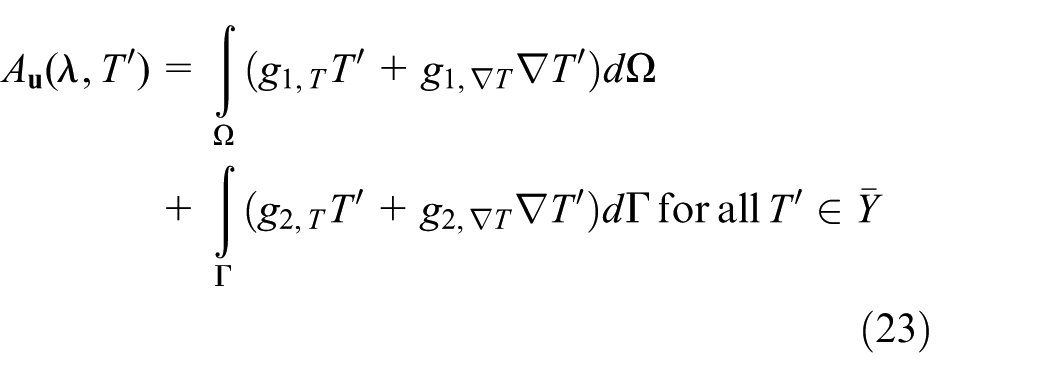
Utilizing the property of a symmetric operator,
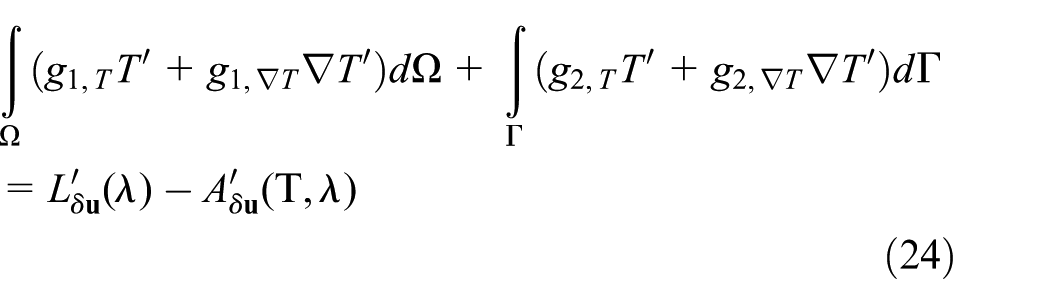
Substituting equation (24) into equation (20), we have 22

The computational efficiency and accuracy of the obtained adjoint equation are demonstrated in “Numerical examples” section.
Formulation of topology design optimization with convection boundary
In the topology optimization of thermal systems, the objective is to find the material distribution minimizing the thermal energy in the system under prescribed thermal loadings. A normalized bulk material density function u defines the material distribution. It has a continuous value from zero to one that implies void state and solid material, respectively. In the finite element method in which the material properties shape functions are defined inside each element, the bulk material densities are constant in each element and they are used as design variables associated with the thermal conductivity as


where


where
For the structural or thermal optimization problems dealing with convex problems, gradient-based optimization methods are preferred. It requires the design sensitivity, that is, the change of the performance measure with respect to the design variables. For this purpose, the continuum-based adjoint variable method is known to be the most efficient and accurate.
For thermal compliance functional

The adjoint equation for thermal compliance is rewritten as

The first-order variation of the performance functional, that is, compliance sensitivity using equation (25) is obtained as

Using equation (31), equation (32) is reduced to

Numerical examples
Example 1: design sensitivity verification with convection boundary
This example is to verify the proposed DSA method in the temperature field and the effects of applying the convection boundary to optimization. Consider a square plate composed of 2500 plane elements and 2601 nodes as shown in Figure 3. The ambient temperature is 0°C. Heat flux,
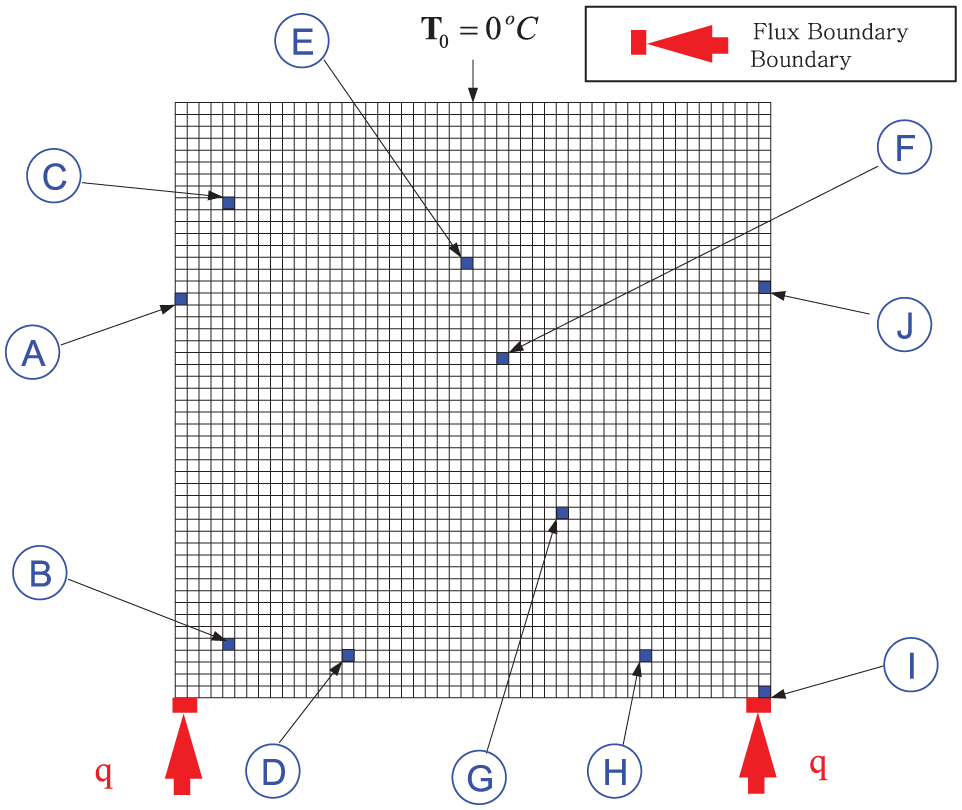
Square plate subjected to thermal boundary conditions.

(a) Bulk material density distribution and (b) heat convection boundary.
The thermal compliance sensitivity of each element with respect to the design variable is plotted in Figure 5. As expected, the sensitivity values of the thermal compliance are sensitive at a high material density or heat convection boundary.

Thermal compliance sensitivity.
The obtained sensitivity values by the adjoint variable method are compared with the finite difference sensitivities during the optimization process in Table 1.
Design sensitivity comparison.

Only 0.15 s is required for the AVM, which does only 0.05% of CPU time for the finite difference one in Table 2. This huge difference is caused by the heat convection term calculation related
CPU time comparison.

FDM: finite difference method; AVM: adjoint variable method.
Example 2: topology optimization with convection boundary
To understand the effect of convective heat flux, two topology optimization examples are considered for the coefficients of convective heat transfer,

Topology design results by heat convection boundary (
The first case solves a square domain model subjected to heat flux
Due to the small value of the convection coefficient, the difference between the two cases is not much. To investigate the effect of topology optimization, the temperature distributions in the two cases are compared. From Figures 6(d) and (e), the overall temperature with the convection boundary is lower that one without convection boundary, as is expected. It can be thought that thermal energy can flow in and out more easily, through the convection boundary. As shown, the effect of heat convection is clearer in the comparison of temperature distribution, showing a smooth transition of temperature profiles.
Figure 7 shows the optimization history without convection boundary and with convection boundary. As we can surmise from Figure 6(d) and (e), the thermal compliance with convection boundary has a smaller value than without one. Different to Example 1 with a simple boundary, the support length

Optimization history for case 1 (
To assess the effect of the convective heat transfer, the same rectangular model is evaluated using the different value of the convection coefficient,

Topology design results by heat convection boundary (
Figure 9 shows the optimization history without convection boundary and with convection boundary. Thermal compliance with convection boundary goes somewhat up and down, but it converges to a smaller value than without one.
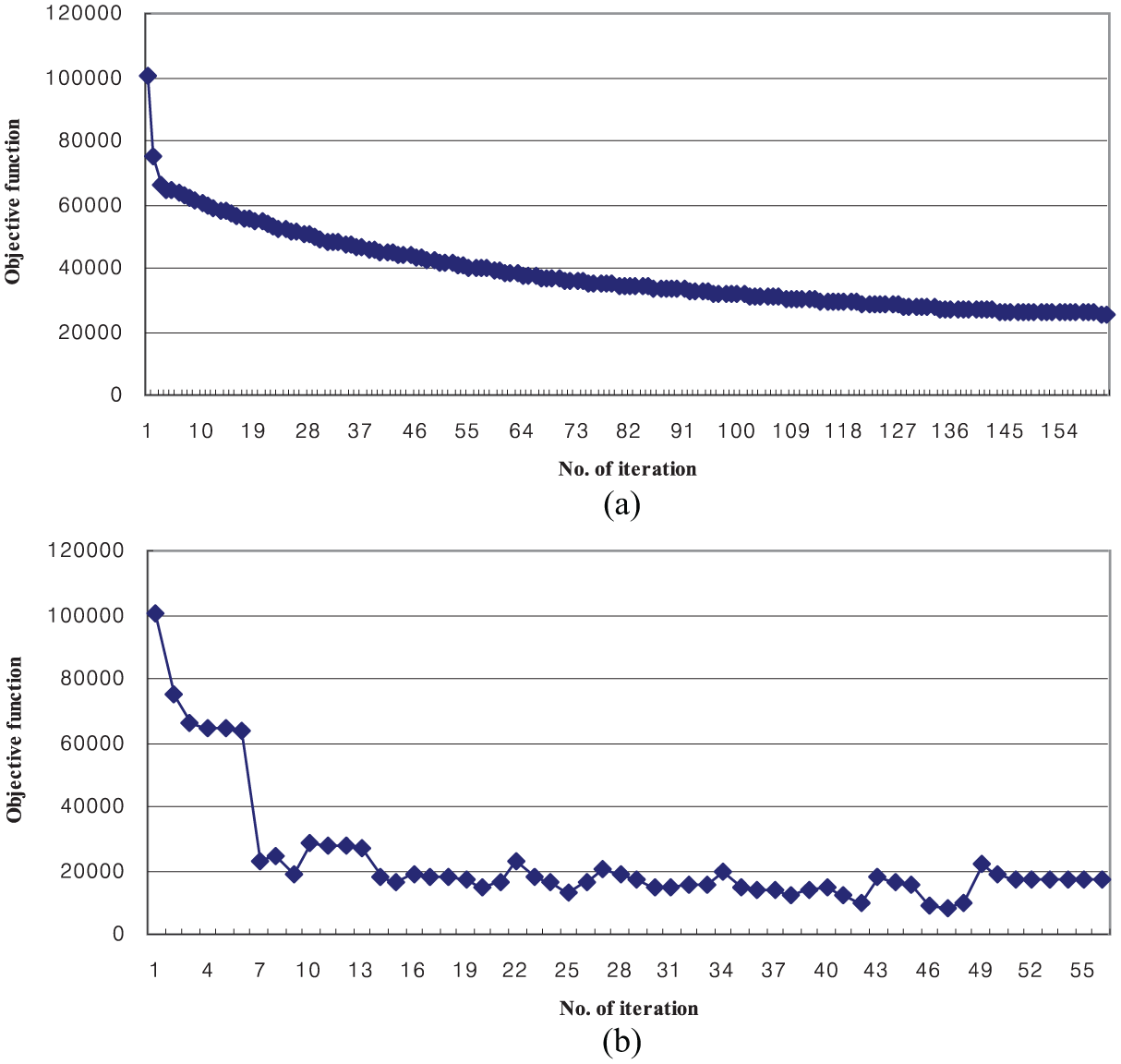
Optimization history for case 2 (
Conclusion
To describe the boundary geometry in the topology optimization of conductive thermal problems with heat convection, we propose the density gradients–based boundary detection approach. Using the proposed technique, a weak formulation for conductive thermal problems including heat convection in steady state and the continuum-based adjoint DSA method are derived for topology optimization. In heat conduction problem subject to design-dependent load, the sensitivity term of convective heat flow plays a role significantly if the temperature difference between solid and fluid is much.
Through several numerical examples, the accuracy of the analytical adjoint DSA method is compared to the finite difference sensitivity showing good agreement. Through demonstrative numerical examples, the proposed approach using density gradients is proven to work yielding meaningful optimization results. In the consideration of design-dependent thermal loading, we obtain different topology designs depending on the heat flow through the convection boundary. The proposed boundary detection technique with density gradients provides a simple but accurate boundary representation applicable in the topology optimization problems subject to the thermally design-dependent loads and it is applicable to the plant engineering and nuclear industries where thermo-mechanical coupling occurs inevitably by the thermal convection.
Footnotes
Handling Editor: James Baldwin
Declaration of conflicting interests
The author(s) declared no potential conflicts of interest with respect to the research, authorship, and/or publication of this article.
Funding
The author(s) disclosed receipt of the following financial support for the research, authorship, and/or publication of this article: This work was supported by the National Research Foundation of Korea (NRF) grant funded by the Korea government (Ministry of Science, ICT, and Future Planning) (no. NRF-2018R1D1A1B07050370), and the Human Resources Development Program (grant no. 20174010201350) of the Korea Institute of Energy Technology Evaluation and Planning (KETEP) grants funded by the Korea government (Ministry of Trade, Industry, and Energy).
