



Abstract
In this study, the micro–macro properties of plastic concrete mixed with low-liquid limit clay were explored, including the mechanical properties, deformation, impermeability, triaxial stress–strain curve, hydration products, phase composition, and pore structure. The results showed that the strength of the plastic concrete decreased with the increase in clay content. When the clay content was 140 kg/m3, the compressive strength and elasticity modulus/strength ratio at 28 days were 3.77 MPa and 316, respectively. The average water-absorption rate of plastic concrete was 10.4%, and the relative permeability coefficient was about 10−7−10−8 cm/s. The stress–strain curves obtained from the triaxial test indicate softening behavior, and the volume change–axial strain curves indicate expansion. The variation in strength showed good linearity with the increase of confining pressure, and the corresponding model parameters were obtained. In addition, micro-analysis showed that the types of hydration products in the hardened paste with different clay contents were almost the same, but the intensity of each diffraction peak was different. As the curing age increased, the degree of hydration of the paste increased, internal pore diameter became smaller, and structural integrity was improved. This study aims to enable the use of local low-liquid limit clay resources to reduce engineering cost and adjust the performance of concrete.
Keywords
Introduction
Plastic concrete is a commonly used anti-seepage material for walls since it possesses considerable strength, lower elasticity modulus, higher impermeability, and adaptability to deformation.1,2 During the preparation, a part of the cement in concrete was replaced by clay, bentonite, or other admixtures. The application of plastic concrete in construction began in the 1970s. It was initially used for anti-seepage walls suitable for medium and low water heads, followed by those for anti-seepage walls of high water head in the 1980s. 3 In China, plastic concrete was used for the anti-seepage wall of a cofferdam in the Shuikou Hydropower Station for the first time in 1989. 4 After that, it was used in a number of other hydropower projects, such as the Xiaolangdi dam, auxiliary dam of the Danjiangkou reservoir, and the first and second stage cofferdams of the Three Gorges project. 5 Hitherto, plastic concrete has been extensively used for such purposes as dam construction, dam reinforcement, cofferdams, foundation anti-seepage, and waste landfill. 6
There are many studies on the mix design and performance testing of plastic concrete. Studies have shown that the strength and elasticity modulus of plastic concrete decrease with the increase in clay content or water–binder ratio, and that the permeability coefficient increases as the intensity decreases.1,3,5 It is also known that the compressive strength can be greatly improved under biaxial compression. In addition, the triaxial stress–strain curve exhibits elastic characteristics at the initial stage, following which severe plastic deformation emerges. With the increase in the confining pressure, the strength and peak strain of plastic concrete also increase.7,8 Cement, bentonite, weathered sand, and water reducer were used to prepare plastic concrete in the second-stage cofferdam of the Three Gorges project. The mixture was uniform and possessed excellent separation resistance. The 28-day uniaxial compressive strength of the plastic concrete reached 5 MPa, and the initial tangent modulus was close to 1000 MPa, which was similar to that of the dam body and dam foundation. Moreover, the modulus/strength ratio was 202, and the permeability coefficient was less than 1 × 10⁻⁷ cm/s.1,5,9
The low-liquid limit clay, a material whose properties are intermediate to non-cohesive and cohesive soils, possesses low-liquid limit, small plasticity index, low strength, poor water stability, and reduced compactability. 10 Studies have shown that low-liquid limit clay can effectively improve the fluidity, cohesiveness, and water-retention capability of the mixture, and greatly delay the setting time of concrete. 11 However, to the best of our knowledge, a systematic study on the use of low-liquid limit clay for plastic concrete has never been undertaken.
The Suwalong hydropower station, which is located in the upper reaches of the Jinsha River, has a cofferdam cutoff wall made of plastic concrete. Considering the locally available low-liquid limit clay resources, the developer hopes to incorporate the clay into the plastic concrete to reduce the engineering cost and adjust the performance of the concrete. In this study, micro–macro test methods were used to carry out experimental studies on the mechanics, deformation, and impermeability of plastic concrete with low-liquid limit clay, as well as the micro-properties of the hydration products and the pore structure of the hardened paste. The objective is to make full use of low-liquid limit clay by leveraging its advantages and limiting its shortcomings, to prepare plastic concrete that has good performance and meets the design requirements.
Materials and mix proportion design
Raw materials
The cement used in this study was ordinary Portland cement (P·O 42.5, from Huaxin Cement Plant, P.R. China). The clay was obtained from the Suwalong hydropower station in the Jinsha River, and the physical properties and chemical compositions of the clay after screening are presented in Tables 1 and 2. It can be seen from Table 1 that the clay proportion was 26.0%, and the plasticity index was 14.8. The main components were SiO2, Al2O3, and CaO. According to the SL 237-1999 (Specification of soil test, China), 12 this clay can be classified as low-liquid limit clay (WL < 50%).
Experimental results of clay properties.

Chemical compositions of clay (%).

Comparative tests showed that 10%, 20%, and 30% of the clay was blended into the cement mortar to achieve the same fluidity, the water demand ratio of the slurry was 101%, 102%, and 104%, respectively. It can be seen that the low-liquid limit clay in this test will increase the water consumption of the cement mortar concrete.
The quality of the crushed aggregates met the requirements of DL/T 5144-2015 (Code for construction of hydraulic concrete, China), 13 the particle size of coarse aggregates is not more than 15 mm, and the particle size distribution of fine aggregates was shown in Table 3. A high-performance polycarboxylic acid water-reducing agent was employed, and the quality met the requirements of GB 8076-2008 (Concrete admixture, China). 14
The particle size distributions of fine aggregates (%).

Mix proportion design
Based on the structure, construction requirements, and characteristics of local raw material of the Suwalong cofferdam, the design index was determined as the slump of fresh concrete from 180 to 220 mm, air content of 3.5%–5.0%, compressive strengths exceeding 3 MPa at 28 days, and the modulus/strength ratio below 350, in order to meet the engineering requirements regarding the deformation of a cofferdam on a deep overburden.
At present, there is no uniform Chinese standard for plastic concrete mix design. The mix proportion of plastic concrete was designed using the mass method. Assuming that the apparent density of concrete was 2200 kg/m3, the quality of cement and clay is pre-recommended, and subsequently, the amount of sand and gravel is calculated on this basis. Through a mixing test of plastic concrete, the unit water consumption required to meet the performance requirements is determined. The amount of concrete components is optimized according to the mechanical, deformation, and durability requirements of the plastic concrete, and the optimal mix ratio that meets these design requirements is recommended.
Moreover, the mixing, forming, and testing of plastic concrete were carried out in accordance with DL/T 5303-2013 (Testing methods for hydraulic plastic concrete, China). 15 The mix proportion of the plastic concrete and mixture properties are shown in Table 4. The water-reducing agent accounted for 0.6% of the mass of cement and clay. The results showed that the plastic concrete mixture had good flow properties with no bleeding or segregation problems.
Mix proportion of plastic concrete and mixture properties.

W/B: water–binder ratio.
Results and discussion
Mechanical properties
Cubes having a size of 150 × 150 × 150 mm were used for the compressive and splitting tensile strength tests of plastic concrete, while cylinders with the size Φ150 × 300 mm were employed for tests of the static compressive elastic modulus. The results of mechanical property tests are given in Table 5. The effect of cement dosage on the compressive strength of plastic concrete can be seen from Figure 1, while the effect of clay dosage on the compressive strength of plastic concrete is shown in Figure 2.
Mechanical properties of plastic concrete.

W/B: water–binder ratio.
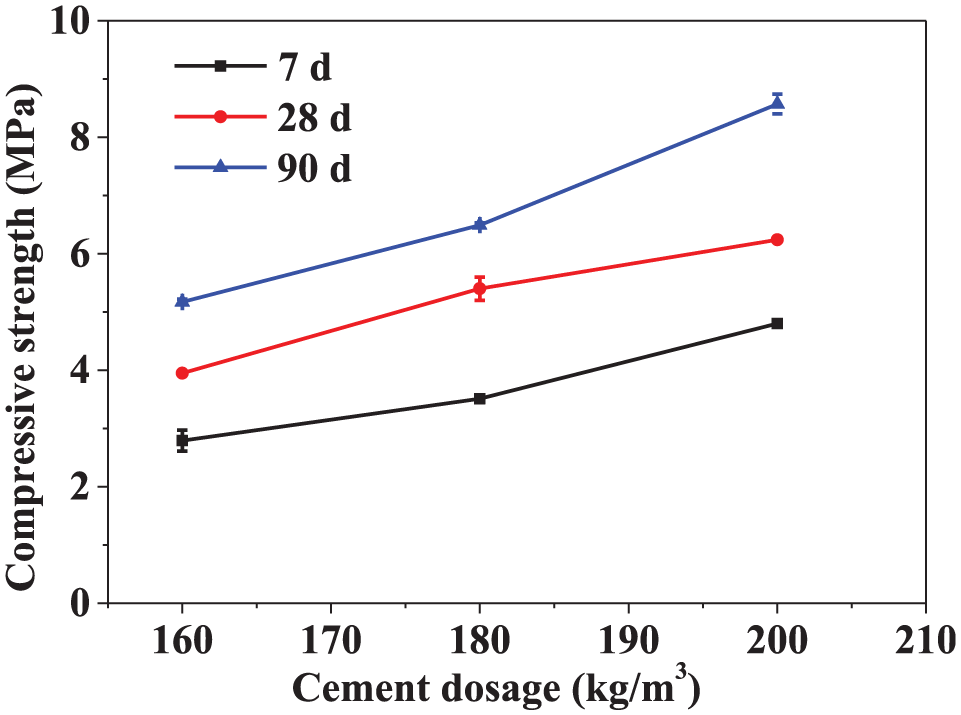
Effect of cement dosage on the compressive strength of plastic concrete.

Effect of clay dosage on the compressive strength of plastic concrete.
The results indicated that the compressive and splitting tensile strengths of plastic concrete gradually increased with the increase of cement dosage, or the decrease of clay content. The water–binder ratio is one of the main factors affecting the mechanical properties of concrete. Generally, the strength of concrete decreases as the water–binder ratio increases. In Table 5, when cement dosage is fixed at 160 kg/m3, although the water–binder ratio is reduced, the strength of plastic concrete is lowered because the clay content is increased. So, the influence of cement and clay content on the properties of plastic concrete is greater in this test. It can be seen from Table 5 that when the clay content was 140 kg/m3 and the cement content was 100 kg/m3, the compressive strength at 28 days could exceed 3 MPa. In addition, the modulus/strength ratio of the plastic concrete was between 299 and 316, and the tension/compression ratio was between 7% and 11%. Thus, it could be surmised that the toughness of the plastic concrete was higher than that of ordinary concrete.
Previous studies have shown that the coagulation hardening of plastic concrete was actually the development of plasticization and solidification. 9 On the one hand, the low-liquid limit clay used in the experiment had strong water-absorption ability and poor water stability that led to a decrease in the strength of the plastic concrete, which was termed as the plasticization effect. On the other hand, with the progress of cement hydration, the solidification effect of the cement–soil–water phase was greatly enhanced, causing a relative weakening in the plasticization effect of the soil–water system, thus leading to an increase in the strength of the plastic concrete.
Impermeability properties
The average water absorption of the plastic concrete was calculated by weighing the dry and saturated test pieces. The water absorption was measured as 10.4% by weight, which was significantly larger than that of ordinary concrete (3%). 16
According to the regulations of DL/T 5303-2013, the impermeability properties of plastic concrete were determined. The water pressure is raised to 0.8 MPa and is maintained constant for 24 h. The relative permeability coefficient is calculated by the expression

where k is the relative permeability coefficient (cm/s); Dm is the water seepage height (cm); H is the water pressure, expressed by water column height (cm), 1 MPa water pressure equals 10200 cm water column height; t is constant water pressure time (s); and a is the water absorption of specimen (%).
The test results of impermeability properties are shown in Figure 3. It can be seen that the results of different specimens vary widely. The water-penetrating time was between 3.8 and 18.1 h, and the relative permeability coefficient was between 4.41 × 10⁻⁸ and 2.66 × 10⁻⁷ cm/s. With the increasing of cement content and the resulting concomitant reduction of the clay content, the water-penetrating time was prolonged and relative permeability coefficient was decreased, and as a result, the impermeability of plastic concrete was more pronounced.

Impermeability of plastic concrete mixed with low-liquid limit clay: (a) the water-penetrating time and (b) relative permeability coefficient.
In order to facilitate the construction, a large quantity of water is usually required to ensure that the plastic concrete mixture has sufficient fluidity. The free water that is not involved in the hydration process could evaporate leaving a large number of pores, and thus forming a non-homogeneous porous structure. Therefore, water seepage occurred in all the concrete specimens under continuous water pressure of 0.8 MPa. However, another point of view indicates that the clay ratio of the low-liquid limit clay was 26.0%, and the montmorillonite and kaolinite in the clay were layered, which could swell in water. Then, the components would squeeze each other, improving the compactness and impermeability of the plastic concrete.17,18
Static triaxial test
Static triaxial tests of plastic concrete No. S4 (cement: 180 kg/m3, clay: 100 kg/m3, and volume sand ratio: 80%) were carried out using strain-controlled triaxial apparatus. The confining pressures exerted on the Ф101 × 200 mm cylindrical concrete specimen were 100, 200, 400, and 800 kPa. The axial deformation rate was 0.16 mm/min, and the specimens were allowed to vent and drain during the shearing process. The strength and deformation characteristics of plastic concrete were investigated by measuring the confining pressure, deviatoric stress, axial strain, and volumetric strain, and the E–μ and E–B nonlinear stress–strain parameters were obtained. The triaxial test results of the plastic concrete were shown in Figure 4.
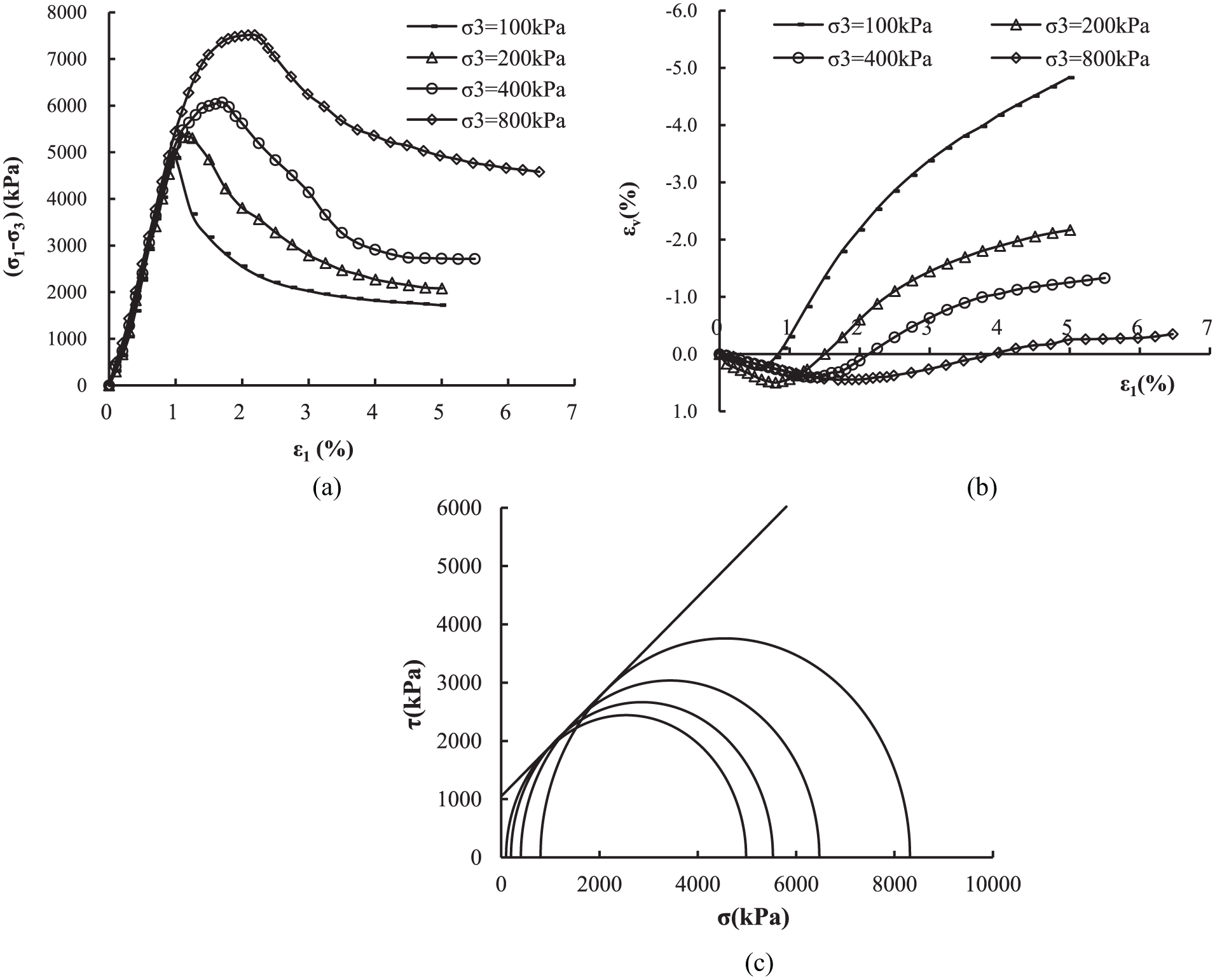
Triaxial test results of plastic concrete: (a) stress–strain relationship, (b) volume–strain relationship, and (c) Moore stress circle.
The stress–strain curves obtained from the triaxial test indicate softening behavior. When the axial stress reached the peak value, the stress decreased rapidly and finally stabilized. Furthermore, the volume change–axial strain curves indicated expansion, and the smaller the confining pressure, the greater the expansion of the specimen. It could be seen that the strength of the plastic concrete showed good linearity with the increase in confining pressure, and the Mohr–Coulomb strength model could be used to describe the strength characteristics of the plastic concrete. The Mohr–Coulomb strength, stress–strain, and volume change parameters of the plastic concrete were calculated and are summarized in Table 6.
E–μ and E–B model parameters of triaxial test of plastic concrete.

In Table 6, the parameter c represents the cohesion of the soil; the parameter
Specimens of plastic concrete after the triaxial test are shown in Figure 5. The specimens had obvious shear planes, and the axial strain was approximately 3%. The angle between the shear plane and the minor principal stress σ3 was approximately 45° + φ/2. The result also verified that the strength of the plastic concrete obeyed the Mohr–Coulomb strength criterion.

Specimens of plastic concrete after triaxial test.
Microscopic analysis
Morphology of hydration products
Scanning electron microscopy (SEM) was used to analyze the morphology of cement paste mixed with low-liquid limit clay, as shown in Figure 6. In order to meet the test requirements and ensure the accuracy of the results, the water–binder ratio of paste was 0.5, the cement dosage was 200 kg/m3, and clay content was 100 kg/m3.

Morphology of cement paste mixed with low-liquid limit clay: (a) 7 days × 1500, (b) 7 days × 5000, (c) 28 days × 1000, and (d) 28 days × 5000.
It can be seen that the presence of low-liquid limit clay does not change the type of cement hydration products in the sense that no new substance appears, but only affects the hydration progress and internal structure of the cement paste. At the hydration age of 7 days, randomly distributed slender fiber-like ettringite with the size of 5–10 μm could be observed. There were also debris-like unhydrated cement and clay, along with some scattered pores. The cement paste was loosely structured. At a 28-day hydration age, the degree of hydration increased. Some fine velvety hydration products were found in the pores and on the surface of the unhydrated particles. The structural integrity was enhanced, but pores still existed. The low-liquid limit clay has the tendency to swell after water absorption, thus reducing the structural compactness of the paste, which is consistent with the macroscopic performance.
However, a definitive conclusion regarding the impact of clay on cement hydration has not yet been reached. Morsy and Hanna 19 showed that Ca(OH)2 in the cement hydration liquid phase reacts with clay particles, causing the disintegration of amorphous calcium silicate and calcium aluminate. Other studies have shown that clay can be incorporated into the cement, forming a new hydration product CnAHn. 9 The variation in the results of the different studies may be due to the different mineral components in the clay.
Phase analysis
X-ray diffraction (XRD) was performed to investigate the hydration products of cement paste mixed with low-liquid limit clay, and the results were shown in Figure 7. The water–binder ratio of paste was 0.5, the cement dosage was 200 kg/m3, and the clay content was 60, 100, and 140 kg/m3, respectively.
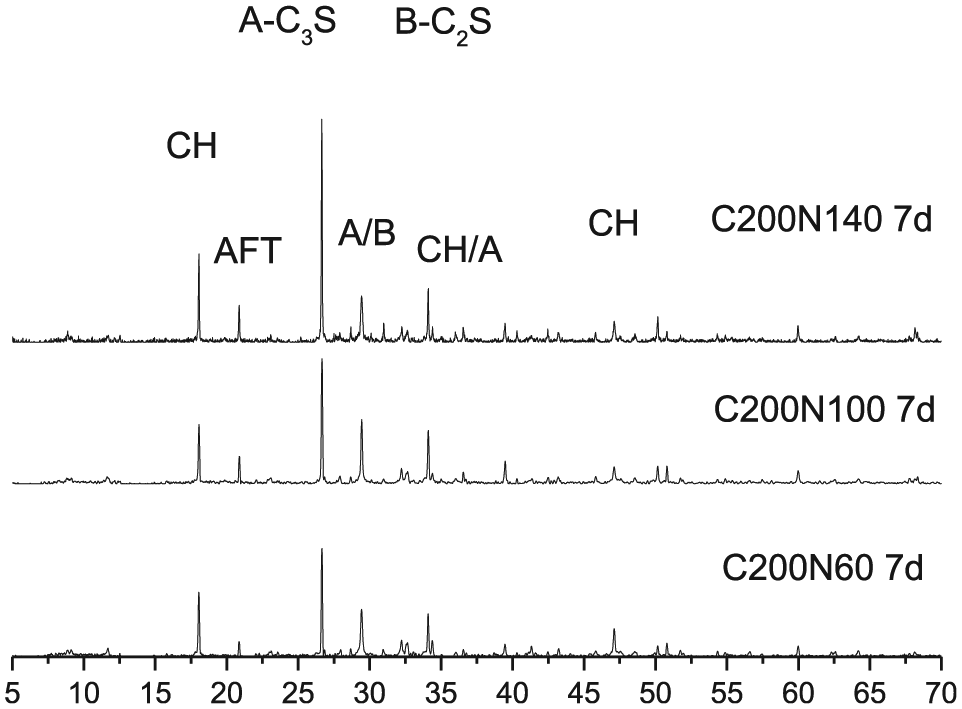
XRD spectra of hydrated products of cement paste mixed with low-liquid limit clay.
It could be seen that the hydrated products of cement paste mixed with low-liquid limit clay were Ca(OH)2 and ettringite (Aft) in addition to mineral components such as unhydrated clinker phase (C3S, C2S) and quartz (SiO2). Since the C-S-H gel was amorphous, it could not be detected by an XRD test. The types of hydration products in the hardened paste were all the same for samples with different clay contents, but the intensity of each diffraction peak was different. Obviously, an increase in the amount of clay led to the formation of more unhydrated phases.
Using the same methods, Fernandes et al. 20 also studied the reaction between clay and cement particles. The results show that clay is a hydrated layered silicate mineral, and its incorporation into the cement does not affect the hydration reaction of the cement.
Pore structure analysis
The pore structure of the hardened cement paste mixed with low-liquid limit clay was measured by mercury intrusion porosimetry (MIP), and the results are shown in Table 7 and Figure 8. The mix proportions of cement pastes used for MIP are the same as that of XRD.
Pore distribution of cement paste with low-liquid limit clay.


Comparison of pore distribution of cement paste with different clay content.
When the clay content was between 60 and 140 kg/m3, the distribution and development rules of pore structure were basically the same. As the age of concrete increased, the degree of hydration of paste increased and the internal pore diameter became smaller.
According to the classification of Wu and Lian, 21 the pores in cement concrete are divided into considerably harmful pores, harmful pores, less harmful pores, and harmless pores on the basis of pore diameters as greater than 200 nm, 100–200 nm, 20–100 nm, and less than 20 nm, respectively. At 7-day hydration ages, the proportion of considerably harmful pores was the highest. The proportion of such pores decreased significantly at the age of 28 days, while the number of less harmful pores and harmless pores greatly increased.
Pore structure has a decisive influence on the properties of concrete. By removing the harmful pores and increasing the number of less harmful and harmless pores, the strength and compactness of concrete can be significantly improved. When the clay content was 100 kg/m3, the number of less harmful pores and harmless pores was growing fastest at 28 days, which was consistent with the trend of rapid development of concrete strength.
Conclusion
The strength of plastic concrete mixed with low-liquid limit clay gradually increased with increasing cement dosage and the concomitantly decreasing clay content. Clay content had a great influence on the strength of the plastic concrete. When the clay content was 140 kg/m3 and cement dosage was 160 kg/m3, the 28-day compressive strength still exceeded 3 MPa. The modulus/strength ratio of plastic concrete at 28 days was between 299 and 316. The mechanical properties meet the design requirements of plastic concrete pertinent to this project.
Water seepage occurred in all the plastic concrete specimens under a continuous water pressure of 0.8 MPa, and the relative permeability coefficient was approximately 10−7 or 10−8 cm/s. As the amount of cement used increased, the relative permeability coefficient decreased, and the plastic concrete became more impermeable.
The stress–strain curves obtained from the triaxial test indicate softening behavior. As the axial stress reached the peak value, the stress decreased rapidly and finally stabilized. The volume change–axial strain curves indicate expansion: the smaller the confining pressure, the greater the expansion. The variation in strength showed good linearity with the confining pressure, and the Mohr–Coulomb strength formula could be used to describe the strength characteristics of plastic concrete.
The hydration products of cement paste mixed with low-liquid limit clay were C-S-H, Ca(OH)2, Aft, and mineral components such as unhydrated clinker phase (C3S, C2S) and quartz (SiO2). There were more unhydrated phases when more clay was used. With the increase of age, the degree of hydration of the cement paste increased, internal structure gradually became denser, and pore diameter became smaller.
Footnotes
Handling Editor: Grzegorz Golewski
Declaration of conflicting interests
The author(s) declared no potential conflicts of interest with respect to the research, authorship, and/or publication of this article.
Funding
The author(s) disclosed receipt of the following financial support for the research, authorship, and/or publication of this article: The National Natural Science Foundation of China (no.51479011 and 51539002) and the Central Non-Profit Scientific Research Fund for Institutes (no.CKSF2019374/CL and CKSF2017052/CL).
