




Abstract
The article presents theoretical and experimental prerequisites for achieving an anomalous friction and wear adopted in tribology from the standpoint of modern physical theories and quantum-mechanical approach to the explanation of the energy dissipation under the external friction. The purpose of this study is to analyze the effect of oscillations generated in most of the tribosystems as a factor of achieving anomalous low friction and wear conditions from a position of the quantum mechanical approach to real tribosystems operating under conditions of dry and boundary friction. Microdisplacement optimal conditions at the actual contact points are achieved in this case by changing rheology of the surface layer.
Keywords
Introduction
Heat release is the main form of the absorbed internal energy resulting from external friction. In the presence of an “ideal” dissipative structure under the conditions of anomalous low friction and wear, a total balance will exist between the absorbed internal energy and the extracted heat, which is confirmed by experimental results.1,2 Such a thermodynamic cycle is related to a steady-state friction mode with a minimum wear rate, for which the energy expenditures are practically equal zero. In case the balance is disturbed with the external energy interaction exceeding the heat generation, part of the absorbed energy will start accumulating in the contact layers and transforming into other non-dissipative forms. This chain of energy transformations will be resumed until the absorbed internal energy is degraded into the dissipative-type energy and the balance between the supplied energy and the evolved heat is restored. When transferring tribosystems from the conditions of normal mechanochemical wear-out to the conditions of anomalous low friction and wear, 3 the supplied mechanical energy is absorbed by the surface layer of a friction object in the form of deformation elastic energy. Elastic oscillations in areas of actual contact have potential possibilities to be transformed, namely, dissipation happens—accumulation by the internal energy as the result of the kinetic state (acceleration) being the intermediate phase between the applied mechanical energy and its degradation due to the kinetic interaction.
These impacts refer to a reversible energy form. They control the processes of structural transformations and, in their further evolution, are approaching irreversible forms. The reversible energy forms possess potentials for transferring the internal energy absorbed from the external friction into other types of energy, in particular to decrease the accumulated energy in contact layers when energy interaction terminates. When analyzing tribosystems under conditions of anomalous low friction and wear, a number of scientists4,5 used waves of different nature for the surface layer structuring; however, this component of external friction was not considered as a channel of the external energy dissipation.
One of the first attempts to attract the wave component as dissipation channel is made in Pogodaev. 4 Author believes that under conditions of abnormally low friction and wear, a quasi-elastic layer is formed on the surface, in the central part of which the hydrodynamic deformation is hypothetically possible, while on the periphery of the transit zone we should expect intensive rotary elastoplastic deformation similar to the structure of vortex formation in the boundary layer of the flowing liquid. This approach, in our opinion, can be considered as a special case displaying the wave component of the frictional force being a dissipation channel of externally supplied energy.
Analysis of main achievements and publications
Achievements in the field of nanotribology are broadly summarized in Bhushan.
6
Through thermodynamic analysis of equilibrium conditions of self-organized tribosystems, which are subject to vibration influences, Michael Nosonovsky and Vahid Mortazavi1,3,7 arrive at an important conclusion that the self-organization of such tribosystems is carried out through the thermodynamic channel of excess entropy production
This theoretical approach was further developed in Gutowski and Leus, 8 which shows the effect of vibration frequency on friction and wear of the tribosystem “silicon against silicon nitride.” The tribometer allows generating both normal and tangential oscillations in relation to the friction plane. It was found that at frequency range 4–6 kHz, we observe decrease of the friction coefficient from 1 to 0.1, both for normal and tangential components of oscillations, as well as reduction of wear. Moreover, within this range, the oscillation amplitude is not critical for frictional force reduction starting from a certain limit value. Analysis of the very effect of reducing friction and wear was carried out without regard to the physical and mechanical properties of the investigated materials and the dissipation mechanisms for the externally supplied energy, though the rheology of the materials behavior is taken into account in the kinematic scheme of investigated tribosystems. The soundness of this approach is confirmed in Starcevic and Filippov. 9 As in Gutowski and Leus, 8 an effect of the specimen microdisplacements at vibration under conditions of dry friction was investigated. A large group of materials—from glass to structural steel—have been researched. The optimal area of microdisplacements was determined, where a minimum value of the relative friction coefficient was observed for all investigated materials (i.e. the ratio of the friction coefficient when moving to the coefficient of static friction). At the initial conditions of friction, it equals 1, while at friction under certain conditions of microdisplacement, it reaches anomalous low values. Unfortunately, this effect was not explained by methods of modern physical theories.
By having analyzed the studies of ultrasound and vibration oscillations in tribology,1,3,7 we can conclude that practically in all these studies, the wave component of the frictional force (introduced by the Stadnichenko and Troshin 3 and Zaporozhets et al. 10 in the expression for the frictional force with a minus sign) exists as a final result of the external wave impact on a tribosystem.
Goal of research
The purpose of this study is to analyze the effect of oscillations generated in most of the tribosystems as a factor of achieving anomalous low friction and wear conditions using the quantum-mechanical approach to real tribosystems operating under conditions of dry and boundary friction. The optimal conditions of microdisplacements at the actual contact points are achieved in this case by changing rheology of the surface layer.
Presentation of the basic theoretical material
The authors of this article managed to transit the tribosystem functioning from the normal friction to the anomalous low friction incidentally. While investigating tribosystem “Steel 40H (40X)—Bronze BrAZhN10-4-4 (БpAЖH10-4-4)” under boundary friction in the working fluid IGP-10 (ИГП-10), the load was increased by a certain program in order to achieve the optimal mode of breaking-in. Upon reaching the maximum operating load (18 MPa), the screw of loading device of the friction machine 2070 SMT-1 accidentally got off the heel, which in turn led to the tribosystem discharge. Trying to restore friction conditions to the original terms and conditions, the author squeezed spring, wearing the screw on the heel. The effect was stunning. All tribological parameters—frictional torque, average surface temperature, and wear rate, measured by the acoustic emission method 10 —reached anomalous low values for few seconds. Furthermore, this experiment was repeated for several times, and the results are presented in Stadnichenko and Troshin, 7 Gutowski and Leus, 8 and Zaporozhets et al. 10 Results of experimental studies provided grounds for a hypothesis that the explanation of the anomalous low friction is based on thermodynamic analysis of the kinetic interaction of quasi-elastic bodies.3,11
True frequencies generated by friction at the level of microroughness contact are in the range of higher frequencies 10 than were stated in the above papers. Moreover, these self-oscillations can have a significant effect on the reduction of friction and wear, leading those to an anomalous low value at a certain level of symmetry (harmonic resonance)—formation of traveling and standing waves recorded in the low-frequency range.
Thermodynamic analysis of externally supplied energy dissipation channels at the external friction carried out in Stadnichenko and Troshin3,7 showed that there were two levels of self-organization—equilibrium and non-equilibrium. In the first instance, there are the dissipative equilibrium structures, and in the latter, dissipative non-equilibrium structures. In the first instance, the equilibrium is achieved through the channel of the thermodynamic entropy, and in the latter instance, the self-regulation occurs through the channel of excess entropy production δ2Ṡ. According to the previous studies,3–13 who conducted analysis of external friction based on thermodynamics, the excess entropy production can only be positive. At the same time, the studies of self-organization for chemical techniques14,15 have shown that under conditions of non-equilibrium, the self-organization of the excessive entropy production can vary both in positive and negative directions. So, it is recognized that the dissipation and anti-dissipation processes can simultaneously exist both with heat release and absorption (Figure 1).
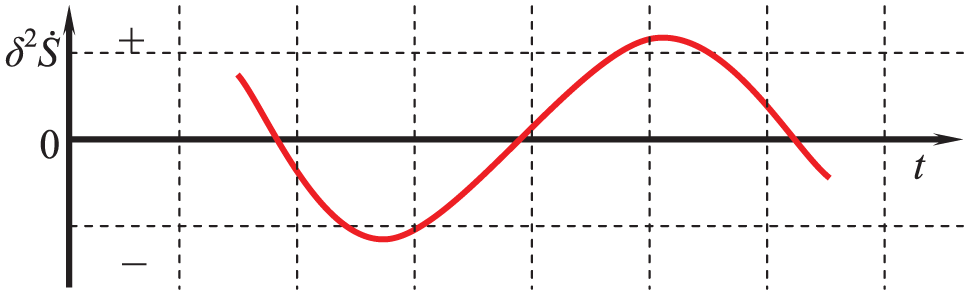
Production of excess entropy for non-equilibrium dissipative processes of self-organization. 16
Class of tribosystems operating under this principle and resulting from the natural evolution and transformation processes of motion have been combined by Fedorov 17 in the group of nominal tribosystems. More correctly, this group should be called tribosystems endowed with the properties of artificial intelligence. In addition to the synergistic and thermodynamic approaches applied for analysis of such tribosystems, application of the cybernetic approach would be logical, as it appeals to the direct linkages and feedback implementing the principles of evolution of living biological matter in the inanimate. Implementing the evolution principles of such kind of tribosystems allows for implementing the principle of maximum reliability at changing external conditions of friction (loading, velocity, temperature, etc.) above the stability boundary.
So, by analyzing kinetic interaction of this kind of rubbing bodies, V Veynik 18 hypothesized the possibility of both zero and negative friction in the tribology based on recognition of simultaneous presence of dissipation and anti-dissipation processes at elastic interaction of tribosystem elements. The dissipation processes are accompanied by the heat release (provided the molecular–mechanical interaction of the contact). The antidissipation process is accompanied by the heat absorption (at slippage in contact). According to VA Veynik, these processes of direct and reverse direction can be interpreted as the processes of plus and minus friction, and on this basis, a completely new interpretation of friction can be developed. The same opinion is shared by Fedorov. 17 The ability of achieving anomalous low friction and wear is associated by the author of this article with irreversible absorption of deformation energy arising through elapsing the reversible elastic-plastic deformation. As in the previous article, the thermal effect at the contact interaction is determined by the sum of two components—static and dynamic specific components of the energy dissipation

where
From our point of view, under the anomalous low friction and wear, the energy defects are of primary importance for the energy exchange. In modern understanding of friction and wear from a position of synergetics and thermodynamics of non-equilibrium systems, 3 the physical theories enable defining the physical meaning of the friction coefficient as the ratio of kinetic component of external friction to a gravity component (quasi-mass of friction performing work on the path of motion). 17 This approach just includes participation of the wave component in the self-regulation of energy flows and their transformation (dissipation) in tribosystems with artificial intelligence.
Let us explain the V Veinik’s position through analysis of the kinetic elastic interaction of micro-relief at movement of triboelements. On the ground of these studies, V Veinik
17
concluded that Newton’s second law and the law of gravity—which in fact make a single law
According to quantum mechanics, the energy and momentum associated with each normal vibration (each wave) are quantized, that is, they can take only discrete values that have a meaning, respectively, of the energy and momentum of the “elementary excitation” of the vibrational motion in the crystal. Each wave, in addition to its polarization (i.e. the direction of the displacement of atoms), is determined by the so-called wave vector, which direction coincides with the direction of propagation, and the value is inversely proportional to the wavelength (

These waves are ordinary sound waves (one longitudinal and two transverse waves), and the constant
Each such elementary excitation can be regarded as a quasiparticle with quasimomentum and energy (equation (3))

These quasiparticles are called phonons. They are, apparently, the simplest type of elementary excitations in solids. 17
Apparently, its value should be very small—this fact was confirmed by the discovery of gravitational waves made through the international collaboration—LIGO Scientific Collaboration and the Virgo Collaboration 19 —because it enters in a large number in each photon, the tiniest of all the particles is presently known.
One of the ways to achieve levitation (antigravity) is to attain a condition of standing wave formation in any physical body.18,20 The results of this approach allowed putting into practice the achievement of levitation for different physical bodies. Based on this model, Veynik 18 and Suhonos 20 proposed the concepts of unsupported antigravity engines of various types. Achievements of modern physical theories in the field of solid deformable body mechanics enable changing our vision on the mechanism of achieving anomalous low friction and wear radically. Up to the present, the selection of triboelements creating a positive gradient of hardness in the breaking-in process is used as such mechanism in tribosystems. At present, the transit from elastic to plastic contact is considered in such conditions. Elastic microdeformation in friction, in addition to thermal fluctuations, determines the dissipation of the mechanical energy of oscillations. Its absorption occurs in the material of parts and in the environment.
Under certain conditions of the operation of tribosystems, the appearance of a contact “antiresonance” mode (the traveling wave effect) is possible, which abnormally reduces the intensity of plastic deformation and the accumulation of damage. Thus, the wave component of the frictional force can be a factor intensifying the processes of friction and wear, as well as a factor in the transition to abnormally low friction and wear.
The stage of dynamic loading of friction surfaces, physicists, is rightly called the mechanism of pumping material by point and other defects, which lead to an increase of internal energy. The wave component under conditions of abnormalous low friction and wear leads on the contrary to its decrease.
As well known, in the theory of oscillations, the description of mass interaction dynamics by the Lagrange equations is the most common. A classic example of such description is the equation of a linear oscillator induced by the harmonic force,
The energy exchange in this case can be estimated according to the scheme proposed by Berkovych et al. 21
The elastic medium (triboelements, working medium), in which transverse and surface waves are generated and propagated, is estimated by the measure of the volume density of the kinetic energy of the medium

and the bulk density of the potential energy

where
The total energy resulting from the elastic interaction of the micro-roughness is

Since the volume density of wave energy depends on the coordinates and time, the rate of its transfer is equal to the speed of displacement in space. Achieving the quantum theory allows asserting that the energy of a wave is transported discretely by phonons.
This approach is presented theoretically in Fedorov
17
and experimentally is implemented in Zaporozhets et al.
10
In these studies, the quantum-mechanical approach was used for the first time to analyze the anomalously low friction, and the concept of mechanical quantum was introduced—the minimum number of atoms capable to ensure their configurational distribution of nanostructure, and which have properties to accept and dissipate (return) reversibly the energy of external mechanical motion. It is also the smallest structural formation under conditions of plastic deformation, and it is formed at the transit of a tribosystem (deformable volume) through utmost activated (critical) condition due to the development of self-organizational processes of tribosystem adaptation. To the extent of tribosystem, under conditions of anomalous low friction and wear (of the elementary tribosystem), the number of such mechanical quantum (tribosystems) is equal to 0.63 × 10
8
, that is, the safe number of fatigue cycles. Mechanical quantum itself is a momentum oscillator of dissipative structures of friction, and its linear dimension is equal to the radius of the spherical ideal crystal
Actually, the mechanical quantum should be considered as an elementary nanostructure of a metallic solid body. 17 This conclusion causes possibility to consider overcoming the frictional forces when moving solid bodies only by internal forces. In our opinion, the source of these forces is the wave component of the external friction.
Let us demonstrate the validity of this statement by the example of the external friction. So, at the elastic interaction of microroughnesses, the amount of heat
Under the maximal compatibility conditions, the tribosystem implements a complete evolutionary cycle of adaptation with the shaping of the most perfect, dissipative structure. Behavior of the structure is subject to the equation of state of quasi-ideal solid body. Interactions between the elements of this structure are minimized by the state of the perfect elasticity. 17
Similar to the classical concept of quantum, let us introduce the concept of mechanical quantum
Through solving the energy balance equation of a quasi-ideal solid body with due account on Planck–Boltzmann formula
On the contrary, taking the meaning of entropy
We propose an explanation for the evolution of transit from a normal to an anomalous low friction based on the quantum approach and classical mechanics. The concept of mechanical quantum does not in any way correspond to the energy of the elementary particles of the gravitational and kinetic nanofield. Only the energy threshold of elementary particles (atoms) of materials at a local contact point can generate momentum (impulse of force) sufficient to overcome the combined force of molecular and mechanical components of the frictional force in the mutual movement of tribosystem elements. Based on the above, the number of mechanical quanta in elementary tribosystem (contact area on the level of the tribosystem microroughness) has its value. For the transit to anomalous low friction and wear (zero friction), the threshold value (of momentum) from a plurality of the tribosystem mechanical quanta must be equal to the momentum of molecular and mechanical components of the frictional force.
Considering that in structural-energy theory of friction and wear proposed by M Nosonovsky and followers, the basic equation to achieve equilibrium under the normal mechanic-chemical friction presumes equal rates of the secondary structures formation and destruction, then the equation to achieve steady state of tribosystem at anomalous low friction and wear presumes the equality of the wave and the molecular-mechanical components of the frictional force measured by the respective pulses of the force generated at local contact points and phase shifted. 1
The most natural explanation of the quasi-elastic interaction of the microroughnesses effective volume is represented as the Markov process with two discrete states, in particular, the “Bilateral reaction,” which offers opportunity in the system of only transit (1-state
Using this approach in Starcevic and Filippov, 9 the distribution function of the friction force pulses in local sections is approximated by the Markov process and is described by the Fokker–Planck equation. On the basis of the solution to this equation, the resultant impulse of the frictional force is obtained for stationary conditions of the tribosystem operation under conditions of abnormally low friction and wear. The expression of the force pulse in this case does not reflect the self-regulation when the equality between the molecular-mechanical and the wave components of the frictional forces is reached when external conditions change, that is, the load changes. Therefore, the final expression for the friction force pulse will look as below

where
When the load changes, the self-regulation in a tribosystem operating under conditions of abnormally low friction and wear will be regulated by the number of mechanical quantas and the canonical energy distribution module along the contact line (surface), and hence by the structure and topography of the surface layer, which has been experimentally confirmed in subsequent studies. Generalizing the above from the thermodynamic viewpoint, it will be regulated through the structural entropy.
In fact, this value imposes the boundary conditions on the rate of relative motion
At that, changes of the surface microgeometric characteristics in this case occur not as the result of wear similarly to that under the normal mechanochemical wear-out, but as a result of rotational mobility in the section where the external friction is converted into the internal friction. The transition to rotational mobility is explained by Shevelya and Oleksandrenko 16 by limiting the reduction of structural elements to the nanocurrent level, which enabled them to use the equations of hydrodynamics to describe rotational mobility. Further studies of tribosystems operating under abnormally low wear conditions using metallographic analysis have proven this hypothesis (Figure 2).

Fractal topological features of friction surface of bronze material VB23NTS (BБ23HЦ) operating under conditions of anomalous low friction and wear—visualization of the surface roughness working under different loads: (a) P = 100 N and (b) P = 600 N.
In case the real tribosystem is represented in the form of plurality of interacting mechanical quanta (oscillators), the main reason for minimizing the magnitude of the tribological parameters (wear rate, temperature in the contact area, frictional force, etc.) will be the kinetic nanofield (reaction of interacting masses to external action, appearing in local points of elastic interaction of rubbing bodies). At that, conditions can be achieved when both effects—dissipation and anti-dissipation—are absolutely equal to each other.
The analyses suggest that achieving conditions for traveling wave formation in the kinetic nanofield represents the scientific paradigm of transit to an anomalous low friction and wear. This causes an increase of the wave component up to the absolute value of the molecular-mechanical component of the frictional force. Verification of correctness of the conclusions drawn about the possibility of achieving anomalous low friction and wear due to the dissipation of the externally supplied energy through the wave channel is their compliance with the energy conservation law, for which analysis of the irreversibility of energy exchange at an anomalous low friction and wear is required.
Friction surface parameters for Figure 2(a) are presented in Table 1 below.
Friction surface parameters of bronze VB23NTS (BБ23HЦ), the working load – P=100N.

Friction surface parameters for Figure 2(b) are presented in Table 2 below.
Friction surface parameters of bronze VB23NTS (BБ23HЦ), the working load – P = 600N.

Criterion of irreversibility
In the latter case, the friction effect is reduced to zero if

On one hand, it is a parameter characterizing in a generalized sense the resistance to the surfaces relative displacement (movement); it reflects a part of the energy, which is “destroyed” by friction in the form of latent energy stored

Implementation methods to achieve anomalous low friction and wear in real tribosystems.
We illustrate achievement of anomalous low friction and wear conditions as a consequence of experimental studies (first implementation method), obtained for the first time as a result of searching the optimal loading mode for real tribosystems breaking-in. 23 Previously, the analysis performed provided reason to believe that it is possible to achieve it only under certain rheological states of the real tribosystems. So, the upper layer must be perfectly elastic, while the underneath elastoplastic layer enables accumulating energy and releasing it at breakage of the microroughnesses external contact. Technologically, it can be carried out according to Gindin–Neklyudov study. 22
The experimental research
To realize an automatically operated loading, the friction machine 2070 SMT-1 was upgraded to ensure regulation of the loading rate in a wide range of values, as well as the possibility of the tribosystem impulsive loading. 24 The automatically operated loading 3 ensures the complete correspondence between the growth of applied load and stress relaxation rate due to the diffusion and microshear processes. After the program loading, metal becomes more uninformative with regard to the character of stress distribution.
The impulsive loading applied to the tribosystem in the quasi-equilibrium structural state causes the spontaneous transit of different displacement values of plastic deformations from the substructure micro-level to a meso-level,13,25 which significantly exceeds the depth of cold-hardened layer. In this case, the severe plastic deformation leads to grain grinding of the nanoquantum level, and determines complexity of materials’ mechanical behavior (hardness, plasticity, etc.).26,27
These quantum levels differ concerning the extent of energy dissipation on the structural elements of dissipative structures with the increasing degree of their fractal-geometric perfection, toward the point of ideal-elastic (anomalous low) friction. 17
The degree of dissipative friction structures’ perfection in the compatibility area may be evaluated by comparing rotation of structural elements in proportion to the total turnover (oscillation) of mechanical (nano) quantum. 17 In further studies, we estimate the fractal perfection level by using this approach and the mathematical apparatus implemented in the software SIA01. 28
To determine the loading rate, the stepwise loading is carried out during the first phase in accordance with the recommendations. 22 In particular, in Figure 4, you can see results of the tribosystem transit from the normal friction to anomalous low friction and wear: “30HGSNA-30HGSNA” (30XГCHA) tribosystem in the oil working fluid M-10G2K (M-10Г2к).

Behavior of main tribological parameters: T is the temperature at the contact;
At the first stage of tests, loading was performed stepwise at 602.88 N at each stage until the maximum permissible load (6028.8 N) was reached. Sample sizes are disk with internal diameter d1 = 20 mm and outer diameter d2 = 28 mm.
Working square of specimen is as follows: S = Souter–Sinner = 615.44 – 314 = 301.44 mm2. Hence, the load is as follows: level: specific load 2 MPa (N/mm2) on an area of 301.44 mm2—602.88 N, maximum: 20 MPa (N/mm2)—6028.8 N.
The first stage of deformation is the stage of accumulating latent deformation energy to the pre-fracture state, which is close to critical density of the latent energy. 17
By increasing the latent energy density in deformable volumes of material (hardening—mechanical activation), the hardening process rate decreases and asymptotically approaches zero. At that, the volumes of a deformable metal are characterized by the maximum hardening, and the extremely unstable thermodynamic state or the bifurcation point is achieved.
At the impulsive loading, during the second stage of the tests, the tribosystem was completely unloaded, held for 30 s while maintaining mutual displacement and impulse loading at 20 MPa. In this case, for a tribosystem, there are two ways of dissipating accumulated latent energy. The first way is the destruction of deformable volume associated with the release of accumulated latent energy of deformation as a result of the setting processes. 17 The second is the way of natural evolution, which is the most favorable one—to implement the dissipative process and adapt to external conditions (the principle of maximum reliability). Moreover, the system is just under conditions conducive to the second path of evolution—a uniform triaxial compression. 29 In this case, automatically operated loading of the tribosystem creates favorable conditions for realizing the tribosystem evolution (transit to an anomalous low friction and wear—Figure 5).
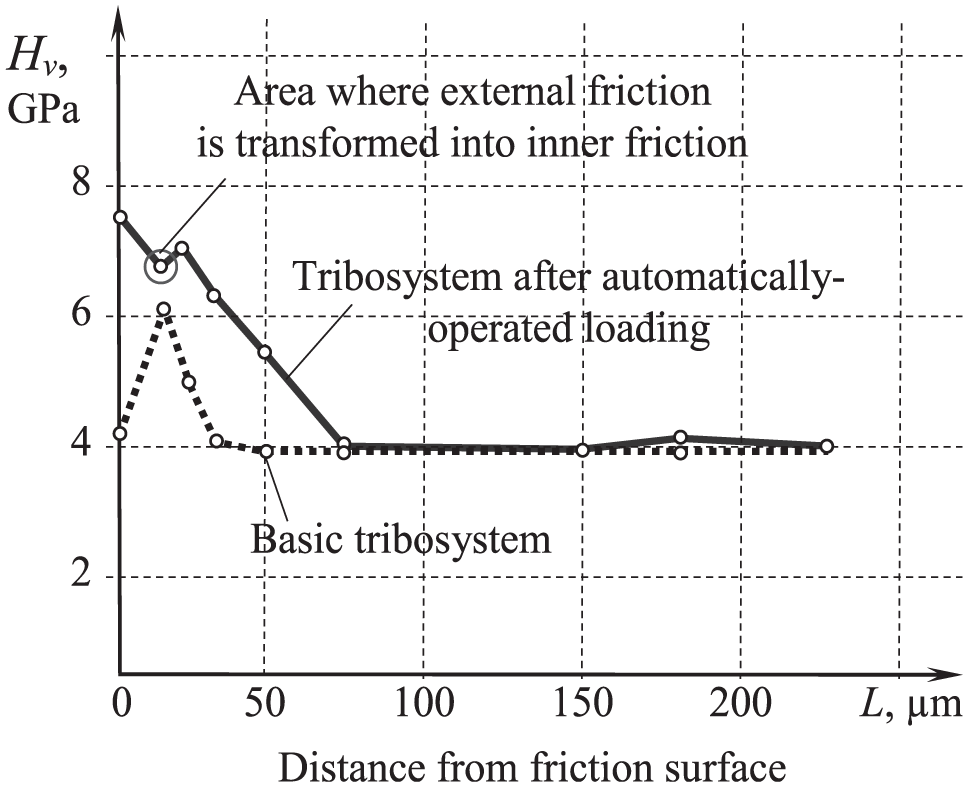
Behavior of microhardness
Study of microhardness in the deep surface layer of motionless elements of these tribosystems (Figure 6) has revealed that following the automatically operated loading, the surface layer had a larger hardness compared to the basic tribosystem, and hardening depth was increased by factor 2 and achieved 75 µm.
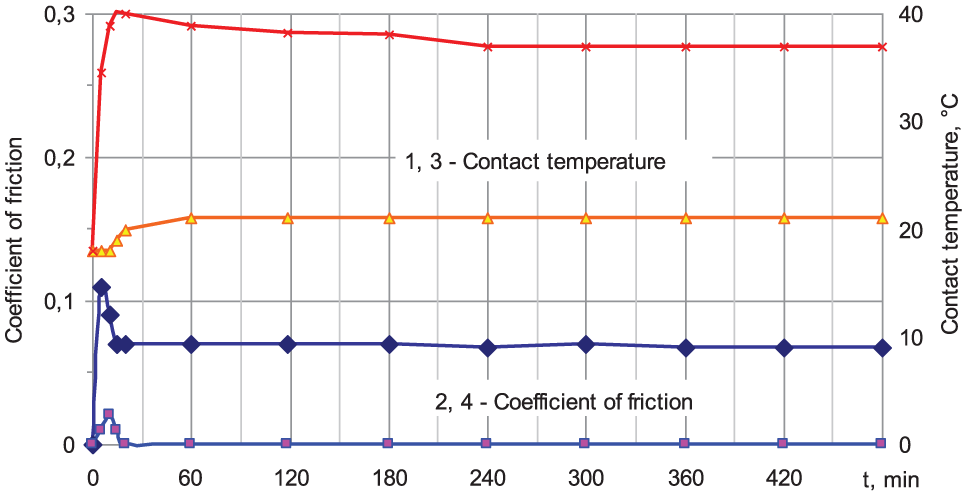
The friction coefficient and the average surface temperature in the contacting zone of tribosystems by the test time: 1, 2—bronze VB23NZn (BБ23HЦ) – steel 30H3BA (30X3BA); 3, 4—bronze BБ23HЦ + MBST (MБCT) – steel 30X3BA.
A feature of the microhardness change under the automatically operated loading is formation of an area on 20 µm depth where external friction is transformed into the inner friction. That is similar to application of a sub-layer in the multilayer ion-plasma coatings. However, in this area, the nanostructural features of the element of the tribosystem operate under anomalous low friction and wear; this area is a potential energy concentrator at contact interaction, which is converted into the kinetic energy, and that generates kinetic nanofield and wave component of the frictional force
Evaluation of tribotechnical characteristics of the tribosystems transited to anomalous low friction and wear conditions is of fundamental importance. For this purpose, a long-term (8 h) wear testing of these tribosystems was performed.
The samples of steel 30H3VA (30X3BA) and bronze VB23NTS (BБ23HЦ) were investigated. The aviation kerosene TS-1 (TC-1) with a flow rate of 3.5 L/h was used as the working fluid. Test conditions were as follows: load was 12 MPa at operation under stationary conditions; drive shaft rotational speed was 1.36 m/s; ambient temperature was +20°C (Table 3).
Conditions of wear testing. Tribosystem: steel 30H3VA (30X3BA) - bronze VB23NTS (BБ23HЦ).

This tribosystem was transferred into anomalous low friction and wear mode in accordance with automatically operated loading, the essence of which is described above.
The results of these studies of the tribosystems wear resistant have shown that their operation under conditions of anomalous low friction and wear was 5.27 times more effective, as was evidenced by measurements of their weight wear after 8 h testing and the average wear rate recorded in relative units of the acoustic emission averaged spectral power parameters. 10 At the times of registration, the fixed value of the averaged acoustic emission power will equal the value of the signal reflecting the wear over the quantization period at a given point. The signal can be reproduced with an accuracy determined by the sampling frequency (sampling rate), which corresponds to the relative motion frequency of tribo-elements. The integral value of the acoustic emission average power signals along the recording time reflects the wear over the period studied, that is, the wear rate. For a basic tribosystem and the tribosystem subject to automatically operated loading, the summarized total wear figures are 0.00395 and 0.00075 g, respectively. The wear in this case happened during the initial stage of automatically operated loading (breaking-in) and virtually discontinued at the final stage of the impulsive loading.
Explanation of the tribosystem operation under the conditions of abnormally low friction and wear from the position of the classical theory of friction and wear, namely the transition from boundary to hydrodynamic friction, can initially not provide a positive result, since the friction force in the conditions of transition to hydrodynamic friction is more important than for boundary friction. In addition, the use of various lubricants having a significant difference in anti-wear properties and physicochemical properties (engine oil M10G2k and kerosene TS-1 (TC-1)) in this experiment do not have a significant effect on the operation of the tribosystem. Also, there is no explanation for the short-term transition of the tribosystem from the condition of anomalously low friction to the “Negative” reflected in Stadnichenko and Troshin. 3 The effect of the frictional force direction change observed in this article cannot be explained through the classical attitude to the friction and wear.
To implement the second method of achieving the conditions of anomalous low friction and wear, the finishing treatment technology MBST (MБCT) was used (the author of this technology is the Ukrainian hydraulic aggregate engineering company FED (ФЭД), and results of these tests are published subject to company’s consent).
The essence of the finishing treatment technology MBST (MБCT) consists of the construction of nanostructured surface layer of tribo-system bronze BrO10C2N3 (БpO10C2H3)–steel 30H3VA (30X3BA) by implanting the solid particles (elastic modulus = 380 GPa, hardness = 87–92 HRC), from the working part of the tool made of the natural mineral related to the group of amphiboles.
Results of the comparative wear resistance tests of the basic tribosystem without applying the MBST (MБCT) technology and tribosystems with a modified surface layer are presented below (Figure 6).
Analysis of the results of total wear of these tribosystems showed the wear of 0.00295 g for the base tribosystem; for the tribosystem with application of MBST (MBCT) finishing treatment technology, the wear was 0.00015 g in 8 h of testing (for the registration, the RADWAG XA 110.4Y scales with a discreteness of 0.00001 g have been used). This technology allows achieving anomalous low friction and wear.
Examples of the third method of transferring tribosystems to conditions of anomalous low friction and wear according to the paradigm shown in Figure 3 are presented in previous studies,1,8,9 the analysis of which was carried out earlier in the text of the present article.
Thus, the wave component of the frictional forces for various methods of implementing the abnormally low friction and wear allows to significantly reduce friction and wear. However, the question of the influence of the wave component on the carrying capacity of tribosystems remains open up to the present day. For this purpose, tests have been carried out to determine the friction coefficient, the scuffing friction resistance (bearing capacity), and the average surface temperature (carried out contactless by applying a pyrometer) of a tribosystem according to the “ring ring” scheme BrO10S2N3 (БpO10C2H3) + MBST (MБCT) – nitrated steel 30H3VA (30X3BA). The specific pressure value is increased 10 times compared to the basic experiments through reducing the area of the bronze sample to a value 48.73 mm2 (Figure 7).

Fragment of bronze triboelement BrO10S2N3 (БpO10C2H3).
To simulate a real cylinder block of a real hydraulic machine, 4 mm thick bronze plate was installed on a steel sample, using a diffusion welding. The 0.8 mm width undercut has been made to 2 mm depth, thus creating the conditions for achieving the 40.8 MPa pressure in the friction contact at the maximum operating load, which could by created by a standard friction machine 2070 CMT-1.
Conditions of testing are boundary lubrication conditions (flow of working fluid = 3.5 L/h). Working environment is aviation kerosene TS-1 (TC-1). The speed of the drive shaft is 1.36 m/s.
The basic tribosystem involving the non-abrasive finishing of the bronze sample has been tested; the test data are presented graphically in Figure 8, being average for tests of three tribosystems. In the course of the staged loading of the tribosystem, the magnitude of the load at each stage was increased by 0.2 MPa. Operation time at each stage was 5 min. Absence of scuffing friction during this period has been controlled by the method of acoustic emission. 10 Upon registering the first signs of deviation of more than 50 relative units, the tribosystem was unloaded. Thus, the maximum value of the bearing capacity (3 MPa) was recorded. The maximum temperature value corresponded to 70–80°C.

The friction coefficient and temperature in the contact zone of the basic tribosystem using the non-abrasive finishing of the bronze sample.
After basic tests have been carried out, similar tests were carried out for the tribosystem with the application of MBST (MБCT) technology for the bronze sample. In this case, previous experiments showed that the specific load needs to be increased 10 times at least. Therefore, the load of the tribosystem at each stage was 2 MPa, with 5 min exposure. The mean values of measurements obtained as the results of tests performed on three tribosystems are shown on Figure 9. The analysis of the obtained results showed that the application of finishing treatment technology MBST (MБCT) allows the tribosystem operating in the conditions of anomalous low friction and wear within the load range up to 20 MPa. Under the conditions of anomalous low friction and wear, the heat realize is practically absent for this tribosystem. With increasing the load up to 22 MPa, a transition to the mechanochemical friction and wear conditions is observed.

The friction ratio and temperature in the contact zone of the basic tribosystem treated with the MBST finishing technology.
The maximum value of the tribosystem load capacity is 30 MPa; thereafter, the transition to scuffing friction is observed. Following unloading, at a load of 30 MPa, signs of bronze triboelement surface dimpling are detected on the nominal working surface of the bronze triboelement (Figure 10). Thus, the bearing capacity of this tribosystem under conditions of anomalous low friction and wear is limited to 20 MPa load.

Fragment of bronze triboelement BrO10S2N3 (БpO10C2H3).
The bearing capacity under the conditions of anomalous low friction and wear compared to the basic conditions has increased almost seven times (3–20 MPa). In order to explain the obtained results, comprehensive metallographic investigations have been carried out, including analysis of the surface chemical composition and their topographical features of the surface layer microrelief. Analyses of the tribosystem materials’ initial chemical composition are presented in Table 4.
Initial chemical composition of friction surfaces. Tribosystem: steel 30H3VA (30X3BA) - bronze VB23NTS (BБ23HЦ).

After having applied the finishing treatment based on MBST (MБCT) technology, chemical composition of the bronze sample (Figure 11(a)) has changed significantly, and the composition of silicon has increased over 100 times. The composition of the rest of chemical elements varies slightly. Upon achieving the maximum possible bearing capacity of this tribosystem, the silicon surface composition decreases almost two times compared to the MBST (MБCT) (Figure 11(b)) finishing treatment technology. Also, a slight decrease of tin and antimony is observed; these results show that silicon has the main impact on tribotechnical characteristics, as declared by the MBST (MБCT) technology.

Chemical composition of the bronze triboelement friction surface: (a) following finishing treatment according to MBST (MБCT) technology and (b) upon reaching the maximum possible bearing capacity (30 MPa).
The results of tribosystems’ scuffing friction tests showed that for the bronze sample, following the application of MBST (MБCT) bronze treatment, a tribosystem works at up to 20 MPa with practically zero heat release. A 2°C temperature increase was observed due to the heat release from the lubrication system pump. In the 20–24 MPa load range, a transition from anomalous low friction and wear to mechanochemical friction is observed (the molecular-mechanical component of friction force is much larger than the wave component). The conditions for the transition from the normal mechanochemical to anomalous low friction and wear are presented in Stadnichenko and Troshin 3 and Stadnichenko et al. 28
Thus, we can conclude that MBST (MБCT) technology allows bronze BrO10C2H3 (БpO10C2H3) dimpling strength above 20 MPa (Figure 10). The analysis of the friction surfaces’ microrelief of investigated tribosystems (Figure 12, Table 5) showed that application of MBST (MБCT) technology allows the tribosystem to achieve higher values of bearing capacity also due to the developed microrelief, which increases the wave component with a minus sign (Figure 3). With the roughness parameter Ra decreasing to 0.05 from 0.11 μm, it means that the surface is smoothed approximately two times and the maximum profile of the profile increases almost three times, which illustrates clearly the 3D surface image (Figure 12). The study of topological (fractal) characteristics of the surface layer during the investigation of anomalous low friction and wear is of fundamental importance, since the traditional methods of assessment cannot explain the formation of micro-relief being not the result of mechanical interaction under normal conditions of friction but the result of the interaction of the kinetic and gravitational nanofields.

Topography of friction bronze triboelement surfaces: (a) non-abrasive finishing and (b) finish treatment with the application of MBST (MБCT) technology.
Topography characteristics of friction surfaces after different types of finishing treatment.

Physical aspects of the tribosystems operation under anomalous low friction, as well as the area of its negative value, can only be explained basing on non-eq9 thermodynamics. The driving force behind the production of negative entropy (the antidissipation process) is the principle of least action taken both in classical and in quantum mechanics. 30 “The most important difference is associated with the trajectories of the motion of particles of the microstructure of the material in this case. In classical mechanics it is assumed that the particle moves has the only trajectory between two points, determined either by the equations of motion or by the principle of least action. Inverse quantum mechanics sums up the contributions of the probability function (based on the action) for all possible particle entities between two points …” 30
The action is to be understood as the generalized gravitational and kinetic, which also contains several components, in particular a centrifugal component. This circumstance provides an understanding that the frictional force that forms over the entire contact surface has, in addition to magnitude, a direction that, as a rule, does not coincide with the direction of motion of the movable element of the tribosystem. Under the influence of this fact, under normal and anomalous low friction and wear, a significant difference in the nanostructural special surface layer is formed, which can be estimated.
In our case, the Fourier method for analyzing the angular rotation of microscopic roughness on the surface relative to the direction of motion of the moving element was used to solve this problem. This approach makes it possible to analyze the result of the elastic interaction of the kinetic and gravitational nanofields under anomalous low friction and wear. The result of this interaction is the micro-relief orientation estimated at submicroscopic level. These opportunities are possessed by the SIA01 program of Fourier analysis developed in V. Bakul Institute for Superhard Materials of the National Academy of Sciences of Ukraine (NASU). The essence of this program is described in37. As a result of the wave interaction, the external friction is converted to inner friction in the subsurface, as shown in Figure 6. The classic dislocation mechanism of plastic deformation in this area is converted into the rotary mobility. 28
Since mezofragments experience shear and rotatable deformation in a sliding stripe, it becomes possible to move the volume structural elements of different size relative to each other in parallel planes. In essence, there takes place formation of nano-layers, and the material becomes of layered gradient structure.
On the surface of friction, this phenomenon can be estimated by change in level of fractal perfection (Figure 13).

Fourier analysis for distribution of orientations of the micro-relief elementary cells at the friction surfaces (specimen—steel 30HGSNA): (a) normal friction and (b) anomalous low friction.
Comparative fractal analysis on the friction surfaces of the motionless specimen when the tribosystem is operating under conditions of normal and anomalous low friction (Figure 8(a) and (b)) has shown that under normal friction conditions, the resultant vector of orientation of the microrelief relative to the direction of motion of the element of the tribosystem had 15° slope of horizontal axis at investigation of the surfaces with magnification 1000×. At the same time, at the anomalous low friction and wear (Figure 8(b)), the resultant vector is neutral (approximately 90°) relative to direction of the tribosystem motion.
Thus, the principal vector of the direction of the wave component of the frictional force can change with respect to the direction of motion and, under certain conditions, change to the opposite “negative” friction, which was experimentally observed in Stadnichenko and Troshin. 3
Experimental studies carried out on reaching the conditions of anomalous low friction and wear fully confirm the theoretical studies of the dissipation mechanism of externally supplied energy carried out by SV Fedorov and presented to them in the form of a structural-energy diagram of the evolution of rubbing surfaces. Thus, the theoretical and experimental analysis of anomalous low friction in the tribology has shown that the quantum-mechanical approach to explain the anomalous low friction and wear in a tribology produced further impetus to the development of molecular-mechanical and structural-energy theories of friction and wear, as well as the prospects for further development of nanotechnology of wear-resistance coatings.
Conclusion
According to the proposed hypothesis of existence of the wave component of the frictional force, the physical meaning of friction coefficient is the ratio of kinetic and gravitational components of friction forces. At the transit to anomalous low friction and wear, the kinetic component is a priority.
The nanostructural features of the surface layers at anomalous low friction are caused by the transit from the classical dislocation mechanism of plastic deformation to the rotary one.
Quantum-mechanical approach to analysis of externally supplied energy dissipation makes possible to formulate a scientific paradigm for achieving anomalous low friction and wear for real tribosystems based on the equilibrium of wave and molecular-mechanical components of the friction force.
There was clarified physical interpretation of the mechanical quantum as constant energy component of the elementary interaction of the tribosystems operating under conditions of anomalous low friction and wear.
The MBST (MБCT) finishing treatment technology forms a multilayered surface layer on the bronze sample, which generates a wave component of frictional force with a minus sign. At a certain equilibrium of the molecular-mechanical and wave component of frictional forces in this tribosystem, it is possible to achieve conditions of abnormally low friction and wear. This tribosystem can be attributed almost to the “ideal,” to the load of 20 MPa, which is in the operating range of this tribosystem, which gives grounds to recommend it to practical implementation in design of modern hydraulic aggregates and devices.
The conducted metallographic studies have allowed to establish that the main factors of the transfer of the tribosystem in the conditions of anomalous low friction is the saturation of the surface layer with silicon and the formation of a developed microrelief, which increases the wave component of the frictional force.
The increase of the bearing capacity in the transition of the tribosystem from the conditions of anomalous low friction and wear to mechanochemical friction is due to a decrease in the effective force of friction of the wave component, that is, the wave component of the frictional force in this case does not disappear. It consists of a normal and tangential component that reduces frictional force and a generalized gravity component, which increases the bearing capacity of tribosystems that operate under anomalous low friction and wear.
Footnotes
Handling Editor: Elsa de Sa Caetano
Declaration of conflicting interests
The author(s) declared no potential conflicts of interest with respect to the research, authorship, and/or publication of this article.
Funding
The author(s) received no financial support for the research, authorship, and/or publication of this article.
