




Abstract
From a manufacturing viewpoint, the profile of a journal out-of-roundness is random. In order to be closer to the engineering practice, the study presents a dynamic modelling, analysis and calculating method for the hydrodynamic journal bearing system considering random roundness error. The random character of manufacturing errors is presented by Monte Carlo method in the analysis to establish the relationship between the level of journal roundness error and the system stability characteristics. The results of theoretical analysis show that the effect on the stability of the hydrodynamic journal bearing system is minimal when the grade of journal roundness error P is below 9; when P > 9, the journal out-of-roundness promotes the system stability. However, the increase in the random roundness error will generate high-frequency vibrations and aggravate the system vibration. Besides, the journal random out-of-roundness has a minimal effect on the system stability when the eccentricity is between 0.5 and 0.6 or the Sommerfeld number is between 0.05 and 0.1, which suggests that the system should be operated within this region to minimise the effect of journal out-of-roundness.
Introduction
As the basic component of mechanical equipment, hydrodynamic journal bearing systems are widely used and the system stability has always been concerned by researchers. In early studies, the system parameters are usually considered to be perfect, and the system dynamic properties are investigated with the nominal values of these parameters, ignoring the effect of manufacturing errors. Although the modern manufacturing technologies have the capability to manufacture the machine components more accurately, due to the limitations of manufacturing accuracy, the manufacturing errors in the structural parameters are unavoidable. Therefore, many researchers focus their study to examine the effect of manufacturing tolerances on the bearing performances.
When analysing the design of rotor bearing tolerances in accordance with the tolerance standards set by British B.S. 1916, Chu and Kay 1 pointed out that a manufacturing error of the system structural parameters is sufficient to cause changes in the bearing dynamic characteristics. The authors optimised the journal bearing system on a basis of maximum value for the minimum film thickness and the results showed that the bearing error has the least effect on the system operation when the diameter/length ratio is 3. In the same year, Martin 2 commented on the issues described by Chu. The comment considered that, in practice, one should check on the effect of clearance, taking into account a full heat balance and consequential change in viscosity. It is not sufficient to check whether the minimum film is adequate. The choice of clearance may depend on other factors such as the power loss, maximum operating temperature and oil film stiffness. Also, if the nominal clearance is too tight, it may be lost due to differential expansion or manufacturing tolerances, the latter being a function of the economics of manufacture. In 1975, Chu 3 responded by agreeing that the concept of an optimum clearance may sometimes be by-passed by designers who may choose bearing length as a design variable, but it is obvious that if bearing geometry is closely related to that of tolerances, then a much more reliable design can be drawn up.
From the view of manufacturing cost, Kulkarni et al. 4 presented a new mathematical technique to determine, from the clearance data, the optimum set of tolerances on the journal and bearing bore which guarantee the correct operating performance of plain journal bearings at a minimum manufacturing cost. The article addressed the stability problem of vibrating rotors supported by hydrodynamic journal bearings with interval parameters and pointed that the error of bearing clearance leads to substantial changes in the stability conditions of the underlying system. The interval analysis method proposed by Kamal is closer to the actual situation. However, this method is based on the linear model and limited to the critical mass of the rotor, without considering other operating characteristics. Xu et al.5–7 discussed the effect of dimensional manufacturing tolerances on stability of a symmetric hydrodynamic journal bearing system by nonlinear analysis method. The results showed that dimensional manufacturing tolerances do have a significant effect on system stability and they influence the system stability in different ways. The previous works1–7 showed that the manufacturing error of the system structure parameters is large enough to cause changes in the performance of journal bearing system. However, these studies focused on the dimensional manufacturing errors, and did not further explore the influence of shape errors on the performance of journal bearing system.
In fact, it is impossible to have an ideal shape of journal bearing system in engineering, which results in many researchers gradually paying their attentions to examine the effect of shape errors on the performance of journal bearing system.8–15
In 1977, Radford and Fitzgeorge 8 experimentally studied the effect of the roundness error of the journal on the bearing characteristics of a hydrodynamic journal bearing system. By comparing the journals with lobes and without lobes, the authors found out that the roundness error not only does not harm but to a certain extent is conducive to the performance of the bearing, considering that it is in a certain range of operating speed and load. Sharma et al. 9 obtained the radial clearance with roundness error of the journal bearing in a test and used the measurement data to measure the oil film thickness of the bearing. From the methodology perspective, the effect of roundness error on the radial clearance measurement was described. The study showed that the change in the radius of the bearing or bearing shell in the circumferential direction is mainly due to the effect of roundness error. Furthermore, the author clearly suggested that the bearing designer should consider the roundness error when designing the bearing. But these studies are only limited to experimental analyses and no model or method for a theoretical analysis.
Iwamoto and Tanaka 10 used a linear analysis method to investigate the effect of machining error on the dynamics of cylindrical bearing oil film, particularly on the dimensionless stability critical speed. The results showed that the effect of roundness error of the bush is larger than that of the dimensional error of the system, and the roundness error should be limited to the smallest possible range. Pande and Somasundaram 11 presented a study that showed that the manufacturing errors have a significant effect on the operating characteristics of aerostatic bearings. In this article, the elliptical distribution roundness error is used. Vijayaraghavan et al. 12 investigated the effect of roundness error on the performance of the connecting rod bearing of a diesel engine. To describe the roundness error of the bearing, the author set the bearing profile to be non-circular, such as oval, semi-oval and trilobal cylinder. By comparing the predicted journal trajectory and performance parameters with the ideal round bearing predictions, the author believed that the ovality in the outer bearing geometry would lead to the decrease in the minimum film thickness, increase in pressure peaks and the average side leakage rate, while the average total power loss is almost the same as the perfect roundness. Therefore, the perfect circular profile bearing will exhibit better properties in diesel engine connecting rod bearing applications. Xu and colleagues13–15 performed a series of theoretical and experimental analyses of hydrodynamic journal bearing systems that consider the out-of-roundness. The result showed that the journal out-of-roundness influences the oil film thickness and further influences the dynamic characteristics of the system. Furthermore, the study presented that the effect of the journal out-of-roundness on the dynamics and stability of the system is much greater than that of the dimensional error. However, the roundness errors considered in these studies mainly focused on typical non-circular profiles with oval or trilobal cylinder, without considering the randomness of the roundness error.
In summary, due to the limitations of manufacturing accuracy, the manufacturing errors in the bearing, such as roundness error, are unavoidable. Even if the absolute values of these errors are small, they are of the order of fluid film thickness and will have a significant effect on the performance of the system, which should be of concern to the engineering designers. Although there have been limited studies on the effects of bearing shape manufacturing error such as roundness, the researchers always set the bearing profile to be non-circular, such as oval, semi-oval and trilobal, cylinder for describing the roundness error of the bearing. These studies are limited to the typical distribution characteristics of roundness error, ignoring the randomness of it. In practical engineering, the roundness error exhibit random distributions depending on the manufacturing process factors and is divided into 13 levels in manufacturing.
The theoretical basis of Monte Carlo method was introduced in early 1940s by Metropolis and Ulam 16 to solve statistic problems numerically by means of the simulation of random variables. Chang and Lin 17 presented Monte Carlo modelling, simulation and heuristic results of the minimum sufficient data set to determine the accuracy of the circularity (roundness) tolerance measurement. In 2008, ‘Supplements to the Guide to the expression of Uncertainty Measurement (GUM)’ was published describing the use of the Monte Carlo method for uncertainty evaluation. 18 Kruth et al. 19 presented a method to determine measurement uncertainties for feature measurements on coordinate measuring machines (CMMs) based on Monte Carlo simulations and a profile database of realistic form profiles. And then Monte Carlo method is widely applied to roundness measurements and promotes the use of GUM.20–23 The method was also applied to the tolerance analysis for simulating each dimensional chain.24–27 The method is explained excellently by Evans28,29 and Chase and Greenwood. 30 The Monte Carlo simulation is an effective tolerance analysis method. Based on mathematical statistics and probability theory, it can perform simulation calculations for various random variables. This method has a very good effect in solving reliability of small sample data and non-linear complex state function problems. Therefore, this study will use this method to describe the profile of the journal surface contour combining with the roundness error level.
The main contribution of this study is to present a dynamic modelling, analysis and calculating method for the hydrodynamic journal bearing system considering random roundness error in order to be closer to the engineering practice. The study resolved the journal roundness error into harmonic component and random term to establish the analysis model of journal surface contour. The random character of manufacturing errors is presented by Monte Carlo method in the analysis to establish the relationship between the journal roundness error level in manufacturing and the system stability characteristics. The influence of harmonic component of geometric roundness error and random error of it on the stability of sliding bearing-rotor system is shown. The study is valuable for the optimization of the bearing tolerances at the bearing design stage or to guarantee the bearing with certain roundness error due to the wear at the running stage to be operated more stable.
Oil film force model for journal bearing with random roundness error
To analyse the effect of roundness error on the stability of a hydrodynamic journal bearing system, a rigid symmetrical analysis model is adopted to eliminate the effects of other factors such as flexibility of the journal, as shown in Figure 1. The rigid symmetrical rotor is supported by two identical hydrodynamic journal bearings. Due to the wedge action and the viscosity-pressure effect of the liquid, the oil film pressure of the journal bearing is formed, and the journal bearing works through the change in the oil film pressure. Considering that the rotor is symmetrical, the oil pressure of the two bearings is equal. To determine the change in the oil film pressure, the Reynolds equation may be directly solved by the differential method to obtain the nonlinear oil film force. Based on the nonlinear analysis method, the dynamic characteristics and stability of the sliding bearing-rotor system may be obtained.
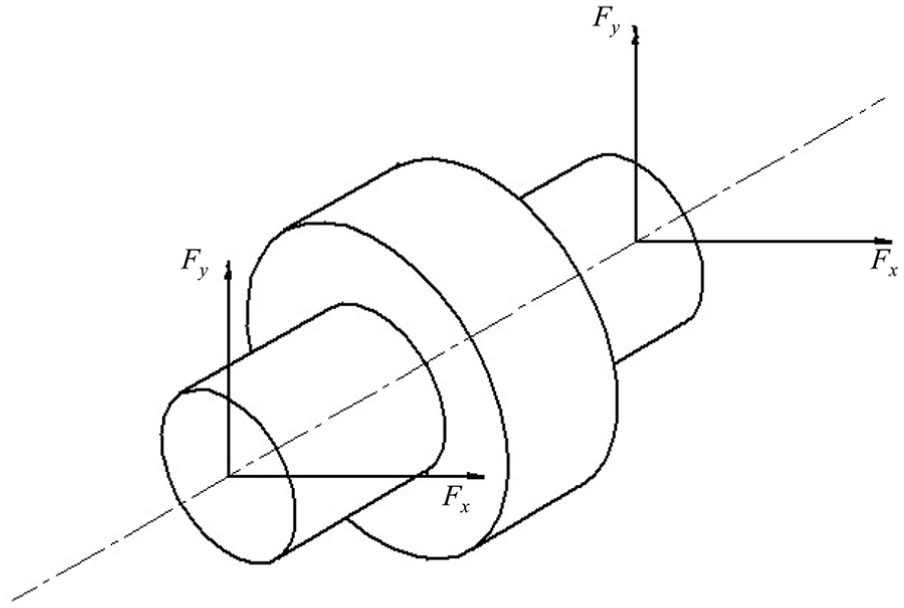
A symmetrical rigid hydrodynamic journal bearing system model.
Surface contour model of a journal
The surface obtained by any machining method cannot be absolutely perfect. As shown in Figure 2, the finished workpiece surface always includes macroscopic surface geometry errors, surface waviness and microscopic surface roughness. From the wave patterns of the surface, the workpiece surface shows macroscopic geometry errors, such as roundness error, which can distinguish from the surface waviness and microscopic surface roughness, when the ratio of wavelength and the peak value λ/H is above 1000. This article mainly studies the effect of macroscopic surface geometry errors on the stability of journal bearing system.

Machined surface contour shape.
From the view of metrology, the journal out-of-roundness is a complex periodic signal which includes harmonic component and random term. The harmonic component is usually composed of the journal eccentricity, ovality and prismatic roundness. In order to establish the analysis model of journal surface contour, the study resolved the journal roundness error into harmonic component and random term, calculated respectively, and then combined together. Therefore, the journal surface contour may be mathematically expressed as equation (1)

where ai is the amplitude of the harmonic component i, φi is the phase of the harmonic component i and ra is the random term.
To present the randomness of the journal out-of-roundness, the contour of the journal surface is modelled by using Monte Carlo simulation technique, which samples based on the rule of probability and statistics and uses random numbers to simulate the complex stochastic process. The ai and ra in equation (1) may be evaluated based on the built model of journal surface contour. Therefore, a roundness error probability distribution model is established at first. A probability density function is proposed to represent the probability that the signal amplitude falls within the designated range, and to provide the distributed information of the random signal amplitudes, as expressed in equation (2)

where Tf represents probability density function and Tr represents probability when the amplitude falls within (rj,rj + Δrj). Due to the randomness of the machining system, the geometry error of a journal profile is also random and its amplitude probability density function is proved to be normally distributed. Therefore, the roundness error probability distribution model in this study is the normal distribution model. The second is to determine the mean and standard deviation of the roundness error distribution model. Statistics indicate the impossibility principle of small probability events, and the ‘3σ criterion’ is often followed in engineering processing and manufacturing. Based on the ‘3σ criterion’, the range of possible changes in the amplitude of the random roundness error may be defined as 6σ, as shown in Figure 3, where σ is the standard deviation and 6σ indicates the tolerance of the journal out-of-roundness. The standard deviation σ may be determine based on the grade of journal out-of-roundness, while the mean may be assigned as zero because the error distribution centre coincides with the variation centre. In this study, the tolerance of journal out-of-roundness comes from Chinese Recommended National Standards (GB/T1184-1996). When the grade of journal roundness error is P = 12, for example, the tolerance 6σ for a journal with a diameter of 50–80 mm is 74 μm; an exaggerated outline of the journal surface with roundness error is shown in Figure 4. The third step is to sample from the given probability distribution model. Along the journal circumferential direction, sampling is done every 10°, and the sample capacity for each sampling is 100. Chi-square test is used to check the distribution of the sample data, and the mean is used as the value of journal surface at this angle. At last, a Fourier series is used to fit the journal surface data. The parameters of the fitted journal surface contour are listed in Table 1, where the random term ra is assigned by the fitting error.
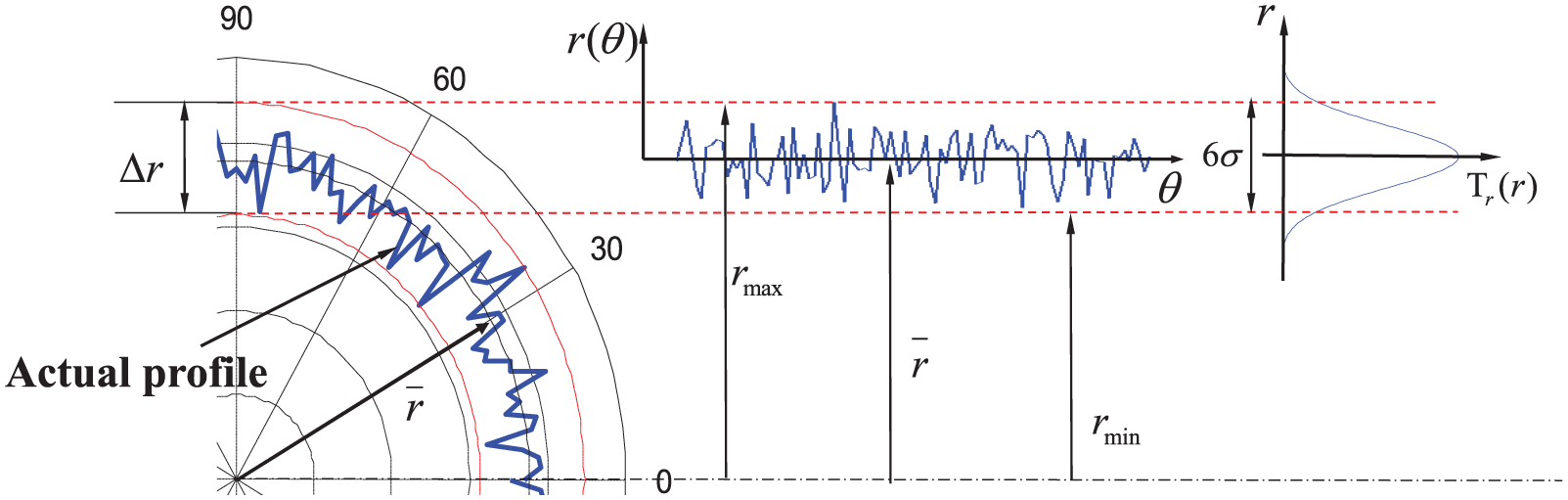
The distribution law of random roundness error amplitude.

An exaggerated outline of journal surface P = 12.
Set parameters of roundness contour curves.

When the order of harmonic component of journal surface manufacturing error is below 14, the harmonic component appears as the journal surface geometric error; when the order is large than 15, it appears as the surface waviness. 31 Therefore, the order of harmonic component of journal surface model is assigned as 14, that is, n = 14, while φi is assigned randomly within [0, 2π], which represents the different phrase.
Oil film thickness
For a perfect cylindrical journal, the oil film thickness h0 in a circumferential direction may be determined by using the bearing structural parameters and the position angle of the bearing, as shown by the equation (3) 2

However, if the random roundness error is considered, then the journal is no longer a perfect circle. The change in oil film thickness in the circumferential direction depends not only on the bearing structural parameters and the journal’s position angle but also on the surface profile of the journal shape error.
To describe the effect of the journal out-of-roundness on the distribution of oil film thickness, an exaggerated journal surface profile with a random roundness error is presented, as shown in Figure 5. A polar coordinate system is established using oj as the pole. The shape error is generally defined as the variation of a single practical element with respect to ideal element. The direction and position of the ideal element may be changed depending on the practical one. Therefore, the centre of the reference circle for the roundness error is also changeable. At any position angle θ, the effect of the roundness error on the distribution of oil film thickness is described by the difference between the actual radius of any given point on the journal surface and the nominal radius of the journal, as equation (4)

where ‘+’ indicates that the distance from the actual contour point to the centre of the reference circle is less than the nominal radius and ‘–’ denotes that the distance from the actual contour point to the centre of the reference circle is greater than the nominal radius.

An exaggerated profile of the journal in a perfect circular bearing.
Therefore, when the random roundness error is considered, the practical oil film thickness may be obtained based on the oil film thickness equation for the perfect journal bearings, as shown in equation (5)

Considering that the bearing clearance is very small relative to the bearing radius, the oil film thickness can be further described as equation (6)

Determination of system operation stability
Based on the obtained oil film thickness, the nonlinear oil film force may be calculated by solving Reynolds equations, and the translational whirling motion of the rotor can be obtained by numerical integrations of rotor motional equations, as presented in authors’ previous publications.5–7 The system stability may be determined by analysing the transient responses of the shaft centre. As presented in authors’ previous publications,5–7 a logarithmic decrement is used as an indicator to determine the threshold of the system stability. When the logarithmic decrement ld > 0, it indicates that the journal centre vibration tends to be convergent and the system is stable, while ld < 0, it indicates that the vibration tends to be divergent and the system is unstable, whereas if ld equals 0, the system is at the threshold.
To demonstrate the stability of system operation, the Sommerfeld number and dimensionless operation parameter Op are introduced to establish the relationship between system structure parameters and system stability characteristics. Sommerfeld Number (S) is one of the important parameters for describing the stability and dynamic characteristics of journal bearing-rotor system, as well as one of the important design parameters, expressed as equation (7)

Operating parameter (Op) is a dimensionless parameter usually used to represent the critical speed of the system stability, 32 which is defined as equation (8)

The results of stability analysis can be described by the critical stability curve of the system based on S – Op. The critical stability curve of the journal bearing-rotor system can be established with the operating parameter Op as the ordinate and S as the abscissa, as shown in Figure 6. A series of critical speed points are connected to form the stability critical curve of journal bearing-rotor system. The coordinate space can be divided into stable region and unstable region. When the operating speed of a bearing-rotor system increases gradually (other parameters remain unchanged), S also increases. In this coordinate system, a trajectory will be formed, as shown in the arrow line in Figure 6, the system gradually enters the unstable state from the stable state, and the intersection point between the trajectory and the critical curve is the critical speed point.

Stability map based on Sommerfeld number.
Analysis of the effect of random roundness error on system dynamics
Analysis of the effect of random roundness error on oil film thickness
Figure 7 shows the variation of the oil film thickness in the circumferential direction when the different journal random roundness errors exist. The running parameters of the rotor bearing system for the analysis is presented in Table 2, where P = 0 indicates that the journal is a perfect circle. PMIC denotes the change in the degree of the roundness errors when it is evaluated by the maximum inscribed circle and PMCC indicates the change in the degree of the roundness errors when it is evaluated by the minimum circumcircle. At this point, the distance from the actual contour point to the centre of the reference circle is less than the nominal radius.

Comparison of the oil film thickness variations.
Operating parameters of a hypothetical journal bearing system.

Figure 7 shows that in the PMIC assessment mode, the oil film thickness decreases with the increase of the roundness error level because the distance between the actual contour point and the reference circle centre is greater than the nominal radius. Moreover, the presence of the random roundness error increases the journal diameter and reduces the gap between the journal and the bearing. However, in the PMCC assessment mode, the oil film thickness increases with the roundness error level because the distance between the actual contour point and the reference circle centre is less than the nominal radius. In addition, the presence of the random roundness error decreases the journal diameter and enlarges the gap between the journal and the bearing. The oil film thickness that varies with these random roundness error levels affects the clearance between the journal and the bearing, which in turn significantly affects the oil film force and system dynamics of the journal bearing system.
Analysis of the effect of random roundness error on system transient response
The random roundness error not only changes the distribution of the oil film thickness but also affects the transient response of the system. Figure 8 shows the comparison of the transient responses of the bearing-rotor system with various random roundness errors. The analysed rotor system operates at a lower speed of N = 3000 rpm. The operating parameters are listed in Table 2. The abscissa indicates the operating time, whereas the ordinate vibration amplitude denotes the displacement of the journal centre from the centre of the bearing bush.

Comparison of the transient responses against the operating time (N = 3000 rpm).
Figure 9 shows the orbit of the shaft centre of a hydrodynamic journal bearing system with several random roundness errors at the rotating speed. The initial position is ε = 0°, φ = 45° and the initial velocity of the journal centre is 0.
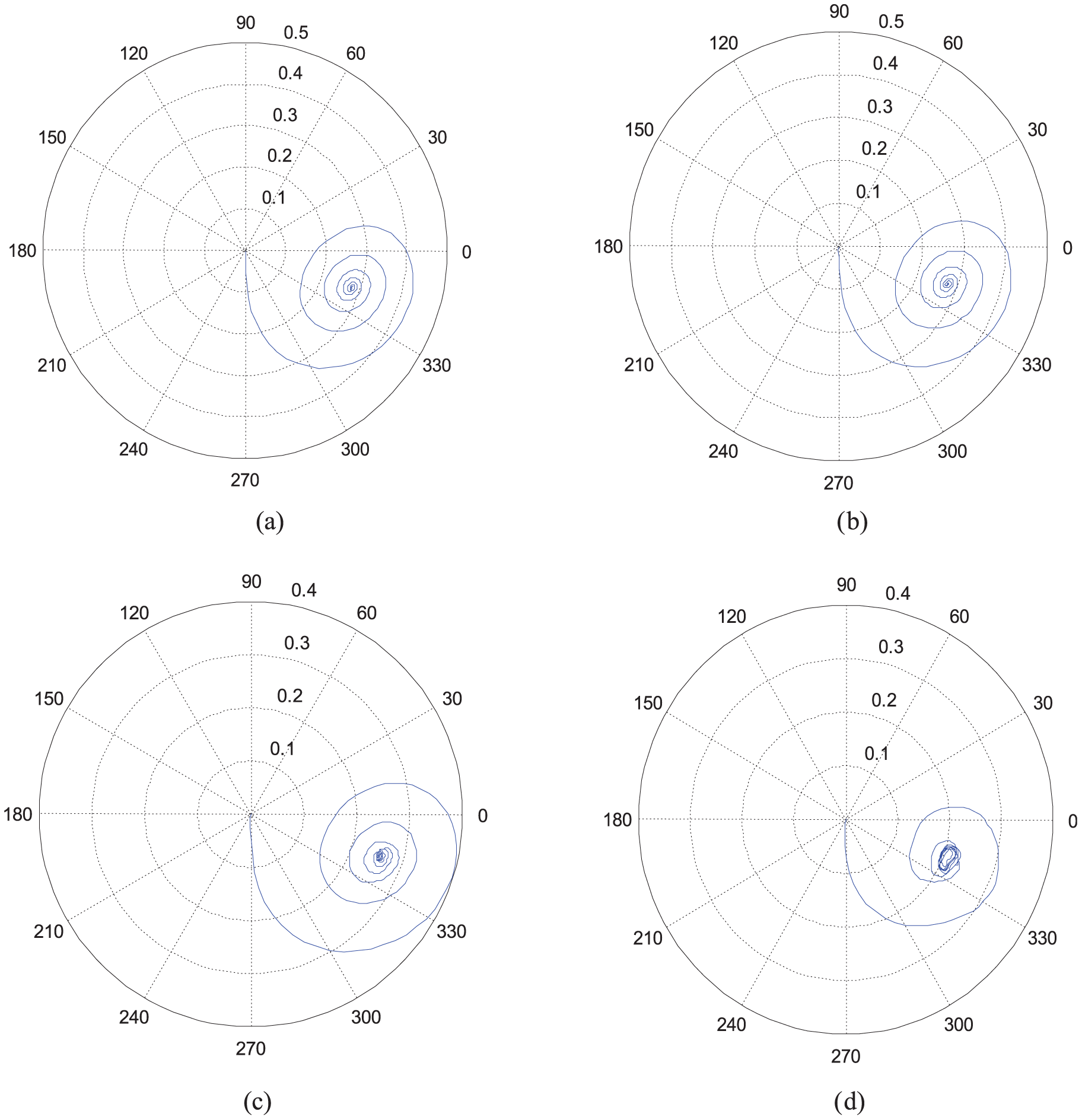
Comparison of the transient trajectories (N = 3200 rpm): (a) P = 0, (b) P = 4, (c) P = 9 and (d) P = 12.
Figures 8 and 9 show that for a perfectly circular journal, when the system is in a stable state, the orbit of the shaft centre converges to a point and the system vibration converges to a stable eccentricity. When the journal out-of-roundness is considered, the orbit of the shaft centre no longer converges to a point in a stable state due to the presence of roundness error, but it converges to a stable oval-like closed loop. The size of the loop is related to the level of the roundness error and the speed of journal. That is, the presence of the random roundness error makes the system vibration no longer to converge into a stable eccentricity. However, the vibration amplitude remains constant after it increases to a certain value, forming a continuous vibration. And the greater the roundness error level is, the greater the vibration amplitude will be.
Figure 10 shows the spectrum analysis of the bearing-rotor system with a level 12 roundness error on the journal at two stable operation states, that is, N = 3000 rpm and N = 4500 rpm. The figure shows that when the operating speed is N = 3000 rpm, the rotating frequency is fn = 50 Hz, the main vibration frequency forming continuous vibration is approximately fn. When the operating speed rises to N = 4500 rpm, the rotating frequency is fn = 75 Hz, the main vibration frequency forming continuous vibration is approximately one-third fn. Figure 10 shows that the system forms an ‘oval-like closed loop’ continuous vibration due to the presence of the random roundness error. The spectral response is characterised by discrete spectral lines and the corresponding frequency can be commensurable. The main vibration frequency is related to the rotation speed. As the speed continues to increase, the frequency spectrum features appear as low-frequency components, such as one-third frequency component. At this time, even if the system operates at the critical point, the system can still respond in a stable state. However, as the rotating speed continues to increase, the system response continues to diverge and the system stability gradually weakens. 33
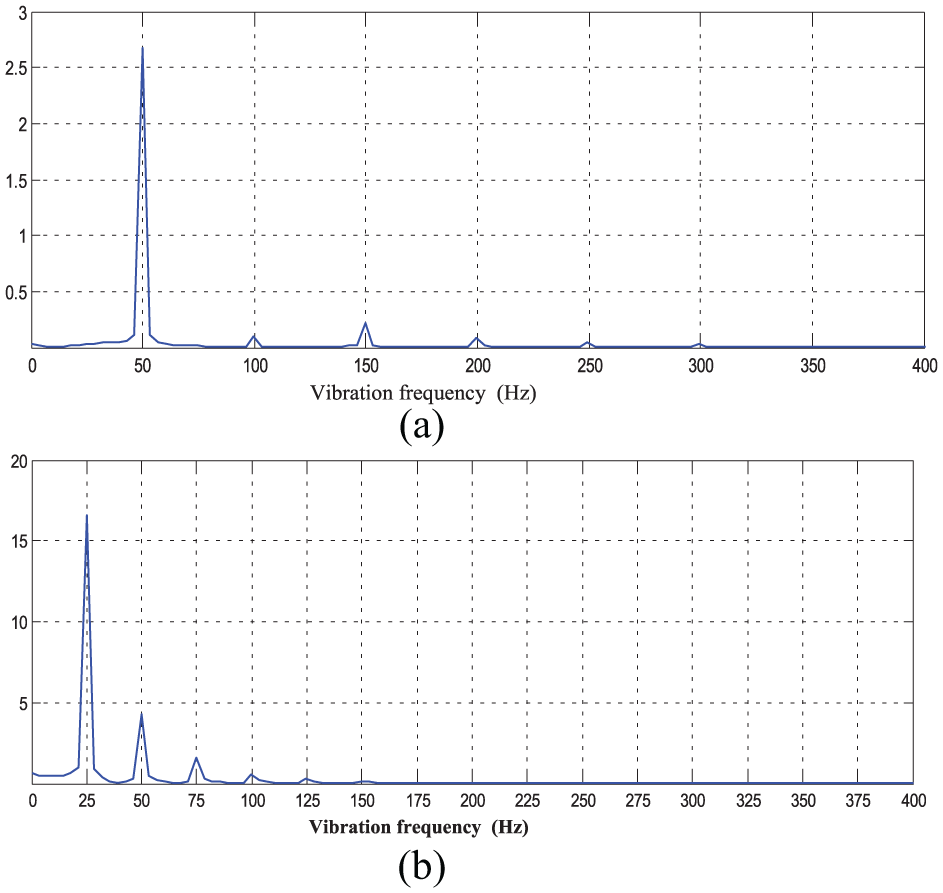
Frequency spectrum of the journal vibration: (a) P = 12, N = 3000 rpm, fn = 50 Hz and (b) P = 12, N = 4500 rpm, fn = 75 Hz.
Analysis of the effect of random roundness error on the system stability
To determine the effect of random roundness error on system stability, this study uses a hydrodynamic journal bearing system with roundness error P = 12 as an example. Moreover, a series of comparisons of transient responses of the hydrodynamic journal bearing system with random roundness error to the system with a perfect circular journal are conducted, as shown in Figures 11–18. The operating parameters of the analysis rotor system are listed in Table 2. The rotating speeds of the shaft are 3000 rpm, 3824 rpm, 4600 rpm and 4800 rpm; the initial position is ε = 0 °, φ = 45° and the initial movement speed of the journal centre is 0.

Comparison of the transient trajectories when N = 3000 rpm: (a) P = 0 and (b) P = 12.

Comparison of the vibration amplitudes when N = 3000 rpm: (a) P = 0 and (b) P = 12.

Comparison of the transient trajectories when N = 3824 rpm: (a) P = 0, logarithmic decrement ld = 4 × 10⁻⁴ and (b) P = 12, logarithmic decrement ld = 0.1463.
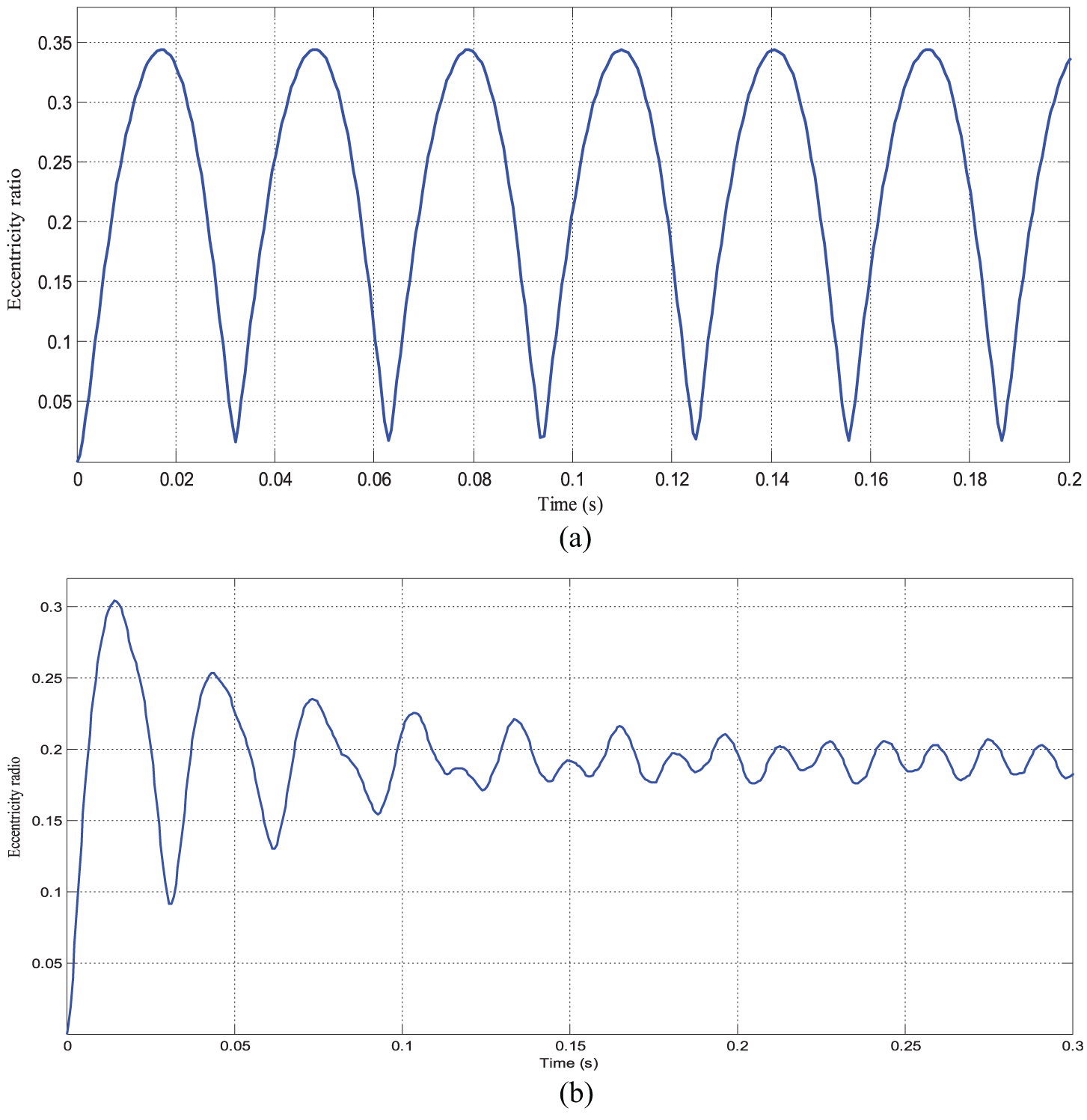
Comparison of the vibration amplitudes when N = 3824 rpm: (a) P = 0, logarithmic decrement ld = 4 × 10⁻⁴ and (b) P = 12, logarithmic decrement ld = 0.1463.
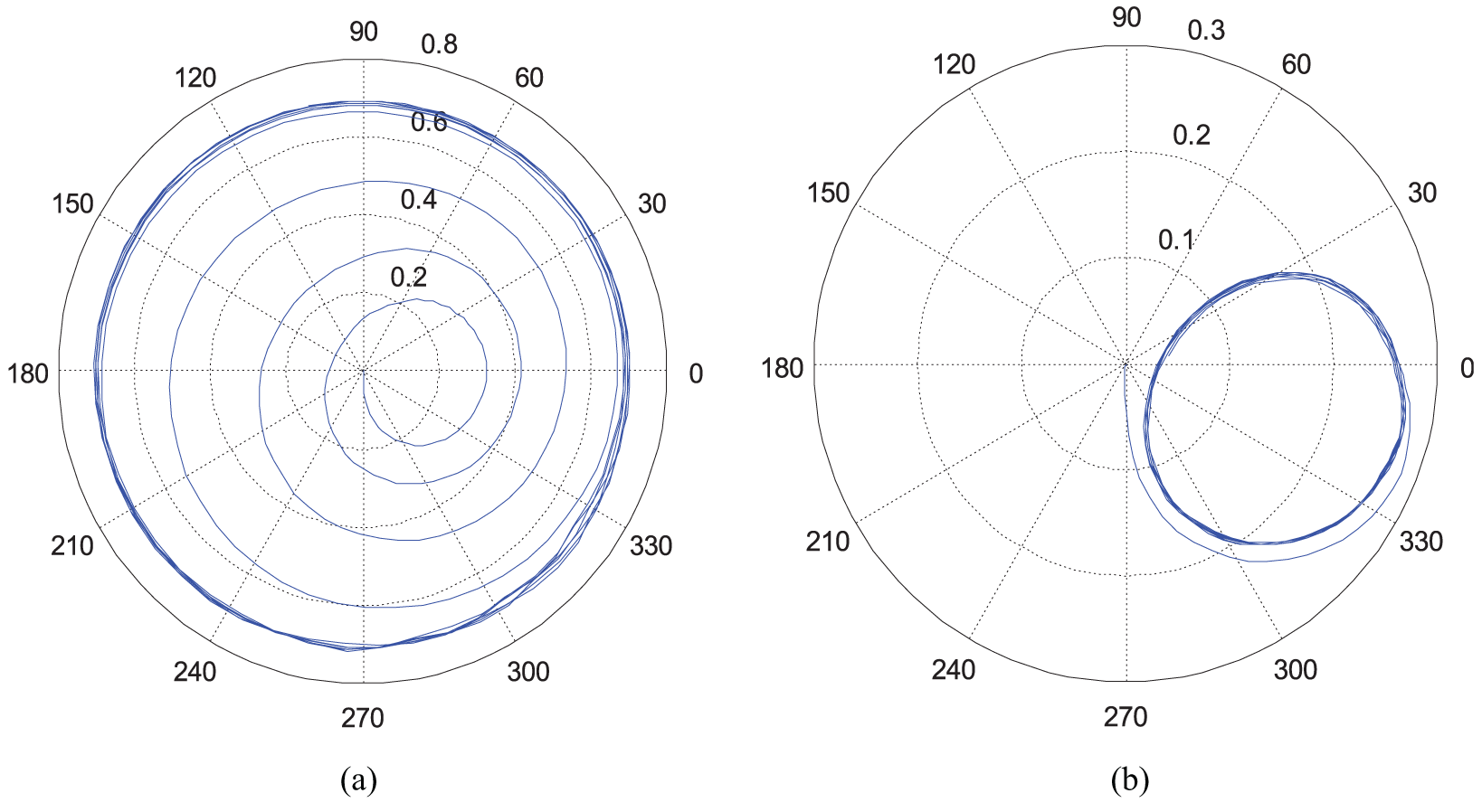
Comparison of the transient trajectories when N = 4600 rpm: (a) P = 0, logarithmic decrement ld = −0.2481 and (b) P = 12, logarithmic decrement ld = 0.0027.

Comparison of the vibration amplitudes when N = 4600 rpm: (a) P = 0, logarithmic decrement ld = −0.2481 and (b) P = 12, logarithmic decrement ld = 0.0027.
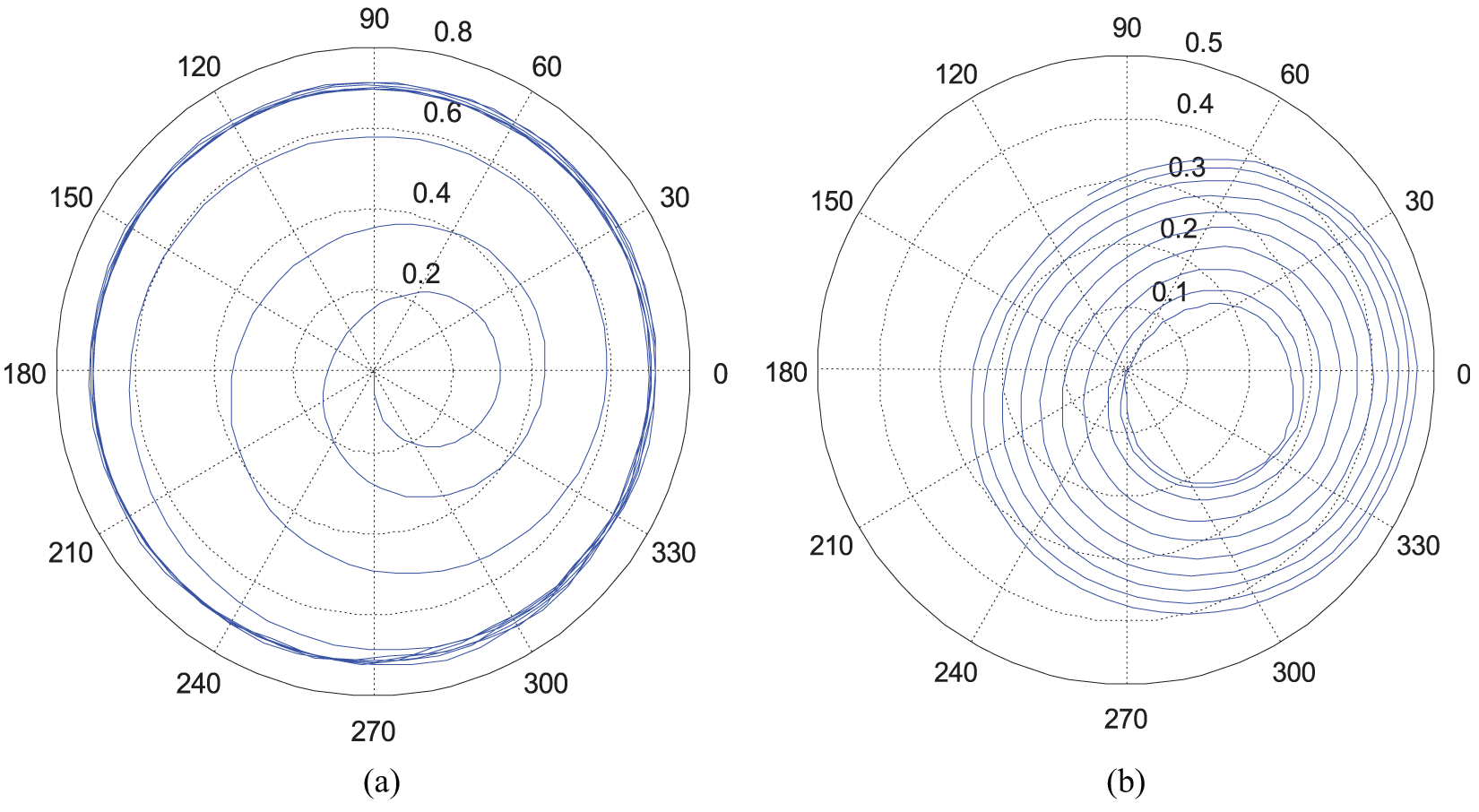
Comparison of transient trajectories when N = 4800 rpm: (a) P = 0 and (b) P = 12.

Comparison of the vibration amplitudes when N = 4800 rpm: (a) P = 0 and (b) P = 12.
Figures 11 and 12 show the transient trajectories of the journal bearing system with a perfect circular journal and a journal with roundness error P = 12, running at N = 3000 rpm. The figures show that when the bearing system with a perfect circular journal runs at N = 3000 rpm, the system’s orbit of the shaft centre gradually converges to a point. In addition, the system vibration amplitude continuously decreases and gradually converges to a stable eccentricity, thereby indicating that the system is in a stable state at this time. Considering the journal with roundness error P = 12, the vibration amplitude of the system will gradually decrease with time at the same speed. However, it no longer converges to a stable eccentricity nor does the orbit of the shaft centre converge to a point. Instead, it converges to a stable oval-like closed loop. The frequency spectrum analysis shows that there is no sub-synchronous vibration component with half operating frequency appearing at this time. At this time, the system shows a periodic eddy turbulence with enhanced stability, and it is still in a stable operation state.
Figures 13 and 14 show the journal orbits and the transient responses when the system operating speed increases to 3824 rpm. The bearing system with the perfect journal rotates along the same orbit of the shaft centre. According to the theoretical method described in ‘Determination of system operation stability’ section, the logarithmic decrement at this speed is ld = 4 × 10⁻⁴, which is nearly equal to 0, thereby indicating that the bearing-rotor system is in a critical state. However, when considering the journal with random roundness error P = 12, at this same speed, the journal trajectory exhibits a gradual convergence. The corresponding logarithmic decrement at this speed is ld = 0.1463, indicating that the bearing-rotor system considering the random roundness error is still stable.
Figures 15 and 16 show the comparisons of the orbits and the system transient responses of the two bearing systems when the speed is increased to 4600 rpm. At this speed, the orbit of the journal centre with a perfectly circular journal is divergent, and the corresponding logarithmic decrement is ld = –0.2481. The result indicates that the bearing system with a perfect journal operates in an unstable state at this speed. At the same rotating speed, the journal orbit of the bearing system with a journal roundness error P = 12 forms a closed repeat locus. At this time, the journal orbit is considerably unregular when compared with that of the perfect journal. The orbit neither diverges nor converges. The logarithmic decrement at this rotating speed is ld = 0.0027, which is approximately equal to 0, which indicates that the bearing system with a journal roundness error P = 12 is running at a critical state at this speed. As described above, the irregularity of the orbit of the shaft centre at this time is mainly due to the interference of the low-frequency components produced by the random roundness errors.
Figures 17 and 18 show the journal orbits and the system transient responses when the rotating speed is increased to 4800 rpm. The figures show that the journal orbits or the transient responses of the two bearing systems are both diverging, thereby indicating that the two systems are both running in unstable state at this speed.
The results presented in Figures 11–18 show that the existence of journal random roundness error may produce many non-half-frequency vibration components, but the error contributes to the increment of system stability.
To further describe the effect of the random roundness error on the stability of a hydrodynamic journal bearing system, the stability analysis results are also described by the system critical stability curve. Figures 19 and 20 reveal the effect on the dimensionless stable operating parameter Op of a hydrodynamic journal bearing system with the change in eccentricity and Sommerfeld number, respectively.

Stability map with consideration of journal random roundness.

Stability map with consideration of journal random roundness based on Sommerfeld number.
As shown in Figures 19 and 20, when the random roundness error is small (e.g. P = 9), the stability of a hydrodynamic journal bearing system with a random roundness error is very close to the critical curve of a perfect journal bearing system. Meanwhile, when the random roundness error increases, the shape and position of the critical stability curve also change. The greater the random roundness error is, the lower the stability curve on the stability map will be. This phenomenon indicates that the presence of the random roundness error increases the size of the system stable area and promotes the stability of the hydrodynamic journal bearing system. The results of the theoretical analysis in this study are consistent with the experimental results of Radford in 1977 8 and the analysis of Xu et al. 15 in 2015. The manufacturing errors in the manufacturing process are not generally a disadvantage because the roundness errors contribute to system stability. Meanwhile, the data also show that the operating parameter Op is noticeably reduced in the area ε < 0.5 or the Sommerfeld number S > 0.1. When the eccentricity ratio is in the range of 0.5–0.6 or the Sommerfeld number is in the range of 0.05–0.1, the effect of the random roundness error on system stability is smaller. This result indicates that to obtain a wider stability area, the system parameters should be chosen within these ranges during the system design stage to ensure the system to be functionally operated.
Conclusion
The study presents a dynamic modelling, analysis and calculating method for the hydrodynamic journal bearing system allowing for random roundness error in order to be closer to the engineering practice. The random character of manufacturing errors is presented by Monte Carlo method in the analysis to establish the relationship between the level of journal roundness error and the system stability characteristics. The following conclusions may be drawn from the analysis results.
When the grade of journal roundness error P is below 9, the effect on the stability of the hydrodynamic journal bearing system is minimal. It is recommended that the design engineers do not have to choose a higher manufacturing requirement on roundness error, which may reduce the manufacturing costs.
When the grade of journal roundness error P > 9, the journal out-of-roundness plays a role in promoting system stability, and the greater the level is, the more noticeable the effect will be. However, the increase of random roundness error will generate high-frequency vibrations, which will aggravate the system vibration.
The journal random roundness error has a minimal effect on the system stability when the eccentricity is between 0.5 and 0.6 or the Sommerfeld number is between 0.05 and 0.1, which suggests that the system should be operated within this region to minimise the effect of journal out-of-roundness.
The presented analysis method is suggested to be utilised in the system dynamic analysis when considering other shape or position manufacturing errors, such as bearing cylindricality errors.
Footnotes
Appendix 1
Acknowledgements
The author gratefully acknowledges the support of the Natural Science Foundation of Guangxi (Grant No. 2018GXNSFBA281195), Guangxi Science and Technology Plan Project (G. K. AC16380032), Liuzhou Scientific Research and Technology Development Project (Grant Nos. 2016C050202 and 2017BC20201) and Guangxi University of Science and Technology Key Laboratory Director Fund (Grant No. 2014JZKG004).
Handling Editor: Shahin Khoddam
Declaration of conflicting interests
The author(s) declared no potential conflicts of interest with respect to the research, authorship, and/or publication of this article.
Funding
The author(s) received no financial support for the research, authorship, and/or publication of this article.
